



Abstract
The forensic literature has described unusual wounds of entry into fatal stab wounds that are rarely found in autopsies. Stab wounds are considered fatal injuries when they occur in vital organs. Many authors have suggested that the description of the wound track helps recreate the crime scene. Still, many say that the recreation of a crime scene is a static event, whereas the actual event is dynamic. We received the dead body of a 25-year-old male for postmortem examination. During autopsy, we found a wedge-shaped stab wound in the epigastric region. Interestingly, when we dissected the skin and subcutaneous tissue without disturbing the wound, we observed two separate wedge-shaped wounds over the rectus sheath. A knife can produce an atypical appearance after plunging into the body. With a single external primary stab wound, two different wound tracks can be made internally. Thus, examining only the wound track made it impossible to comment on the circumstances of violence.
Introduction
The forensic literature has described unusual or uncommon wounds of entry into fatal stab wounds that are rarely found in autopsies. The amount of force used, whether the weapon twisted during withdrawal, and whether the weapon had been plunged to the hilt are only a few of the variables that can cause anomalies in the exterior as well as the interior of the wound. 1 A stab wound is considered a fatal injury when it is produced in vital areas. Few cases have been reported in which it is produced during a suicide. Most of the time, they are produced due to homicidal injuries. Hence, a description of the wound track is important when preparing post-mortem reports. It provides a clear idea of the direction of force and the position of the victim and assailant at the time of the incident. 2 In contrast to the significance placed on the wound track, some forensic experts argue that the description of the wound track may not always provide a clear idea of the direction of force and position of the victim and assailant at the time of the incident. They highlighted that the variability in human anatomy and the unpredictable nature of human movements during an alteration can lead to inconsistencies in interpreting the wound track. In addition, it is argued that the presence of defensive wounds and the behavior of the victim and assailant during the incident may be more indicative of the dynamics of the altercation than the wound track itself. This opposing viewpoint emphasizes the need for a comprehensive analysis of the entire crime scene and the behavior of individuals involved, rather than solely relying on the description of the wound track in isolation.3,4 In this case report, we are going to report a case of an abdominal stab wound with the atypical internal presentation of the wound.
Case report
Recently, we received the dead body of a 25-year-old male for postmortem examination. During the autopsy, we found one wedge-shaped stab wound over the epigastrium region, measuring 4 × 0.5 cm, extending toward the peritoneal cavity (Figure 1). Interestingly, when we dissected the skin and subcutaneous tissue without disturbing the wound, we found the presence of two separate wedge-shaped wounds over the rectus sheath with clean-cut margins, measuring 3 × 0.3 and 3 × 0.2 cm, respectively, which proceeded in two different directions (Figure 2). Upon further exploration, it passed through the omentum, produced a perforated wound in the stomach, and finally terminated in the peritoneal cavity (Figure 3). Another wound track passed through the omentum and extended to the left costal margin of the diaphragm (Figure 4). This atypical presentation of stab wounds in a 25-year-old male raises several intriguing questions and considerations for forensic examinations. The presence of one external stab wound and two different internal tracks that travel in different directions add a layer of complexity to the interpretation of events leading to fatal injuries.

Wedge-shaped stab wound over the epigastric region.

Two separate wedge-shaped wounds over the rectus sheath.
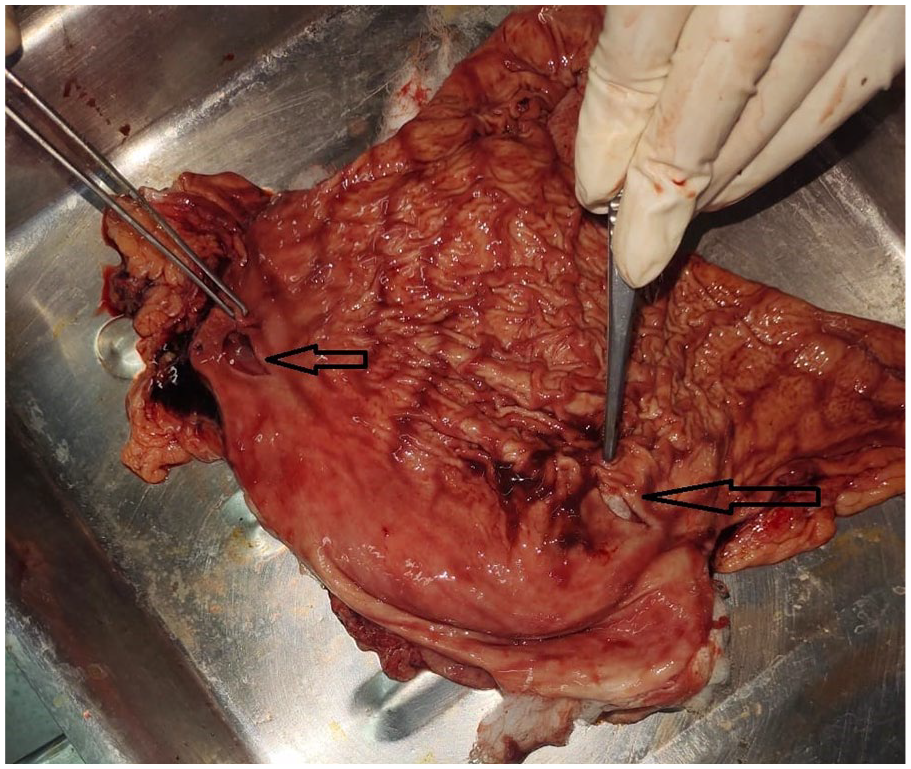
Perforated wounds in the stomach.

Wound over diaphragm.
Discussion
A knife can produce an atypical appearance after plunging into the body. With a single external primary stab wound, two different wound tracks can be produced internally. This can be observed when the knife is slightly rotated or when the victim moves slightly or partially retracts the knife from the wound and inserts it in a different direction.5,6 Sharma et al. reported a case in which there was one stab wound over the chest externally, but further investigation revealed there were two wound tracks present underneath the external wound. In the aforementioned case, the assailant attempted to stop the bleeding by inserting cotton through the external wound and producing pressure on the chest. This finding indicates a potential lack of knowledge and experience in dealing with such situations. The insertion of cotton failed to effectively control bleeding and may have exacerbated the injury by creating a second track. 7 Menon et al. reported another case in which a 22-year-old male presented with a single-stab wound over the chest, and the outer end of the wound revealed another cut connecting to the primary wound, giving the swan tail appearance. While the pleura and pericardium displayed single-stab wounds, two-stab wounds were observed in the left lung and the heart. According to the author’s analysis, slight rotation of the knife and a subsequent fall after the injury caused an unusual wound and internal condition. This led to a shift in the position of the internal organs (heart and lungs) around the knife, which had already been in place. 1 Similar to the current case, Singh et al. reported a case in which the authors received the dead body of a 22-year-old man with an alleged history of suicidal stab wounds. On external examination, a stab wound extending into the chest cavity was observed on the left side of the chest. For further exploration, the authors observed two separate wounds at the fourth and fifth intercostal spaces, directed in different directions of the chest cavity. 8 According to Schädler et al.’s study, it is crucial to analyze the post-mortem findings in conjunction with the victim’s circumstances and the results of the police investigation when dealing with stab wounds on the trunk, which may be the result of suicide or homicide. 9
Conclusion
It is imperative to meticulously examine the trajectory of the wound to gain a deeper understanding of its characteristics. The case reported by Inokuchi et al. showed that evaluating the external wound and wound track helps in determining the circumstances of violence. 10 However, in this case report, a solitary stab wound in the epigastrium eliminated the chance of the individual being stabbed twice through an identical external wound. In addition, this action resulted in the formation of two distinct tracks, starting at the level of the rectus sheath. The unusual wound of entry and odd internal presentation can be attributed to a relative displacement between the knife and the victim or possibly a slight rotation of the weapon. Although it is possible to describe and document injuries correctly, the precise source of these anomalies is often indeterminable and may only be postulated or guessed. Forensic pathologists may have difficulty providing a definitive explanation for these specific characteristics. Advocates usually perceive a fight as a stationary clash and try to recreate the incident as if both parties are motionless, with the attacker simply swinging their arms. This interpretation is unrealistic, considering that the dynamic and continuous movement of the bodies and limbs of both participants characterizes all conflicts.
Footnotes
Acknowledgements
None.
Data availability statement
Not applicable.
Declaration of conflicting interests
The author(s) declared no potential conflicts of interest with respect to the research, authorship, and/or publication of this article.
Funding
The author(s) received no financial support for the research, authorship, and/or publication of this article.
Ethical approval
Ethical approval to report this case was obtained from: IEC/BU/2023/Cr.2023/246/2023 dated April 9, 2023. Institutional Ethics Committee-2, Bhaikaka University, Karamsad, Anand, Gujarat-388325, India. DHR Reg. No. EC/NEW/INST/2021/592.
Patient consent
The legal guardian of the deceased gave written informed consent for anonymized information to be published in this article. The registered Institutional Ethics Committee also approved the waiver of consent as the case report and photographs do not contain an identifier.
Informed consent
Written informed consent was obtained from the legal guardians of the deceased for anonymized information to be published in this article. The registered Institutional Ethics Committee also approved the waiver of consent as the case report and photograph contain no identifier.
Trial registration number/date
Not applicable.
Grant number
Not applicable.
Other journal-specific statements as applicable
Nil.
