




Abstract
The objective of this case report is to present how the chronic condition significantly complicates life-saving procedures and influences further treatment decisions. A 64-year-old man suffering from arterial hypertension and immune thrombocytopenic purpura presented to the Emergency Department with anterior ST-elevation myocardial infarction. An immediate coronary angiography was performed where critical stenosis of the proximal left anterior descending was found. It was followed by primary percutaneous intervention with bare metal stent. In first laboratory results, extremely low platelet count was found (13 × 109/L). Consulting haematologist advised the use of single antiplatelet therapy and from the second day of hospitalisation only clopidogrel was prescribed. On the sixth day of hospital stay, patient presented acute chest pain with ST elevation in anterior leads. Emergency coronary angiography confirmed acute stent thrombosis and aspiration thrombectomy was performed. It was therefore agreed to continue dual antiplatelet therapy for 4 weeks. As there are no clinical trials where patients with low platelet count are included, all therapeutic decisions must be made based on clinician’s experience and experts’ consensus. Both the risk of haemorrhagic complications and increased risk of thrombosis must be taken into consideration when deciding on patient’s treatment.
Introduction
It is common to see patients in a life-threatening condition in the Emergency Department where diagnostic and therapeutic procedures must go beyond the standards included in the published guidelines of European or American Cardiac Societies.
Presented case describes a 64-year-old man suffering from severe thrombocytopenia (platelet (PLT) 13 × 109/L) and admitted with anterior ST-elevation myocardial infarction. The challenge was to find the optimal treatment strategy with significantly high risk of ischaemic and haemorrhagic complications. The ESC/AHA/ACC guidelines do not specify the treatment of patients with ST-elevation myocardial infarction (STEMI) and such a low level of PLTs.1,2
Case report
A 64-year-old man with arterial hypertension and immune thrombocytopenic purpura (ITP), under the regular care of a haematology outpatient clinic, was brought to the Emergency Department with symptoms of anterior STEMI. Patient suffered from persistent chest pain for 5 h. Electrocardiogram (ECG) showed ST-segment elevation in leads V1–V6 (Figure 1). According to the patient’s medical documentation, 2 weeks before the admission, the PLT count was 14 × 109/L and the use of oral glucocorticosteroids (Encorton (Prednisone) 30 mg/day) was ordered. On clinical examination, the patient did not present symptoms of haemorrhagic diathesis. Blood was collected for laboratory tests and emergent coronary angiography was carried out. It showed critical stenosis of the proximal left anterior descending (LAD). The primary percutaneous coronary intervention (PCI-LAD) was performed with bare metal stent (BMS) and optimal angiographic result (Figure 2). The patient remained in good general condition and was haemodynamically stable.

ECG on admission to the hospital.

Critical lesion of LAD (left side) and the angiographic result of the primary percutaneous intervention performed with BMS (right side).
Blood test results were received after the procedure showing an extremely low PLT count: 13 × 109/L (from blood collected on citrate: PLT 16 × 109/L), haemoglobin level: 10.2 g/dL and creatinine: 0.52 mg/dL.
It was immediately questioned what antiplatelet should be given. Which medications should be used knowing the extremely high bleeding risk? Single or dual therapy (dual antiplatelet therapy (DAPT))? If DAPT, how long should it be administered for and which medications should be discontinued first?
Periprocedurally, an oral loading dose of acetylsalicylic acid (ASA) (300 mg) and clopidogrel (600 mg) was administered. We considered either single antiplatelet therapy with clopidogrel or short DAPT with discontinuing ASA after 4 weeks and lifelong clopidogrel use. The consulting haematologist advised on continuing single antiplatelet medication with close observation of possible symptoms of thrombocytopenic diathesis.
Finally, in the presented case, due to an extremely high risk of haemorrhagic complications and based on haematological consultation, it was decided that ASA would be discontinued on the second day, whereas treatment with clopidogrel would continue. The PLT count remained low (14 × 109/L), and prednisone was maintained. On the sixth day of the hospitalisation, the patient complained of severe chest pain. ECG showed ST-segment elevation in anterior leads (Figure 3). Emergent coronary angiography was carried out diagnosing stent thrombosis. An effective aspiration thrombectomy was performed restoring Thrombolysis In Myocardial Infarction Score 3 flow. The stent was dilated with the non-compliant (NC) balloon (Figure 4). The restoration of the vessel patency was immediately followed by ventricular fibrillation effectively treated with single defibrillation (1 × 200 J). After this, incident DAPT (ASA + clopidogrel) was reintroduced. During the hospital stay, the patient remained stable without the recurrence of angina pectoris or haemorrhagic diathesis symptoms. The patient was discharged in good general condition. The DAPT was recommended for 4 weeks. After this period, ASA would be discontinued and clopidogrel would be maintained as a lifelong therapy under both cardiological and haematological supervision.

ECG on the sixth day of hospitalisation, obtained after the recurrence of severe chest pain.
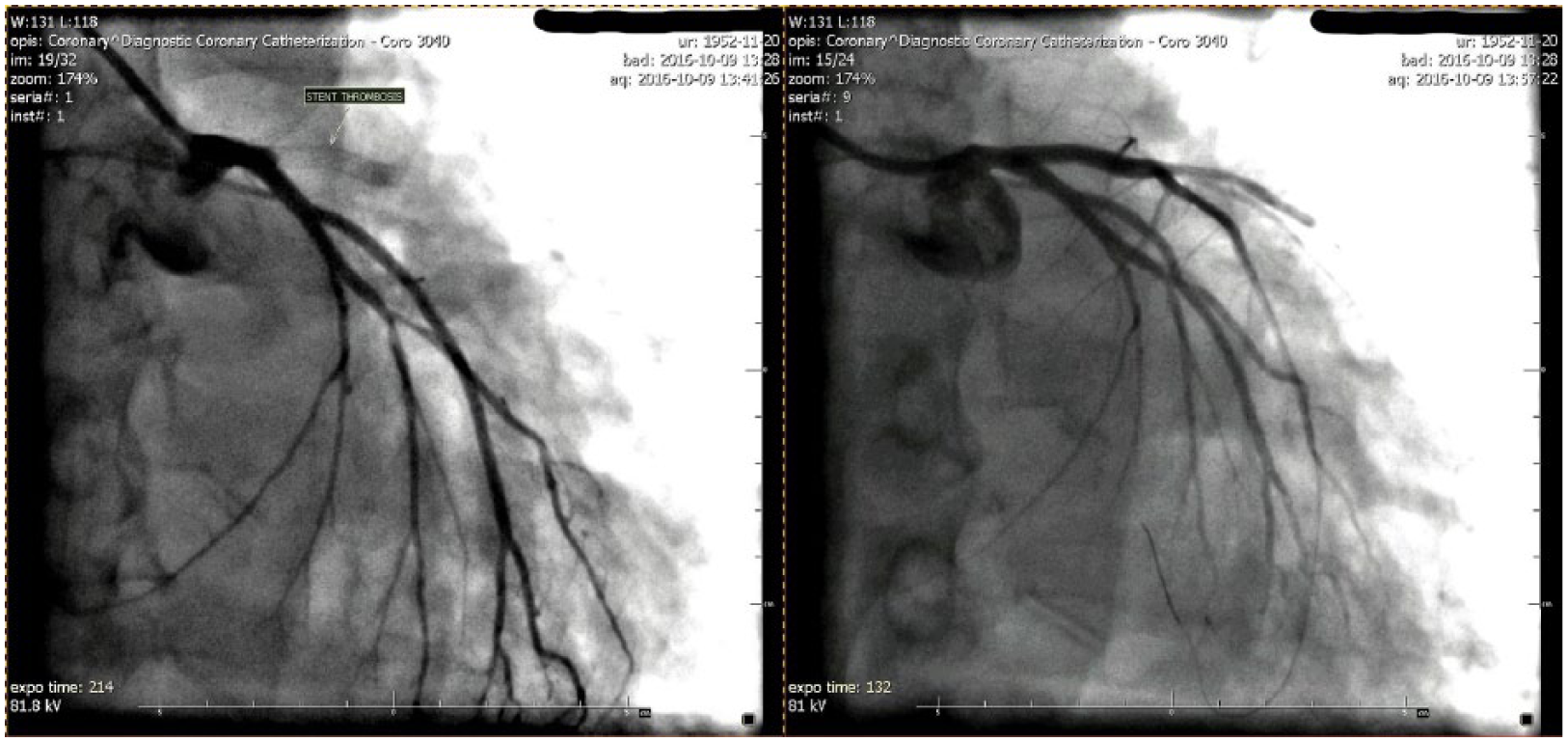
Emergency coronary angiography showing stent thrombosis (left side) and the restored blood flow after aspiration thrombectomy and dilation of the stent with NC balloon (right side).
Discussion
The low PLT count significantly increases the risk of haemorrhagic complications as well as ischaemic events.3,4 It is believed that in patients with ITP, several factors are responsible for the thrombogenic effect: the presence of endothelial cell-specific activation antibodies, the increased percentage of young activated PLTs, the release of PLT particles in the process of immunological PLT destruction and the presence of leukocyte/monocyte/PLT complexes in blood.5–7 Thus, the risk of stent thrombosis remains a significant concern despite the low PLT count. An additional recommendation in this particular patient group should be to optimise stent implantation and use intravascular ultrasound (IVUS)/optical coherence tomography (OCT) to ensure optimal deployment. This is crucial to avoid stent-related factors that can predispose to stent thrombosis.
Therapeutic decisions made in the case of the described patient were mainly based on clinical experience and experts’ opinions. There are no large randomised clinical trials in patients with acute coronary syndrome (ACS) and thrombocytopenia. On the contrary, patients with thrombocytopenia were excluded from large clinical trials.8–10 Yet, it is estimated that the percentage of patients with ACS where a reduced PLT count is observed is almost 13%. It mainly affects elderly patients with diabetes, renal failure, cardiac failure or those already diagnosed with a cardiovascular disease. 11 It is confirmed that thrombocytopenia in patients with ACS significantly deteriorates the prognosis.11,12 According to the observations from the CRUSADE study, 25% of patients who were diagnosed with at least moderate thrombocytopenia (PLT < 100 × 109/L) died during hospitalisation due to ACS. 11 The relationship between the cause of thrombocytopenia itself and the prognosis of patients with ACS is unclear.
In 2017, the European Heart Journal published an expert consensus on antiplatelet therapy in patients with ACS and thrombocytopenia. 13 Presented strategies to minimise the risk of haemorrhagic complications included the following:
Avoiding the use of medications that increase the risk of thrombocytopenia development (such as unfractionated heparin, glycoprotein (GP) IIb/IIIa receptor inhibitors, furosemide, nonsteroidal anti-inflammatory drugs (NSAIDs), penicillin);
Avoiding triple anticoagulation therapy;
Limitation of DAPT up to 1 month;
Preference of second-generation stents releasing antimitotic drugs;
Including proton pump inhibitor (PPI) in the therapy.
Furthermore, a therapeutic regimen was also proposed for patients with ACS and thrombocytopenia. Patients with mild (PLT > 100 × 109/L) or moderate (PLT 50–100 × 109/L) thrombocytopenia who underwent invasive cardiac procedure should receive DAPT for 1 month followed by the clopidogrel monotherapy (with the co-administration of PPI). Proposed treatment for patients with severe thrombocytopenia (PLT < 50 × 109 L) and ACS (without making any distinction between STEMI, non-ST-elevation myocardial infarction (NSTEMI) or Unstable Angina) deserves particular attention and discussion. According to the experts’ consensus, the discontinuation of all antiplatelet medications and avoiding PCIs (the latter recommendation may be, in our opinion, controversial) are recommended. Finally, it is advised against using new antiplatelet medications (prasugrel and ticagrelor) due to the higher risk of haemorrhage.
Conclusion
The presented case shows once more how difficult it is to make therapeutic decisions in situations where the risk of opposing complications co-exists. The guidelines, which are useful in the diagnostic and therapeutic process, do not answer all the questions that arise during various clinical situations. It is extremely important that decisions which are made are well-thought-out, individualised and based on available knowledge.
Footnotes
Declaration of conflicting interests
The author(s) declared no potential conflicts of interest with respect to the research, authorship and/or publication of this article.
Ethical approval
Our institution does not require ethical approval for reporting individual cases or case series.
Funding
The author(s) received no financial support for the research, authorship and/or publication of this article.
Informed consent
Written informed consent was obtained from the patient(s) for their anonymized information to be published in this article.
