




Abstract
Background:
Collision tumors, composed of histologically distinct tumor types, are rare entities, especially in the colorectum, and corresponding evidence-based clinical management or treatment strategies are poorly defined. This is the first report of a collision tumor composed of two histologically distinct adenocarcinomas.
Case presentation:
A 78-year-old male showed severe anemia and a 10% body weight loss over 1 month. Preoperative examination revealed T3N1M0 stage IIIA gastric cancer and T3N0M0 stage IIA rectal cancer. Distal gastrectomy and rectectomy with regional lymph node dissection were performed. Immunohistochemistry revealed two distinct adenocarcinomas with gland duct structures – a colorectal adenocarcinoma and a disseminated gastric adenocarcinoma – that had collided to form an invasive tumor on the serosal surface of the anterior rectum wall.
Conclusion:
This extremely rare case of a collision tumor supports that precise immunohistochemical identification of all tumor components is needed for guiding decisions affecting overall prognosis, adjuvant treatment and survival.
Introduction
Collision tumors, initially reported by Meyer, 1 are rare clinical entities in which two histologically distinct tumor types show involvement at the same organ site. Collision tumors and composite tumors most frequently affect the stomach.2–5 Malignant lymphoma, carcinoid tumor, and gastrointestinal stromal tumor can occur in collision with gastric adenocarcinoma.6–8
In terms of the colorectum, collision tumors are very rare. Previous studies have reported that collision tumors affecting the colorectum typically include adenocarcinomas with malignant lymphoma, carcinoid tumors, transitional cell carcinomas, neuroendocrine tumors, and ovarian granulosa cell tumors.9–13 In the present case, a collision tumor consisting of a colorectal adenocarcinoma and dissemination of gastric adenocarcinoma was identified in the rectum, which is an extremely rare presentation. To the best of our knowledge, the present case is the first report of a colorectal collision tumor with this composition. Interestingly, these two histologically distinct adenocarcinomas with gland duct structure collided with each other at the invasive tumor front.
Due to the infrequency of colliding tumors, it is difficult to ascertain the biological behavior of these tumors, and therefore, which component will determine long-term outcome is not well known. For example, it is debatable whether such outcomes depend on the most predominant component of the collision tumor or the more histologically aggressive component.14–16 For these reasons, evidence-based clinical management or treatment strategies for collision tumors remain poorly defined.
In the present report, we present an extremely rare case of a resected collision tumor composed of two histologically distinct adenocarcinomas including a colorectal adenocarcinoma and dissemination of a gastric adenocarcinoma. Additionally, we review and discuss the relevant literature on collision tumors as well as the clinical, histopathological, and therapeutic management of these entities.
Case report
A 78-year-old male presented with severe anemia and loss of 10% of body weight over 1 month. The patient’s medical history included diabetes mellitus and angina pectoris. His abdomen was soft and exhibited no tenderness on examination. Laboratory findings revealed a hemoglobin concentration of 10.6 g/dl. Serum carcinoembryonic antigen and carbohydrate antigen 19-9 levels were 12 ng/ml and 100.3 U/ml, respectively. An esophagogastroduodenoscopy revealed a Bormann type II tumor located in the lesser curvature of the lower body of the stomach. A colonoscopy also revealed a tumor with ulceration in the rectum (15 cm above the anal verge). Abdominal computed tomography revealed that the mass in the lower body of the stomach was associated with regional enlarged lymph nodes, whereas the wall thickness of the rectum showed no regional enlarged lymph nodes. Distant organ metastasis including liver metastasis and peritoneal dissemination was not observed in preoperative radiological findings. Thus, the TNM stages of the gastric cancer and colon cancer were preoperatively classified as T3N1M0 stage IIIA and T3N0M0 stage IIA, respectively, according to the 8th International Cancer Control (UICC) guidelines. Therefore, the patient underwent distal gastrectomy and rectectomy including dissection of each regional lymph node. In the operative findings, distant organ metastasis including liver metastasis and peritoneal dissemination were not observed. The patient’s postoperative recovery was uneventful, and he was discharged from the hospital after 11 days.
Histopathological findings
In terms of the gastric cancer, a 50 × 40 mm Bormann type II tumor was observed in the lesser curvature of the lower body of the stomach (Figure 1). Microscopically, this tumor displayed moderately differentiated tubular adenocarcinoma. Among the 39 lymph nodes that were dissected, aggressive lymph node involvement was also observed, with 16 positive lymph nodes.
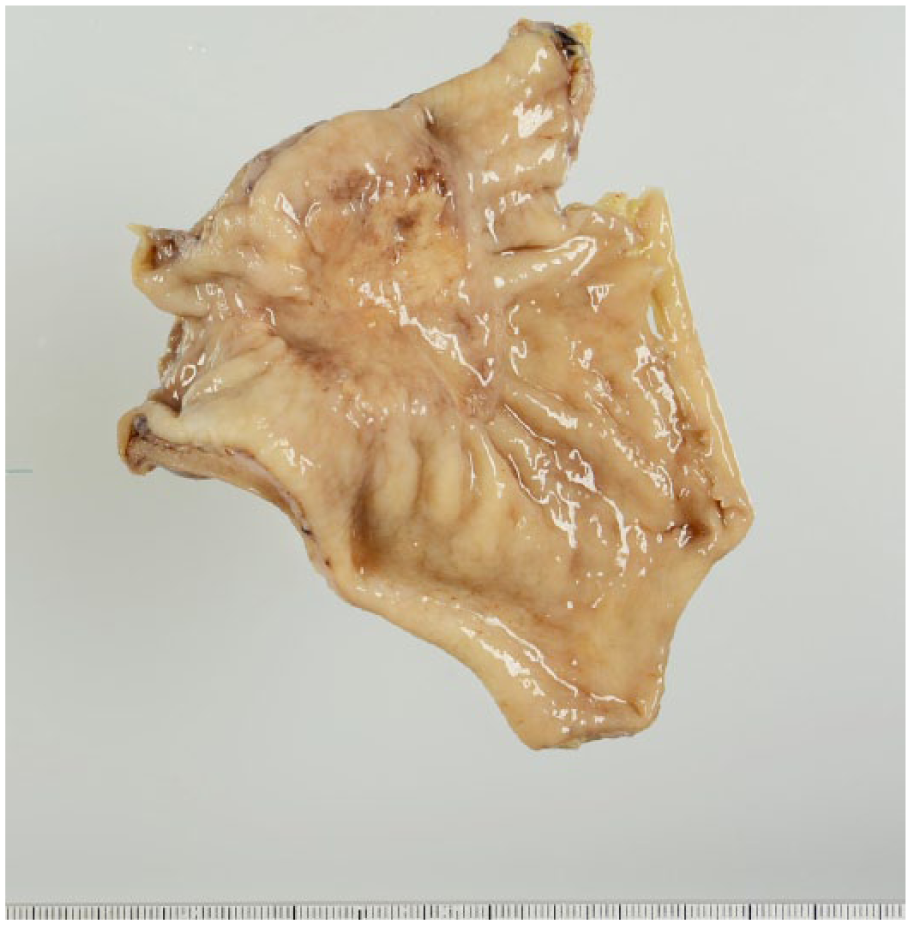
Macroscopic view of the gastric tumor. A 40 × 40 mm Bormann type II tumor was observed at the lesser curvature of the lower body of the stomach.
In terms of the rectal cancer, a 35 × 28 mm tumor with ulceration was observed in the anterior rectum wall (Figure 2). Microscopically, this tumor displayed well-differentiated tubular adenocarcinoma. Lymph node involvement was also observed. Furthermore, two types of adenocarcinoma cell with dissimilar differentiation types were observed on the serosal surface of the rectum (Figure 3).

Macroscopic view of the rectum tumor. A 35 × 28 mm tumor with ulceration was observed in the rectum wall.

Microscopically, two types of adenocarcinoma cell with dissimilar differentiation types were observed on the serosal surface of the rectum. Hematoxylin and eosin staining: (a) ×50 and (b) ×200.
Immunohistochemical analysis clearly delineated the two components of the collision tumor in a closely admixed zone on the serosal surface of the rectum. Colorectal adenocarcinoma cells are known to be strongly positive for cytokeratin (CK) 20 and negative for CK 7.13,17 In contrast, gastric adenocarcinoma cells are known to be moderately positive for CK 7 and negative for CK 20.18,19 In the present case, the rectal adenocarcinoma was CK20-positive and CK7-negative (Figures 4 and 5), whereas the adenocarcinoma cells in the other component of the collision tumor were CK20-negative and CK7-positive, which was the same profile as that observed at the primary gastric adenocarcinoma site (Figures 4 and 5). Therefore, these immunohistochemical profiles confirmed the histomorphological diagnosis of a collision tumor composed of two histologically distinct adenocarcinomas including a colorectal adenocarcinoma and dissemination of a gastric adenocarcinoma. Furthermore, we observed that these histologically distinct adenocarcinomas with gland duct structure collided with each other at the invasive tumor front.

Immunohistochemical staining showing that the colorectal adenocarcinoma was positive for CK20: (a) ×50 and (b) ×200.

Immunohistochemical staining showing that the gastric adenocarcinoma at the primary site was positive for CK7: (a) ×50. Immunohistochemical staining showing that the composite adenocarcinoma in the rectum wall was also positive for CK7: (b) ×50 and (c) ×200.
The final histopathological analysis of the specimen revealed that the gastric cancer and rectal cancer were T4aN3bM1 stage IVB and T3N1bM0 stage IIIB, respectively, according to the 8th UICC guidelines. At the postoperative follow-up, the patient was followed without adjuvant chemotherapy due to poor performance status and low cardiopulmonary function. The patient gradually exhibited massive ascites caused by peritoneal dissemination and died 3 months after surgery.
Discussion
To the best of our knowledge, this is the first reported case of a resected collision tumor composed of two histologically distinct adenocarcinomas including a colorectal adenocarcinoma and dissemination of a gastric adenocarcinoma.
Meyer 1 reported that collision tumors are morphologically synchronous neoplasms that develop “every other” territories and appear latero-laterally within the same organ. Spagnolo and Heenan 20 histologically defined the following three diagnostic criteria for collision tumors. First, two distinct topographically separate sites of origin for the two components must be present. Second, there must be at least some separation of the two components so that the dual origin can still be recognized, despite intimate mixing at points of juxtaposition. Third, in addition to intimate mixing of the two components, some transitional patterns may be seen in the region of the collision. According to World Health Organization (WHO) histological classification, collision tumors comprise at least two different malignant components with no mixed or transitional area in between. 16 Without special or unique clinical features, collision tumors are difficult to diagnose preoperatively. In fact, the present case was also difficult to diagnose preoperatively, and the collision tumor was only confirmed after postoperative histopathological diagnosis.
There are several important reasons underlying why evidence-based clinical management or treatment strategies for collision tumors remain poorly defined. First, it is not easy to morphologically distinguish a collision tumor from a composite tumor due to the rarity of collision tumor.9–16 Second, it is very difficult to predict which component of a collision tumor has a more predominant role in the tumor’s behavior or contains the more aggressive histological component, both of which influence long-term outcome.9–16 In the present case, we clearly distinguished the gastric cancer adenocarcinoma from the colorectal adenocarcinoma using immunohistochemical analysis including CK7 and CK20 staining. Consequently, we assessed that the gastric adenocarcinoma with peritoneal dissemination was predominant and had the more aggressive histological component than the colorectal adenocarcinoma in the collision tumor examined here. These results highlight that immunohistochemical study is very useful in distinguishing a collision tumor from a composite tumor and in predicting which component of the collision tumor has predominant behavioral features or contains the more aggressive histological profile.
Due to the rarity of collision tumor, there have been limited prior reports on the condition, and most have not described the course of disease after diagnosis. Therefore, further accumulation of collision tumor cases with clinical information including the procedure of diagnosis and details of patient prognosis is required.
In conclusion, we present an extremely rare case of a resected collision tumor composed of two histologically distinct adenocarcinomas including a colorectal adenocarcinoma and dissemination of a gastric adenocarcinoma. Precise immunohistochemical identification and recognition of all components of a collision tumor is important for guiding decisions on overall prognosis, adjuvant treatment options, and survival.
Footnotes
Acknowledgements
The authors thank the Department of Pathology of Tsukuba Medical Center Hospital for histopathological consultations.
Declaration of conflicting interests
The author(s) declared no potential conflicts of interest with respect to the research, authorship, and/or publication of this article.
Ethical approval
Our institution does not require ethical approval for reporting individual cases or case series.
Funding
The author(s) received no financial support for the research, authorship, and/or publication of this article.
Informed consent
Written informed consent was obtained from a legally authorized representative for anonymized patient information to be published in this article.
