



Abstract
Objective:
This study aimed to develop an observational tool to assess the social interactive behaviors of children with special education needs during animal-assisted activity and to examine its reliability and validity.
Methods:
The study comprised two phases: developing and evaluating the measurement tool. The tool was created through literature reviews and expert interviews. The pilot observational study was conducted in a special educational school in Hong Kong, China, involving 138 children with intellectual disability participating in animal-assisted activity sessions to examine the tool’s reliability and validity.
Results
Initially, the measurement tool included 26 observational variables across three dimensions (inter-rater reliability of 0.74). After excluding variables with low discriminability, the final tool contained seven observational variables. The tool demonstrated strong reliability (inter-rater reliability of 0.81) and satisfactory validity, significantly discriminating among different intellectually disabled students (ps < 0.05).
Conclusions:
This study developed and validated an observational tool for measuring the social behaviors of children with special education need during animal-assisted activity sessions. More extensive studies are needed to further evaluate the instrument.
Keywords
Introduction
Children with special educational needs (SEN) are those with disabilities characterized by significant impairment in adaptive behavior including motor disabilities, learning difficulties, and social dysfunction.1,2 It is estimated that about 240 million (1 in 10) children worldwide with disabilities in 2021, 3 and the number is increasing over time, with 93 million (1 in 20) in 2013. 4 A robust body of empirical evidence has revealed that children with SEN encounter an increased risk of maltreatment or abuse from families, 5 bullying from peers, 6 negatively biased ideas (e.g., viewing them as difficult to interact with), 3 discrimination, and stigma from society. 7 These findings suggest that children with SEN not only struggle to live independently due to their limited life skills but also are vulnerable to social adaptation. Therefore, it is urgent to find an effective intervention to improve their socialization skills and protect them from rejection and isolation in society.
Animal-assisted activities (AAA), as one form of animal-assisted intervention, have emerged as a promising approach to improve social skills in children with SEN. 8 AAA provides opportunities for less-structured interactions with animals in relaxed settings, where children can naturally engage in basic interactive activities (such as greeting and petting) under the guidance of trained facilitators. 9 Moreover, animals provide a nonverbal, nonjudgmental, and nonthreatening presence, which can help individuals, especially those with social and verbal communication (VC) difficulties, practice their socialization skills while they do not receive any negative feedback despite making mistakes. Specifically, AAA has been found to have positive effects on health and well-being as well as improving cognitive and social development 10 among different special needs populations, such as patients with a heart attack, 11 children or adolescents with acute mental disorders, 12 and elderly with dementia. 13 These studies indicated that AAA would be a potentially effective intervention to achieve social and behavioral improvement in vulnerable populations.
However, although there is an increasing number of studies that have used AAA in children with SEN, there is no assessment tool specifically adapted to measuring social behavioral outcomes in this population, making it difficult to evaluate its effectiveness in improving social skills and limiting the widespread application of AAA in clinical and educational settings. Children with SEN often have limited communication skills and some may exhibit repetitive, rigid, and perplexing motor actions (e.g., children with autism spectrum disorders),2,14 which can make it challenging for them to self-report or for parents to accurately report their behavior changes during AAA sessions. This often leads to potential biases and limited reliability in both self-reports and proxy reports from parents or teachers. 15 Moreover, existing standardized assessment tools (e.g., Social Responsiveness Scale) are designed to assess relatively stable social traits, such as reciprocal social communication or social anxiety/avoidance, 16 making them inadequate for capturing the subtle, real-time, and bidirectional nature of social interactions that occur during AAA sessions. To evaluate children’s social interactions in real-time, observational methods offer a promising alternative assessment approach that captures how children interact in natural settings. Richeson and McCullough developed an observational tool, the Animal Assisted Therapy Flowsheet, 17 which can effectively capture real-time interactions, but this tool is designed for general populations and some of the items (e.g., “reminisced about own dog”) may not be appropriate for children with SEN. Thus, there is a clear need for an observational assessment tool specifically tailored to the linguistic, cognitive, and behavioral characteristics of children with SEN participating in AAA.
According to the social interaction theory, 18 facial expression (FE), VC, and NVC or interactive behaviors are the three primary aspects of social skills in social adaptation and social integration. A number of studies have provided evidence that social skills including FE, verbal, and NVC behaviors play an important role in the process of socialization.19–21 More specifically, positive social skills such as smiles, sincere language, and approachable gestures would help individuals improve their confidence, sense of belonging, and ability to interact with others.21,22 Existing studies found that FEs, like eye contact, will help individuals avoid breaking social norms and help them control themselves in social settings. 23 Furthermore, a study on autistic children reported that verbal and NVC had a salient role in the adaptive social relationships of children with Autism Spectrum Disorder (ASD). 24 Therefore, observing whether children with SEN improve their social skills in FE, VC, and NVC during AAA, may help determine whether their social skills improve during AAA. Therefore, the current study aims to develop an observational tool to assess social behaviors among children with SEN during AAA sessions and to evaluate its reliability and validity.
Methods
Phase I
Measurement tool development: To enhance the professionalism and specificity of the measurement tool for assessing socialization skills among children with SEN, the literature review was conducted to understand their socialization limitations and key aspects of socialization development. The review revealed that (a) traditional self-report assessments are impractical for children with SEN due to their communication limitations, (b) measuring comprehensive behavioral adjustments or changes in behavior patterns is challenging due to their diverse and sometimes perplexing behaviors across different settings, and (c) observational methods are needed but must be specifically adapted to capture meaningful social behavior is crucial in children with SEN. As for social behavioral indicators, previous studies have identified several observable behaviors that reflect social skills in children with SEN. These indicators can be systematically categorized into three primary dimensions:
(a) FE: Observable facial cues play a critical role in social interaction. Key indicators identified in the literature include eye contact, smiling, frowning, and other expressions that convey emotional states or social engagement. 23 For example, sustained eye contact and spontaneous smiling are commonly associated with positive social adaptation and are frequently used as markers of social engagement in both typically developing and SEN populations.25,26
(b) VC: Verbal behaviors are essential for initiating and maintaining social exchanges. Indicators in this dimension include initiating conversation, responding to questions, making requests, and expressing needs or emotions verbally. Studies have shown that the frequency and quality of verbal initiations and responses are reliable indicators of social competence. 27
(c) NVC: Nonverbal behaviors encompass gestures, body language, and other forms of interactive behavior that occur without spoken language. Common indicators include the use of gestures (e.g., waving, pointing), physical proximity or orientation toward others, engagement in joint activities, and turn-taking during play or conversation. These behaviors are particularly important for children with limited verbal abilities and are widely recognized as core components of social interaction.23,24,28
Although FE is conventionally considered a core component of NVC, in this study, we present FE as a distinct dimension for clarity and emphasis. This distinction allows for more detailed observation and analysis of key social behaviors, such as eye contact and smiling, which are particularly salient indicators of social engagement in both research and practical settings involving SEN populations. By separating FE from other forms of NVC (such as gestures and body language), we aim to ensure that our measurement tool captures the nuanced and multifaceted nature of social skills in children with SEN.
Second, we conducted semistructured interviews with teachers of children with SEN to investigate the characteristics of social behaviors and the primary social challenges currently encountered by children with SEN. Then, we concertized the results of the literature review, theory construction, and semistructured interviews with teachers of children with SEN to construct the preliminary observational checklist. Furthermore, expert consultation—comprising two experienced AAA practitioners from the Hong Kong Guide Dog Association (HKGDA) and one child development expert from the University of Hong Kong—was invited to assess whether the developed tool could accurately capture and record changes in the social behaviors of children with SEN during AAA. This process ensures the rationale and validity of the developed tool and finally, we developed a preliminary measurement tool called AAA Social Observational Tool, which includes 26 specific observational variables of three dimensions: FE, VC, and NVC (Table 1).
The variables and the corresponding codes in the preliminary version of the AAA social observational tool.

FE: facial expression; VC: verbal communication; NVC: nonverbal communication; P: positive; N: negative; Neu: neutral.
Phase II
Participants
Participants were consecutively recruited from a special education school in Hong Kong, China, in June 2023. All students with SEN attending the school were invited to participate. To participate in the study, the inclusion criteria were (a) primary schoolers aged >5 to <17 years; (b) without hearing or visual disabilities; and (c) children who expressed willingness to participate and had parental informed consent for this study. Exclusion criteria were (a) cannot understand the instructions of facilitators; (b) with severe neurodevelopmental or mental disorders (like Rett syndrome and schizophrenia); (c) children displaying overwhelming and deliberating fear in the presence of a dog. Ultimately, 138 children with intellectual disabilities (96 boys, 69.5%, and 42 girls, 30.5%, aged 7–14 years) were included in the pilot study. They were further divided into two subgroups: mild intellectual disabilities (MID; IQ: 50–69; n = 119) and moderate intellectual disabilities (MoID; IQ: 35–49; n = 19). The classification of intellectual disability was based on formal diagnoses documented in school records, which followed standardized cognitive assessments (IQ testing) and professional evaluation by qualified clinicians prior to school admission.
The sample size was determined based on practical considerations and methodological recommendations for pilot studies on instrument validation and reliability, which typically suggest 10–40 participants per group. 29
Measurement tool evaluation: An assessment was conducted to evaluate the reliability and validity of the instrument. We used an event sampling approach to rate the targeted measure items that were observed in children with SEN during AAA. Equipping observers to provide accurate ratings, two independent observers were trained and certified by the principal investigator before the AAA commencement. Special attention was given to ensuring that the observational variables were clear and unambiguous to both observers. Each participant’s specific behavior was recorded only once to avoid duplications in the observation.
A total of 10 consecutive observations were conducted, including 8 conducted in the MID group, and 2 conducted in the MoID group, with about 10–15 students in each group. We calculated the inter-rater reliability and compared the observational tool scores between these two intellectually disabled groups of children with SEN to evaluate the reliability and validity of the measurement tool. Each AAA session involved a facilitator, a dog handler, and a therapy dog. In the current study, the facilitator is a trained special education teacher with over 53 years of experience working with children with SEN. She has also completed specialized courses on dog–human interactions provided by the HKGDA. During the sessions, the facilitator introduced the therapy dog, demonstrated appropriate interaction behaviors, guided and supported students throughout the activity, and ensured safe and effective engagement between the children and the dog. The dog handler is an experienced female handler who has completed at least 10 h of formal continuing education annually in areas such as animal-assisted intervention, dog training/handling, and dog behavior. Her responsibilities included managing the therapy dog’s behavior and ensuring the well-being of both the animals and participants during sessions. The therapy dog was provided by the HKGDA. The dog is a certified therapy animal, having passed assessments for temperament, obedience, and suitability for therapy work. The dog’s health is regularly monitored by professionals to ensure it is fit for participation in AAA sessions.
The AAA was set at 30 min, and it was conducted as follows: During the first 15 min, a therapy dog, a dog facilitator, and a dog handler entered a classroom. The dog facilitator introduced the dog to the students, including the dog’s name, age, and how to interact with the dog. The facilitator invited the children to become familiar with the dog by demonstrating how to call the dog’s name, how to greet the dog, how to shake hands with the dog, and how to pet the dog properly. The students were encouraged to ask any questions related to dogs and to familiarize themselves with dogs. In the next 15 min, the students were allowed to line up and interact with the dogs one by one. The facilitator would guide each student to interact with the dog, such as by waving to the dog, petting the dog, and shaking hands with the dog. Each child was allowed to interact with the dog for approximately 90 s. The facilitator provided appropriate guidance and support while allowing for more natural and child-initiated interactions with the dog.
Ethics statement
The study has been approved by the Institutional Review Board (IRB) of The University of Hong Kong (IRB approval number: UW 19-131, IRB approved on 21 March 2019) and was conducted in compliance with the Declaration of Helsinki of 1975, as revised in 2024. 30 Prior to participating in the study, a detailed description of the research objectives, procedures, and safety of participants was introduced to each child’s parents or legal guardians. It was explained to them that the enrollment was voluntary and confidential. Moreover, before each session, the facilitator explained the activity to the children using simple language and visual aids and only children who expressed willingness to participate in the AAA would be recruited in this study. Willingness was indicated either verbally or through affirmative nonverbal behaviors (such as nodding, raising a hand, or approaching the facilitator or dog). Children who showed hesitation or declined in any way were not included. Then, written informed consent signed by the children’s parents or legal guardians was obtained before the AAA commencement. All participant information was de-identified. In addition, a certified dog handler was designated to remain in constant proximity to the dog during the AAA to ensure the welfare and safety of both participants and the dog involved in the study.
Statistical analysis
For each session, observers recorded the number of times each specific social behavior was exhibited by each individual child during the AAA. The score for a specific behavior is calculated by the total number of occurrences of that behavior divided by the total number of children attending the AAA. Higher scores indicate more children exhibiting the targeted social behaviors during the AAA. Moreover, inter-rater reliability is a critical index for an observational measurement tool. We conduct Pearson’s correlation to assess the inter-reliability of the AAA social observational tool. Furthermore, independent samples t-tests were conducted to determine differences in variables in the AAA social observational checklist between the MID group and MoID group to assess the validity of the instrument. Items that showed no significant difference between the MID group and the MoID group were considered less sensitive and were screened out to make the tool more concise and to the point. All statistical analyses were performed by using the SPSS statistics 25.0 (IBM, Armonk, NY, USA) and all reported p-values are 2-tailed with a statistical significance of 0.05. The reporting of this study conforms to Strengthening the Reporting of Observational Studies in Epidemiology guidelines. 31
Results
Reliability of the preliminary instrument
Inter-rater reliability was calculated among two independent observers who filled out the instrument with 26 observational variables (Table 1). The results of inter-rater reliability values were acceptable, with the correlation coefficients: 0.740 for all data, 0.768 for the MID group, and 0.627 for the MoID group.
Validity of the observational tool
The validity of the preliminary instrument was assessed by evaluating its sensitivity in detecting differences between various groups. The results of this evaluation can be found in Table 2. Out of the 26 observational variables in the instrument, 7 variables (FE-P1, VC-P1, VC-P2, VC-P3, VC-P5, NVC-P2, NVC-N4) exhibited significant differences between the MID group and the MoID group (Figure 1). In terms of FE dimension, MID students were observed to have a higher frequency of staring at the dog with delight and ease than MoID students, although the significance of this difference was not statistically significant (p = 0.057). Regarding VC, the MID group demonstrated more positive VC behaviors such as saying hi or bye to the dog, actively asking dog-related questions, answering the facilitator’s questions, and complimenting the dog, in comparison to the MoID group (ps < 0.05). Lastly, the dimension of NVC also exhibited a significant difference between the MID group and the MoID group. The MoID group displayed more negative NVC behaviors, such as stepping up more frequently and petting the dog less often (ps < 0.05).
The validity results of the AAA social observational tool.

FE: facial expression; VC: verbal communication; NVC: nonverbal communication; P: positive; N: negative; Neu: neutral.
In bold are variables that have good validity.
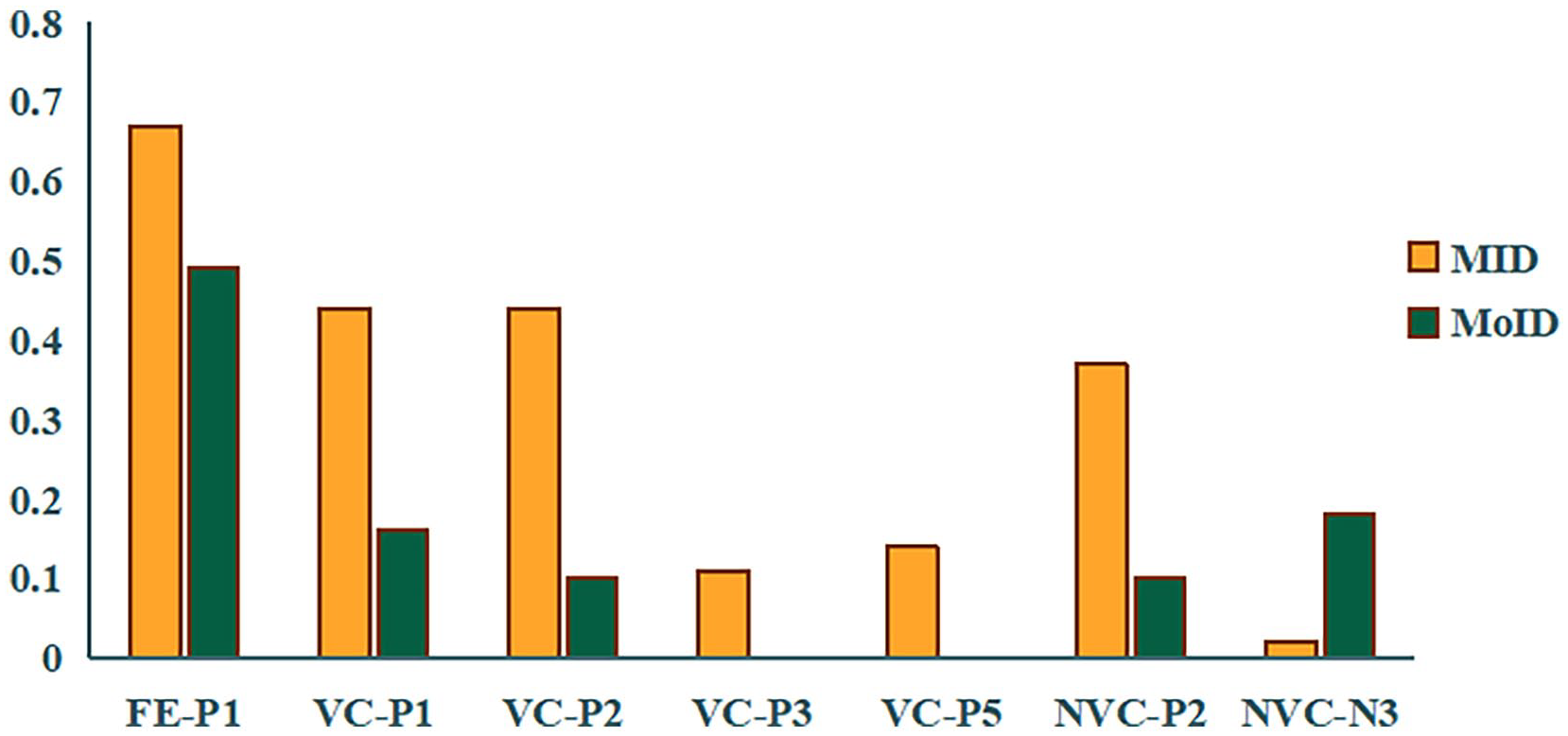
Seven observational variables that showed significant differences between the MID group and the MoID group.
The refinement of the observational tool
Based on the results of the reliability and validity of the instrument in the pilot study, we further refined the instrument and made it more concise and more effective. After pruning the undesirable variables from the preliminary instrument, the final instrument consisted of seven observational variables with three dimensions (Table 3). The reliability of the final instrument is 0.81, which showed strong agreement.
The final version of the AAA social observation tool.

FE-P1, VC-P1, VC-P2, VC-P3, VC-P5, NVC-P2, NVC-N3 are codes in the preliminary AAA social observational tool. Dimensions are FE: facial expression; VC: verbal communication; NVC: nonverbal communication.
Discussion
This is the first study to develop an instrument for measuring the effectiveness of AAA on social behaviors among Chinese children with SEN. The instrument, which was found to have good reliability and validity, identifies social behaviors in three dimensions based on social interaction theory. This pilot study is a crucial step toward establishing a tool that can effectively measure social behavior changes among children with SEN in AAA.
The established instrument comprises seven observational variables organized into three dimensions: FE, VC, and NVC. The FE dimension includes items related to positive eye contact specifically observing how children with SEN engage with the dog. Eye contact is known to play a critical role in social interaction and adaptation, 32 as it enhances self-awareness and increases interpersonal synchrony, ultimately leading to more prosocial behavior. 23 Moreover, previous research has identified eye contact as a valuable indicator of improved social interaction in individuals with autism. 33 Although the findings regarding positive eye contact in this study were of insignificance, it should be considered an important indicator of behavioral improvement among children with SEN.
The VC dimension includes four variables: saying hi or bye to the dog, proactively asking or answering dog-related questions, and complimenting the dog. The students with MID in this study were more likely to exhibit positive VC compared to those with MoID. A cohort study involving elementary school students found that VC positively impacts the development of emotional intelligence in children, 34 facilitating their social integration and social adaptation.35,36 Furthermore, research has shown that compliment behaviors increase individuals’ likability, thereby aiding their integration into society.37,38 These findings strongly suggested that saying hi or bye to the dog, proactively asking or answering dog-related questions, and complimenting the dog are crucial observational variables related to the social skills of children with SEN during AAA.
The NVC dimension includes variables that indicate positive or negative interactive behaviors, such as petting the dogs or stepping back when approaching them. The study found that students with MID exhibited more positive interactive behaviors than those with MoID, while the latter group displayed more negative behaviors, such as keeping a distance from the dog. Existing studies demonstrated a link between interactive behaviors, including postures and movement, and social ability and adaptive behaviors in individuals with autism spectrum disorder. 39 Additionally, NVC often conveys emotions and allows children with SEN to express feelings such as happiness, fear, or surprise when interacting with others, 40 aiding them in regulating relationships and compensating for limited verbal communication in various situations.41,42 Therefore, the presence of more positive interactive behaviors during AAA indicates a higher level of NVC skills and represents an improvement in the social skills of children with SEN.
Implication
This study developed and preliminarily validated an observational tool specifically designed to assess both verbal and nonverbal social interaction behaviors in children with SEN during AAA. By providing a structured and standardized observational tool for capturing real-time social behaviors in children who may have communication or cognitive challenges, this tool addresses a gap where traditional self-report or parent-report measures are often limited. In educational and therapeutic contexts, the tool enables teachers, therapists, and healthcare professionals to systematically observe and record behavioral changes during AAA, supporting individualized intervention planning and progress monitoring. For the field of animal-assisted interventions, this tool lays the groundwork for future refinement and validation in broader and more diverse SEN populations and in various intervention settings. Ultimately, it supports more effective and inclusive use of AAA by enabling objective assessment of social engagement and communication skills, thus promoting evidence-based practice and tailored support for children with intellectual disabilities and other SEN.
Limitation
While this study provides valuable insights, there are several limitations that should be acknowledged. First, the presence of the Hawthorne effect in the observational study may have influenced the results, potentially leading to biased outcomes. It is important to consider this potential bias when interpreting the findings. Second, although recruitment was initially open to all students with SEN, the final sample consisted only of children with a formal diagnosis of intellectual disability aged 7–14 years. This limits the generalizability of our findings to other SEN subgroups and age ranges. Future studies should aim to include and validate the tool among other SEN groups to enhance its applicability and external validity. Moreover, while our observational tool was designed to be broadly applicable, certain items may not be suitable or observable for all children depending on their individual abilities, especially those who are nonverbal or have specific communication challenges. Users are encouraged to adapt the tool as needed for different SEN profiles, and future research should further refine and validate the tool across more diverse subgroups to enhance the external validity of the measurement tool. Third, the measurement tool used in this study was specifically designed to assess the social interactive behaviors in children with SEN during AAA. Future studies are needed to determine the reliability, validity, and effectiveness of the observational tool in different animal-assisted interventions such as animal-assisted therapy (AAT) or animal-assisted education (AAE) programs for children with SEN. It is crucial to refine and expand the measurement tool to accurately assess social behavior improvement in various contexts. Finally, all observations of social behaviors were conducted during the AAA sessions, and no formal baseline data on students’ social behaviors were collected prior to the intervention. This limits our ability to determine changes in social behaviors attributable to AAA or to establish causal relationships. Future research should include both pre- and postintervention assessments and adopt longitudinal designs to more rigorously evaluate the effectiveness of AAA and the sensitivity and external validity of the observational tool.
Conclusion
While further validation across diverse SEN populations is warranted, the observational tool demonstrated good reliability, validity, and internal consistency in assessing the social behaviors of children with intellectual disability during AAA sessions. This instrument should be useful in evaluating the real-time social interactions of children with SEN during AAA. Furthermore, the insights provided by this tool may be used to develop tailored interventions and guide evidence-based practice in special education settings.
Supplemental Material
sj-pdf-1-smo-10.1177_20503121251363015 – Supplemental material for Developing a measurement tool for assessing animal-assisted activity effectiveness on children with special educational needs’ socialization: A pilot study
Supplemental material, sj-pdf-1-smo-10.1177_20503121251363015 for Developing a measurement tool for assessing animal-assisted activity effectiveness on children with special educational needs’ socialization: A pilot study by Liuzhi Hong, Xingyu Shen, Terence King-Heng Hui, Ronda Ka-Wai Luk, Hung-Kwan So and Wilfred Hing-Sang Wong in SAGE Open Medicine
Footnotes
Acknowledgements
The authors acknowledge the school and the students who participated in the study, and their parents who gave their consent. The authors are deeply grateful to the Hong Kong Guide Dog Association (HKGDA) for their invaluable assistance and support. The authors also gratefully acknowledge the invaluable assistance and support from the dog facilitators, Ms. Amy Tso, Mr. Kwok Tze Hang Victor, and the dog handler, Ms. Bowie, all of whom played crucial roles in facilitating the dog-assisted activities. Finally, the authors acknowledge the Advisory Committee on Mental Health which provided funding support for the study.

Ethical considerations
The study has been approved by the Institutional Review Board (IRB) of The University of Hong Kong (IRB approval number: UW 19-131, IRB approved on 21 March 2019) and was conducted in compliance with the Declaration of Helsinki.
Consent to participate
Written informed consent was obtained from the parents of the students and each included student provided assent.
Author contributions
Liuzhi Hong, Wilfred Hing-Sang Wong, and Hung-Kwan So contributed to the design, interpretation, and critical revision of the manuscript; Liuzhi Hong contributed to the conception, analyzed and interpreted the data, drafted and completed the manuscript. Xingyu Shen, Terence King-Heng Hui, and Ronda Ka-Wai Luk contributed to the acquisition of data. All authors read and approved the final manuscript.
Funding
The author(s) disclosed receipt of the following financial support for the research, authorship, and/or publication of this article: This study was supported by a grant from the Advisory Committee on Mental Health, Phase 2 of Mental Health Initiatives Funding Scheme (Grant No. MHI2_0032).
Declaration of conflicting interests
The author(s) declared no potential conflicts of interest with respect to the research, authorship, and/or publication of this article.
Supplemental material
Supplemental material for this article is available online.
References
Supplementary Material
Please find the following supplemental material available below.
For Open Access articles published under a Creative Commons License, all supplemental material carries the same license as the article it is associated with.
For non-Open Access articles published, all supplemental material carries a non-exclusive license, and permission requests for re-use of supplemental material or any part of supplemental material shall be sent directly to the copyright owner as specified in the copyright notice associated with the article.
