



Abstract
Objectives:
Perceptions of beauty, deeply rooted in societal norms, significantly impact self-esteem, self-concept, and mental well-being. This study aimed to develop and validate the Perceptions of Beauty Standards Scale, a tool designed to assess how individuals perceive societal beauty standards.
Methods:
The Perceptions of Beauty Standards Scale was developed and validated following extensive literature review, expert consultation and survey among 313 adolescents in Kathmandu, Nepal. Items in the scale reflect societal standards of beauty, focusing on physical attributes such as weight, skin color, and body imperfections.
Results:
Content validity was established with a scale-level content validity index of 0.95 and an item-level content validity index above 0.83 for all items. The initial 10-item Perceptions of Beauty Standards Scale underwent exploratory factor analysis, which revealed two factors: “Beauty Perceptions” (38.67% variance explained) and “Acceptance of Beauty Diversity” (10.47% variance explained). However, two items exhibited instability in factor loadings and item-total correlations, prompting their removal from the scale. Confirmatory factor analysis was performed for the Perceptions of Beauty Standards Scale-10 two-factor model, the single-factor model, and the revised 8-item version (Perceptions of Beauty Standards Scale-8). Confirmatory factor analysis results confirmed that the Perceptions of Beauty Standards Scale-8 exhibited a good fit (CMIN/DF = 2.30, TLI = 0.947, SRMR = 0.040, RMSEA = 0.061), demonstrating strong construct validity.
Conclusion:
The scale showed good psychometric properties, including content validity, construct validity, and reliability. The Perceptions of Beauty Standards Scale-8 offers a robust measure of societal beauty perceptions, providing valuable insights into body image and mental health, particularly in environments where societal beauty standards strongly influence self-esteem.
Introduction
The perception of beauty is a complex construct shaped by cultural, social, and individual factors. It encompasses how individuals interpret and internalize societal ideals of physical appearance, which are often influenced by media, traditions, and social interactions. These ideals significantly affect how people view themselves and others, forming both conscious and unconscious judgments about appearance. Various theories support body image and beauty perception and its relation with self-esteem.1,2 Globally, while beauty standards vary, common themes such as body shape, skin color, and facial features dominate. Societal perceptions of beauty profoundly shape self-concept, self-esteem, and mental well-being, often contributing to psychological and dermatological conditions. 3 However, these beauty standards are not universal and are deeply influenced by cultural contexts. For instance, lighter skin tones are idealized in many South Asian cultures, including Nepal, while Western cultures often emphasize thinness or athletic body shapes, while some culture prefer facial symmetry over other things.4,5 This cultural variability means that internalization of beauty standards and its psychological impact can differ significantly across regions. The pressure to conform to unrealistic beauty standards largely propagated through social and mainstream media, has been linked to conditions such as body dysmorphic disorder (BDD), social anxiety disorder, and charismaphobia.6–10 The prevalence of BDD has been estimated at approximately 2% globally, with high rates of comorbid conditions such as depression, anxiety, social phobia, and obssessive-compulsive disorder (OCD). 11
The challenges associated with beauty perception and dissatisfaction are particularly concerning in resource-limited settings, such as Nepal, where societal beauty standards and mental health resource constraints compound the psychological burden, particularly for young individuals.12–14 Individuals with visible skin conditions, such as acne, psoriasis, and vitiligo, often experience heightened psychological distress and are at increased risk of developing BDD, underscoring the intricate relationship between skin health and mental well-being.8,13,15 Additionally, the interplay between social appearance anxiety and negative body image perceptions has been linked to eating disorders and social anxiety, reflecting the widespread impact of beauty-related pressures.13,14,16 However, the effects of beauty norms are not uniform across populations, as factors such as age, education, and cultural background moderate the impact of media exposure on self-perception and body image. 13
Internalization, the process by which individuals adopt societal beauty standards as personal benchmarks for self-evaluation, is influenced by repeated exposure to societal and media representations of ideal beauty, which can lead individuals to compare themselves with these ideals. However, the degree to which these beauty standards are internalized varies across cultures, as societal norms shape the extent to which individuals accept or resist dominant beauty ideals. Social comparison theory provides a framework for understanding this phenomenon as it suggests that individuals evaluate their self-worth by comparing themselves to others.17,18 Upward comparisons, where we measure ourselves against those we perceive as more attractive, can lead to feelings of inadequacy and low self-esteem. In contrast, downward comparisons might offer temporary boosts in self-worth but can also reinforce negative body image.19,20 These dynamics are especially pertinent in today’s world, where unattainable beauty standards promoted by social media and the fashion industry exert immense pressure on individual self-perception. 21 This theory provides a foundation for understanding why many individuals feel pressure to conform to societal standards, which can result in body dissatisfaction and negative self-image. Similarly, the Objectification Theory could further illustrate this issue by highlighting how the frequent portrayal of individuals, especially women, as an object of beauty and glamor, could lead to self-objectification.22,23 They tend to treat their bodies as objects to be evaluated and judged by external standards. This internalization process not only shapes self-perception but also contributes to several mental health issues. When societal standards are internalized, self-worth could often become tied to appearance, resulting in body shame and psychological distress. 24
The concept of “body capital” describes physical appearance as a form of social capital. 25 Women and gender minorities experience disproportionate pressures to conform to beauty standards, perpetuating gender hierarchies and inequalities. Objectification and commodification of appearances not only sustain these hierarchies but also exacerbate economic and political disparities.1,2,26 Minority stress theory further highlights the appearance-related pressures faced by marginalized groups, particularly nonconforming body types or racial identities, where discrimination and anxiety could lead to maladaptive behaviors and worsening mental health and well-being.1,27 Body image dissatisfaction is linked to various adverse outcomes, including mental health issues such as depression, anxiety, lowered self-esteem, and eating disorders.28–30 Studies indicate body image dissatisfaction affects 35%–81% of female adolescents and 16%–55% of male adolescents in developed countries.31–33 For instance, a study in the United States found that approximately 60% of adolescent girls and 30% of adolescent boys were dissatisfied with their body image. 34 Similarly, 66% of adolescent girls aged 13–18 years in the UAE were found to have a desire to become thin. 35 A National Survey of School Health from Brazil reported that more than 38% of adolescents did not consider their body shape as normal. 36 For instance, a study in the United States found that approximately 60% of adolescent girls and 30% of adolescent boys were dissatisfied with their body image.37,38 Thus, understanding how individuals perceive and internalize beauty standards is crucial for developing effective prevention and intervention strategies.
Despite the growing recognition of the link between body image dissatisfaction and mental health issues, existing psychometric tools primarily focus on measuring body image dissatisfaction without fully capturing the broader societal influences at play. The Perceptions of Beauty Standards Scale (PBSS) was developed to address this gap, as a tool to systematically measure societal attitudes toward beauty norms and their implications for body image dissatisfaction, providing a more comprehensive understanding of the multifaceted dimensions of beauty that individuals internalize, such as skin color, body shape, and physical appearance.
Materials and methods
Nature of the study
This study employed a community-based cross-sectional design to develop and validate the PBSS among adolescents in Nepal.
Instrument and procedure
The development and validation of the PBSS followed a systematic process outlined by Boateng et al. 39 The initial stage of developing the PBSS involved an extensive literature review utilizing PubMed, Scopus, and Google Scholar databases, and employing combinations of keywords such as “body image,” “beauty standards,” “internalization of beauty norms,” and “adolescents.” Articles were included if they were published in peer-reviewed journals, written in English, focused on adolescents or young adults, and discussed body image or societal beauty standards with an emphasis on psychometric scale development or validation. Articles that did not meet these criteria were excluded. The research team comprised professionals from public health, and health promotion and education, who consulted with experts in psychology, social science, and public health to ensure a comprehensive understanding of the constructs underpinning beauty standards and body image. This helped to create a comprehensive pool of 30 items grounded in existing theories of beauty standards. These items were then reviewed by a panel of experts from psychology, social sciences, and public health to assess their relevance, clarity, and cultural appropriateness. Items were excluded if they were deemed redundant, lacked clarity, or did not align with the theoretical framework of beauty standards and body image. For instance, the item “A deep or clear voice can enhance a person’s attractiveness” was excluded because it pertains more to auditory perception than visual beauty standards. Similarly, the item “People who wear bright and colorful clothing appear more attractive than those who wear dull colors” was removed, as it reflects fashion preference rather than an internalized beauty norm. Additionally, statements such as “Wearing accessories such as jewelry, watches, or handbags enhances a person’s attractiveness” were omitted since they emphasize material adornment rather than inherent beauty standards. Experts were selected based on their academic qualifications, research experience in psychometric scale development, and familiarity with body image research.
A total of 10 items were selected for refinement, emphasizing conciseness and clarity. The response was assessed on a 5-point Likert scale with response options ranging from 1 = “strongly disagree,” “disagree, uncertain/neutral,” “agree,” to 5 = “strongly agree.” To ensure that participants are attentive to the items and respond carefully to the items, two items were kept for reverse coding. Higher PBSS scores indicate greater support for societal beauty standards, which are often unattainable. The PBSS is provided in the Supplemental file (S1; PBSS).
Item refinement
Face validity
Face validity is the initial subjective assessment of the tool’s relevance and appropriateness for its intended purpose, as perceived by both the test participants and experts in the field. 40 To ensure clarity and cultural relevance, cognitive interviews were conducted in two phases. Cognitive interviewing is a qualitative method used to assess how participants interpret and respond to the survey questions or scale items,41,42 in this context. In the initial phase, eight adolescents, including four males and four females, were individually interviewed to identify ambiguities and improve item clarity. After refining the scale based on their feedback, a second round of interviews was conducted with four new adolescents, including two males and two females, to confirm the effectiveness of the revisions. This iterative approach follows best practices in scale development and ensures that the modifications enhance comprehension without altering the intended meaning of the items.
Content validity
Six experts from the fields of public health, social science, and psychology were invited to evaluate the items for relevance and clarity. They used a 4-point scale, with higher scores indicating greater approval of the items’ relevance and clarity for assessing perceived beauty standard, while lower scores indicated disapproval. Content validity was assessed by calculating the content validity ratio (CVR) and content validity index (CVI) to measure the level of agreement among the experts.
Study participants and data collection
This tool was developed as part of a community-based cross-sectional study aimed at assessing body image dissatisfaction among adolescents in Nepal. The sample size for this study was determined using Cochran’s formula, considering a prevalence of body image dissatisfaction of 75.2% among adolescents in Kathmandu, 43 a 95% confidence level, and a 5% margin of error. The initial calculation yielded a sample size of 288 participants. Adjusting for a 10% nonresponse rate, the final sample size was determined at 320 participants. Out of the 320 participants approached, 313 adolescents residing in the Kathmandu Metropolitan City provided complete responses, meeting the minimum recommended sample size for confirmatory factor analysis (CFA) (not less than 200 samples).44,45 All adolescents residing within the Kathmandu Metropolitan City were eligible for inclusion in the study, with no exclusions made except for cases where informed consent/assent from the adolescents or parental consent was not obtained. Face-to-face interviews were conducted using a Nepali-translated version of the PBSS after acquiring the necessary informed consent from each of the participants. The data were collected from 8 to 30 June 2024. To ensure translation validity, the instrument was translated into Nepali by a qualified translator and then back-translated into English by another translator.
Statistical analysis
Descriptive statistics (mean, standard deviation, frequency, and percentage) were used to illustrate the general characteristics of the sample. Exploratory Factor Analysis (EFA) and computation of Cronbach’s alpha were performed using Statistical Package for the Social Sciences (SPSS) version 22.0, whereas CFA was performed using Analysis of Moment Structure software (AMOS) version 23.0.
Construct validity
The factor analysis was used to evaluate the construct validity of the PBSS, as it helps to identify underlying factors or dimensions captured by the scale and helps to assess whether the newly constructed scale measures what it is intended to measure. 46 Bartlett’s test of sphericity and the Kaiser–Meyer–Olkin (KMO) index were used to evaluate the adequacy of the sample for factor analysis (p < 0.05, KMO > 0.50). 47 EFA aimed to identify factors, compute commonalities, and assess item loadings, using principal component analysis (PCA) with Varimax rotation to enhance interpretability. PCA is a common approach in EFA, and Varimax rotation is an orthogonal method that enhances interpretability by maximizing the variance explained by each factor while minimizing overlap between factors. Guttman’s rule and Cattell’s scree plot were used to confirm the number of factors, retaining those with eigenvalues > 1 and factor loadings >0.40. 48 CFA was performed to validate the factor structure, using multiple indices to evaluate model fit: normed Chi-square (CMIN/DF ≈ 2), Tucker–Lewis Index (TLI ⩾ 0.90), Standardized Root Mean Square Residual (SRMR < 0.08), Root Mean Square Error of Approximation (RMSEA < 0.05 good; <0.10 acceptable), PCLOSE > 0.05, and Comparative Fit Index (CFI ⩾ 0.90).49–52
Criterion validity assessment
To evaluate the criterion validity of the PBSS, the PBSS scores were compared with the scores of the Body Shape Questionnaire (BSQ-16), 53 an established measure of body image concern. The PBSS scores were categorized into three groups based on set cutoffs: opposition to beauty standards, mild support, and high support or deep internalization of beauty standards. Pearson’s correlation analysis was performed to assess the relationship between PBSS and BSQ-16 scores. Additionally, analysis of variance (ANOVA) was conducted to examine significant differences in mean BSQ-16 scores across the three PBSS categories, using the F-statistic to determine whether varying levels of support for beauty standards were reflected in different levels of body shape concern.
Reliability
The Cronbach’s alpha coefficient was used to determine the reliability of the PBSS. A value of Cronbach’s alpha > 0.70 indicates that the scale meets the reliability standard. 54 Additionally, a split-half test was conducted to further assess the scale’s reliability.
Ethical consideration
This study adheres to the Declaration of Helsinki. Ethical approval was obtained from the Institutional Review Committee of CiST College (16/080/081). For the participants aged 17 years and below, written informed assent from them along with the written informed consent from their parents (who are the legally authorized representatives of minor subjects) was obtained prior to data collection, whereas for participants aged 18 years and above, their written informed consent was acquired. Confidentiality of participants’ data was ensured throughout the study. Participants were informed about their voluntary participation in the study, and they had the right to withdraw from the study at any point without facing any repercussions.
Results
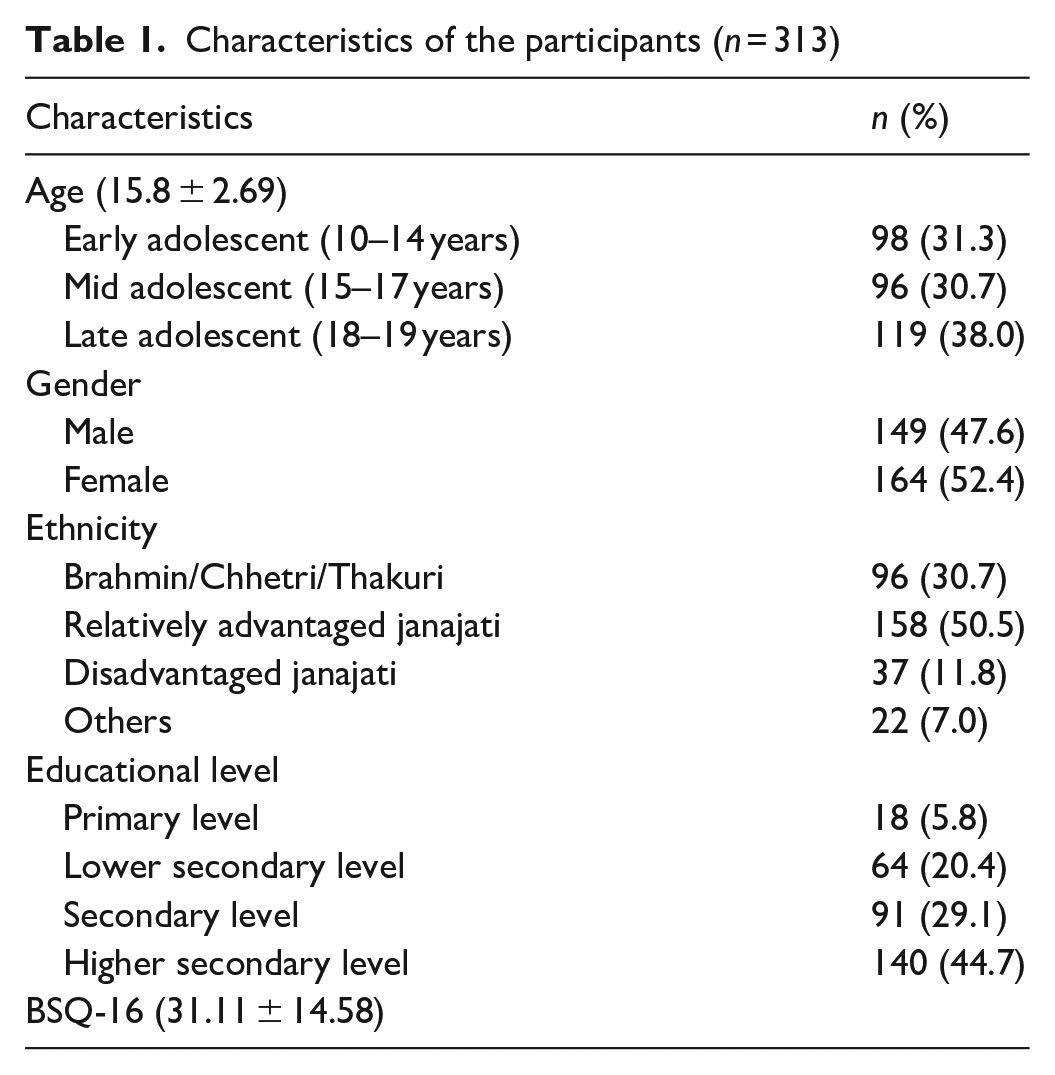
Among the 313 participants, there were almost equal numbers of males and females. The age of the participants ranged between 10 and 19 years, with a mean age of 15.8 ± 2.69. The distribution of participants based on three age groups showed that there was almost equal proportion of early, mid, and late adolescents at 31.3%, 30.7%, and 38.0% respectively. The BSQ-16 scores among 313 participants showed a mean of 31.11 (SD = 14.58) with a broad range from 16 to 81, reflecting diverse levels of body shape concern (Table 1).
Characteristics of the participants (n = 313)
Face validity and content validity
The cognitive interviews conducted with eight adolescents, comprising four males and four females, provided valuable insights into their understanding of the items. Based on these interviews, several items were rephrased for improved clarity. For example, the item “A person cannot be beautiful if he/she is overweight or obese” was revised to “A person cannot be beautiful if they appear overweight or have an unfit body shape,” emphasizing appearance rather than weight. Similarly, “People having uneven lower and upper body parts make them unattractive” was rephrased as “Having an uneven body shape, such as disproportionate legs and torso or other physical irregularities, makes a person less attractive.” Following these revisions based on the responses from the participants, an elaboration of all the items was created to make the items clearer for administration (Table 2). When the revised version was administered to a new group of participants consisting of two males and two females, they clearly understood all the items. Experts’ evaluation showed strong agreement on content validity, with all CVR values exceeding 0.67, indicating essentiality. The item-level content validity index (I-CVI) ranged from 0.834 to 1, confirming relevance and clarity. The scale-level content validity index (S-CVI) averaged 0.95, demonstrating excellent overall content validity for the tool.
Revision and elaboration of the items for a better understanding

Items that are reverse coded.
Data distribution and reliability
The total score of PBSS-10 ranges between 11 and 44, with a mean score of 23.428 ± 4.65. The skewness and kurtosis suggested that the items generally display moderate skewness and kurtosis, with values that suggest a reasonably normal distribution for most items, but the Kolmogorov–Smirnov and Shapiro–Wilk tests for normality further suggest that the data for the PBSS does not follow a perfect normal distribution as p < 0.001. The internal consistency of the PBSS was evaluated using Cronbach’s alpha, which was found to be 0.812 for the entire 10-item scale, suggesting good reliability. Additionally, the Guttman split-half coefficient of 0.802 further supports the robustness of the scale, indicating that the items are consistently measuring the same construct. These reliability coefficients suggest that the PBSS is reliable for measuring perceived beauty standards in the target population (Table 3).
Descriptive and reliability statistics for PBSS

Items that are reverse coded.
The inter-item and item-total correlation provides an overview of the relationships between individual items and their alignment with the total scale score. Most items demonstrate positive and statistically significant correlations (p < 0.05) with other items and with the overall PBSS score, indicating that they are generally aligned with the construct being measured. Notably, items 4 and 8 of PBSS had lower item-total correlations at −0.013 and 0.105, respectively (Table 4).
Interitem and item-total correlation matrix for the PBSS scale items
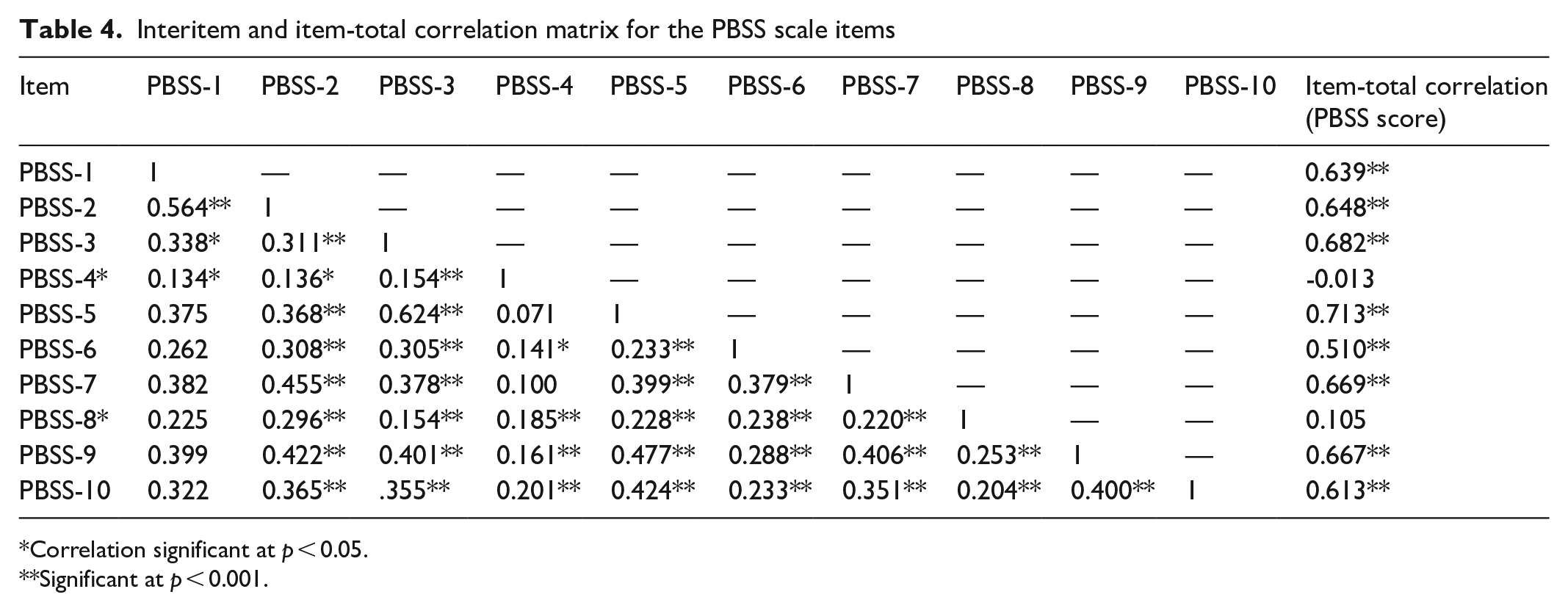
Correlation significant at p < 0.05.
Significant at p < 0.001.
Factor analysis
Exploratory factor loading for 10 items of the PBSS scale was performed, where the KMO measurement of the samples’ adequacy was 0.854 (i.e., >0.600), suggesting sample adequacy. Bartlett’s test of sphericity was significant at p < 0.001, suggesting that the data were suitable for factor analysis and that the variables were correlated. A total of two factors explained 49.17% of the total variance, with eigenvalues > 1. Factor I: Beauty Perceptions, loaded eight items (explaining 38.67% of observed variance) related to negative evaluations of physical attributes, such as weight, skin color, and body imperfections, suggesting a prevalent standard of beauty. Factor 2: Acceptance of Beauty Diversity, loaded only two items (Explaining 10.47% of observed variance) reflecting acknowledgment of differing beauty standards and acceptance of imperfections, which challenges traditional notions of beauty (Table 5).
Factor loadings for the PBSS items based on exploratory factor analysis (n = 313)

Items that are reverse coded.
Bold entries signify factor loadings >0.40.
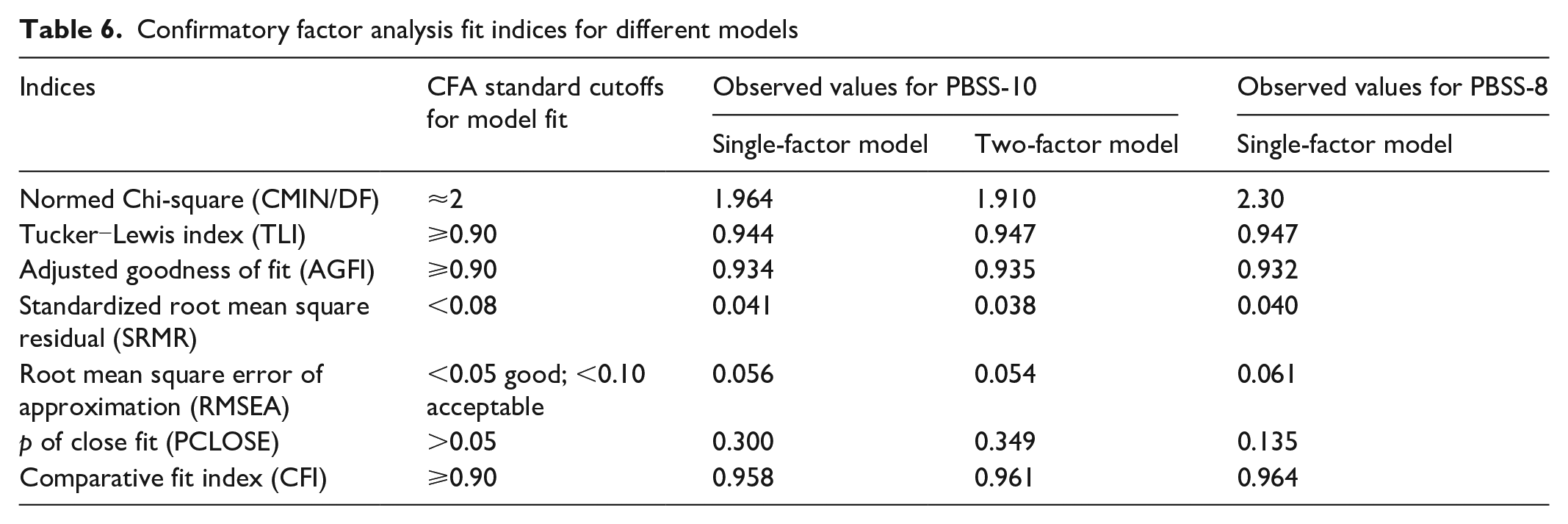
The factors identified in the EFA were subjected to CFA (Figure 1), where fit indices such as CFI, CMIN/DF (≈2), TLI, SRMR, and RMSEA indicated an acceptable model fit. Both the single-factor and two-factor models were tested. The two-factor model produced slightly better-fit indices, with a CFI of 0.961, TLI of 0.947, AGFI of 0.935, and RMSEA of 0.054 (Table 3). However, despite the marginally better fit, Factor II consisted of only two items, items 4 and 8, which demonstrated low item-total correlations at −0.013 and 0.105, respectively, and raised concerns regarding factor stability and reliability. To improve model fit and alignment with theoretical expectations, two items were removed, resulting in the modified 8-item PBSS (PBSS-8). The KMO value of 0.854 indicated strong sample adequacy, supporting the use of factor analysis. CFA results for PBSS-8 confirmed the model’s goodness-of-fit, with key indices meeting recommended thresholds for model validity, as follows: CMIN/DF = 2.30, TLI = 0.947, AGFI = 0.932, SRMR = 0.040, RMSEA = 0.061, PCLOSE = 0.135, and CFI = 0.964. Thus, the PBSS-8 is recommended as the final validated version (Table 6).

CFA comparing two-factor and single-factor models for PBSS-10 and PBSS-8 single-factor model
Confirmatory factor analysis fit indices for different models
The factor loadings for all items ranged from 0.456 to 0.689, indicating a moderate-to-strong relationship between each item and the underlying construct of perceived beauty standards, which reflects convergent validity. Additionally, Cronbach’s alpha coefficient of 0.812 further supported the internal consistency and convergent validity of the scale. In the PBSS scale, higher the score, higher is the individual support of the perceived beauty standards. The PBSS-8 scores were also compared with the BSQ-16 scale, an established measure of a related construct for further validation where PBSS-8 scores showed a near-to-moderate correlation with BSQ-16 scores at r = 0.114, p = 0.043 (Table 7).
Standardized factor loadings, and internal consistency for final PBSS-8

Discussion
This study presents the development and validation of the PBSS, a psychometric tool designed to assess societal beauty norms and their influence on body image perceptions. The tool focuses on how individuals perceive and internalize societal beauty standards, rather than merely reflecting on their self-perception of how beautiful they are. This approach effectively captures participants' views on beauty standards and societal expectations, which can provide valuable insights into how these perceptions influence body image and self-esteem. By incorporating items related to weight, skin tone, body symmetry, and physical features, the PBSS could offer a more comprehensive view of the societal pressures that individuals face. Additionally, it allows researchers to assess the degree to which individuals internalize these standards, thus providing insights into potential risk factors for body dissatisfaction and mental health issues. However, in its current form, it cannot be used in a clinical context.
The PBSS-8 underwent a rigorous development process to ensure content validity, construct validity, and reliability. Cognitive interviews and expert feedback refined the initial items, and the content validity analysis demonstrated high agreement among experts regarding the items’ relevance and clarity. The content validity analysis demonstrated a high level of agreement among the experts regarding the items’ essentiality and clarity for assessing perceived beauty standard. The CVI analysis showed strong agreement among experts, with I-CVI scores exceeding 0.83, indicating excellent content validity. It has been suggested that CVI scores greater than 0.79 are considered acceptable.46,55–57 The S-CVI is greater than 0.95, indicating good content validity.56,57 The I-CVI for all the items was above 0.83, which is an acceptable threshold for content validity where there are at least six experts involved. 58 This ensures the relevance and clarity of the PBSS items for assessing societal beauty standards.
EFA initially revealed two factors for the PBSS-10. However, CFA indicated that a single-factor model provided a better stability. The initial two-factor solution included a second factor with only two items (items 4 and 8), which exhibited low item-total correlations, raising concerns about factor stability and reliability. Consequently, these two items were removed, resulting in the revised PBSS-8 scale with a single-factor structure. The KMO value of 0.854 indicated strong sample adequacy. The CFA indices for PBSS-8 confirmed the model's goodness-of-fit, with key indices (CMIN/DF = 2.30, TLI = 0.947, AGFI = 0.932, SRMR = 0.040, RMSEA = 0.061, PCLOSE = 0.135, and CFI = 0.964) meeting recommended thresholds for model validity. It has been suggested that KMO values < 0.50 are unacceptable, whereas values between 0.70 and 0.80 can be considered average and acceptable, and values between 0.80 and 0.90 can be considered excellent.47,59 All of the CFA indices are in line with the recommended standard thresholds, such as TLI should be ⩾0.90, and SRMR < 0.08, which suggests that the model is a good fit.49–52 These findings suggest that the PBSS-8 is effective in measuring the intended construct.
A near-to-moderate correlation was observed between the PBSS and BSQ-16 scores. This may be attributed to the fact that, although both tools examine body image, they serve distinct purposes in assessing beauty perceptions. The PBSS encompasses a broader range of beauty standards, including skin color, abnormal anatomy, body hair, disproportionate body, and minor deformities. In contrast, the BSQ-16 measures the concerns about body shape by individuals focusing specifically on body image dissatisfaction related to weight, assessing individuals' concerns and dissatisfaction regarding their weight and overall appearance. 60 This distinction reinforces PBSS-8’s validity as a tool for assessing societal beauty standards and highlights its potential to inform targeted interventions addressing body image issues
This finding supports the validity of the PBSS as a measurement tool, demonstrating that it accurately reflects the constructs it aims to assess and can assess the varying degrees of support for beauty standards among individuals. In terms of tool development and validation, such results underscore the importance of establishing clear distinctions among different groups within the population, which is crucial for understanding the impact of societal beauty norms on self-perception and body image. The ability of the PBSS to identify these differences reinforces its potential as a reliable instrument for further research on beauty standards and their psychological implications, as well as its applicability in developing targeted interventions to address body image issues. PBSS-8 fills an important gap in existing psychometric tools by focusing on societal beauty standards rather than solely on individual body dissatisfaction. Unlike tools such as the BSQ-16, which primarily targets weight-related concerns, PBSS-8 encompasses broader societal constructs, including biases related to skin tone, visible physical differences, and cultural variability in beauty norms. These features make PBSS-8 particularly relevant for understanding the psychological impact of societal pressures, including conditions such as BDD, social anxiety, and low self-esteem. However, the PBSS-8 does not include items explicitly related to disordered eating behaviors. Its primary focus is on measuring internalized societal beauty standards and body dissatisfaction, which is closely linked to these psychological conditions. Future research could explore whether the PBSS-8 might be expanded or used in conjunction with other tools to assess its relevance to disordered eating and related behaviors. This would further enhance its applicability to a broader range of psychological concerns influenced by societal beauty norms. The PBSS has a significant potential for public health research, particularly given the strong association between body image dissatisfaction and various mental health disorders.
Studies have shown that individuals who experience body image dissatisfaction are at a higher risk for eating disorders, depression, anxiety, and lower overall life satisfaction.28–30,37,38 Moreover, the PBSS addresses a critical gap in mental health research and practice by linking societal beauty standards with individual psychological outcomes, offering a more contextualized understanding of mental health concerns. Current diagnostic tools, such as the DSM, often focus on individual pathology and decontextualize mental health issues by overlooking broader societal influences. The PBSS complements these frameworks by highlighting the role of societal pressures, thereby helping to design interventions that incorporate both individual and sociocultural factors. The implications of PBSS-8 extend to public health research and interventions. By identifying specific societal beauty standards internalized by individuals, PBSS-8 can inform the design of targeted programs to mitigate body dissatisfaction and mental health challenges. This tool is particularly valuable for developing culturally sensitive interventions, given its origin in a resource-constrained, diverse setting like Nepal. Additionally, its ability to measure the degree of acceptance or opposition to societal beauty norms can support advocacy efforts promoting body positivity and mental well-being.
Despite the rigorous process undertaken to develop and validate the PBSS-8, ensuring its reliability and construct validity in assessing societal beauty standards among adolescents, the scale is not without limitations, which should be considered when interpreting the findings. While PBSS-8 demonstrated strong psychometric properties, including good internal consistency and model fit indices, its validation was limited to adolescents in Kathmandu, Nepal, restricting its applicability to other contexts and populations. Future studies should explore the scale in more diverse groups, such as adults, older adults, and individuals from varied cultural and socioeconomic backgrounds, to enhance its generalizability. Additionally, the self-reported nature of the data may introduce response bias, as participants might provide socially desirable answers rather than fully accurate ones. The removal of two items from the original PBSS-10 during factor analyses could raise questions about the scale’s content comprehensiveness, particularly regarding the exclusion of items related to the naturalness of skin conditions (PBSS-4) and the subjectivity of beauty standards (PBSS-8), which future research could further explore. Moreover, the study did not incorporate other well-established scales to compare and further validate the PBSS-8, and future research could address this limitation to enhance the scale’s criterion validity. Lastly, although the scale underwent rigorous validation, future studies should assess its longitudinal reliability and cross-cultural applicability to strengthen its use as a universal tool for measuring beauty perceptions. Expanding the scale to include items related to behavioral outcomes, such as disordered eating or social anxiety, may also enhance its applicability further in clinical and research settings. Regardless of these limitations, PBSS-8 is a novel tool with significant potential for advancing research on societal beauty standards and their impact on body image and mental health.
Conclusion
The PBSS demonstrated good psychometric properties, including content validity, construct validity, and reliability. This tool offers a robust measure of societal beauty perceptions, with the potential to provide insights into the factors that influence body image and mental health. While the scale has been validated in adolescents, future research should explore its applicability across diverse populations and cultural contexts.
Supplemental Material
sj-docx-1-smo-10.1177_20503121251324085 – Supplemental material for Unpacking beauty norms and body image: Development and validation of the perceptions of beauty standards scale
Supplemental material, sj-docx-1-smo-10.1177_20503121251324085 for Unpacking beauty norms and body image: Development and validation of the perceptions of beauty standards scale by Shishir Paudel, Anisha Chalise, Shaina Tamrakar and Dhurba Khatri in SAGE Open Medicine
Supplemental Material
sj-docx-2-smo-10.1177_20503121251324085 – Supplemental material for Unpacking beauty norms and body image: Development and validation of the perceptions of beauty standards scale
Supplemental material, sj-docx-2-smo-10.1177_20503121251324085 for Unpacking beauty norms and body image: Development and validation of the perceptions of beauty standards scale by Shishir Paudel, Anisha Chalise, Shaina Tamrakar and Dhurba Khatri in SAGE Open Medicine
Footnotes
Acknowledgements
We share our gratitude to all the experts for their support in the tool development and validation process. We are thankful to all the adolescent who participated in this study and provided their valuable time and information. Without them, this study wouldn’t have been possible.
Author contributions
Conceptualization: Shishir Paudel, Shaina Tamrakar, Anisha Chalise. Data curation: Shaina Tamrakar, Shishir Paudel. Formal analysis: Shishir Paudel. Methodology: Shishir Paudel, Anisha Chalise. Visualization: Shishir Paudel, Anisha Chalise, Dhurba Khatri. Validation: Shishir Paudel. Writing – original draft: Shishir Paudel, Shaina Tamrakar, and Anisha Chalise. Writing – review and editing: Shishir Paudel, Anisha Chalise, Shaina Tamrakar, and Dhurba Khatri.
Data availability statement
Data available from corresponding author upon reasonable request.
Declaration of conflicting interests
The author(s) declared no potential conflicts of interest with respect to the research, authorship, and/or publication of this article.
Funding
The author(s) received no financial support for the research, authorship, and/or publication of this article.

Supplemental material
Supplemental material for this article is available online.
References
Supplementary Material
Please find the following supplemental material available below.
For Open Access articles published under a Creative Commons License, all supplemental material carries the same license as the article it is associated with.
For non-Open Access articles published, all supplemental material carries a non-exclusive license, and permission requests for re-use of supplemental material or any part of supplemental material shall be sent directly to the copyright owner as specified in the copyright notice associated with the article.
