




Abstract
This article explores normative ways of conceptualizing Islamic ethics, animal ethics, and the divergent positions on the ethical treatment of animals by Muslims within Islamic scholarly discourse. Too often, the literature addressing the intersection between Islamic ethics and animal ethics is narrowly focused on the topic of halal slaughter. Therefore, this article proposes a wider conversation about an alternative relationship between Muslims and nonhuman animals in the industrialized factory farming era, suggesting that an ethical-vegetarian lifestyle may more accurately uphold the Islamic principles of compassion and mercy, as well as the Islamic practice of intellectual effort, ijtihad. At the very least, a reconceptualization to that end deserves rigorous consideration within Islamic scholarship, taking the debate beyond simply the moment and manner of an animal’s death.
Introduction
Should Islamic ethical discourse include a conversation about the overall acceptability of animal slaughter, considering two of the most critical components of Islamic morality: compassion and mercy? This article will explore the possible justifications for an expanded debate within Islamic studies circles by challenging the morality of Islamic animal killing altogether, rather than merely scrutinizing the moment and methods of halal slaughter. It will further assess the possibilities for an Islamic framework for ethical vegetarianism that could preserve the lives and well-being of animals based on the teachings of Islam, utilizing an Islamically informed ecofeminist theoretical framework (Warren 2000).
Muslims throughout history have played an integral role in the development of human society. Their contribution to modern scholarship is substantial in areas encompassing science, math, literature, art, ethics, and philosophy. Though modern Islamic scholars such as Magfirah Dahlan, Kecia Ali, Richard Foltz, Sarra Tlili, and Arthur Saniotis have questioned the permissibility of meat-eating in Islam, their positions are in the minority, and their attention to the issue of Islamic vegetarianism and the lives of animals in Islam, as a relevant topic for Islamic ethics, remains uncommon. Islamic communities ranging from ancient Muslims in South Asia to modern Sufis in Turkey have explored Islamic vegetarianism (Foltz 2001, 40), but the issue of whether or not animal slaughter should occur at all within a modern Islamic ethical framework is understudied within the contemporary academic canon and overlooked in many modern neoliberal Muslim societies.
A robust ethical-vegetarian literature does however exist, from which Islamic studies scholars could model their inquiries, offering precedent and exploring religion as the philosophical framework to justify a non-violent vegetarian lifestyle. Furthermore, exploration of vegetarianism as a tenet of spirituality is found in many religious traditions, as well as in religious studies literature. As described by Durkheim, choices often mark or distinguish one’s self as sacred or profane, with food choices as a frequent symbol of spiritual identity (Pikering 2009, 134). Vegetarianism is mandated explicitly in the Vaishnava and some other traditions of Hinduism, though debate among the broader Hindu base continues (Narayanan 2020). Jainism embraces the tradition of alhimsa, or non-violence in all they do, including the prohibition of meat-eating. Although the modern picture for Buddhists is less clear, all early Buddhist traditions promoted vegetarianism, and today the Mahayana tradition continues to do so. Finally, the Hebrew Bible suggests that idyllically, the earliest human beings were vegetarian and although the debate continues in these circles, there is no mandate for or against vegetarianism in Judaism, nor in Christianity. And there were many historical figures, including a man thought by some to be the brother of Christ, whom tradition accords to have been a vegetarian (Davidson 2003, 12). This writing does not aspire to a comparative analysis, but it is important to highlight that religious frameworks in support of ethical vegetarianism, whether in actual religious traditions, contemporary religious studies, or animal ethics literature, are robust, even though academic debate in Islamic scholarship still wants for expansion.
Methodology and literature summary
A standard literature review utilizing six key search terms—Islamic ethics, Islamic vegetarianism, Islam and animals, Islam and animal rights, eco-halal, and halal slaughter—reveals that modern Islamic discourse on the intersection between Islamic morality and ethics, and the rights and welfare of animals, focuses narrowly on the topic of halal slaughter methods. Significant controversy and a substantial body of literature surrounds the issue of bolt stunning before slaughter, a method of rendering an animal temporarily unconscious before its death, which has been addressed by numerous scholars (Nakyinsige et al. 2013; Barrasso et al. 2020; Abdullah et al. 2019). Extensive discussion has taken place on the politics of halal regulations and the moral permissibility of halal practices in Western societies (Lever 2018; Lever and Fischer 2018; Lever and Miele 2012; Wills 2020). Another emergent discussion addresses halal and kosher practices as symbols of minority religious or ethnic community identity (Freidenreich 2011; Kurth and Glasbergen 2015; Wright and Annes, 2013). Kristen Stilt (2017) examined the methods by which animals are transported across borders in the international halal meat market. Green halal, an idea exploring expanded meanings of halal, as discussed by Manon Istasse (2016), references a modern halal movement in its infancy among Muslims in Belgium, in part promoting an Islamic veganism. Still, Istasse’s central focus was the question of whether or not animal stunning, should be employed in halal slaughter. Although the editors of the volume in which Istasse’s entry appeared clearly sought to explore a wider understanding of halal practices, the debate with reference to animal suffering, remained again focused on slaughter methods, not the greater question as to whether Muslims should be slaughtering at all (Bergeaud-Blacker, Fischer, and Lever 2016).
Sarra Tlili (2018), examining the Islamic discourse on animals, also suggested that it was lacking and insufficient and that existing scholarship was neither in-depth enough to capture the nuance and complexity of the issues, nor broad enough to incorporate the wide range of concerns. She proposed that while there was a substantial shift between the nineteenth and twentieth centuries in the public perception of how Muslims interacted with animals, all human interactions with animals evolved alongside colonialism, industrialization, and modernization, and current scholarship does not address this nor determine if it was actual behavior or just perception that shifted among Muslim communities. Tlili described nineteenth century literature in which Muslims were portrayed as having compassion and thoughtfulness toward animals, whereas subsequent literature from the twentieth century illustrated disdain and callousness. Though she did not posit whether the literary shift was a reflection of reality, like Arthur Saniotis, she considered how the global industrial shift toward capitalism affected the relationship between Muslims and animals. Certainly discourse about animals and/in Islam should examine the overall relationship between modern Muslims in the industrialized world, and animals and the natural world. Yet, to a large degree, Muslims are still following a model for the ethical treatment of animals that was prescribed in, and interpreted for, a very different time.
Considering the many Islamic teachings about compassion for animals, discussed in detail below, it is curious why the current Islamic scholarly debate about the “animal issue” is so narrow. Why does it overlook so much of the life of nonhuman animals and skip right to the moment and manner of their death? Should the conversation not go farther to address the overall necessity and morality of animal slaughter in the modern era altogether? With nearly two billion Muslims on earth and no single Muslim identity, with diverse modern Muslim societies and modern industrial farming practices, and with a venerable history of Islamic teachings on animal welfare, the picture of where animals are situated within Muslims’ ethical framework is uncomfortably opaque. And then, too, Muslims’ ethics are not to be confused with Islamic ethics, as Amina Wadud (1999) pointed out: Not all that Muslims do, is Islamic.
Therefore, after examining the discourse and debate in contemporary literature on animal slaughter and Islam, this article has three primary aims: First, it seeks to contribute a moral and Islamic justification for a wider conversation about Islamic morality and Muslims’ obligations toward animal beings within the Islamic ethics discourse. Next, looking at contemporary and historical scholarship about the treatment of animals within Islam, it seeks to highlight the framework for an Islamic ethical vegetarianism and increased compassion toward animals that “are communities like yours,” as described in the Quran (Bakhtiar 2007, 120). Ultimately, it endeavors to understand if an Islamic vegetarianism can be forged from the broad Islamic principles of compassion and mercy, the many teachings embedded in Islamic sacred texts, or the creative tool of 'al ijtihad almaqasid', intellectual effort and reasoning.
The context of an identity conflict
Muslim majority countries began experiencing substantial political, economic, and social change roughly seventy years ago at the end of the colonial era. Until today, many are still experiencing turmoil, social uprisings, and economic instability, on account of various geopolitical and economic influences (Saniotis 2012). This confusion and identity opacity can be seen not only in the political and public arenas, but also in personal ethical dilemmas facing Muslims today. The way many modern Muslims interact with animals and the natural world is in conflict with the teachings of Islam with respect both to the treatment of animals and a general reverence for the earth. Saniotis described an Islam that is charitable, kind, and nurturing toward the environment and its nonhuman animal inhabitants. Nevertheless, he suggested that currently, throughout much of the Islamic world, environmental ethics and ensuing protective policies and activism have taken a back seat to economic development efforts based on Western capitalistic neoliberalism. Thus, further consideration of the global systems of power, domination, trade, and colonialism over the last one hundred years is critical. While majority Muslim countries grew weaker, the dominant European, humanist, positivist model grew stronger. And with economic gain as the primary goal of the European colonial mission, the capitalist systems in place during the nineteenth and twentieth centuries disregarded care for the environment and exploited resources to the highest degree (Lugones 2010, 756). Subsequently, though the colonists eventually left Muslim countries, the centralized economic development models were left in place, causing ongoing degradation of the environment in further attempts at reaching some abstract goal of modernity. Additionally, colonialization and subsequent global Western economic supremacy resulted in Muslim countries also getting caught in various global development schemes in pursuit of the catch-up development myth (Mies and Shiva 1993, 55).
In contrast, Muslim cosmology and ontology present three fundamental pillars that guide Islamic environmental ethics. First, the universe as divinely created by God embodies tawhid (the divine) in proportion, harmony, and beauty. Second, humans have the responsibility of khalifah (stewardship) in caring for the earth. And lastly, humans will be held accountable in the akhirah (the afterlife) for their actions on earth with specific reference to their stewardship and preservation of the divine (Saniotis 2012, 157). Although human stewardship over the earth and nonhuman animals could be interpreted by humans in a manner demanding mercy and compassion for all, this celestial hierarchy of beings provides a dangerous framework allowing for domination, including subsequent abuse, according to Karen Warren’s (2000) logic of domination theory. Nevertheless, these enshrined principles indicate that Islam, as described by Saniotis, by no means condones human actions or activities resulting in global warming, human-induced animal extinction, or the extreme cruelty inflicted upon animals in the factory farming industry. Rather, he attributed these trends to a shift in thinking within Islamic modern societies, where European-imported utilitarianism has replaced traditional Islamic ideas concerning the sacred or mystical natural earth. With this replacement, the ontological value of animals and nature was lost to a scale that measures only the transactional, financial gain that can be squeezed out of the natural world.
While the current article is not attempting to compare Islamic ethical practices with other religious practices, or the level of anthropocentricism among the various Abrahamic religions, Basheer Ahmad Masri (2007) did so, suggesting that across the Abrahamic religions, the holy scriptures offer, to varying degrees, both negative and positive rights to animals even while allowing them under certain circumstances to be used or consumed, such as out of necessity. Masri asserted that Islam uniquely attributes substantial intelligence and even spirituality to animals, suggesting that animals have their own communities, their own prayer; that the Quran was revealed equally to and for them, and that they too will face judgement by God for their actions. He implied that with these responsibilities, also come rights. And since in these descriptions animals have personal responsibilities, not unlike humans, a consideration of their rights is warranted. A full discussion of how these rights might apply to other environmental presences, such as rivers or mountains, is outside the scope of this writing; however, serious scholarship is examining these issues as well (Magallanes 2018). Masri concluded that despite references to rights and responsibilities being attributed to animals by Islam, many religious scholars do not take these teachings seriously, and thus they are easily overlooked. This is a concern shared by Sira Abdul Rahman (2017), who suggested that if the average Muslim understood the inhumane treatment of animals in the meat industry, they would indeed reduce or reject meat eating altogether.
Beyond halal slaughter
Halal slaughter methods, and specifically the use of stunning, produce a prolific debate among Islamic scholars. Nakyinsige et al. (2013) described numerous methods of animal slaughter deemed Islamically acceptable. They cited studies, debates, and discourse concerning humane slaughter methods and the acceptability of using penetrative versus percussive bolt stunning into a cow’s head before cutting of the neck. They described precisely the positions in which cows, for example, are held within the slaughter houses by chains, ropes, contraptions, and machines before being killed, and they sought a rubric for a nicer way to kill an animal that meets halal requirements. However, if we compare their description of the technical underpinnings of halal slaughter, with or without stunning, with the many pertinent hadith (sayings of the Prophet Mohamed) and Quranic verses, a conflict clearly emerges between Islamic nia (intention) and the reality within factory farming. It seems that while Islam does make allowances for the use of animals, it also emphasizes moderation. The modern capitalist systems, however, have steered the conversation in one direction, using certain teachings of Islam, like halal slaughter, to implicitly condone what has evolved into fully unIslamic ways of interacting with animals, such as those existing in factory farms. Not only have halal slaughter methods become largely the only topic of debate, the debate by its very nature implicitly accepts that slaughter is Islamic, without ever considering a different conversation—whether slaughter in any capacity is halal in the modern world.
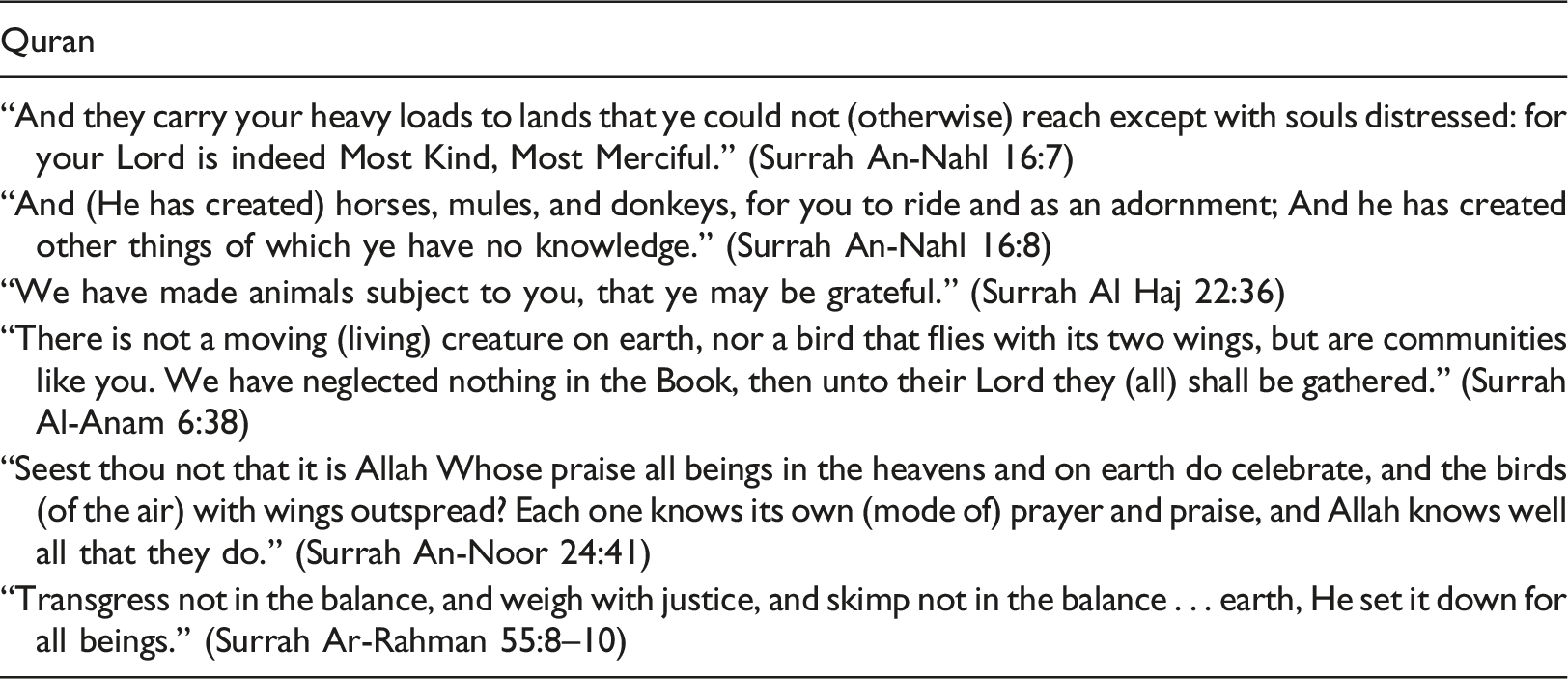
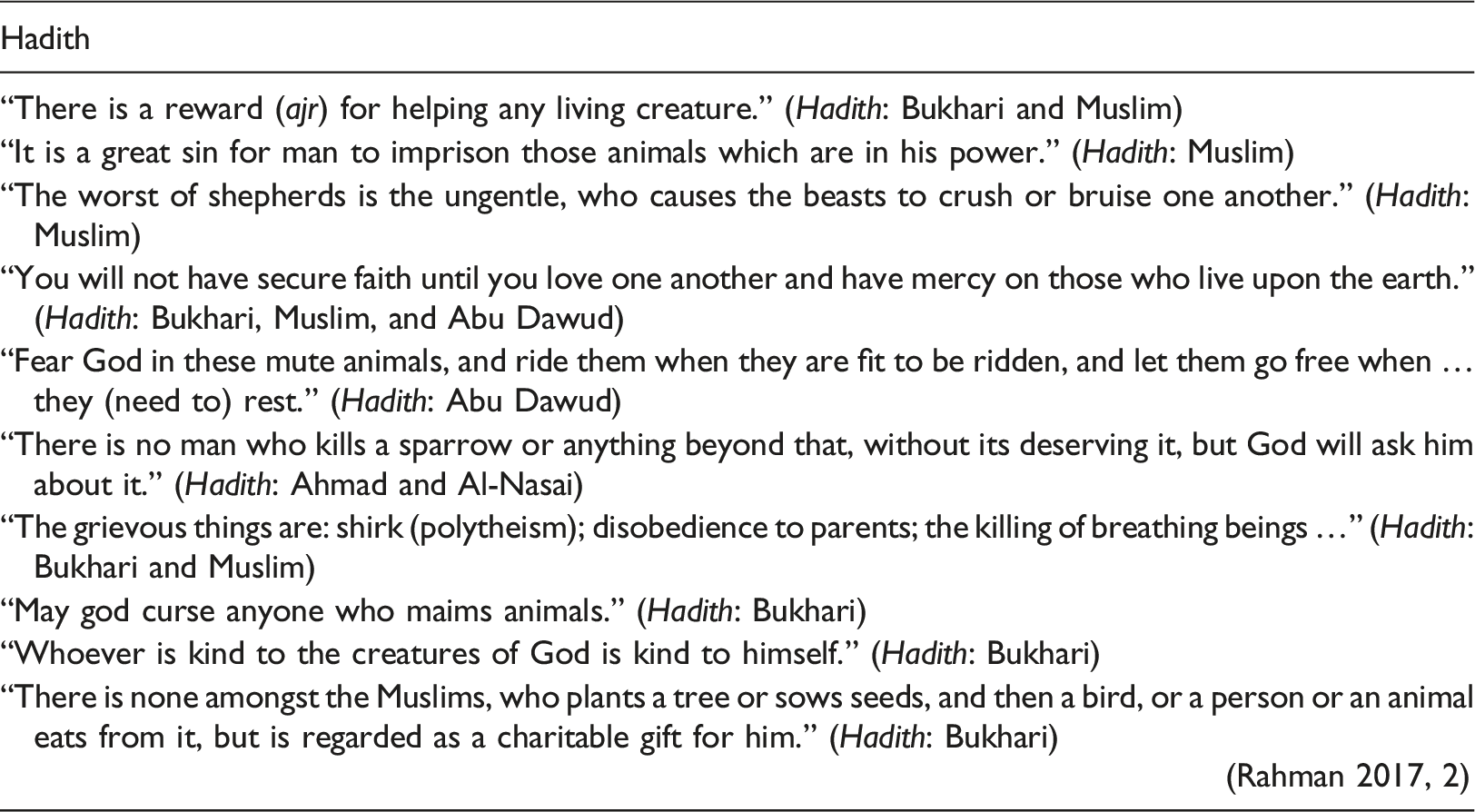

In Bakhtiar’s translation one could assume that the animal helps the human to make a profit, and from that profit one could buy food to eat. It is thus possible to understand this verse without justifying the killing of an animal. Accordingly, the true meaning and intention of the verse remains, at the very least, debatable.
Life in the seventh century, when the Quran was revealed in segments over a period of twenty-two years, was vastly different than the lives of Muslims today. Muslims who live in the twenty-first century face the difficult challenge of reconciling tradition and Islamic identity with the social constructs of modernity (Bakircioglu 2019). That is not to say that the revelations are no longer applicable. Quite the contrary. Yet they should be applied in ways appropriate to the situational considerations of the twenty-first century, just as they were upon their initial revelation in the Prophet’s time. This is particularly true for those living in high income countries where meat has been incorporated into nearly three meals a day and where the meat consumed has likely come from factory farms, where nonhuman animals are managed by machines and automation, and with a single-sighted focus on financial gain and an absolute disregard of the animals’ ontological life value.
For this inquiry, we reviewed and compiled a video sampling of practices in so-called halal slaughter houses filmed by various contemporary news and NGO outlets, which have revealed that not only are the most basic principles of halal slaughter often not followed, but the cruelty, terror, and pain inflicted upon these animals unequivocally lack both mercy and compassion, two critical components of Islamic ethics. The search terms included for this video inquiry were: halal slaughter; undercover halal slaughter; Islamic slaughter; undercover Islamic slaughter; Islamic factory farming; undercover Islamic factory farming; halal factory farming; and undercover halal factory farming. 1 All fourteen videos reveal severe violations of the spirit of Islamic animal ethics. The apparent brutalization is beyond any framework of Islamic ethics. What is happening to the animals in these so-called halal slaughter houses can only be described as physical and psychological torture of the worst nature. Such treatment of animals would have been unimaginable during the life of the Prophet. Animals living in the ancient Arabian dessert were cherished by human companions, honored as part of nature, and allowed to live a natural, happy life until the point of death. Accordingly, such slaughterhouses violate the spirit of the rules governing the slaughter of animals, and a literal or textual interpretation of these rules is incompatible with the ways in which animals are bred and killed in modern industrialized slaughter houses fueled by the global capitalist economy (Yusef 2015).
The commodification of animals, especially to the extent happening in the modern factory farming system, goes beyond anything that is recognizable in Islam. Islamic ontology is based on a concept known as ayaat, which is the description of everything in nature created by God, including all flora, fauna, landscapes, animals, etc. But it is not just the observable. In Islam ayaat is known to be objects and beings, as well as the deep mysteries and sacredness of the universe; it is all of that which is around us, as well as all of that which is beyond the grasp of human understanding. Further, humans are held as the stewards of earth according to the covenant between humans and God, but in no way are they owners of anything sacred or of anything in nature. Accordingly, the value placed on all of God’s creations based on their innate sacredness would fundamentally delegitimize nearly all modern factory farms’ claims of adherence to Islamic halal principles (Hashas and Al-Khatib 2020).
Ijtihad for challenging normative knowledge
Ijtihad is the practice of thinking, reasoning, and debating to draw conclusions based on the human application of thought, considering the overall spirit of Islam. However, a controversy surrounds the process of ijtihad within Islamic communities. In early Islam, ijtihad was encouraged. Around 900 CE, scholars then decided that the door of ijtihad should be closed and that henceforth Muslims should stop reinterpreting or debating religious teachings, but rather should only emulate what had already been considered, debated, and decided upon by past scholars (Schacht 1964). Many scholars today maintain this thinking; however, within more progressive and reformist sectors, some believe that failure to engage in ijtihad is, in and of itself, unIslamic (Salim 2007). The suggestion that ijtihad is a critical component of Islam dates back to Iman Al-Shatibi’s five hundred year old Maliki school of thought, in which he strongly emphasized focusing on the maqasid, the goals and objectives of Islamic ethical tenets, not just the superficial rules, as described by Ahmad Al-Raysuni (1991).
Fiquaha are those who act as the thinkers, debaters, and decision-makers around issues and questions that may not be explicitly addressed within the Quran or hadith, the primary sources, but require an Islamic policy nevertheless. Using domestic violence (DV) as an example, Amina Wadud (2006) pointed out the necessity of bringing DV victims and experts into the sphere of Islamic debates when it comes to addressing the issue of DV. In furtherance of ijtihad inclusivity, Wadud proposed that decision-making teams be inclusive of those who will be affected by the decisions, illustrating the necessity of a wider and more comprehensive understanding of who is and should be considered a fiquaha (typically scholars and subject matter experts). For just Islamic decisions to be made, the circle of scholars must be broadened to include laypeople with personal expertise and knowledge of the issues at hand (Wadud 1999). Historically, the voices of women and numerous other underrepresented groups throughout history have been unheard, including those of animals, whose ‘voices’ remain painfully silenced (Bakhtiar 2007).
Many people, and perhaps specifically feminists, may be uncomfortable and even offended by the comparison of women and other marginalized human groups to animals; however, these comparisons are made in consideration of an ecofeminist theoretical framework. The theory of ecofeminism utilizes and justifies these comparisons by highlighting not the similarity of the abused or dominated necessarily, such as the women or animals, but the similarities of the oppressors, suggesting that the root causes of the domination and abuse of both women and animals lie within the patriarchal capitalist system. Further, as described by Joan Dunayer (1995), the pejorative comparisons between women and animals only hold meaning insofar as humans maintain the belief in their superiority over animals. If the oppositional dualities and hierarchy of value between humans and animals were eliminated, the comparisons would be just that—neutral comparisons.
Sara Ahmed (2017), a feminist postcolonial scholar, pointed out that for women and girls to force themselves to be heard is often criticized by society as being willful in a bad way, and goes against the will of the other party imposing their will. The question implied by Ahmed, however, is that when two parties are being willful, why should one will hold power over the other will? Why should the will of a meat-eater, a butcher, or the entire meat industry dominate and suppress the will of so many animals, who in the above videos were clearly trying to impose, albeit unsuccessfully, their will to live? Why should one will be extinguished, while the other remains normative? Academia, and in these cases, academia in Islamic communities, has been dominated by male meat-eating voices that have drowned out all other voices within the conversations where decisions about animals and ethics are being made. To that end, a feminist or ecofeminist reading of an Islamic ethic could offer a more compassionate or considered treatment of an animal’s will, and right, to live. Moreover, Zakia Salim (2007) underscored the importance of not relying solely on textual interpretations of Quranic verses, but rather finding a balance between the primary sources and independent thinking, which could open up the conceptual space for a reinterpretation of will, ethics, and rights for animals within an Islamic framework.
Returning to the original verse in question, 16:5, Bakhtiar’s interpretation more accurately fits the overall spirit of Islam when taking into account the Quranic verses and hadith in Rahman’s collection of teachings on animals. Further, many teachings of both modern and historical Islamic scholars indicate that thinking and consideration are a necessary component of Islam. In this light, Rahman (2017) questioned why the debate is so narrow, focusing so substantially on the issue of stunning and other aspects of halal slaughter, despite animals being so revered within the spirit of Islam. He suggested a deeper consideration of the animal’s well-being, recommending that Muslims reject all meat-eating if an animal has not lived a normal, happy, and healthy life up until the moment of death, which would be in keeping with the aforementioned obligations for the treatment of animals. All this, as well as the Quran’s continuous emphasis on moderation and necessity, indicates that the central question within Islamic animal scholarship must evolve past how Muslims should slaughter, to whether or not Muslims should be slaughtering at all.
Fatima Mernissi (1998), in a discussion of women’s rights in Islam, raised the question of inauthentic hadith, which is pertinent to the current analysis. Chatting in the grocery story with men who she considered friends and neighbors, she asked them simply: Can women be leaders of Muslims? They responded with shock and disdain, along with appeals to God to protect them—presumably from such a disastrous and dangerous proposition! One of the men offered her a hadith that Mernissi would make a central theme of her research: “Those who entrust their affairs to a woman will never know prosperity” (Mernissi 1998, 1). Questioning how a hadith like this could fit within her understanding of an Islamic ethical framework, she engaged in an exhaustive review of hadith scholarship and the science of hadith verification, attempting to determine if indeed her beloved religion was one that would seek to oppress her. Reviewing centuries of scholarship, she thoroughly discredited this hadith, submitting that it was indeed false, despite the fact that millions of Muslims, men and women alike, know it, recite it, and believe it. Thus, she posited that a significant problem facing Muslim communities today is the existence of a wide body of normative knowledge that is oppressive and, in her view, unIslamic.
Mernissi suggested that a common failure among Muslims today is their blind acceptance of normative understandings that are oppressive to women and, we would also argue, oppressive to animals. Muslims inclined to challenge the status quo for the sake of either women or animals, do not know the process by which they can question or verify hadith, and that indeed not only do they have the right to do so, but that they are obligated to do so by the teachings of Islam. Masri’s ideas suggesting that most Muslims are unaware of the ugly realities in the meat industry, together with Mernissi’s that most Muslims do not know about their Islamic rights and obligations to question normative knowledge, lead us to a serious three-pronged problem facing Muslims (and most people) today: 1) The general Muslim population does not fully grasp the cruelty toward and suffering of animals that fuels the modern meat industry; 2) The general population is unaware that much of what they believe about animals is not truly in keeping with the ethical spirit of Islam; and 3) If and when the general population learns something new that contradicts normative knowledge, they do not know how to question it or that they have an Islamic right and even obligation to do so.
Ijtihad allows Muslims to think deeply and draw their own conclusions or put them forward for debate to challenge normative understanding (Kamali and Al-Haj n.d.). Changes to culture and norms are thus encouraged within Islam, thereby leaving the door open to new ways of life, and in particular, new ways of thinking about our relationships with animals. Although some interpretations of Islam allow eating meat and using animals for labor, no mandate exists. The Islamic texts are imbued with metaphor, not always providing exact answers to complex questions and leaving meaning and intent to interpretation. However, by embracing ijtihad, a total reimagination of the human relationship with animals is nothing if not Islamic. A well-known and verified hadith states the expectation of change as societies evolve: “Allah sends to this Ummah a man at the end of every hundred years to renew the matters of its religion for it” (Sunnah 2023).
An ijtihad-based reimagination is prudent when considering the great emphasis the Quran places on the rules governing the killing and use of animals, and in particular that they should never be used or killed unnecessarily. During the time of the Prophet, Arabs lived in an environment where meat was a vital form of sustenance in an otherwise harsh and arid landscape (Wynbrandt 2010). Humans depended on animals for labor, supplies, and food. Under those circumstances, Islam allowed the use and even consumption of animals. However, with today’s convenience, technology, biotechnology, and advanced food production, eating meat is hardly a necessity in much of the Global North. Nevertheless, vegetarianism and veganism are often expensive and accessible only to the privileged (Warren 2000). Therefore, to maintain a decolonial spirit of respectful equality, ethical-vegetarian discourse should acknowledge people living traditional lifestyles with no connection to the modern meat industry, as well as people in impoverished circumstances who rely on moderate meat consumption for the necessary calories to survive, with no other option for expanding their diet. And although vegetarianism and veganism are beneficial in reducing animal slaughter, nearly all diets have some ill effects on animal life, from insects that die during crop harvesting, to male chickens that are discarded in the egg production industry (Tlili 2018). But simply having the conversation would be useful and could push societies to find innovative solutions to these legitimate challenges.
A new ethical framework
Magfirah Dahlan (2017) offered refreshing possibilities for how Islam could reshape the global conversation about animal ethics. Addressing the debate’s focus on the issue of stunning before halal killing, she suggested that this conversation was based on a literal interpretation that fails to account for contextual understandings of the Quran’s teachings, or a contemporary analysis of what she calls the postdomestic sphere. Today’s postdomestic sphere exists wherever humans live in environments that have become physically and psychologically separated from nature and from animals. Such people are largely ignorant to the realities of modern-day meat production. This contextual evolution therefore warrants further and deep consideration, given the substantial changes that have occurred within societies in how humans relate to animals and the environment compared to 1,400 years ago at the time of the revelation. Dahlan rightly pointed out that too many Muslims are focused on the literal interpretation of the Quran, and on the moment of death for the animal, while ignoring the overall quality of life of each animal that is slaughtered.
Using terminology such as eco-halal or organic-halal, Dahlan suggested that a small but growing number of Muslims acknowledge that pain and suffering at the point of death is critical to consider, but also that the lives and circumstances under which the animals are raised for the months or years leading up to that point are at least equally important (Dahlan 2017, 256). Ensuring that animals are not living in unnatural, cramped factories or industrialized settings and are not being shipped long distances in stressful environments, and that the animals are not being scared by, for example, “having their flight zone invaded” by touching their heads, is even more important for the overall health and well-being of the animals than whether or not stunning is used in the moments before their death (Dahlan 2017, 259). Finally, although many Muslims are debating about the ethical killing of animals as a way to preserve their religious traditions, a deeper and more thoughtful way of preserving the true spirit of Islam would be to use an Islamic framework to promote a global shift in thinking about the treatment of animals toward holistic and compassionate human/nonhuman animal relations overall (Dusuki and Abdullah 2007).
In a non-Islamic study, Sue Donaldson and Will Kymlicka (2011) suggested an approach to understanding animal citizenship that has important parallels with Islamic values toward nonhuman animal communities. They outlined three main components of citizenship: 1) nationality—the right to live in and return to a particular area; 2) popular sovereignty—when rulers are ruling on behalf of the citizens; and 3) democratic political agency—the act of participating in the government (Donaldson and Kymlicka 2011, xx). Although the first two components can readily be understood with respect to how animals might be included in a citizenry, the third component—political agency—could easily be dismissed as ridiculous. Donaldson and Kymlicka, however, drew parallels and borrowed methodological ideas from current movements for people with disabilities, who cannot always participate in the political process in the same way as a fully able-bodied or neuro-typical person, but nevertheless have the right to have their thoughts and opinions “heard” by the system. Animals, too, could have the right to “supported decision making” for “non-communicating citizens” (Prince 2009; Wong 2009). It would require the support of collaborators to help non-verbal beings articulate their conception of a good life (Silvers and Francis 2007). The movement for the rights of people with disabilities represents a creative model for those working in the animal rights movements. Minimally it could be a thought-provoking starting point for a debate about how animals could be considered and incorporated into a circle of decision-makers.
Although written from very different perspectives, the works of Masri and Donaldson and Kymlicka have intriguing parallels. As Masri pointed out, not only does the Quran suggest that animals are communities of their own, but that animals have spirituality and their own morality. They are capable of making choices, and God judges them accordingly (Masri 2007, xx). The Quran uses the same Arabic-rooted word, wahy, meaning revelation, when describing how the Holy Word and the commandments of God were revealed equally to humans and to bees. Thus, considering the logic of both Masri and Donaldson and Kymlicka, an Islamic framework for nonhuman animal citizenry starts to emerge.
Nazrul Islam and Saidul Islam (2015) identified an intrinsic flaw that seems to exist in the common understanding of Islam’s take on “the animal issue.” They described an Islamic Ecological Paradigm (IEP) as a framework existing within Islam that predates the modern ecological and animal ethics movements, offering historical context and Quranic intent to protect animals within the religious framework. The IEP, as presented, has parallels with the contemporary animal welfarist positions exhibiting conflicting ideas (Paccagnella and Marchetto 2019)—namely, it condones the idea that killing animals is okay, that humans are superior to nonhumans but that animals should be treated with compassion, and no unnecessary harm or cruelty should come to them. However, here lies the conflict. As long as other food sources exist, it is difficult to suggest that killing an animal for food or other “useful” purpose is compassionate and inflicts no unnecessary harm or cruelty, especially when the animals more often than not are subjected to a life of torture within the factory farming industry.
The world community has now promulgated the Universal Declaration of Human Rights and other guiding international human rights documents, declaring that all human beings at the very least equally deserve a safe and dignified life, in an attempt to prevent cruelties and atrocities from taking place in the modern world (United Nations 1948). Nevertheless, we as a human society have not yet achieved the goal of equality and dignity for all. And it was not long ago that despite the United States Constitution declaring that all men are equal, millions of African Americans were explicitly denied the right to be free, to pursue happiness, and even to live, on account of their purportedly less than human status. While human slavery is now viewed as unequivocally immoral, rampant killing and torture of animals still persists around the world because they too are categorized as lower beings and thus not deserving of the same rights as those who are in power and write the rules. In a new and more just ethical framework, perhaps the import should be placed on the being, rather than the human, when considering the rights, dignity, or well-being of the living. Although this comparison to slavery may be uncomfortable and even offensive for some readers, the comparison illustrates an important point, not about the enslaved or abused, but about the decision-makers, the rule-writers, and the attendant judgement of beings. Further, compassion is not finite (Warren 2000, xx). We, as scholars and beings, can hold compassion for the lives and suffering of minority communities in our hearts, while at the same time holding compassion for the lives of animals who are suffering. Compassion for one does not preclude or denigrate the importance of having compassion for the other.
Islam and Islam (2015) described at length the humane treatment of animals mandated both by Quranic traditions and the hadith. The Prophet Mohamed, whose life and sayings are accepted in Islamic communities as the highest standard of ethical human behavior, consistently showed respect, love, and compassion for animals. The hadith documents numerous incidents in which peoples’ sins are forgiven after they have shown kindness to animals. Islam recognizes that animals have souls, intention, and choice and accountability for their behavior. They are social beings capable of developing complex, multifaceted societies under God that are deserving of protection and peace (Rahman 2017). However, alongside this love for animals also comes the contradictory messaging that humans reign preeminently over animals and that it is our right to use animals for our benefit. In some religious traditions the use of animals is permitted because they are understood not to have souls and therefore no consciousness of feelings (Steiris 2012). But this is not the case in Islam, making the common practice of killing them even more confounding and reminding us of the confusing murkiness of locating animals within the Islamic ethical framework.
In Islam, vegetarianism is not discouraged, and meat eating, although allowable, is also not encouraged. Both are considered ethically neutral, provided the slaughtering of the animals meets halal and humane standards set forth (Islam and Islam 2015). In light of this ethical neutrality, an ethical IEP would reconsider some of the common practices among Muslims today, in order to discourage the modern versions of killing God’s beings. The most prolific killing season among Muslim communities is during Eid Al Adha, when Muslims commonly sacrifice a sheep in symbolic honor of the Prophet Ibrahim’s willingness to sacrifice his son to God but when at the last minute God offered him a lamb to sacrifice instead. However, in the hadith when the Eid Al Adha tradition is being described by the Prophet Mohamed, the language he uses suggests that his own killing of a lamb in that moment was on behalf of all humanity, thereby ending the need to sacrifice any further lambs in the future for Eid Al Ahda. The Prophet Mohamed was essentially “taking one for the team” and honoring God and Ibrahim by undergoing the one last and final killing of a lamb for all humanity. Richard Foltz (2001) observed that the tradition of sacrificing a lamb is not religiously mandated but merely a custom that can be modified, as was done by King Hassan of Morocco multiple times during the 1990s. Further, Foltz suggested that since the Quran was revealed over twenty-two years in response to societal circumstances of that time and place, the animal sacrifices that were permitted in Islam were customs of early Arabian societies born out of necessity and survival, not spiritual or religious atonement. Finally, Foltz proposed that while in many religions the practice of sacrifice is commonly understood as a spiritual undertaking, no such prolific tradition of sacrifice exists in Islam; thus, an understanding of the Eid Al Adha sacrifice as mandatory is a serious misinterpretation of the hadith.
Furthermore, though it is not well known, there are two versions of the hadith that references slaughter during Eid Al Ahda. The first version suggests that the Prophet’s killing of a lamb was for his gameean umma, or all followers, for all time, without qualifications (IslamWeb 2023). 2 This version is a verified hadith following the science of hadith verification going back to the Prophet himself. This version, which is a direct quote of the Prophet, is clear. The sacrificial killing is finished with the Prophet’s last act in that moment. However, the second version of this hadith is only the words of the Prophet’s companions, who sought to qualify and expand upon his original words; this version allows for further sacrificing, suggesting that the Prophet's sacrifice should serve as an example for those who have not yet made a sacrifice (Alwaseet 2021, 6:300). 3 This second version is the one most commonly cited today to justify the killing and eating of lamb on Eid Al Adha. However, this hadith has a lower level of authenticity. According to the science of hadith verification, it was the words of a companion of the Prophet describing not even a direct quote, but descriptions of his actions, while the actual words of the Prophet are often overlooked.
Finally, one of the most fundamental tenets in Islam is il rahman, al rahim, or mercy and compassion. Therefore, with mercy and compassion deemed mandatory, and the fact that neither killing nor meat eating is mandatory or even encouraged, one must ask why the killing continues. A handful of Quranic verses and hadith are indeed open to interpretations allowing for the use and consumption of animals. However, the mandate for compassion and mercy in Islam is undisputed. Of the 114 chapters in the Quran, 113 opens with “In the name of God the merciful and compassionate.” 4 In the sole chapter not opening with this text, the words are yet found in the middle of the chapter. So, how can Islamic communities condone the current industrial levels and practices of killing (seen in the above videos), which cannot reasonably be described as merciful, compassionate, or necessary?
The ecofeminist connection between violence against women and violence against animals is instructive (Adams 1990). Carol Adams highlighted the metaphoric as well as literal ways in which both women and animals are dominated and abused by the same oppressor, the capitalist anthropocentric patriarchy. She reasoned that if we as a society accept any one form of abuse, then we have implicitly condoned the entire system of abuse and domination in which “ups” dominate “downs,” thereby condoning our own potential abuse depending on who is writing the rules or not. Examining the intersecting power and domination structures that dominate either women, minority groups, or animals provides a deeper understanding of the capitalist patriarchal systems that reigns supreme throughout the world today, and indeed throughout much of the Muslim world as well, providing insight into some of the root causes of violence (Eisenstein 2010).
Kecia Ali (2015) offered a timely and important analysis of the intersection between women, animals, and Islam. Like Dahlan, she posed a new way of thinking about animal ethics from an Islamic perspective, suggesting that Islamic vegetarianism is not only a moral lifestyle in its own right, but is also simultaneously a rejection of the same power duality that allows domination of women and minorities. Building on Carol Gilligan’s (1982) care ethic, and critical animal theories presented by Carol Adams and Josephine Donovan (1995), Ali presented an Islamic framework comparable to the aforementioned Islamic Ecological Framework, albeit more comprehensive. Extending the IEP to include feminism’s care ethic with animal ethics is the ultimate moral trifecta. Like Adams and Donovan, Ali drew parallels and saw significant overlap in violence against animals and violence against women. She recognized that these two phenomena uphold and influence each other, and therefore argued to dismantle both systems of hierarchy.
As Ali pointed out, using labels drawn from other ideological camps can be identity-challenging; however, embracing helpful components of other discourses can illuminate the most ethical and comprehensive way of interacting with animals. Even though Muslims’ identity around the world is challenged by Western societies often using offensive modern colonial methods such as regulatory control of women’s hijab (Brayson 2019), Ali suggested that scholars can gain from engaging critically with other ideological discourses. She urged Islamic scholars to consider secular animal rights theories and feminist theories for their own merit, without having to reframe them with Islamic language. Similarly, she suggested that secular academics adopt Islamic teachings and scholarship within their discourses without removing the spiritual component.
Conclusion
The industrial revolution brought many advances. Due to colonial and capitalistic aspirations, Western economic development practices spread throughout much of the Islamic world. At the same time, much of the Islamic world had stopped innovating, preferring to emulate for some time thereafter, making them vulnerable to these outside colonial and capitalistic powers (Siad 1978). The past one hundred years of modernization resulted in somewhat of an identity crisis, disenchantment in the Islamic world, and the removal of humans from most natural and nonhuman animal environments, which has led us to where we are today with respect to human and nonhuman relationships, which too are colonial in nature. This onslaught of modernity has resulted in a loss of social consciousness and societal understanding of the ontological value of the natural world and the animals that reside on earth. Modernization and industrialization have resulted in improved global economies, resulting in higher incomes and greater access to luxury items like meat that once were reserved for infrequent celebrations. The drive toward ever-increasing production and financial gain has led human societies the world over to create a factory farming industry that holds regard only for production capacity and economic gain. In this process, nonhuman animals have paid the price in billions of lives, not only lost but also tortured beyond imagination.
Mernissi has shown us how normative knowledge can take root in communities. As a scholar, a feminist, and a Muslim, she demonstrated how complex and challenging is the endeavor to discredit and disprove embedded errors. Despite her thorough research and clear argument against the anti-woman hadith described above, that hadith will likely remain in the public consciousness as truth. Her anecdote illustrates the power of normative knowledge, making it easy to understand how Muslims can be comfortable in their belief that eating meat is not only an Islamic tradition, but one condoned by God and fully endorsed by the Prophet Mohamed. Questioning this knowledge, or any knowledge that has taken root in the social consciousness, can pose a significant challenge to the Islamic status quo, but also to Islamic identity, which is perhaps why the debate among much of the Islamic scholarly world regarding animals touches only on the issue of how to slaughter animals for the sake of human consumption as part of the Muslim culture.
Yet this questioning is not only allowable but encouraged in Islam. Ijtihad, the process of questioning, reasoning, and making decisions, though long dormant, is fully endorsed by Islam and offers a pathway for Muslims to think and rethink ethical dilemmas and perhaps embark upon a more compassionate life that is aligned with the primary tenets of Islam—compassion and mercy. In both historic and modern academia, the voices of women and those questioning normative knowledge have been silenced. But within Islam, as we have seen demonstrated by scholars such as Wadud and Salim, a more genuine way to engage in ijtihad is to widen the circle of voices that are included, such as those advocating for the welfare and protection of animals by promoting an Islamic vegetarian lifestyle. Balancing the texts of the Islamic primary sources, and the realities of the world today, tells us that compassion and mercy are mandatory in Islam and that the modern meat industry is not compassionate or merciful in any way (Barrasso et al. 2020). Thus, engaging in ijtihad might result in a decision, or at least a debate, that eating meat originating from factory farms may not actually be halal, regardless of whether or not it meets the halal regulatory rules applied at the moment of death by those within the industry.
Islam tells us that animals have souls. Animals pray. Animals are communities just like us. Nonhuman animals are accountable to God for their actions; with this responsibility should rights not come? The right to be free; the right to life. Islam tells us that human beings are the vice regents of earth; with this right should responsibility not also come? This responsibility requires us to give up our desire bias, to be moderate in all that we do, to engage in thought and deductive reasoning. And with that, inshallah, Muslims and Islamic scholars can expand the debate beyond halal slaughter, if not becoming altogether dedicated to the welfare, well-being, and rights of nonhuman animals by embracing an ethical-vegetarian lifestyle.
ORCID iD
Mary-Justine Todd https://orcid.org/0000-0002-3926-4826
 .
.