




Abstract
Understanding the ways in which Muslims are turned into “a problem” requires an analytic incorporating the insights gained through the concepts of Islamophobia and anti-Muslim racism into a larger frame. The “Muslim Question” can provide such a frame by attending to the systematic character of this form of racism, explored here through biopolitics. This article develops a conceptualization of Europe’s “Muslim Question” along three lines. First, the “Muslim Question” emerges as an accusation of being an “alien body” to the nation, often expressed through the Trojan horse legend. Second, the “Muslim Question” is elaborated through demands of integration and assimilation, in which the production of difference entangles with calls and measures to regulate Muslims. And third, the “Muslim Question” is brought to life upon the terrain of gender and sexuality, as the imaginary of threat at the heart of the “Muslim Question” is a replacement conspiracy centered on birthrates.
Introduction: What’s in a trope?
In the 2004 European elections, the Austrian politician Jörg Haider focused his campaign on the question of Turkey’s membership to the EU, citing Muammar Gaddafi, who purportedly warned that Europe would be accepting a Trojan horse if Turkey became a member of the EU (Bunzl 2005). In a speech in the Dutch parliament in 2015, the politician Geert Wilders warned against the “Islamization” of the Netherlands, stating that “Islam is the Horse of Troy in Europe” (Wilders 2015). At a meeting with European leaders in Malta in 2017, Hungary’s Prime Minister Viktor Orbán lambasted the EU’s refugee policy, in particular the EU responses toward the “refugee crisis” of 2015–2016. “Migration turned out to be the Trojan horse of terrorism,” he declared, while raising alarm about how migration has been leading to “a dominant Muslim presence in western Europe in even the lifetime of our generation [since] the Left has a clear action plan to transform Europe. They want to let millions of Muslims in” (Orbán 2017).
A trope is haunting Europe, that of Islam as a Trojan horse at, or already within, the gates of Europe. During the last decades, various far-right discourses have elaborated the trope of the Islamic Trojan horse within the construction of Europe’s enemy, the Muslim Other. In these elaborations, a fictional genealogy has been established (in which “the gates of Europe” connects contemporary imaginaries of Fortress Europe with imaginaries of 1529 and of the “Turks at the gates of Europe”), different categories have been collapsed into each other (Muslims, refugees, migrants, and terrorists), and an array of racial stereotypes of Muslims (notably terrorism, hypersexuality, and replacement fears) have been articulated with each other. The trope, then, connects the dots between the movement of refugees, terrorism, and eventually the replacement of so-called native Europeans by Muslims. The Trojan horse legend is mobilized and exploited to recruit, entertain, and advance the fear of the Islamization of Western values, norms, ideas, and culture, and increasingly the fear of population replacement. 1 The effectiveness of the Trojan horse legend resides in the way it recycles, reinscribes, and mobilizes an age-old narrative about unwittingly inviting an enemy into one’s own secured place and deploys it to construct Muslims simultaneously as an alien body to the nation and as a group committed to destroying the West by means of infiltration. These racial fears are, as it were, folded into the familiar Trojan horse legend.
We consider the trope of the Trojan horse as central to the imaginary and analytic of what we conceptualize as Europe’s “Muslim Question,” namely, a plethora of debates, discourses, practices, legislations, and different forms of violence and discrimination centering on problematizing the presence, existence, belonging, and practices of Muslims in Europe. Discourses ranging from the early headscarf affairs in 1989 to the French 2004 headscarf ban which was replicated in several other European countries and subsequently extended to the burqa ban, to polemics on ritual male circumcision and ritual slaughtering, to the multiple national polemics debating Muslims’ belonging to Europe despite being European citizens, to countless discussions on radicalization, extremism, and Islamism as the ultimate threats to Europe. Many of these debates problematizing Muslims have been well-documented and analyzed. 2 When taken all together, they reveal a systematic character which often eludes analyses focused on particular debates or analyzed solely through a specific conceptual lens. This systematic character has been invoked and articulated by an array of actors. It should be noted that the far-right politicians cited in the opening paragraph of this article are not alone nor exceptional in how they question or frame the source of the “problem” and call out for solutions. Similar questions and frames have organized debates about Muslims and Europe among pan-European grass roots movements of “concerned” citizens such as the Identarians (Zúquete 2018), Pegida, and its different offshoots (Keskinkilic 2016; Schmidt 2017), the counter-jihad movement and ideology, as well as white supremacist inspired terrorist violence, but also within more mainstream institutional contexts. In France, for instance, Bernard Godard, who can look back on a career as a civil servant in the Ministry of Interior, including in the domestic intelligence service as well as the Bureau central des cultes (the public administration regulating religion in France), has organized his thoughts and knowledge on the predicament of Muslims in France in a book entitled La Question Musulmane en France (2015). In Germany, die muslimische Frage (the “Muslim Question”) has been posed in the media as the looming threat of Islamist jihad and terrorist violence (Zastrow 2005). Here, the “Muslim Question” appears as a question of violence and how the government should react to this potential threat. Accordingly, the German government must, seriously and decisively, democratize and liberalize Islam thus enabling the Muslim minority to be integrated into the democratic state.
The “Muslim Question,” in other words, is invoked in different milieus all over Europe, albeit in different ways, with different content and with different purposes. Relying on Stuart Hall’s theorization of race and processes of racialization (Hall 2017), we might consider the “Muslim Question” to operate as a floating signifier in this respect, which, by now, includes a scholarly production of knowledge on what this “question” entails. In this article, we set ourselves the task of advancing the analytic of the “Muslim Question” as a theoretical frame to understand the systematic character of the problematization of Muslims in Europe, which we understand, following Foucault (1984), as the vast array of discourses delineating how and why something or somebody is turned into a problem that politics must answer. We do so by first providing an analytic review of the scholarship that engages the frame of the “Muslim Question” and by subsequently elaborating the analytic by means of three theoretical approaches: a theory of biopolitics at large, a theory of governmentality, and social reproduction theory. Our discussion proceeds in the following manner: We begin with a brief account of how the “Muslim Question” has been invoked and put to work in scholarly texts in the past years and this leads us to our working definition of what constitutes the “Muslim Question.” The two subsequent sections each further explore one dimension of this working definition, while in the final section we return to the influential trope of the Trojan horse and analyze it in the context of conspiratorial fears of replacement which reside at the heart of the “Muslim Question.”
The rise of the “Muslim Question”
For the last couple of decades, the notion of Islamophobia has been the main conceptual and political approach toward the overall problematization of Islam and Muslims. From the moment in which the concept came of age (Klug 2012) with the Runnymede Trust (1997) elaboration of Islamophobia in 1997 as “closed views” on Islam, to more recent discussions situating Islamophobia within the realm of racisms (Meer and Modood 2009, 2010; Taras 2013) and inquiring into its similarities and divergences with antisemitism (Judaken 2018; Hafez 2016; Kalmar 2009; Meer 2013; Renton and Gidley 2017; Schiffer and Wagner 2011), Islamophobia has been fundamental for understanding the manifold expressions and materializations of the systematic problematization of Muslims. 3 The concept has been taken up and further developed through different lines of inquiry: empirical studies that offer solid data documenting Muslims’ experiences of discrimination (Bayrakli and Hafez 2018; De Koning 2016; EUMC 2007; Law et al. 2019); intersectional analyses exploring how Islamophobia entangles with gender-based discrimination (Jung 2016; Navarro 2010; Šeta 2016; Soliman 2016); media studies of how Islamophobia creates expanding narratives demonizing Islam and Muslims (Hafez and Schmidt 2015; Morgan and Poynting 2012; Schiffer 2007; Werbner 2013); studies exploring the articulation of Islamophobia with processes of homonationalism (Kuntsman, Haritaworn, and Petzen 2010; Puar 2007); and investigations of the relevance of the state and its security apparatuses in policing Muslims and Islamic communities (Fekete 2004; Kundnani 2014; Sayyid 2014).
By advancing the analytic of the “Muslim Question” our intention is not to disregard the significant knowledge gained through research conducted under the banner of Islamophobia. Rather, we seek to build upon these insights while simultaneously contributing to a systematic and structural analysis of the problematization of Muslims in Europe at large—a problematization which the concept of Islamophobia alone does not always exhaust. In analytical terms, the frame of the “Muslim Question” offers a number of advantages: First, it interrogates the systematic problematization of Muslims from a historical perspective and situates this problematization within modern European histories and racial formations, and notably Europe’s colonial histories shaped by an Orientalist system of representation as well as Europe’s “Jewish Question.” Second, and relatedly, the analytic of the “Muslim Question” interrogates the constructed (legal and extralegal) parameters of inclusion and exclusion in the nation-state and is thus centered upon processes of citizenship and more precisely citizen making. Understood as a discursive formation centered on understanding the systematic problematization of Muslims as “Muslims,” the analytic of the “Muslim Question” brings forth the conceptual and empirical insights gained through the notion of Islamophobia, along with knowledge acquired through the experience and study of the European “Jewish Question,” Orientalism, and racism, and situates them in a frame that appraises and interrogates the manifold forms of discrimination experienced by Muslims, their racial, gendered, and hypersexual characterization, as well as the processes of inclusion and exclusion produced by them. We argue, for instance, that analyzing the pan-European discursive obsession with and legal reactions on the hijab, niqab, burka, and burkini requires taking into account the histories of European colonial formations and Orientalism as well as the genealogical formations of sexual and gendered distinctions.
Over the past decade, the analytical frame of the “Muslim Question” has gained traction within scholarly discussions and analyses of Muslims and Islam in Europe (see e.g., Bracke 2013; Farris 2014; Mansouri, Lobo and Johns 2015; Meer and Modood 2009; Norton 2013; O’Brien 2015; Parekh 2008; Selby and Beaman 2016). So far, we discern five lines of investigation within this scholarship, lines that might be analytically distinct even if in practice they are often entangled. First, the observation and analysis of the usage of the term “Muslim Question” in contemporary political discourse. Here, the scholarship traces where and how the “Muslim Question” is deployed in (political) debates and polemics that question Muslims and reify and affirm a variety of secularization projects, in what Selby and Beaman (2016, 8) call a Huntingtonian register of the construction and enactment of the binary Islam versus the West. Second, an approach that takes discussions about the integration of Muslims as its object of critical inquiry. This involves shifting the analytical gaze from Muslims to the ways in which Muslims are framed, which implies an interrogation of the ways in which Muslimness is constructed and essentialized in contrast to so-called Western secular values and entails a critique of the question itself. At the same time, there is an acknowledgment that this critique remains part of what constitutes the “Muslim Question,” as it partakes in creating discourse about Muslims and Islam (Selby and Beaman 2016). Third, a focus on who is asking the question. This involves yet another analytical shift, this time from the (Muslim) subject of the question to the (white/Christian/European) questioner. Anidjar (2012), for instance, turns the attention toward Europe, both as a concept and a place where the different “questions” have been formulated, while also emphasizing how this art of questioning turns subjects into problems—eventually leading Anidjar (2014) to pose the “Christian Question.” Fourth, bringing the “Jewish Question” and the “Muslim Question” to bear upon each other. In this vein, Sara Farris understands the “Muslim Question” as “the contours of a debate according to which Muslims, now rather than Jews, are criticized for allegedly behaving as a separate body within Western nations and discriminated against on this ground” (2014, 296); that is, a debate about an “alien body” that needs to be integrated into the nation and in which the limits to integration are situated within religion (Scott 2007). And last but not least, more recent investigations have begun to explore counter discourses to the “Muslim Question,” in particular how Muslim women “talk back” to the frame which problematizes them (Van Den Brandt 2019; see also Bracke 2011; Fadil 2014; De Koning 2016; Van Es 2018).
Relying on insights from the wealth of scholarship on Islamophobia and the burgeoning scholarship on the “Muslim Question,” and relying in particular on Farris’s approach of the latter, we understand the analytical frame of the “Muslim Question” in Europe to be structured by two interrelated dimensions, which might also be seen as two kinds of interpellations. First, the accusation of being an “alien body” to the nation (Farris 2014, 296–297) and second, the demands of integration and assimilation (Farris 2014, 297). We approach these two dimensions as the workings of different technologies of power, which analytically and historically have been deployed to craft an alien body, namely, biopolitics, and to reform and reshape conduct, that is, governmentality.
These two dimensions, moreover, are deeply intertwined, in somewhat of a double bind: the alien body is constructed in such a way that it is, by definition, “not us,” and can never become us, despite integration and assimilation measures. This might ostensibly make the demands for integration and assimilation look ineffectual or even pointless, yet their point, we argue, is situated elsewhere (see also Bracke 2020). The continuous requests to become us turn out to be very productive as a way to create that alien body. Hence, such requests and their effects are precisely what constitutes the “Muslim Question.” The question is indeed productive or even performative: producing self and other, in an eternal reminder that “they” are not “us.” This “Muslim Question” is further animated by the conspiracy of replacement, which holds that white/Christian populations are being replaced by Muslims, in a deliberate and combative strategy of “demographic warfare” or “demographic Jihad” (Bracke and Hernández Aguilar, 2020). 4 The conspiratorial fear of replacement and its focus on demographics and populations in turn causes us to mobilize social reproduction theory to complement and complicate the operations of biopower and governmentality in the unfolding of the Muslim Question.
The biopolitics of the “alien” body
The analytic of the “Muslim Question” revolves around the accusation of being an alien body to the nation (Farris 2014, 296–297). Thus, the question operates both as frame and as a terrain of debate in which formal membership and symbolic belonging of a political community—understood as a national community in the modern context of the nation-state—is contested and often denied, but also as a means of production of an alien body. Through a process of problematization, the other of the nation, who remains intimately tied to constructions of the national self, is elaborated and animated. This is a familiar pattern when it comes to the history of European nation states, which have been shaped by various questions seeking to establish the material and symbolic boundaries of the nation, notably through producing the subject—the national self—who asks the questions which concomitantly produce (national) difference. While European nation states have been shaped by different kinds of questions (see e.g., Scott 1997 and Brown 2008 on the “Women’s Question,” or Milevska and Saldanha 2013 and Thorne 2011 on the “Roma Question”), the “Jewish Question” is a paradigmatic instance of such contestations and definitions of national belonging and citizenship, and resonates significantly with the “Muslim Question” in terms of a deep-rooted conceptual entanglement of race and religion in the production of difference (Anidjar 2003, 2008). When it comes to Muslims in contemporary Europe, the construction of (insurmountable) difference occurs in terms of values, culture, and norms, a difference which is often articulated with racial characterizations of Muslims as premodern, archaic, and violent subjects.
The production of an alien body to the nation has been one of the central features of the operations of modern racism writ large (Foucault 1997; Lemke 2011; Macey 2009; Stoler 1995). It is captured by the notion of biopolitics, which finds its locus of power in the population. As a technology of power creating caesuras within the continuum of the population (Foucault 1997), biopolitics crafts the population as a political problem that has to be regulated and defended from internal enemies, that is, an alien body to the nation. In this sense, biopower stands in as a technology of regulation and security that requires for its functioning a highly complex system of knowledge and information centralized and coordinated by the state. Biopolitics has a critical relationship to race (Foucault 1997; Puar 2007; Sheth 2011; Weheliye 2014), encompassing the often indistinguishable processes of racialization (differentiation) and racism (hierarchization and exclusion), as Alexander G. Weheliye (2014, 72) puts it, but also to sexual differentiation (Bracke and Hernandez Aguilar 2020; Fassin 2001; Foucault 1997; Schuller 2018; Stoler 1995). The Other within becomes the alien body to the population, a sub-population that threatens the health, security, and well-being of the larger body: the population that has to be defended from this internal threat. This creates the axiom based on racial differentiation, in order to live the (racial) Other must die, but it also establishes an axiom based on sexual differentiation; the larger body has to keep reproducing itself, it has to keep reproducing life. As such, biopolitics operates concomitantly on the specters of life and death. The alien body that threatens the security, health, and well-being of the population has to be killed (and this includes social and political death); the health of the larger national body depends on this defense. But equally important, biopower is also deployed to encourage the reproduction of life, albeit only the life of the “racially superior” national body. To further explore this, we turn to social reproduction theory.
In order to think through biopolitics as the reproduction of life (and) of the population, we rely on social reproduction theory as an analytical tool to further unpack the reproduction of the national population. Social reproduction theory (Bhattacharya 2017; Federici 2014) focuses on the time, the labor, and resources that are necessary to reproduce and maintain the worker, and indeed the human, in the context of a capitalist society—efforts that are, to a large extent, kept outside of the productive economy, that is to say, that are rendered informal, invisible or valueless, and very often naturalized, notably through the workings of gender, race, and sexuality (Bhattacharya 2017; Arruzza, Bhattacharya and Fraser 2019). While social reproduction theory is most often mobilized to account for how human beings, workers, households, or economies are sustained, we can bring it to bear upon the efforts, both material and symbolic, to reproduce and maintain a population as well as the notion of the human. The social reproduction of the national population is regulated and secured through a wide array of technologies that encompass legal definitions of citizenship, the census and population statistics (Anderson 1985), the governing of migration and border regimes, the regulation of marriage and kinship, processes of racialization, and of course biological reproduction (which comes with its own technologies, including the governmentalization and medicalization of fertility and birth). In other words, the question of population reproduction is indeed multilayered and contains different dimensions, and notably the legal, cultural, racial, economic, and biological reproduction of that population. While the latter is an important dimension, the regulation and making of a population cannot be reduced to the birthrates, and the question of biological reproduction, as Nira Yuval-Davis (1996) reminds us, is always already social in complex ways. Biological and social reproduction at large, moreover, are intimately related. Discourses about birthrates can often be seen as a direct comment on concerns with the constitution of the population and the national body (e.g., through new citizenship laws), and more specifically as a crucial way of both accounting for and intervening in this constitution. The “Muslim Question” encompasses all of these dimensions; it is the result of intense symbolic and material labor within the realms of the legal, the cultural, the racial, the economic, and the biological—labor which we might understand as reproductive, as it aims to reproduce the national population and indeed the idea of the nation in a specific manner. As the “Muslim Question” advances the fear of replacement—a native population being replaced by an alien one—the social reproduction of the national population at large includes the reproduction of the very distinction between European and Muslim and the production of the alien body of Muslims.
So how is this alien body of Muslims produced? Within the contours of the contemporary “Muslim Question,” different concepts and metaphors have been utilized to signal that Muslims live in a world of their own, isolated from the nation, living under their own dogmas, somehow different from the native European populations. The crafting of Muslims as an alien body to Europe operates through their problematization within different realms, inter alia, temporal, spatial, and racial masqueraded into the cultural. 5 Teleological notions of progressive and enlightened times, for instance, have been mobilized to deem Muslims as an archaic population and individuals arrested in the past, inhabiting a different temporal zone, that of patriarchal tradition and violent atavism, misaligned and thus out of sync with the modern times of Europe (Hernández Aguilar 2018). Spatially, Muslims have been constructed as a different sub-group of the European nation states, particularly through discussions of Islamic parallel societies (Parallelgesellschaften) in German-speaking countries (Ronneberger and Tsianos 2009; Yildiz 2009), or the talk about communitarianism (communautarisme) in French-speaking ones (Fernando 2014; Guénif-Souilamas 2006). These notions not only mobilize imaginaries about the spatial distribution of Muslims within a nation or a city to entertain and prove Muslims’ self-segregation from society, but also signal those places as dangerous, unruly, and inaccessible to the reach of the law, places ruled by Sharia instead of the constitution. And while the spatial separateness and the temporal lag of Muslims vis-à-vis the national body have been key avenues to represent Muslims as an alien body, the central terrain whereby this process has occurred is the usage of the notion of integration to mark Muslims as foreigners to the European ethos—to which we now turn.
The governmentality of integration and assimilation
The framing of Muslims as an alien body within the nation is tightly articulated with a second dimension of the “Muslim Question,” namely the relentless demands of integration and assimilation (Farris 2014, 297), seeking to know, control, regulate, and ultimately refashion Muslim populations and individuals. This regulation can be initiated or organized on the level of the state, but also by civil society initiatives, in schools or neighborhoods, on the labor market, and through quotidian interactions including literal questions or demands that interpellate Muslims on a daily basis, such as the continuous questions posed to Muslim women about wearing the hijab, and even the attempts to enforce its removal. Perhaps this is where the “Muslim Question” emerges most clearly as a form of what Foucault calls governmentality. Broadly, governmentality stands in as a technology of power and rationalities oriented toward conducting conducts (Foucault 2007, 193), encompassing the guidance of individual subjectivities—that is, the government of the self, as well as political rationalities, the government of the others, and thus “as the conduct of conduct, governmentality has multiple points of operation and application, from individuals to mass populations, and from particular parts of the body and psyche to appetites and ethics, work and citizenship practices” (Brown 2008, 81). Governmentality, moreover, also refers to the interconnected and complex set “formed by institutions, procedures, analyses and reflections, calculation and tactics that allowed the exercise of this very specific, albeit very complex, power that has the population as its target, political economy as its major form of knowledge, and apparatuses of security as its essential technical instrument” (Foucault 2007, 108). This broader definition integrates the aspect of knowledge as the base for calculating the rationale behind conducting conduct, the regime of truth that produces the object, namely, the population, as well as the specific technique to fulfill the objective, that is, the police. Furthermore, governmentality reinscribes biopower and discipline in a web of technologies influencing the processes of state and subject formation (Foucault 2007, 108).
At the heart of this regulation of the political, social, and individual body of Muslims lies the notion of integration. The interpellation of Muslims to integrate into the national body, to learn, embrace, and interiorize the Western ethos, European values, or even the Leitkultur (guiding/leading culture) while unlearning their current norms, values, and sensibilities, operates through governmentality (see also Fadil 2011). This political rationality of guiding Muslim conduct has expanded to the most intimate domains. From guidance about the “proper” way to dress in schools, the public sphere, and at the beach (that is, the ban on the hijab, burqa, and burqini), to (pre-COVID-19) incitements to Muslim men and women to shake hands or urging Muslim women to marry outside their faith. 6
The notion of integration operates here as a floating signifier (Hall 1997; Laclau and Mouffe 2001), that is to say, as a notion empty of meanings in and of itself, but signifying a plethora of meanings through a web of relations with other concepts and statements, and through attaching itself to certain populations deemed problematic due to their lack of integration. Integration works as a classificatory system of differences constructing those who are a priori integrated as well as those who need to be integrated, folded into the nation; the notion of integration is thus also a discursive mechanism sustaining the distinction between national majority and minorities (see also Schinkel 2017). In this sense, integration operates through a wide range of interrelations with other signifiers: At times it denotes speaking the national language, being (truly) loyal to the nation, and avowing gender equality, while at other times it attaches itself to dress-codes, including dress-codes in the swimming pool, gym, or sauna, the selection of sexual partners and friends, the place one lives, and so on. The discourse of integration can be deployed for problematizing trivial issues, such as shaking hands, but also can be articulated into a web of knowledge production and institutional settings related to national security and the state’s security apparatuses—the more integrated, the less radical.
Demands to integrate, in other words, can be performative, in a number of ways. First, integration requests are part and parcel of the systematic problematization of Muslims. The problems that Muslims supposedly represent to society and the nation are evoked to signal their lack of integration and vice versa. In other words, integration is one way to create and establish biopolitical caesura within the continuum of the national population—those who are integrated by “birthright,” and those who are in dire need of integration, beyond and despite citizenship status. This lack of integration subsequently provides fertile ground for entertaining the threat of an “alien body;” a threat that does not only revolve around potential violence and terrorism, but also the erosion of European’ cultural values and the demographic fear of replacement. The discourse of integration, moreover, is part and parcel of the racialization of Muslims, as it highlights and elaborates Muslims’ deficits and lack, and integration differences are created and ranked in a hierarchical system. Processes of racialization have never been reduced to the optics of color, but, rather, have recruited and mobilized a wide range of visible and invisible marks and foci in what racially characterized groups did, do, and will continue to do (Goldberg 2016; Mitchell 2012; Stoler 1995, 2000). Marking Muslims as unintegrated—incapable or unwilling to integrate—articulates racial constructions pertaining to the nation with cultural competences, capabilities, passions, and sensibilities. Last but not least, integration discourse contains a strong emphasis on the need for emancipation from religion, which resonates with how the “Jewish Question” was shaped in nineteenth century Germany (Farris 2014; Weir 2013). Notably, Judaism then (Benz 2008; Heschel 2008; Judaken 2018), as Islam now (Ahmad and Hernández Aguilar 2018), have been constructed as archaic religions in dissonance with secular, modern, and enlightened Europe, and are put under a permanent and persistent request to secularize.
The “Islamic Trojan horse” and the conspiracy of replacement
With this analytic of the “Muslim Question” in mind, we now return to the trope invoked at the outset of this article: the Islamic Trojan horse at, or already within, the gates of Europe. Concretely, we look at two cases that illuminate the power of the trope: first, a widely circulating cartoon that visually represents Islam as a Trojan horse, and second, a prominent example in which an “Islam as a Trojan horse” conspiracy led to consequential policy measures. We first turn to the following cartoon, 7 in which a wall and a gate represent the borders of the West at large, protected by an army. The army is keeping watch, looking hesitantly at the wooden horse before the gates. 8 The viewer is able to see that the wooden horse represents Islam, and we also get a glimpse of something, somebody inside the horse, but all of this remains unseen by and unbeknownst to the army, let alone the inhabitants of this gated community. The millennia-old legend, however, leaves no shred of doubt about what happens next, which is the message that the cartoon seeks to convey: if the West opens its gates to Islam, the downfall of the West is inevitable. Visually, the image is mounted on an historicist understanding of social life and politics as a perpetual war between two sides or “races” (Foucault 1997): the West and Islam in two opposing sides of a civilizational struggle. Islam and the entire population of Muslims—symbolized by indistinct shadows or even ghosts (Sayyid 1997; Tyrer and Sayyid 2012) hiding inside the wooden horse—are imaginatively crafted as outsiders, foreigners to that walled entity called the West. In short, Islam and Muslims are crafted as an alien and highly dangerous body. This trope has traveled widely: besides political speeches and cartoon which we have already offered as illustrations, the trope can be found in other discursive genres such as Internet fora, news reports, videos, non-fiction books, and novels, to name but a few. 9
Figure 1 The “Islamic Trojan Horse.”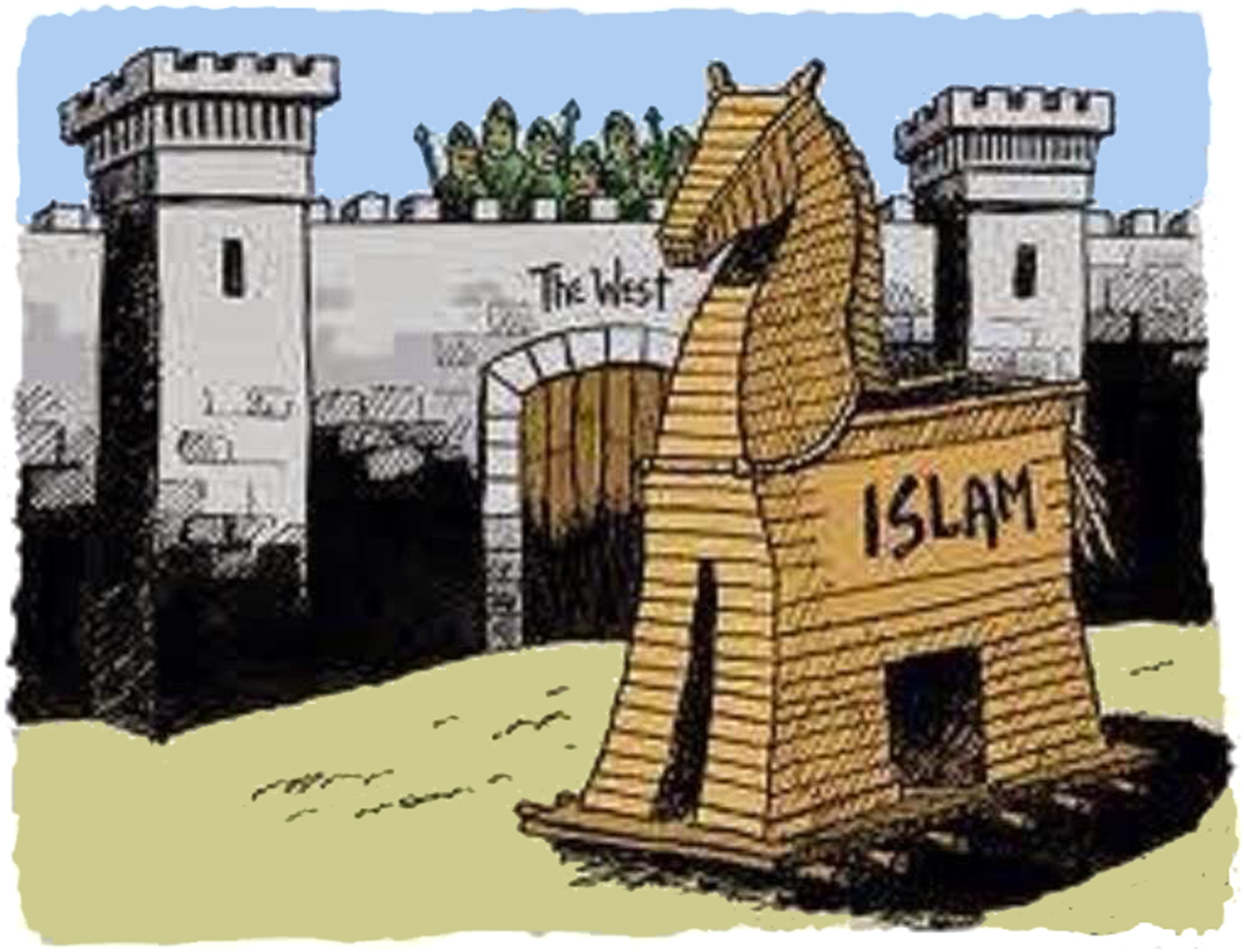
In order to retrieve and unpack the power of the trope of the Islamic Trojan horse, with all of the suggestions it holds and the fear it instills, we return to the original legend of the horse of Troy, whose structural narrative has provided fruitful ground to the production of conspiracies. The legend is established and predicated within a frame of war (the Greeks versus the Trojans); war serves as the stage of the story and plot, and war between races and race wars have been powerful historicist devices to understand reality, politics, society, and life itself (Foucault 1997). Moreover, the strategic deployment of the Trojan horse (hiding Greek soldiers inside) to enter Troy and fight the battle from within also speaks of a destruction from inside, a cunning warfare stratagem to penetrate the border, the wall, and from within bring forth ruin. 10
This is a crucial dimension of how the legend is invoked today; one of the calculated means in which Islam is set to take over Europe in particular is through migration. Or rather, migration has been discursively constructed as a weapon of Islamization and replacement. This reasoning is spelled out in a 2009 book by Sam Solomon and E. Al Maqdisi, entitled Modern Day Trojan Horse: Al-Hijra, the Islamic Doctrine of Immigration, Accepting Freedom or Imposing Islam? in which the authors develop the argument that Al-Hijra, the Islamic doctrine of migration modeled after the Prophet’s migration from Mecca to Medina, is a combative strategy to expand Islam globally. Accordingly, they consider Al-Hijra to be a doctrine exercised by Muslims for more than a millennium in order to both spread Islam and arrange the deployment of violence through jihad. The Trojan horse is known to be a vehicle for destruction, and from this viewpoint, migration is tantamount to destruction. Muslims are thus seen to enter the West in general, and Europe in particular, through migration, but also through a naïve and celebratory opening of the gates of Europe to (Muslim) migration by those (elites) who are unable or unwilling to see the dangers of migration. The original Trojan horse legend indeed stresses the unwilling complicity of the Trojan elite in the fall of Troy. King Priam of Troy is warned by Helen of Troy and by his own daughter Cassandra about the horse as a cunning tactic of the Greeks, yet he ignores these warnings and orders bringing the horse inside the towering wall. The Greeks’ strategy, in other words, would have not worked without the (involuntary) aid of the king. In the face of a deaf or naïve elite, prophetic voices spoke out, yet their words fell on deaf ears. This structural position within the legend is a coveted one today; many have claimed to be those cautionary voices, warning about the drama of multiculturalism, migration, and the dangers of Islam, yet feel ignored by a complicit European elite.
There is, however, another dimension to the original legend that is relevant for our argument, and that we can retrieve from a perspective of sexual difference. While the Trojan war was cast as a war between men, female figures were pivotal in the belligerent plot: from the quarrel between the goddesses settled in favor of Aphrodite who, in return, made Helen the most beautiful of all women, over the abduction or elopement (which remains ambiguous in the legend) of Helen as the reason why men went to war, to the prophetic words of Cassandra, who warned her father the King of Troy against keeping the horse. “Beware, beware the brood of the mare,” Cassandra cautioned, to which Aeneas replied “This is clearly no mare ... Cassandra, you have been a virgin too long” (Davidson 2008). Seeing the wooden horse as a warfare mare, Cassandra prophesied the fall of Troy: Oh my country! Troy, home of the gods! You great walls of the Dardans long renowned in war! “Four times it [the wooden horse/mare] lurched to a halt at the very brink of the gates—four times the armor clashed out from its womb. But we, we forged ahead, oblivious, blind, insane, we stationed the monster fraught with doom on the hallowed heights of Troy … But the Greek armada was under way now, crossing over from Tenedos, ships in battle formation under the moon’s quiet light, their silent ally, homing in on the berths they know by heart—when the king’s flagship sends up a signal flare, the cue for Sinon, saved by the Fates’ unjust decree, and stealthily loosening the pine bolts of the horse, he unleashes the Greeks shut up inside its womb. The horse stands open wide, fighters in high spirits pouring out of its timbered cavern into the fresh air … They steal on a city buried deep in sleep and wine, they butcher the guards, fling wide the gates and hug their cohorts poised to combine forces. Plot complete. (Virgil 2006, 81 [circa 19–29 BC, our emphasis])
Cassandra, of course, was right all along. The horse was a mare, and the weaponized wooden womb of the mare deceitfully hid soldiers who would open the gate of Troy to the rest of the Greek armada in order to bring destruction into the city. The wooden mare then also represents a fertility of sorts; while she might be made of innate material, her womb contains life—the life of soldiers, ready to destroy and take over the society that lets them in, a life that brings death.
The legend of the horse of Troy, in other words, loudly reverberates with the contemporary population replacement palimpsest, and its focus on the weaponization of the womb, and thereby puts that second dimension of the alleged take over strategy center stage: fertility. The problematization of Muslims in Europe is indeed particularly and anxiously concerned with demographics—both the dimension of migration, which has been central to debates on Islam in Europe, as well as the dimension of fertility and birthrates, which is increasingly gaining traction. More specifically, the birthrates among Muslim populations in Europe are perceived as (too) high in comparison to the lower (too low) birthrates among those who consider themselves native to Europe. The explicit fear here is one of “replacement,”that is, that Muslim populations will replace the white/Christian populations that are taken to be “native” to Europe. This conjuncture, moreover, is repeatedly framed as the result of a deliberate and combative strategy on the side of Muslims, and subsequently labeled as “demographic warfare” and “demographic Jihad.” In sum, migration and fertility—a migrant fertile “alien” body entering the gates and spreading through reproduction—as two central demographic dimensions of the biopolitics conceptualized as the “Muslim Question” (Bracke and Hernández Aguilar 2020).
This rich and multilayered character renders the Islamic Trojan horse trope particularly powerful and effective in doing its job of creating that alien body that is cast as a racial, sexual, and violent threat: a force of destruction. And while the trope offers a forceful visual imaginary of the biopolitical dimension of Europe’s “Muslim Question,” it also operates within the realm of governmentality. This brings us to our second case, which is perhaps the most prominent reference to the Islamic Trojan horse in policy-making in a European country in the past decade, that is, the Trojan horse inquiry in the United Kingdom. 11 In 2014, the city of Birmingham became the epicenter of a “moral panic” (Abbas 2017) in relation to an alleged secret plot to Islamize British schools and then the country. The Birmingham City Council had received an anonymous note in November 2013, accompanying a supposedly leaked letter that laid out an Islamist plan to take over local schools and run them according to strict Islamic principles, and that threatened to take the story to the press if the city council did not take action. The “Trojan horse letter,” as it was called, appeared to be an exchange between Muslims on how to take control of schools, and described a five-step plan (the Trojan Horse Operation) to Islamize the schools from within through a methodical and continual strategy. These guidelines proposed to target schools with a high percentage of Muslim pupils, recruit Salafist parents, and engage them in putting pressure on the school staff, so that they resign and be replaced by subjects (of Islamic faith) who will, slowly and steadily, turn the British curricula and values of the schools into Islamic ones. The Birmingham city council passed the letter on to the British Department of Education and the Home Office and investigations were set up. The letter was also leaked to the press and stirred countless debates. Although the letter was swiftly dismissed as a forgery “the allegations it contained took on a life of their own” (Shackle 2017), reappearing cyclically every now and then, while cementing the preexisting fear that Muslims were, are, and will be on a mission to take over Britain through different strategic means.
The fact that the Trojan horse letter and the operation were forgeries, and that a thorough analysis of the reports commissioned by the Department of Education “show an absence of a systematic and coordinated plot to take over these schools and an absence of any concerted and deliberate plot to promote radicalization and violent extremism of Muslim children in these schools or elsewhere” (Mogra 2016, 444), did, however, not prevent the unfolding and deployment of a large governmental interpellation toward the attitudes and behaviors of British Muslims in particular. This took place through a two-fold strategy to tackle radicalization in schools while strengthening British values; that is, a twofold governmental rationality of unlearning radicalization while learning Britishness, which included five investigations into the content of the forged letter, a budget of £12 million allocated to thwart radicalization in schools, and a vast amount of knowledge about the schools in general and British Muslims in particular (Mogra 2016, 446–447). The British Office for Standards in Education (Ofsted), moreover, expanded unannounced inspection of schools to scrutinize if they were promoting British values. The larger British counter-terrorism strategy CONTEST was also deployed through its arm PREVENT “by making it a regular feature in all schools by recommending that the Department for Education ensures the responsibility and mandatory training of the teacher designated Child Protection Officer includes Prevent within his/her role” (Mogra 2016, 446).
Conclusion
Over the past decades, the presence of Muslims in Europe is increasingly problematized, and this problematization has occurred in systematic ways. Until now, the predicament of Muslims in Europe has mostly been charted through the concept of Islamophobia, which resulted in a considerable body of scholarship that documents the discrimination of Muslims in different realms of society all over Europe and that shows how systematic patterns of discrimination profoundly and consequentially “interrupt citizenship,” as Salman Sayyid (2014) argues. More recently, this predicament has been apprehended, both in the public debate as well as in academic scholarship, through the frame of the “Muslim Question.” This frame has a number of advantages: it is particularly attuned to interrogate the systematic character of the discrimination that Muslims in Europe face, and to engage the genealogies of modern European nation-state formation and racial formations, which includes questions of European colonialism, Orientalism, and also resonances and differences with another “question” situated both at the race/religion nexus as well as at the heart of the making of Europe, that is, Europe’s “Jewish Question.”
In this article, we theoretically engage with this frame, and, relying both on the scholarship on Islamophobia as well as the scholarship that invokes and elaborates the “Muslim Question,” to further develop it into a strong analytic. We do so through an analytic review of the burgeoning scholarship on the “Muslim Question” in Europe in order to understand what this analytic enables to know thus far and through conceptually developing the analytic from three theoretical approaches: biopolitics, governmentality, and social reproduction theory. A biopolitical approach enables us to conceptualize the ways in which a part of the population is deliberately and systematically constructed as an “alien” body, while a governmentality approach brings in view what demands of integration and assimilation, which more concretely seek to know, control, regulate, and ultimately refashion Muslim populations and individuals in Europe, do. These theoretically approaches allow us to conceptualize Europe’s “Muslim Question,” as an analytic that attends to the systematic and indeed systemic character of problematization of Muslims in Europe, to be based on two inseparable premises: first, Muslims are different from Europeans in terms of culture, beliefs, attitudes, sensibilities, passions, physiognomy, and whatnot, and due to this “difference” Muslims are understood and constructed as an alien body to Europe. Second, this unsurmountable almost ontological difference calls for and delineates measures, policies, and practices oriented toward integrating Muslims into Europe by guiding their conduct so that they learn and ultimately interiorize those sensibilities, attitudes, beliefs, and behaviors properly through European integration policies. We emphasize that these premises are intertwined, in somewhat of a double bind: the alien body is constructed in such a way that is, by definition, “not us” and can never become us, and hence the relentless demands to become “us” turn out to be productive,that is, to be part and parcel of the production of that alien body. Moreover, we bring social reproduction theory to bear upon the biopolitical management of the population, which allows us to elaborate the biopolitical axiom, laid out by Foucault and many others, that in order to live, the (racial) Other must die works alongside the axiom that the larger population must keep reproducing life. While this reproduction of national life occurs in many realms (notably within legal, economic, or cultural dimensions), biological reproduction is one crucial dimension where the reproduction of national life occurs. In this vein, we have connected the contemporary constitution of the “Muslim Question” to the rise of replacement conspiracies (see also Bracke and Hernández Aguilar 2020).
Last but not least, we examine a trope that figures prominently within the “Muslim Question” as it presents itself in public debates all over Europe: the trope of Islam as a Trojan horse. Investigating this trope has been important to our argument in several ways: it has ushered us into further exploring the biopolitics of the “Muslim Question,” as the trope is centered around the idea of a threatening alien body. And we briefly discuss two cases that center around the trope: a blatant visual representation of the trope in the form of a widespread cartoon, and the infamous Birmingham Trojan horse operation in which the deliberate mobilization of the conspiracy of Muslims as the enemy seeking to destroy public schools subsequently unlocked a series of governmental policies aimed at reforming and refashioning Muslim subjectivities. The trope of the Islamic Trojan horse is indeed not only a powerful illustration of the problematization of Muslims in Europe, but it equally plays a forceful role in crafting and articulating that alien body of Muslims—an articulation that comes with a discursive need to interfere in Muslim conduct, whether in schools or in public, or in private life, through an elaborate discourse on integration. In this vein, the trope can function as another name for Europe’s “Muslim Question”: it can do the quotidian work of creating and consolidating the alien body of Muslims under a less sensitive or controversial name. The trope also insinuates the attempt to influence the conduct of European decision-makers so that they “keep Muslims out,” in material and symbolic ways. In the process, the trope does something else: it covers up the discriminatory nature upon which it is built and the discriminatory practices that produces and enables the alien body.
Footnotes
Funding
The author(s) disclosed receipt of the following financial support for the research, authorship, and/or publication of this article: This work is part of the research program EnGendering Europe’s “Muslim Question” (project number 016.Vici.185.077), funded by the Dutch Research Council (NWO).
