




Abstract
Light is a discursive tool that Sufis have drawn upon over the centuries in order to elucidate systems of thought and practice. In medieval Islamic thought, light was closely associated with the soul as well as conceptions of sight and the eye. It also occupied an important place in cosmology. By the twelfth- and thirteenth-centuries, Sufis began to consider notions of light more systematically, creating close correspondences between vision, cosmology, and anthropology within Sufi thought. This coincided with the increased production of complex diagrams in Sufi texts. This article shows that these developments were interrelated. By analyzing Shams al-Dīn al-Daylamī’s (d. 587/1191) diagrams alongside his theories of light with respect to the nature of the soul and body, it demonstrates that the theory of the soul as light played an important part in shaping Sufi thought, practice, and visual culture.
Introduction
Discourses of light recur in Sufi texts written over the centuries. This enduring theme in Sufi thought indicates that light has been, and remains, an important discursive tool that Sufi thinkers have drawn upon throughout history in order to articulate Sufi ontology, epistemology, cosmology, and practice. The works of Shahab al-Dīn Yaḥya al-Suhrawardī (d. 587/1191), Najm al-Dīn Kubrā (d. 616/1220), and Muḥyī al-Dīn Ibn al-ʿArabī (d. 638/1240) stand out in this regard and have received much scholarly attention. Theorizing the nature of light was an important aspect of many other medieval Sufi thinkers’ mystical frameworks. In this study I examine a lesser studied work, Shams al-Dīn al-Daylamī’s (d. 587/1191) The Mirror of Souls (Mirʿāt al-arwāḥ) and those passages therein that detail the nature of the soul, understood as a subtle body (jism laṭīf) of light. 1
Further, I will demonstrate how this conception of the subtle body as light makes possible the depiction of the soul in the form of a diagram in the text. I contend that this diagram plays an important role in al-Daylamī’s Sufism, drawing together a complex constellation of Sufi thought, practice, and visual culture that is predicated on the conception of the soul as a light. As Bender and Marrinan have argued, diagrams concretize processes of knowledge and “generate understanding” relationally, in the visual meeting of user and image. The knowledge produced through this visual practice therefore depends upon the user’s “orientation and expertise” (Bender and Marrinan 2010, 52). As they put it, “users process this information by tapping individual reservoirs of experience to produce knowledge” (60). The production of complex diagrams in Sufi texts in the twelfth and thirteenth centuries then is not coincidental. This was a period that saw the institutionalization of Sufism that shaped the lives of Sufis, along with the systematization of Sufi theory that imbedded Sufis within a shared cosmology. The prominence of diagrams in this period then indicates that, firstly, Sufis were expected to adhere to a set of formalized bodily practices in a communal setting that shaped their experiences and habitus. And secondly, that Sufi thought became increasingly systematic, especially regarding the nature of the soul and its attachment to the body.
Sufi diagrams often elude contemporary scholarship. The full significance of these diagrams may never be completely grasped through historical research since they are intended to be esoteric and obscure to the uninitiated. My aim is not to provide an explanation for all the possible uses and meanings of al-Daylamī’s diagram in this study. In his own words, this is something that is only realized through Sufi discipline, and is revealed in moments of experiential gnosis. Rather, my goal is to ask what role this diagram that depicts the soul might play in mediating the unseen. By drawing on scholarship from Islamic studies and religious studies, this article sheds light on the nexus of Sufi thought and practice at a time when detailing the nature of the soul and body came to be an increasingly salient feature of Sufi discourse. By focusing on the practice of ocular contemplation within Sufism, this study aims to elucidate the place of diagrams in medieval visual and sensory regimes, that is, how these diagrams “operate in the context of embodied, habitual practices of looking, display and figuration” (Meyer 2015, 335).
Diagrams in Sufi texts
Diagrams were a common feature in many Arabic-Islamic texts, especially those that concerned the structure of the cosmos. Cosmological diagrams commonly feature in philosophical and scientific texts as well as Sufi treatises. They usually took the form of concentric circles, often divided and organized into further geometric forms, and tended to convey a Ptolemaic understanding of the cosmos (Karamustafa 1992, 71–74). Such depictions helped the users of these diagrams conceptualize the relation between the cosmos, existents on earth, and human beings (Nasr 1964, 70).
Some of the earliest Sufi diagrams however were not necessarily concerned with cosmology. Despite this, the circular motif does emerge in these Sufi texts as well. For example, Manṣūr al-Ḥallāj’s (d. 309/922) Ṭāwasīn contains a number of diagrams that are intended to elucidate his mystical experiences. Some prominent diagrams in the Ṭawasīn feature concentric circles, while others consist of disjointed letters, squares, and lines (al-Ḥallāj 2002, 175, 201, 203, 207, 209). These early diagrams do not have a particularly cosmological significance since al-Ḥallāj’s focus is on the mystical experiences of the Sufi. However, these images indicate an early attempt to move beyond language, to a more abstract visual representation of mystical experience. This seems only natural since mystical experiences were largely considered ineffable. Although al-Ḥallāj (2002, 207) explains the meanings of these figures, he does not present a detailed description of each image and rather points to their meanings through allusion (ishāra). They are therefore intended to be understood within the context of Sufi devotional practices. Although al-Ḥallāj does not explicitly ask the reader to contemplate these images, there seems to be a precedence here for the practice of contemplating diagrams that we find in later Sufism.
Later Sufi texts indicate a stronger alignment with Greek cosmological schemes, largely adopting the standard cosmological accounts that were prevalent in philosophical works at the time. In addition, the human soul and body were commonly understood as a microcosm that reflected the organization of the macrocosm. This seems to have influenced Sufi depictions of the soul. Abū Ḥāmid al-Ghazālī for example details the faculties of the soul in the form of concentric circles, in a manner that references its microcosmic nature by referring to each faculty of the soul as a world (ʿālam). 2 Diagrams become a far more common feature in Sufi texts that were written after the twelfth and thirteenth centuries. In the thirteenth-century, Ibn ʿArabī produced much more complex cosmological diagrams featuring overlapping circles in the manner of a Venn diagram. As Karamustafa (1992, 85–86) has noted, these diagrams are not intended for mystical contemplation unlike al-Daylamī’s diagram.
Despite the uniqueness of Shams al-Dīn al-Daylamī’s diagram, it has not received much scholarly attention. While studies have rightly highlighted al-Daylamī focus on visionary phenomena, his diagram has not been the subject of a detailed study. Bowering (1987, 233) has mentioned the diagram briefly, dedicating a paragraph that focuses on its cosmological significance. Al-Daylamī himself however indicates that the diagram covers far more than cosmology, primarily representing the soul itself, and is intended to be used in contemplative visual practice. Al-Daylamī also emphasizes that he beheld the figure of the diagram in a vision. It therefore acts as proof of his capacity for spiritual sight as well as an object of contemplation and a guide to al-Daylamī’s disciples (al-Daylamī a, fol. 66a).
While this particular use of diagrams was not necessarily pervasive at the time, some other contemporaries of al-Daylamī also began to use diagrams in similar ways. The case of Aḥmad al-Būnī (d. 618/1225) stands out in this regard. Al-Būnī’s writings feature many diagrams that also appear as objects to be contemplated, facilitating “visionary access to the invisible worlds” (Gardiner 2017, 419). Diagrams begin to acquire spiritual significance as agents of mediation through vision in this case. We can therefore point to at least one other case where ocular experiences were made sense of in a shared conceptual framework and based on the lived experiences of Sufis. This indicates a shift towards diagrams that were intended to generate moments of mystical insight through visual practice.
In addition to this shift towards contemplation, al-Daylamī’s diagram also departs from previous Sufi diagrams in terms of organization and shape. It notably abandons the circular motif that structures most other diagrams. Its detailing of the human’s various spiritual faculties reserves a circle only for the state of spiritual perfection. The remainder of the diagram consists of geometric shapes, that together with the circle, represent a human body in an abstracted form (with the circle standing in place of a head).
A further unique feature of al-Daylamī’s depiction is its role in structuring the text of the Mirror of Souls. Its chapters are arranged so that the image is discussed in order, from the bottom to the top. Alongside this visual depiction of the soul, the text also theorizes its nature, functioning as a guide to understanding the diagram. The diagram therefore is directly related to al-Daylamī’s conception of the soul as a subtle body of light. 3 This is because al-Daylamī asserts that light is a substance that is both bodily and spiritual, and this accounts for the immaterial soul’s attachment to the material body. This has implications for Sufi notions of psychology and phenomenology. It also outlines the importance of Sufi practice, and allows for the visualizations of the soul and the hidden world (al-ghayb). This theory therefore informs al-Daylamī’s depiction of the soul in the shape of an abstract human body, hinting at its liminal state between the bodily and spiritual.
It is widely acknowledged that the twelfth and thirteenth centuries saw the transition of Sufi groups from loosely structured communities to centralized institutions (Ohlander 2008, 1–15). Many studies have already detailed the social, historical, and institutional changes that facilitated these transitions (Paul 1998, 76–77). However, that these social and institutional transitions accompanied changes in Sufi visual culture and theoretical configurations of the body has not been widely studied. These interrelated developments however reinforce one another, since the spiritual significance of visual experience is understood in relation to the lived, embodied experiences of Sufis.
Elizabeth Alexandrin has noted that al-Daylamī’s works prioritises the “ephemeral and episodic quality of embodied visionary experiences” while drawing on medieval medicine, philosophy, physiology and optics (Alexandrin 2013, 526–527). In my view, al-Daylamī’s attention to mystical visions in this respect also explains his tendency to include visual depictions in the form of diagrams in his works. Here, diagrams are not simply explanatory guides to one’s spiritual anatomical make-up, but are depictions intended to elicit kinaesthetic and affective responses in the viewer. This in turn imbeds the viewer’s habitus within Sufi theoretical frameworks, shifting the boundary between the body, cosmos, and Sufi community through visual practice. In al-Daylamī’s text, it is the conception of the soul as light that binds these aspects of Sufism together, making possible the depiction of the soul as an abstracted body.
The text of the Mirror of Souls
The Mirror of Souls exists in two manuscript versions. The complete text is found in the Suleymaniye library in Istanbul, while an abridged version of the text is found in the Gotha library’s Arabic manuscript collections. 4 The structure of the shorter version of the text can significantly alter the implications of certain passages. Given that al-Daylamī was known to revisit and rework his material (Bowering 1987, 232), I tentatively treat it here as one of al-Daylamī’s works which can supplement the reading of the more extensive text. I discuss the abridged version in some places as its shortened structure serves to emphasize certain aspects of al-Daylamī’s thought that are less apparent in the more extensive version of the text. It should be noted that both versions of the text open with the same diagram of the human soul.
Shams al-Dīn al-Daylamī is a little studied twelfth-century author who nevertheless wrote substantial works of Sufi theory (Bowering 1987, 231–232). Not much is known about al-Daylamī other than being identified as the teacher of Maḥmūd al-Dīn al-Ushnuhī in fifteenth-century hagiographical literature (Alexandrin 2012, 217). We therefore cannot concretely determine the extent of al-Daylamī’s significance for the institutional changes of Sufism in this period. Nevertheless, his work is indicative of wider trends in Sufism at the time and a connection to Ushnuhī is likely to have existed in some form.
Bowering has suggested that al-Daylamī’s writings bear certain similarities to those of Kubrawī Sufis (Bowering 1987, 235), a nascent school of Sufism in this period, well known for emphasizing visionary mystical experiences. Early Kubrawī writers laid much of the theoretical groundwork in the twelfth and thirteenth centuries that prefigured the emergence of more detailed conceptions of the subtle centers of the soul (laṭāʾif) in the fourteenth-century (Elias 1995, 81–85). I posit therefore that al-Daylamī’s text, was part of a wider Sufi trend that theorized the nature of the soul to a greater extent and conceived of vision as an advanced form of mystical experience.
Alexandrin has noted that al-Daylamī’s visionary cosmology helps to “re-map the internal schema that the human being embodies” (Alexandrin 2012, 219). What is peculiar to al-Daylamī is his use of diagrams in this regard. The salience of visual practice in order to effect these re-mappings is striking. For example, at the end of the section detailing the diagram in the Mirror of Souls al-Daylamī makes clear that only the elect Sufis, who have activated a spiritual mode of seeing, will be able to understand this diagram (al-Daylamī a, fol. 66a). Along with the notion that al-Daylamī had beheld the shape of the soul in this form in a spiritual vision, the reproduction of the image on paper is clearly intended to mediate the perception of the hidden world.
The interconnection of Sufi thought, practice, and visual culture is concisely illustrated in The Mirror of Souls since the very organisation of this text is informed by the diagram placed at the beginning of the work. As mentioned, the text itself is presented as a rumination on the graphic image. Al-Daylamī opens the Mirror of Souls stating that the image of the diagram was revealed to him in a vision that was witnessed by his heart. He then inquired about its name and was told that it is the “reflected form” (ṣūrat al-wijāh) that contains signifiers to the essence of the human souls (fīhā ishāra ilā māhiyyat al-arwāḥ). He then explains the structure of the book, dividing it into two sections. The first is dedicated to detailing the meaning of the image, while the second concerns interpretations of his visions that are intended to act as guides to his disciples (al-Daylamī a, fol. 39b).
The subject of al-Daylamī’s treatise therefore is the figure itself. In his own words, al-Daylamī’s treatise regards the significance of images, whether graphic and drawn, imagined in dreams, or revealed in spiritual visions. Graphic diagrams and spiritual visions were therefore closely related. This has been highlighted by Henry Corbin who noted that Najm al-Dīn Kubrā’s focus on circles in his visions recalls the centrality of circles in al-Ḥallāj’s diagrams (Corbin 1971, 83). Al-Daylamī’s diagram points to a synthesis between his Sufi theory that explains the nature of visions and the soul. It highlights that bodily practices inculcate the potential for spiritual vision within the Sufi. And in doing so it also shapes Sufi material culture in the form of texts and graphic figures. The image drawn in the text is revealed to al-Daylamī in a vision. It is then drawn and becomes an object of mediation that points to hidden truths. The centrality of the graphic image is exceptional for a Sufi of his time. Karamustafa (1992, 85) for example has shown that diagrams in the works of Ibn ʿArabi were often not particularly integral to the text, serving a more didactic function.
As mentioned, the organization of the text follows the organization of the depiction. Its chapters discuss each faculty of the soul in order, from the bottom of the image to the top. Al-Daylamī begins his discussion of the image at the lower plane of the body (badan) and ends with the circle (al-dāʾira). In the unabridged version of the text, the image is summarized in this manner before moving on to more extensive discussions of each faculty. The concordance of image and text is further accentuated in the shortened version however. This abridged version of the text omits the more technically complex passages. It reads as a more accessible, concise guide to understanding al-Daylamī’s diagram. The visual representation of the soul then reinforces the theoretical and organizational structures of Sufism, creating a close connection between image, text, theory, and practice.
Moreover, this depiction of the soul is remarkably evocative of human anatomy, clearly representing a head, chest, and stomach in abstracted form. Here, the lower faculties of the human being, including the lower soul (nafs) and body (badan) are placed below the stomach-like structure, while the intermediary faculties such as the heart (qalb), innermost soul (sirr), and rational faculty (ʿaql) are placed within it. The higher faculties of the soul, the spirit (rūḥ) and mystery (khafī), are located in the chest-like structure, while the highest spiritual faculty of the higher spirit (al-rūḥ al-aʿlā) is represented by the square. Finally, what al-Daylamī terms the head (al-raʾs) is placed in the circle which signifies spiritual perfection. No faculty of the soul is assigned to the circular head since spiritual perfection consists of the complete negation of the soul and its subsistence within God. Moreover, the soul’s organs map onto differing realms of the cosmos, such as the physical world (al-dunyā), the hidden world (al-ākhira), and the world of abstract intelligible knowledge (ʿālam al-ʿulūm al-ʿaqliyya). The image then highlights the soul’s microcosmic nature. This depiction of the soul not only represents that part of the human being that is hidden, but the hidden cosmos that is simultaneously external and internal to the human’s composition. To fully appreciate the function and significance of al-Daylamī’s depiction of the soul, we must first turn to his theory of the soul as light. It is al-Daylamī’s conception of the soul as light that allows for the representation of the soul in the diagrammatic form below in Figure 1 (al-Daylamī b, fol. 77a).
The subtle body of light in al-Daylamī’s Mirror of Souls
Like other Sufis of his time, al-Daylamī came to think of the soul as a light that was attached to the dark substance of the body. This was not necessarily uncommon. The reception of Avicennan philosophy in Sufism in this period led to the emergence of highly systematic Sufi psychological and cosmological theories. Notions of light in this context proved to be useful for systematizing epistemic frameworks based on experiential gnosis (Treiger 2012, 68–70), and led to increasingly sophisticated conceptions of the human soul and body. On the one hand, Sufi texts began to speak in terms of light when elaborating upon the psycho-spiritual progression of the Sufi. On the other, the soul came to be understood, in a literal sense, as a subtle substance of light shrouded by the darkness of the materially complex human body. Theories of light and darkness then serve to map out the relation between the soul and body, resulting in what came to be known in later Sufism as laṭāʾif, the subtle centers of the soul that corresponded to certain points in the body (Mayer 2010, 271).
With the reception of the Greek philosophical tradition in the Islamic world, the notion that all material existents on earth were composed of the four elements of air, water, earth, and fire, came to be commonly accepted by many philosophers such as al-Kindī (Adamson 2007, 181). Particular mixtures of elements were commonly understood to form the humors that constituted the human body. Changes in the composition of the humors produced changes in the body and could lead to its corruption. Yet unlike the material body, the immaterial intellect was unaffected by such changes (Mcginnis 2010, 129). This understanding of the composition of the body was adopted in Sufism and formed part of Sufi psychological theory. For example, al-Ghazālī explains various emotional dispositions with recourse to the composition of elements within the body. To rid oneself of the dominance of these dispositions over the soul, al-Ghazālī prescribes spiritual disciplining (Al-Ghazālī 2011, vol. 4, 596–612). Al-Daylamī’s Mirror of Souls also discusses at length, the effects of the humors and the need to regulate them (al-Daylamī a, fol. 43b–44b).
Amongst contemporaries of al-Daylamī affiliated with the Kubrawī school of thought, the human body was considered to be the most complex material existent, containing the potentialities of mineral, vegetable and animal. Hence, a notion of the human body as the most obstructive to light is found in the work of Najm al-Dīn al-Rāzī (d. 654/1256) for example (Al-Rāzī 1982, 124). Such discussions accompany an increasing trend in Sufism to characterize the soul as a subtle light (laṭīfa nūrāniyya) of divine origin that must be brought forth from beneath the density of the human body as Najm al-Dīn Kubrā (d. 617/1220) does in his Fawāʾiḥ al-jamāl wa fawātiḥ al-jalāl (1993, 129). Like all other bodies in existence, the human body too was thought to be composed of a mixture of material that acted as a barrier to light. The notion of the soul as a light that found itself mixed with an opaque material body therefore seems to have become common among twelfth- and thirteenth-century Sufis.
In the Mirror of Souls, Shams al-Dīn al-Daylamī speaks of the composition of the body as a mixture of four elements along with a fifth, the “fermenting agent” (khamra) of God’s light, or the soul. According to al-Daylamī (a, fol. 57a), this mixture distinguishes the human being’s composition from all others in existence. al-Daylamī goes on to explain that this mixture inculcates four natures within man: angelic, meek, savage, and satanic. However, added to these potentialities is a fifth which is spiritual light, and it is with this faculty that the human is able to transcend these four lower natures. In one section in the text, al-Daylamī explains that the body itself will be transformed into light upon spiritual completion. He makes this claim with reference to a theory of the elements being able to transform and change into one another. Just as earth can become water, then air, and then fire and light, so too can the human faculties undergo such a transformation from the bodily and dense to the spiritual and subtle, through Sufi training (Al-Daylamī a, fol. 56a).
Underlying al-Daylamī’s discussion of the body and soul here is a common debate in Islamic thought regarding the place of the soul after death. This discussion largely pertained to whether or not the soul was material and bodily, therefore disappearing after death until it was resurrected, or whether it was immaterial and non-bodily, surviving in some other form after the passing away of the body. Particular understandings of the nature of the soul had implications for whether the soul would experience the afterlife as an imagined or external reality (Sinai 2015, 92–93). The former position was sometimes seen as problematic and contradictory to Islamic scriptures. In the Mirror of Souls al-Daylamī presents various theological and philosophical positions regarding the afterlife before proceeding to put forward his own theory of the soul (Alexandrin 2012, 221). His understanding of the soul as a subtle body of light attempts to provide an answer to this eschatological dilemma by arguing that the soul is both spiritual and bodily.
Al-Daylamī explains this in more detail at a later point in the text where he discusses his theory regarding the nature of light. Here, he states that light can be either bodily, spiritual, or maintain an in-between state between the spiritual and bodily. While the sensory world is filled with bodily lights, only one type of light occupies this intermediate state between the two. This is the light of the sun which al-Daylamī describes as a “subtle body” (jism laṭīf), the same term he uses to describe the soul. Al-Daylamī explains that it is bodily in that it has a measurable length, width, and depth, yet spiritual as it is beyond time and space. The latter characteristics are demonstrated, al-Daylamī says, by the fact that if the sun’s light were truly bodily it would obstruct and collide with other lights; yet, instead we find that it merges with them. It therefore diverges from the usual behavior of bodies with respect to space. In addition, it is spiritual with respect to time as al-Daylamī explains: These rays reach distant places without travelling the distance between two points. Do you not see it to be the case, that when the sun rises from the east, its rays reach the [earth’s surface] in the west, from the moment it rises. (Al-Daylamī a, fol. 68b)
Al-Daylamī’s understanding of light as bodily in one respect and spiritual in another recurs throughout the text. For example, discussions regarding the nature of light also allows al-Daylamī stratify the various organs of the body and soul. For al-Daylamī the light of the eyes remains bodily as it is bound by time and place, while the light of the human intellect and its power of reason is subtler as it is not limited in the same way. Above the light of the intellect are the lights of the human’s spiritual faculties which are found in the heart (qalb). The first is the innermost heart (sirr) which, in al-Daylamī’s scheme, arrives at truths from the spiritual world through visionary experiences such as dreams. This is followed by the even subtler mystery (khafī). The hierarchy seems to end in the essence of the human soul which is understood by al-Daylamī to be the most spiritual light in creation, being the subtlest and most pure light in existence (Al-Daylamī a, fol. 69b). This is termed the subtle body (jism laṭīf) that is the center of the heart and the ultimate locus of mystical perception (Alexandrin 2013, 536).
By discussing these spiritual faculties with reference to his conception of light then, al-Daylamī details his own spiritual anatomy. In earlier Sufism the human soul is traditionally divided into the lower soul (nafs), the spirit (rūḥ), the heart (qalb), and the innermost heart (sirr). The lower soul is understood to be the most bodily of these substances being the cause of blameworthy dispositions, as such it requires conditioning through discipline (Schimmel 1975, 112–113). By stratifying these faculties in accordance with his conception of light al-Daylamī attempts to systematize a hierarchy of subtle centers that increase in subtlety as they approach the innermost faculties of the soul.
Light and Sufi psychology
Al-Daylamī’s ideas seem to find precedence in Abū Ḥāmid al-Ghazālī’s (d. 505/1111) thought. In his treatise Mishkāt al-anwār (The Niche of Lights), al-Ghazālī stratifies the human faculties involved in acquiring knowledge into degrees of perfection (al-Ghazālī 1964, 53-54). In the Mishkāt, al-Ghazālī refers to knowledge attained by each faculty of the human soul or body as a light. According to al-Ghazālī, bodies that are luminous in themselves are more deserving of the name “light” than those that require illumination by another source. For al-Ghazālī, modes of knowing are ranked in degrees according to this conception of light. For example, physical sight requires an external light to function and cannot perceive itself whereas the rational faculty is not bound by time and space and has a form of self-awareness. It therefore attains more accurate forms of knowledge than those perceived by the sense of sight, making it worthier of the term “light” (al-Ghazālī 1964, 49–51).
Al-Ghazālī describes the soul as a mirror to God’s light, reflecting it to varying degrees of perfection. The purified soul receives and manifests God’s light fully, whereas the imperfect soul whose heart is not polished receives imperfect imprints upon the mirror of the soul, manifesting it imperfectly (al-Ghazālī 1964, 18). For al-Ghazālī, the psycho-spiritual faculty of the heart functions as the soul’s faculty of perception, receiving imprints of any of the realities perceived according to the degree to which it has been spiritually cleansed. Hence, the soul may remain at the level of an imperfect light by simply remaining in its bodily state, or ascend to a perfected mode of knowledge akin to a light which is luminous in itself and illuminates that which is other than itself (al-Ghazālī 1964, 51). The soul’s attachment to the body therefore generates this hierarchy.
At one point in the Mirror of Souls al-Daylamī likens the soul to sight, which can apprehend things far beyond the boundaries of the body (Al-Daylamī b, fol. 77b). Here al-Daylamī relies on an account of sight whereby the eye is thought to send out rays that establish contact with the surfaces of visible objects. 5 This account of sight, known as extramission, is employed by al-Daylamī to account for the soul’s ability to transcend time and place while being attached to the body. Just as the organ of the eye can emit rays that sense distant objects, so too does the soul travel great distances, perceiving things beyond the temporal world without detaching from the body.
For this higher mode of gnosis to be realized, the soul and body require disciplining. In his description of the innermost heart and the intellect, and their connection to the heart, al-Daylamī sets the theoretical grounding for the importance of Sufi discipline: Their darkness is not with respect to themselves, but is due to the heart, which is like a glass. For if the glass is blackened, the light [of the innermost heart and the intellect] which is transmitted through it from the inside of the heart to the lower soul is rendered black. Just as if the glass were clear, so would the light being transmitted through it be clear … If the sun shines upon a glass window, the rays transmitted from the window, to the house would be coloured accordingly by the glass… Therefore, if the glass of the heart is blackened by sin, the rays transmitted from the innermost soul and the intellect to the lower soul are blackened by the attributes of sin. Therefore, those rays do not add anything to the lower soul other than darkness, wrongdoing, and sin. (al-Daylamī a, fol. 47a–47b)
Bodies, sensation and practice
In this period, particular Sufi practices such as recollection (dhikr), audition, and fasting came to form a standardized curriculum of Sufi training. Certain Sufi practices also came to act as markers of social relations, expressing belonging to particular Sufi institutions. Conceiving of the human being as a mixture of light and darkness in anthropological terms also coincided with the proliferation of Sufi training manuals in the twelfth and thirteenth centuries such as ʿUmar al-Suhrawardī’s ʿAwārif al-maʿārif. These modes of belonging often overlapped with other networks of social and political loyalties (Mottahedeh 2001, 190).
In his study of Sufi literature regarding the body, Shahzad Bashir has posited that the body acts as a “tableau for mapping social as well as cosmological relations” (Bashir 2003, 3). This is demonstrated by the notion of subtle centers that are located within the body. As Hermansen has argued in an analysis of the theory of subtle substances in later Islamic mystical traditions, Sufi conceptions of the human body may “transcend the visible or physical order to postulate parallel, subtle, or spiritual bodies.” This provides “an especially flexible and malleable field for mapping concepts of the human individual and relating these to wider metaphysical and ideological systems” (Hermansen 1988, 1). These theoretical systems are in turn enacted in bodily, and sensory practices. Al-Daylamī’s detailing of the nature of the subtle body in the Mirror of Souls signifies new ways of representing the soul and body. At the very beginning of the Mirror of Souls, al-Daylamī discusses the boundaries between the soul and body that seems to justify its depiction in the form of an abstracted body: The soul bears the same shape as the body and is present within all its extremities and limbs, for it is the agent of action, intellection, speech, and will. And the body is unaware of any of that, but is the instrument and vehicle of the soul. The soul is in fact greater in size than the body, but is compressed within it. It is a subtle body, similar to air, and its size, whether large or small, varies. The very smallest the soul can be is the [exact] same size of the body: no more and no less. The human in this case is one whose soul only gives him the capacity to live and die; [even] many animals exceed this. As for the largest the soul can be, it may come to such a size that cannot be contained between the heavens and earth and what is beyond them. It cannot, however, exceed the world of God’s dominion (malakūt)—for it is of the world of bodies—unless it has achieved the same purity and contentment as the innermost heart and mystery, and has ascended and risen to the highest point. Then, it is spiritual and beyond [the corporeal]. (al-Daylamī a, fol.40a) And despite that, it remains fixed within the body, unsevered from it during its travels in the world of the truth and reality. It is like the rays of the sun that you see emerging from the very sun itself while they radiate to the Eastern and Western parts of the world. (al-Daylamī a, fol.40a)
That Sufi practice is central here is evident from the anxieties al-Daylamī expresses regarding the potential abandonment of Sufi devotion and Islamic legal requirements. At one point in the text al-Daylamī responds to the question of whether one may dispense with religious obligations (taklīf) once spiritual completion is attained and true freedom (ḥuriyya) is realized. He responds that the obligations of the sharīʿa “are not lifted [from the Sufi] as long as reason remains, and [one’s rational] capacity is present” (al-Daylamī a, fol. 58a). Al-Daylamī’s conclusion then seems to suggest that Sufis are never free from the religious strictures so long as they are alive and are not deemed to have lost the capacity to reason.
Moreover, al-Daylamī is wary of “traps” along the Sufi path that may lead the Sufis to delusions and bar them from spiritual completion. In his Muhimmat al-wāṣilīn, al-Daylamī states that God is represented in the Sufi’s mystical experiences as a vision of a spiritual light. Yet such visions are in themselves veils to God and can mislead the Sufi initiates, potentially leading them to the incorrect assumption of God’s incarnation within one’s own body, or the assumption that God may inhere within a body or image (ḥulūl). According to al-Daylamī (1966, 51–52) this mistaken belief arises out of an improper understanding of the relation between the body and soul, which in his view explains the heretical doctrine of God incarnated as Jesus in Christianity. It is worth noting here that conceiving of the soul as a light that is both spiritual and bodily undermines the possibility of inherence. Furthermore al-Daylamī’s solution to such dangers along the Sufi path is engagement in Sufi discipline and practice under the guidance of a Sufi master (al-Daylamī 1966, 53). Anxieties regarding bodies and spiritual visions are brought to the fore here.
This is more apparent in the abridged version of the Mirror of Souls, where a close connection between the spiritual heart and body is cultivated. Here al-Daylamī explains that the spiritual and physical heart are intertwined “as oil is within sesame seeds” (al-Daylamī b, fol. 78b; al-Daylamī a, fol. 46a). In this version of the text, the discussion of the heart and body is directly related to the concept of the heart as a light, as he goes on to explain that its dual bodily and spiritual nature is a consequence of it being a subtle body with a form, or flame, like that of a candle and a subtlety similar to the subtlety of the sun (al-Daylamī b, fol. 79a). Bodily discipline is therefore required to realize the true nature of the soul that can never fully dispense with the body before death.
In this period, it was common for Sufis to distinguish between scholastic modes of learning and mystical training under the guidance of a Sufi master. The twelfth-century hagiographical work Asrār al-tawḥīd for example contrasts knowledge of books with Sufi practice when the well-known Sufi master Abū Saʿīd ibn Abī al-Khayr (d. 440/1049), who whilst studying his books prior to his conversion to the Sufi path encounters a blind man who proclaims “The Shaykhs have declared: true knowledge is what is unveiled in the hearts” (Ibn al-Munawwar 1992, 81). Abū Saʿīd is later said to have abandoned the study of all sciences and withdrawn from society in order to engage in constant prayer, recollective meditation (dhikr), and bodily austerities (Ibn al-Munawwar 1992, 91).
Such accounts served to stress the importance of bodily discipline for the reception of spiritual truths. This training also affected the conception of the body and its perceptions. In the hagiographical narrative, Abū Saʿīd describes the effects of these practices as vivid visionary and kinaesthetic experiences. In response to one particularly frightening vision of a threatening dark figure Abū Saʿīd says: “Night and day, out of dread and fear of him, I shook and burned. I never fell asleep or was neglectful. And this continued until every one of my atoms came to cry out: Allah, Allah, Allah!” (Ibn al-Munawwar 1992, 91). This episode from Abū Saʿīd’s hagiography indicates the type of somatic training a Sufi was expected to undertake. These hagiographical accounts also reveal a close interconnection between visions, the kinaesthetic and affective responses induced by Sufi practice, and belonging to the Sufi community.
This link between initiation and spiritual modes of “seeing” can be seen in further examples such as the case of Shi’ite esotericism highlighted by Amir Moezzi, where “vision by the heart” is associated with the belief in the Shi’ite imams’ “pre-existential luminous entity” and “subtle anatomy” (Moezzi 1994, 44). The association of the prophet Muḥammad with light is pervasive in the early Shi’ism and the notion that he existed pre-eternally in the form of light that was then partly transmitted to the Shi’ite imams was common in esoteric Shi’ism (Rubin 1975, 114). Al-Daylamī’s conception of the soul as a subtle body of light provides a theoretical basis that can account for such interconnections in the Sufi context, mobilizing the Sufi viewer’s lived experience alongside Sufi theory in moments of spiritual vision. It is initiation onto the Sufi path that allows the subtle body to be activated and perceived in mystical visions and in the contemplation of diagrams. This points to the interconnection between conceiving of the subtle body as light and the emergence of particular visual regimes.
Visualising the spiritual body of the soul
As well as detailing Sufi theory and reinforcing the need for bodily discipline, al-Daylamī’s understanding of the soul and body in terms of light and darkness informs Sufi visual practices, cultivating distinct modes of seeing. As discussed above, Sufi practice presents the possibility of attaining new modes of perception in the bodily and spiritual world. In this context, diagrams indicate the emergence of distinct bodies of knowledge by offering their users visualizations of complex and often disparate information beyond the usual limits of sight (Bender and Marrinan 2010, 60).
This betrays the fact that systematizations of Sufi thought, practices, and organizational structures were accompanied by shifts in Sufi sensory regimes. In this period, there emerged a greater emphasis on visual contemplation in Sufi thought and practice, with more detailed attention being given to the interpretation of dreams and visions, for example (Qudsi 2012, 206). We may also speak of an emerging ocular-centric framework of mystical experience in certain Sufi communities at this time (Abuali 2019, 12–13). Outside the realm of Sufism, it seems that other Muslim thinkers began to consider the significance of images in more detail. The twelfth-century scholar Muḥammad b. Maḥmūd al-Ṭūsī’s ʿAjāʾib al-makhlūqāt (dated between 562/1167 and 573/1194) for example, conceives of images as intermediaries between the perceptible world and the spiritual, hidden world (Pancaroglu 2003, 38). As Pancaroglu (2003, 40) notes, in Ṭūsī’s work “images are harnessed to explore and give meaning to the movable boundaries of human knowledge and vision.” Hence, the twelfth-century seems to witness an increased interest in images amongst Arabic-Islamic thinkers.
The emphasis on the primacy of vision in this period accompanied an increased and more elaborate usage of diagrams in Sufi texts. As discussed, diagrams depicting the cosmos or the soul can certainly be found in Sufi treatises prior to al-Daylamī. However, they are relatively infrequent, often simpler, and do not play a central role in structuring texts as the diagram of the soul in the Mirror of Souls does. The steady emergence of increasingly complex and detailed diagrams then coincides with a time when greater value was placed on the visual and visionary experiences in Sufism. Evidently, this was not confined to changes in Sufi manuscript traditions but was part of a wider trend that emphasized ocular experiences in Sufi practice as well.
In al-Daylamī’s work, conceiving of the soul as a light that could transcend the body, while remaining anchored to it, transforms the human being in his or her entirety into an intermediary between the hidden and manifest worlds. Not only does the body itself act as such an intermediary, but once the Sufi achieves an advanced spiritual state, the boundaries between the hidden and manifest world seems to collapse. Al-Daylamī’s depiction of the spiritual body too, is rendered an image that grants access to the hidden. This understanding of the body and its perceptions is demonstrated by al-Daylamī’s diagram, as its microcosmic composition seems to blur the lines between the soul and that which is external to it. The visualization of the soul both depends upon and reinforces these changes in Sufi thought and practice.
As Meyer has noted, visual media may act as bodies that are “incorporated by, and at the same time form their beholders and shape their habitus” (Meyer 2015, 345). This is certainly the case regarding diagrams found in Sufi texts. As Gardiner has highlighted with regard to the Sufi occultist Aḥmad al-Būnī, access to the hidden world through contemplation of diagrams requires the Sufi to adhere to a set of practices including fasting and recollection (Gardiner 2017, 19). This is true for al-Daylamī as well. Contemplation of the diagram must therefore be accompanied by the appropriate theory and wider repertoire of Sufi disciplines. This is clearly stated by al-Daylamī who emphasizes that only those who have attained an advanced spiritual station are able to grasp the meaning of the diagram: Be aware that we have drawn this image (shakl) so that the Sufi initiate may contemplate it. If he is of the people of mystical unveiling (mukāshafa), he will strive until its doors open. But if he is not a wayfarer upon the Sufi path, he is not permitted to look at it, and will be beguiled by it. Rather, he should be a believer in the Sufi path, a lover of Sufism, affirming the Sufi masters (mashāyikhihim) and not doubting their teachings. [In this case] he will be permitted to contemplate this image, from which he can know the stations of souls in Sufism. (al-Daylamī Gotha, fol. 84a; al-Daylamī a, fol. 66a)
Given the bodily shape of the soul depicted in the diagram, the Sufi initiate is encouraged to associate certain psycho-spiritual faculties, and their corresponding spiritual-affective functions, with particular locations within the body. Hence, the heart with its accompanying spiritual states of love (maḥabba) and faith (īmān) is associated with the stomach. 6 The spirit and mystery, along with their respective mystical states are associated with the chest. And finally, the highest spiritual states of annihilation (fanāʾ) or bewilderment (ḥīra) are associated with the head. Given that much of Sufi training would involve inculcating the appropriate kinaesthetic and affective dispositions as part of one’s habitus, often in response to sensory stimuli such as when witnessing a mystical vision, practicing recollection (dhikr), or in musical audition (samāʿ), the visualization of the soul acts as a means to reinforce the stratification of certain affective states by mapping them onto the spiritual and physical body, as well as the cosmos.
Placing the lower faculties of the soul in or near the stomach like structure of the diagram therefore accords with general Sufi thinking that perceives the stomach and waist to be the primary ways through which the lower soul may dominate one’s inner being, as it is associated with gluttony, sexual desire, and ritual impurity (Alexandrin 2013, 528; al-Tirmidhī, 12). Moreover, the beginning stages of the Sufi path often required controlling the humoral composition of the body through diet and fasting. Once the stomach is disciplined, the Sufi may purify the heart that acts as the locus of mystical perception, progressing to higher stages of the path and deriving knowledge of the hidden world. As Alexandrin (2013, 535–536) has noted, overcoming these impediments leads to the lifting of the barrier to the unseen and makes visionary experience, or perception with the inner eye, possible. This barrier is itself depicted in the diagram at the point at which the spiritual stomach meets the spiritual chest. Moreover, each section of this “spiritual body” maps onto a given cosmological realm, hence the stomach-like structure lies firmly in the physical world of the dunyā, the chest lies between the hidden world (ākhira) and the realm of annihilation (ʿālam al-fanāʾ). Finally, the head-like structure is identified with the world of the unknown (al-majhūl).
The latter annotation reminds us of the fact that when language is present within Sufi diagrams, it is often esoteric and obscure to the uninitiated viewer. As Merinnan and bender have noted, while “explanatory text keyed to the imagery may attempt to stabilise this flux of information,” the text “cannot fully specify all the ways in which users employ diagrammatic material.” And the knowledge created by a diagram does not rely on any single “element” but arises from the “unspecified interaction of varied components” (Bender and Marrinan 2010, 34). This is evident when it comes to Sufi diagrams that rarely make sense to those outside the Sufi community. Here, knowledge arises in a relational manner between the Sufi’s visual practice and embodied experiences. The practice of contemplating al-Daylamī’s diagram of the subtle body of light is therefore intended to generate experiential knowledge through visual practice. This permits Sufi initiates to inhabit the Sufi cosmos and community.
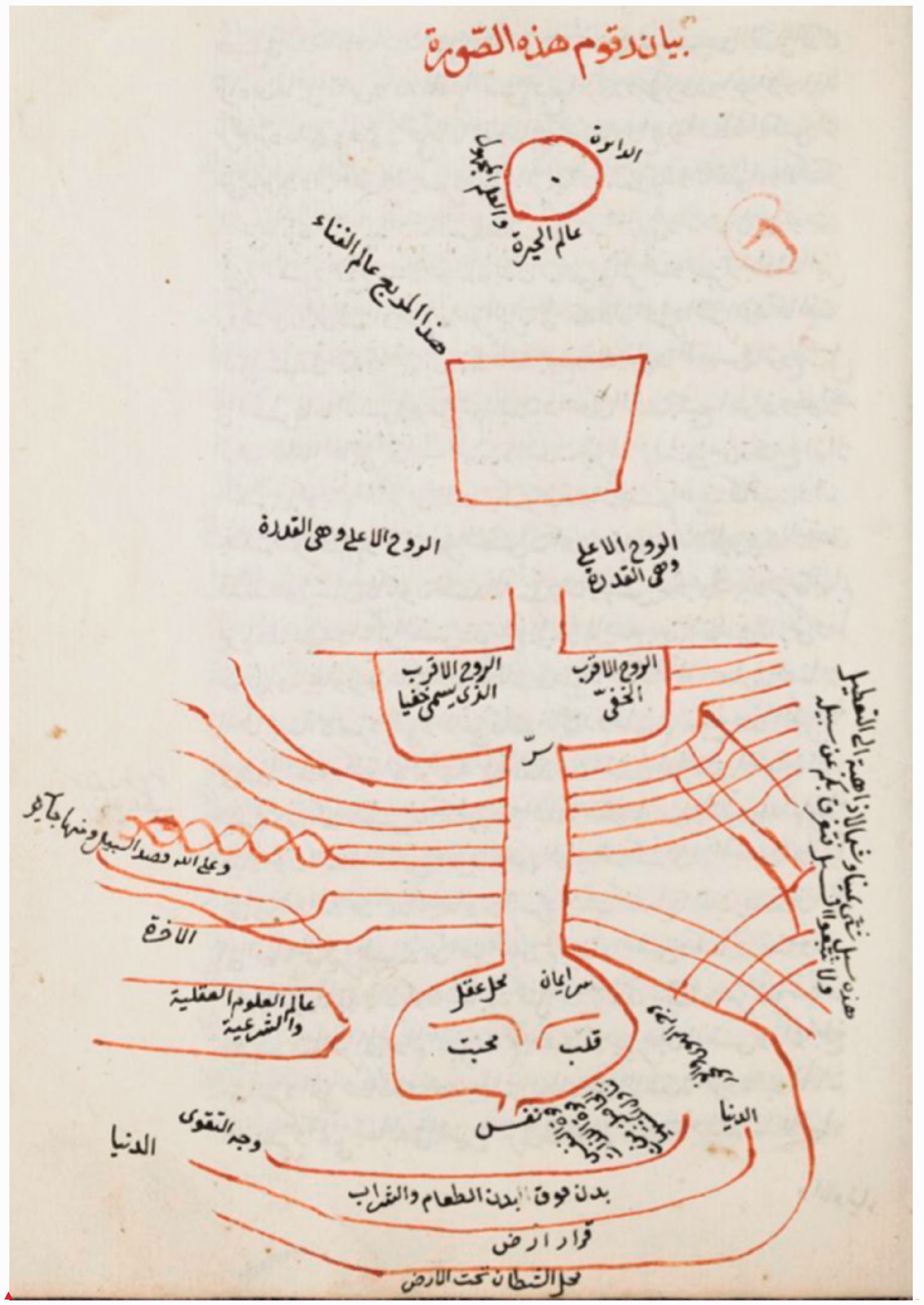
Shams al-Dīn al-Daylamī’s diagram of the spiritual body at the beginning of the Mirror of Souls. Courtesy of the Gotha Oriental Manuscript Research Library.
Conclusion
In this article, I have highlighted the relevance of a lesser studied work of Shams al-Dīn al-Daylamī to the study of Sufism. Discussions of the nature of light were central to al-Daylamī’s understanding of the soul and body. As I have shown, aspects of al-Daylamī’s thought seem to have been echoed by later authors such as al-Simnānī who developed a much more intricate system of subtle bodies. For al-Simnānī these subtle centers increase in subtlety in the following sequence: the subtle center of the bodily frame, followed by the lower soul, then the heart, the innermost heart, the spirit, the mystery, and finally the subtlest substance of the soul’s reality (ḥaqiyya) (Elias 1995, 81–85). Al-Daylamī’s account of the subtle bodies as varying degrees of light seems to prefigure these developments. Furthermore, these ideas influenced later thinkers such as Shāh Walī Allāh (d. 1172/1762) whose system of subtle centers is far more intricate and complex, and was integral to his project of religious reform, reconfiguring notions of the individual with implications for wider society (Hermansen 1988, 7, 24–25). Studying al-Daylamī in this regard then offers an insight into these theoretical discussions regarding the subtle centers of the soul when they were still relatively nascent.
Twelfth-century Sufism was characterized by a number of transitions. Apart from more centralized communities, Sufis in this period also cultivated a synthesis between theory and practice that was realized in the emergence of new sensory regimes. In al-Daylamī’s case, these elements of Sufism were bound together by the conception of the soul as light. Emphasizing the soul as a substance of light that is both bodily and spiritual strengthened the case for embodied spiritual training. Part of that bodily discipline was the inculcation of a mystical mode of vision, as a means to access spiritual truths and the unseen. The diagram of the Mirror of Souls represents the hidden imperceptible soul that is only fully understood through Sufi practice and training. In turn, it informs the Sufi’s understanding of the human body and soul. Moreover, since the text of the Mirror of Souls is structured according to the diagram, a close connection between practice, theory and depictions of the soul is realized. This in turn shifted Sufi understandings regarding the boundaries of the body and the senses, transforming them into intermediaries between the hidden and manifest worlds that facilitate belonging to the Sufi community.
