




Abstract
As a field, mobile media and communication (MMC) has centrally been concerned with how people use mobile communication technology and the implications for human sociality, psychology, and culture. This article encourages us to think more deeply, and differently, about concepts and practices of mobile media and mobile communication by examining the uses and consequences of MMC among whales. By looking at MMC in the animal world, we gain a new vantage point for thinking about the core elements of mobility, media, and communication, and how they can come together to shape everyday life and survival. By looking beyond the Anthropocene, this more-than-human perspective offers conceptual enrichment for scholarship in the field, while using MMC as a lens for considering how humans (“culture”) and animals (“nature”) are entangled in meaningful ways (natureculture).
Keywords
As a field, mobile media and communication (MMC) grew out of scholarship on the ways people use mobile phones and the resulting implications for human sociality, psychology, and culture. As the landscape of MMC expands beyond phones (e.g., Internet-of-Things, smart cities, intelligent vehicles, mobile AI), we need to expand our research agendas to better account for the growing scope of mobile communication technologies and practices. Although this need has been well-recognized (e.g., Frith & Özkul, 2019; Goggin, 2025), many remain predominantly interested in what people are doing with their phones, evidenced by scholarship published in this journal. In fact, at the journal's 2025 annual business meeting, the editors shared that many submissions are so focused on what people are doing with their phone, they overlook the integration of mobile, media, and communication. They note that submissions, for example, on phone-snubbing (“phubbing”) or use of some particular app (e.g., TikTok, WhatsApp, WeChat) commonly do not account for mobility or why anytime-anywhere access matters. The editors further observed that phubbing remains one of the most dominant topics in submissions to this journal, which is notable considering this is also one of the earliest topics of study when the field was new, albeit under the moniker of “absent presence” (Gergen, 2002) or some other language. To be sure, we have grown beyond research on phubbing; however, its continued popularity is emblematic of how changes in the socio-technological landscape of MMC are outpacing developments with research and theory.
This article encourages us to think more deeply, and differently, about concepts and practices of mobile media and mobile communication. We offer a “more-than-human” (Latour, 2017) perspective to stretch thinking about MMC beyond the traditional confines of humans and our technologies, while still centering the field's core elements. By studying MMC in the animal world, we gain a new vantage point for thinking about the core elements of mobility, media, and communication, and how they come together to shape everyday life and survival in ways that are highly visible but not studied. This article takes a “deep dive” into the whale communication literature to understand how whales use water as a medium to support various mobile communication practices. Although the “uses and gratifications” of MMC among whales map onto those in our own human-centered literature, we nevertheless avoid layering anthropocentric understandings of MMC onto whales. This would be a mistake, considering MMC among whales predates human existence – indeed, by millions of years. Rather, our aim is to advance this more-than-human perspective to open up new thinking about what MMC is and how to study it, beyond the familiar technologies (e.g., smartphones) and practices (e.g., phubbing). By looking beyond the Anthropocene, this more-than-human perspective offers conceptual enrichment for scholarship in the field, while also using MMC as a lens for viewing how nonhumans and humans are entangled in meaningful ways.
Conceptual Grounding
Our analysis is informed by the concept of natureculture, which pushes back on the outlook that human cultures are separate from and superior to nature, including animals and the environments they inhabit (Haraway, 2003; Latour, 2017). Rather than being divided, the concept of natureculture asserts that human and nonhuman worlds are mutually constituted and materially entangled. Being entangled, biological and cultural forces continually intra-act, as opposed to interacting as separate agencies, to emerge and evolve together (Barad, 2007). From this perspective, MMC is not merely a human techno-practice, but something that is relied on for survival and daily life activities throughout the world of animals, including humans, but not only humans. Through the lens of natureculture, we are able to see beyond human society and technology for a better view of MMC's core elements of mobility, media, and communication, and how they work together. As we discuss later, this approach helps bring conceptual focus to the defining contours of the field, while also helping to bring greater focus to how humans and animals are entangled in a shared environment, where divisions between nature and culture are not inherent or divine, but rather materially and discursively constructed.
This analysis is also informed by Peters’ (2015) philosophical argument that natural elements can and do serve as media. We are not the first to propose whales use water as a medium. Peters (2015) conceptualizes water as a medium for cetaceans to illustrate his philosophy that media are not inherently technological, but rather elemental in nature. Although with more focus on dolphins, he explains, “The water medium is their natural environment … the sea is the taken-for-granted element shaping all they do” (p. 71). Peters (2015) widens the concept of media to include natural resources that are meaningful and utilized in the creation of meaning in everyday living. From this perspective, people have always been using and surrounded by media, and modern-day technologies expand our abilities to connect with and through media. Media do not make us human, but rather reflect something more than human. As Peters (2015) explains, “the difference between humans and animals lies not in our intelligent use of media, but rather in our technologies and techniques of media use” (p. 91). According to Peters (2015), there is a fine but very definite line between techniques and technologies. Both refer to the use of gestures (i.e., symbolic strategies) and tools (i.e., biological and/or environmental materials) to create meaning; however, techniques for communication (e.g., speech) are not durable, whereas technologies (e.g., writing) are. Peters (2015) explains, “The line between technique and technology is externalization into durable form, and thus the ability to profit from distance and absence” (p. 91). Techniques and technologies of communication are enacted through media, including the elements of water and air. This study draws from this elemental perspective of media to demonstrate how whales have evolved over a period of 50 + million years to perform MMC and to explain how it structures modes of living.
Placing media on geologic timescales (Mattern, 2015; Parrikka, 2015) is useful for gaining a “deep time” (Zielinksi, 2006) perspective, and considering how whales have evolved toward MMC over millions of years invites an evolutionary understanding of human communication and media. Scholars view media, including mobile and social media, as appealing to evolved (e.g., Lim & Tan, 2024) and hardwired (Katz & Aakhus, 2002) needs for social relationships and to be aware of potential threats (e.g., Grabe, 2012). From this perspective, mediated communication helps fulfill needs for humans to survive and thrive. It is important to note that some also propose media, including smartphones (Sbarra et al., 2019) and social media (Lim & Tan, 2024), can present evolutionary mismatches by reconfiguring communication networks in ways that conflict with ancestral adaptations for sociality (Dunbar, 1992). By conceptualizing MMC as more than human, our analysis offers a new perspective for thinking about it as reflective of an evolutionary drive, shared among humans and other animals, to be able to connect and create meaning anytime-anywhere.
Mobile Media and Communication Among Whales?
Key to our argument is that MMC is a more-than-human phenomenon. Perhaps less obvious is how animal communication, and specifically the case of whales, fits as mobile media and communication. For several reasons, we have selected the case of whales. However, as we elaborate on later, this study could also be conducted with other animals. One reason we select whales is because it extends on momentum generated by Peters (2015) for conceptualizing water as a medium for cetacean communication. This study draws from Peters’ (2015) elemental media perspective, while adding to his illustration of whales by uniquely foregrounding how their communication is mobile and how different types of connected mobilities are distinctively meaningful for them. Another reason for choosing whales is the lively and growing body of literature on their communication (e.g., Youngblood, 2025) and their mobilities (e.g., Johnston & Painter, 2024). Furthermore, whales can have very powerful and extensive infrastructure supporting MMC. Sound travels much faster and farther in water than air, and the songs of the very large whales, such as humpbacks and blue whales, famously carry for thousands of miles (e.g., Peters, 2015). Whales are not the only case of animals using and relying on MMC, but they provide a good deal of leverage for initially understanding how this happens and why it is meaningful in the animal world.
To establish that whales use MMC, we break down each of the individual components of “mobile,” “media,” and “communication.” Considering this article fundamentally contributes to the study of communication, we move through these components in reverse order to first establish that this is, indeed, fundamentally a study of communication.
Communication: Do Whales Communicate?
For those who study whale vocalizations, this is hardly a question. For example, Youngblood's (2025) extensive study of efficiency in whale communication covers a great deal of research on the linguistic structure and characteristics of whale vocalization. That said, some scientists have expressed skepticism that animals can communicate, proposing their noises generate direct nervous-system responses in other animals (e.g., Owings & Morton, 1997, 1998; Rendall et al., 2009). However, only a minority of researchers share these views, and the more accepted view is that animals communicate intentionally and referentially (Seyfarth et al., 2010). By way of evidence, animals tend to make alarm calls only in response to threats and only when an audience is present. Without an audience, they tend not to issue alarm calls, even if a predator is present (Kaplan, 2015).
In fact, the sophistication of whale communication is a major theme in the literature (e.g., Allen et al., 2019; Begus et al., 2024; Owen et al., 2019; Youngblood, 2025). Depending on the species, whales can produce an array of vocalizations, including clicks, whistles, pulses, and songs, that reflect structure and rules for how they are formed (Youngblood, 2025). For example, humpback whale songs contain individual “units” of sound that come together to form “phrases,” which are repeated into “themes,” which then cluster (in groups of 4–7) to form a “song” (e.g., Allen et al., 2019; Garland et al., 2017; Lewis et al., 2018).
There is also theoretical support that whales communicate. Researchers in the area commonly draw from theories of human communication to hypothesize and interpret findings. For example, Youngblood (2025) uses laws of efficiency in human communication to accurately predict the length of sequences in whale vocalizations. Scholars have also used information theory, such as Shannon's (1948) theory of uncertainty reduction, to guide research on the structure of whale song (Suzuki et al., 2006) and symbolic nature of whale vocalizations (Seyfarth et al., 2010). The application of theories of human interaction aligns with our premise that whales communicate. That said, we agree with Cartmill's (2023) position that, “To compare animal communication and human language, we must acknowledge biases resulting from the different theoretical models used” (para. 1). Our aim here is not to impose a human understanding of MMC onto whales, but rather to recognize and, to the extent possible, distance ourselves from it, for a wider view of communication and media.
Media: Is Whale Communication Mediated?
Before answering this question, it is useful to first ask, “what is media?” Along with Peters (2015), many scholars conceptualize media as being elemental rather than technological in nature. This theme is prominent in Miconi and Serra's (2019) study of how scholarly experts define and understand media. As one of Miconi and Serra's respondents explains, “there are natural media, such as oxygen/nitrogen for sound waves, and sticks and trees for drumming, or light to see hand-waving, or fire for smoke signs or signals. Then there are technological media” (p. 3448). In fact, prior to the 19th century, the notion of media primarily referred to elements in nature, including earth, air, fire, and water (Hörisch, 1999).
Miconi and Serra (2019) also find that many scholars define media from a transmission perspective, as the exchange of messages between senders and receivers through select channels (Lasswell, 1972). From this perspective, whales select from different channels for transmitting signals through water, including clicks, pulses, calls, and songs, depending on the species. Here, we recognize that channels may take the form of natural substances as well as technological innovations.
Miconi and Serra's (2019) study further recognizes media as social and cultural constructs. They highlight Gitelman's (2006) definition of media “as socially realized structures of communication, where structures include both technological forms and the associated protocols, and where communication is a cultural practice” (p. 7). Following this, whale media includes not only water, but also the organs used to produce and hear sounds, their language protocols, and the techniques and practices that reflect rules of communication. Whales also have an impressive “objectnetwork” for mediation, if we consider that the songs of the largest whales can travel for thousands of miles at over four times the speed that sound travels in air (Peters, 2015).
There are different ways of conceptualizing media, and we regard them all as useful resources that can serve different theoretical purposes. For the purposes of this analysis, we take up Peters’ (2015) understanding of media as elemental. We extend on his illustration of water as a medium for whale communication by showing the ways in which their mobilities are configured with their communication.
Mobile: Are Whales Mobile During Mediated Communication?
Our last qualifying question is whether whales are mobile while communicating from a distance. The answer is quite clear – yes, whales are extremely mobile while communicating over long and short distances. Whales communicate while traversing local spaces as well as vast oceanic, even intercontinental, waters (Clapham, 1996). These mobilities provide valuable insights into how movement impacts communication and media use, as they are variable, purposeful, and demonstrate keen awareness of space (Lefebvre, 1991) and tactical practices (de Certeau, 2011). Whales also have vertical mobility, which shapes their communication. Because their sounds carry further in more shallow depths, this is where we see the most vocalizations (Lewis et al., 2018). Their communication with others (e.g., during migration) and the environment (e.g., echolocation) informs vertical as well as horizontal mobilities.
In fact, the continual movement of whales in water means a more interesting question might be, when are they not mobile? Even in their sleep, whales are moving through water, keeping one side of their brain awake enough to navigate (Lyamin et al., 2002). In our research, we found immobility among whales to be rare, usually to accommodate mating or feeding of young (Armstrong & Mitchell, 2021; Swartz et al., 2023). Another exceptional case of immobility is a filmed observation of a male humpback stopping to vertically position his body over a coral bed while singing into it (re-enactment in Figure 1), to amplify its song (Armstrong & Mitchell, 2021). This case of immobility is striking because it underscores how mediated their environment is. In this situation, coral is used as a resource for optimizing audio. Through a human lens, we might see this situation as similar to how people give up their mobility to watch a movie in a theater or on television to optimize the experience.
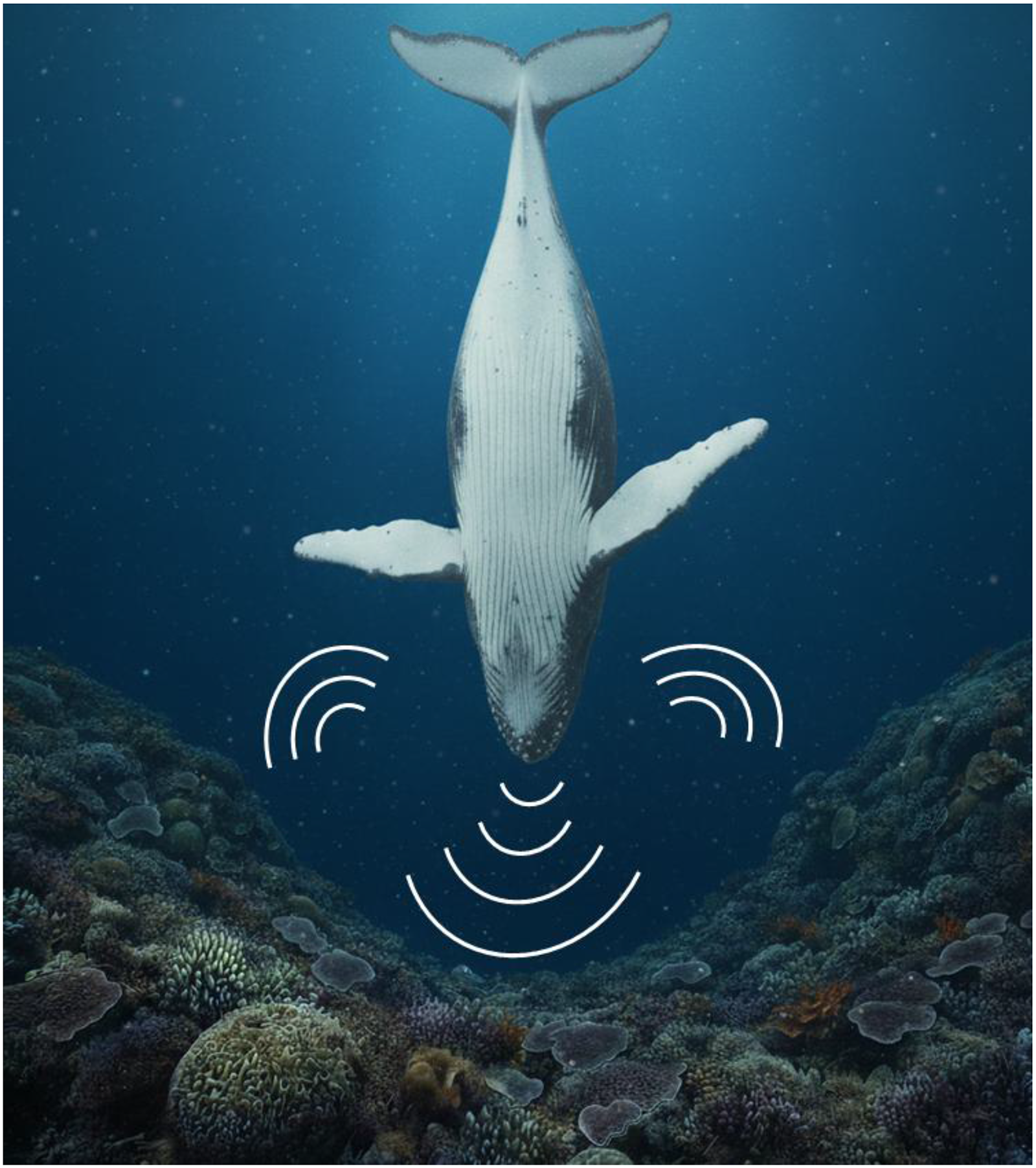
Humpback using coral as media.
As we turn to in the next section, research on the communication and mobilities of whales provides fodder for developing a narrative about how and why they rely on MMC. The following section reports on themes in the research on whale communication and mobilities for an understanding of how and why whales use MMC.
How and Why Whales Use MMC
This initial inventory of MMC in the lives of whales is based on our reading of the whale communication research, informed by Youngblood’s (2025) recent literature review and our own searching (e.g., “whale communication research”) in Google and Google Scholar. The first author also interviewed three academic scholars (recognized in the Acknowledgments) who study the communication and mobilities of whales to help refine themes and to identify gaps in the literature. Although more illustrative than exhaustive, this initial inventory is valuable in understanding different ways in which whales rely on MMC and, in fact, enact many aspects of their lives through it.
Social Coordination
To begin with, we observe that whales rely heavily on MMC for social coordination. Whales communicate while mobile to coordinate with each other in a variety of ways and for a variety of reasons. One that stands out is identifying members of the pod and coordinating their positions. For example, sperm whale calves begin using clicks to locate and coordinate with their mothers from a distance as early as three months (Gero et al., 2016). Other types of whales use dedicated calls to identify and coordinate positions of family and pod members at long ranges and other dedicated calls for maintaining contact at close range when visibility is low (Filatova et al., 2013; Johnston & Painter, 2024). Whales are constantly in movement, and the research shows they use an assorted mix of nuanced calls and clicks to communicate their locations and movements in ways that allow them to stay connected as they go about near and far.
Much of the reason why whales are so mobile is to find food, with MMC for social coordination being key to hunting and foraging. For example, the fin whale sings songs to guide others to food sources (Begus et al., 2024; Croll et al., 2002), while other types of whales extract units from songs to coordinate feeding (Lewis et al., 2018). As we discuss below, many whales also rely heavily on echolocation to help them navigate while chasing prey and to pinpoint the strike on their target. However, our interest here is in highlighting how MMC is used socially to coordinate hunting and foraging.
Furthermore, group travel is a context in which whales have been observed to use MMC for social coordination (Lewis et al., 2018). One of the purposes of whale song is to help guide migration of populations, and “the migration patterns of humpback whales are written into their songs” (Owen et al., 2019, para. 1). It is believed that whales rely on the “many wrongs principle,” with collective navigation effectively averaging out individual errors across the group (Johnston & Painter, 2024). Moreover, they communicate while mobile to change their routes to avoid anthropogenic noise, which has caused some whales’ migrations to increase by 20%, resulting in three-to-four additional days of travel in season migrations. Some compensate for this noise by vocally forming a relay “mesh” network, connecting information-rich zones with information-poor zones, allowing them to stay connected even when their ability to gather information is limited (Johnston & Painter, 2024). This practice, along with the others above, highlights how whales use MMC not just for coordination, but for social coordination. It also highlights that whale mobilities and communication are in dynamic relation to human activities, as anthropogenic noise shapes their social coordination practices.
Geographic Mapping
Another notable theme in the scholarship on whales is reliance on MMC to map out their geographic environments. Toothed whales (odontocetes) have echolocation, which is useful because, “In the opaque and viscous marine environment, other sensory modalities such as vision, touch, smell or taste have severe limitations in effective range and speed of signal transmission” (Nowacek et al., 2007, p. 83). Toothed whales can channel clicks at rates of over 300 per second through a fatty “melon” on their forehead to detect and interpret echoes. They hear these echoes with great precision through the lower jaw and inner ear to map out the surrounding environment and objects in it (Madsen et al., 2023).
Navigation is a primary reason why whales use echolocation for geographic mapping. We differentiate echolocation clicks for navigation from the social coordination practices above in that the former is an inherently collective practice, whereas echolocation can be used for individual navigation. Whales use echolocation to construct acoustic images, offering a kind of sound-based vision to navigate complicated estuaries, canyons, and reefs, while avoiding obstacles when visibility is low (St. Lawrence, 2024). They integrate immediate locative information with data from previous experiences to inform their movements (Fais et al., 2015). In other words, whales rely on MMC to construct mental maps of their environment, which they use to navigate through spaces where they have previously experienced favorable outcomes.
Echolocation also offers a great deal of precision for locating and catching fast-moving prey in water with little or no visibility (e.g., Madsen et al., 2023; Vance et al., 2021). Whales adjust the pulse intervals, or time between echolocation clicks, to the speed and size of prey, and as they approach a target, they emit a rapid series of clicks, or “buzz,” to increase tracking accuracy. By helping with precision, echolocation also helps ensure whales do not spend more energy hunting than what their prey has to offer as food (Madsen & Surlykke, 2014). This point speaks to the evolutionary implications of echolocation for toothed whales. Fais et al. (2015) explain that to efficiently manage the high energy costs of hunting, foraging, and wayfinding, whales rely on echolocation to assess resource availability before “committing effort” (p. 671).
Echolocation for navigation and hunting demonstrates how whales use MMC to perceive and interact with their surroundings with a great deal of intelligence. They exhibit acute perceptual sensitivity to their environment, as media, and have accumulated knowledge and skills to utilize their environment as media. Echolocation shows how whales are attuned to both environmental conditions and evolutionary needs for survival (e.g., Fais et al., 2015; Madsen & Surlykke, 2014).
Courtship
The literature on whales also reveals that MMC is integral to courtship behaviors. For example, males sing during their travels to attract potential mates and to warn off competitors (e.g., Garland & McGregor, 2020; Herman, 2017). Not all whales sing, and others rely on calls and pulses to communicate sexual interest (e.g., Eguiguren et al., 2023; Fais et al., 2015). Sometimes the medium is the message (McLuhan, 1964), in that what is being communicated is the quality of a whale's signal and the size of the organ producing the sound. For example, female sperm whales can detect the size of a male's sound-producing organ, the spermaceti, based on the quality and characteristics of the pulses it produces (Eguiguren et al., 2023). Producing strong, high-quality sounds while swimming takes a great deal of energy, and whales leverage the natural advantages of water, as an elemental medium, to be able to produce these sounds while on the move. Because sound carries so well in the ocean, acoustic displays can be an energetically effective way for males to advertise their size and dominance, while also saving energy by avoiding confrontations and minimizing travel (Orbach et al., 2019). Whales are also known to eavesdrop and may choose to avoid vocalizing their sexual interest if they do not like the sounds of nearby competitors (Dunlop & Noad, 2016).
Although courtship vocalizations tend to be a male mating behavior (Eichenberger et al., 2023), females from some whale species also signal their location and sexual interest through vocal or percussive means (Brown & Sironi, 2023; Eichenberger et al., 2023; Herman, 2017, p. 1803). Females also commonly play an active role in choosing a mate. We see this with a mating ritual known as the competitive scramble, where groups of males physically compete for a female's attention (e.g., Eichenberger et al., 2023). With humpbacks, the scramble takes the form of a chase, where a group of males chase after a female who is ready to mate, while blowing bubbles to express dominance (Armstrong & Mitchell, 2021). These bubbles expand the scope of whale media discussed so far by functioning as a form of nonverbal communication. Ultimately, the female stops swimming, which stops the chase, and chooses a mate to pair up with, bringing the ritual to an end (Armstrong & Mitchell, 2021).
Humpbacks provide us with another example of mobile-mediated courtship in the way males form alliances and play the role of “singing escort” to females and calves during migration, akin to “wing-manning” in human social dynamics (Herman, 2017). Whale migration is closely linked to reproductive cycles, reflecting the inherent mobilities connected to these processes (Swartz et al., 2023). As noted, scholars believe escorting males sing for two reproductive purposes – to express interest in the female and to warn off other males (Janik, 2014; Smith et al., 2008). Relatedly, fin whales use their song to guide females to food sources (Croll et al., 2002). These examples reflect well-patterned behaviors that carry manifest as well as latent messages about a male's capacity to provide and protect (Begus et al., 2024).
(Nature)culture
Finally, we point to “culture” as integral to why and how whales use MMC. The scientific literature repeatedly suggests that whales have culture. This literature is an exception to most modern knowledge discourses, which bifurcate nature/culture with human (culture) existing separate from nonhuman lifeworlds (nature) (Jones, 2009). Whales challenge the notion of culture as a human construct. More broadly, the concept of natureculture disrupts the bifurcation altogether, emphasizing that nature and culture co-constitute one another. Nevertheless, we present the culture-focused scientific literature here for the purposes of understanding, while insisting that nature is constitutive of culture and vice versa (i.e., natureculture).
The production and reproduction of culture stands out in the literature as a major reason for, and outcome of, communication among whales on the move. Researchers of whale communication understand “culture” as shared behavior and information within a community acquired through social learning (e.g., Garland et al., 2017; Owen et al., 2019) and have identified numerous traditions among whales. For example, sperm whales develop shared vocalizations that are used to identify social structures within their communities, which are maintained over decades through social learning and repetition (Rendell & Whitehead, 2003). Transmission of knowledge through whale MMC has also been observed with hunting, prey specialization (Whitehead, 2017), and how migratory patterns are encoded into the songs of humpbacks (Owen et al., 2019).
As with bird song, whale song is widely recognized and studied as a form of cultural transmission, and scholars are especially interested in the song of male humpback whales (e.g., Garland & McGregor, 2020). Because their songs can travel thousands of miles, humpbacks have the unique ability to share one song across great distances (Allen et al., 2019). Other whales are not known to share songs at the population level like this, and researchers are fascinated that humpbacks all fall in line with one song (Erbs et al., 2021). Because their song can travel intercontinentally, we might say that MMC serves as global media in the transmission of a shared humpback whale culture (Garland & McGregor, 2020; Garland et al., 2017).
Cultural transmission is also evident through a great degree of conformity around changes in the humpback's song and when it is time to replace it with a new one (Begus et al., 2024). As Owen et al. (2019) explain, male humpback whales perform “complex, culturally transmitted song displays that can change both evolutionarily (through accumulations of small changes) or revolutionarily (where a population rapidly adopts a novel song). The degree of coordination and conformity underlying song revolutions makes their study of particular interest” (para. 1). Scholars have also noted there are rules of structural similarity for the way old songs are spliced with new songs (Garland et al., 2017). Collectively, these rules and the practices surrounding them comprise culture, and whale song is one example of how whales perform, transmit, and change culture through MMC.
From Uses and Gratifications to Modes of Living
The themes resulting from our review of the whale literature invite reflection on how they relate to the uses and consequences of MMC among humans. By asking how and why whales use MMC, it may seem we are moving into the theoretical territory of uses and gratifications (U&G) (Katz et al., 1973). The U&G framework theorizes media use as a matter of gratification-seeking, emphasizing that individual motivations shape how and why people use media. Our review of the whale literature has generated themes that strongly resonate with those in the U&G tradition, as well as in the MMC literature.
However, we remain mindful of Cartmill's (2023) warning that when comparing animal and human communication, “we must acknowledge biases resulting from the different theoretical models used” (para. 1). Although it may seem intuitively applicable, the U&G framework is insufficient in that whales do not just “use” MMC. They embody it. Whales are not merely seeking gratifications with MMC; they live their lives through connected mobilities supported by water as media. Patterns of MMC that resemble “uses and gratifications” to us are actually “modes of living” for whales. They reflect much more than the “use” of something; their embodied connected movements support their survival and ways of life. Rather than interpreting our findings through the anthropomorphic lens of how people use media, we present them as “modes of living.”
This point is supported by the fact that other animals, including but not just humans, rely on MMC in highly resonant ways. Crows, for example, rely on mobile communication, using air as media and flight for mobility. Indeed, the themes we find among whales’ MMC are also evident with crows. Crows are perceived as highly social and intelligent animals by anthropocentric measures and have a complex suite of “caws” they incorporate into travels and movements (Wascher & Youngblood, 2024). Crows vocalize while flying to socially coordinate food sources, alert others to danger, and organize mobs to defend against threats (Connecticut Department of Energy & Environment, 2025; Mates et al., 2015; Wascher & Reynolds, 2025). Much of their mobile communication is for location-sharing and navigation. Crows rely on vocalizations to provide “location checks” and to exchange geographic information as they go about, allowing the group to navigate around dangers and toward known food sources (Earth Clinic Team, 2024; Wascher & Reynolds, 2025). MMC is also essential for courtship, with male crows performing aerial dives to communicate their intentions to potential mates, and on the ground they strut around, while puffing out their feathers, to communicate health and interest in pairing up (Connecticut Department of Energy & Environment, 2025; Ramel, 2022). These examples show that crows also rely on nonverbal communication during MMC. Furthermore, the literature shows that through their communication and mobilities, crows develop and pass along culture. In fact, crows are one of the few species known to possess cumulative culture, where knowledge and innovations are passed down and developed over generations (Cornell et al., 2011).
Although crows and whales communicate and travel differently, some of their core purposes for engaging with MMC are notably similar. In fact, we could say the same thing about humans. The fact that there are shared, underlying ways in which animals rely on MMC means that we need to think beyond theories of human communication, such as U&G, for explanation. Animals evolved toward MMC well before the evolution of humans, suggesting something much more fundamental than gratification-seeking occurs through media use. Media are not just technologies that people use; they are the fabric upon which we (and other animals) enact our lives.
MMC as More Than Human: Proof of Concept
The literature on whales shows how mobility, media, and communication come together to structure many aspects of whales’ lives, including social coordination, geographic mapping, courtship, and culture. These themes demonstrate “proof of concept” for our more-than-human approach to MMC. They show not only how we can see MMC among animals, but also that MMC is integral to core aspects of their daily lives, survival, reproduction, and evolution. We often think of MMC exclusively in human terms, and yet this analysis has shown that MMC exists in other domains, if only we consider MMC's core elements. A lesson we can take away from this exercise is that thinking about and studying MMC through its interrelated core elements of mobility, media, and communication can reveal fresh avenues of research (beyond mobile phones), while strengthening conceptual grounding. For some, this message is more of a reminder than a lesson. However, based on the editors’ characterizations of submissions to this journal, bringing focus to MMC's core elements remains an important lesson for many.
Moreover, this article demonstrates that MMC can be studied without a focus on human technology, or even humans. It encourages scholars to think beyond the human to the agencies and practices of the more-than-human, when exploring what MMC is or can be as a field. However, we offer a word of caution in doing so. While conducting this research, we found it tempting to, and sometimes did, compare whale MMC practices to those of humans. For example, the use of echolocation brought to mind navigation apps, and the use of whale song for courtship reminded us of location-based dating apps. While these comparisons aided our understanding, they also reproduced anthropocentric epistemologies and risked reducing whales’ unique perceptive-communicative capacities to those capacities observed in humans.
Of course, thinking differently about whale MMC is challenging. The scientific literature and the field to which we direct this work have developed largely around anthropocentric understandings of communication and perception. Moreover, we cannot think outside of our own (human) thinking. We will always draw upon human-constructed social meaning to interpret our nonhuman, more-than-human companions. Following Åsberg and Braidotti (2018), then, we must acknowledge “human imagination” as constitutive to understanding any object of study (p. 6). Reflexivity is key and is demonstrated by asking recurrent questions of how we materially-discursively construct the more-than-human and to what consequence.
This challenging work also begs the question of why we should care about, and what emerges from, attempts to interrogate the more-than-human companions and their MMC practices on their own terms. Such inquiries might nuance or add to existing frameworks and taxonomies that we use to understand MMC. Moreover, these inquiries may reframe our relationship to more-than-human companions as we better understand the role of MMC in their lives. With that said, we argue against the tendency to seek out human practices in more-than-humans simply to justify having – or to avoid having – an ethical relationship with them.
From “Nature” and “Culture” to “Natureculture”
This more-than-human approach helps us look beyond the Anthropocene, which is especially important during this time of climate change and environmental crisis. Although our primary aim was to enrich and expand scholarship in the field, we also find it valuable for people to think about communication and mobilities beyond the Anthropocene. It is interesting that scholars in communication do not study how animals communicate. Our review of the literature shows that those in various other disciplines (e.g., biology, psychology) study animal communication for various reasons. Although many hope to gain new insights into our own evolution, development, and technological capacity, many also study animals for the sake of studying animals. As Yong (2022) puts it, “Some scientists study the senses of other animals to better understand ourselves … Animals are not just stand-ins for humans or fodder for brain-storming sessions. They have worth in themselves” (p. 7). Communication should be a space where the study of animal communication is welcome. It can broaden perspectives on communication and our understanding of humans, as well as our place in the world.
From the perspective of natureculture, humans and animals do not inhabit separate worlds, but rather are entangled and intra-act within a shared environment (Haraway, 2003). The differences between the environments of whales and humans are discursively constructed, in that water, air, and land are entangled and intra-act through their entanglements to form “the” environment that we all share (Barad, 2007). We materially-discursively separate our shared environment with whales and other animals into “culture” and “nature” to serve our own needs, and this happens at the expense of the animals. Hunting, boating, communications, weapons testing, pollution, and climate change are all examples of how cultures and nature are entangled, and the discursive divisions we construct between them shield us from seeing this. Blue whales (among the largest and farthest-singing) have experienced a recent and dramatic decline in singing, as they expend greater energy on mobility due to environmental challenges attributable to human cultures (National Geographic, 2025). This problem is not just about less singing; it has downstream effects on their livelihood and reproduction. It serves as an illustration of how human cultures are not separate from nature; they are directly entangled with whales’ MMC, and therefore their primary modes of living. Humans like to separate nature from culture to advance our own interests while not recognizing that we are polluting our own backyard. However, this is a material-discursive exercise that only provides psychological reassurance. Thinking about the shared ways that whales and humans construct and experience our world reminds us that we are entangled, and this perspective is important in light of the climate and environmental challenges that shape our future. Here, “our future” refers to all of our futures – humans and our more-than-human companions alike. If mobility and mobile communication are encoded as necessary to our survival and livelihood, we must protect the natural environments through which we mediate them.
Footnotes
Acknowledgments
We are grateful to the following experts for their conversations with the first author about whale communication and mobilities: K. Alex Shorter, Mason Youngblood, Bogdon Popa.

Ethical Approval and Informed Consent Statements
Not applicable.
Funding
The authors received no financial support for the research, authorship, and/or publication of this article.
Declaration of Conflicting Interests
The authors declared no potential conflicts of interest with respect to the research, authorship, and/or publication of this article.
Data Availability Statement
No data reported on.