




Abstract
Mobile media, and the larger digital technological systems of which they are a part, both shape and are shaped by contemporary experiences of aging. With the aim of exploring older adults’ understandings, uses of, and experiences with digital technologies in their everyday lives, we conducted four exploratory focus groups in two Canadian cities, with a total of 29 participants representing a diverse range of ages, living situations, and socio-economic statuses. Challenging stereotypes of technophobic or health-obsessed elders, our participants reported using a wide variety of devices and apps for a multiplicity of purposes. Focus groups were characterized by open-ended discussion, eliciting complexity, creativity, and agency in our participants’ understandings and experiences of their digital worlds. Two main themes emerged from the analysis. First, a number of tensions – self-talk vs practice, design vs adaptation, “scripts” vs recreation – were articulated. Second, participants recounted the complex negotiations between technologies and people, bodies, environments, and resources that conjoined to shape their navigations of digital worlds. We suggest that open-ended dialogue with older adults is a promising method for understanding their ongoing, complex, and socially and materially situated engagements with technology. As a generative methodological tool, the focus group not only captures these dynamics but also produces the frictions, negotiations, and shared reflections that reveal them.
Keywords
Introduction
Mobile and digital devices are increasingly central in the lives of older adults, but stereotypes persist in assumptions about their use. Digital ageism is an underrecognized but underlying set of biases embedded in the designs, engineering, and marketing of digital technologies (Rosales et al., 2023). Older adults are often portrayed as too dependent, impaired, or simply too old to easily adopt technological products and interventions (Chu et al., 2022; Mannheim et al., 2023).
Our study is situated at the intersecting fields of critical aging studies and socio-gerontechnology. Socio-gerontechnology builds on Peine and Neven's model of the co-constitution of aging and technology (2019; 2021); that is, how technologies and aging are “co-constituted in a social field, comprised of actors, discourses and power relations” (Wanka & Gallistl, 2018, p. 2). Co-constitution is a reciprocal phenomenon that can also define “elderliness” itself in the process (Cozza, 2021). At the same time, as older adults live with their technologies, they also shape and change them. They contest demeaning images of an age-based digital divide (Neves et al., 2018), resist the age–tech interventionism that disrupts their lives (Berridge & Wetle, 2020), and hybridize and create technologies of their own (Bergschöld et al., 2020).
This article takes up Joyce's challenge to “imagine elders as technology users rather than problems to be solved” (2021, p. 190, emphasis added) by reporting on the results from four exploratory focus groups with 29 older adults held in varied settings across two Canadian cities. Participants, representing a diverse range of ages, living situations, and socio-economic statuses, were prompted to share their understandings, usages, and experiences with (or without) digital devices (including mobile communication devices) in their everyday lives. Focus group prompts enabled participants to speak, in their own ways, to our own, broad interests in understanding the ways in which older adults participate in the co-constitution of technology and aging, particularly through adaptation or innovation in their use of digital devices. The exploratory nature of our focus group allowed participants to relay a number of unexpected experiences, opinions, and questions, ultimately making visible three sets of tensions (self-talk vs actual practice; design vs adaptation; scripts vs recreation) and four negotiations (with people, bodies, environments, and resources) that participants broker in their daily lives with (or in spite of) digital devices. Alongside the empirical findings presented, this article also makes a methodological contribution. We argue that the focus group setting – particularly one that is open-ended, exploratory, and socially oriented – acts not only as a data collection tool but as a site where shared practices, frictions, and contradictions emerge in real time. Rather than merely collecting attitudes or usage patterns, our focus group structure generated a form of collective storytelling and critique that allowed participants to co-construct meanings and expose the situated tensions of their digital lives. In this way, we suggest that how we talk tech with older adults matters deeply in shaping what becomes visible in socio-gerontechnological research.
Literature review
The initial expansion of scholarship on mobile media and communications was characterized by a paucity of work on older adult users (and non-users), as a number of critiques have pointed out (Crow & Sawchuk, 2014; Fernández-Ardèvol & Rosales, 2018; Fondevila Gascón et al., 2015; Kadylak et al., 2018; Nimrod, 2016). More recently, this gap has been addressed by a growth in research on older technology users (see Beneito-Montagut et al., 2022; Fernández-Ardèvol et al., 2023; Loos et al., 2022; Miller et al., 2021; Yu et al., 2023). This research has cast critical scrutiny on the ageist assumptions of technosolutionism – what Peine and Neven (2019) term an “interventionist logic.” Here, aging populations are framed as problems, and technological interventions are promised as solutions to issues of older adults’ isolation, frailty, inactivity, and loneliness (Barbosa Neves et al., 2023; Cozza & Cersosimo, 2023). Technosolutionism, despite the optimism of its claims, tends to reinforce negative stereotypes of older people while minimizing their heterogeneity and agency related to technology use (Peine et al., 2021). Two recent large-scale international studies on mobile media use in later life are instructive as examples of empirical challenges to these shortcomings.
The BConnect@home project (Loos et al., 2022) included a sample of 430 people aged 55 to 79 in Sweden, Spain, the Netherlands, and Canada. Participants had their smartphone and mobile app activity passively tracked through installed software for a period of 4 weeks, followed by online surveys and semi-structured interviews with a subset of users. On average, participants used their phones (defined as turning on the screen) more than 100 times per day, dispelling myths that older people are unable to, or uninterested in, using digital technologies (Loos et al., 2022). Little quantitative difference in usage was noted across the participant age range of 55–79 (Beneito-Montagut et al., 2022), although there was a good deal of heterogeneity in the types of apps and activities most frequently accessed. Calls and messaging were most common, followed by social media, images and videos, games and gambling, news and media, shopping, finance, health/fitness, travel, weather, government, and productivity. Country of residence shaped smartphone usage patterns in later life, largely influenced by the price structure in each location.
The Anthropology of Smartphones and Smart Ageing project (Miller et al., 2021) included 10 community field sites across the global north and south, in which researchers lived for 16 months, observing and participating in a host of activities to understand the impact of the smartphone on aging. Across all sites, there were varying complaints by participants about the widespread reliance on smartphones – from their making some traditional skills, such as mental arithmetic and calligraphy, obsolete, to difficulties in getting appropriate support in learning how to use them. There was also considerable evidence, particularly in the global north, that widespread smartphone adoption has been central to changes in the experience of aging. Five aspects of smartphone use in different contexts were identified. First, smartphones may be important in “crafting” new identities and lifestyles in retirement, as part of a reconfiguration of relationships, activities, and interests. Second, the smartphone can be viewed as not just having technological capacities but as “a device that stands for a certain relationship to age itself” (p. 177). Third, smartphone adoption may not simply eliminate generational digital divides but create new ones. Fourth, the oft-noted difficulties of smartphone use for some older people – such as lack of dexterity or failing eyesight – are linked to stigmatizing aging. Finally, the wider social, political, and economic contexts of use are central to understanding the relationship between mobile technologies and aging. As they conclude, “the processes by which smartphones are related to social relations and cultural values are extraordinarily dynamic” (p. 179).
While these two studies focus on smartphones, these do not exhaust the concept of mobility. Laptops, wearables, apps, and voice-activated devices, such as Google Home and Alexa, link mobile and non-mobile digital technologies. Thus, our focus group conversations consider mobile media as part of larger digital ecosystems. This aligns with research that highlights context, relationships, and connections in shaping older adults’ engagements with mobile devices (Beneito-Montagut et al., 2023; Knowles & Hanson, 2018). In considering broader contexts, our conversations with participants are also attentive to intersecting relations of power and social inequalities around aging and technology uptake (Dalmer et al., 2022). As Jensen (2013) observes, while “media have been mobile for millennia,” what is mobile about media today “is not so much the particular device, individual user, or general technology, but the social contexts in which these components come together in communication,” mobilizing, in effect, entire social worlds (p. 27).
In their ethnographic analysis of self-tracking and smartphone use, Pink and Fors (2017) found that “it is not often the technologies themselves that participants are interested in, but the activities and life trajectories in which they become embedded” (p. 235). They argue for a decentering of technology, focusing instead on the situated practices of use so that we may begin to “unpick the contingencies through which digital media are used, appropriated, and improvised with, as these unfold within the context of everyday activity” (p. 235). Building on this approach, our study, focusing on practices of use rather than devices, attends to the entanglements, tensions, and negotiations in digital ecosystems. Our open-ended, focus group conversations sought to unsettle the increasingly “taken-for-granted” nature of mobile technologies (Vanden Abeele et al., 2018, p. 5) to bring forward the many ways that, as older adults live in and with their technologies, they also shape and change them.
Methods
To understand how older adults think about and engage with (or avoid) digital technologies, we organized exploratory focus groups, a series of conversations concerned with discovering and identifying similarities and differences in participants’ experiences and views (Fern, 2001; Smithson, 2008). Focus groups provide the ideal conditions for researchers to learn about the meaningful worlds older adults create and inhabit (Heller et al., 1990). Drawing on feminist methodologies, we paid attention to conditions of comfort, safety, reciprocity, collaboration, and power-sharing (Herron, 2023) within the groups in order to “[open] for other ways of knowing” (Mark, 2021, p. 178) to be expressed among participants. In doing so, particularly in keeping with an exploratory, qualitative framework, we sought to allow for the unexpected, incomplete, emergent, and possible. The exploratory nature of our focus groups was essential given our desire to avoid any pre-determined or stereotypical ideas about older people and technology use and/or non-use by centering the questions, experiences, and problems that participants raise.
We conducted four focus groups with a total of 29 individuals that were held in-person across three locations in two different cities in southern Ontario: two in a central public library branch (Focus Groups 1, n = 11; and 2, n = 9) and one in a rent-geared-to-income retirement complex (Focus Group 3, n = 4) were held in a small city, and one group in a private retirement residence was held in a large, urban city (Focus Group 4, n = 5). Each focus group lasted for 90 minutes, although it was clear that participants wanted even more time to continue conversations and share websites, apps, and tips and tricks. Participants were recruited using different mechanisms: the public library focus group participants were recruited through posters displayed throughout the downtown core and posted at recreational centers, coffee shops, and the local library. This strategy proved to be valuable in attracting a diverse range of older participants in different living situations and of different socio-economic statuses.1 The remaining two focus groups in retirement residences were recruited through known networks and snowball sampling.
Participants ranged in age from 55 to 94, with a majority (n = 14) between 65 and 74. Twenty participants identified as women. The majority of participants were married (n = 11), with seven participants widowed, five divorced, four single, one common-law, and one not disclosing. Fourteen participants lived alone, with most others living with their partner (n = 10). A majority of participants indicated that they had completed a university or college degree, with most others achieving some amount of college (n = 10) or finishing high school (n = 6). Finally, 21 of the participants were retired, with four participants working part-time and four not disclosing.
The authors served as moderators in the focus groups. Participants were welcomed, the study purpose was clarified, consent was obtained, participants selected their pseudonyms, and snacks were served. Starting purposefully with the broad question “What digital devices or technologies do you use most often?”, the moderator(s) guided discussions and encouraged all participants to share, ensuring, as much as possible, sufficient time for each participant to express their own view. Focus groups were digitally audio-recorded, with one of the moderators taking live notes. The social nature of the focus groups was palpable – participants appeared to enjoy the experience of learning from and listening to one another. This group interaction is particularly salient to the focus group method, with group exchanges, lively interactions, and discussions being vital in producing data. Given that Focus Groups 1 and 2 were relatively large, ensuring that all participants had opportunities to voice their experiences required purposeful attention. We especially noted the ways in which the exchanges in the focus groups allowed for interpersonal learning and reminiscence, corroborated in other focus group studies with older adults (e.g., Mehta, 2011). The focus groups served not only as a method for data collection but also as dynamic sites of meaning-making, where participants actively co-created insights and challenged stereotypes in real time. The format enabled a performative quality (Kitzinger, 1994) – participants joked, contradicted themselves, questioned each other, and collaboratively explored their relationships with technology. These dialogic frictions, rather than being noise, were central to illuminating the ambivalences and tensions that characterize older adults’ digital practices.
Our collaborative analysis of the focus group transcripts revealed two broad themes: tensions and negotiations that are grounded in our collective reflections, and analyses of the current landscape of gerontechnological innovation and research.
Results
Across all focus groups, participants’ conversations, questions, feedback, and anecdotes collectively demonstrated a constant negotiation and fluidity of values in participants’ relationships with their technology use (or refusal). Whether or not a technological device (old or new, digital or analog) was used or rejected was based on a series of shifting deliberations about cost, privacy, comfort, desire to be connected, environmental impact, availability, and utility (among others).
As outlined in Table 1, the first theme highlights a series of three tensions – self-talk vs actual practice; design vs adaptation; scripts vs recreation – that coexist and that structure participants’ technological engagements. Here, “tensions” refers to the contradictions or dissonances experienced by older adults when it comes to their thoughts, expectations, and actual practices around technologies. These are internal or conceptual struggles that shape their attitudes and behaviors.
Overview of the Results.
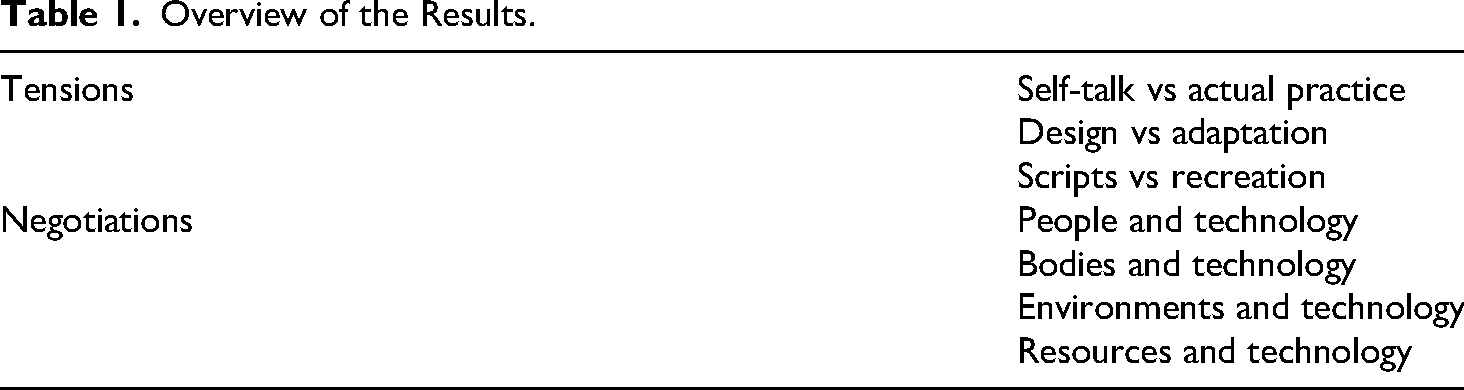
The second theme, negotiations, recounts the ways participants discuss their adoption, use, and rejection of specific technologies as both situated and negotiated, focusing in particular on four facets: people, bodies, environments, and resources. “Negotiations” refers to the active, ongoing processes through which older adults navigate, adapt to, or resist technology use based on their specific contexts. These are practical decisions and compromises made in daily life. These themes of tensions and negotiations were not just abstracted from participants’ statements but arose directly through the social, conversational format of the focus groups. The setting encouraged mutual recognition, disagreement, reflection, and even debate – bringing to light the very frictions and relational dynamics that structure older adults’ engagements with digital technologies.
Tensions
Our first theme, tensions, is based on how participants’ experiences and practices with technologies were shared as sets of tensions that appeared to be contradictory in nature.
Tension 1: self-talk vs actual practice
Participants across the four focus groups would, at times, characterize themselves in self-stereotyping technophobic terms: And I don't have an iPhone, I have a little flip phone which I cannot operate so, I feel like a I’m having a hard time getting away from that I would rather do a crossword on paper than – or paint by number on paper. And I know that's not the way things are going and I –
Table 2 provides an overview of the inventory of devices and apps that participants mentioned over the course of our conversations across the four focus groups.
Inventory of Devices and Apps.
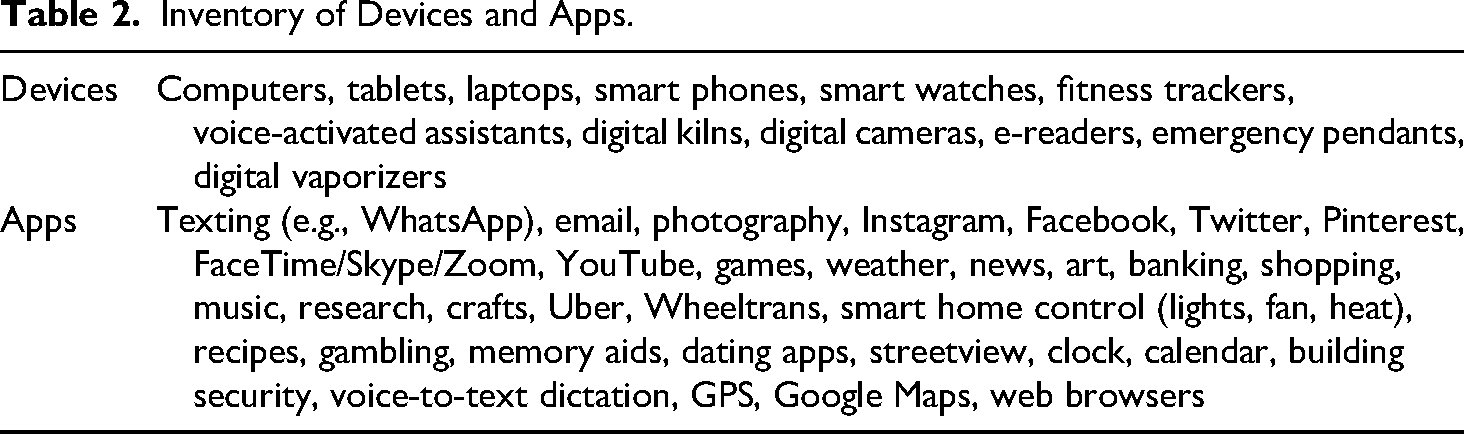
The extensive list of apps and devices outlined in Table 2 counters narrow stereotypes of older people as technophobic. Participants also articulated a critical awareness of technology and digital capitalism, along with emerging issues of information and data manipulation, privacy ethics, and environmental impacts. Several participants also recounted their resistance to using automated technologies such as automatic teller machines, ticket machines, computer voice menus, and self-checkout aisles in grocery stores, seeing them threatening their communities by replacing human labor: And this is called shadow work … And that's what digital technology is doing … they’re taking away jobs that somebody got paid for and we’re doing it for free. (CatFish Willie, Focus Group 2) Pytor: I think the digitization is sort of the last and final encompassing of just monetizing everything in existence. And continuing our domestication to the point where we’re good little producers, if you will. We’re kind of like the equivalent of cows or chickens pumping out data for the large corporations. And that's really what it's really all about – is power and control. And we’re just kinda handing it over to them. Gail: This is the way the world ends … with an emoji!
Finally, concerns about online privacy and safety appeared in all four focus groups. Participants shared their history with scams, ransomware attacks, and being compromised on social media, highlighting a general unease with the indelibility of information they share online: “Like once you put something in a computer … It's there for life. Like even when people delete and re-delete, it's still … it's still there” (Deedee, Focus Group 3). Others voiced a broader discomfort with the ways in which privacy is enacted in digital spheres: I love technology. The only thing I find is – I find privacy is a big issue. No matter where you go, no matter what you do. It's like – your information is out there for grabbing. It almost feels like you’re out there as a person for grabs, too. I mean, there's no real privacy except in your head anymore and I don’t even know if that's private anymore. (Jayla, Focus Group 1)
Tension 2: design vs adaptation
The second group of tensions emerged as participants discussed how the technological devices and apps they used were not specifically designed for older adults. Despite the AgeTech imagery of health concerns driving technology adoption in later life (hence the corporate focus on activity trackers and telehealth), health was not a particularly strong or specific motivator for technology use.
Mobilizing, selecting, and accessing health and medical information was about as important to participants as it might be for any other age group. Deedee (Focus Group 3), for example, explains how she used YouTube to be able to watch surgery videos to prepare for her own upcoming surgical procedure: I watched – I had knee and hip surgery replacement … I watched the surgeries before I [went]. I watched them like 10 times and I was in the operating room and I said to the doctor, “I think I can do my own surgery” because I’ve watched it so many times and I wanted to watch it.
Tension 3: scripts vs recreation
Our focus group conversations about technology and entertainment revealed alternative values to technoscientific hopes and promises of efficiency and productivity scripted into digital devices. These conversations recounted both the ways in which technologies are a means to access entertainment and the ways in which the technologies themselves serve as entertainment.
Participants in Focus Group 3, for example, recounted the many ways they tried to trick Alexa when Deedee first acquired “her” and the hours they spent with her, giving her math problems, questions about history, news, and even questions about where (and when) Alexa herself was from: Deedee: When we first got her … we were trying to think of things to ask. Well, I asked her her birthday … and she said in San Francisco in whatever year it was, probably when it was made. Kitty: It's a little bit fun to play with.
For some, this access to entertainment served a utilitarian role, often with the goal of staying active in body and in mind. Fipps (Focus Group 1), for example, explained her use of a game with …wood squares and you have to fill them in and the better you are the more points you get and it's very interesting too. It really activates your mind … and I’m looking at it so I can keep my brain activated for now … I want to give my brain some work.
This notion of using technology in order to keep one's mind sharp was not shared by all. Vrolijk (Focus Group 1) classified herself as a “resister of most things to do with digital technology.” She went on to elaborate the ways in which she opted out of technology as a means to keep her mind active: And so if we’re talking about grocery lists or taking a picture of a product in a store, I would prefer to write it down. Even though I lose the pieces of paper now that I’m over 65, I would much prefer to do the work with my hand and look at it that way or try to rely on the memory.
In working through these three series of tensions, in their multiple and creative uses of apps and devices, participants challenged the stereotype of “technophobic elders” and negative health-determinist assumptions that technological engagement in later life solely serves gerontologic purposes around care, dependency, and safety.
Negotiations
Our second theme, negotiations, refers to how the adoption, use, and rejection of specific technologies were both situated and negotiated. Participants recounted the role of adult children, grandchildren, or other family members in assisting them in setting up home networks, the ways in which changing physical capacities were navigated, the varying experience and skills they brought to their digital lives, and the role some technologies, such as building security systems using residents’ individual smartphones to admit guests, played in maintaining boundaries between public and private space. We learned that participants’ experiences with digital technologies were constantly shifting. While participants spoke about a range of elements that they negotiate in their engagements with technologies, we focus this section on those four components (people, bodies, environments, and resources) that were especially prominent throughout the focus group conversations. Importantly, while we discuss each of these components in turn, they do not exist independently but inform and shape one another. Indeed, the situated nature of technology use is reflected in the varying ways that devices and apps are taken up or resisted as contexts change.
Negotiation 1: negotiating people and technology
Participants implicated a number of different types of people and relationships throughout the focus groups. Pytor (Focus Group 1) shared how his parents’ fondness for technology informed his engagement with and knowledge about technology: “Both of my parents were way online like really early on … they were on America Online as soon as it came out and he had a Bluetooth when Bluetooth came out and they were all over it, right?”
Adult children were often mentioned for their roles in setting up technologies for their older parents, and for creating a desire for technology: “I'm going to get Alexa. I’ve seen it operate at all of my children's homes, and I said, ‘that's it, I want one’” (Farfle, Focus Group 4). Sometimes adult children gave their parents what was deemed as an “unwanted technology” either because the device served no use or it presented concerns about control: I was given an iPad but I haven’t used it yet. Partly because the first time I went on it and my daughter was encouraging me and it was Facebook she set up an account for me and it just felt terribly shocking to me. To have fast, immediate contact with peripheral people … And I just thought no, I’m not doing that right now. It feels awful. (Gail, Focus Group 1)
Interestingly, Elizabeth Taylor (Focus Group 4) shared how it was not her, but her husband's, health concerns that were keeping her from engaging with technology in a way that she might enjoy: Four years ago, before I moved in here, I had a computer. I did some reports on the computer. I did emails. I did Scrabble. When I moved in, my husband had a stroke, and he lost his sight, and I was busy. And then, within the 6 months of when we moved in, he had a stroke and two heart attacks. I never connected to the computer, I never set up any technological steps sitting there. I have an iPad, which [husband] also bought around the same time and stopped using it about 5 years later in 2017. I picked it up and started using it. And that's when I started taking classes at [local public library system], I got on Facebook, I got on Twitter. And Pinterest.
Grandchildren were often referred to in terms of participants’ desires to connect with them and how technology could be used to accomplish this goal. For example, Russ (Focus Group 2) notes: I’ve got 10 grandchildren, and we all have a different relationship. Some are texters, some are prolific on Facebook, and so, I go on Facebook and it tells me when she posts something – so you build a different relationship depending on who you want to connect with.
For some, the ability to connect with family virtually was described as nothing short of miraculous: Because of my iPad, I was fortunate enough to see my great granddaughter in England. And, another is 11 months old in New Jersey … if it hadn't been for my iPad, I would not have known what they looked like … They know who I am, because they see me all the time, and I see them. I watched them progress, not the same as physical, but it's the best thing to have. The pictures they put on. I think it is amazing. The technology of the iPad, or whatever you want to call it, I think is revolutionary. (Farfle, Focus Group 4)
Others, however, found the familial connection via technology more fraught. Russ (Focus Group 2), for example, felt that technological ways of connecting could not match face-to-face interaction with his grandchildren: With the grandchildren I’m actually at the point now where I say – I don’t want to Skype. I want to see you. I want to cuddle ya, you know? And that's what we do. So I said nah, we’re not Skyping this time. We’re coming over for a visit.
Catfish Willie (Focus Group 2) followed up linking this statement to a broader issue that participants were raising: “What's missing is humanity. Humanness. It's an existential threat to our humanness. It's not human, it's algorithms, it's zeros and ones, and we’re not zeros and ones. We’re humans.”
While family was typically the topic of conversation, others indicated that connectivity was important in creating a community based on specialized interests or concerns not widely represented in their immediate, physical community. As Robert (Focus Group 2), a kinetic sculptor, explains: “If you have a particular interest in some narrow little field … you can find a whole community online that shares that interest and have an interesting discussion with them.” For our participants, then, mobile technologies were experienced through connections with other people, whether familial, extra-familial, proximate, or at a distance, with both opportunities and shortcomings carefully considered. However, such connections are always changing and require skillful negotiation.
Negotiation 2: negotiating bodies and technology
Participants also shared the many ways in which their bodies were changing in relation to their engagement with technologies. Experiences with awkward technological designs were often shared. The weight and poor design of alarm pendants, for example, were discussed at length among Focus Group 4 residents: Lady Di: They’re very heavy. I can’t wear it around my neck. Farfle: I can’t either. Lady Di: It's very heavy, it's very awkward. It goes off and they charge you every time you are on independent floors. And you press the button, and somebody comes, they charge you.
At different points in Focus Group 2, Russ and Justy both discussed their frustrations with the too-small size of keyboards on phones and tablets that limited their ability to use them for writing. Justy remarked, “I can’t stand those little buttons. Those things drive me crazy – I want a big keyboard I can put my fingers on!” and Russ similarly noted, “If I’m going to do some work, write, then I have to sit down at my laptop and write an email. I can’t write on these little – drives you nuts!” Such accessibility limitations of everyday technologies were brought up across all focus groups, often in reference to older participants’ changing bodies. Participants’ embodied experiences shared here align with those tensions outlined in the earlier “design vs adaptation” section, particularly in highlighting the many ways in which they adapt non-gerontechnological devices to their own ends and needs.
Negotiation 3: negotiating environments and technology
The ways in which participants negotiated their relationships to place and its impact on technology use and accessibility was also shared. For example, in Focus Groups 1 and 3, participants shared that their alarm pendants and devices were only functional in certain areas of their residence. Fipps (Focus Group 1) noted that her device does not have any reception in her underground parking stall. A number of residents in Focus Group 4 also shared concerns that their location would impact whether or not they would be able to receive immediate medical attention: Deena: It's only so far. It's only within a certain radius. If you’re visiting a restaurant, no way… Lady Di: If you're outside walking and you fall down on the sidewalk, I don’t think it will— Farfle: Unless you’re in front of the building. If you’re in the back patio or if you’re in the front, it will work. If you go outside— Lady Di: It won’t work.
Finally, the ways in which technologies might support (or constrain) older participants in keeping their environment secure was another issue raised. Participants in Focus Group 3 explained how they pressed a button on their phone (landline or cellphone) to open the main door to admit people into their building. However, without accompanying video, they were often unsure whom they were “buzzing in.” Conversations here underscore the analytical importance of place, with questions raised about how technologies have the potential to both constrain and enhance older adults’ agency in their immediate environments.
Negotiation 4: negotiating resources and technology
Finally, the issue of cost was frequently raised across all four focus groups as a determinant in purchasing devices. Some mentioned that they only own a smartphone because owning both a landline and a mobile phone is cost prohibitive. Others used their local public library to access the internet. Pytor (Focus Group 1) explains his use of a digital camera: It's digital because I can’t really afford film. It's cheap – the thing is you can take a thousand pictures, two thousand pictures, it's not gonna cost you anything. So that's the only reason. If – if it wasn’t available I wouldn’t be taking pictures probably.
Interestingly, others spoke about financial constraints in other ways. Instead of restricting their digital practices, Kitty (Focus Group 3) shared that she felt comfortable and safe with online banking because “I don’t have any money. That's why I don’t worry about my banking being online … Because those guys would say, ‘Oh my God! She's only got that! Forget it! Go to a different bank account!’”
In addition to money as a finite resource shaping participants’ negotiation with technology, time as a resource was also discussed. SunDiva (Focus Group 1) carefully differentiated the “real” world from her digital activity and would thoughtfully reject time spent with devices: Maybe it's because we’re older and I – for myself I speak that all of us and I realize how old I am … and how much of my life is gone and I think it's a balance between what you’re comfortable – how much more of my life do I want to devote to sitting in front of a screen or do I want to enjoy the real world that's out there? Because you don’t know how long it's going to last.
Time as a finite resource that could be “wasted” due to a reliance on technology was debated by other members of Focus Group 1: Vrolijk: We go around … and you see that all over the world. If you’re traveling and you’re looking at a beautiful site, it's… Fipps: Everybody has these things [cellphones] out! Pytor: Go to a concert! People are all like this with their phones! They’re not watching – just holding… Vrolijk: It's just a secondary experience, then, because it's no longer direct. Gail: Life is being a voyeur.
Discussion
Our exploratory focus group method served as an opportunity for community creation and local knowledge-making, and it revealed its strength as a methodological approach, enriched by our participants’ diverse socio-economic status and living situations. This method enabled unexpected findings to emerge and allowed for a nuanced discussion of the entanglement of tensions and negotiations that may have otherwise been missed. Our exploratory focus groups created an improvised, flexible, and informal community where personal stories, advice and cautions, and technical knowledge were produced rather than merely recorded. In this way, the focus groups acted not only as sites of data collection but also as co-creative spaces. The social nature of each of the focus groups mirrored the social nature of the technology-linked experiences shared. Through shared storytelling, laughter, frustration, and critique, participants actively shaped the discourse on aging and technology. The social environment and the open-ended flow of conversations supported participants in jointly contributing to the outcomes, including defining their digital worlds, which included – but went beyond – mobile technologies. This underscores our claim that methodological openness – inviting older adults to narrate and negotiate their digital lives together – can unsettle dominant AgeTech imaginaries and nurture richer, more complex accounts of aging-with-technology.
Participants demonstrated that the negotiated nature of technology usage places their devices in a web of relationships among people, bodies, devices, environments, and knowledges. This is a process that is social, not individual (Beneito-Montagut et al., 2023), and is both collective and ongoing (Lindberg et al., 2022). The highlighted social, collective ways of living and engaging with technologies pushes against the prevailing individualistic interventionist logic that permeates research, policy, and design at the intersection of technology and later life.
The two broad themes, tensions and negotiations – suggestive of a broader conflict between AgeTech optimism and technosolutionist problems of privacy, market-driven priorities, digital ageism, and design stereotyping (Peine & Neven, 2019) – frame four key observations stemming from the focus group findings. First, in their multiple and creative uses of apps and devices, participants challenged the stereotype of “technophobic elders” and health-determinist assumptions about technological engagement in later life. Devices used by participants were numerous and varied, and were not exclusively shaped by their health or medical concerns, challenging the idea that the dominant benefits of adapting innovative technologies for older adults is to deal with compromised physical, cognitive, and social functioning (Wahl et al., 2012). Second, participants’ experiences of digital technologies are neither static nor universal but shift through ongoing negotiation. Aligning with Lehtinen's (2023) findings, participants shared their ambivalences in using digital devices that were simultaneously helpful and problematic. Technologies are taken up or resisted within changing relational contexts involving humans, bodies, environments, and resources, and it is crucial to consider mobile media as part of these wider networks and infrastructures. Third, participants articulated a shared and critical political awareness about technology and digital capitalism, and issues of information and data manipulation, privacy ethics, and environmental impacts, challenging negative age-based stereotypes of older adults as “non-users” and “digital immigrants,” and their portrayal as technophobic, stubborn, or incapable (Kania-Lundholm & Torres, 2015). Finally, while some participants characterized themselves in self-stereotyping technophobic terms, these were defied by their own accounts of sophisticated technological activities and relationships. Curiously, whereas Köttl et al. (2021) found that internalized ageism led to decreased technology use among older adults, participants’ use of ageist self-descriptors did not appear to correlate with their knowledge about technologies; nor did it diminish their technology use. As Beneito-Montagut et al. (2023) note, these findings suggest a challenge to the surfeit of studies of older people and technologies that are framed by the presumed technosolutionist role of the latter in alleviating age-related “needs, impairments, illnesses, declines and other deficiencies” (p. mpa#nbsp;581). Together, our discovery of these themes and components were enriching ways to learn not simply about, but with, our participants and their emergent material worlds of technological co-constitution, whereby aging is a more-than-human experience.
Conclusions
Our study, in its critical exploration of adults’ understandings, uses, and experiences with digital technologies in their everyday lives, sought to disrupt these typical approaches to AgeTech research by suggesting more nuanced and sensitive interpretations.
We align our work with what Sheahan (2024) calls the productive use of “frictions” as a means to subvert technosolutionist relations between aging and technology that dominate contemporary imaginaries of AgeTech. We see our work as offering two sites of “frictions” that contribute to the critical and socio-gerontechnological scholarship at the intersection of aging and technology. First, countering typical gerontological research that works with white and “well” older adults, we spoke with 29 older adults who represent a diverse range of ages, living situations, and socio-economic statuses, in order to illustrate the importance of including a range of voices in ongoing AgeTech research. Second, our themes of tensions and negotiations, while changing and ongoing, are provocative friction points serving as starting points for additional research that continues to call into question how mobile communication technologies, increasingly constructed as ubiquitous (and even welcomed) aspects of our everyday life, are shaping how we live, age, and engage in and with technologies.
Footnotes
Acknowledgments
We wish to express our gratitude to the 29 individuals who participated in our focus groups and who shared their experiences and insights with us.

Ethical Approval and Informed Consent Statements
The research was reviewed and approved by Trent University Research Ethics Board (File #: 25591) and informed, written consent was obtained from individuals prior to their participation in the study.
Funding
We are grateful to the following granting agencies for their support: the Social Sciences and Humanities Research Council's Insight Grant “Digital Culture and Quantified Aging” (435-2017-1343, 2017-2022) and the Canadian Institutes of Health Research's Team Grant: More Years/Better Lives “Being Connected at Home: Making Use of Digital Devices in Later Life” (MYB 155188, 2018-2021).
Declaration of Conflicting Interest
Not applicable