




Abstract
Despite having been extremely popular in the 1980s and 1990s, the pager has received scant academic attention. Drawing on speed theory, this article provides a discourse analysis of popular representations of the beeper in the Netherlands between 1987 and 1999. It shows that it was first merely “emergency professionals” who were expected to be reachable whenever, wherever. However, the 1990s saw a growing number of occupations adopt the pager, which, additionally, was deployed to speed up tasks. Pagers enabled but also required people to work more efficiently and be more flexible. Articles and advertisements helped naturalize the idea that this was commonsensical. After 1994, an unprecedented pager marketing campaign sold the wider populace on the expectation of continuous reachability, which rapidly became the new norm. Advertisements successfully presented the pager as a communication technology that enabled reachability, yet—unlike its main competitor, the mobile phone—shielded users from constant availability. It thus offered autonomous reachability. All the same, journalists took issue with the reachability boom and flexibilization that pagers helped bring about. They criticized that pagers helped usher in a 24/7 economy, which in turn led to a stress society. Ultimately, then, this article demonstrates that the provenance of our sped-up society—or at least the pervasive idea that we live in one—is to be found before mobile phones and the Internet became ubiquitous.
Introduction
In September 2022, the Dutch government launched a public campaign, “Don’t app me!” It urged people to inform others before driving, so they will not be distracted on the road. Apparently drivers cannot be trusted to leave their smartphone alone, a commentator scolded. The campaign epitomized a bigger societal problem, another added, that we “are defenseless against our smartphones and that we have accepted this as an established fact” (Bouyeure, 2022).
These commentators stand in a tradition that is believed to hail back to the smartphone's precursors, the mobile phone in particular. Since it became popular in the mid- to late 1990s, scholars have stressed that the mobile phone “pressures us to always be in touch” and can “imprison us in a cell of omni-accessibility” (Levinson, 2004, p. viii), effectively “speed[ing] the pace and efficiency of life” (Katz & Aakhus, 2002, p. 2). The advent of the mobile phone coincided with the popularization of the Internet. In tandem, they created “expectations of instant communication […] twenty-four hours a day, seven days a week” (Hanson, 2007, p. ix).
In this article I argue that the provenance of our sped-up society, or at least the pervasive idea that we live in one, is to be found before mobile phones and the Internet became ubiquitous. I do so based on a discourse analysis of popular representations of the pager—also known as beeper or bleeper—in the Netherlands between 1987 and 1999, the heyday of this mobile technology.
To date, few scholars have studied the pager. 1 It has repeatedly been stressed that we, scholars in the field of mobile media and communication studies, should not restrict our research to mobile phones (e.g., de Souza e Silva, 2016, p. 6; Jones et al., 2013, p. 4), since devices such as “laptops, iPods, walkmans, personal digital assistants (PDAs), digital cameras, Game Boys and so on” (Fortunati, 2014, p. 21) are mobile media, too. However, exceptions notwithstanding (e.g., Frith & Özkul, 2019; Verhoef, 2016, 2017, 2022, 2023a, 2023b), mobile communication studies still predominantly focus on mobile phones (now: smartphones) (Frith, 2023), which has gone at the expense of the pager. If it is discussed at all, the pager usually functions as a side note to the mobile phone (Morton, 2018). In mere passing, scholars for instance note that the advent of Short Message/Messaging Service (SMS) “owes much to the earlier successes of the pager” (Taylor & Vincent, 2005, p. 79), or that mobile phones inherited their screen from pagers (Katz, 2008, p. 141). The few exceptions tend to focus on uses and gratifications (Heckman, 2006; Leung & Wei, 1998, 1999; Okada, 2005). They highlight how the pager was domesticated and could empower users. In the United States, for example, users used it to wrestle control over who had physical and electronical access to them (Dutton et al., 2001).
The extant literature has not studied the discursive construction of the pager. This is a shortcoming, for scholars have abundantly shown that the response to new media technologies provides a unique site to study “multiple anxieties about the changing nature of everyday life” (Spigel, 1992, p. 3). Mobile media, too, function as “a barometer for broader patterns of change” (Hjorth et al., 2012, p. 2). Therefore, this article will answer the question: What did the construction of the pager in Dutch popular discourses look like? It will show that the pager was a locus of (concerns about) the emergence of persistent reachability, which in turn spurred the flexibilization and acceleration of society.
It should be acknowledged that discourses are always situated in a particular socio-cultural context. This study, then, first and foremost speaks to the sociocultural history of the Netherlands—though life speeding up was fiercely debated elsewhere, too. Other scholars that have grappled with the relationship between technology and the acceleration of society predominantly focused on a Western context, too (see Theoretical framework)—sometimes implying that their results are “part of global and more general social trends” (Wajcman, 2015, p.10) and hence apply to the Global South as well. This is not necessarily the case. In passing, Castells et al. (2006, p. 57) for example point out that in the early 2000s in China, pagers were “stigmatized among the urban middle class […] as suited only for the culturally ‘unsophisticated’ migrant workers,” which is not something that happened in the Netherlands. Moreover, this article is cognizant of the fact that the pager might have been appropriated differently by various social groups within the Netherlands, affecting their lives in different ways.
Material and method
Data
I analyzed popular discourses from 1987 through 1999 in Dutch newspapers, magazines, novels, song texts, and other publications such as pager code guides, as well as an online discussion of former pager users. 1987 marked the introduction of a new paging network and alphanumerical beepers to the Dutch market, which gave sales and coverage a boost. In 1999 sales plummeted and the pager was barely discussed thereafter.
My findings are predominantly informed by digitized newspaper archives, which contain all important national newspapers and a few regional ones. 2 After removing false positives, a search query containing “pager” and equivalents resulted in about 2,100 articles. 3 The largest Dutch news magazine Elsevier published 35 articles concerning the pager; Veronica Magazine and Webber, which targeted youth, each a handful. Pager advertisements in all these publications were examined, too.
Moreover, I read dozens of best-selling novels and, helped by songteksten.nl, identified song texts of Dutch acts that featured the pager—each yielding a couple of pager references.
Finally, I analyzed a discussion about the pager on the then-largest Dutch virtual community Fok.nl. Fifty-four responses were posted in 2005, an additional 28 in 2009. This forum does not constitute a representative group of pager users. In the absence of Dutch uses and gratifications research, however, these memories do provide an inkling of what pagers meant and how they were used—particularly to and by young people, as most users indicated they had had been a teenager when they acquired a (teener) beeper.
Method
This article draws from social construction of technology research (SCOT), in that it not only conceives of technologies and society as mutually constitutive, but also tries to offer “theoretical explorations of that technology's relations to society” (Bijker et al., 2012, p. xxvii). Therefore, I applied a grounded theory informed discourse analysis to analyze popular representations of the pager. I close read and coded the data—which predominantly mentioned the pager in passing—right away, initially as inclusively as possible. Subsequently I revisited the data three more times to establish patterns and coalesce categories. This approach does not intend to provide an exhaustive overview of topics that were discussed. Rather, it sets out to interpretatively theorize “how meanings, actions, and social structures are constructed” (Charmaz, 2006, p. 151) through specific discourses—that is., through cultural–historically specific ways of communicating about a topic, which structure how people think, act and (re)produce worldviews. My analysis, then, produces “readings of texts and contexts that are warranted by careful attention to detail and that lend coherence to the discourses” (Gill, 2000, p. 181).
To understand these readings and grasp how they relate to existing literature, the next section presents the theoretical framework and historical background.
Theoretical framework and historical context
Speed theory
Scholars have claimed that around the turn of the twenty-first century, particularly as of the 1990s, life sped up (for an overview, see e.g., Sharma, 2014). Though some acknowledge that discussions about the acceleration of life had a long history (e.g., Hassan, 2009; Wajcman, 2015), the prevailing opinion was that the “rising curve of change is more steep than ever” (St. Clair, 2011, p. 3): “Everything moves faster now” (Eriksen, 2001, p. 59). Scholars discerned a new era of extreme hurriedness, characterized by a widespread “cultural sense of an increasing scarcity of time” (Rosa & Scheuerman, 2009, p. 8), which was associated with alarming time pathologies: people increasingly felt harried, stressed, and depressed.
Though it was admitted that other factors such as globalization factored into this overwhelming experience of the acceleration of life, information and communication technologies (ICTs) were considered the main catalysts (e.g., Tomlinson, 2007). As mentioned in the introduction, particularly the Internet and mobile phone were singled out. They created a new experience of the world and propelled a culture of immediacy or instantaneity (e.g., Agger, 2004; Tomlinson, 2007). On the other hand, some argued that people could use technologies to gain control over time (Wajcman, 2015). These views are not mutually exclusive, sociologist Hartmund Rosa suggested. He theorized that an acceleration cycle exists: new high-speed technologies (for example, the computer) often […] cause an acceleration of everyday life; this in turn is likely to lead social actors to pursue novel, purportedly time-saving technological devices in order to tackle the imperatives of an increasingly hectic everyday life. The paradox, however, is that new forms of high-speed technology are thereby likely to be created, and resulting technological innovations then generate subsequent forms of acceleration […] as well new temporal pressures in everyday life (Rosa & Scheuerman, 2009, p. 23).
In short, speed theory assumes that the “tempos of life and the way durations […] are experienced are always linked with the technologies of an era that regiment and divide time” (Farman, 2018, p. 16). That is, people deploy technologies to do so, which is deeply political. Therefore, Sarah Sharma righty points out that we must take “power chronography” into account: we should pay attention to social struggles and power dynamics that occur “in particular technological environments” (Sharma, 2014, p.11). Not everyone is “temporally precarious”: the way various groups must recalibrate their lives to new technologies and the acceleration of life differs greatly and tends to sustain or exacerbate existing inequalities (cf. Wajcman, 2015).
An important caveat regarding speed theory is the question whether life objectively accelerated. Juliet Schor (1992) argued it had, at least in the United States; others disputed this. The next subsection shows that a similar debate was waged in the Netherlands. This debate, in conjunction with empirical data on pager ownership and usage that is presented subsequently, forms the backdrop to my analysis, which ultimately focuses on the social construction of the pager in popular discourses, that is, on the subjective side. After all, whether acceleration had a basis in fact or not—and it likely did—speed and its relation to technology “preoccupied the cultural imagination” (Tomlinson, 2007, p. 1).
The Netherlands in the 1990s: pressed for time
In the 1990s, consecutive Dutch governments successfully adopted a “work, work, work” policy (Sociaal en Cultureel Rapport, 1998). Unemployment rates decreased and women entered the job market in massive numbers. As a result, Dutch people in the 1990s on average worked significantly longer hours than before (Breedveld & Broek, 2001). Moreover, parents needed to start combining tasks that had previously been separated: working and caring—which left them pressed for time. On top of this, a variety of factors such as decreasing job security and the emergence of a just-in-time economy caused people to experience increased pressure at work, leading to anxiety and burn-outs (e.g., Wieling & Reemers, 1998). Taken together, the idea gained ground that the Netherlands became a “stress society” (Wansink, 1994).
The government took measures, which predominantly propagated flexibilization. Most prominently, in 1996 it flexibilized working time limitations—which made it easier to (have employees) work outside of office hours, that is, late in the evening and on the weekend—and liberalized opening hours of stores. These measures were typical of the neoliberal wind that swept the Netherlands in the 1990s, which deemed it preferable to reorganize society according to market principles and increasingly put the onus of one's wellbeing on individuals rather than society (Sociaal en Cultureel Rapport, 1998). Some pondered whether these measures amounted to fighting fire with fire, that is, sustained or even exacerbated problems and led to a “24-h economy” with relentless time pressure. Especially in the late 1990s and early 2000s, pleas to decelerate (onthaasten) began to sound (e.g., Geldof, 2001; Hogenhuis et al., 2001). Time researchers were quick to discard such concerns and claim that the 24/7 economy was not in sight (Breedveld & Broek, 2001). In line with government policy, they suggested that the flexibilization of society was to be welcomed.
The ICTs were deemed an important instrument to help individuals adjust to “new temporal regimes” (Breedveld et al., 2002, pp. 91–92). Advocates of flexibilization argued that they “help accelerate the economy and [at the same time] slow down the lives of people” (Hogenhuis et al., 2001: 13). Since actual research into the societal consequences of technologies was scarce (Dijk et al., 2000, p. 7), this was conjecture at best. Preliminary findings suggested it rather was wishful thinking: ICTs sped-up the economy and the pace of life (Hogenhuis et al., 2001, p. 205)—yet how this was experienced has not been researched.
Diffusion and usage of the pager
In the decades following its introduction, the pager had a small user base, mainly composed of professionals. This changed in the 1980s and, particularly, 1990s. Pagers were miniaturized and, next to the tone-only models, (alpha)numerical beepers hit the market, which greatly expanded communicative options. Consequently, consumers adopted the device, which came to occupy “quite a significant role in people's lives, not much different from that of the cell phone” later (Castells et al., 2006, p. 86). The number of pagers rose from 3.2 million worldwide in 1980 to 61 million in 1994 (Goggin, 2006, p. 28); it peaked in the years thereafter. The pager was extremely popular in China (Castells et al., 2006), Japan (Okada, 2005), and the United States (Agar, 2013, p. 84; Castells et al., 2006; Dutton et al., 2001), but did not really catch on in Europe.
The Netherlands, which had been among the first countries to launch a national paging network in 1964, was among the few exceptions (Bekkers & Smits, 1995, p. 135). Only with the introduction of a new network in 1987 could Dutch demand be met and did the pager turn into a mass-market medium (Table 1).
The Popularity of the Pager in the Netherlands in Historical and Comparative Perspective.
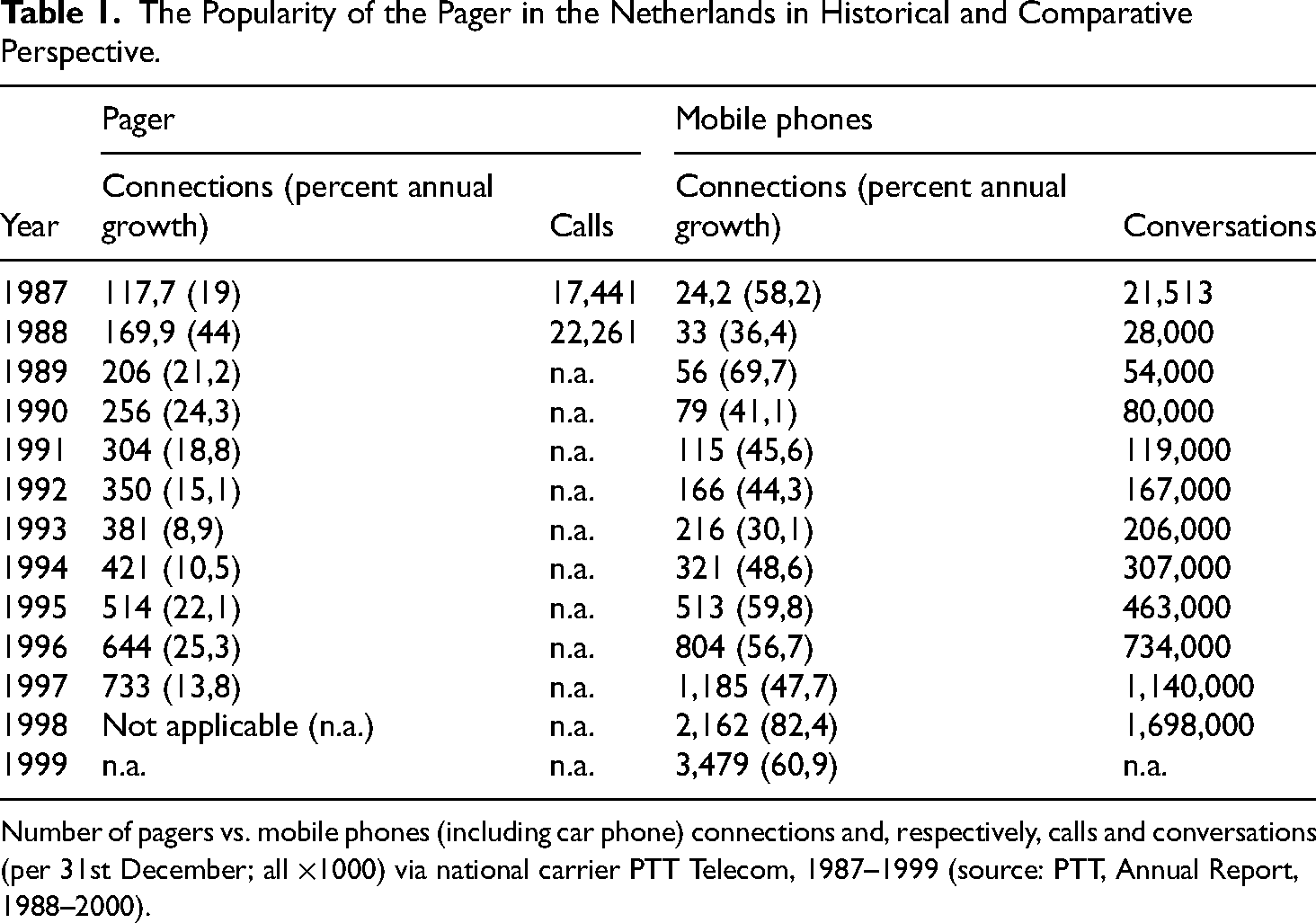
Number of pagers vs. mobile phones (including car phone) connections and, respectively, calls and conversations (per 31st December; all ×1000) via national carrier PTT Telecom, 1987–1999 (source: PTT, Annual Report, 1988–2000).
Up to 1994, the pager was the only truly mobile, wireless device through which people could be reached throughout the entire country, since the mobile telephony network required a car phone. In 1992, national carrier PTT Telecom did introduce portable handhelds that functioned without a car (originally called Kermit), yet these could only be used at certain designated locations. They also could not receive calls, which was why, as of 1993, they could be bought with a built-in beeper—underlining the pager's importance. After the Global System for Mobile Communications network was introduced in 1994, prepaid mobiles and texting (SMS) in the years thereafter, and prices dropped significantly, the mobile phones overhauled the pager and at the end of the century turned the latter into an obsolete consumer technology.
Analysis
The SCOT literature has suggested that it is vital to identify relevant “social groups concerned with the artifact and [analyze] the meanings that those groups give” to it (Pinch & Bijker, 1984, p. 414). In Dutch popular discourse, there was a clear difference between representations of professionals and consumers, which will be discussed in turn. Each of these subsections also addresses how these groups were targeted in advertisements, a crucial meaning-making site (Verhoef, 2015; Wevers & Verhoef, 2017). The third subsection will discuss the public opinion, particularly what the key social group of journalists and pundits made of the beeper and its alleged effects on society.
Professionals: reachability, efficiency, and service
Up to 1994, the pager was associated almost exclusively with professionals. A plethora of occupations such as police officers, rescue workers, and service technicians relied on this communication technology. A recurrent theme that stands out in coverage is that these professionals, particularly those whose work concerned emergencies, were expected to be reachable 24/7 wherever they were—which the pager made possible. Fire-fighters and medical personnel were the most prominent case in point. They occasionally complained that their lives were governed by pagers, which even accompanied them in bed, though such criticism took issue with pressure of the job, which the pager “merely” symbolized. If they quit or retired, this was habitually referred to as “handing in the pager.” Continuous reachability came to be expected of politicians, too. In 1991 the chairwoman of the Labor Party was abroad and nowhere to be reached when a crisis ensued, which would eventually cost her position–an incident that newspapers still referred to during the formation of government in 1994 and 1998.
It is intriguing to note that, complaints notwithstanding, this usage of the pager was barely questioned. I encountered only one example of “emergency professionals” that defied the expectation to constantly carry a pager. In 1987, local firefighters opposed the plan to replace sirens with pagers, for they deemed “the psychological load” to be unacceptable (Leeuwarder Courant, 1987). Apparently, professionals deemed unrelenting reachability commonsensical—and the hundreds of articles that, mostly in passing, described how central the pager was to their job helped naturalize this idea. As did advertisements, which of course always portrayed the pager in a positive light. One of the first, in December 1988, highlighted five “mobile occupations, often needed all of a sudden, often unreachable,” such as a plumber and nurse. It presented the pager as a solution; the necessity of being reachable, it was implied, was a given. Some professionals went one step further and explicitly presented the pager as an insignia that signified how dutiful they were. A press officer for example called it his second heart and a pastor said: “I will only retire when I’m in my coffin. And even then I want my pager with me” (Brabants Dagblad, 1999).
As pager sales rose, newspapers noted that its usage expanded. Next to enabling professionals to tend to emergencies, beepers came to be deployed to speed up tasks and increase efficiency. Examples abound. Budget-cuts caused nurses “to race against the clock and their pager” (Ploeg, 1993); the same went for cleaners. Cutbacks in the Catholic Church had pastors serve two or three parishes (“pastoral care with an eye on the clock”), which they managed by means of pagers. Again, professionals did not directly criticize the pager; it was perceived as a consequence and reflection rather than a cause of the acceleration and flexibilization of work life, as the next example demonstrates. After local public bus transport was liberalized—in itself telling of the neoliberal zeitgeist—and the company that had won the concession demanded that drivers flexibilize their duties and hours, they went on strike because “before you know it, we will have to carry a beeper with us: if you have to drive, they will page you” (Damme, 1995). In short, the pager enabled and required professionals to work more time and cost efficiently.
Though the pager proved a bane to many, newspapers reported that others capitalized on its affordances. New courier services were started and call girls could go to the movies rather than wait at home. About a hundred articles associated beepers with drug dealers (cf. Dutton et al., 2001, p. 13), who used them to speed up distribution. These articles, too, often framed the pager in economic–rational terms: efficiency was key. As one drug dealer put it: “The competition is fierce, so you have to provide service,” that is, 24/7 reachability (Trommelen, 1993).
Providing service to clients was a rationale for using pagers. A businessman explained: “Reachability is my trademark. Clients can reach me 24/7” (Bruijns, 1989). This rationale tied in with the second, increasing efficiency. Various organizations for example deployed pagers as an instrument that enabled clients to use their time efficiently. Some hair salons presented customers with a pager so that they could shop while waiting. Catering to the shopping needs of parents—a growing number of whom were strained for time, as outlined before—some supermarkets even started free in-house daycare, handing out a beeper so that parents could be paged if need be.
Congruent with its user base, most advertisements—save for the “teener beepers” discussed in the next subsection—targeted professionals. In the 1990s beepers were predominantly rendered an indispensable device for “the mobile businessman or woman,” as they enabled one to be “on the go, but at the office all the same.” To be successful, these advertisements conveyed, one had to be always reachable, which both furthered and normalized the idea that professionals were expected to be reachable. This is best illustrated by a 1991 PTT Telecom advertisement that read: “Success has a downside. The better it goes, the busier you are. And the greater the chance you miss out on something.” It explicitly presented the pager—next to other technologies such as the answering machine and mobile phones, which advertisements often did—as the only viable solution: “You can only achieve something if you are easy to reach.”
These advertisements seem to have been successful in that, going by public discourse, the 1990s saw a rising number of occupations adopt the pager. Usage was no longer limited to professionals that were frequently on the move; ever more white-collar workers were equipped with a beeper, too. Some companies even forced employees to answer their pager 24/7 under penalty of a fine (Escher, 1997).
The latter example underlines that not everyone was affected equally by the fast-paced, flexible society that the pager helped bring about (cf. Geldof, 2001). Though power differences were mostly left implicit, some articles unequivocally concluded that employees paid the price in the form of anxiety and stress, while employers benefited financially (cf. Breedveld et al., 2002, p.27). Intriguingly, one article reported that even employers widely acknowledged that technology and constant reachability contributed to stress and illness. They acted on this, but only in their own interest, as the headline powerfully encapsulated: “Important people exchange pager for secretary” (De Volkskrant, 1997). The article quoted managers who stated that “someone who really means something, decides for himself where, by whom and when” he is contacted, “so as not to be driven crazy”—an option the average employee obviously did not have. But even professionals who were arguably privileged were not immune to stress engendered by pagers. A famous Dutch saxophone player complained that pop artist Prince had treated her “terribly:” “He had me carry a pager 24/7, so that he could summon me to the studio whenever he wanted” (De Telegraaf, 1990).
Penetrating the consumer market: autonomous reachability
Until 1994 the pager predominantly remained in the realm of professionals. The miniaturization and introduction of (alpha)numerical models apparently had only limited appeal to consumers. Only when a new pager, the Buzzer, was launched in late 1994 did beepers penetrate the consumer market, creating a beeper resurgence (Table 1). In this subsection I argue that, rather than consumers (Okada, 2005), it was keen and relentless marketing which was critical to this success, which sold the wider populace on the advantages and expectation of continuous reachability.
Much to the chagrin of then-network monopolist PTT Telecom, in the early 1990s several pager providers introduced subaddressing, that is, they grouped up to 999 pagers under one subscription. This practice, next to the business market becoming saturated (Table 1), factored into PTT's decision to launch the Buzzer. Contrary to other pagers, it came with a unique telephone number right away and did not require a subscription. PTT made up for the latter by charging the one calling the pager a relatively high fee. Coupled with its relatively low price, the Buzzer became affordable to the average young adult, its prime target audience.
Journalists called Buzzers like they saw them: regular pagers in a new, hip outfit. The beeper had “the appeal of an Opel Kadett [a small family car]” (Nieuwsblad van het Noorden, 1994), Buzzers ought to change that. These “teener beepers,” they contended, were a mere gadget, which did not meet, but rather create a need. While PTT acknowledged that it was a gadget, it also claimed that market research had indicated that eighty percent of youth was interested in this type of communication. Though it is impossible to assess whether an intrinsic consumer need had existed, journalists pointed out that the then-recent history of portable phone Kermit (see Diffusion and usage) speaks against this. Kermit had been rather cheap and targeted youth as well, but had not caught on.
Consequently, journalists argued, a far more important reason for the Buzzer's success was marketing. Its launch was accompanied by an unprecedented campaign that cost over 10 million guilders. Together with other manufacturers and resellers, it chiefly targeted 17-to-24-olds. A deluge of radio, television, newspaper, and magazine advertisements followed and the device was promoted at dance parties, schools, and universities. In this way, PTT's wish that the Buzzer would become the Nintendo of the next years came true. In conjunction with resellers and youth press outlets—which, sponsored by manufacturers, handed out free Buzzers and wrote ravingly about them—they created a hype. In two years, 250,000 Buzzers were sold.
The way the Buzzer was advertised helps to understand how the pager was embraced by the wider populace—youth first, older consumers slightly later—as well as how the idea that continuous reachability was preferable gained acceptance. First, ‘Buzzing’ was successfully presented as a cool lifestyle, much like skating. The name itself exuded speed, as did advertisements (see Figure 1). Additionally, Buzzers were available in bright colors and Motorola named one of its models “LifeStyle.” They became a status symbol. “To Buzz and get Buzzed, that's what it's all about,” a news magazine quipped (Elsevier, 1995). A forum user recounted: “I got one and felt the man.” Second, to create a bandwagon effect PTT spurred the sense of a community. User guides and advertisements for example stressed that users could settle on codes, to communicate in an efficient and secretive way (e.g., “844” meant “Would you like to study together,” 349 “I have naughty thoughts about you”); booklets with suggestions were published (cf. Okada, 2005).
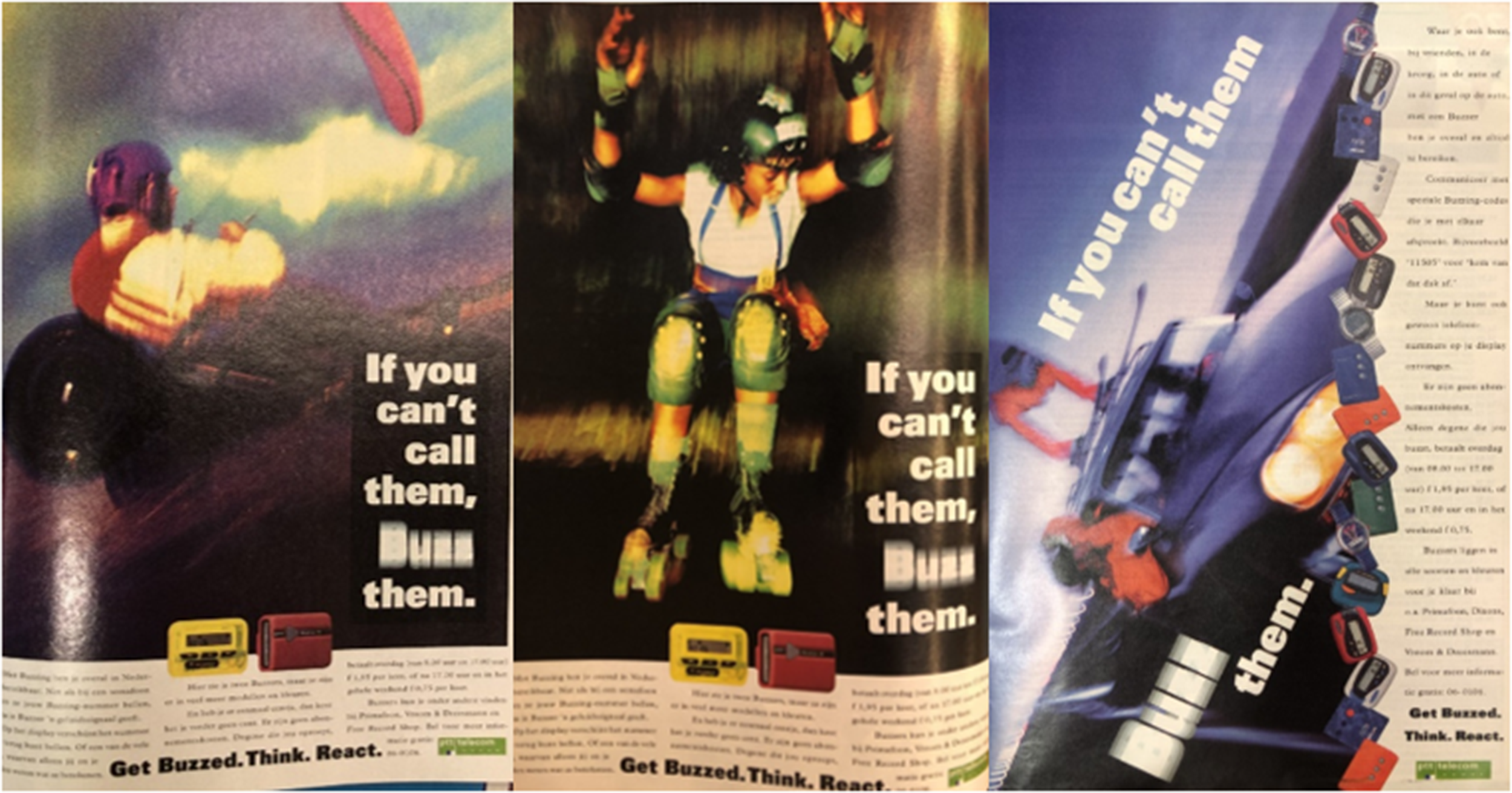
Pager advertisements in magazines.
The third frame is the most important considering this article. Newspapers and magazine advertisements presented the Buzzer as a device that enabled users to be reachable all the time, while they would also gain autonomy. These qualities seem at odds, for reachability could easily result in less control over one's actions, as demonstrated in the previous subsection on professionals. However, these qualities were reconciled in an intriguing manner.
On the one hand, the Buzzer campaign drove home the idea that it was desirable to be reachable 24/7. The first lines of the right-hand advertisement in Figure 1 for example read: “Wherever you are […], with a Buzzer you’re reachable, everywhere and always.” One needed to be, the slogan of Motorola's advertisements implied, in order to “keep in touch with life,” or, as Veronica Magazine put it, “so that friends can tell you where the next mega dance party is.” A Buzzer code book sponsored by PTT urged users to “keep your Buzzer within reach at all times to not miss emergencies” (Molegraaf & Haller, 1996, p. 20). Much like the 2022 campaign mentioned at the start of this article, it continued: “If you don’t want to be bothered needlessly, tell others when they shouldn’t buzz you.” 24/7 reachability, in other words, was presented as the new norm.
On the other hand, both advertisements and articles—so not just parties that had an interest in selling as many pagers as possible—regularly highlighted that those pagers gave users autonomy. In practice, responding to incoming messages required a telephone, which was not always at hand. But advertisements presented it in a different light. PTT's website “The Buzz” opened with: “Freedom is determining your own life. You yourself choose. You have that freedom with the Buzzer.” This included the freedom to decide whether one wanted to respond to incoming messages. Notwithstanding the final part of the Buzzer slogan (“Get Buzzed. Think. React”), the second part indicates that this was not an automatism. Other advertisements explicitly added: “Only if you feel like it, of course.” This discursive construction is remarkable, because PTT made money of usage and because it runs counter to the urgency that paging was ascribed, particularly in professional settings. Autonomy was foregrounded anyway, as it was conceived of as a competitive edge over the mobile phone, which was far outgrowing the pager. The mobile phone was expected to be answered right away, which, as some pager users attested to in public discourse, not everyone liked. A 20-year-old explained that she handed out her pager number to people she wanted to stay in touch with, but did not always want to speak to; true friends received her mobile phone number. A manufacturer posited that eighty percent of mobile phone conversations were not urgent and presented paging as means to curb empty calls that could increasingly be heard in public places—which frustrated many (cf. Wit, 2002, p. 267). In other words, the pager was construed as a communication technology that enabled reachability everywhere, yet shielded users from constant availability.
Since no research looked into it and publications barely wrote about it, it is hard to recount how often the hundreds of thousands of new (teen) pagers that hit the consumer market were used, what they were used for, and whether users experienced autonomy or rather felt tethered to their device. Usage was not negligible, since newspapers reported that some schools banned them (cf. Agar, 2013, p. 131). On the other hand, most forum users recalled that it had been a gadget rather than something functional. A letter to the editors of youth magazine Webber points in this direction, too: “Now that I finally have one, no one wants to buzz me. Could you print my number, so that readers can buzz me?” (Webber, 1995). It seems that the pager to youth predominantly was a symbol. A symbol of great historical significance, nonetheless, as it marked the transition to “our” contemporary era, in which people are expected to be reachable, wherever, whenever—which had not been the case before the pager. In the words of a forum user: “Funny how unreachable we used to be!”
The pager hype was strengthened and prolonged in 1995, when CallMax, the one competitor of PTT Telecom with its own network, introduced an alphanumerical beeper, the Maxer. It aggressively targeted youth, too, and gained over 200,000 customers. That same year, Swatch and Seiko introduced watches with built-in alphanumerical beepers, which sold over 50,000 units—which means that at its peak (cf. Table 1), close to one million Dutch people owned a pager. These smart watches avant la lettre were among the first pagers to offer news services (cf. Leung & Wei, 1999). Users could for example subscribe to stock market updates. This spoke to an older clientele, which increasingly adopted the pager, too. Newspapers noted that it became common for about-to-become fathers to hire a pager (“as soon as contractions start, they are beeped”); people on organ waiting lists purchased one. Families brought a pager on vacation; others used it for birdwatching or to set up a neighborhood watch.
Public opinion: rushed society
As the user base expanded, pagers increasingly elicited reflections on the societal consequences. Dozens of newspaper and magazine articles explicitly and elaborately grappled with the “reachability boom” that pagers helped bring about. Though journalists and experts admitted that devices such as the pager had advantages, particularly for professionals, the vast majority showed disdain.
Criticism that concerned professionals was often aired in a playful manner. Journalists mocked people who were believed to not truly need a pager. A mayor of a small town that prominently sported one was asked whether he had joined the fire brigade. It was claimed that many merely owned a pager as a status symbol, to project their alleged indispensability. “The greater the ego, the more communication means,” a typical comment held, embodied by workaholic chefs and politicians who, “next to the pecking order, have developed a beeping order” (Fokkinga, 1996). Its conclusion captures the prevailing attitude of journalists: “It's all baloney. There are very few people that have to be reachable all the time. The doctor, the fire fighter, the prime minister. That's about it, don’t let yourself be fooled and don’t fool yourself.”
As the number of pager users grew and came to include consumers, journalists started to berate pagers more vigorously. Beepers terrorized users, various journalists maintained, and led to reachability neurosis. One wrote that he “detested pagers, which have you telecommunicate even in the bathroom” (De Volkskrant, 1990). Always being reachable, they asked rhetorically, is this what we always wanted? Even some young people were annoyed, as illustrated by a sarcastic letter to the editors published in Webber: “Do you really have to be reachable everywhere? Imagine you miss out on something…That would be the worst. Everyone, get behind your Buzzer like a bunch of morons” (Webber, 1995).
Journalists and the experts they spoke with leveled criticism which would later be directed at the mobile phone. Work came to invade private lives. The popular Dutch children's choir Kinderen voor kinderen (1997) complained that parents were regularly beeped into work during leisure time. In a speech for the Dutch Institute for Efficiency, an organizational theorist chided managers for squeezing every drop of energy out of employees by the “all-seeing eyes” of beepers and mobile phones. Due to these portable mini-offices, a journalist added, the living room would gradually become a branch of the office. Several journalists implicitly invoked Rosa's acceleration cycle. “Because we’re in a hurry,” one wrote, “we are constantly reachable via beeper, fax, and portable phone,” yet the time that was freed was immediately used to take on more work (Blanken, 1994). In 1998, unions, churches, and environmental organizations jointly protested this “rush system without oasis moments” (Schipper de, 1998), that is, the emerging 24/7 economy, which among others was believed to be engendered by beepers.
The tenor in popular discourse was that professionals no longer had any respite and that the pager, together with other ICTs, consequently created pressure and stress. Though technologies were not deemed the only cause (cf. Historical background), they certainly contributed significantly. A professor of Organization Psychology, for example, was bewildered that even a stress expert he had spoken with had constantly been interrupted by his pager. Being on call meant being on edge.
Only a couple of times did journalists, pundits or, faced with criticism, the PTT emphasize that pagers had an off-button—usually glossing over the question whether users actually were in a position, that is, had the power to turn it off. Right after a newspaper article quoted a professor of Communication Studies who vehemently opposed the idea of 24/7 reachability (“I can’t get anything done if every idiot can bother me any time of the day”), it reminded its readers: “But customers of a commercial company of course do demand such reachability” (Dirks, 1999). The dominant idea was that “the 1990s are the turbo age of communication” (Snoeijen, 1994) and that being reachable always was reprehensible though inescapable. A psychologist diagnosed: “Technology isn’t the cause: it is the spirit of the times that imposes these [electronic] devices on us. Everything has to be faster, more flexible” (Hollander, 1995). Others criticized PTT. Since its denationalization in 1989 it constantly looked for new ways to make a profit. Consequently, it created “superfluous” gadgets such as the Buzzer and “drummed into the heads of youth” (Trouw, 1996) that one was expected to be reachable. Whatever the cause, many articles noted that the norm in the 1990s underwent a notable change: being reachable 24/7 quickly turned into “all but a civic duty” (Snoeijen, 1994). Asked to turn off her Buzzer for a moment during a diner à deux, an 18-year-old novel character for example replied: “I rather don’t” (Zwagerman, 1997, p. 189)—end of discussion.
In short, pagers were widely perceived as both a catalyst and a product of this reachability boom and the acceleration and flexibilization of society. Other technologies, particularly the mobile phone, were charged with creating a deep-seated feeling of hurriedness, too, but by sheer number of connections alone the pager was key in bringing this change about. One journalist encapsulated the result: “Everywhere the alarm bells of the modern age ring and rattle and time to breathe in this frantic epoch is ever shorter” (Wierenga, 1990). Except for advertisements and youth publications, the consensus in popular representations was that this could not be healthy. The pager helped usher in a 24/7 economy, which in turn led to a stress society. In other words, beepers were thought to create reachability that was chronic in both senses: persistent and troublesome.
Conclusion and discussion
This article examined the construction of the pager in Dutch popular discourses. It analyzed how key groups conceived of it and argued that the pager provides a window into a development that characterized the 1990s: the emergence of continuous reachability, and the expectancy thereof, which helped flexibilize and accelerate society.
Between the late 1980s and late 1990s, the pager turned into the first mass-market personal portable (albeit one-way) communication technology. 4 In the Netherlands, close to a million beepers were dispersed. Up to 1994, they were chiefly associated with professionals, who used them to be stand-by for emergencies, speed up tasks and increase efficiency, and offer customer service. Complaints about increasing work pressure and anxiety did regularly surface, yet professionals very rarely took direct issue with the pager; it was perceived as a symptom of changing work conditions rather than its cause. They apparently took for granted that the pager became an intrinsic part of their job; some even explicitly identified with it. In so doing, they helped naturalize the transition to persistent reachability, which in truth was a radical rupture—which was not accepted as easily elsewhere, the following anecdote suggests. At a 1988 medical convention in Belgium, Flemish doctors mockingly carried a potato—in Dutch: pieper, a homonym of pager—in their breast pocket: “We don’t want to lag behind our Dutch colleagues, who always carry a pieper with them” (Leeuwarder Courant, 1988). Advertisements drove home the idea that the pager was vital to tend to urgent matters and achieve professional success.
Beepers did not enjoy much success with consumers before the mid-1990s. The introduction of new (teener) pagers and the accompanying marketing campaign changed that. They were positioned and perceived differently than pagers for professionals. It was stressed that they—in contrast to the mobile phone, which by then was eclipsing the pager—gave users the freedom not to respond to calls or messages, while still emphasizing the advantage of being reachable on the go. It successfully warmed consumers, youth in particular, to the pager and helped normalize the idea that non-professionals, too, had to be reachable whenever, wherever (cf. Ling, 2012). This helped pave the way for the mobile phone, which turned reachability into availability. This is one reason why forgotten media such as the beeper should receive more scholarly attention: they “leave legacies that have been remediated in new media” (Balbi, 2015, p. 243), in this case a new norm.
The response of journalists who reflected on the reachability boom that pagers helped bring about, underlines that the success of the beeper was far from self-evident. Up to the early 1990s, beepers were chiefly associated with a limited number of occupations; other people that sported one were habitually considered posers. In a mere couple of years, this changed. Though journalists were aghast that the pager spread like wildfire, the dominant sentiment was one of begrudged acceptance. The communis opinio was that society undeniably and inevitably transitioned into a 24/7 society that demanded incessant flexibility, which the pager and other ICTs enabled. The “reachability neurosis” that the pagers helped to create has arguably only increased since, think only of the now common “nomophobia,” the anxiety experienced when one is without a mobile phone.
A limitation of a discourse analysis is that it cannot representatively establish whether and to what extent pager users themselves experienced an acceleration of life and an increase in stress, much less whether they did so because of their device. Public debates about popular media technologies tend to highlight extreme visions; reality might have been less black-and-white. No surveys were conducted in the Netherlands, but a study in the United States points in this direction. Though it functioned as an electronic tether, too, the beeper also aided users (Dutton et al., 2001). On the other hand, in line with my findings, focus group interviews in 1999 suggested that though reachability was important to both Americans and Dutch people, they perceived this differently: “The Dutch respondents need to have personal choice in the matter. They want to be reachable, but they definitely want to stay in control – no cell phone calls in improper places and at inconvenient times” (Mante, 2002, p. 118). This sense of autonomy, I argued, is one reason why the pager was popular among consumers, even after the mobile phone had entered the stage: it offered reachability without availability, a characteristic highlighted by advertisements.
The (experienced) relation between pager use and ceaseless reachability on the one hand and pressure and stress on the other likely differed per group. Whereas consumers could still enjoy autonomous reachability, in that they had the freedom to decide whether they wanted to act on incoming calls and messages, the (work) life of professionals was increasingly governed by the pager and other ICTs. Building on Sharma's power chronography, I contended in particular that the expectation to adapt to a new temporal regime worked out differently and unequally for employers and employees. By and large, the former seem to have reaped the financial rewards of the flexbilization and acceleration that new technologies such as the pager helped bring about, whereas the latter habitually faced negative consequences such as stress. Yet, it is likely that within the category “employees” not everyone was affected equally. Popular representations, however, are not the best source to study power chronography in more detail (cf. Sharma, 2014, p.15). Future research could examine the experiences of specific groups (Rose, 2014), for example, by means of interviews with cleaners. It should also be open to other potential axes of temporal inequalities, such as gender (Wajcman, 2015) and race—which were not evident in my data.
Finally, it would be interesting to compare my findings to the social construction of the pager elsewhere, particularly in the understudied Global South, as “institutional arrangements, public policy and national cultures” (Dutton et al., 2001, p. 29) factor into this construction.
Footnotes
Declaration of conflicting interests
The author declared no potential conflicts of interest with respect to the research, authorship, and/or publication of this article.
Funding
The author received no financial support for the research, authorship, and/or publication of this article.

Notes
Author biography
Jesper Verhoef is a historian and media scholar who has published on Digital Humanities, modernization, individualization, identity formation, and media history, with a focus on popular discourses surrounding new media such as cinema, the portable radio, the Walkman, and Nintendo's Game Boy and other handhelds.