




Abstract
This article considers the roles that smartphones play as young people living in low-income communities navigate everyday activities, including those of online civic engagement. Drawing on ethnographic data collected during the COVID-19 lockdown, we offer empirical and methodological support for Hartmann’s concept of mediated mobilism, highlighting smartphone-related frictions and tensions that emerge at the intersections of social and political mobilities and immobilities. Specifically, our data demonstrate that as smartphones kept young people on call for parents, caregivers, siblings and others who might need them to help negotiate the heightened demands that characterized family life during the pandemic, young people found themselves in situations that we term tethered compliance, torn between the desire to participate in online civic engagement and political mobilization and the need to fulfill various exigencies of family life that emerged as a result of physical and social immobilities. Whereas scholars previously argued that mobile media held promise for mitigating structural inequality and enhancing youth online civic engagement, our findings suggest that these technologies are instead adding a new layer to be managed.
Keywords
Introduction
Gloria, a 17-year-old who identifies as Latina, chose to create political commentary as part of an after-school civic engagement project. She selected images of Black Lives Matter protests juxtaposed with images of her own bloodied hands, arms, and neck, edited rapidly to Childish Gambino's song, “This is America.” She then used her smartphone to share the resulting video with friends and followers on her TikTok feed.
The smartphone plays an important role in the online civic engagement activities of young people like Gloria. In this article, we define online youth civic engagement as the behaviors that young people enact online that aim to promote the well-being of local communities and of wider society, often as they call attention to and seek to address injustices (Ferrucci et al., 2020; Kim & Kim, 2022). As they participate in online youth civic engagement, young people use their smartphones to view social media and then share forms of political expression that inspire or outrage them (Graef, 2016; Jenkins et al., 2016; Literat & Kligler-Vilenchik, 2019).
While many scholars have focused their analyses on the resource mobilization, protest activities, and shared forms of political expression that take place in social media spaces (see, e.g., Kaskazi & Kitzie, 2021; Lane et al., 2018; Lee, 2018; Literat & Kligler-Vilenchik, 2018), more research is needed to better understand how and when US young people, and in particular those who live in low-income and under-resourced neighborhoods, actually use their smartphones to enter these online civic and political spaces in the first place. We argue that it is important to consider not only mobilization as traditionally understood in political communication but also as it occurs in the spaces between possibility and actuality in both the social and technological realms. We are particularly interested in the approach of mediated mobilism as articulated by Maren Hartman (2013), who underscored the ways that mobility relates to the concept of domestication, in that mobile phones are personal devices that move with individuals and that have affordances that must be enacted and interpreted by users in those contexts of mobility. Hartman proposed that scholars must first consider the smartphone's use “while-doing-something-else,” and then consider the technology's relationships with both political mobilization and with social/economic mobility, paying attention to the frictions that emerge in relation to mobile phones as people are mobilized or immobilized and as technological affordances are actualized or not. Rousseau (2016) and Fernandez-Ardevol and colleagues (2019) further developed Hartmann's concept by considering the consequences of increased fluctuation, mobilization, and mobility, exploring the individual traits, personal relationships and networks, and community connections that affect the ways social connections are made and unmade via mobile phones. Karnowski (2020) observed that this approach encourages researchers to consider a more fluid notion of home, questioning the extent to which mobilities make the contemporary home possible (see Hartmann, 2014; Keightley & Reading, 2014).
Fortunati (2023) further argues that rather than isolating the smartphone in our studies, we need to look at how this technology is part of a network of personal technologies, conceived and designed together with a whole set of digital technologies that are increasingly integrated with each other. The smartphone makes it possible for people to engage in an ever-increasing number of societal activities while on the move or wherever they happen to be at the moment. In this article, therefore, we consider how young people use their smartphones to participate in civic and political activities while also in the midst of their everyday lives. Relying on ethnographic observational data gathered via Zoom during the lockdown period of the COVID-19 pandemic, we explore the contexts in which young people used their smartphones to engage in youth online civic engagement activities. This period of time offered a rare view into the ways that smartphone affordances intersected with the actual and imagined aspects of the technology, thus revealing tensions and frictions in the ways youth online civic engagement activities were experienced in young people’s everyday lives.
We build on Neumayer and Stald's (2014) work that identified the affordances of mobile phones as increasing repertoires for coordination, mobilization, and the creation of counternarratives. We also build on the research of Mendoza Perez and Morgade Salgado (2020), whose ethnographic work among transitory Spanish young people identified how mobile phones allowed young people to participate in youth microcultures while maintaining close relationships with relatives and community members. Grounded in these works, we argue that in order to understand online youth civic engagement among those experiencing marginalization, it is important to foreground the ways that the smartphone is central to both the negotiations and the frictions that come up in young people's everyday lives.
The pandemic further heightened societal inequities and deepened the challenges facing people who are experiencing multiple intersecting forms of marginalization (Milan et al., 2021; Robinson et al., 2021). And much as the smartphone became a source of heightened “presence bleed” (Gregg, 2013) for upper-income families as home and work boundaries collapsed, we observed marginalized families experiencing what we here refer to as tethered compliance, a term we develop in this article as a means of further exploring the frictions that emerge in relation to mobile phones, mobilities, and immobilities in the context of family and home life.
As detailed below, we observed that as members of families experiencing marginalization negotiated school, home, and co-curricular activities from their homes, the constant presence of the smartphone made it possible for young people to be called upon by parents and caregivers at any time. And as parents and caregivers managed their changing work situations, many of which involved essential front-line work that was regularly impacted by sudden outbreaks, quarantining, lockdowns, or other interruptions, parents and caregivers relied on young members of their family in new and often urgent ways. Thus, young people were expected to be available to comply with requests for assistance in childcare, transportation, or work-related tasks, and the urgency of the situation meant that such requests needed to take precedence over all other commitments the young person might have. In effect, young people in low-income families became the invisible labor force that made it possible for their parents and other family members to provide maximum availability as front-line and service industry workers within the economy of what Kaun and Trere (2020) and others have termed accelerated capitalism. This situation of tethered compliance shaped how young people experienced participation in civic and political life during the pandemic, and, given the heightened demands on lower-income family life, we argue, it serves as a bellwether for what participation in online civic engagement may continue to look like, both now and in the future.
In this article, we explore the following research question: How can scholars best understand the role of the smartphone among civically and politically minded marginalized young people as they seek to navigate the dynamic tensions between systems of family, school, peers, and community? To consider this question, we review data gathered from two interdisciplinary ethnographic research projects. With an emphasis on leadership and online civic development, these two civic engagement projects sought to provide support to at-promise youth (a term developed as an asset-based contrast to the deficit-based idea of at-risk youth; see Rios, 2011, 2017). As the young people in these after-school endeavors relied on their smartphones to both participate in after-school online civic engagement activities and to navigate home, school, and family life, they encountered many unanticipated challenges. An analysis of observational and interview data, much of which was recorded via Zoom, offered an opportunity to better understand how dynamic tensions related to conflicting logics of mediated mobilism played out in the lives of young people, in particular those who were experiencing marginalization and who were seeking to participate in online civic engagement activities as newcomers to politics. Through this analysis, we are able to illustrate the tensions and frictions that we believe are central to Hartmann's concept of mediated mobilism, thus providing empirical support for the concept and further highlighting the importance of examining the mundane when considering questions of political mobilization.
We begin with a discussion of what we mean by online youth civic engagement, youth political participation, and youth political mobilization, followed by an introduction to the term tethered compliance as it grows out of existing research on mobile phone use in family situations. After a discussion of our methods, we then introduce four different modes of participation we observed in the online civic engagement activities of young people who, during the pandemic, were experiencing immobilities related to marginalization yet were also determined to participate in their own self-mobilization in the political realm. As we review the role of the smartphone in their activities, we highlight the seemingly mundane factors of everyday life that served as barriers to full participation in youth online civic engagement activities. The article thus further raises questions regarding what we understand immobility and mobility to mean, and how the smartphone plays a role in creating frictions that work to hold certain immobilities in place.
Literature review
Youth and online civic engagement
As noted above, we define online youth civic engagement as the behaviors that young people enact online that aim to promote the well-being of local communities and of wider society, often as they call attention to and seek to address injustices (Ferrucci et al., 2020; Kim & Kim, 2022; see also Barrett & Pachi, 2019). Following Cohen and Kahne (2012), we consider online youth civic engagement as a form of participatory politics—a concept used to describe efforts that employ new media tools to exert voice and influence on such issues of public concern (Kahne & Bowyer, 2018; Kahne et al., 2021; Middaugh & Asato, 2020; Middaugh et al., 2017). Previous research has established that youth offline participation predicts online engagement (Kim et al., 2017) as does the use of social media for news consumption (Pang et al., 2022), and that those who use mobile social media to communicate with a wide range of people develop a sense of social capital that in turn leads to greater levels of civic engagement (Kim & Kim, 2022).
Previous research has established that youth of color are more likely than their white counterparts to be cynical about existing political systems and to encounter state and police violence when engaging in political activities (Gordon & Taft, 2011; Lee, 2018). Research has documented the negative impact that political rhetoric can have on Latine, Muslim, Asian American, and queer and trans young people (Saleem & Ramasubramanian, 2019). Nevertheless, many young people who are marginalized or have experienced marginalization still express interest in addressing important societal concerns, including systemic racism (Hope et al., 2016). Programs of civic engagement that emphasize training in youth leadership and Paulo Friere's (1970) conscientização can be powerful tools for at-promise youth living in under-resourced neighborhoods, as participating in civic life is linked with academic achievement as well as self-esteem, social connectedness, and health and well-being (Ballard et al., 2019; Ozer, 2016; Watts et al., 2011).
Scholarship also has observed that young people assume political agency as they participate in self-mobilization and in mobilization with their peers through the activities of participatory politics (Jenkins et al., 2016), and that even though these online spaces are often adult-designed and sometimes adult-managed (Banaji & Buckingham, 2010), there is evidence that young people find ways to negotiate their own viewpoints and activities in order to fulfill their civic goals (Pathak Shelat & Bhatia, 2019).
Although some have noted that there is unequal participation as a result of a lack of digital access or disposable income (Jenkins et al., 2013), few studies have considered where young people are located when they participate in these activities, or on which days of the week or times of day they are most likely to participate. In effect, there is little research on the out-of-school contexts in which young people participate in youth online civic engagement activities. This is interesting given the fact that in spite of the many differing approaches to defining civic engagement, most seem in agreement with the early argument of Verba and colleagues (1995) that civic activity is voluntary. This suggests that it is important to consider the contexts in which young people spend most of their time: at home and at school.
The smartphone in the everyday lives of young people
Mobile phones largely have been viewed as an extension of the teenage self (Lenhart, 2009; Lenhart et al., 2010; Oksman & Rautiainen, 2017). Some scholarship has documented the tensions that have emerged as young people have sought to bring their smartphones into the contexts of their academic lives, as parents have expressed opposition to the incorporation of smartphones into the school day (Hadad et al., 2020) and teachers have been divided on the extent to which the smartphone is best viewed as a source of educational innovation (Kiger & Herro, 2015) or, more commonly, as a reason for heightened concerns regarding distraction, cheating, and bullying (Deni Sutisna et al., 2019; Martinez & Olsson, 2021). Validating many prior concerns, scholars found that when smartphone use increased dramatically during the pandemic, there were related increases in negative clinical, psychological, and social outcomes among children and adolescents (Serra et al., 2021).
Prior to the pandemic lockdown Katz (2017) had documented the fact that many lower-income immigrant households in the United States were under-connected, with shared devices, limited data plans, slow internet speeds, and occasional service disconnection. This earlier work suggests that during the pandemic, for many there was little choice: in households where there were shared laptops or other limits, young people experiencing marginalization generally relied on their smartphones almost exclusively for educational as well as for all other activities.
As many activities moved out of public spaces and into private ones during the lockdown period, the role of the smartphone in the context of family life took on heightened importance. Earlier mobile phone scholarship demonstrated the ways that changing individual and familial usage patterns and decisions had an effect on the quality of interpersonal and familial life (Storch & Ortiz Juarez-Paz, 2023). Others have explored youth and issues of parental control and relationships, at times across geographic distances (Horst & Miller, 2006; Ling & Yttri, 2006; see also Madianou, 2016). Research has suggested that young people learned to navigate their privacy and to develop strategies of resistance to parental monitoring through their uses of the mobile phone (Clark, 2013; Ling & Haddon, 2008).
Some scholars in the area of family and young people's communication have utilized the term “tethered” in relation to mobile phones prior to the pandemic. Mihailidis (2014) argued that young adults perceive themselves as tethered to their phones and thus to their peers. Wajcman and colleagues (2008) observed that while the mobile phone tethers parents to their work, it also can allow parents to maintain stronger connections with their family members and friends (Wajcman et al., 2008). Ribak (2009) suggested that the mobile phone both connects parents and teens and also mediates their relationships: “The mobile phone serves as an object that both ties parents and their adolescent children together and at the same time contributes to the growing autonomy of the latter,” she argues. We found that during the pandemic, the smartphone similarly tethered parents and their adolescent children. Yet we found that in addition to the potential for heightened youth autonomy, the smartphone also placed young people in situations in which they were expected to be less autonomous, and more heavily relied upon, as members of their families. We argue that if we are to better understand the roles that the smartphone plays as young people seek to participate in youth online civic engagement while also navigating the dynamic tensions between the many other demands on their time, we need to understand more about these tensions as they play out in relation to mobilities and immobilities.
Methods
Data for this article were generated via two after-school projects that took place between March 2020 and March 2021, as the authors provided pedagogical leadership while also working alongside paid staff in low-income-serving not-for-profit urban organizations. Across the two projects, a total of 25 young people and 12 adult and young adult mentors were involved, generating more than 36 h of observational material and more than 50 material artifacts of young people’s experiences with online youth civic engagement. The research received approval through the institutional review board at the home university of the researchers, with written consent received from parents and verbal assent from participants under the age of 18. Names are changed in accordance with this consent and assent and to protect the privacy of participants and their families.
All of the youth participants lived in economically precarious neighborhoods where the average household income was well below the median household income. Participants in the first project, the Gang Rescue and Support Project (GRASP), included one African American and three Latino males between the ages of 16–18 years, each of whom had been impacted by the educational and/or criminal justice system. Youth participants in the second project, YELL (Youth Engaged in Leadership and Learning), at first included 21 young people, although the number of regular weekly participants dropped after the first month to 11 young people between the ages of 13–17, including one Latina, two Asian American females, an Asian American male, an African American male, two African American females, three white females and one white male. There were four GRASP youth workers including one of the article's authors, two of whom were Latino and two African American, and eight YELL leaders, four of whom were college students (two Latine, two white), two were graduate students (one Latino, one white), and the other two leaders were the article's other authors (one Latino, one white). Each of the adult and young adult leaders had been trained in critical race pedagogies and critical race media criticism (Ginwright & James, 2002; Ramirez, 2018).
Youth participants were recruited into both programs based on their involvement in year-round after-school programs that had served young people in impoverished communities for many years. Youth received a small stipend for their participation, and aside from the authors, all adult and young adult leaders were also paid.
Both projects embraced Youth Participatory Action Research (YPAR) approaches and engaged young people in the work of discussing how race intersected with other forms of social and cultural oppression. As we collectively identified community problems, developed a supportive community for action, and worked together to address those problems, the endeavor followed Friere's critical consciousness pedagogy, which situates young people as questioners who identify and seek to transform oppressive structures through actions of solidarity (Friere, 1970; Giroux, 2010). The GRASP project utilized photo voice methodology to visually document community disparities and engaged youth in producing docushorts highlighting the stories, testimonies, and conditions of their community to be used later in a digital organizing campaign on Instagram, X (formerly Twitter), TikTok, and Facebook (Bender et al., 2017). The YELL project involved young people in the analysis and critique and then the creation of their political expressions for sharing on TikTok, Instagram, and YouTube, following methodologies of critical media literacy (Clark et al., 2020; Jimenez & Clark 2022; Jimenez et al., 2021; Mihailidis et al., 2021).
Although originally planned for in-person participation, when the pandemic began in 2020, both of these projects moved online. A total of 36 meetings took place via Zoom, FaceTime, or phone calls between young participants and leaders, and each meeting was documented via field notes or video recording.
Information about and summaries of meeting recordings were entered into Dedoose, an online platform used for qualitative data analysis. Additionally, all materials that were mentioned, critiqued, shared, and created by the young people were also entered into Dedoose. We employed Dedoose to use a grounded theory approach (Strauss & Corbin, 1998), beginning with open coding so as to break the data into distinct parts, first by the chronological order of team meetings and in relation to youth participants. We then engaged in axial coding in which we organized the codes into themes. At this stage we began to notice patterns in how and when young people withdrew from participation and the reasons they gave for their withdrawal. We also observed differences in the devices that were available to the participants during the pandemic. We developed a codebook to code experiences of how and when young people withdrew from participation, the reasons they gave, and the devices that were available to them during the pandemic.
In the final selective coding stage, we integrated broader themes so as to develop an explanation of the findings. At this point, data analysis proceeded from the framework of mediated mobilism, as we first considered the aspect of the smartphone's use “while-doing-something-else” (Fujimoto, 2005; Hartman, 2013), and then considered the relationship between the contextualized nature of the smartphone's use and the technology's relationships with both political mobilization and with social/economic mobility. This led us to map the various ways in which the young people in our studies were experiencing (1) physical mobility and immobility due to the conditions of the lockdown, (2) socioeconomic immobility and their aspirations to mobility, and (3) political mobilization and demobilization, all occurring in the actual or imagined experiences of mobilization and mobility and all taking place (4) while engaging in the mundane activities of everyday life, or “while-doing-something-else.” We see this approach as consistent with the mobile ethnographies that Hartmann (2006) has called for in that we wanted to foreground not only devices but also how they, and the subjects who used them and those of us observing and participating in actions with them, were in motion, thus integrating more “mobile” concepts into the methodologies available for researching mobile media.
Findings
We began by looking at physical mobility and immobility and how these conditions shaped youth participation in online civic engagement activities. We witnessed mobility as the young participants frequently moved from place to place within their homes or neighborhoods, often as they were engaged in supervising younger family members, participating in online youth civic engagement activities while engaged in the activities of their everyday lives. We also witnessed immobility, in that the young participants were confined to their households in part due to pandemic constraints but also in part due to the constraints that emerged in relation to the particular situations of their households as we detail below. We witnessed socioeconomic immobility that led parents and caregivers to work many hours in low-paying positions during the pandemic, relying on young people as caregivers, household managers, and transportation providers. We also witnessed imagined opportunities for upward socioeconomic mobility. This had been particularly evident prior to the experience of the pandemic as parents of the young participants had been invested in the academic success of their young people, which involved signing consent forms to support their participation, ensuring that their children had transportation to voluntary activities, and speaking with enthusiasm about the leadership and civic engagement training programs in which their young people participated.
Finally, we witnessed the desire to engage in political mobilization, as the young participants discussed and critiqued local and national protests and shared evidence of these events with one another via their smartphones, as they used their smartphones to sign and create and circulate petitions, and as they used their smartphones to experiment with sharing forms of political expression with one another and with their peers (see also Jimenez & Clark, 2022).
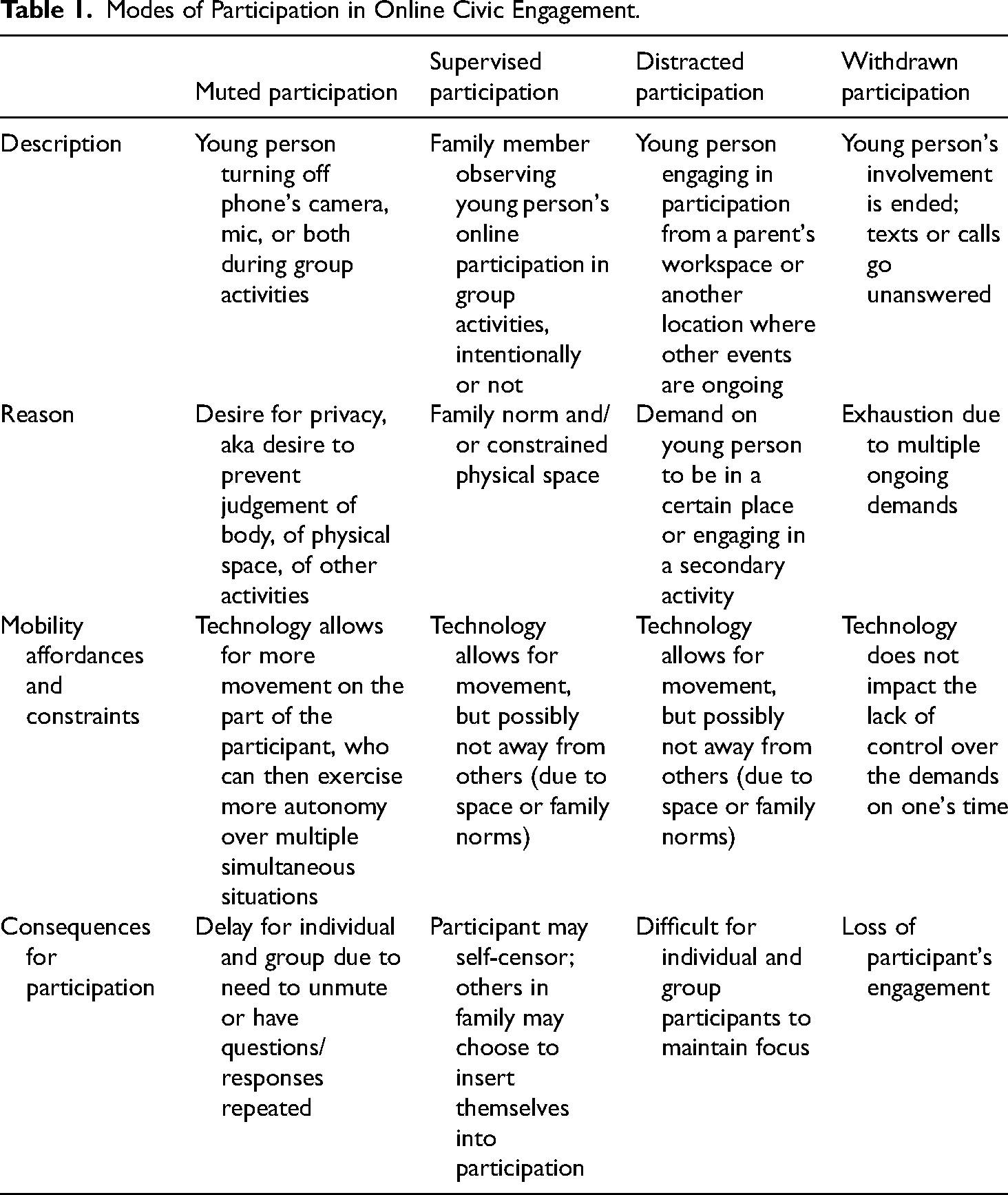
Drilling down further into the data, we identified four modes of participation that emerged among young people as they utilized mobile communication in online civic engagement activities: muted, supervised, distracted, and withdrawn participation. Each of these modes highlights both an extension and a grounding of concepts of mobility and mobilization, fleshing out how Hartmann's concept of mediated mobilism reveals the socioeconomic and familial forces limiting the full smartphone participation of young people, whether at home or in motion (or not). We detail these modes of participation next.
Muted participation
Muted participation was evident when young people turned off their cameras, their microphones, or both during their meetings with others. This practice was prevalent across almost all participants and even more so among those with smartphones when compared with those utilizing laptops. The mobile phone allows for movement, and we noted that the more movement the young person engaged in, the more likely they were to be muted. One young African American, Noah, was walking around his neighborhood headed to the park with his younger brother during a meeting when the group were discussing their responses to the national Black Lives Matter protests in May and June of 2020. When he was asked questions by his peers or adults, his response was often delayed as he had to unmute to speak, or in some cases he had to be caught up.
Sometimes, it seemed that young people might have engaged in muted participation out of a desire for privacy, for example in the large group meetings that involved some participants they did not know well, as a turned-off camera protected them from judgment of their physical bodies. Other young people may have wanted to avoid having their peers or other members of the team examining their household surroundings. We observed that muted participation also occurred because of limited access to high-speed Wi-Fi or cellular service, as Wi-Fi freezes were more frequent when onscreen visual data demanded more bandwidth. Because the limits of access provided a reasonable rationale for turning off cameras or microphones, this may have been voiced as a more palatable and socially acceptable reason for keeping one's camera or microphone turned off. This muted mode of participation is an example of mediated mobilism in that it shows the intertwined nature of mobilities and mediated communication, here with the additional emphasis on the particularity of mobile media as well as how these mobilities impact social and civic participation.
Supervised participation
We identified a second mode as supervised participation. Almost all of the young people in our civic engagement projects had experiences when parents or grandparents entered the rooms where they were participating in discussions and in civic engagement work with others. At one point, for example, Arianna, a Latina university student-aged mentor, asked a group of four young people to talk about what issues they’d been paying attention to and to which they would like to respond. Jessica, one of the white participants, responded that she would like to create a TikTok that highlights how young people of color are experiencing heightened racism. This prompted a response from Gloria, the young Latina introduced earlier, who is a member of her color guard team. In US high schools, the color guard team provides “color” while the band plays at halftime by twirling flags and rifles in choreographed routines. Gloria, who twirls a rifle on her school's color guard team, explained to the group that she lives in what she described as a “white” neighborhood. “I refuse to practice outside with the rifle, because I have this bad feeling that people are gonna be like, ‘oh my God, she has a rifle with her, what are we gonna do?’ I just have a bad feeling about it. So I refuse to use my rifle outside even though I really need to practice, so I’ve been trying to do it in the backyard but there really is not that much room and I could break a window.” Just as she was talking about having a “bad feeling,” her grandmother walked by behind her, appearing in the Zoom frame for a moment with a quizzical look, expressing her curiosity about what Gloria was saying and to whom. Then, after Gloria had stopped speaking and her grandmother had moved on, Gloria started to laugh and told the group sheepishly, “that's my grandma in the background.” In this case, the mobility of a laptop allowed Gloria to set up virtually anywhere that Wi-Fi reached at home, but either because of a limitation of space or a request to be within earshot of family, the laptop and Gloria were both situated in the kitchen. In her communal location, Gloria had to navigate the ways that others in her family might listen in and potentially misunderstand her as she sought to share with those in the online meeting her lived experiences of racism and her desire to find ways to respond to it collectively through civic engagement activities.
This supervised mode of participation is an example of mediated mobilism in that it again shows the intertwined nature of mobilities and mediated communication, this time emphasizing the ways that mobilization and civic engagement activities can be shaped by the lack of some control over spaces and mobilities. As young people like Gloria navigate expectations as they participate in online civic engagement activities while under some form of supervision or surveillance in the home, this situation influences how the young person may perceive the limits of what actions they can or should engage in. These perceptions, made possible because of the smartphone as a vehicle for participation, shape youth social and civic participation.
Distracted participation
Family members became part of the conversation in other ways, as well. In the third mode of participation we observed, young people were immersed in situations where a great deal of “something else” was taking place. Jake, a 15-year-old who identifies as Vietnamese, participated in almost every meeting from within the restaurant where his parents worked. Jake had a laptop, but regularly switched to a mobile phone and cellular data because of inferior Wi-Fi at the restaurant. His participation, like others who accompanied their parent to a workplace, was often punctuated by the distractions of the workplace environment. During one meeting, he was talking with a small group of five peers and a university student mentor. He described his wish to create a media intervention that would encourage people to respond to Black Lives Matter in a way that would enlighten them about predictive policing while inviting them to share their own experiences with racial injustices. As he spoke, it was evident that a great deal was happening in the restaurant. During the 2 min that he was thinking through and articulating his ideas, it was possible to hear the sound of a hammer pounding in the background and then a small child speaking, yelling, and then singing. Throughout these noisy interruptions, Jake continued to look intently at the group through the camera in his phone, although his struggle to maintain focus in the midst of a distracting situation was evident.
Distracted participation thus also served as a distinct form of mediated mobilism. Under supervised participation, young people navigated a balancing act over what they shared and which unintended audiences might be listening, but with distracted participation, adults were otherwise engaged and the young person's challenge involved timing their verbal contributions to the group while mitigating surrounding distractions and staying focused in both group and individual civic engagement work. The smartphone made it possible for Jake to participate in civic engagement activities, but the family's movements were limited by their lack of transportation and the need for the entire family to be in the same restaurant location for extended periods of time, thus again highlighting the frictions between the imagined opportunities presented by the smartphone and the actualities that curbed those opportunities. Still, despite the high level of distraction we observed in Jake's environment, Jake was among the most productive of the young people involved in online youth civic engagement activities, creating the most social media content and gaining the attention of state legislators (see Jimenez et al. forthcoming).
Serving as a childcare provider was the most common context for distracted participation that we observed. In our summer endeavors, the young people of color, especially women participants, experienced a gendered division of labor as they became the main caretaker of their siblings while older caregivers were at work, often in front-line jobs. Four of the 11 young people who participated in the summer of 2020 were always in the company of a younger sibling, cousin, or neighbor during their involvement in civic engagement activities. We observed one young man moving around with his smartphone as he needed to follow younger siblings or move to a quieter space. At one point his younger brother made an appearance on his screen to ask what he was doing. The inadvertent participation of a younger sibling occurred for the two female multitasking childcare providers as well. Sometimes these young multitasking caregivers turned off their cameras or their microphones to address the needs of the children who were with them. Distracted participation is thus another example of how mediated mobilism can reveal the frictions between aspirations for mobilization as aided by the smartphone and the actualities of in-person demands that make participation in mobilization difficult or impossible to achieve.
Withdrawn participation
Sadly, several young people who had started the programs that encouraged youthful online civic participation eventually withdrew. One reason given was the pressures of childcare and multitasking. One 16-year-old female African migrant let the group know that she needed to withdraw from the project after the first week due to childcare demands; another female African migrant attended for three weeks and then returned texts intermittently before dropping out entirely. A third female of the same age and cultural background (all three were Muslim) withdrew because, as she explained, she was balancing a part-time job to support her family, caring for younger children, and schoolwork. Each of these young women had been involved in earlier online youth civic engagement efforts, with one creating a video about her neighborhood's experiences with gentrification, another creating a piece highlighting her experiences of racism in school, and the third questioning anti-Muslim bias. Noah, the male African American multitasking childcare provider introduced earlier, attended one online meeting, engaged in muted and distracted participation, and then did not answer texts and phone calls. In the years before the pandemic, Noah, like the young women who withdrew, had been one of our most energetic youth who, without fail, had attended every in-person meeting and had contributed extensively. Another instance of withdrawn participation surfaced in relation to other economic pressures and needs of the family. One of the GRASP youth participants, Joaquin, an 18-year-old Latino male who was a former school pushout and was system impacted as a juvenile, truly began to experience an awakening of social consciousness and motivation for social change during the political participatory program. As part of the group's commitment, members of the GRASP team were preparing to present their research findings and recommendations as an advocacy tool for city officials, school board members, community leaders, and youth leaders from several different community-based youth organizations in the Denver metro area. However, the global pandemic's call for a shift to meeting virtually via Zoom and the need for youth participants to use their smartphones as their primary device to access the project created challenges and barriers to their initial heightened level of engagement. Joaquin, who was one of the outspoken members of the team, needed to withdraw from biweekly meetings and from virtual presentation opportunities because his mom, who worked as a domestica (housekeeper), was unable to clean her clients’ houses due to COVID quarantine restrictions. Joaquin got a full-time job at Walmart, becoming an essential worker, in order to financially assist his mom in paying the rent for both his immediate and his extended family. Withdrawn participation reveals an understanding by youth that given their particular circumstances and set of responsibilities, there simply was not enough opportunity for them to engage in muting, supervised, or distracted participation.
Withdrawn participation was the most extreme instance of mediated mobilism, revealing the challenges of social economic mobility and the resultant physical immobility of young people who were in effect demobilized after first seeking opportunities to participate in civic engagement and political mobilization (Table 1).
Modes of Participation in Online Civic Engagement.
Participation and tethered compliance
In each of these modes of participation—muted, supervised, distracted, and withdrawn—we observed the felt need for the young people involved in civic engagement projects to remain “on call” for parents, caregivers, siblings, and others who might need them to help negotiate the increased demands that characterized family life during the pandemic. We term this felt need tethered compliance to highlight the many ways that youth's online and mobile communication is not friction free, but demands that they navigate existing responsibilities, family situations, and shared spaces. Furthermore, we argue that tethered compliance may be a characteristic of political participation for young people who are part of many families experiencing various forms of economic, social, political, and cultural discrimination and marginalization, and this needs to be taken into consideration when designing, implementing, or otherwise hoping for youth civic and political participation, whether via smartphone or in person. As it took place during the unique moment of the pandemic lockdown, our study was able to foreground challenges that young people and those in their family and social circles had negotiated and would continue to negotiate as they balanced any desire for political participation with other often competing expectations. Many of the young people engaged in these four modes, and thus these modes of participation need to be part of how scholars and others conceptualize youth civic and political participation in the future.
It is worth noting that some young people we observed were able to participate regularly online from their bedrooms with minimal distractions. These young people primarily relied on laptops or desktop computers, and occasionally used a smartphone as a backup. They were either the only child in their family, they had their own room, or they had dedicated space in the home apart from other siblings where they were able to participate uninterrupted in their own online activities. These young people were able to exert greater control over their time, space, and physical mobility in order to maintain a quiet and focused domestic space. They experienced fewer frictions of mobilities and mobilization, and as a result theirs were some of the most productive contributions to youth political participation in the civic engagement programming we observed.
Discussion: Mediated mobilisms and the problem of tethered compliance
In their study of digital and mobile media use among communities that have experienced disaster, Madianou et al. (2015) observed a structuring of opportunity according to class and resources similar to what we observe and describe here. Additionally, building on Palen and Hughes’ (2007) observation that mobile phones extended the scope and reach of “home base” and of parental influence and obligation, we found that older children were compelled to operate within an expanded realm of “home base” that overlapped and interfered with their own autonomy, which in turn curtailed their ability to move as freely as they otherwise may have preferred.
The young people themselves, while they of course had agency to make their own choices, were living in a context that prized familial relationships over almost all else. The same young people who wanted to express care for the concerns of their communities therefore also were inclined to express care for the concerns of their immediate and extended families. They laughed off the reality of parental or grandparent surveillance, willed themselves to focus through familial distractions, and removed themselves from group activities when the technology, the family situation, or either their personal desire for privacy or their exhaustion compelled them to remove themselves. They were making the best choices they could given the constraints they experienced in their own processes of navigating their sociomaterial circumstances during the lockdown period of the pandemic. Their phones enabled tethered compliance, or opportunities both for participation and for connection to responsibilities that might distract them from that participation at any time.
We use the term compliance to signal that young people are making a choice to be agreeable to the requests of caregivers. Compliance with parental and familial demands in situations of smartphone-related frictions is, we argue, an expression of the fact that mothers and grandparents were particularly important in the lives of the young people we studied who had an expressed desire to be involved in online youth civic engagement (see Jimenez & Clark, 2022; Jimenez et al., forthcoming). This is consistent with the research of Muddiman and colleagues (2019) who, in their study of 976 13–14-year-olds in South Wales, determined that “the family is the most frequently identified route into civic participation,” the mother is the strongest predictor of young people's civic participation, and “parents played a strong role in encouraging young people to take part in civic activities” (see also Davis et.al., 2021; Fredrickson & Losada, 2005; Holden et al., 2016; Luengo Kanacri et al., 2020).
The young people we observed experienced physical mobility and immobility as they cared for siblings while also moving around and navigating their own efforts to participate in youth online civic engagement efforts. They experienced constraints that came about as a result of the family's socioeconomic immobility as they were confined to small household spaces or to parental and familial workplaces. They sought avenues to participate in self- and peer-oriented mobilization activities, yet also found themselves in situations in which withdrawal, and hence demobilization, was their only option. In this sense, we observed, in an extension of Hartman's (2013) and Karnowski's analysis, that mobile technologies made possible not only youth participation, but also the home—and at times, these were in conflict with one another.
This study suggests that there are both technological and contextual affordances and constraints related to mobile technologies in each of the forms of participation we observed, and that there are ways that these affordances and constraints, in turn, have consequences in relation to the quality and quantity of participation. Thus, the tensions that we observe in this exploratory study between the dynamics of mobility and immobility as experienced in mundane contexts of family life cannot be resolved, but in fact are further exacerbated, with mediated communication. In unpacking the pathways to youth online civic engagement and the barriers that emerge at the intersections that we characterize as mediated mobilisms, this article offers insights into how mobile communication's promises of transforming public involvement are stunted in the situations of young people experiencing marginalization. Their ability to participate in what Bakardjieva (2012) termed “mundane citizenship” is perhaps a promise that remains largely unfulfilled.
Conclusion
This article has provided empirical support for Hartman's (2013; Hartmann, 2022) concept of mediated mobilism, highlighting smartphone-related frictions and tensions that emerge at the intersections of social and political mobilities and immobilities. We have focused our analysis on young people living in marginalized communities who were interested in youth online civic engagement activities so as to tease out the frictions and tensions that emerge in relation to media and mobilisms, arguing that mediated mobilism is a helpful framework for thinking through the ways that mobile phones, physical and social mobilities and immobilities, and political mobilization and demobilization play out in everyday life.
As the pandemic presented an opportunity to foreground the tensions taking place for young people in domestic spaces of the home, the article also has addressed a gap in the research on youth civic engagement, as that research too often has been discussed separately from family dynamics and from the mundane activities of everyday life. The article described muted, distracted, supervised, and withdrawn forms of participation in online youth civic engagement that we were able to observe during the constraints of the pandemic. We introduced the term tethered compliance as a means of articulating the frictions young people feel as they navigate between the desire to participate in online civic engagement and political mobilization, and the need to fulfill various exigencies of family life that emerged as a result of physical and social immobilities.
We caution, however, that the pandemic merely accelerated practices that were already becoming normalized. Future research is thus needed to determine the extent to which these modes of participation may have resonance in life after the lockdown. Given the accelerated demands on workers in the service industry and in other employment deemed essential, we argue that the tensions we observed are likely to continue in families where economic precarity is greatest.
The experience of tethered compliance, or the linkages between young people and their efforts in youth online civic engagement that are actualized in relation to both their smartphones and their varied experiences of mobility and immobility, speaks to young people’s lived experiences at the intersection of structural and technological inequality. Whereas once scholars argued that mobile media held promise for mitigating structural inequality and enhancing youth online civic engagement, our findings suggest that these technologies are instead adding a new layer to be managed. Highlighting the experiences of mundane youth citizenship in light of mediated mobilisms, then, demands a recognition of structural barriers that shape and limit youth online civic engagement and political participation.
Footnotes
Declaration of conflicting interests
The authors declared no potential conflicts of interest with respect to the research, authorship, and/or publication of this article.
Funding
The authors received no financial support for the research, authorship, and/or publication of this article.

Author biographies
Lynn Schofield Clark is a distinguished professor in Media, Film and Journalism Studies at the University of Denver. She is author, co-author, and editor of several books as well as numerous articles and book chapters on digital media use among U.S. young people experiencing marginalization including Young People and the Future of News (with Regina Marchi, Cambridge University Press 2017), The Parent App: Understanding Families in a Digital Age (Oxford University Press 2013), and From Angels to Aliens: Teenagers, the Media and the Supernatural (Oxford University Press 2003). Contact:
Carlos Jimenez is an assistant professor in Media, Film and Journalism Studies at the University of Denver. His research examines the role of media (mobile phones, social media, community radio, and automation) in the everyday lives of low-wage immigrant workers and among marginalized youth and he is a member of the Mobile Socialities Research Network. In California he helped farmworkers build a community radio station called Radio Indigena and is completing a book manuscript on the experience to be published by University of Illinois Press titled, Media in the Fields: Indigenous Mexicans, Emergent Technology, and Community. Contact:
Johnny Ramirez is an assistant professor and graduate advisor in Chicano/x Studies at San Jose State University. He is a first-generation transfer student who grew up in the low-income barrios of the San Gabriel Valley and Inland Empire in southern California. His research examines how to use social justice youth development programs as prevention/intervention strategies to dismantle the school-to-prison nexus and prevent high pushout/dropout rates for Chicana/o/x youth. Contact: