




Abstract
Personal safety apps provide new ways for crime data to be utilized by citizens within the context of urban mobilities. Yet, high-profile stories reveal the fear many women continue to experience in their daily lives. Operating as locative media, personal safety apps seem to imply that environments can simply be avoided. This is not always possible. Women students attending a city-based university, for example, might have to move through various urban spaces to get to their institution. Using a bespoke chatbot app for recording the experience of environments rather than avoiding them and semi-structured interviews, the purpose of this article is to examine the experiential fear of crime (EFC) that women students attending a city-based university experience in their daily lives. Between May and June 2022, 24 students who identify as women and attend a London-based university took part in this project. Our research first explored the question, how does EFC frame the experience of moving through a city-based university? Second, how does EFC frame the experience of ambulating the wider urban environment beyond campus? The article contributes to the wider field of locative media, by revealing how fear can shape extant understandings of digital wayfaring.
Introduction
Smartphones are a ubiquitous and impactful feature of everyday life (Chataway et al., 2017). The confluence of these devices and the mobile web has led to the overlaying of physical environments with digital information. The public availability of locative crime data has seen these data being used by pedestrians to avoid criminality (Blom et al., 2010). As a corollary to this, mobile devices have been discussed in the context of women and safety within urban spaces (Topping, 2022). Related studies have highlighted the “perceived or ‘felt’ sense of bodily safety and security” that smartphones can provide (Hardley & Richardson, 2021, p. 1). In this vein, mobile media can, in part, shape how environments are experienced (Evans & Saker, 2017).
Indeed, mobile telephony can elicit feelings of “absent presence” (Gergen, 2002), where users are physically present in one environment, such as a train carriage, while cognitively elsewhere. Likewise, devices can simulate a sense of “perpetual contact” (Mascheroni & Vincent, 2016), precisely because users are continuously contactable regardless of physical proximity. For women, this can make “venturing out alone” feel less intimidating (Cumiskey & Brewster, 2012).
Equally, by potentially enabling users to take “safer” routes home that hinge around imminent information (Wood et al., 2022), locative apps such as WalkSafe+ or Crime Map Watch UK, are ostensibly predicated on personal wellbeing. As reasonable as this might sound, there are numerous issues with so-called “personal safety” apps and more generally, the visualization of where offences have taken place as well as where people have been most fearful of violations being committed. Though studies have been undertaken that are more sensitive to, say, crimes against women (Hall, 1985), this information is still not enough to create accurate mappings of crime, particularly as both violent crime and sexual crime are frequently underreported (Walby et al., 2014). Perhaps more importantly, personal safety apps seem to imply that certain environments can simply be avoided, which is not always possible. Women students attending a city-based university are a good case in point (Christie, 2007).
City-based universities are defined as those universities where enrolments comprise a high degree of “non-residential” students. On the one hand, the mobilities of these “commuter students” could be interpreted as commensurate with any work setting that involves people ambulating urban space. On the other hand, these students—who are oftentimes young adults—will likely navigate a wider urban environment than residential students (Maguire & Morris 2018). These spaces will span those settings in-between home and university associated with heightened insecurity and fear (Engström & Kronkvist, 2018). This is significant for the following reasons. Extant research examining students and fear of crime have predominantly focused on university campuses (Maier & DePrince, 2020). Yet, the experience of university extends beyond the confines of campus for many commuter students. Furthermore, extant research has chiefly drawn on survey data (Engström & Kronkvist, 2018), which “tend to produce data that lack ecologically valid information … needed to assess fear of crime within a person's natural environment” (Chataway et al., 2017, p. 301).
It is our contention that related research should examine the experience of fear beyond the space of university, which is associated with heightened security (Birenboim, 2018). Likewise, an experiential understanding of fear of crime (EFC) (see Farrall et al., 2009) should be adopted that appreciates this emotion is fleetingly felt in the moment symptomatic of environmental factors (Engström and Kronkvist (2018). At the same time, we argue that mobile media scholarship (Evans & Saker, 2017), not only demonstrates how experiences of space and place can be surfaced in situ through a confluence of smartphones and locative apps (Hjorth & Pink, 2014), but also how this body of work can be used to contextualize the spatial impact of EFC. The purpose of this article is, therefore, to gain a more situated understanding of the EFC students who identify as women experience while attending a city-based university by using a bespoke chatbot app entitled City Life.
Reporting on an original research project conducted in 2022, our study is driven by the following questions. First, how does EFC frame the experience of moving through a city-based university? Second, how does EFC frame the experience of ambulating the wider urban environment beyond campus? In either case, we are correspondingly interested in what these experiences might suggest about extant understandings of locative media and “digital wayfaring” (Hjorth & Pink, 2014). Our chatbot revolves around the following aspects of university life: (1) commuting to and from university; (2) spending time in university; (3) moving through university; (4) socializing in university; and (5) going out for the evening. In total, 24 participants used City Life for a period of two weeks between May and June 2022. The study concluded with a series of semi-structured interviews that provided participants with the opportunity to reflect on their experience of fear within a city-based university.
Our research contributes to addressing several pertinent gaps in the surrounding literature. First, our research extends beyond the usual focus on campuses to include the wider urban landscape that student mobilities can encompass. Second, our research explores how chatbot apps can be used to surface place-making practices that offer a more nuanced comprehension of fear and the dynamic relationship between fear and its associated environment. Third, our research situates personal safety apps firmly in the field of locative media. In doing so, our research provides insights on the unintended consequences of app-based documentation of place-based experiences, while contributing to the wider field of locative media, by revealing how fear can shape the praxis of locative devices.
In the next section, we explore how fear of crime (FoC) has historically been defined, before introducing experiential approaches to FoC (EFC) as the approach adopted throughout this research. We then investigate environmental factors surrounding EFC, with a focus on educational settings, while revealing the methodological weakness of this body of work. Following this, we draw on the field of locative media, to demonstrate how locative apps can be used to surface rather than avoid experiences of space and place in situ. The methodological design of this study is detailed before our findings are presented. Finally, we conclude by reflecting on the potential implications of our research for future studies.
Background
Experiential FoC and locative media
Fear of crime is a hugely important area of study. FoC can dramatically affect the lives of those who experience it (Rader et al., 2020). Though much uncertainty remains about how this term is defined (Etopio & Berthelot, 2022, p. 2), Ferraro and Grange (1987) were among the first scholars to present a taxonomy of FoC. To this end, “their taxonomy separated perceptions of crime into three categories: judgments (about risk of crime), values (concern), and emotions (fear)” (Etopio & Berthelot, 2022, p. 3). In doing so, Ferraro and Grange (1987) challenged Furstenberg's (1971) earlier definition of FoC as indicating a “perceived risk,” while supporting Garofalo's (1981) proposition that FoC is an “emotional reaction” that corresponds with “anxiety” associated with “the threat of physical harm” (p. 840, emphasis in original).
Scholarly efforts to further define FoC continued throughout the 1990s and 2000s (Engström & Kronkvist, 2018), as did typographical disagreements (see Warr's, 2000 critique of Ferraro and LaGrange's suggestion that FoC is a “negative emotion” for the simple reason that this could be said of other “negative” emotions, such as anger and sadness). Importantly for the direction of this article, debates surrounding FoC have gradually evolved to appreciate that FoC is a dynamic experience associated with various situational aspects (Chataway et al., 2017; Engström & Kronkvist, 2018; Pain, 2000). Following in this vein, Gabriel and Greve (2003) make a helpful distinction between dispositional and situational FoC. Dispositional FoC implicates a person's tendency to be fearful of crime, while situational FoC is an experience that is fleetingly felt in the moment when “kinds of people” and “kinds of settings” collide (Wikström et al., 2012). Similarly, Farrall et al. (2009), suggest that the label EFC can be applied to those experiences that are spatially and temporally proximate to a particular event framed by fear.
The focus of this article is the EFC women students attending a city-based university experience within and beyond the confines of campus. Accordingly, our interest is in situational factors, rather than individual aspects. While individual aspects surrounding FoC can be measured (Engström & Kronkvist, 2018), for the sake of clarity, we are not attempting to measure the EFC of our participants. As Etopio and Berthelot (2022) comment, “it would be practically impossible to measure situational fear of crime (outside of a lab setting) because a researcher would have to take measurements during a criminal situation” (p. 3). Rather, our focus is on the following aspects of a person's environment: “where and when fear is experienced, what one is doing and who else is present” (Engström & Kronkvist, 2018, p. 4).
Regarding the “where,” environmental “cues send signals to individuals of the potentiality of personal danger, and therefore, affect an individual's attitudes about safety” (Steinmetz & Austin, 2014, p. 512). In this vein, Fisher and Nasar (1995) suggest that “prospect, refuge, and escape … [have] an impact on pedestrian behavior and feelings of safety” (p. 37). Goffman's (1971) notion of “lurk lines”—those spaces where one's line of sight is broken and that can induce fear—provides another way of appreciating the phenomenology of this situation. Significantly, educational settings, such as universities, are “dotted with classroom buildings, bus stop structures, columns, signs, shrubbery, trees, open expanses of grass or concrete, and other objects that may obstruct one's line of sight” (Steinmetz & Austin, 2014, p. 512). Conversely, research also suggests that those open spaces that lie in-between one's university and home can similarly increase the sense of insecurity felt by individuals as they move through these settings (Birenboim, 2018).
Regarding the “when,” research undertaken by del Carmen et al. (2000) establishes that the fear of crime on campus is understandably influenced by the time of day, with students feeling more fearful of violent crimes at night-time. Tellingly, then, darkness can transform unnoteworthy environments into something qualitatively different (see Warr, 1990), which “adds complexity to the perceptions of a given location, since a place considered safe during the day may be considered unsafe at night” (Engström & Kronkvist, 2018, p. 5). This is not to suggest, however, that the documented fear associated with the night-time and poorly lit environments is imaginary. Research by Fisher et al. (1998) reveals a correlation between the risk of victimization and whether students spend additional time on campus during the evening.
Regarding “what one is doing,” social ties can be especially impactful (Austin et al., 1994). This is because social activities, in part at least, constitute how a setting is experienced. To this end, social activities are related to reduced levels of fear (Engström & Kronkvist, 2018). Other people provide some protection against the threat of violence (Hunter & Baumer, 1982). Research also suggests that participation in local organizations can lessen the level of fear that women experience (Austin et al., 1994). At the same time, this is not to suggest that social support always has a positive impact on fear itself (Sacco, 1993). The presence of unknown men, for instance, can elicit “stranger danger” for women (see Scott, 2003). Likewise, other people might be engaged in anti-social behaviors, and these behaviors might occur in those spaces that permit “mobile stillness” (Bissell & Fuller, 2011), such as public transport that are not immediately easy to vacate (Moore, 2010).
Moving forward, then, these environmental aspects clearly extend beyond the confines of campus. Yet, extant research in this field has tended to concentrate on campuses as the main site of student activity, rather than also considering the wider mobilities of students attending city-based campuses (Clark, 2006). Research in this field has also largely drawn on survey data, which will produce data that are not rooted in the natural setting of participants (Chataway et al., 2017). These factors have led to mounting interest in examining the dynamics of crime through situational data gathered via mobile devices, as well as the suggested need to explore FoC through the lens of EFC (see Engström & Kronkvist, 2018). Nonetheless, this does not mean that mobile media have not been implicated in discourse surrounding women and safety within urban spaces in other ways (Topping, 2022). Research on mobile media already includes pressing questions about the safety function devices might have for women in urban spaces (Cumiskey & Brewster, 2012; Hardley & Richardson, 2021).
In the United Kingdom, for instance, the Home Office recently backed a controversial safety app allowing the physical movements of users to be remotely tracked by friends, to ensure that these users get home safely. Understandably, campaigners have voiced their concerns about the effectiveness of such an approach, and the extent to which it fails to tackle underlying issues (Topping, 2022). It is also apparent that beyond emerging personal safety apps, locative apps have long been used to negotiate urban settings and to provide a “perceived or ‘felt’ sense of bodily safety and security” (Hardley & Richardson, 2021, p. 65). The locative app Fearsquare is a good case in point. Drawing on extant Foursquare data (a pioneering location-based social network (LBSN) that was released in 2009), combined with data from the United Kingdom's Police Crime database (Garbett et al., 2014), Fearsquare enabled users to gain a clearer understanding of crime levels amidst their daily mobilities. In a similar vein, Liao et al. utilized augmented reality as a visual probe to overlay certain areas in the United States with crime statistics, with a view to better understanding “[how] people make sense of this visual, individualized, and location-specific crime information (Liao et al., 2020, p. 360). In doing so, such research underlines the varied ways in which mobile media can be used to display crime data in the context of lived experience. Though apps such as Fearsquare ostensibly hinge around circumventing certain spaces, they are nonetheless associated with “digital wayfaring” (Hjorth & Pink, 2014) precisely through their connection to earlier LBSNs, such as Foursquare.
Following in this vein, we suggest that extant understandings of locative media might be leveraged to reflect on the impact EFC might have on place-making practices. To this end, the body of work surrounding locative media illuminates the effect these apps can have on environmental understandings (Evans & Saker, 2017). Studies reveal that these apps can facilitate spatial practices, such as Flânerie and the ambulation of urban milieus without a specific destination in mind (Evans & Saker, 2017). Likewise, extant research has shown that “new visualities and socialities of place and place making” (Hjorth & Pink, 2014, p. 40) have been established through a confluence of locative apps and camera phones. For Saker and Evans (2016), a key function of early locative media was precisely the ways in which apps surfaced the relationships people had with different spaces. Foursquare, for instance, saw users become more cognizant of the settings they regularly traversed as well as the place-making practices that became the armature upon which familiarity was reflexively established, such as the frequenting of this or that café.
In sum, then, it is our contention that extant understandings of locative media can be used to examine how EFC frames experiences of space and place in situ, just as the functionality of these early apps can be drawn on in the methodological approach taken by this study. At the same time, understandings of locative media can be used to reflect on the unintended consequences of mediating place-based experiences through locative apps, as well as to contribute to the wider field of locative media, by revealing how fear can reshape present understandings of “digital wayfaring” (Hjorth & Pink, 2014).
Data and methods
The original research for this project was conducted between May and July 2022 and involved the use of a bespoke chatbot (N = 24) and follow-up semi-structured interviews (N = 22). A purposeful sampling strategy was employed to recruit a diverse range of students (Emmel, 2013)—regarding age, program of study, and whether participants were full-time or part-time—that identify as women enrolled at a city-based university. After ethical approval, researchers contacted course offices associated with undergraduate and postgraduate programs and student societies at our chosen institution to ask if they could distribute information about the project. In either case, messages encompassed information on our project, what participation would involve, contact details for further information, and explained that each participant would receive a £20 Amazon voucher upon completing the project. The age of participants ranged between 18 and 40 years old (mean = 25). 20 participants were full-time students, 2 participants were part-time students, and 2 participants did not provide this information. 11 students were undergraduates and another 11 were postgraduates while 2 participants did not provide this information. All participants identified as women. In the following subsections, we outline the methods used, and how data were analyzed.
Chatbot data
In total, 24 participants used City Life, for a period of two-weeks. 1 During this time, all participants completed eight tasks that revolved around fear as it pertains to university life. City Life was developed using Flow XO, an online chatbot software. It allowed us to control various aspects of the chatbot experience, such as the tasks involved, when tasks would be broadcast to participants, and the time between first and second reminders to complete tasks. In sum, all participants moved through the same tasks, with the only difference being whether participants received programmed reminders, or individualized texts if the research team noticed that a participant had not provided a response to this or that task even after automated reminders had been sent.
The reasons for using a chatbot to gather data are as follows. First, though there is a “growing interest in using situational data for studying the dynamics of crime,” FoC has “received less attention” (Engström & Kronkvist, 2018, p. 2). Second, and in line with experience methods, such as ecological momentary assessment (EMA), that frequently “involve the repeated collection of real-time data in subjects’ real-world environments” (Shiffman, 2014, p. 76), the chatbot enabled us to engage participants in virtual dialogues about the present moment or the immediate past. Recalled experiences were, therefore, less likely to be impacted by biases associated with remembrance after a protracted period (Pain, 2000). Third, the use of the chatbot provided participants with an uncritical space to detail their response to meaningful experiences à la locative media (Evans & Saker, 2017) prior to semi-structured interviews. Fourth, the chatbot permitted us to develop insights through a series of event-focused tasks to be completed over a specific period, as participants navigated their way through relevant places or shortly following that experience (Chataway et al., 2017; Solymosi et al., 2015). To be clear, however, our study notably differs from how experience methods are commonly used. First, experience methods are generally associated with the health sciences and frequently draw on quantitative data. Second, experience methods can precipitate ecological momentary intervention (EMI), which is an “extension of EMA that facilitates intervention based on responses provided in EMA” (Wright et al., 2018, p. 3). In contrast, our study chiefly focused on qualitative data in the context of EFC and did not intervene.
The data gathered through City Life were outputted into individual documents that were then organized into a data structure and were uploaded into the qualitative data analysis software NVivo for a period of post-research thematic analysis. The chatbot data associated with each participant were initially read multiple times by the researchers. Meaningful text, images, and media shared were dialectically coded for visualization and further in-depth analysis in the context of indicating something as safe or unsafe. When all data had been analyzed in this way, the researchers went through highlighted material to further refine the coding. Coded material was, then, arranged into the following broad themes, directed by our conceptual framework: (1) people; (2) mobilities; (3) environment; (4) ambience; and (5) crime. We continued to refine our code while interviews commenced.
Semi-structured interviews
In total, 22 participants were interviewed. The age of participants ranged between 18 and 40 years old (mean = 23.4). For the most part, interviews lasted for roughly 1 hour and were conducted using the video conferencing software Zoom. Interviews were semi-structured and revolved around fear as it pertains to university life at a city-based institution. In the main, questions related to City Life and the following themes: (1) sociodemographic information; (2) home and surroundings; (3) traveling to and from university; (4) spending time at university; (5) moving through university; (6) socializing in university; (7) precautionary behaviors; (8) using City Life; and (9) aspects we might have missed. In this vein, the chatbot data were frequently used during interviews as a jump-off point for participants to reflect on meaningful aspects of EFC it helped gather in situ.
Transcribed interviews were subsequently uploaded into NVivo for a period of post-research thematic analysis. In line with the analysis of chatbot data, interviews were read multiple times, with highlighted text thematically organized into the following categories: safe or unsafe. We then further refined our code by sub-sectioning the material under the same headings: (1) people; (2) mobilities; (3) environment; (4) ambience; and (5) crime. We continued to refine our code throughout the interview process by comparing interview data and code with our chatbot data and code.
Findings
As research participants completed chatbot tasks, they were asked to reflect on locations such as their home or university and the experience of moving between these spaces. A key prompt for reflections was the question “Do you feel either mostly safe or mostly unsafe in this setting?” followed by an invitation for them to then explain their answer. In Figure 1, we summarize participant reports (N = 24) of their sense of safety in a total of seven locations and movements through (e.g., university buildings) or between them (e.g., from home to university). Figure 1 is a divergent heatmap rendered with the Python package Seaborn (Waskom, 2021) where the extreme colors (dark gray and bright red) represent opposite assessments of locations or movements as either “safe” or “unsafe.” The intermediate colors signify locations or movements described as “mostly safe” or “mostly unsafe” and, lastly, the median value, “sometimes safe, sometimes unsafe.” Finally, light gray cells designate non-responses or the absence of a participant answer.
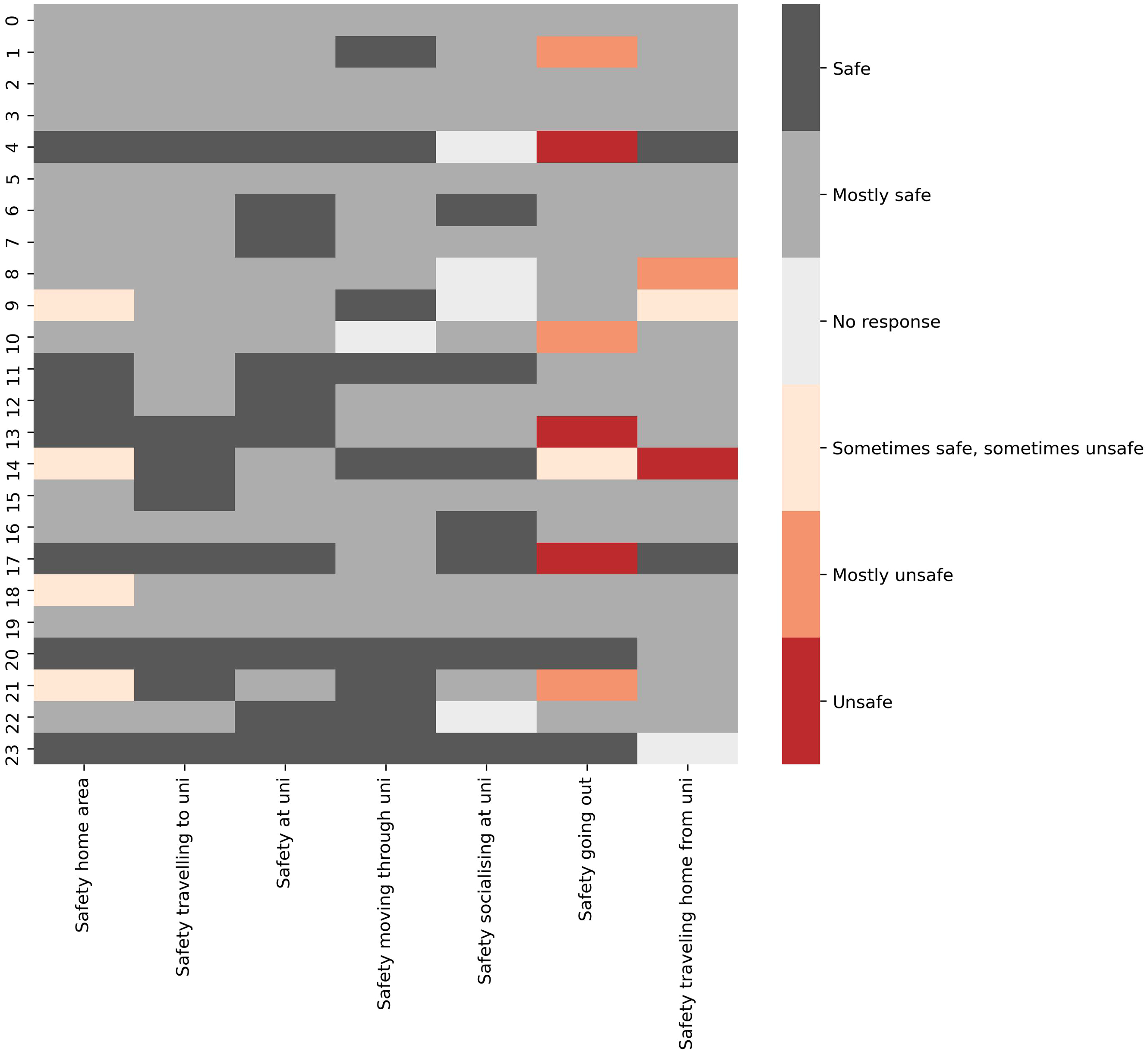
Heatmap Summarizing Chatbot User Reports of Their Sense of Safety in Places Located in and out of the City-Based University.
Figure 1 condenses several pertinent preliminary observations. First, overall, research participants felt safe or mostly safe traveling to university, while at university as well as when moving through university. Yet, participant reports regarding their home area, or of when they traveled home from university and finally of going out were less clear-cut. Four participants described sometimes feeling unsafe in the home area; three said they felt sometimes un/safe, mostly unsafe, or unsafe when traveling home from university; and, lastly, seven of them said that they felt unsafe, mostly unsafe, or sometimes un/safe when going out. In addition, there were four non-responses to the question of safety when socializing at university. While we caution against a quantitative reading of these results, we interpreted them as a cue to seek a deeper understanding of those places, movements and any experiences of fear associated with them, with the free-text responses elicited by the chatbot and the in-depth interviews. With that aim in mind, it was notable that research participants felt sometimes unsafe, mostly unsafe, or unsafe when traveling home from university and when going out, respectively. Moving forward, then, we first explore how EFC frames the experience or moving through a city-based university (RQ1) before moving on to examine how EFC frames the experience of ambulating the wider urban environment beyond campus (RQ2).
Fear within a city-based university
For our participants, a noteworthy aspect of university buildings as a physical setting was the confusion frequently felt trying to navigate these spaces. As P#20 (31) stated while using our chatbot, “[the] layout of the buildings tends to be very complicated.” For some participants, a significant facet of this predicament was the association between being lost and the experiential fear this could provoke: Part of that is feeling unsafe … not wanting to get lost and then ending up somewhere I really do not know and then feeling unsafe. (P#9, 23, Interview)
Our chatbot data also revealed that negotiating these settings could involve many in-between spaces. During the two-week period, multiple images were shared in situ that depicted empty corridors replete with numerous doors. These images implicitly suggest how “digital wayfaring” (Hjorth & Pink, 2014) might be shaped by EFC, and the extent to which this setting, which is generally associated with reduced levels of insecurity (Birenboim, 2018), can suddenly become unsettling through a combination of “lurk lines” (Goffman, 1971) and the absence of other people (Engström & Kronkvist, 2018). In other words, this insight that “adds complexity to the perceptions of a given location, since a place [usually] considered safe” (Engström & Kronkvist, 2018, p. 5), can feel different when other factors collide. Equally, this digital mapping resonates with Farman's (2010) suggestion that other users—in this instance, the research team—were engaged with as “embodied interactors rather than disembodied voyeurs” (p. 869). An unintended consequence of documenting the interior space of secluded buildings for participants might, therefore, be the simulation of sociability (Austin et al., 1994), which correlatively lessened the fear they were feeling. In the following extract, P#22 (18) elaborates on her experience of this setting: There is a lot of like empty alleys or corridors… You can’t see any cameras. You can’t see anyone. There's no windows or anything. (P#22, Interview)
For our participants, surroundings could be rendered more unsettling by darkness (Warr, 1990). Unlike a campus-based university that may very well be populated with resident students across terms and in the context of extracurricular activities (López & Wodtke, 2010), this is not always the case for city-based universities. These institutions are prone to becoming less populated throughout the day as students leave to commute home. Accordingly, another factor that could influence the fear participants felt was if they were alone (Warr, 1990): If I’m staying late in the office and there aren’t many other people in the building, I would be afraid of someone who … works at the university acting inappropriately and making sexual comments or sexual advances when … it's difficult for me to leave. (P#10, Interview)
In this vein, then, P#10's fear is not experienced in relation to her actual situation per se, but the potential of this situation to provide a space for strangers to emerge (Scott, 2003), and within a setting that might be hard to exit (Steinmetz & Austin, 2014)
Echoing P#10's anxieties, many participants were aware of environments that they might struggle to vacate quickly should the need arise. This apprehension resonates with Fisher and Nasar's (1995) notion of “prospect, refuge, and escape” (p. 37). While many participants were not explicitly scared of people they knew, there was a general nervousness surrounding the ease with which non-university others could access the institution, and, thus, the potential of “stranger danger” (Scott, 2003). As P#19 (40) commented while using our chatbot, “[it] is easy for people to gain access to the campus, as the university building does not require a swipe card. I have not noticed any real security around either.”
Along similar lines, the wider environment where city-based universities are physically placed also came up during interviews: Some campuses can be massive … like a small little town. [Our institution] doesn’t have that feel … it, sort of, blends into the place where it is … I could have easily walked past [our institution] not realizing it was a university. (P#12, 26, Interview)
Given that universities are commonly associated with reduced levels of insecurity (Birenboim, 2018), P#12's comments implicitly illuminate the ways in which city-based universities might feel different from residential institutions, and why this difference is noteworthy in the context of EFC. Nonetheless, and as illustrated in Figure 1, though participants acknowledged fear within the university itself, for the most part, participants felt safe within the university grounds.
For our participants, fear within university was associated with established factors such as the physical setting (Steinmetz & Austin, 2014), lighting (Warr, 1990), solitude (Austin et al., 1994), and the accessibility of this space to non-university individuals. Notably, these fears were in part documented through our chatbot app, which allowed participants to chart and visualize mobilities in situ. Perhaps more importantly, in certain instances, this practice seemingly became co-constitutive of place (Hjorth & Pink, 2014), with associated renderings implicating a dialogue of sorts, which we suggest might have been instigated to lessen the fear participants felt when they were in quiet and isolated spaces that were not easy to vacate. In the next subsection, we explore RQ2 and the extent to which EFC might frame the experience of ambulating the wider urban environment beyond campus.
Fear and the wider urban environment
Many participants lived a considerable distance from campus. P#4 (24) and P#9 (23) used our chatbot to share images produced in separate apps that visualized the complexity of their respective journeys. P#9's route took her roughly an hour. This was not an uncommon situation for many participants, which underlines an experiential distinction between “commuter students” and their residential counterparts (Christie, 2007; Maguire & Morris, 2018). As Figure 1 demonstrates, concerns about safety became more of an issue when participants were either traveling home from university or going out for the evening (Birenboim, 2018). Accordingly, the distance participants had to travel, as well as London as a particular kind of location, was experientially meaningful: That's the funny thing with London, it can feel like you’re in a completely different world depending on what area you’re in. (P#3, 27, Interview)
In contrast to the EFC that participants discussed while moving through university buildings, participants detailed specific incidents that had happened beyond campus, which made them experience fear when either traveling to or from university, or when they were going out for the evening. Here, EFC can be explained through a confluence of environmental aspects that include darkness (Warr, 1990), being alone (Engström & Kronkvist, 2018), and unfamiliarity (Birenboim, 2018). For P#1 (29), one specific incident has stayed in her mind. She had not long moved to London and a bus alteration meant she was suddenly stranded on her own in an unfamiliar environment: So, at that time, I guess, because I was quite new, and I had to use those Google Maps to check if the bus [was coming] it was dark, and I was alone … I was quite scared. (P#1, Interview)
In the wider context of locative media, this also demonstrates the effect that fear might have on extant understandings of “digital wayfaring” (Hjorth & Pink, 2014). An important function of early locative media was specifically the reshaping of unfamiliar environments through the process of “localization,” as users were able to adopt a “local” identity in spaces they did not commonly frequent by drawing on “local data” (Evans & Saker, 2017). Contra this, when wayfaring combines with fear to produce “wayfearing,” as we subsequently term it, the functionality of locative apps can assume a different purpose. In the extract above, far from exploring seemingly local information to develop a deeper sense of place-based connection, P#1 used Google Maps to physically remove herself from this setting as soon as possible, precisely because of its unfamiliarity.
The process of commuting also meant that participants could find themselves sharing spaces with people engaged in anti-social behavior (Moore, 2010). This point came up in the chatbot data. Significantly, P#22 used our chatbot to share a selfie overlayed with text describing an unsettling predicament as it unfolded in situ, during her commute. The image, shot at a low angle to perhaps avoid raising any suspicion, was of P#22's face, with her free hand covering her mouth. The surrounding environment—an artificially lit train carriage—pointed to the image being taken when it was dark outside, which is, of course, readily associated with FoC (Warr, 1990). The following text was superimposed across the image: “Guys I gott [sic] tell you about this… Of course, it is the creepy drunk guy on my train telling me I have the same aura as the character in the fifty shades of grey THE BOOK not the movie verson [sic] and some other porn book. And he tells me I am so sweet and cute and lovely while atrociously staring into my face. And he tells me he has debts of like 100k and if he doesn’t pay it back he is going to prison for it and OTHER STUFF. And he pees in the corridor between the two cabins after. And when I move he says “take care love be careful”
To interpret #P22's experience, we draw on the work of Bissell and Fuller (2011) and their suggestion that public transport can form sites of “mobile stillness” that facilitate reflection. In their study, Hjorth and Pink (2014) consider the impact that smartphones might have on this practice arguing that public transport, such as trains, provided research participants with space to reflect on the various photographs taken at other times in the context of digital wayfaring. Accordingly, this situation ostensibly configured a certain “absent presence” (Gergen, 2002). In contrast, the visuality of P#22's surroundings demonstrate how mobile phone usage can be restructured when the site of “mobile stillness” is imbued with fear through the collision between “kinds of people” and “kinds of settings” (Wikström et al., 2012). Though P#22 is reflecting on images taken on her mobile device, this picture is notably proximate to her physical position. In other words, unlike the “digital wayfaring” of Hjorth and Pink (2014), this practice did not function to cognitively transport P#22 elsewhere. Instead, we would suggest that the functionality of this practice revolved around the performance of “absent presence” (Gergen, 2002), and the physical distancing this enactment might have indicated to others while P#22 was in a situation when corporeal separation was not a possibility (Hardley & Richardson, 2021). At the same time, this image also explicitly supports the suggestion that situated data can “provide a rich picture of the phenomena studied” (Engström & Kronkvist, 2018, p. 3).
For participants such as P#10 it is precisely the inability to quickly “escape” (Fisher & Nasar, 1995) public transport, such as trains, which underpinned decisions to walk home, rather than taking the tube or catching a bus: When I am on the tube or the bus you have limited exit routes … it is easier to be put in a difficult situation where you have to play along and be nice and try not to escalate the situation. (P#10, Interview)
This is not to suggest that walking did not produce its own problems. Some participants frequently walked through remote spaces, when either going out for the evening or while commuting, which are similarly associated with fear (Birenboim, 2018). And these settings could include people engaged in anti-social behavior (Warr, 1990), as well as encompass routes for perpetrators to either hide or escape (see Goffman, 1971). For P#4 (23), this was a park where people smoked “weed,” while for P#22 (18) it was a particular street connected to a series of alleys. To be clear, some participants had to navigate these settings to get home from university: I often walk home in the dark and have to walk through a tunnel, and there are very often drunk people. (P#10, 29, Interview) I have to go through this small green space … a frequent gathering place for people who smoke weed … it really doesn’t feel safe … so I have to run as fast as I can. (P#4, Interview)
Notably, these EFCs illuminate how wayfearing can reshape the contours of locative media. Traditionally speaking, LBSNs allowed users to move through their environment in a manner that resonated with flânerie, and the poetic practice of ambulating without a destination in mind (Saker & Evans, 2016). Of course, this changes when EFC collides with sites that cannot be avoided. In these instances, the municipal setting is not so much a blank canvas to create on, but a canvas of meaningful environmental aspects that might indicate “the potentiality of personal danger” (Steinmetz & Austin, 2014, p. 512).
Finally, P#19 reflected on the changing experience of student mobility as it pertains to required technologies to facilitate learning: I usually have like £2,000 to £3,000-worth of stuff on me … we have to take our laptops and various assorted tech … there's no way really of avoiding that … I can’t leave my stuff at uni overnight because I need it for the next day. (P#19, Interview)
Though students at both campus-based and city-based institutions will very probably carry expensive technologies on their person, our data suggest that students attending city-based institutions are likely to carry these technologies over long distances. Put differently, what one is doing in these spaces, such as carrying expensive equipment, can exacerbate the other aspects surrounding fear, such as “where,” “when,” and “who one is with” (Engström & Kronkvist, 2018, p. 5). This situation can be made worse should students choose to use promotional bags given to them at the beginning of their program, as P#7 astutely observed. More importantly, this point might suggest something about the practice of wayfearing as it pertains to understandings surrounding locative media. For the most part, research on locative apps (Evans & Saker, 2017) observes two ways of understanding “absent presence” (Gergen, 2002). First, it can indicate a certain phenomenology of place, where users physically and cognitively occupy divergent spaces. Second, it can signify a certain praxis where the physicality of mobile devices as material objects dissolves beneath the impact of their functionality. Regarding the latter, fear may very well reverse this process. In the context of digital wayfearing, users such as P#19 were seemingly more conscious of the materiality of these devices (the “what”) and how these devices might be sought-after by others (the “who”). Consequently, this practice might indicate a shifting relationship with mobile media, and, therefore, locative apps. In this instance, the co-constituting of place is not so much configured through the functionality of mobile media, but instead through its materiality. As a corollary to this, then, rather than disconnecting users from the experience of place, these devices more firmly emplace users in the physicality of their environment, and in doing so, the phenomenology of their EFC.
Discussion and conclusion
The purpose of this article has been to examine the fear women students attending a city-based university experience in their daily lives, both within and beyond the confine of campus. Accordingly, this research adopted an experiential understanding of the fear of crime (EFC), with this EFC understood as revolving around fleeting experiences configured through a confluence of environmental factors. Our study and its methodological approach in turn revealed the kind of settings these participants moved through, as well as the experience of these spaces in situ. For the most part, our article cast a light on the various ways the “where and when fear is experienced” alongside how “what one is doing and who is present” (Engström & Kronkvist, 2018, p. 5) can be impactful in the context of EFC. In doing so, our research makes several contributions.
First, our research extends beyond the usual focus on campuses to include the wider urban landscape, and for good reason. Nearly all our research participants traveled a considerable distance to get to university. Although the size of London makes longer journeys more likely, distance is pertinent when it comes to comprehending the fears associated with the wider environment. As P#6 succinctly put it, the most “daunting part of studying in London,” is the getting “to and from London.” The necessity to use public transport to attend university also meant that participants routinely inhabited enclosed spaces with strangers engaged in anti-social behavior. Again, it was not always the case that participants could simply sidestep specific settings if these sites were an unavoidable element of their journey.
Second, our research explores how chatbots, as locative media, can be used to surface place-making practices that offer a more nuanced comprehension of fear and the dynamic relationship between fear and its associated environment. In contrast to existing studies that frequently draw on survey data, our chatbot app allowed participants to document experiences as they occurred in situ. Accordingly, participants were able to reflexively detail environmental experiences that hinged around fear and the association between this emotion and concomitant surroundings. In other words, the data collected were “ecologically valid” (Chataway et al., 2017, p. 301) precisely because chatbot information was frequently gathered in the environments that participants were reflecting on. Likewise, our study illuminates how chatbot data, and the process by which said data is gathered, can be complemented with interviews. This mix of methods effectively allowed participants to elaborate on key aspects of EFC after they were collected in situ. At the same time, this article demonstrates how the functionality of smartphones, and their association with “digital wayfaring” (Hjorth & Pink, 2014), can be used to gather visual data in situ, which can be drawn on to unpack the significance of environmental aspects and their influence.
Third, our research makes a theoretical link between personal safety apps (Wood et al., 2022) and the field of locative media (Evans & Saker, 2017). This association provides a space to reflect on the unintended consequences of documenting place in this way. P#22's selfie is a good case in point. In this instance, we would suggest an unintended consequence of this practice might be the extent to which it allowed P#22 to perform a certain “absent presence” (Gergen, 2002), while remaining cognitively proximate and conscious of her surroundings. At the same time, our research contributes to the wider field of locative media, by revealing how fear can reshape the praxis of locative media. In the main, research within this field has focused on users who are comfortable with their surroundings (Evans & Saker, 2017). In other words, when those environmental aspects are not interpreted in the context of EFC. In contrast, our research suggests that associated mobilities can be reshaped in a variety of ways by the EFC, just as the materiality of mobile devices can be rendered “present” when these devices suddenly become a conduit to filter and document those environmental factors that are the focus of EFC.
In conclusion, our research illuminates the various ways that EFC is felt both within and beyond campus, as well as the various ways EFC is especially intense for women students attending a city-based university as it pertains to those spaces in between institutional buildings and home (Birenboim, 2018). Accordingly, our research casts a light on EFCs, which is an area of FoC research that is markedly lacking (Engström & Kronkvist, 2018). Given the noted impact FoC can have on the lives of those who experience it (Etopio & Berthelot, 2022), future research should continue to examine how EFC might impact both the lives of commuter students, alongside their educational experience. In a similar vein, surrounding studies should also consider the precautionary behaviors that students might adopt to alleviate fears beyond the campus, as well as the effects these behaviors might have on the learning experience. Finally, future projects should explicitly examine how the use of mobile media might reshape the experience being recorded, as well as the unintended consequences of this methodology, from the reflexive position of participants.
Footnotes
Declaration of conflicting interests
The authors declared no potential conflicts of interest with respect to the research, authorship, and/or publication of this article.
Funding
The authors disclosed receipt of the following financial support for the research, authorship, and/or publication of this article: This work was supported by the SASS QR-SPF (Strategic Priorities Fund), (grant number 577927).
Notes
Author biographies
Michael Saker is a Senior Lecturer at City, University of London. His research explores the impact of mobile and locative technologies, alongside virtual and augmented reality, in daily life. He is co-author of From Microverse to Metaverse: Modelling the Future Through Today's Virtual worlds (Emerald Publishing, 2022); Intergenerational Locative Play: Augmenting Family (Emerald, Publishing, 2021); and Location-Based Social Media: Space, Time and Identity (Palgrave Macmillan, 2017). He is co-editor of The Changing Face of VR (Vernon Press, 2022).
Dan Mercea (ORCID:  ) is Professor of Digital and Social Change at City, University of London. He has a lasting interest in social movements and the implications flowing from the adoption and repurposing of Internet technologies in various domains of social and political activity.
Carrie-Anne Myers (ORCID: ) is Reader in Criminology with special reference to Victimology at City, University of London. She has extensive research experience in many key areas including: Youth Criminality; School Violence and Bullying; Cyberbullying and Online Harms Across the Educational Lifespan; and Victimization Processes. She has published widely in these key areas and her research has attracted both national and international acclaim, and has fed into policy initiatives globally.