




Abstract
This article draws on the concept of “transportal home” to examine the intersection of mobile media, mobility, and place-making among homeless food delivery workers in the Shanghai lockdown. Shanghai's lockdown lasted from February 28 to May 31, 2022, and was one of the strictest in China, resulting in thousands of food delivery riders being locked out of their homes, treated as potential carriers of the virus, and forced to sleep on the streets until the lockdown was lifted. The article uses qualitative research methods to explore the COVID-related homelessness of food delivery riders during the lockdown, focusing on their media practices and highlighting their experiences and agency in using mobile media to negotiate their lives amid the (im)mobile mobility they faced. It argues that mobile phones, as a transportal home, can offer a technological imaginary of home out of “homelessness”; however, they also serve as a reminder of the constraints of such an imaginary, as these (temporarily) homeless food delivery riders continue to be subject to platform exploitation and pandemic surveillance.
Introduction
Shanghai, a city with a population of about 25 million, underwent a strict lockdown from February 28 to May 31, 2022 as part of the Chinese state's “zero-tolerance” COVID policy (British Broadcasting Corporation [BBC], 2022). Just as in other Chinese cities, Shanghai authorities sought to eliminate the spread of the virus through highly aggressive methods, including forbidding residents from leaving their homes, closing restaurants and other public spaces, and suspending public transportation during lockdowns (Shanghai Municipal Health Commission, 2022). Also, the Shanghai government employed a series of technological approaches to monitor its residents, including the use of the health code—a digital QR code system that uses different colors to identify users’ COVID-19 infection status (Liang, 2020). Against this backdrop, the residents of Shanghai were impacted by restrictions on their movement and were concerned about their access to essential supplies. Delivery riders faced an especially difficult choice between being locked at home without income or locked out and homeless. Due to the strict lockdown policies that restricted outdoor work and access to residential communities, these delivery riders were likely to experience a paradoxical situation of being houseless—having a home but still being homeless—and having to seek temporary shelter in parks, streets, and vehicles.
The homeless experience of Shanghai food delivery riders sheds light on mobility in a unique temporal and spatial framework under China's COVID-19 lockdown policies. These riders were among thousands of people who found themselves homeless all of a sudden and their health code notification popping up while shopping in a supermarket, travelling on a bus, or walking home from a short trip elsewhere because the health code and contact-tracing big data showed they were close contacts of a positive case. What distinguishes the food delivery riders from other COVID homeless cases is their willingness to embrace involuntary homelessness for the sheer purpose of survival.
Existing literature has explored the various reasons for and types of homelessness. Susanne Speak (2004) proposes three types of causes for homelessness: supplementation (being away from home for the purpose of supporting one's original family), survival (leaving one's hometown because it is difficult to survive there), and crisis (abandoning one's home against the background of certain crises). Speak argues that homelessness can be a result of both voluntary factors (like supplementing a family's income) and involuntary factors (like being unable to survive or facing crises). More importantly, it is the state of homelessness—not necessarily the lack of shelters—that defines the plight of people who become homeless voluntarily or involuntarily. Even though a person might have a place (a shelter, tent, or a friend's couch) to stay for the night, the feeling of a lack of security, privacy, and control (Fazel et al., 2008; Kellett & Moore, 2003; Parsell, 2012) or the disconnection from social relationships (Parsell, 2012; Tester & Wingfield, 2013; van der Klis & Karsten, 2009) can be the cause of a sense of despair.
Homelessness can be transitional or episodic, chronic or transient, or visible or hidden. Homelessness in China had been less visible prior to the COVID lockdowns. It used to be a rare sight in China's cities in the Mao era due to strict control of internal migration via the hukou system (F. Wang, 2010). Many cases in the post-Mao reform era involved internal migrant workers, mostly rural-to-urban, who temporarily slept rough on the streets due to a lack of access to affordable housing or shelter (He et al., 2020). Others who became homeless were victims of natural disasters, abusive or impoverished households (including children), and those with mental health or substance abuse problems. Homelessness has been regarded as an eyesore by urban administrative officials (chengguan) who used to round up homeless people—dubbed the “floating population” or vagrants—to put them in “custody and repatriation” centers or forcibly send them back to their hometowns in the name of maintaining social order and stability. Since 2003 and the case of Sun Zhigang (Hand, 2006), China has shifted its policy from detention and forced repatriation to assistance in finding shelter and returning home. Government-run rescue centers or shelters have been set up (to replace the custody and repatriation centers) to accommodate homeless people; financial assistance is offered to send them back to their hometowns. Limited assistance from charity organizations and volunteers is allowed to provide material help within the orbit of government control (Sheng et al., 2015; Economist, 2019).
Still, many homeless people do not trust and therefore do not use government-run rescue centers and services (Q. Wang, 2012). Homelessness runs deep, and cannot be solved simply by making the floating population invisible. The COVID-19 lockdowns have resulted in the re-emergence of homelessness in China, as traditional culture and community integration have been disrupted and trust in government-run shelters has been lacking. As noted by Ying Wang et al. (2021), these individuals have been adversely affected by the Chinese government's strict pandemic control measures. Their research, along with many reports in western media (e.g., BBC, 2022; Dou & Wu, 2022; Economist, 2022), illustrates how migrant workers, inter-city travellers, and food delivery workers have become COVID homeless due to the strict measures implemented by Chinese authorities to achieve the COVID-zero goal. These measures have included extreme tracking and surveillance technologies such as the health code system, as well as eviction, quarantine, and lockdown policies that have caused significant hardship.
The traumatic 3-month lockdown in Shanghai rendered thousands unable to enter their residential districts, compounds, or buildings because of strict COVID control measure taken at the local level. They were forced to sleep on the street, under bridges or overpasses, in public parks, green belts, or in makeshift tents. Among those COVID-homeless people were food delivery riders, who comprise a wide range of individuals ranging from short-term (migrant workers and temporary visitors) to long-term workers in China's food delivery platform economy. These food delivery riders, along with public health and quarantine enforcement officials, police and public security personnel, and community lockdown volunteers, were the only people allowed to move around the city to carry out essential duties and ensure at least some of the daily operations of the city continued. Their visibility on Shanghai streets contrasted sharply with the invisibility of their homeless status, as did their mobility in contrast to the immobility of the rest of the city.
Although the traditional notion of homelessness is typically associated with the lack of physical shelter (Springer, 2000), the term has expanded to encompass a broader range of circumstances in the ever-changing world of techno-social development. In her work, Doreen Massey (1994, 2005) argues that the concept of “home” is not fixed or static, but rather one that is socially constructed and shaped by a variety of social and economic factors, such as migration, globalization, and urbanization. As a result, the concept of homelessness cannot be solely defined by a lack of physical shelter but must also consider the social and economic factors that shape our understanding of what it means to have a home.
Existing literature on COVID homelessness has focused on the plight and potential public health problems of the victims (Tsai & Wilson, 2020) or their mental health issues (Su et al., 2022). There is little study on their perception of homelessness and ways of living with the status of homelessness in the era of technomobility (see Wallis, 2013). It is known that homeless people make use of media technologies to receive welfare or look for housing, thus maintaining minimum living standards (Harpin et al., 2016; Humphry, 2014; Rice & Barman-Adhikari, 2014). They may take advantage of mobile media technologies to engage in “capital-enhancing” skills and activities in order to improve quality of life and escape homelessness (Marler, 2021). Of course, mobile media are important tools for leisure and social connection (Rice & Barman-Adhikari, 2014). There is, however, a lack of scholarship on homelessness and mobile media practices in the Chinese context. The homeless food delivery riders in Shanghai during the 2022 lockdown offer valuable insights into the nexus of power, labor, and mobility, which is mediated by mobile media.
This article explores the mobile media practices of homeless food delivery riders during the 2022 Shanghai lockdown, paying attention to their experiences and agency in engaging with mobile media to negotiate a way of life amidst the sense of (im)mobility (Martin & Bergmann, 2021; Wallis, 2013). Drawing on Daniel Miller and his colleagues’ (2021) concept of “transportal home,” we examine the intersection of mobile media, mobility, and placemaking among transient homeless food delivery workers in Shanghai during the COVID lockdown. The article employs qualitative methods for data collection and analysis—specifically, participatory research and interviews, which are detailed in the data and methods section. It then addresses three key aspects of the empirical study, corresponding to three sections exploring: (a) what contributed to the riders’ homelessness (under “involuntary homelessness in the COVID lockdown”); (b) how the riders lived with homelessness (under “living with homelessness”); and (c) how they made sense of homelessness via mobile media (under “mobile media as the transportal home”). The article ends with a discussion of the paradox of mobility and immobility by drawing on Wallis’ (2013) concept of “immobile mobility.” We argue that homeless food delivery riders during the Shanghai lockdown faced the conundrum of being digitally and physically mobile but socio-economically and politically immobile bodies to be used and controlled. Even though the mobile phone played a key role in mitigating the homeless status of the riders, it is a reminder of the constraints of their mobility, as these once-homeless food delivery riders continue to be subject to platform exploitation and pandemic surveillance.
Data and methods
To understand how delivery riders experienced homelessness with the social-techno use of mobile phones in Shanghai lockdowns, we conducted ethnographic fieldwork in the Qiantan-Sanlin area of Shanghai from May to October 2022 via participatory research. The fieldwork was approved by the Science and Technology Ethics Committee at Tongji University before data collection began. Participatory research was conducted by the lead author, who registered and worked as a delivery rider on the Eleme food delivery platform between July and November 2022. This enabled us to gain an in-depth understanding of the work and life of delivery riders via participant observation and informal chats with fellow riders; it also facilitated the interviewing process. To become a delivery rider, the author downloaded the rider's version of the Eleme application, known as fengniao zhongbao. Personal and health information, such as the green health code, were provided to obtain a digital pass. Surprisingly, the author became a qualified rider without any official training. Instructions and guidance were provided informally by a mentor (shifu) and teammates (duiyou) via Weixin (Chinese version of WeChat).
The team of delivery riders that the lead author joined was based in the Qiantan-Sanlin area of the Pudong district, located in the south-eastern part of Shanghai. Qiantan-Sanlin is a vibrant area that combines both business and residential spaces. While Qiantan boasts numerous fancy office buildings and is a newly built international business zone, Sanlin is more of a grassroots neighborhood. This mix of businesses and residences results in a high volume of orders throughout the day and night, contributing to the concentration of delivery riders in this area.
Upon joining the delivery team, the lead author discovered two gathering places for delivery riders in the Qiantan-Sanlin area: Yongtai Road and Alley Lianfeng Road. These two locations are dotted with many food delivery restaurants, providing delivery workers with affordable food and a place to rest and socialize with their peers. Additionally, they can easily receive new orders from these restaurants after taking a break. As a result, these two gathering places became important fieldwork sites for the author to conduct formal and informal interviews.
To obtain a more thorough understanding of the everyday life of a food delivery rider and their social-technological uses of mobile phones, we received consent from the owner of a food delivery restaurant located in 160 Yongtai Road to conduct observations and informal interviews on-site. This restaurant is a small, ordinary establishment that specializes in Huainan beef soup and baklava. The owner of the restaurant was previously a delivery rider who opened the store after the Shanghai lockdown in July 2022. Due to his close connections with other delivery riders, the restaurant has become a popular gathering spot for many workers to eat, rest, and socialize. This provided us with valuable opportunities to conduct on-site observations, talk to fellow riders, and approach potential candidates for interviews.
During the 5 months of fieldwork, we conducted semi-structured interviews with 37 participants who were recruited through informal chats with fellow riders at the Huainan restaurant and via the reverse snowball sampling technique (Parker et al., 2019). We posted recruitment information on Weixin and shared it through existing networks to attract the initial participants. Seventeen people were recruited through the combined methods. Each person was compensated with RMB80 per hour for their interviews. We then asked the initial participants to forward the information about the study and the researcher's contact details to potential candidates in their networks. A further 20 participants were recruited. Before the interviews started, we asked for consent from participants, in either verbal or written form, to record and use their interview data. The length of interviews varied between 30 and 120 min. Interview questions focused on how delivery riders managed and experienced homelessness with smartphones during lockdowns.
The interviews took place over 2 rounds: 37 initial interviews and 7 follow-up interviews. The data used for this paper is informed by the first-round interviews and focuses on the seven in-depth follow-up interviews. The seven people were chosen for their diversity in backgrounds and experiences during the lockdown (Table 1). They all consented to further interviews, which were built upon themes and patterns that emerged from the initial analysis of the first-round interviews. The participants in this study primarily slept in temporary shelters such as hostels or tents, or on the street, exposed to the elements. Most of them had to find accommodation by themselves, and only a few received subsidies from their employers. One participant decided to return to his rental home amid the lockdown for fear of contracting the virus, but he shared valuable insights on the experiences of fellow riders during the lockdown and reflections on the contingency of “homelessness.” He was therefore included in our data analysis. To protect the participants’ privacy, we assigned them pseudonyms. All interviews were transcribed and translated by the authors. All fieldwork data were stored in the lead author's institutional cloud storage, which was accessible only to the authors.
Interviewees (for in-depth interviews).
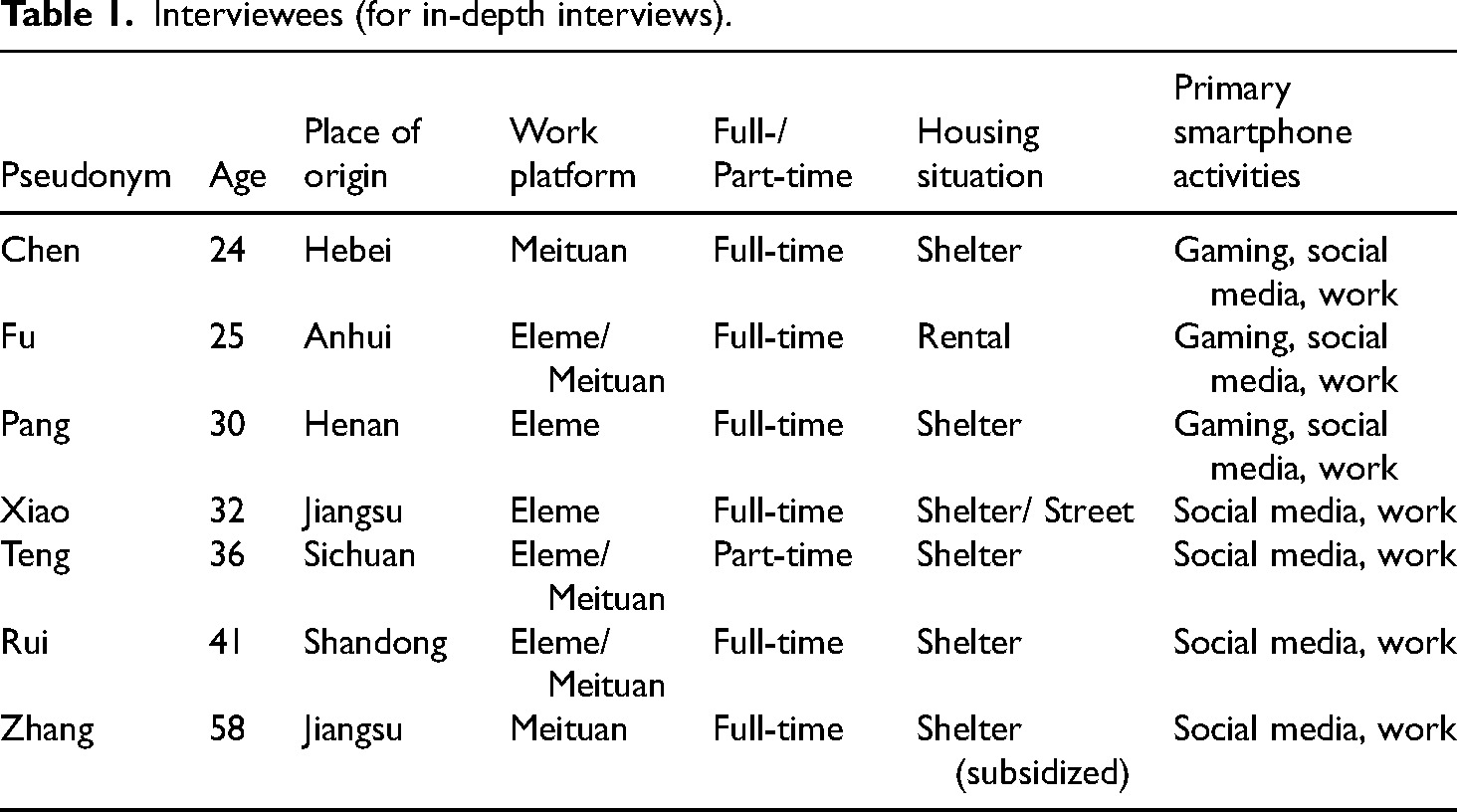
In analyzing the data, we applied the six-step thematic analysis method proposed by Braun and Clarke (2006, 2019) to identify, analyze, and interpret patterns of meaning within qualitative fieldwork data. The six steps are: familiarizing oneself with the data, generating initial codes, searching for themes, reviewing and refining themes, defining and naming themes, and producing a report of the analysis. We identified at least 5 shared themes from the initial 37 interviews. We then manually analyzed the interview data to hone in on three key themes that aligned with our three research questions: the context of the riders’ homelessness, their experience of homelessness, and the role of mobile media in homelessness.
Involuntary homelessness in the COVID-lockdown
In this section, we analyze empirical data in response to the first question: what contributed to the riders’ homelessness during the Shanghai lockdowns? Through formal and informal interviews, we found that food delivery riders became involuntarily homeless in the atmosphere of fear that the Chinese government had encouraged and instilled among the Chinese people for more than two years: the fear of the “deadly” virus and of being made immobile. Such involuntary homelessness was caused by two key stakeholders: the government and the platform.
The lockdowns
Firstly, the lockdown policies were a factor contributing directly to homelessness among delivery riders. The Shanghai government implemented mass testing and strict lockdowns of the city in response to the state's “Dynamic zero-Covid” policy. Consequently, there was an overwhelming surge in orders for food and medicine deliveries, creating an unprecedented demand for delivery riders. However, the strict lockdown measures put riders in a difficult situation in which they had to choose between being locked in at home without any income or mobility or being locked out and homeless but with the ability to work and earn money. Unfortunately, many riders who chose to continue working became newly homeless, resorting to sleeping on the streets, in parks, or even in their cars. The decision to work during the lockdown forced them to sacrifice the security of a home in exchange for the ability to earn a living.
In several instances during our interviews with delivery riders, we discovered that they made a conscious decision to leave their homes and continue their delivery jobs, even though it meant that they would not be able to return home. For instance, Zhang, a 58-year-old delivery rider from Wuxi, Jiangsu province, left home as soon as he received his lockdown work permit and returned to work. He disclosed that he had spent 2 entire months sleeping on a park bench, but he was content with doing so because he could earn a substantial amount of money to support his family during this unusual period. However, despite his willingness to work at the risk of contracting COVID-19, he still expressed dissatisfaction with the policies, as he stated: “Getting a work permit pass means you can go out for work, but it does not guarantee that you can return home. This is so strange. I don’t know why it's like this.”
The work permit pass is a digital QR code that is based on the health code from the Shanghai government. It includes essential information such as the individual's name, ID number, enterprise name, nucleic acid test results, and antigen test results. During lockdowns, this “pass” served as legal proof for delivery and shipping work. Although the pass ideally allowed riders to come and go freely, numerous residential areas were blocked, preventing them from returning home. To avoid the expiration of their passes, riders had to undergo COVID tests regularly and avoid contact with infected individuals. Our participants expressed how the health code, nucleic acid code, and travel code used on smartphones disrupted their normal ways of living, working, mobility, and leisure. They highlighted the feelings of powerlessness and anxiety caused by these codes, passes, and tracking systems. Zhang pointed out: I would rather work and sleep on the streets than have no income and be forced to quarantine at home. No one can afford to stay at home without an income. It's better to get paid than avoid the risk of getting infected.
The strict lockdown measures affected not just the general population but also had a profound impact on the institutions that are meant to support vulnerable communities like the homeless. Take the Shanghai Rescue and Relief Station, for instance. This government-run organization, which played a critical role in managing homeless individuals such as stray beggars, was forcibly shut down. As a result, delivery riders faced even greater challenges, as they could not rely on institutions like this for assistance.
Most of the homeless delivery riders in Shanghai are known as hupiao (“floating in Shanghai”), referring to migrant workers who have left their hometown or hukou location in search of employment opportunities in the city. During the lockdowns, these individuals, who mainly worked as day laborers, were left without a steady income and struggled to make ends meet. Many, including delivery riders, had no choice but to continue working to survive, leading to their homelessness.
This particular type of homelessness, as described by Speak (2004), is known as “supplementary homelessness,” and arises when individuals are forced to leave their housing in pursuit of work and income—in this case, within a locked-down city. It is clear that the lockdown policies themselves were the primary cause of the riders’ predicament. Food delivery platforms were another factor that contributed to the predicament of homeless delivery riders.
Food delivery platforms
Food delivery riders are part of China's economically and socially marginalized urban population, and they face numerous challenges and exploitative practices within the platform-based food delivery system (Sun, 2019). During the pandemic-induced lockdowns, people became more reliant than ever on digital platforms to obtain daily essentials, and food delivery platforms experienced an unprecedented surge in orders. To meet this demand, platforms required more consistent and reliable riders. However, as lockdown policies became more stringent, a growing number of riders were unable to work, causing a shortage in the platforms’ delivery capacity. To keep their businesses running and even improve them, platforms introduced various incentives and measures, with a focus on recruiting new riders and retaining existing ones. To attract new riders, delivery platforms like Eleme and Meituan offered referral bonuses, extra work bonuses, guaranteed accommodation, free nucleic acid testing, and other incentives. Our interviews with delivery riders revealed that many were lured by these incentives and promises of accommodation. However, the reality proved to be vastly different, as highlighted by 41-year-old Rui's experience: Initially, our company promised to provide us with a hotel to stay in, and they delivered on that promise for the first few days. However, we were later forced to move out because the hotel had been booked by other companies. Our company then assured us that they would offer a housing subsidy of 80 RMB per day, but we were responsible for finding accommodation ourselves. Despite this promise, I ended up living in a hotel for a full month without receiving any subsidy at all. It was clear that they had lied to us.
Teng, a 36-year-old Meituan employee, had a comparable experience. His team leader informed him of an additional work bonus and guaranteed accommodation. However, when Teng eventually ventured out to work, he discovered that there was no accommodation provided as had been promised. For two weeks, he was forced to sleep in a tent. Teng recounted his experience to us thus: “Afterward, the company relocated us to what they called a ‘resettlement site’ in an old factory plant. There was no access to water or electricity—just a bare shelter with nothing else.”
It is evident that food delivery platforms failed to support their riders despite luring them into work. Riders are like the wheels that keep the food delivery platforms running smoothly, yet these platforms neglected their responsibility toward their employees and society during the lockdowns. The power dynamic between food delivery platforms and riders is deeply imbalanced. Riders are considered temporary and precarious labor by digital platforms. They often feel disadvantaged when dealing with customers and platforms, especially during lockdowns when delivery services were restricted by numerous policies and regulations. Moreover, this disempowered status has contributed significantly to the homelessness of riders.
Living with homelessness
In this section, we will examine how delivery riders coped with homelessness amid bias and discrimination while searching for shelters. Food delivery riders in Shanghai are often faced with constraints arising from social discourse that labels them as waidiren (outsiders) and “high-risk groups,” particularly during lockdown periods. Existing research has demonstrated that social inclusion is a significant factor that influences the homeless experience (Marler, 2021, 2022). Our research is consistent with this perspective. The subsequent analysis aims to demonstrate that public attitudes and actions toward homeless food delivery riders can significantly impact their experience of homelessness.
Xiao, a 35-year-old delivery rider from Henan province, had been working in the Qiantan-Sanlin area for over 5 years. He knew the area's roads, stores, and residential apartments like the back of his hand. During the first few weeks of the lockdown, he slept on a park bench. Parks are attractive to homeless people because they are public spaces and there are no restrictions on access. For Xiao, the benches provided an acceptable place to stretch out and sleep. However, a peaceful night's rest does not guarantee future comfort and safety. As Shanghai transitioned from spring to summer, mosquitoes and flies became more prevalent in the parks. As a result, Xiao started looking for cheap hotels to stay in. However, no hotels were willing to accept him because they considered delivery riders to be high-risk individuals that might cause them to have to close their business.
Later, Xiao was able to obtain a tent thanks to a colleague's help. Like many other delivery riders, he pitched his tent near his rider friends under a viaduct. However, after only two nights, they had to relocate because of complaints from nearby residents. The residents claimed that the cluster of riders posed a high risk of spreading the virus and endangering the health of their community. When the police arrived, they informed Xiao and the other riders that they could set up their tents under the viaduct but could not stay together due to social distancing guidelines. Xiao then moved to a remote park, far away from residential areas and his community. He felt lonely, anxious, abandoned, and humiliated. As he put it: “They think we are like viruses, dangerous, and high-risk. But it's interesting that they also depend on us to deliver food and supplies. How could they survive without us? I don’t understand why.”
Xiao felt even more isolated and disconnected from the city that he had worked in for five years when he was regarded as a virus and a threat to public health by the locals. The psychological pain he experienced had a much greater impact on him than the physical discomfort of sleeping rough and being unable to shower or change clothes for over 40 days. Nevertheless, he had no other choice but to keep working longer hours than usual in order to survive.
Social exclusion and discrimination against food delivery workers is not only a reality in their daily lives but also a mediated reality. When they finished their hard work for the day, the food delivery riders we spoke to used short video platforms like Douyin and Kuaishou for entertainment. However, the content recommended by these platforms often made them feel even more insecure and angry. Pan, a 30-year-old delivery rider, complained that Douyin kept showing him clashes between local people and “outsiders,” between lower classes and higher classes, and between delivery riders and the public. He expressed frustration with the platform, asking: Have you watched the videos on Douyin? It's frustrating to see how some locals treat outsiders in Shanghai. It's so unjust! I feel like they’re being arrogant and have no regard for people who aren’t from here. But aren’t we all humans?
The food delivery riders’ already difficult reality of working long hours during the day and experiencing homelessness at night was compounded by social exclusion and being labelled as “the virus.” However, amid the seemingly endless nights, there were also instances of community spirit and mutual aid toward homeless riders, offering a glimmer of hope. Xiao shared that many of his customers, both familiar and strangers, offered free food and essential medical supplies like masks and sanitizers. One day, while delivering food to a designated area in a residential apartment, an official staff member wearing PPE, or “big white,” as they are called, stopped him: Initially, I thought he was checking my digital pass. But it turned out that he wanted to give me a lunch box. He explained that they had an extra work meal that day and he wanted to share it with me because he had seen on social media that many delivery riders struggle with food and shelter.
To most homeless food delivery riders, having access to food and shelter is crucial, but equally important is keeping their mobile phones charged and on hand. Mobile phones are vital for their jobs, earning a living, and dealing with unexpected situations while living through the lockdown in a state of involuntary homelessness. However, battery life has always been a problem for delivery riders, even before the pandemic. Chen, a 24-year-old rider, told us that during the lockdown, his biggest fear was running out of battery on his mobile phone: “Running out of battery (duandian) is like running out of income (duancai). You can’t receive orders. You can’t use maps. You can’t contact customers. It means you cannot work at all.”
The situation worsened during the lockdowns, when riders could not charge their phones while being homeless. To keep their phones charged, riders had to find power outlets and shared power banks in public places or use their electric motorcycles to charge their phones while working. However, at night, when they were off work and had no access to the batteries of their e-motorcycles, charging their phones became a serious problem: “I have to save some phone power at night. After chatting with family and friends, I usually turn on aeroplane mode to save power. Running out of phone power would affect tomorrow's work” (Pang).
To avoid limiting the functions of their phones by turning on aeroplane mode, food delivery riders would often carry multiple power banks. Sharing and gifting power banks became a sign of humanity, as shared by Pang: One day, after delivering food to a customer, he asked if he could help in any way. I asked if he had an Android charging cable as mine was broken. A few minutes later, he gave me a power bank with a charging cable, which really touched me. The power bank was really what I needed, and it gave me a sense of mutual support. The virus has no heart, but we do.
As mentioned earlier, mobile phones were crucial for the survival of food delivery riders, and therefore keeping their phones charged was of utmost importance. When riders like Pang faced the challenge of running out of mobile phone power, which exacerbated their homelessness, it was the support from the local community that helped to alleviate their disadvantaged situation. While mobile devices could sometimes be limiting, the bonds between people made up for it. The coexistence of exclusion and inclusion around delivery riders during the lockdown highlights the complexity of public response to their homeless status, and that mobile phones became a critical site for the manifestation of such exclusion and inclusion. The kindness shown toward riders also aided them in escaping homelessness, which will be the focus of the next section.
Mobile media as the transportal home
Homeless food delivery riders used their mobile phones for work, entertainment, information, and connection with family and friends. Their mobile phones were the carrier and symbol of their vagrancy; they also constituted the “home” out of homelessness for the vagrant riders. Their phone was a “transportal home,” an affective and imaginary space that mediates and shapes users’ everyday life practices and experiences (Miller, 2021). As a transportal home, the mobile phone was perceived not merely as a digital communication tool but also as a space where one resided—that is, a space of leisure, work, and socialization.
The mobile phone was considered and experienced as analogous to “home” for delivery riders, as it enabled them to transcend physical and logistical barriers to reconnect with family and friends. In doing so, these riders experienced a sense of belonging and ontological security, which served as a coping mechanism when confronting loneliness in homelessness. The mobile phone was not just a tool for work and existence (e.g., information sharing and financial transactions) but also a transportal home that provided ontological security via socialization and entertainment. It was an affective space to connect and interact with fellow riders, family, and friends who were locked up in their homes—the physical space with gates and locks. The food delivery riders could take their “home” in their pockets, on their bikes, and in their palms as they worked, rested, and chatted. The “home” became transportable, literally. Such a transportal home was both private and communal.
After talking to several riders, it became evident that Weixin groups played a crucial role in helping them access information about COVID restrictions and regulations, as well as finding assistance to cope with homelessness. One of these riders, Rui, started his delivery job in March 2022, just before the lockdowns hit. Initially, he had hoped to earn more during the lockdown, but he was unprepared for the unexpected challenges of navigating blocked roads and closed shops. Fortunately, his mentor, an experienced rider, introduced him to a Weixin group called “Bullshit Life,” which consisted mostly of food delivery riders like himself. This group proved to be a lifeline for Rui during his time of homelessness, as he shared: At first, I slept on a park bench, but then I discovered that many other riders were sleeping in tents. However, since most shops were closed, I didn’t know where to find a tent. I asked for assistance in the group chat, and thankfully, the group members guided me on where to obtain one. This was incredibly beneficial because, with a tent, I could finally get a good night's sleep.
The Weixin group gave Rui a sense of belonging and friendship after a long period of isolation and separation from his usual social networks. Tapping on their mobile phones to open Weixin was often the first and last thing our riders did in a day, and they did it throughout the day whenever they had a break between delivery jobs. Many mentioned the supportive relationships they made in those Weixin groups. The support riders obtained was both emotional and practical.
The mutual help was not limited to the rider community but also extended to local communities that riders frequented. As discussed in the previous section, many homeless riders received support from community members. The riders in turn repaid single gestures of kindness and generosity with their mobility. During the lockdown, many residents faced a lack of essential supplies such as food and medicine. Riders like Pang stepped in to help his regular customers. Pang created a local neighborhood Wexin group for those who were in need of essential supplies. He would take group purchase orders from the group members, run around to get the items from available stores, and then deliver them to residents. He charged 5RMB per person/order. As a regular food delivery rider to the community, Pang felt that he had become part of the neighborhood, especially when his kindness was repaid with the kindness from community members. Pang fondly told us: Once, after I delivered supplies to them, one of the customers shared a bag of supplies with me. After learning that I had no way to cook and that fresh vegetables and meats were useless to me, she brought me a bunch of instant food and fruits. I felt relieved and warm.
With the use of apps like Weixin to maintain bonds with people, Pang and his fellow riders lived through the COVID homelessness in the transportal home of their mobile phones. This home gave them a sense of community among peers and connection with the neighborhood communities that they served through mutual support. It in turn gave them a sense of home out of homelessness.
The transportal home of the mobile phone could also be a communal space, where one could bond and socialize through digital leisure activities like “yun” (云, cloud) socials, or socializing virtually in other words. In our chats with the riders, they frequently mentioned yun drinking/eating (云喝酒/云吃饭) with friends or families at the end of a hard day of work. As Xiao told us: I saw people yun drinking on Douyin, so I invited my friends to do it with me. Because online rumours say alcohol kills illnesses, we drink alcohol to prevent COVID. To be honest, it is just an excuse. More importantly, it is about catching up, reuniting a little bit, and passing the time.
Essentially, yun drinking/eating were social activities that helped homeless riders to reconnect with their immediate social networks, and, as a result, to escape from isolation and homelessness and experience co-living in their “transportal home.” Digital leisure through mobile phones served as a mitigator of stress, boredom, loneliness, isolation, and insecurity. Many riders would also do online drinking and eating with fellow riders and even strangers. Their mobile phones were their “homes,” which were portable and agile; they were not the cold device or tool but the symbol of “heart” (as Pang said).
The transportal home “lies as much in acknowledging the increasingly problematic relationship that migrants, young people, and others have to traditional homes as it does in appreciating the smartphone's capacity to compensate for this loss” (Miller et al., 2021, pp. 226−227). The loss was acutely felt and heightened during the Shanghai lockdown by homeless food delivery riders. While everything else seemed to be in flux and uncertainty, the mobile phone was among the few things that would give our riders a sense of security, privacy, and control. As the transportal home, the mobile phone was the physical object that enabled homeless riders to feel and reimagine a sense of “home,” a home that transcended the physical and structural constraints that most residents in Shanghai had to live with.
Conclusion
As pointed out earlier in this article, whether through repatriation or assistance (Y. Wang et al., 2021), the Chinese government has tried to make homelessness invisible in Chinese cities in the name of maintaining social stability and social order (Qiu & Zufferey, 2017). We have examined homeless food delivery riders during the 2022 Shanghai lockdown as an exceptional form of homelessness not only because of their temporal or transient nature but also because of their high visibility and number. Due to the Chinese government's strict COVID-zero policies (Y. Wang et al., 2021), all public transport was suspended, which left thousands of people including migrant workers stranded in the once most vibrant metropolitan city in China. Most of the public facilities in Shanghai, including government-run shelters and popular commercial venues for homeless people like the McDonald's, were also shut down. As the city went through the shock treatment of lockdowns, food delivery riders working for platforms like Eleme and Meituan kept the city alive with their presence on the streets, in the parks, and under viaducts.
Most food delivery riders chose work over being locked up at home in order to make a living. They suffered from homelessness involuntarily because of the strict lockdown policies and lack of support from their employers (i.e., food delivery platforms). Their case differed from traditional forms of homelessness that are associated with the digital divide and poverty (Humphry, 2014). Instead, the homeless food delivery riders were financially independent and digitally connected. With easy access to their mobile devices and sufficient skills in mobile media, these riders actively made use of their phones to live with homelessness. We have used “transportal home” to refer to the role of mobile phones in overcoming physical and material barriers to afford a sense of home and feeling of affect or “heart” in the face of the heartless lockdowns. For our riders, the mobile phone was not merely a technological device and digital communication tool; it was the virtual home that they resided in, in lieu of their physical home. It gave them a sense of purpose and control over their lives and enabled homeless food delivery riders to rebuild connection with family, the rider community, and the residential communities that they served. As discussed earlier, “home” transcends the physical space to encompass the socially constructed and imaginary space, which is shaped by affective connectivity. The case of homeless food delivery riders during the Shanghai lockdown in 2022 illustrates the transportal nature of “home” that resides in the mobile phone. The mobile phone symbolizes a transportal home that allows these riders to imagine a home out of homelessness.
Homelessness brings attention to the complicated interplay of power and powerlessness, control and lack of control, security and insecurity, and mobility and immobility. The “immobile mobility” is no longer the plight of a marginalized population as captured by Wallis (2013), but the fate of the whole nation characterized by compulsory geo-fixed and intensified digital-mobile lives. The lives of homeless food delivery riders in Shanghai and other parts of China, both before and after the Shanghai lockdown, are characterized by the continuity of migrant workers’ immobile mobility. Despite being physically mobile, they experience social, political, economic, and cultural immobility. The Shanghai lockdown made it even more challenging for these food delivery riders to be physically mobile, as they were required to undergo frequent COVID-19 tests and show proof of being healthy through a green health code. These requirements were particularly stressful for them. While the mobile phone could serve as a transportal home for delivery workers, it was also a surveillance device that haunted them day and night; it was the devil that they wished to throw away when their health code turned red (high risk, 14-day quarantine) or yellow (low risk, 7-day quarantine) for visiting a high-risk area or being a close contact. This could mean being locked up in quarantine centers and losing income for a period of time until the code turned green. Hence, riders’ mobility was contingent, as they could be made immobile at any time. Their mobile phones (via the health code) became the tyranny that dictated their mobility or immobility.
The immobile mobility is the perpetual state of contradiction in life for many migrant food delivery workers in Shanghai and elsewhere in China, during and after the lockdowns. At the end of the 2-month strict lockdown in Shanghai, “homeless” food delivery riders were able to go home, either to their homes in Shanghai or their hometowns in other cities and provinces. A new term emerged toward the end of the Shanghai lockdown, “rùnxue” (runology or the philosophy of running away). “Rùn” is the Chinese pinyin homonym of “run” in English. To rùn means to run away, often referring to moving to other places and countries. Middle- and upper-middle-class people in Shanghai have, since the lockdown ended, tried to emigrate, or have their children emigrate overseas (Anon, 2022). Poor migrant food delivery workers also wanted to run away from Shanghai back to their hometowns. Some vowed to never come back to the city out of disappointment; others chose to come back to the “heartless” city simply for the need of financial gains.
During several rounds of lockdowns in Shanghai, many delivery riders, like 32-year-old Xiao, became disappointed with their lives as homeless migrant workers. Xiao decided to return to his hometown, Lianyungang, in Jiangsu province, to continue his career as a delivery rider there. He left because he wanted to reunite with his family and escape the isolation of being homeless. However, after only one week, he gave up the job and returned to Shanghai because the income for delivery riders in Lianyungang was not as good as in Shanghai, and there were many unfair terms and requirements that did not allow for the freedom he had in Shanghai. Just like the decision to become homeless rather than lose their income during the lockdown, the choice of whether to stay or leave Shanghai is an existential question and a strategic decision for food delivery riders. Mobility is constrained, and immobility seems to be their perpetual state of life. The transportal home of the mobile phones can offer a technological imaginary of home out of “homelessness,” but it is also a reminder of the constraints of such an imaginary as these once-homeless food delivery riders continue to be subject to platform exploitation and state surveillance.
Footnotes
Funding
The authors disclosed receipt of the following financial support for the research, authorship, and/or publication of this article: This work was supported by the MOE (Ministry of Education in China) Project of Humanities and Social Sciences (grant number 22YJC860008).

Author biographies
Pengfei Fu is currently a post-doctoral researcher in the School of Humanities at Tongji University. His scholarly pursuits are centered on the intricate interplay around Chinese digital platforms, labor dynamics, and governance mechanisms.
Chengxi Liao is a PhD research candidate with RMIT, School of Media and Communication. Specialising in topics of niche cultures and relevant phenomena in China, Chengxi's current PhD project puts a particular focus on the Chinese fans of otaku culture, a type of Japanoriginated culture that is about the ardent affection for cultural artifacts like animation. His research areas of interest also include studies of media platforms, cultural industries, and cultural policies.
Haiqing Yu is a professor of Media and Communication and an ARC Future Fellow at RMIT University, Australia. She is a critical media studies scholar with expertise on Chinese digital media, technologies and culture and their sociopolitical impact in China, Australia and the Asia Pacific. Her current projects examine the social implications of China's social credit system, technological innovation, and digital transformation; China's digital presence in Australasia; and Chinese-language digital/social media in Australia.