




Abstract
Parental phubbing refers to parents being distracted by their phone during an interaction with their child. The present study investigated how parental phubbing relates to adolescents’ self-control through the mediators of parent–adolescent closeness and loneliness. The current study also compared the effects of maternal and paternal phubbing. Having a sibling may influence adolescent mental health and behaviors. Thus, this study also examined whether siblings attenuate the effects of parental phubbing on self-control. We recruited 670 adolescents to participate in our survey. Path analyses revealed that maternal phubbing had both direct and indirect effects on self-control through mother–adolescent closeness and loneliness. However, paternal phubbing had only a sequential indirect effect through father–adolescent closeness and loneliness. This shows that maternal and paternal phubbing have different effects on adolescents’ self-control. Multi-group comparisons revealed that the direct and indirect effects of maternal phubbing on self-control were non-significant for adolescents with siblings. Thus, siblings attenuated the adverse relationships between maternal phubbing and adolescent self-control.
Introduction
Parental phubbing refers to parents being distracted by their phones during interactions with their children (X. Xie et al., 2019) and includes maternal and paternal phubbing, which refer to phubbing from mothers in mother–child communications and from fathers in father–child communications, respectively. Numerous studies have revealed that parental phubbing increases adolescents’ social difficulties and impairs mental health (e.g., Geng et al., 2021; K. Liu et al., 2021; Solecki, 2022; Wei et al., 2022; X. Xie et al., 2019; X. Xie et al., 2021; X. Xie & Xie, 2020). However, few studies have separately tested the differential roles of maternal and paternal phubbing. To our knowledge, only Geng et al. (2021) and P. Wang et al. (2022) have separately examined the impact of maternal and paternal phubbing on adolescent psychosocial development.
Mothers and fathers play different parenting roles. Typically, mothers represent caring and warmth, while fathers represent authority and discipline (Paquette, 2004). Considering these differences, the present study supposed that maternal and paternal phubbing may impact adolescents differently. Thus, the present study sought to distinguish between the effects of maternal and paternal phubbing.
Adolescence is an essential period for developing self-control (Allemand et al., 2019). Self-control is the ability to inhibit one’s dominant response tendencies and regulate one’s emotions, behaviors, and thoughts (de Ridder et al., 2012). Adolescents with high levels of self-control usually exhibit good work performance and have high quality romantic relationships in adulthood (Allemand et al., 2019). Family environments, especially parent–child interactions, are essential to a child’s self-control development (Finkenauer et al., 2005). Parental phubbing is negatively related to adolescents’ self-control (Niu et al., 2020; Qiao & Liu, 2020). Additionally, technoference, an interchangeable concept for phubbing (McDaniel & Drouin, 2019), in parent–adolescent communication impairs adolescents’ attentional control, which has been associated with self-control (Qiao & Liu, 2020). However, little is known about the potential mechanisms that underlie the relationship between parental phubbing and adolescent self-control. Illustrating these mechanisms enable us to expand the previous literature and provide a clearer model of how parental phubbing affects adolescent self-control. Thus, this study aimed to examine the relationship between parental phubbing and adolescent self-control.
Parent–adolescent closeness and loneliness are two important indicators of adolescent development. High-quality parent–adolescent closeness is a protective factor that provides adolescent positive development, whereas loneliness is an index of unhealthy mental status that hinders adolescents’ positive development (Lerner & Steinberg, 2009). Studies have found that parental phubbing decreases parent–adolescent closeness (X. Xie et al., 2019) and increases loneliness (Q. Liu et al., 2020), both of which may harm self-control (Li et al., 2021). Accordingly, this study also examined the mediating roles of loneliness and parent–adolescent closeness.
Siblings play an important role in child and adolescent development by providing support and buffering against the negative effects of stressful life events (Zhao & Yu, 2017). However, it remains unclear how having a sibling attenuates the adverse effects of parental phubbing. Thus, the second aim of this study was to test whether siblings moderate the relationship between parental phubbing and self-control.
Parental phubbing and self-control
Adolescence is a stage in which individuals have yet to mature in terms of self-control (Icenogle & Cauffman, 2021); thus, impulsive behaviors are common (Murray et al., 2021). Self-control can inhibit impulsive actions and is related to numerous psychosocial indicators, including work performance, diet, addiction, social relationships, emotional regulation, well-being, and deviant behaviors (de Ridder et al., 2012). Therefore, it is necessary to protect and enhance adolescent self-control.
Previous studies have shown that parental phubbing is correlated with low self-control (Niu et al., 2020; Qiao & Liu, 2020) and various self-control related behaviors (Qu et al., 2022; X. Wang, Qiao, et al., 2022; P. Wang et al., 2022; X. Xie et al., 2019). The limited strength model of self-control proposes that self-resources are depleted after being excluded (Baumeister, 2018). Phubbing can be viewed as a type of exclusion (Chotpitayasunondh & Douglas, 2016; David & Roberts, 2017). Thus, when adolescents feel excluded by their parents, their limited resources can be depleted and self-control decreases. Thus, this study hypothesized the following: H1: Maternal and paternal phubbing would be negatively correlated with adolescent self-control.
The mediating roles of loneliness and parent–adolescent closeness
The context-process-outcome model (Roeser et al., 1996; X. Xie et al., 2021) explains that the environment affects adolescent development through psychological, emotional, and cognitive processes. In light of this model, parental phubbing as an adverse family context may not only relate directly to self-control but also through potential mediators, such as loneliness and parent–adolescent closeness.
The current study aimed to examine the simple mediating roles of loneliness and parent–adolescent closeness and a sequential mediation model in which loneliness and parent-adolescent closeness mediate the relationships between parental phubbing and self-control. Sequential mediation can divide the process of parental phubbing effects on self-control into interpersonal (i.e., parent–adolescent closeness) and intrapersonal (i.e., loneliness) processes.
Among the previous studies, only Hong et al. (2019) investigated both processes with regard to parental phubbing, specifically how parental phubbing increases adolescent problematic mobile phone owing to a decrease in parent–adolescent relationship quality (interpersonal process) and adolescent self-esteem (intrapersonal process). However, in that study, the intrapersonal process was a protective variable (i.e., self-esteem) in which parental phubbing impaired the protective process of adolescent development, whereas in our study the intrapersonal process was a risk variable (i.e., loneliness) in which parental phubbing deteriorated the risk process of adolescent development. Thus, the present study considered both intrapersonal and interpersonal processes.
The mediating role of loneliness
Loneliness is a psychological experience that leads to feelings of alarm and pain when an individual lacks adequate social association and support (Rudolf, 2017). Loneliness is a consequence of unsatisfactory social needs due to insufficient social relationships (Terrell-Deutsch, 1999). In addition, the discrepancy between desired and actual social relationships predicts loneliness (Terrell-Deutsch, 1999). As mentioned above, parental phubbing reflects that the need for the desired parent–adolescent relationship is unfulfilled (X. Xie & Xie, 2020). It is not surprising then that adolescents who perceive high levels of parental phubbing tend to report high levels of loneliness (Q. Liu et al., 2020; P. Wang et al., 2021). Therefore, the current study predicted that maternal and paternal phubbing would be positively correlated with loneliness.
According to the limited strength of self-control theory, psychological stressors, such as loneliness, can act as antecedents of poor self-control (Li et al., 2021). Self-control has also been found to mediate the relationship between loneliness and addiction to mobile phones and/or the internet (Li et al., 2021; Özdemir et al., 2014). Thus, the current study expected loneliness to be related to a lower level of self-control. Additionally, a previous study demonstrated that loneliness mediates maternal and paternal phubbing and problematic mobile phone use among Chinese adolescents (Geng et al., 2021). Based on these findings, we proposed the following second hypothesis: H2. Loneliness would mediate the relationships between maternal and paternal phubbing and self-control.
The mediating role of parent-adolescent closeness
Parental phubbing is a serious risk factor for parent–adolescent closeness (K. Liu et al., 2021; McDaniel et al., 2018; X. Xie et al., 2019; X. Xie & Xie, 2020). Parental phubbing absorbs parents’ attention to their adolescent children which, in turn, violates adolescents’ expectations and weakens parent–adolescent closeness (Miller-Ott & Kelly, 2015). Family members’ behaviors or activities can influence each other. Paternal phubbing is negatively related to both father and mother adolescent communication quality (P. Wang et al., 2022), meaning that parental phubbing has a spillover effect (one system impacts another) on parent–adolescent communication quality (Erel & Burman, 1995). However, although parent–adolescent communication quality differs from parent–adolescent closeness, studies have not yet tested the spillover effect of parental phubbing on parent–adolescent closeness. In a family, the mother–adolescent relationship and the father–adolescent relationship are separate parent–child dyad systems. In this study, we considered that phubbing in one parent–child dyad may be related to closeness in another parent–child dyad; that is, maternal phubbing may impact father–adolescent closeness.
Therefore, the present study aimed to examine both maternal and paternal effects and predicted that maternal phubbing would be negatively related to both mother–adolescent closeness and father–adolescent closeness. Similarly, paternal phubbing was predicted to be negatively related to both father–adolescent closeness and mother–adolescent closeness.
Although self-control may appear to be a stable personality trait, one study found that children’s self-control abilities could be impacted by parent–child interactions (Finkenauer et al., 2005). Closeness between parents and adolescents positively affects adolescent self-control (Brody et al., 2005; Farley & Kim-Spoon, 2014). Both cross-sectional (F. Liu et al., 2020; Moilanen et al., 2010) and longitudinal studies (Janssen et al., 2017) on adolescents revealed that parent–adolescent closeness is positively related to adolescents’ self-control. Studies have also illustrated that parental phubbing increases adolescent low self-control behaviors (i.e., addiction) by deleting parent–adolescent relationship quality (Hong et al., 2019; Niu et al., 2020). Therefore, based on above theoretical and empirical evidence, this study hypothesized the following: H3. Mother and father–adolescent closeness would mediate the relationships between maternal and paternal phubbing and self-control.
The sequential mediation model
Parents occupy a core position in adolescents’ social networks (Maes et al., 2016). According to Rudolf’s (2017) definition of loneliness and Rokach’s (1997) study, a high level of parent–adolescent closeness reduces adolescent loneliness. Several other studies have also found that a high level of closeness in parent–adolescent relationship lessens adolescent loneliness (Appel et al., 2012; Cooper et al., 2021; Scharf et al., 2011). Sequential mediation combines the process of parental phubbing effects on self-control into interpersonal (i.e., parent–adolescent closeness) and intrapersonal (i.e., loneliness) processes. Thus, this study proposed the following sequential mediation hypothesis: H4. Parent–adolescent closeness and loneliness would sequentially mediate the relationships between maternal and paternal phubbing and self-control.
Differences in only-child status
“Many scholars have compared only-child adolescents and those growing up with siblings” (Chi et al., 2020). To date, however, the results have been inconsistent. Resource dilution theory provides a theoretical basis for why adolescents who grow up with siblings may have poorer developmental outcomes. Specifically, this theory supposes that family resources are limited and that having siblings leads to a division of resources (Kalmijn & van de Werfhorst, 2016), as a result of which adolescents with siblings receive fewer resources and have poorer developmental outcomes than their only-child counterparts. Supporting this theory, children and adolescents without siblings have better developmental outcomes than those with siblings (e.g., Cao et al., 2021; Kwan & Ip, 2009; Lin et al., 2021; Yu et al., 2017).
In contrast, other studies have indicated that having siblings aids in adolescent development. Studies have found that adolescents with siblings feel happier when they are alone and have a weaker relationship between smartphone addiction and depression compared to those without siblings (Lee et al., 2021; Wikle et al., 2019). Given these inconsistent findings, this study does not provide a directional hypothesis of the moderation effect of having siblings. Thus, comparing the mediation effects in adolescents with and without siblings is an exploratory analysis.
Method
Participants and procedure
The present study recruited 683 Chinese adolescents to participate in a survey. Among the 683 adolescents, 13 participants had a significant amount of missing data on questions related to the key variables (missing rate over 50%). These participants were not included in the final sample. Thus, 670 participants remained in the final sample which included 343 participants identified as males (51%) and 327 participants identified as females (49%). For the final sample 391 participants identified as not having siblings (58%) and 279 identified as having siblings (42%). The mean age of the participants was 14.38 ± 1.38 years and ranged from 11 to 16 years. Informed consent was collected from teachers and students prior to data collection. In-person surveys were administered by trained undergraduate students in two randomly selected middle-school and high-school classrooms. The ethics committee of the first author’s institution approved the survey before data collection. All participants completed the paper and pencil questionnaires with the guidance from research assistants. Participants were assured that they could withdraw from the survey and that their survey results would be deidentified. The current data did not from a large project and all data will be shared upon request.
Measures
Parental phubbing
This study used the Chinese version of the parental phubbing scale (X. Xie et al., 2019; X. Xie & Xie, 2020) to measure the level of adolescent-perceived paternal and maternal phubbing. The scale consists of nine items (e.g., When we have dinner together, my mother/father takes up her/his mobile phone and looks up information). Participants rated the items on a 5-point Likert scale from Never = 1 to Always = 5. Larger average scores represented higher perceived parental phubbing, after adjusting for reversed items. In this survey, we separately measured maternal phubbing and paternal phubbing. In the current data, the McDonald’s omega coefficients of maternal phubbing and paternal phubbing were .81 and .82, respectively.
Parent–adolescent closeness
The Inclusion of Others in the Self scale (IOS) (Aron et al., 1992) was used to measure the parent-adolescent closeness between participants and their parents. The IOS is a single-item scale with a 7-point anchor. In the anchor, there were seven paired circles; one circle represented the participant and the other represents their mother or father, respectively. The distance between the circles represented the closeness. In this survey, we separately measured mother–adolescent closeness and father–adolescent closeness.
Loneliness
The UCLA (University of California, Los Angeles) Loneliness Scale (Russell et al., 1980) was used to measure participants’ loneliness levels. The scale consists of 18 items (e.g., I feel lonely). Participants rated the items on a 4-point scale from Never = 1 to Always = 4. After adjusting for the reverse scored items, larger average scores indicated higher levels of loneliness perceived by participants. For the current data, the McDonald’s omega coefficient was .91.
Self-control
The Chinese version of the dual-mode of self-control scale (D. Xie et al., 2014) was used to measure adolescent self-control. This scale consists of 21 items with an impulsive system dimension (12 items; e.g., “I speak without thinking”) and a control system dimension (9 items; e.g., “I usually think through things from different angles”). Participants rated the scale on a 5-point Likert scale from Not at all true = 1 to Completely true = 5. After adjusting for the reversed scored items, the average score of the two dimensions represented the extent of self-control that the adolescent possessed. Higher scores indicated a higher level of self-control. For current data, the McDonald’s omega coefficients of the impulsive system and the control system were .75 and .76, respectively.
Analytic strategy
Initially, the means, standard deviations (SDs), and Pearson’s correlations between variables of interest were calculated. Next, path analyses were conducted to test the mediation hypotheses. Multiple-group comparisons were carried out to test the potential moderator role of siblings using Mplus 8.3 (Muthén & Muthén, 1998–2017). All missing data were dealt with using the maximum likelihood method. According to the classical criteria, the current study indicated a model of good fit: χ2/df was less than 5, comparative fit index (CFI) and Tucker-Lewis index (TLI) were over .90, and root mean square error of approximation (RMSEA) was less than .08 indicated the good fit of the model (J. C. Wang & Wang, 2020). The indirect effects were tested using the bootstrapping method with 1000 times bootstrap sampling. A 95% confidence interval (CI) that did not include zero indicated statistical significance.
Results
Preliminary analyses
To test the first hypothesis, we tested the Pearson’s correlations between variables. The means, SDs, and Pearson’s correlations between core variables are displayed in Table 1. Maternal and paternal phubbing negatively correlated with mother-adolescent closeness (r maternal = -.29, r paternal = -.19, ps < .001), father-adolescent closeness (r maternal = -.25, r paternal = -.34, ps < .001), and self-control (r maternal = -.14, r paternal = -.11, ps < .01), and positively correlated with loneliness (r maternal = .17, r paternal = .15, ps < .001). Mother- and father-adolescent closeness positively correlated with self-control (r mother = .11, r father = .16, ps < .01), and negatively correlated with loneliness (r mother = -.24, r father = -.25, ps < .001). Loneliness negatively correlated with self-control (r = -.39, p < .001). Thus, H1 was supported.
The means, standard deviations (SDs), and correlations of core variables.
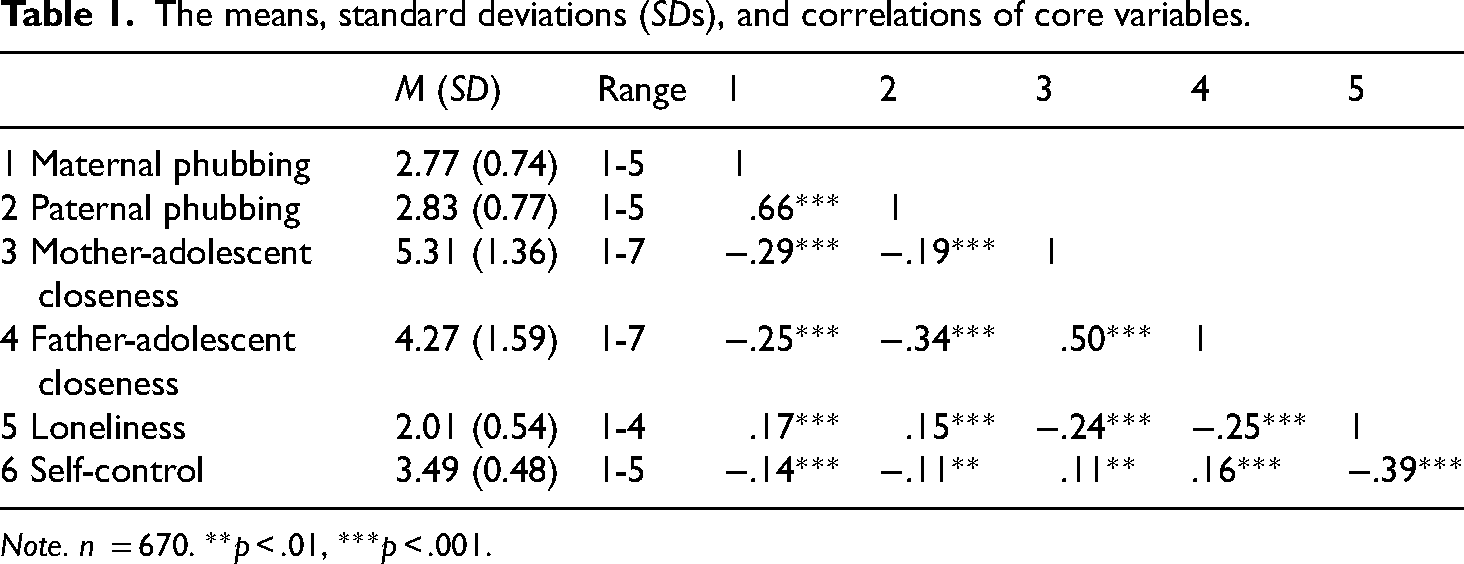
Note. n = 670. **p < .01, ***p < .001.
Next, t-tests were carried out to compare the mean differences of parental phubbing, parent–adolescent relationships, loneliness, and self-control between only-child adolescents and adolescents with siblings. Results showed that only-child adolescents perceived higher maternal phubbing (M = 2.86, SD = 0.75) than adolescents with siblings (M = 2.63, SD = 0.72), t = 4.03, p < .001, Cohen’s d = 0.31. Similar results were found for paternal phubbing (M only-child = 2.90, SD only-child = 0.77; M with siblings = 2.73, SD with siblings = 0.76), t = 2.87, p = .004, Cohen’s d = 0.22. For other variables, including parent–adolescent closeness, loneliness, and self-control, there were no mean differences between only-child adolescents and adolescents with siblings (ps > .05).
Mediating analyses
In order to examine the H2, H3, and H4, we examined the mediation models. Given the significant correlations between the variables of interest, the mediating roles of parent–adolescent relationship and loneliness were examined. After trimming the non-significant paths, the final model had a good fit, χ2(6) = 2.72, χ2/df = 0.45, CFI =1.00, TLI = 1.02, RMSEA = .000. The final model is shown in Figure 1. In the model, maternal phubbing negatively predicted mother–adolescent closeness (β = -.29, p < .001), and paternal phubbing negatively predicted father–adolescent closeness (β = -.36, p < .001). However, maternal phubbing did not predict father–adolescent closeness, and paternal phubbing did not predict mother–adolescent closeness. Maternal phubbing positively predicted loneliness (β = .09, p < .05), but negatively predicted self-control (β = -.08, p < .05). Mother– and father–adolescent closeness negatively predicted loneliness (β = -.13, p < .01; β = -.16, p < .001). Loneliness was negatively related to self-control (β = -.38, p < .001).
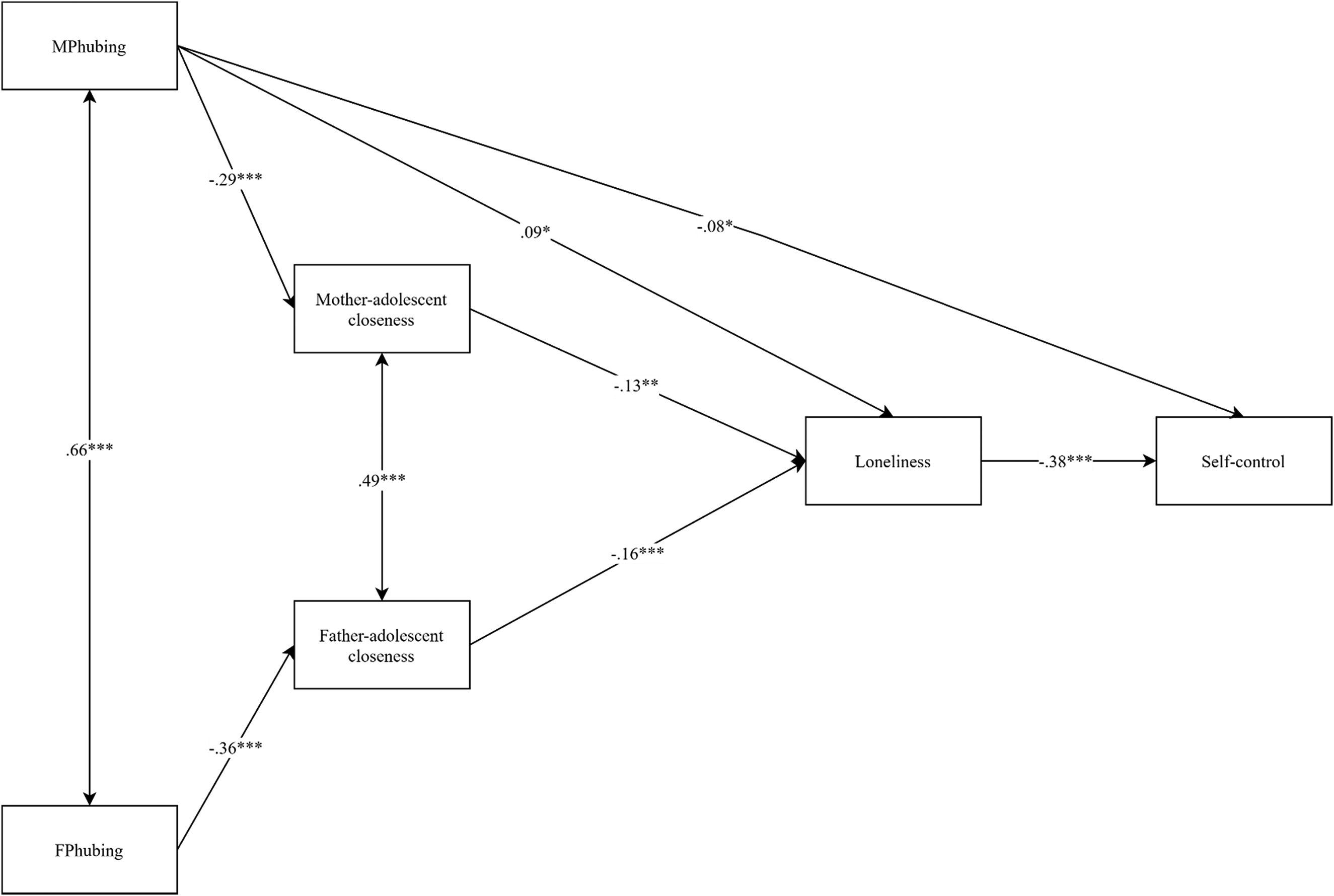
The mediation model (general). Non-significant paths were deleted.
In terms of the mediation effects, the current analyses revealed that the negative direct effect of maternal phubbing on self-control was significant, β = -.08, 95% CI = [-0.15, -0.002]. In addition, two indirect effects were found between maternal phubbing and self-control. The first one was maternal phubbing→ loneliness→ self-control, which had an indirect effect of -.03, 95% CI = [-0.07, -.001]. The second one was a sequential indirect effect: maternal phubbing→ mother-adolescent closeness→ loneliness→ self-control, and the indirect effect was -.02, 95% CI = [-0.03, -0.004]. The total indirect effect was -.05, 95% CI = [-0.08, -0.02], and it accounted for 39.52% of the total effect of maternal phubbing on self-control. For paternal phubbing, only a sequential mediating effect was found: paternal phubbing→ father–adolescent closeness→ loneliness→ self-control. The indirect effect was -.02, 95% CI = [-0.04, -0.01], and it accounted for 18.18% of the total effect of paternal phubbing on self-control. These results indicated that parent–adolescent closeness and loneliness were mediators in the relationships between parental phubbing and adolescent self-control. The results indicated that H2 and H4 were supported. H3 was not supported, because the simple mediations from parental phubbing to self-control through parent–adolescent closeness were not significant.
The moderating role of only-child status
A multiple-group comparison was used to test the moderating role of only-child status. Before testing the model invariance, independent mediation models for only-child adolescents and adolescents with siblings were tested. The model for only-child adolescents was similar to the general model (see Figure 2), χ2(6) = 11.53, χ2/df = 1.92, CFI = .98, TLI = 0.95, RMSEA = .049. Maternal and paternal phubbing negatively predicted mother- and father-adolescent closeness (β = -.22, p < .001; β = -.35, p < .001), respectively. Maternal phubbing negatively predicted self-control (β = -.11, p < .05), and positively predicted loneliness (β = .12, p < .05). Mother– and father–adolescent closeness negatively predicted loneliness (β = -.17, p < .01; β = -.16, p < .01). Loneliness negatively predicted self-control (β = -.36, p < .001). Two indirect effects were also found between maternal phubbing and self-control. The first one was maternal phubbing→ loneliness→ self-control, and the indirect effect was -.04, 95% CI = [-0.08, -0.01]. The second one was a sequential indirect effect from maternal phubbing→ mother-adolescent closeness→ loneliness→ self-control. The indirect effect was -.01, 95% CI = [-0.03, -0.003]. The total indirect effect was -.06, 95% CI = [-0.10, -0.02]. For the paternal phubbing, only a sequential mediating effect was found: paternal phubbing→ father–adolescent closeness→ loneliness→ self-control. The indirect effect was -.02, 95% CI = [-0.04, -0.01].
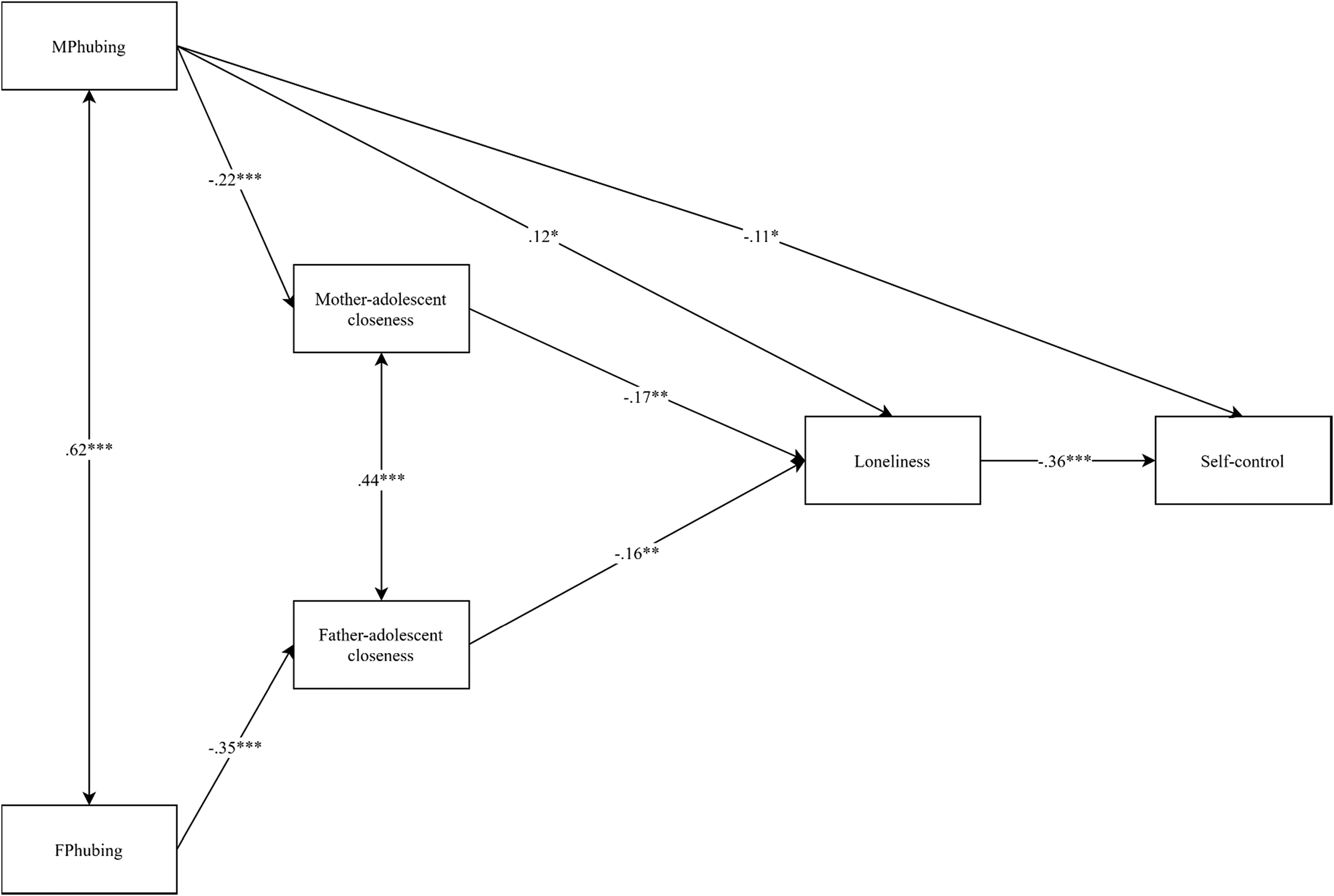
The mediation model (only-child adolescents). Non-significant paths were deleted.
In the model for adolescents with siblings, the mediation model pattern was different from the general model (see Figure 3), χ2(6) = 2.63, χ2/df = 0.44, CFI = .00, TLI = 1.03, RMSEA = .000. Results showed that maternal phubbing did not predict self-control (β = -.04, p = .50) and loneliness (β = .09, p = .15). Moreover, mother–adolescent closeness did not predict loneliness (β = -.09, p = .28). The remaining paths were similar to the general model. The indirect effect was only found in the relationship between paternal phubbing and self-control: paternal phubbing→ father–adolescent closeness→ loneliness→ self-control. The indirect effect was -.02, 95% CI = [-0.05, -0.002]. The direct and indirect effects of maternal phubbing on self-control were non-significant. Hence, the configural invariance between the model of adolescents without siblings and the model of adolescents with siblings was not satisfied. This indicated that the mediation model was moderated by adolescents’ only-child status, especially in the relationships between maternal phubbing and self-control. This means that having a sibling can reduce the negative influence of maternal phubbing on self-control.
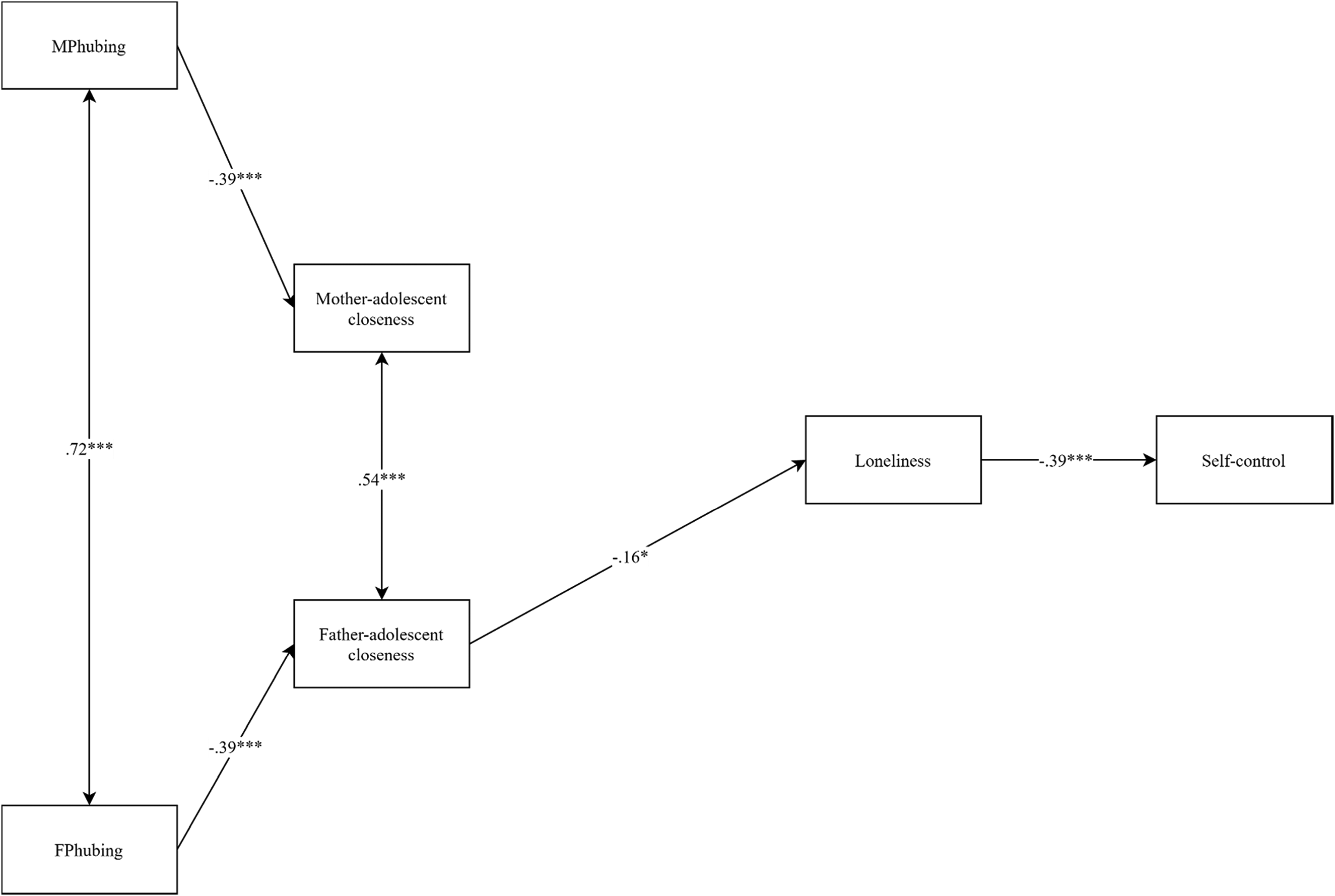
The mediation model (adolescents with siblings). Non-significant paths were deleted.
Discussion
The present study investigated how maternal and paternal phubbing are associated with adolescent low self-control through parent–adolescent closeness and loneliness and explored the moderating role of only-child status. Our main results revealed that both maternal and paternal phubbing were negatively correlated with adolescents’ self-control, and parent–adolescent closeness and loneliness played mediating roles in these relationships. Additionally, only-child status moderated the mediations.
Our preliminary analyses revealed that only-child adolescents reported higher levels of maternal and paternal phubbing than those with siblings. A previous interview study demonstrated that adolescents growing up in only-child families received more child-centered and protective parenting but less authoritative parenting than adolescents growing up in multi-child families (Khadaroo & MacCallum, 2021). Another explanation is that, compared with adolescents with siblings, only-child adolescents spend more time together with their parents and have a greater chance of being phubbed. Adolescents with siblings can play with their siblings; thus, the present study theorized that adolescents without siblings experienced higher parental phubbing than adolescents with siblings.
Parental phubbing and self-control
The current study found a negative association between paternal phubbing and adolescent self-control, indicating that adolescents with high parental phubbing tend to report low levels of self-control. These results are in line with those of previous studies (e.g., Niu et al., 2020; Qiao & Liu, 2020) and with the limited strength model of self-control, which illustrates that social exclusion leads to low self-control (Baumeister et al., 2005). According to this theory, adolescents who are phubbed by parents may expend less effort to self-regulate, and thus present a low level of self-control.
Pearson’s correlation analyses revealed that both maternal and paternal phubbing were negatively related to adolescents’ self-control, suggesting that maternal and paternal factors are important to consider when studying the effects of adolescents’ developmental environment on low self-control. The structural equation modelling for mediation analyses revealed that maternal phubbing, but not paternal phubbing, was directly related to self-control, a novel finding of this study that distinguishes the effects of maternal and paternal phubbing, and goes beyond those of previous studies. This differential effect illustrates that maternal phubbing may have a stronger effect on adolescent outcomes than paternal phubbing. However, this result may be specific to the context of our sample in China, where mothers tend to play a more important role in parenting than fathers.
Mediating roles of parent–adolescent closeness and loneliness
This study found sequential mediations from: (a) maternal phubbing to self-control through mother–adolescent closeness and loneliness; and (b) paternal phubbing to self-control through father–adolescent closeness and loneliness. In the mediating model, the negative correlations between parental phubbing and parent–adolescent closeness are similar to those of previous findings (e.g., K. Liu et al., 2021; Solecki, 2022). According to expectancy violation theory (Miller-Ott & Kelly, 2015), parental phubbing negatively affects adolescents’ expectancy in parent–adolescent communications, inducing loneliness among adolescents.
In terms of the simple mediating role of parent–adolescent closeness, unexpectedly, we found a pathway from maternal phubbing to mother–adolescent closeness and a similar relationship between paternal phubbing and father–adolescent closeness. These results do not support the findings of a previous study (P. Wang et al., 2022). Further, our findings do not support the existence of a spillover effect of parental phubbing. One possible explanation is that parent–adolescent closeness is a strong emotional link between adolescents and a specific parent. Phubbing from one parent can decrease the closeness relevant to the other phubbing parent but does not strongly influence the closeness relevant to the other parent. Although maternal and paternal phubbing have unique effects, the phubbing of both parents has a similar effect on parent–adolescent closeness. Therefore, our findings highlight that parents’ mobile phone usage potentially interrupts efforts to maintain strong parent–adolescent relationships.
Additionally, we found that loneliness is another important mediator in parent–adolescent relationships. The current study demonstrated that adolescents with a higher degree of closeness in mother– and father–adolescent relationships had lower levels of loneliness. These results echo the findings of previous studies (e.g., Cooper et al., 2021; Scharf et al., 2011). Taken together, the present study illustrated that parental phubbing is positively related to loneliness through the reduction of parent–adolescent closeness. The path from loneliness to self-control can be explained by the limited strength of self-control theory (Li et al., 2021), and is in line with the results of Özdemir et al. (2014).
Sequential mediation analysis supports the context-process-outcome model (Roeser et al., 1996). Following this model, parental phubbing acted as a context factor for low self-control, parent–adolescent closeness and loneliness acted as two psychological processes, and low self-control was the outcome. Theoretically, our results went beyond and expanded the model by dividing the different types of processes. Parent–adolescent closeness can be regarded as an interpersonal process, whereas loneliness can be considered an intrapersonal process. This distinction contributes to the literature on the mechanisms of parental phubbing on adverse developmental outcomes among adolescents. It also goes beyond previous studies that either test only the interpersonal process (e.g., P. Wang et al., 2022; X. Xie et al., 2019) or the intrapersonal process (e.g., R. Liu et al., 2019; X. Wang, Wang, et al., 2022).
The present study shows that both interpersonal and intrapersonal processes are critical for understanding the relationship between parental phubbing and adverse developmental outcomes. These two processes illustrate a mechanism that moves from external to internal. Interpersonal processes are proximal and external consequences of parental phubbing. Conversely, intrapersonal processes are a distal and internal consequence of parental phubbing. Neither of these processes can be overlooked when testing parental phubbing mechanisms.
Role of having siblings versus only-child status
The present study also explored the moderating role of only-child status. The results showed that the indirect effects of maternal, but not paternal, phubbing were moderated by only-child status. More specifically, the indirect effects of maternal phubbing were not significant for adolescents with siblings but were significant for only-child adolescents. These results did not support the resource dilution theory (Kalmijn & van de Werfhorst, 2016) but are consistent with those of some previous studies (e.g., Lee et al., 2021; Wikle et al., 2019).
In the present study, the moderating effects of only-child status occurred on the paths between several variables: maternal phubbing to loneliness, mother–adolescent closeness to loneliness, and maternal phubbing to self-control. The distinct roles of mothers and fathers in parenting may account for why only-child status moderated processes related to the mother but not the father. Mothers’ roles are typically represented as caring and intimate, whereas fathers’ roles are represented as authoritative or disciplinarian (Paquette, 2004). In a previous study, adolescents sensed more emotional support and intimacy from their mothers than their fathers during interactions. They also perceived that they learned more problem-solving skills, social norms, and responsibilities during their interactions with their fathers than with mothers (Collins & Russell, 1991).
Therefore, paternal and maternal phubbing may be related differently to loneliness. According to expectancy violation theory (Miller-Ott & Kelly, 2015), loneliness related to paternal phubbing may be a consequence of adolescents’ unfulfilled expectations about what they had hoped to learn from their fathers. Paternal phubbing may prevent Chinese adolescents from learning social norms and responsibilities from their fathers and consequently increase their loneliness. On the other hand, maternal phubbing might reflect inadequate warmth and intimacy. Adolescents can seek warmth and care from their siblings to ease their loneliness, but they cannot compensate for the violated expectations of fathers by playing with siblings. Thus, we conclude that siblings can attenuate the effect of maternal phubbing-related loneliness but not the effect of paternal phubbing-related loneliness.
Another potential explanation is that the relationship between father–adolescent closeness and adolescents’ internalization of problems is stronger than that between mother–adolescent closeness and adolescent’s internalization of problems (Day & Padilla-Walker, 2009). This suggests that the link between father–adolescent closeness and loneliness may be more stable than the link between mother–adolescent closeness and loneliness. Thus, the indirect relationship between maternal phubbing and self-control is easier to buffer than that between paternal phubbing and low self-control. In summary, the present study illustrates that having siblings is a potential protective factor for adolescent development. This study has practical implications for Chinese population policy adjustments. The 2-child and 3-child policies were issued by the Chinese government in 2015 and 2021, respectively, signifying the end of an only-child policy that lasted 30 years (Chi et al., 2020). Owing to this policy adjustment, it is becoming increasingly more common for Chinese children and adolescents to have siblings. Therefore, in practice, our research provides scientific support for policy adjustments.
Limitations and future directions
Although the theoretical and practical implications of this study have been mentioned above, several limitations should be noted. First, the present study only compared only-child adolescents with adolescents who have siblings, without considering birth order and sibling quantity, which are also related to adolescent outcomes (Easey et al., 2019). Therefore, future research should incorporate sibling quantity and birth order into their analyses. In addition, sibling relationship valence was not taken into account. Positive sibling relationships (e.g., helping) relate to more positive developmental outcomes, while adverse sibling relationships (e.g., conflicting) have the opposite effect (Zhao & Yu, 2017). Therefore, future studies should consider different types of sibling relationships.
Second, the ego depletion theory cited in our study has received substantial criticism during the replication crisis (e.g., Carter et al., 2015), which limits the robustness of our results.
Third, phubbing may be a reciprocal or contagious behavior (e.g., Büttner et al., 2022; Finkel & Kruger, 2012). In other words, the role of the phubber (a person who is phubbing others) and the phubbee (a person being phubbed) can change, and it is even sometimes the case that one person can simultaneously be a phubber and phubbee. In families, adolescents with low self-control phub their parents and vice versa. A longitudinal study is required to test this hypothesis. In addition, future studies should measure how much time each parent spends with the child and how much time they phub their child to determine whether the relative amount of phubbing makes a difference in predicting adolescents’ psychological outcomes.
Fourth, parents’ phubbing behaviors and adolescents’ perceived phubbing may not match. Future studies should also consider objective phubbing behavior (e.g., phubbing duration).
Finally, we only used cross-sectional self-report measurements in this study, which limit the ability to draw causal and reciprocal relationships between parental phubbing and adolescents’ self-control. In future research, a longitudinal design will be helpful to test causal and reciprocal relationships.
Conclusion
The present study concludes that maternal and paternal phubbing are negatively related to adolescent self-control. Parental phubbing decreases adolescent self-control by reducing parent–adolescent closeness and inducing loneliness. Only-child status moderates the mediating model, and having siblings attenuates the adverse links from maternal phubbing to adolescent self-control.
Footnotes
Acknowledgement
This study was supported by National Natural Science Foundation of China (61907006).
Authors’ contributions
X. Xie: design, data collection, analysis, manuscript draft, manuscript revision; X. Tang: design, data collection, manuscript revision; S. Wu: data collection; X. Shen data collection.
Ethics approval
This study was approved by the research ethics committee of the corresponding author’s institution and certify that the study was performed in accordance with the ethical standards as laid down in the 1964 Declaration of Helsinki and its later amendments or comparable ethical standards.
Data availability statements
The datasets generated during and/or analyzed during the current study are available from the corresponding author on reasonable request. Anyone can contact the corresponding author for the data with reasonable request.
Funding
The author(s) disclosed receipt of the following financial support for the research, authorship, and/or publication of this article: This work was supported by National Natural Science Foundation of China (grant number 61907006).

Author biographies
Xiaochun Xie is an associate professor at the School of Psychology, Northeast Normal University. His research interests include media and adolescent psychosocial development, media literacy, adolescent mental health.
Xiangyun Tang is a PhD Candidate in the Human Development area of the Educational Psychology department at University of Wisconsin-Madison. Her research interest broadly focuses on the role communication technologies play in youth's psychological well-being.
Siqi Wu is a master at the School of Psychology, Northeast Normal University. Her research interest is media literacy and online learning.
Xinyuan Shen is a master at the School of Psychology, Northeast Normal University. Her research interest is parental phubbing and adolescent mental health.