



Abstract
Phubbing—ignoring another person in order to use a smartphone instead—is an increasingly common behavior that disrupts interactions and harms relationships. Using the frameworks of the theory of planned behavior and an interaction value approach, we examined the driving factors of phubbing frequency. Four preregistered predictors were tested: attitudes toward phubbing, subjective norms of phubbing, interaction value, that is, the extent of valuing a social interaction, and the perceived interaction value of the partner. After having had lunch together, a total of 128 participants in 64 dyads filled out a survey assessing the four predictors. Dyadic linear mixed model analyses confirmed that a more positive attitude toward phubbing increases phubbing, as well as being phubbed. Moreover, we disentangled screen-sharing time (i.e., using a phone together), phone use, co-present phone use (i.e., using a phone alone), and phubbing: we found that valuing the social interaction more decreased phone use, but not phubbing, and holding more accepting subjective norms on phubbing increased co-present phone use, but not phone use in general. We further found that the person that used their phone first, phubbed more. Overall, this research extends our understanding of the factors driving phubbing and may be fruitfully harnessed to reduce phubbing.
Introduction
Phubbing—ignoring another person to use a smartphone instead—is increasingly prevalent (e.g., Al-Saggaf and MacCulloch, 2018) with numerous detrimental consequences: Phubbing may harm social interactions and relationships, decrease work performance, and foster depression (e.g., Chotpitayasunondh & Douglas, 2018; Ivanova et al., 2020; Roberts & David, 2020), creating economic and societal costs. So far, little attention has been devoted to variables conducive to phubbing. This study focuses on attitudes, norms, and one factor of the social interaction in dyads, namely, the extent to which individuals value the interaction. Addressing the reasons for phubbing is important, because to reduce phubbing, targeting the mechanisms that elicit and maintain phubbing is likely to prove particularly efficacious. We derived hypotheses based on the theory of planned behavior (Ajzen, 1991) and a values approach (Gloster et al., 2017).
Phubbing
Phubbing, composed of the words “phone” and “snubbing” (Macquarie Dictionary Blog, 2016) refers both to its cause—using a phone—and its effect on the conversation partner—feeling snubbed. Phubbing thus refers to an objective situation—someone uses a phone in the presence of another person—and a subjective experience—the other person feels ignored. Importantly, not all objective situations of co-present phone use are considered to be phubbing. For instance, if two individuals share a screen, this may not be considered to be phubbing because the partner is not being snubbed (e.g., Lutz and Knop, 2020). Similarly, using a phone alone might not be phubbing if it does not involve ignoring, for instance, when phone use is related to the conversation.
With the fast-spreading use of smartphones, phubbing has become increasingly prevalent. Research suggests that most smartphone users phub daily in a range of social contexts such as at work or at lunch (e.g., Al-Saggaf and MacCulloch, 2018). Particularly prone to being phubbed—so called phubbees—are romantic partners and friends (e.g., Al-Saggaf & O'Donnell, 2019; Al-Saggaf & MacCulloch, 2018; Roberts & David, 2016).
It appears that phubbing negatively affects human interactions. Phubbing may lead to being less satisfied with an interaction and enjoying it less (e.g., Dwyer et al., 2018). This happens because phubbing disengages a person from their partner by taking attention away from the other person, which results in feeling less connected, more distant, and less empathetic (Kushlev & Dunn, 2019; Kushlev & Heintzelman, 2018; Misra et al., 2016).
With increasing prevalence, phubbing may be perceived as acceptable and be reciprocated (Chotpitayasunondh & Douglas, 2016) so that vicious cycles of withdrawing attention in conversations could ensue: The phubbee withdraws attention in response to phubbing (e.g., Chotpitayasunondh and Douglas, 2018), which could in turn prolong the initial phubbing because the phubber will receive no signs from the phubbee to reengage in a focused conversation. Ironically, the phubbee might also start to use their phone (e.g., Finkel and Kruger, 2012), thereby fueling the initial phubbing.
Continuous experiences of phubbing may then affect relationships and individual well-being: relationship satisfaction and perceived relationship quality between phubbees and phubbers may decrease, while feelings of jealousy, relationship problems, and depression levels may increase (e.g., Al-Saggaf & O'Donnell, 2019; Halpern & Katz, 2017; Ivanova et al., 2020; McDaniel et al., 2018).
Predicting phubbing behavior
Given that phubbing may hurt social interactions, why do people phub? Previous research has focused on dispositional factors, that is, rather stable individual differences such as personality traits, that correlate with or predict phubbing behavior. For example, being neurotic, having a high fear of missing out, and addictive tendencies have all been associated with phubbing frequency (e.g., Balta et al., 2018; Karadağ et al., 2015). However, dispositional factors, by definition, are difficult to change and thus may not be very conducive to effective interventions. In contrast, examining characteristics of the social interaction may prove more efficacious, but so far little is known about such influence factors. To fill this void, we now turn to theoretical considerations about relevant predictors.
Predictions derived from the theory of planned behavior
To predict behavior, various theories have been proposed. We focused on the theory of planned behavior (TPB; Ajzen, 1991), which explains behavior as a function of three components: attitudes toward the behavior, subjective norms, and perceived behavioral control. Attitudes toward the behavior refer to the perceived valence of the behavior. Subjective norms refer to what the person thinks others want them to do. Perceived behavioral control refers to how the individual perceives the ease or difficulty of performing a behavior. Together these variables shape the intention to perform the target behavior, and ultimately the behavior itself.
TPB has been successfully used to predict various behaviors, including digital technology use, such as social media (e.g., Pelling and White, 2009), thus constituting a promising starting point when predicting phubbing. Three further reasons render TPB a helpful framework for predicting phubbing: First, by measuring attitudes toward the behavior, TPB addresses the attitude–behavior gap that may be critical to understanding behavior formation (e.g., Godin et al., 2005; Homer & Kahle, 1988). To date, attitudes toward people that phub (i.e., phubbers) have been investigated (e.g., Chotpitayasunondh and Douglas, 2018), but phubbing researchers have called for investigations into attitudes toward phubbing (see Al-Saggaf and O'Donnell, 2019). Second, norms have been shown to critically affect phubbing (Chotpitayasunondh & Douglas, 2016; Hall et al., 2014; Schneider & Hitzfeld, 2019). The TPB framework highlights the importance of norms, especially for behaviors that are judged morally (Godin et al., 2005), which applies to phubbing (e.g., Schneider and Hitzfeld, 2019). Third, TPB has been successfully applied to predicting other phone-use behaviors, for example, using a phone while participating in road traffic (e.g., Jiang et al., 2017; Nemme & White, 2010; Walsh et al., 2008).
Prior research on TPB predictors informed our hypotheses on attitudes and subjective norms. For instance, previous studies have linked positive attitudes toward using a phone while crossing a street and intentions to use a phone while crossing the street (Jiang et al., 2017). Consistent with TPB's emphasis on attitudes, we hypothesized:
Additionally, previous research highlights that norms may determine phubbing frequency (e.g., Schneider and Hitzfeld, 2019). Consistent with TPB's emphasis on norms, we therefore hypothesized:
Interaction value as a phubbing predictor
We further investigated the predictor interaction value to understand the characteristics of the social interaction in which phubbing takes place. The concept of interaction value holds that how we interact with other people depends in part on how much we value the interaction. In the clinical research of Gloster et al. (2017), values are described as individually chosen areas of importance. While leading life in accordance with one's values is a powerful psychological treatment (e.g., Gloster et al., 2017), leading a life that contradicts one's values may foster psychopathological symptoms (e.g., Michelson et al., 2011). By way of extension, we argue that valuing a particular interaction will impact one's actions (e.g., Gloster et al., 2017). For instance, someone may be less likely to phub if they are flirting or if their partner talks about a meaningful loss, compared with when there is a lull in the conversation (e.g., Kelly et al., 2017; Przybylski & Weinstein, 2013).
Interestingly, one might speculate that valuing an interaction may not be the same as discussing important topics. Indeed, one might value an interaction strongly, but still talk about rather mundane topics; here, sharing an interaction in a caring, attentive manner is central. Conversely, one might value an interaction very little, but still discuss important topics (e.g., resolving a fight with a neighbor). Interestingly, previous research found phubbing to be less frequent in conversations with a serious versus casual topic (Przybylski & Weinstein, 2013) but equally hurtful (Hales et al., 2018). Thus, it may not be the conversation's content that is decisive for phubbing frequency, but the extent of valuing the specific interaction. However, specific contexts or topics may be more likely to yield highly valued interactions, such as dating (e.g., Kelly et al., 2017) or meeting for lunch (as in the present sample). Importantly, individuals judge the value of the specific interaction and not just the relationship with the other person. As such, we accounted for the processes of the social interaction rather than stable relationship processes. We hypothesized that the extent of valuing the interaction would impact phubbing frequency:
Previous research suggests that humans care intensively about how they are viewed by their interaction partners (Boothby et al., 2018). We therefore included the perspective of the interaction partner's perceived thoughts, which we refer to as the individual's perceived interaction value of the partner:
As required for testing Hypotheses 3a and 3b and following up on the notion that interpersonal phenomena are best studied in groups or dyads, not in isolated individuals (e.g., Kenny et al., 2006), this study utilized a dyadic research design. Additionally, we deemed it necessary to study both perspectives on phubbing: phubbing someone (the phubber) versus being phubbed by someone (the phubbee). This distinction is important because phubbing is a phenomenon that, by definition, includes at least two individuals, though both need not be actively phubbing. Although literature on the consistency of the phubber's and the phubbee's estimate of phubbing frequency is scarce (Vanden Abeele et al., 2019), we suspected that the frequency of phubbing may be judged differently by the phubber and the phubbee.
To date, information on phubbing stems primarily from retrospective self-reports, possibly with associated biases. Studies that examine phubbing behavior in situ (i.e., in close temporal and spatial proximity to the phubbing situation) are much less common (e.g., Vanden Abeele et al., 2019).
Methods
This Study aimed to clarify why people phub. Using a dyadic in situ study, we examined four possible predictors of phubbing: attitudes toward phubbing, subjective norms on phubbing, interaction value, and the perceived interaction value of the partner.
We ran a pre-test to gauge scale properties. Verbatim materials and data for the pre-test and main study are publicly available (https://osf.io/xh436/). Conforming to international ethical standards, the Institutional Review Board approved the pre-test and the main study.
Pre-test
Method
Fifty-nine first-year psychology students (Mage = 21.02, SD = 2.91; 79.66% female) completed the pre-test. One participant reported an insufficient level of seriousness of participation (lower than 6 of 9 scale points) and was excluded from data analysis.
Participants provided informed consent and were then instructed to think of and describe a meal that they had shared with one other person (hereafter: partner).
Interaction value
Participants reported on their own interaction value, using five 7-point Likert scaled items (1 = not at all; 7 = very much; e.g., “How important was the interaction to you?”; Cronbach's α = .80, see Appendix A on OSF for all items). Participants’ perception of their partner's interaction value was assessed by the identical five items, but framed to reflect the perceived partner's valuing of the situation, for example, “In your opinion, how important was the interaction to your partner?” (7-point Likert scales; 1 = not at all; 7 = very much; α = .89, see Appendix A).
Phubbing frequency
Only participants who reported owning a smartphone and having it with them during the meal proceeded to answer the phubbing questionnaire about their own behavior. Phubbing refers to incidents where the participant phubbed their interaction partner. Only participants reporting that their partner owned a smartphone and had it with them during the meal, proceeded to answer the partner phubbing questionnaire. Partner phubbing refers to incidents where the participant perceived having been phubbed by their interaction partner. The order of phubbing and partner phubbing questionnaires was randomized. Phubbing was assessed by five items adapted from Halpern and Katz (2017) and Roberts and David (2016) on 6-point Likert scales (0 = never; 5 = often; e.g., “During the interaction, I looked at my smartphone”; α = .73, see Appendix B). We assessed partner phubbing with the same five items, reworded to fit the partner's perspective (e.g., “During the interaction, my partner looked at their smartphone”; α = .83, see Appendix B).
Attitudes toward phubbing
Attitudes toward phubbing were measured with four items adapted from Chotpitayasunondh and Douglas (2016) and Ajzen (2013) on 7-point Likert scales (1 = completely disagree; 7 = completely agree; e.g., “I think it is normal to use my smartphone during a social interaction”; α = .76, see Appendix C).
Subjective norms
Subjective norms on phubbing were measured with seven items adapted from Chotpitayasunondh and Douglas (2016) and Nemme and White (2010) on 7-point Likert scales (1 = completely disagree; 7 = completely agree; e.g., “People that are important to me think that it's okay that I look at my smartphone during a conversation”; α = .75, see Appendix D).
Results
All Participants reported owning a smartphone. Apart from one participant, all participants reported that their interaction partner owned a smartphone. However, only 67.24% (N = 39) reported having their smartphone with them during the described past meal. Therefore, only 39 participants answered the phubbing scale. Another two participants reported that their partner did not have their smartphone with them during the described meal, leaving a final sample of 37 participants who answered both questionnaires of phubbing and partner phubbing.
Some descriptive trends were interesting: First, phubbing was rare, M = 1.63, SD = 0.56, as was being phubbed, M = 1.62, SD = 0.67 (self-report; 0 = never, 5 = often). Regarding the interaction value, participants overall reported having valued the interaction highly, M = 5.66, SD = 0.83, and also perceiving that their partners overall valued the situation highly, M = 5.52, SD = 0.89. On a scale from 1 to 7, participants’ attitudes toward phubbing were rather negative, M = 2.20, SD = 0.80, as were their subjective norms on phubbing, M = 3.07, SD = 0.84, indicating that participants perceived phubbing as negative and socially rather unacceptable.
Reliability analyses revealed good internal consistency for all scales, suggesting that these could be used in the main test. All scales showed good model fits, except for the subjective norms scale, which showed acceptable fit on average.
We report confirmatory factor analyses for all scales (pre-test and main study) on OSF. In the pre-test, interaction value and anticipated interaction value yielded little variance across participants. To construct a fair test for these variables’ predictive power, we added further items to both scales (e.g., “I felt connected to my partner,” see Appendix A).
Main study method
We preregistered all hypotheses (https://aspredicted.org/a54re.pdf). Participants were recruited at a university cafeteria when leaving the cafeteria in dyads. Participants received approximately $3 (or course credit) and a chocolate bar. Based on the pre-test's overall effect size f2 = 0.145, power analysis for the main study using G*Power (Faul et al., 2007)—with power set to .80 and alpha error to .05—suggested a sample size of 88 individuals, hence 44 dyads. Anticipating dropout, we planned to oversample by 10%. However, through informal conversations with participants it became clear that more participants than initially assumed were unsure whether their partner had a smartphone with them or not, yielding a higher than anticipated dropout. To account for this challenge, we continued over-sampling. (We did not define a stopping rule but continued sampling until our lab closed down due to construction work, resulting in 13 days of data collection.) Data were not analyzed during data collection.
From the entire dataset of 128 participants, 12 incomplete cases were excluded. Three participants wished to be excluded from data analysis. Twenty-four participants were excluded because either they or their partner did not have a smartphone with them. Four participants were excluded because they reported insufficient levels of seriousness of participation (lower than 6 of 9 scale points). This left a sample size of N = 92. Notably, the 92 participants did not represent complete dyads; there were only 37 complete dyads because sometimes only one participant of a dyad was excluded. Because dyadic analyses necessitate complete dyads, dyadic analyses were performed with the sub-sample of N = 74 individuals (37 dyads; Mage = 22.73, SD = 6.62, 52.70% female). In contrast, aggregated analyses do not necessitate complete dyads, so the N = 92 individuals were included in the aggregated analyses (Mage = 23.55, SD = 7.18, 50% female).
After providing informed consent, participants were asked to describe the lunch situation they had just had to ensure that participants’ answers related to this situation. Subsequently, participants stated whether they had shared this lunch with one other person. Participants that did not meet this criterion concluded their participation in the study, were thanked, and received a chocolate bar. All other participants proceeded to answer items about their relationship with the interaction partner, the importance of that person to them, and their contact frequency. Participants answered the extended questionnaires about interaction value (Cronbach's α = .87) and perceived partner interaction value (α = .89). Next, participants reported whether they and their partner had smartphones with them during the interaction and reported on the following measures: in random order, either first phubbing (α = .84) and then partner phubbing (α = .86), or vice versa; attitudes toward phubbing (α = .86); and subjective norms on phubbing (α = .78). Thereafter, participants reported their phone use time during the interaction and their partner's phone use time (in percent). If participants had used their smartphone, they next reported what they had done with their smartphone and what they recalled their partner having done with their smartphone. To assess screen-sharing that could otherwise be mistakenly interpreted as phubbing, participants stated the amount of time during which they had shared the screen, for example, to watch a video on the smartphone together. Lastly, participants indicated whether they or their partner had used the smartphone first. Participants provided demographic information, rated the seriousness of their participation, and had the chance to self-exclude from data analysis. The study took 10 to 15 min to complete. Participants were thanked and compensated.
Results
Descriptive results
Most participants indicated close relationships with each other and frequent contact. Generally, participants indicated that the other person was very important to them (see Table 1).
Descriptive Results Main Study, N = 92.
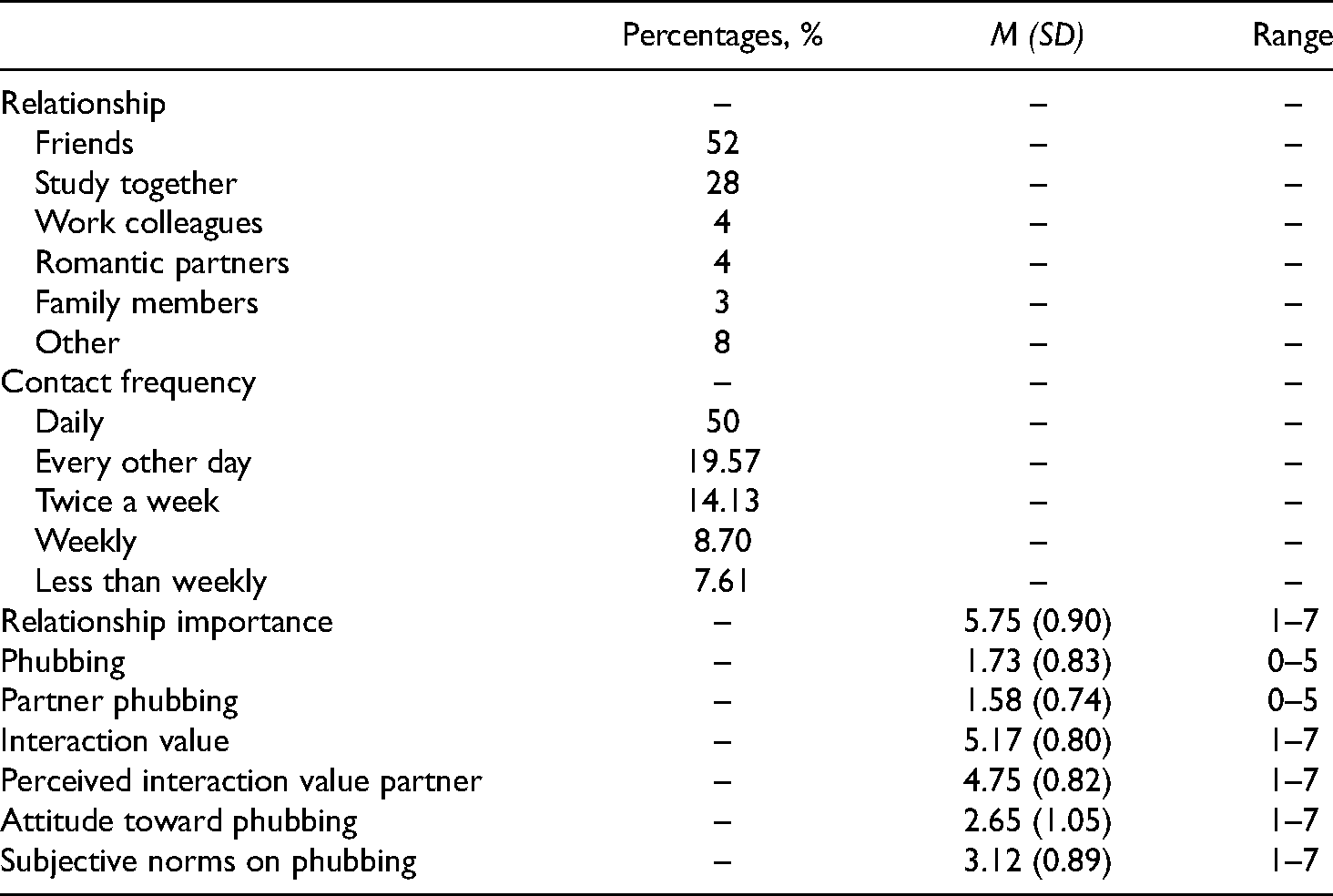
Overall, participants reported rather low phubbing scores and low partner phubbing scores (see Table 1). The most frequently reported phone-use behaviors were using messenger applications and screen-sharing. Participants reported high interaction values, and they also perceived that their partner valued the interaction (see Table 1), yet, significantly less than they did, t(91) = 8.40, p < .001, d = 1.76. The participants’ attitude toward phubbing was rather negative. In comparison, their subjective norms on phubbing were less negative (see Table 1).
Analysis strategy and hypothesis testing
For hypothesis testing, we computed mixed models in R (lme4; Bates et al., 2015; nlme, Pinheiro et al., 2020). Dyadic linear mixed models account for the nestedness of participants by considering the dependence of errors in dyads using generalized least squares that allow errors to be correlated (Pinheiro & Bates, 2000).
To gauge the findings’ robustness, further aggregated analyses were conducted. Aggregated analyses do not account for the nestedness of individuals within dyads but treat individuals as if they were independent of each other. These analyses can therefore complement the picture observed with dyadic analyses, but should nevertheless be considered with caution, as they ignore the non-independence of dyadic data and thus can result in biased variance and standard errors (Kenny et al., 2006).
Items pertaining to one construct were averaged (e.g., phubbing), and then mean-centered. To account for skewness, phubbing (skewness = 1.87) and partner phubbing (skewness = 2.65) were log-transformed.
Phubbing and partner phubbing correlated positively, r = .563, t(89) = 6.42, p < .001. Consistent with preregistration, every hypothesis was tested separately for phubbing and partner phubbing. We provide approximations of Cohen's d for each analysis, based on the doubled regression coefficients divided by the estimated standard deviation of the errors, sigma (see Westfall, 2016 for a discussion on computing mixed models’ effect sizes).
H1 holds that a person with a more positive compared with a more negative attitude toward phubbing will phub more frequently. Dyadic linear mixed models showed a significant effect of attitude toward phubbing on reported phubbing, t(72) = 2.59, p = .012, d = 0.46, and on reports of having been phubbed, t(72) = 2.77, p = .007, d = 0.56. Aggregated analyses also showed a significant effect of attitude toward phubbing on phubbing, t(90) = 3.03, p = .003, d = 0.61, and on reports of having been phubbed, t(90) = 2.86, p = .005, d = 0.57. Together these analyses provide strong support for H1.
H2 refers to subjective norms and holds that a person who believes more strongly compared with believing less that phubbing is a socially acceptable behavior, will phub more frequently. The dyadic models showed no effect of subjective norms on phubbing, t(72) = 0.13, p = .894, d = 0.03, or partner phubbing, t(72) = 1.04, p = .301, d = 0.26. The same was true for the aggregated analyses: phubbing, t(90) = 0.81, p = .422, d = 0.19; partner phubbing, t(90) = 1.23, p = .221, d = 0.29. Thus, H2 could not be supported.
H3a holds that a person valuing the social interaction more compared with less will phub less frequently. Dyadic linear mixed models revealed no significant effect of interaction value on reported phubbing, t(72) = 0.57, p = .570, d = 0.15, and no effect on partner phubbing, t(72) = 0.59, p = .560, d = 0.16. The same non-significant patterns emerged for aggregated analyses: phubbing, t(90) < 0.01, p = .998, d < 0.01; partner phubbing, t(90) = 0.12, p = .902, d = 0.03. Thus, H3a could not be retained.
H3b holds that a person believing that their interaction partner values the social interaction more compared with less, will phub less frequently. Dyadic linear mixed models indicated no effect of the perceived interaction value of the partner on phubbing, t(72) = 1.09, p = .280, d = 0.28, or on partner phubbing, t(72) = 0.15, p = .885, d = 0.04. Using aggregated analyses, the same non-significant pattern emerged for phubbing, t(90) = 0.48, p = .635, d = 0.12, as well as for being phubbed, t(90) = 0.01, p = .981, d < 0.01. Thus, H3b could not be supported.
Exploratorily, we computed dyadic models with all four predictors in one model: for phubbing, only attitudes predicted phubbing, t(69) = 2.66, p = .010, d = 0.72. For partner phubbing, again, only attitudes predicted partner phubbing, t(69) = 2.66, p = .010, d = 0.68.
The effect sizes for predicting phubbing and partner phubbing were very similar except for H2 and H3b: For H2, the effect sizes for subjective norms predicting partner phubbing were considerably higher (albeit the effects were non-significant) than for predicting phubbing, both in the dyadic- and the aggregated analyses, d = 0.26 and d = 0.29, respectively, compared with d = 0.03 and d = 0.19, respectively. This may suggest that one’s own subjective norms more accurately predict the experience of being phubbed than of phubbing oneself. For H3b, the effect sizes for the perceived interaction value of the partner predicting phubbing were considerably higher (albeit the effects were non-significant) than for predicting partner phubbing, both in the dyadic- and aggregated analyses, d = 0.28, and d = 0.12, respectively, compared with d = 0.04, and d < 0.01, respectively. This may suggest that thinking the partner valued the social interaction more is a better predictor of phubbing oneself than of being phubbed. We discuss possible reasons for these effect size patterns in the Discussion.
Exploratory analyses: Disentangling phone-use behaviors
We further explored the phubbing phenomenon by examining possible differences between phubbing and partner phubbing, the consequences of who started using their phone, phone-use time and, more specifically, phone-use time during which the screen was not shared, as an approximation of co-present phone use (computed based on self-reported subjective measures, as the difference of phone-use time minus screen-sharing time).
Consequences of who starts using their phone first
A dyadic linear mixed model showed that who started using their phone first had a significant effect on phubbing, t(72) = −3.63, p < .001, d = −0.64, Mfirst = 2.19, SD = 0.99, Msecond = 1.49, SD = 0.86, suggesting that the person using the phone first, phubbed more. That same pattern emerged using aggregated analyses, t(90) = −3.72, p < .001, d = −0.85. There was no effect on partner phubbing: dyadic analyses, t(72) = 1.58, p = .119, d = 0.33, Mfirst = 1.50, SD = 0.47, Msecond = 1.97, SD = 1.36; aggregated analyses, t(90) = −0.14, p = .889, d = −0.03.
Phone-use time
Phone-use time was assessed to capture the mere effect of having a phone present (e.g., Dwyer et al., 2018; Misra et al., 2016). Table 2 offers correlations of phone-use time and partner phone-use time with phubbing, partner phubbing, and the measured predictors. Phone use time (skewness = 3.12, M = 7.71, SD = 13.41) and partner phone use (skewness = 3.24, M = 7.30, SD = 13.86) were heavily skewed. Moreover, the mode of both variables was 0, with 27 of 92 participants reporting no phone use time and 30 of 92 participants reporting no phone use time of their partner. Because omitting cases in which participants reported no phone use time would bias the analyses, we refrained from using own and partner phone use time as outcome variables and report correlations only. Phone-use time, partner phone-use time, phubbing, as well as partner phubbing all correlated highly and positively, all ps < .001. Furthermore, phone-use time correlated negatively with interaction value, r = −.276, t(90) = −2.72, p = .008, as well as perceived partner interaction value, r = −.220, t(90) = −2.14, p = .035, and positively with attitudes toward phubbing, r = .308, t(90) = 3.07, p = .003. A similar pattern emerged for partner phone-use time, which also correlated negatively with interaction value, r = −.291, t(90) = −2.88, p = .005, as well as perceived interaction value of the partner, r = −.250, t(90) = −2.45, p = .016, and positively with attitudes toward phubbing, r = .304, t(90) = 3.02, p = .003.
Correlations Main Study, N = 92.
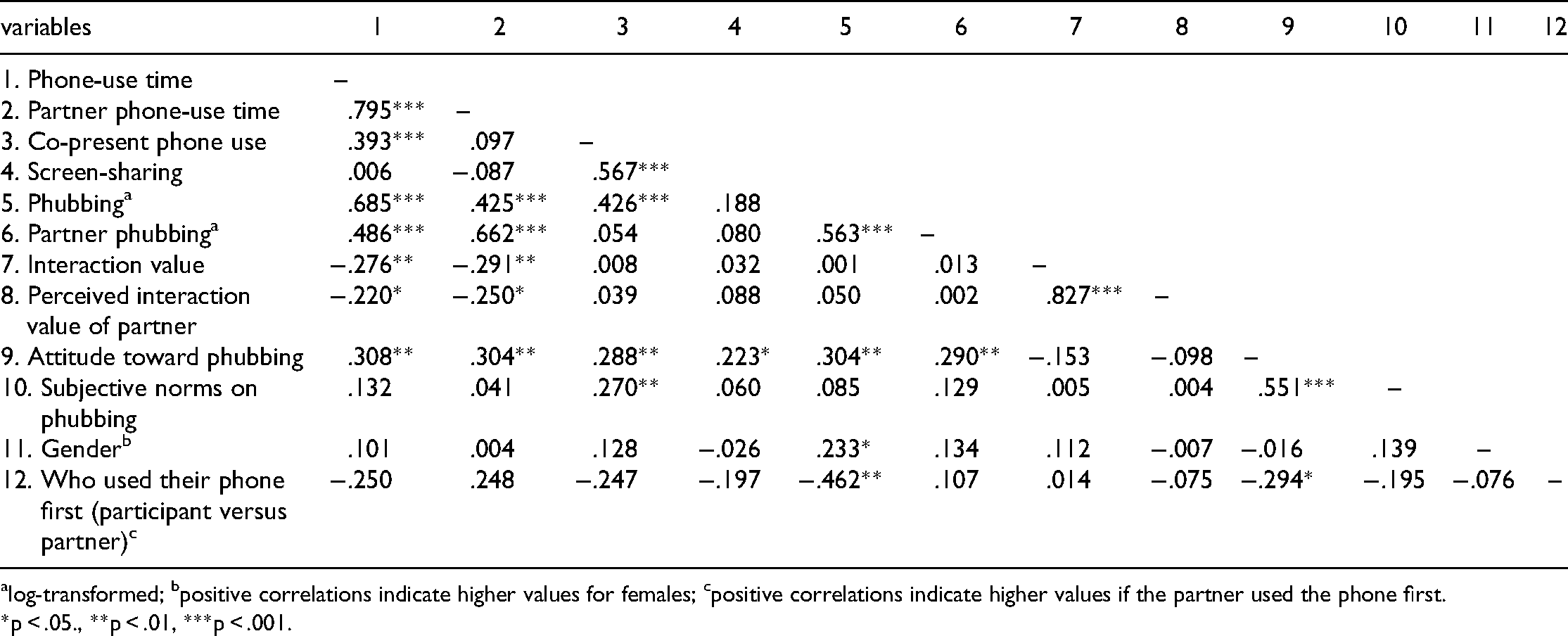
alog-transformed; bpositive correlations indicate higher values for females; cpositive correlations indicate higher values if the partner used the phone first.
*p < .05., **p < .01, ***p < .001.
Co-present phone use
We now focus on the key element of phubbing—having a phone present and using it alone. Based on the phone-use time reports, we computed co-present phone use as the difference between phone-use time minus screen-sharing time. Co-present phone use thus reflects the self-reported amount of time during which participants used their phone in the presence of the other person without sharing the screen. Separating screen-sharing from co-present phone use appears important, because screen-sharing is typically not hurtful to the interaction (e.g., Lutz and Knop, 2020). Further, the measure taps into the phubbing construct with a different approach that seems less amenable to social desirability editing. This is because it is not necessarily salient to participants that phubbing is the variable of interest when questions refer to total phone-use time and screen-sharing time only. Aside from its advantages, however, the measure is silent about feelings of being ignored, therefore, it can only capture one aspect of the phubbing (i.e., using a phone alone), not all aspects (i.e., feeling ignored). Co-present phone use complemented the (preregistered) self-reported phubbing measures. In the current study, co-present phone use was highly skewed (skewness = 4.66, M = 1.90, SD = 4.56) and the mode was 0, thus log-transformation was not an option. We therefore report correlations (Table 2). Co-present phone use showed positive correlations with phone-use time, phubbing, and with screen-sharing, all ps < .001. Furthermore, co-present phone use correlated positively with attitudes toward phubbing, r = .288, t(90) = 2.86, p = .005, and with subjective norms on phubbing, r = .270, t(90) = 2.66, p = .009. Screen-sharing was also correlated with attitudes toward phubbing, r = .223, t(90) = 2.17, p = .033.
Gender bias
Because prior research consistently documented a gender bias in phubbing (e.g., Chotpitayasunondh & Douglas, 2016; Karadağ et al., 2015), we compared females and males: females (Mfemale = 1.92, SD = 0.96) reported phubbing more than males, Mmale = 1.55, SD = 0.62, t(88) = 2.28, p = .025, d = 0.49. Interestingly, from the phubbee's perspective (i.e., partner phubbing), this gender difference was not significant, t(85) = 1.28, p = .204, d = 0.28; Mfemale = 1.68, SD = 0.89, Mmale = 1.47, SD = 0.53. Also, there were no significant correlations of gender with any other measures (Table 2).
Discussion
Phubbing—ignoring someone to use a phone instead—has emerged with the mainstream use of smartphones and alters social interactions. Those being phubbed feel annoyed and ignored (e.g., Hales et al., 2018); phubbing thus threatens social interactions, relationships, and mental health (e.g., Chotpitayasunondh & Douglas, 2018; Ivanova et al., 2020). Combining TPB (Ajzen, 1991) with an interaction value approach (Gloster et al., 2017) in a dyadic study, we offer new insights into what drives phubbing and how phubbing and other phone-use behaviors affect social interactions in different ways. Consistent with TPB, we found that attitudes toward phubbing predicted phubbing and being phubbed. Further, we identified phone-use time, screen-sharing, and using a phone alone (i.e., co-present phone use), as being distinctly related to the tested predictors: We found that valuing the social interaction more decreased phone use in general, but not co-present phone use, and holding more accepting subjective norms on phubbing increased co-present phone use but not phone use in general.
Attitudes, but not subjective norms, predict phubbing
Consistent with TPB and calls for investigations into the role of attitudes toward phubbing predicting phubbing (see Al-Saggaf and O'Donnell, 2019), attitudes toward phubbing proved to be the strongest predictor of phubbing. Interestingly, however, subjective norms that are also considered to be important players, both in the TPB framework and in previous phubbing research (e.g., Schneider and Hitzfeld, 2019), did not predict phubbing.
Valuing the social interaction does not predict phubbing
We also hypothesized that valuing the interaction would have an impact on phubbing (e.g., Gloster et al., 2017), in line with findings that phubbing is less frequent in serious than in casual conversations (Przybylski & Weinstein, 2013). Interestingly, valuing the interaction less did not predict phubbing. This was surprising, because one might have expected that a less valued interaction would be associated with more phubbing.
Future research might fruitfully disentangle whether interaction value and phubbing are not associated, or whether their measurement could be improved. However, we found that valuing the interaction more decreased phone use, but not co-present phone use. This suggested that using a phone in general might lower the valuing of an interaction, in line with previous research (e.g., Dwyer et al., 2018; Misra et al., 2016), or vice versa, that is, a less valued conversation might increase phone use. This may suggest that if an interaction is valued less, people more easily disengage from it by using their phone.
Prediction of phone-use behaviors in social interactions
We also examined how different phone-use behaviors predicted different interactional outcomes, thereby ensuring that phubbing was carefully differentiated from other phone-use behaviors that might even be beneficial for relationships, such as screen-sharing (Kelly et al., 2017). We identified phone-use time, screen-sharing, and using a phone without sharing the screen, which we termed co-present phone-use. Attitudes toward phubbing correlated with phone-use time and co-present phone-use time, suggesting that more positive attitudes toward phubbing were indicative of co-present phone-use and of phone use in general. Subjective norms on phubbing, however, correlated only with co-present phone use. Subjective norms thus seemed to be a specific predictor of co-present phone use, going beyond a general propensity for phone use. Interestingly, subjective norms predicted neither self-reported phubbing nor self-reported partner phubbing. This may suggest that the impact of norms on phubbing is best captured by calculating co-present phone use, and not by participants’ self-reported phubbing behavior. Finally, we observed differences in phubbing based on who used their phone first: the person who started phubbing, phubbed more. Previous findings suggest that seeing another person use their phone increases the likelihood of beginning phone use oneself (Finkel & Kruger, 2012), as if phone use was contagious. Further, engaging in phone use as a response to phubbing has been speculated to be adaptive if it is used to compensate for lost affiliation with social contacts using their phone (Hales et al., 2018). Taking an interaction value approach, this is interesting as it could lead to a vicious cycle of contagious phone use, lowered valuation of the interaction, and continued phubbing. However, even if phone use is contagious, in the present dataset, the person who started phubbing remained the one who phubbed more by a wide margin.
Avenues for future phubbing and phone use research
This study investigated several phone-use behaviors: self-reported phubbing, phone use, co-present phone use, and screen-sharing. Future research is needed into what the conceptual core of phubbing is and what drives the effects of phubbing. Is it only using a phone alone in the presence of a partner? Or is phubbing defined by the partner feeling ignored? These considerations will need to be reflected in how phubbing is best measured in the future.
Strengths of the dyadic approach
By assessing phubbing in close temporal and spatial proximity to the actual phubbing situation, potential biases were likely reduced, thus increasing validity.
Moreover, several of our findings would not have been as comprehensive had they not relied on dyadic data. For example, concerning attitudes toward phubbing, not only did the phubber's attitude predict self-reported phubbing, it also predicted self-reports of being phubbed. The dyadic approach also painted a more nuanced picture of the effect of subjective norms: while the effect of subjective norms on phubbing was negligible, the effect of subjective norms on being phubbed reached a medium effect size (albeit the effect was non-significant). Thus, it could be that being phubbed leads to the perception that this is a socially acceptable behavior, consistent with the general tenet that norms are formed and learned by observing others (Bandura, 1978).
The pattern of effect sizes could also point to a mechanism of justifying having been phubbed as an acceptable behavior to make it less painful. Such justification processes could also have been operating when phubbed individuals reported more positive attitudes toward phubbing. Not only could reporting more accepting attitudes and norms on phubbing justify and thereby mitigate the effects of being phubbed, it could also justify own phubbing. This idea was further supported by the finding that own subjective norms correlated with co-present phone use: if I believe that others accept my behavior, then it is more acceptable to exert this behavior, which protects a positive self-image, a fundamental motive to human behavior (Greenberg et al., 1986). However, the current findings were non-significant and therefore there was high insecurity in estimating their effect size. This warrants cautious interpretation until other studies replicate the effects.
Another example for the strength of the dyadic approach was the gender bias in phubbing: although prior research consistently found a gender bias (e.g., Chotpitayasunondh and Douglas, 2016), our dyadic approach showed that this bias was only clearly apparent for self-reported phubbing and was less clear for reports of being phubbed.
To our knowledge, this study is among the first to simultaneously examine experiences of phubbing and of being phubbed. Our differential findings for phubbing and partner phubbing as well as the medium-sized correlation of the two indicated that much further insight into the phubbing phenomenon could be gained in a dyadic context that captures social dynamics.
Limitations
Future studies might complement the present approach with longitudinal study designs, as cross-sectional data is silent about the causal pathway of effects. Particularly, experience sampling could address questions that were outside the scope of the present context. Using experience sampling with dyads (Gloster et al., 2020), phubbing may be investigated longitudinally, across different situations. This may reduce recall biases and context selectivity. Additionally, mobile sensing could be used to assess whenever two individuals interact while using their phones so that phubbing is not solely identified via self-report. However, experience sampling of phubbing also poses risks if executed on participants’ smartphones because answering questions on the phone may be interpreted as phubbing by the participant's partner. Moreover, once the phone is used to answer questions, it may foster further use and, ultimately, phubbing.
Further, although the data were collected immediately after participants shared their lunch, thus reducing biases, the data may nevertheless be subject to biased retrospective recall. Moreover, habitual phubbing may increase the threshold for recognizing phubbing as such, thereby making it more difficult to recall (Vanden Abeele et al., 2019). Future studies may benefit from incorporating objective observations of phubbing and phone-use behaviors such as observer ratings of co-present phone use (see Vanden Abeele et al., 2019 for an example). Ideally, observer ratings would be combined with subjective ratings because, while observers may rate phone-use time more accurately (Vanden Abeele et al., 2019), only subjective assessments are informative about whether this behavior actually elicited feelings of being phubbed.
We also suggest addressing self-selectivity in the sample by looking at phubbing in dyads in other contexts, for example, work contexts, or by randomizing participants into dyads in experimental manipulations. Future research might wish to sample more extensively to mitigate the potentially higher dropout rates in dyadic study designs.
Conclusion
Why do people phub? Individuals phub more when they have a positive attitude toward phubbing, and they engage in co-present phone use more when they hold the belief that phubbing is acceptable, consistent with predictions derived from TPB. In addition, valuing the social interaction more may serve as a protective factor against phone use. The results add to a more profound comprehension of the factors driving phubbing specifically, and phone use in social interactions more generally.
Supplemental Material
sj-docx-1-mmc-10.1177_20501579211059914 - Supplemental material for Your phone ruins our lunch: Attitudes, norms, and valuing the interaction predict phone use and phubbing in dyadic social interactions
Supplemental material, sj-docx-1-mmc-10.1177_20501579211059914 for Your phone ruins our lunch: Attitudes, norms, and valuing the interaction predict phone use and phubbing in dyadic social interactions by Christiane M. Büttner, Andrew T. Gloster and Rainer Greifeneder in Mobile Media & Communication
Footnotes
Acknowledgements
We would like to thank Morena Rothmaier and Bernhard Raschka for their tireless help with data collection.
Funding
The authors received no financial support for the research, authorship and/or publication of this article.

Supplemental material
Supplemental material for this article is available online.
Author Biographies
Christiane M. Büttner is a PhD student in the Department of Social Psychology at the University of Basel.
Andrew T. Gloster heads the Department of Clinical Psychology and Intervention Science at the University of Basel.
Rainer Greifender heads the Department of Social Psychology at the University of Basel.
References
Supplementary Material
Please find the following supplemental material available below.
For Open Access articles published under a Creative Commons License, all supplemental material carries the same license as the article it is associated with.
For non-Open Access articles published, all supplemental material carries a non-exclusive license, and permission requests for re-use of supplemental material or any part of supplemental material shall be sent directly to the copyright owner as specified in the copyright notice associated with the article.
