




Abstract
Recently, in many countries, the use of mobile messaging applications for news has risen while the use of Facebook for news has declined. The purpose of this study is to identify who shares news on messaging applications, why and in what ways. Findings from a survey and focus groups in the US, the UK, Germany, and Brazil show that (a) the main motivation for news users to share news in these spaces is context collapse; their aversion to news sharing on an open network like Facebook, (b) the anytime/anywhere mobile affordance facilitates their need for private news sharing, (c) news stories chosen for sharing usually revolve around niche interests or breaking news events and not politics and current affairs, (d) news sharers are likely to be young, and to trust news found on social media in the Western countries of our sample, while they tend to be older and partisan in Brazil where 38% of the population shares news on mobile messaging apps during an average week.
Introduction
In recent years, there has been a sharp increase in the use of smartphones for news consumption in developing and developed countries (Pew Research Center, 2019a; 2019b), particularly among the youth (Chan, 2015). Subsequently, people started using mobile messaging applications like WhatsApp, Facebook Messenger, Viber and Telegram to share and consume news at increasing rates, while the share of population who uses Facebook for news has, for the first time, declined in many countries (Newman et al., 2018).
Previous literature suggests that users are aware of the multiple contexts collapsing on open social networks like Twitter and use techniques to tailor their messages to different audiences (Marwick & boyd, 2011). The recent rise of messaging applications for news is related to the need for communication with strong ties and it is facilitated by mobile affordances. The anytime/anywhere affordance of mobile technologies can strengthen communication between strong ties at the expense of communication with weaker ties (Ling, 2008). Different social network infrastructures (Bossetta, 2018) are also affecting the way social networks are used. Messaging applications are primarily being used on mobile and not on desktop, 1 and this change can have effects on where news is being disseminated. Different social networking sites also have different network structures (Bossetta, 2018): news use on WhatsApp, for instance, takes the form of direct messages shared and received between people connected through their phone contacts lists. People can also connect with their acquaintances in larger group chats made up of phone contacts or contacts of contacts. In more open social networks like Facebook the network structure allows people to connect and share information with their weaker ties more easily.
The recent move of the audience from open platforms to messaging apps for news has implications for news publishers as well. News organizations may lose their existing (and already weak) levels of control over their content distribution. On their social media pages, news organizations can distribute news to thousands or millions of followers. On messaging applications, news publishers do not have control over distribution and, in many instances, they seem reluctant to engage with the audience (Boczek & Koppers, 2020). In addition, it is likely that large parts of the audience do not pay attention to the news brands they used when they clicked on a news story via a messaging application. People tend not to remember which news brands they use when they access news via social media and search engines (Kalogeropoulos et al., 2019). Assuming that people will notice news brands even less in mobile messaging applications where the logos and the names of news organizations are even less prominent than on Facebook or Twitter, the rise of messaging apps for news can have powerful implications for the dissemination of disinformation from malicious news sources as well as for the business of news. At the same time, the users who share news become more central in news distribution, given the absence of algorithmic filtering (Bossetta, 2018).
In this article, we focus on news sharing on mobile messaging applications, with three exploratory questions about the profile of those who share news, the circumstances under which news is being shared in these spaces and the reasons behind the rise of news sharing in mobile messaging apps. Aiming to understand the move of the audience in these spaces for news sharing, we draw on a comparative and mixed method design. By employing survey and focus group data in the US, the UK, Germany and Brazil, we find that (a) the main motivation for news users to share news in these spaces is context collapse – their aversion to news sharing on an open network like Facebook, (b) the anytime/anywhere mobile affordance facilitates their need for private news sharing, (c) news stories chosen for sharing usually revolve around niche interests or breaking news events and not politics or current affairs, (d) news sharers are likely to be young, and to trust news found on social media in the Western countries of our sample, while they tend to be older and partisan in Brazil where 38% of the population shares news on mobile messaging apps during an average week.
The first part of the article presents a review of studies on mobile messaging applications and news sharing, as well as the development of three research questions. This is followed by a presentation of the data, the measures used, and the country selection. The third section includes the results, and a concluding section. There the main findings are discussed, returning to the interplay of news sharing with mobile messaging affordances, as well as a discussion of the potential implications of news sharing in mobile messaging applications for the information environment and for news organizations.
Mobile messaging applications and news sharing
The architecture of social networks and their infrastructural characteristics shape how users interact with each other and how news is being shared. One of the key features of mobile technologies is the ‘anytime-anywhere’ affordance (Campbell, 2013) that allows users to interact with each other during every moment of their daily lives. Ling (2008) has argued that mobility and the ‘anytime-anywhere’ affordance can strengthen strong ties and our relationships with family and close friends: ‘More than other forms of mediated interaction, mobile communication favors contact with those with whom we are close – family members, friends, colleagues’ (p. 4). Scholars have argued that the ‘social logic’ of mobile technologies allows for frequent interpersonal interactions and they could be an answer to challenges related to the quick pace of modern life (Vanden Abeele et al., 2018). The social logic of mobile technologies is further supported by the use of multiple media on mobile communication (Boase, 2008). The ‘multiplexity’ refers to multiple types of communication being used simultaneously on mobile applications: social networks, emails, texts, and voice calls (Boase, 2008; Schrock, 2015). This is particularly easy with modern mobile technologies that allow calls, group chats and easy link sharing being used simultaneously between different applications.
A question then is how mobile messaging app technologies affect the news sharing experience. The features of messaging applications are related to intimacy and interpersonal communication (Karapanos et al., 2016), thus mediation in messaging applications occurs in a ‘relatively private and controlled environment’ (Gil de Zuñiga et al., 2019, p. 4), that can be attractive for political and current affairs discussion among strong tie contacts. Sharing news via messaging apps has further special characteristics related to the way group conversations are created, the speed of sharing news stories with multiple people and, more broadly, the use of a mediated space. One of the key attributes of mobile news use is the proximity of users with their devices (Ohme, 2020). Alerts and notifications from news organisations or messaging applications can reach users anytime. Apart from news consumption and sharing, the move to mobile messaging applications could have an effect on political participation, as studies suggest that discussing political and current affairs with weak ties is related to higher levels of political participation, while discussing politics in strong tie networks is not (Valenzuela et al., 2012) Thus, it is important to examine news sharing in mobile messaging applications in relation to the technological affordances they offer.
First, we are interested in the profile of people who share news on messaging applications, given that specific sharer characteristics could shape the content being shared and the follow-up discussions in chats. We are interested in whether sharers tend to skew in terms of their demographic profile in different countries. Research on the demographic profile of those who share news on open social media suggests that they are likely to be young and female (Kalogeropoulos et al., 2017); however, a study among WhatsApp sharers in Chile suggests that the percentage of users who share information on WhatsApp is similar across different social groups (Valenzuela et al., 2019). Given the concerns around partisan misinformation being shared on messaging applications like WhatsApp (e.g. Machado et al., 2019), it is important to examine whether those who share news on such platforms are more likely to have specific political predispositions, news diets, or levels of trust towards news and social media platforms. While research on these correlations is scarce, previous studies have shown that in Western European countries partisans are more likely to post political messages on messaging applications (Valeriani & Vaccari, 2018). Another study has shown that in Western European countries and in the US, those who share news on social networks tend to have lower trust in news (Kalogeropoulos et al., 2017). Two questions related to news preferences of sharers are whether mobile messaging app sharers trust news they find on Facebook and other social media and whether they prefer to get their news via traditional or alternative news sources. Answers to these exploratory questions about the profile of news sharers can provide insights about the type of content being shared and discussed.
Our second research question revolves around the process of news sharing on mobile messaging apps. What types of news stories are more likely to be shared? With whom? When is a news story shared? While research on these processes is limited, a recent study suggests that etiquette is important when news stories are shared on WhatsApp. This is not seen as a casual behaviour, but rather as part of a ritual of a reciprocal behaviour that is tailored to the audience of each message (Goh, 2019) In the Netherlands, users of apps make a distinction between family/local groups where they share news and leisure-based groups where they usually do not share such information (Swart et al., 2018; 2019) Valenzuela et al. (2019) further found that in Chile, there is a distinction between personal and public use of WhatsApp with public uses becoming more prominent when the political context is more heated (e.g. before elections). The answer to the second research question will give us further insights about the content being shared in these applications and etiquette on news sharing in mobile messaging apps in different countries.
Third, we are interested in the reasons why people increasingly use messaging apps to share news. Previous literature on interpersonal discussions about politics and news has focused on self-expression dynamics in groups. The spiral of silence theory (Noelle-Neumann, 1974) suggests that when individuals feel isolated in a group, they are more likely to remain silent than express their opinion, a dynamic that also exists in social media networks (Gearhart & Zhang, 2014). Thus, we argue that the fear of isolation could explain the move of the audience from open social media networks, such as Facebook, to private messaging apps for news consumption and discussion. The fear of isolation in this case may be not related to majority/minority dynamics per se but to the imagined and constructed audiences of the users that influence their behaviour in these environments. boyd (2008), applying Meyrowitz’s theory of multiple collapsing contexts in electronic media (1985) on network media, suggested that ‘When performing in networked publics, people are forced to contend with invisible audiences and engage in acts of impression management even when they have no idea how their performances are being perceived’ (p. 35). As research has documented, people perform different self-presentations in a variety of different internet spaces, such as their webpages (Papacharissi, 2002) or dating site profiles (Ellison et al., 2006). The open nature of social networking sites like Facebook though, complicates these self-presentations, as Marwick and boyd (2011) suggest. A key feature of mobile messaging apps like WhatsApp is that they are offer privacy, and thus the sharer can tailor the audience of their posts.
Messaging apps allow more intimate and private interactions given their simplicity, when compared to the ‘open and asynchronous’ nature of the Facebook feed (Goh et al., 2019). Swart et al. (2018) document that users tend to use Facebook less often and in a more formal and passive setting, when compared to WhatsApp. It is evident from these studies that a crucial feature of mobile messaging apps is that they allow users to tailor their audiences and enable direct interpersonal communication with a controlled part of their network. In this study of messaging app users, we are interested in exploring whether these differences are key to motivating the rise of messaging apps for news.
Research questions
Using an exploratory approach, we examine three aspects of the recent move to the audience to messaging apps for news consumption.
Method, data and country selection
To effectively answer the three research questions, we use a mixed method approach that combines a quantitative (survey) and a qualitative (focus groups) element in four different countries. The mixed method approach allowed us to use the survey’s strengths to identify the profile of messaging app news users and to use the strengths of qualitative research to gain understanding about the patterns and the reasons behind news use via messaging apps. The data collection process for both studies took place simultaneously in January and February 2018.
Country selection
Both the quantitative and the qualitative elements of this study are conducted in four countries: the US, the UK, Germany and Brazil. The US, the UK and Germany are high income Western democracies, while Brazil is a global South democracy and an emerging economy. During the past years all four countries went through a political crisis. All four crises were later discussed partly in terms of the quality of the digital and social media information environment: the elections of Donald Trump in the US (Allcott & Gentzkow, 2017) and of Jair Bolsonaro in Brazil (Machado et al., 2019), the Brexit referendum in the UK (Bastos & Mercea, 2019), and to a lesser extent, the rise of the far right-wing AfD in Germany (Serrano et al., 2019). A difference between these countries is the rate of adoption of social media for news among the population (Pew Research Center, 2018). Brazil (41%), followed by the US (39%) and the UK (36%) have high social media use for news but Germany (21%) is behind the other three countries. In addition, there is a variation in trust in news, an attitude linked to social media news use (Fletcher & Park, 2017). Germans show very high levels of trust in news (72% think that news is being reported fairly), while citizens in the other three countries show lower levels of trust; only about half of the sample think that the news media report political issues fairly (Pew Research Center, 2018).
Study 1: Quantitative study
The survey data come from the 2018 Digital News Report Survey (Newman et al., 2018). The survey is based on an online questionnaire, conducted by YouGov in 37 countries, during late January/early February 2018. The sample (8563 respondents across all four countries) is representative of the online population in each country and it is weighted on age, region and gender. Given that the study’s main goal was to examine digital news consumption, users who responded that they have not consumed any news during the past month were screened out of the survey at an early stage (on average 3% per country). The strength of the survey is that it asks extensive questions about the online news media diets of news users, their attitudes towards news, as well as key demographic variables. The survey data were captured at the same point in time across all countries. The main limitation of the sample is that it is drawn from an online panel. As a result, it underrepresents older, less educated and less affluent people. This limitation is particularly important when considering the Brazilian data, where only 66% of the population is online. At the beginning of the survey, news was defined as follows: ‘By news we mean national, international, regional/local news and other topical events accessed via any platform (radio, TV, newspaper or online)’.
Measures
The key dependent variable of our survey is a binary variable related to the sharing of messaging apps for news. Respondents were asked to denote whether they ‘share a news story via an instant messenger (e.g. WhatsApp, Facebook Messenger)’ during an average week. To assess ideology and ideological strength, we used a political orientation question asked in the survey. Respondents had to place themselves on a 1–7, far left- to far right-wing axis. The question was ‘Some people talk about “left”, “right” and “centre” to describe parties and politicians. (Generally socialist parties would be considered “left-wing” while conservative parties would be considered “right-wing”). With this in mind, where would you place yourself on the following scale?’ We further measured interest in political news on a Likert scale. Two measures of trust in news were included as independent variables. We included two statements related to general trust towards the news: ‘I think you can trust most news most of the time’ and for news found on social media: ‘I think I can trust news in social media most of the time’. Respondents could agree or disagree with the statements on a 1–5 scale. We further test for associations with preference for non-mainstream news sources. Respondents who picked digital-born news websites, social media, blogs and online communities (e.g. Reddit) as their main source of news were coded as 1, while respondents who picked TV, radio or print outlets or their websites as their main source of news were coded as 0 in a variable called ‘Preference for non-mainstream news’.
Study 2: Qualitative study
To answer Research Questions 2 and 3 we relied on qualitative, focus group research. We worked with Kantar, a market research company, and academic partners in each country to conduct eight focus groups with messaging app users, two in each of the countries we looked at in February 2018. We conducted one focus group with young adults (20–29) and another one with slightly older individuals (30–45) who were unknown to each other in each country. Our sample included participants with a balanced gender split, from different socioeconomic and political backgrounds. In Brazil, the focus groups took place in São Paulo, in Germany in Hamburg, in the UK in London and in the US in New York. Given that the participants use messaging apps for news, they have higher than average levels of interest in news. The focus groups were conducted in German in Germany and in Portuguese in Brazil. They lasted for two hours and each comprised five to eight participants. The groups were run by professional focus group moderators and observed by academic partners in these countries. All focus groups were approximately the same length, given that they followed a common discussion guide that went through the participants’ news consumption, their social media and messaging apps use habits and their attitudes towards news and platforms. We analysed the focus group transcripts using a grounded-theory approach (Charmaz, 2006), particularly examining how and why participants said they use messaging apps for news. For the analysis, we used NVivo software and engaged in a two-cycle coding process (Saldaña, 2009). The first cycle involved examining the data line by line to begin to discern patterns in the responses. In the secondary cycle, we aimed to ‘develop a sense of categorical and thematic organization’ (Saldaña, 2009, p. 207) of the data. We describe those broader themes, which were evident across countries, in the RQ2 and RQ3 sections below.
Both the qualitative and quantitative datasets have served as the basis for descriptive, industry-oriented reports about messaging application news use around the world (Kantar Media, 2018; Newman et al., 2018). This study goes further than the reports in its application of different and more sophisticated data analysis methods, the use of a different dependent variable (news sharing), and the connection of the findings to the growing academic literature on news sharing on social media and messaging applications.
Results
RQ1. The profile of those who share news via messaging apps
First, we look at how widely messaging apps are used for sharing news in each country of our sample. The share of users who share news via messaging apps varies greatly: from 6% in the United Kingdom to 38% in Brazil (Figure 1). For comparative purposes, we have included the share of the respondents that share news on open networks like Facebook or Twitter. In the UK and the US, more respondents share news on these networks than on messaging apps, while in Germany and Brazil the proportions are more similar.
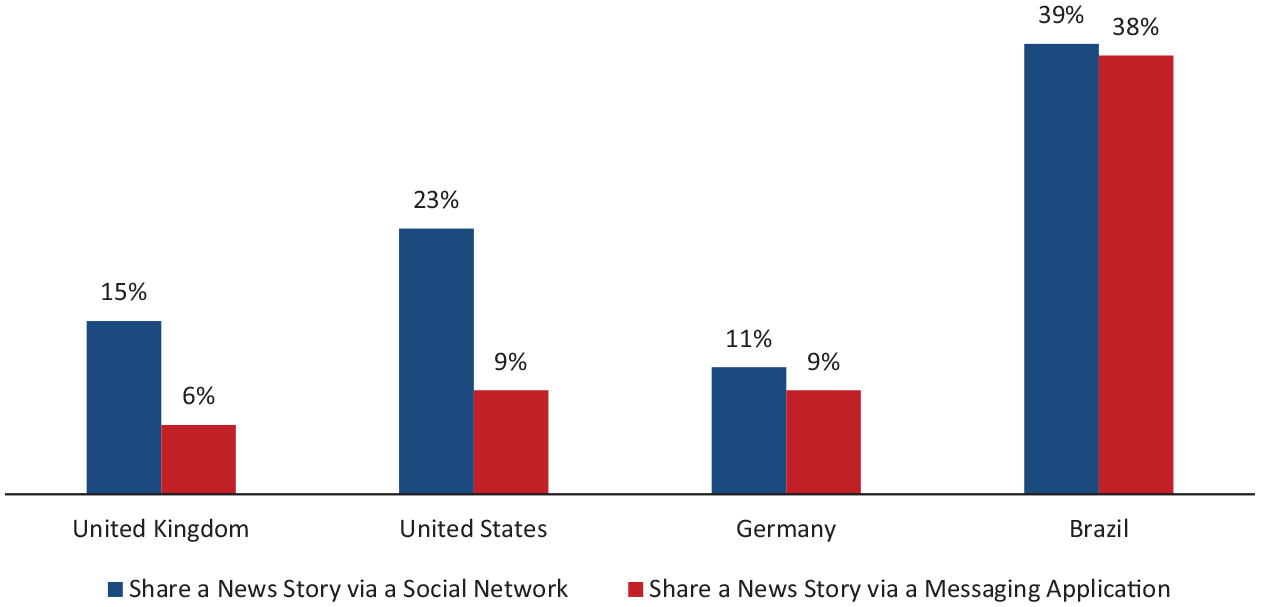
News sharing in social networks and in messaging applications in different countries.
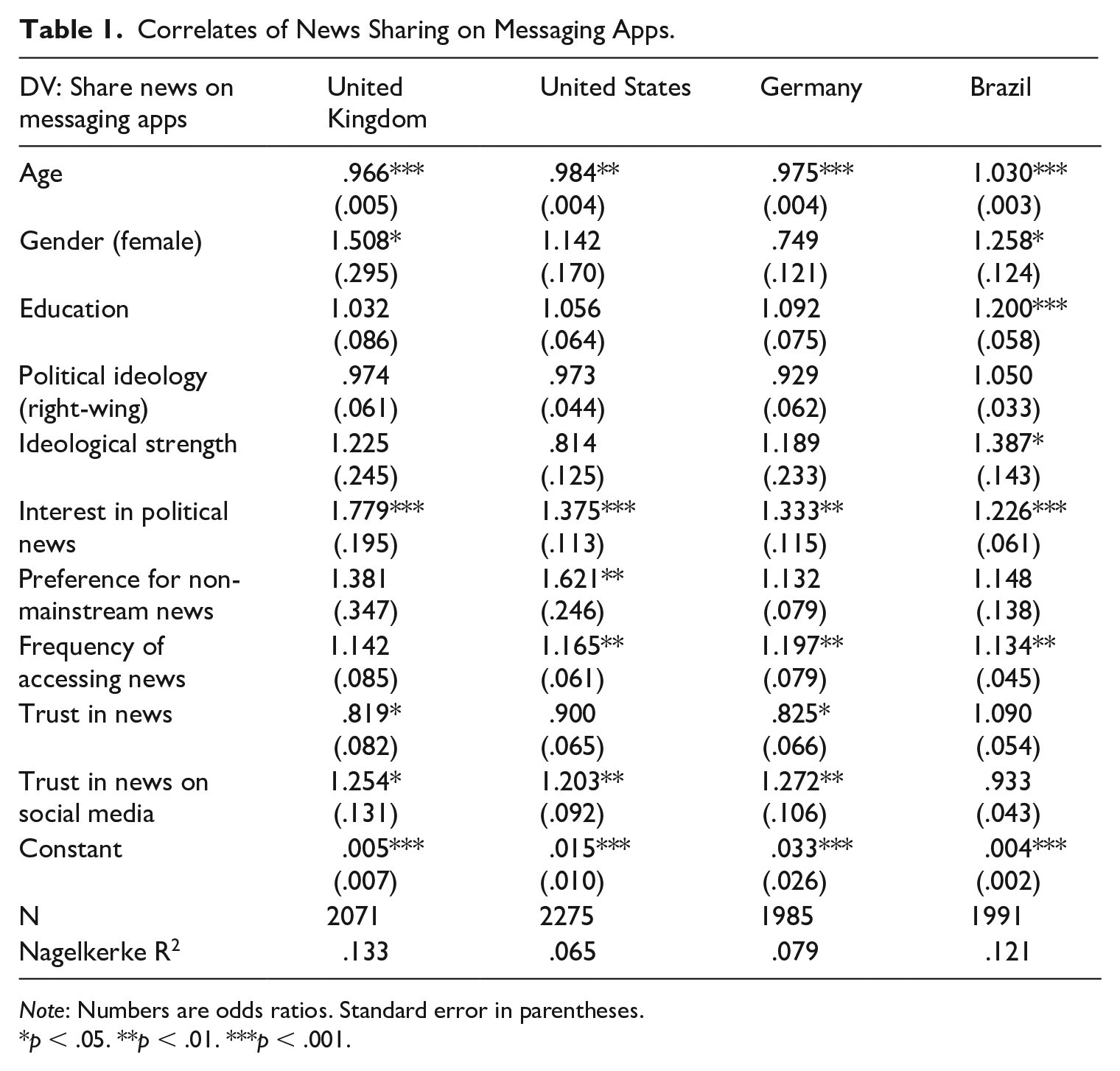
To examine the profile of news users that share news via messaging applications, we ran four logistic regressions, one in each country (Table 1). When looking at the demographic variables, we found that younger individuals are more likely to use messaging apps for news sharing in the US, UK and in Germany while in Brazil older individuals were more likely to do so. These differences could be related to the very high use of messaging apps for news in Brazil, where unlike in the other countries, their use for news is widespread among all ages, and even higher among older users. Education is a significant predictor of use in messaging apps in the Brazil, where high levels of education are correlated with the use of messaging applications for news, but not in the other three countries. Females were more likely to share news on messaging apps in the UK and in Brazil.
Correlates of News Sharing on Messaging Apps.
Note: Numbers are odds ratios. Standard error in parentheses.
p < .05. **p < .01. ***p < .001.
Identifying as left- or right-wing was not associated with sharing news on messaging apps in any country; however, having a strong left/right-wing ideology was associated with sharing news via messaging apps in Brazil. Interest in political news was positively and significantly correlated to using messaging apps in every country.
In the US, Germany and Brazil, respondents who share news were likely to be frequent news users, and in the US they were more likely to prefer alternative news sources like digital-born outlets and social media for news, over more traditional news sources. Low levels of trust in news were negatively correlated with news sharing on messaging apps in the UK and in Germany. Sharing news via messaging apps was correlated with high levels of trust in news on social media in the UK, Germany and the US.
RQ2: How do news users share news on mobile messaging apps?
Our second research question concerns the circumstances under which users share news on mobile messaging apps. Focus group participants mentioned that their primary contacts on messaging apps are people they feel close to (family, friends and co-workers). As a result, most of their discussions in 1-1 or group settings are casual. When discussing the role of news in these apps, focus group participants described news and current affairs chat as a side activity to catching up. Only two focus group participants in the US mentioned that they were members of a group that was specifically set up to discuss politics. One exception is breaking news stories, particularly related to safety in their vicinity: ‘If there’s something that also affects our community somehow, then we post it there, or if there is an accident or some terrible news to keep each other up to date’ (Female, 20–29, Germany). The sharing is often followed by a discussion: ‘If there’s something happened overnight my friends will send it to the group chat and we’ll all discuss it’. (Female, 20–29, USA).
Apart from the casual conversation groups, a minority of participants has set up messaging app groups to discuss special interests like sports, books and wellness. In these groups they reported different news sharing patterns when compared to the casual chat groups. News sharing is limited to these interests and does not revolve around other news or current affairs. An example is a participant who has set up a wellness group with her friends: ‘I have a group with my two girlfriends where we share health and nutrition news. [. . .] And we have a brief conversation about them within the group’ (Female, 30–45, UK). Their group serves no purpose other than the discussion of news stories related to health and nutrition. The conversations are brief and, in many cases, news related activities in niche interest groups only involve sharing and receiving news stories without any discussion.
Similar to niche interest groups, participants mentioned similar patterns of sharing funny or ‘weird’ news stories in some of their casual conversation groups: A lot of the groups we have actually don’t actually talk to each other; [. . .] we don’t actually have a conversation. [. . .] You just literally send each other stuff and I get like a smiley face or a crying face “that is really funny” but we don’t actually talk or converse with each other. It is just a way of sharing information and because quite regularly I don’t want anyone to reply back to me and have a conversation about it. (Μale, 30–45, UK).
These practices are related to the digital affordances offered by these applications that make it very simple for users to share links. Participants value how easy it is to forward or share links on messaging applications. It allows them to share news stories quickly, often to multiple groups at once. In addition, mobile affordances like alerts and notifications are also important in how they use these applications for sharing news given that they expect to get immediate responses as can be seen from the discussion below: Male participant: I am much more active on WhatsApp [than on Facebook]. Male participant: Yes, I agree, it is much more dynamic, you share the news, and everybody soon starts pitching in. Female participant: Same here, especially because you get the notifications right away, and on Facebook, you have to open the app, and on WhatsApp you take a peek at what is happening. (20–29 group, Brazil)
Some users reported using their phones to send links they find on their computers due to the ease of use.
Everything that we do communication-wise is on our phone. All of the WhatsApp apps are on our phone. We’re looking at an article on a computer and we want to send it; we do it through our phone. (Male, 20–29, US)
While for most participants news consumption on messaging apps tends to be a side activity, it is a more focused experience when compared to news exposure on Facebook. This difference can be attributed to etiquette. Participants felt that information is directed at them, unlike a post they see on Facebook: ‘You could sort of ignore Facebook. You can filter things out. Whereas on WhatsApp or any messenger [. . .] you can’t ignore your friends if they say something to you. You’ve got to respond’. (Female, 20–29, US). Similarly, as a female focus group participant in Brazil mentioned: ‘You are going to stop and read something that your friend sends you. If it’s just a random person on Facebook, you might not read it’ (Female, 20–29, Brazil).
However, Facebook still occupies a central role for news use among focus groups participants: The source is still Facebook because we’re going to share something on WhatsApp, usually the article we’ve found it on Facebook. And then we’ve shared into our group on WhatsApp because we want them to see it. So Facebook is still king in that sense. (Male, 20-29, USA).
These quotes reflect our survey findings in Table 1, which show that those who share news on messaging apps are likely to trust news they find on social media.
Overall, we find that technological affordances, intimacy and shared interest play a central role in news sharing on messaging apps. Participants driven by consideration are likely to read news shared by their closed ones and share news to them as part of a reciprocal behaviour In the next section, we are looking at imagined audiences on open platforms and their role in the move of the audience in more intimate spaces for news sharing.
RQ3: What is the role of imagined audiences in news sharing on mobile messaging apps?
The main reason why participants use messaging apps for news purposes is privacy. Most focus group participants have been using open networks like Facebook for many years. As a result, they have accumulated a number of ‘friends’ on these platforms from different settings: co-workers, extended family, acquaintances, classmates. The flattening of these audiences into one on Facebook makes their need for privacy stronger. An additional reason behind the move of the audience away from Facebook to more private networks is the incivility they encountered.
More specifically, participants referred to partisans who are vocal about their opinions on Facebook as a group that prevents them from sharing news on the platform: ‘Ιt [Facebook] became a very aggressive and angry platform’ (Female, 30–45, UK) or ‘A lot of my family are really into Brexit and my mum loved Donald Trump; so whenever I go on Facebook the interaction works only if you agree with what they are saying; otherwise it is quite stressful’ (Female, 30–45, UK).
As a result of these tensions focus group participants use messaging apps rather than Facebook to share news. This focus group discussion in New York reveals how focus group participants think about expressing their political views on open networks and how these discussions occur on private apps: Male participant: I have one [WhatsApp] group specifically for politics. And it’s just on the political agenda. It’s always things that are happening. They’re weird or interesting in our new presidency, you know. Moderator: And is that a group of friends with similar views to you? Male participant: We have to keep it private because in whatever industry you may be in there’s Right and Left. So, you have to be very careful. And on Facebook we’re in a day and age where we have to keep connections. So, you’ve got to be respectful and keep things private. Shared interests and it’s all political. Female participant: Yes, like if I feel a certain way about Trump I would never comment anything on Facebook. I know in the group chat I can voice my opinion. Male participant: Yes, it’s personal. These are your friends that you would talk about that if you guys were all hanging out anyway versus the whole world. (30–45 group, United States).
As the discussion above reveals, the privacy that messaging apps offer, is seen by users as a tool to express themselves without risking relationships with their imagined audiences on open platforms. It also allows them to reconstruct their ‘self-conscious identity performances’ (Marwick and boyd, 2011, p.115) by tailoring their posts to specific friends. Imagined audiences as restraints for self-expression were mentioned by participants from all four countries and age groups. In the US, participants mentioned co-workers and employers as the main imagined audience preventing them from sharing news online: ‘If what you post goes against your small business employer’s beliefs you could lose your job and you don’t have to even tell you why’ (Female, 20–29, US).
Last, it is also noteworthy that while Facebook, Twitter and other platforms offer curating tools that allow users to tailor the audience of their posts and thus overcome the ‘flattening of different audiences’, no focus group participant mentioned using them.
Discussion
In this study, we explored key aspects of news sharing via mobile messaging applications: who shares news on messaging apps, under which circumstances, and why? We find that across all four countries, the need for privacy in news sharing is facilitated by the social logic of mobile technologies (Vanden Abeele et al., 2018). The need for privacy and control of one’s audience is the most cited motivation for using mobile applications for news. This need stems from the imagined audiences of open network users like Facebook, particularly when it comes to sharing news about sensitive topics like politics or religion. Marwick and boyd (2011) find that in networks like Facebook ‘individuals learn how to manage tensions between public and private, insider and outsider, and frontstage and backstage performances’ (p. 130). A way for some users to manage or to avoid these public tensions, is to move news sharing from open social networking sites to private messaging applications. Changes in mediums used for online communication have been considered to have a potentially disruptive effect on weak ties (Haythornthwaite, 2005). Our respondents share news in mobile messaging apps partly because they desire the disruptive effect that it can have on their weak ties.
Even if users have the opportunity to tailor their audiences on Facebook, as previous research suggested (Bode, 2016), very few use curating tools on their Facebook news feeds. Mobile affordances in messaging applications allowed users to limit their news sharing to their strong ties (Ling, 2008) or to a tailored audience for discussions around specific interests. However, Facebook is still central in online news consumption and sharing. New technology affordances that allowed easy link sharing between applications allowed news links from Facebook to flow into conversations, reflecting the multiplexity of mobile communication (Boase, 2008; Schrock, 2015).
News sharing is a side activity in mobile messaging applications. Focus group respondents primarily use messaging apps to catch up with intimate contacts or to share humorous content. However, they are also sharing news stories in case of a breaking news story, or news stories related to their niche shared interests. News sharing is often reciprocated as part of etiquette, as shown by Goh (2017), something that increases the frequency of news being shared on these spaces. Users further mentioned that mobile sharing affordances are very easy, and facilitate news sharing. As previous research has suggested mobile devices and their perceived ease of use make news use more attractive especially to groups that are not usually engaged with news (Chan-Olmsted et al., 2013; Van Damme et al., 2015). News shared on mobile messaging apps are often news stories found on Facebook. This finding underlines the centrality of Facebook for news use and dissemination, even as sharing on Facebook decreases (Newman et al., 2018).
While we did not find large country-level differences in why and how focus group respondents share news on mobile messaging apps, we find country-level differences in the profile of news sharers. In the Western countries of our sample (UK, US and Germany) where a small minority shares news on mobile messaging apps (6–9%), sharers are likely to be younger and interested in political news, but no significant relationship was found in terms of education or partisanship. Interestingly, they show lower trust in news, but higher trust in news found on social media compared to the population. This combination of attitudes towards news and their pathways can potentially increase the spread of dissemination of misinformation found on social media. In Brazil, a country where 38% of the online population shares news on mobile messaging apps, they tend to be older, interested in political news, educated and partisan.
Based on our research findings we explore the implications of the rise of news sharing on mobile messaging applications. Does it have positive or negative implications for the diffusion of information? On the one hand, news users that felt that Facebook was not a welcoming environment to discuss political developments now feel more comfortable to express themselves on messaging applications and they do that by limiting the size of the audience of their posts. However, there are also potentially negative implications. Previous research has suggested that political and current affair discussions in strong tie networks, like the ones described by our focus group participants, were not correlated with political participation (Valenzuela et al., 2012) unlike weaker tie discussions, usually taking place in more open networks. In addition, in Brazil those who share news on mobile messaging applications tend to be partisans, something that could colour the content of the news to which people are being exposed.
The rise of news sharing on messaging apps can also have negative implications for the news media industry and the information environment. As previous research has shown, news brand attribution is already low on Facebook and on Twitter (Kalogeropoulos et al., 2019), and could be even lower in environments such as WhatsApp where the logos and the names of news organizations are less prominent, affecting their business models and further enabling the spread of misinformation from malicious sources that appear to be legitimate news organizations. These concerns are highlighted given our finding that messaging app news sharers are likely to trust news found on social media like Facebook. While news publishers can create their own WhatsApp pages that people can get in touch with by adding a number at their phone contact list (e.g. The BBC 2 ), this process requires a lot more effort when compared to connecting with news publishers in open platforms like Facebook. Overall, the move of the audience from Facebook to mobile messaging applications for news sharing may mean even less power over content distribution for news publishers.
This study does not come without limitations. First, the survey is representative of adults of all ages in the four countries, while the focus groups were limited to urban app users up to the age of 45. This can be particularly limiting for Brazil where, as the quantitative analysis shows, older individuals are more likely to share news on mobile messaging apps. In addition, while offering a comparative framework to understand the uses of messaging applications for news purposes in casual chat conversations, our study does not capture examples of people using messaging applications for mobilization and dissemination of information free from the influence of authorities. Previous research has suggested that in non-free countries like Hong Kong, journalists create large messaging application groups to disseminate information (e.g. Belair-Gagnon et al., 2017) while in India people disseminate information in massive app groups with sometimes powerful and dramatic implications. 3 While our sample did not capture similar dynamics in any of the four countries examined, similar uses of messaging apps have been reported in Brazil after our data collection, during the general election of 2018. 4 Last, as previous research has shown, our findings regarding context collapse do not necessarily occur everywhere; it is common in non-Western countries like Turkey for users to create multiple Facebook profiles to avoid such tensions (Costa, 2018).
Overall, while the present study is about sharing news with friends, family, colleagues or acquaintances on messaging applications, future research could look at the uses and the implications of sharing and consuming news in large chat groups, particularly in authoritarian countries.
Footnotes
Funding
The author(s) received no financial support for the research, authorship, and/or publication of this article.
