




Abstract
This paper details the contribution of mobile devices to capturing commemoration in action. It investigates the incorporation of audio and sound recording devices, observation, and note-taking into a mobile (auto)ethnographic research methodology, to research a large-scale commemorative event in Amsterdam, the Netherlands. On May 4, 2016, the sounds of a Silent March—through the streets of Amsterdam to Dam Square—were recorded and complemented by video grabs of the march’s participants and onlookers. We discuss how the mixed method enabled a multilevel analysis across visual, textual, and aural layers of the commemorative atmosphere. Our visual data aided in our evaluation of the construction of collective spectacle, while the audio data necessitated that we venture into new analytic territory. Using Sonic Visualiser, we uncovered alternative methods of “reading” landscape by identifying different sound signatures in the acoustic environment. Together, this aural and visual representation of the May 4 events enabled the identification of spatial markers and the temporal unfolding of the Silent March and the national 2 minutes’ silence in Amsterdam’s Dam Square.
Introduction
In a country with almost complete household Internet access, and among Europe’s highest mobile phone Internet access when on the move (Eurostat, 2017a, 2017b), it is no easy feat to create a situation in which the population in the Netherlands stops, switches off, and takes pause. The 2 minutes of silence during the annual Remembrance Day (Dodenherdenking), on May 4, are part of a larger, contested history (Raaijmakers, 2014), and remain widely observed, resulting in a temporary halt to street traffic, public transport, and air travel. In 2015, the air traffic control at Amsterdam’s Schiphol Airport released a video showing how the entire complex was brought to a standstill, in time for the bugle call that marks the start of the 2 minutes of silence at 8:00 p.m. (Luchtverkeersleiding Nederland, 2015). Shot from the control tower, the video provides a wide view of grounded planes, empty roads, and cleared skies, with the silenced soundtrack eventually broken by the performance of the national anthem, signaling the end of the 2 minutes.
This example, reflecting a desire to control mobility in urban public space as well as in the realm of mobile and online communication, gives us cause to turn to the primary focus of the current special issue. Initially described as a “new mobilities paradigm” (Sheller & Urry, 2006), mobility studies were framed as an energetic, interdisciplinary project to attend to various types, scales, and processes of (im)mobility, most prominently articulated by scholars working in the fields of geography, sociology, and media and communication studies. Four of the six theoretical resources identified by Sheller and Urry (2006) within the new mobilities paradigm, hold resonance to this paper’s methodological remit. First, that all mobile actions have spatiality—“all social processes take place somewhere” (Hein, Evans, & Jones, 2008, p. 1268). Second, that the corporeal body is “an affective vehicle through which we sense place” (Sheller & Urry, 2006, p. 216). Third, that mobility challenges us to engage our senses (sight, sound, smell, and touch) as embodied experience in/with the surrounding environment. And, fourth, to understand connections between people and place, we must also know something about the social networks at play (Hein et al., 2008); more specifically in the context of our focus on remembrance these social networks relate to a Dutch politics of postwar memory.
In recent years, the new mobilities paradigm has resulted in more extended reflections on the possibilities and challenges of mobile methods (Büscher, Urry, & Witchger, 2010; D’Andrea, Ciolfi, & Gray, 2011; Hein et al., 2008). While some of this work has been concerned with the implications of multimethod research, others have called for the development of new methods for approaching affective, relational, sound-based, or processual qualities of contemporary (im)mobility (Bissell, 2010; Butler, 2007; Laurier, 2010; Spinney, 2015). In response, this paper will reflect on the specific contribution of mobile devices to memory research that studied commemorative rituals in public outdoor space. Even though memory studies is a rich field comprised of humanities, social science, and human science scholarship, questions of method and methodology remain limited (Keightley & Pickering, 2013). Early memory research pioneered the use of portable sound recording—and later video recording—for interviews (Perks, 2011); yet oral history studies traditionally relied on indoor, and primarily static, environments for audio(-visual) data collection. In turn, this paper will investigate the consequences of incorporating mobile devices within the embodied and emplaced approaches predominant within the field of cultural geography, such as (auto)ethnography, site walks, and sound walks (Pink, 2009). The methodological focus of the article will therefore be the adoption of mobile devices for the purposes of capturing audio (sound recorder), as well as photos, videos, and note-taking (GoPro and mobile phones).
The paper draws from fieldwork conducted on collective national remembrance in Amsterdam, specifically Remembrance Day, held annually on May 4. We undertook a visual and aural (auto)ethnography to better understand the relationship between the practice of commemoration, its affect, and its resonance with discourses of national identity (Anderson, 2004; Revill, 2016). On May 4, 2016, the sounds of the Silent March (Stille Tocht)—through the streets of Amsterdam to the Dam Square—were recorded and complemented by field diaries, photographs, and video grabs of the march’s participants and onlookers. Being mobile and emplaced in the field allowed for more nuanced insights into how participants engaged and encountered performances of national identity. We will discuss these insights gleaned from taking an innovative methodological approach, and critically evaluate how this mixed-method approach has assisted our study of memory-making in action. To explicate processes of memory-making and their importance to (re)producing and maintaining national identities, especially in the context of war and commemoration, in the following section we provide a synopsis of literatures that have linked memory, identity, and place to the commemoration of war.
Remembering war, remembering for the nation
War remembrance is a hallmark characteristic of how modern nations link the past to present, and future-orient articulations of national identity. As Johnson (1995, p. 54; see also Till, 1999) have argued, war remembrance enables an awareness of how “national cultures conceive of their pasts and mourn the large-scale destruction of life.” It facilitates the opportunity to commemorate and venerate the sacrifice and suffering of a nation’s citizens, which Renan (1990/1882, p. 19) articulated as essential to the continuance of collectively remembered and articulated national narratives by stating that “indeed, suffering in common unifies more than joy does.” Such suffering leaves wounds on the individuals who experienced war, on the cities and town’s war ravaged (Drozdzewski, 2016; Till, 2012), and on the nation. Walter (2001, p. 495) has reasoned that “when death fractures the body social, one human response is to gather together, to re-embody the society whose strength has been weakened by death.” This call for collectivist action manifests socially and culturally in how the nation commemorates the experience of war and builds it into its narrative identity through acts of commemorative vigilance (Nora, 1996) that solidify collective national memory.
Collective memory functions to reinforce the “shared memory of a commonly inhabited and similarly experienced past” (Brockmeier, 2002, p. 18), it binds together carefully chosen stories of the nation into an overarching common narrative. The purpose is to ensure cohesiveness among citizenry and to present a familiar and recognizable narrative to each member of the nation regardless of their geographic location in the nation and their individual histories, the latter is especially important among culturally pluralistic and multicultural nations such as the Netherlands. As consensus builders, collective national narratives are performed in coordinated and all-encompassing commemorative events, such as those that form the focus of this paper. Our interest in the annual May 4 events stemmed from the mobile quality of the Silent March that requires people to move through the city along a purposefully designed commemorative walk. Here, commemoration is not place-bound, rather it comprises memory-making with a fluid capacity, it gathers pace through building a sense of collectivity among others partaking in the events (Hay, Hughes, & Tutton, 2004; Johnson, 1999; Till, 1999). Collective commemoration, as a vehicle for building and sustaining collective cohesion—in this case aided by mobility—echoes Ingold and Vergunst’s (2008, p. 1) sentiments that social relations “are not enacted in situ but are paced out along the ground.” We will return to the mobile qualities of the Silent March in the Discussion section, which is preceded by an explanation of how we employed a mobile ethnography coupled with mobile devices to garner nuanced insights into commemoration on the move. Before the explication of research methods, and in the text that follows, it is necessitous that we provide brief context on post-1945 war commemoration in the Netherlands.
Shortly after the liberation in 1945, it was agreed that May 5 would be used in future as the official date for the celebration of Liberation Day. The proposal to hold remembrance events the day before, on May 4, was primarily prompted by former members of the resistance. In fact, the widespread adaptation of similar commemorative rituals on May 4 and 5—consisting of 2 minutes’ silence, the laying of wreaths and flowers, and the playing of the national anthem, preceded by a silent march—were the result of a set of recommendations by former resistance member Jan Drop, whose active lobbying resulted in over 600 local councils holding silent marches starting from May 4, 1946 (Magry, 2006, pp. 57–60; Raaijmakers, 2014, p. 15). Today, Remembrance Day on May 4 is organized by the National Committee for 4 and 5 May, the national coordination body formed in 1987. While local events continue to be organized at 8:00 p.m., the live national TV broadcasting of the Dam Square events—with the presence of the Dutch royal family, heads of state and military, and tens of thousands of civilians—marks these events as the “main stage,” and sets other program events, the Silent March in particular, as taking place “off stage.” The Silent March, nonetheless, follows a route along significant memorial sites in the city, led by the Amsterdam Lord Mayor, who is joined by local children, representatives of Jewish, Roma and Sinti, and other groups, and several thousand participants.
One of the striking absences from early Dutch commemorative discourse was the Holocaust. It took some decades before May 4 events shifted from a predominant discourse of national heroism to an acknowledgment of individual suffering, and thereby the fate of Jews, Roma and Sinti, and other civilian victims (de Haan, 1997; van de Reijt, 2010; van Vree, 2009). Increasingly, the Remembrance Day events sparked debate and discussion in the years around 1970, when attendance on May 4 was declining, and new social and political movements contested the memory narrative that was maintained by resistance fighters and war veterans. In Amsterdam’s memorial landscape, too, it was not on the Dam Square, but rather in other inner-city areas that monuments to Jewish, Roma and Sinti, homosexual, and other victims were eventually unveiled. The memorial landscape in Amsterdam has increasingly come to reflect a strategy of “unity in diversity” (Dewulf, 2012, p. 245). Amsterdam’s local government has tended to support monument building as a means of maintaining harmony and sign of respect to residents and their respective communities. Remembrance Day remains an open-ended commemorative event, concentrated around standardized and (fairly) inclusive ritual elements on May 4 (van Ginkel, 2011), but it prompts contemporary discussions about “who the Dutch should mourn, what they should celebrate, and how they should do it” (Raaijmakers, 2014, p. 13).
A mobile memory ethnography
To capture and examine the chronologically sequential commemorative performances of Remembrance Day in Amsterdam—the Silent March, the National Commemoration at Dam Square, and the Remembrance of the Dead (2 minutes’ silence)—we undertook a mobile memory (auto)ethnography, which incorporated both visual and auditory recording devices in combination with (more) traditional observation and note-taking methods (UNSW Human Research Ethics Panel E, No. HC16328). The mobile quality of the Silent March motivated us to think differently about how we could best describe, while also simultaneously experience, this memory-making in process. Movement, sound, and affect were integral to the research’s methodological approach and to the corporeal experience(s) of the researchers’ bodies on/at the events of May 4. Walking with others also enabled critique of Hill’s (2013, p. 391) contention that “walking creates powerful recollections because it provokes a distinct and familiar tactility with the world.”
To broaden our engagement with the theme of tactility, we drew from the new mobilities literature to consider how being in place facilitated recognition that these commemorative actions occurred in specific places (and we return to this point when we explain the route of the Silent March in what follows). Being “in motion” during much of the research meant that our bodies’ movements were a source of knowledge as we were constantly in touch with the research environment—as Pink (2007, p. 245) has argued “the experiencing body is central to the production of place.” Combining walking with acts of national collective commemoration is intensely purposeful as it capitalizes on the shared experience of remembrance; it affirms Ingold and Vergunst’s (2008, p. 1) contention that “walking is a profoundly social activity.” We also drew from our respective research experiences with more-than-textual and more-than-verbal research data in designing the research method; previously we had teamed video and visual technologies with observation and vox pops (Drozdzewski, 2016) and sound recordings with in-depth interviews (Birdsall, 2016). In this research, to place and utilize our bodies as affective (research) vehicles, we became part of the commemorative processes, tuning our ears, eyes, and senses. In the sections that follow we detail how the mobile devices operated through the sequence of events—during the Silent March and at the Dam Square—and how we have analyzed the data generated.
At 5:45 p.m. on May 4, 2016, the participants in the Silent March met outside the Stedelijk Museum, Museumplein, before setting off in the direction of the Dam Square (Figure 1). The march was scheduled to enter Dam Square just before the national 2 minutes’ silence at 8:00 p.m. The stated purpose of the march was to commemorate “the civilians and members of the armed forces who have died in war and peacekeeping missions since the outbreak of World War II” (Silent March information pamphlet, The National Committee for 4 and 5 May, 2016). We assembled with the crowd at the Stedelijk Museum to undertake a soundwalk of the Silent March. An Olympus digital voice recorder was in an external pocket of Danielle’s handbag with the external mic positioned to record the sounds of the Silent March. Additional mobile devices were deployed to produce a visual and aural spectrum of the Silent March. Photographs were taken both on a digital camera (Sony Cybershot DSC-H70) and our mobile phones; video footage was captured using a GoPro Hero 3+ attached to Danielle’s handbag and positioned so that the direction of the lens captured other participants’ footsteps; field notes were recorded both on our mobile phones and on paper. All the mobile devices were small, lightweight, and versatile, and utilized in a way to maintain the anonymity of others partaking in the commemorative events. For example, “the GoPro’s functionality and optimal performance demands physical movement by its carrier and subjects” (Vannini & Stewart, 2017, p. 153); its fishbowl lens could be positioned towards the pavement to capture fellow walkers from the waist down only (Figure 2). We avoided taking photographs that could identify people, referencing panoramic shots or shots of the crowd moving forward. As stipulated in the ethics approval, image capture was primarily to record the research event, for data analysis, and for the purposes of reflexivity, to think about how we moved with the crowd of people and how the crowd marched (Garrett, 2011). In any reproduction (at conferences or in publications) we needed to ensure that people were not identifiable.
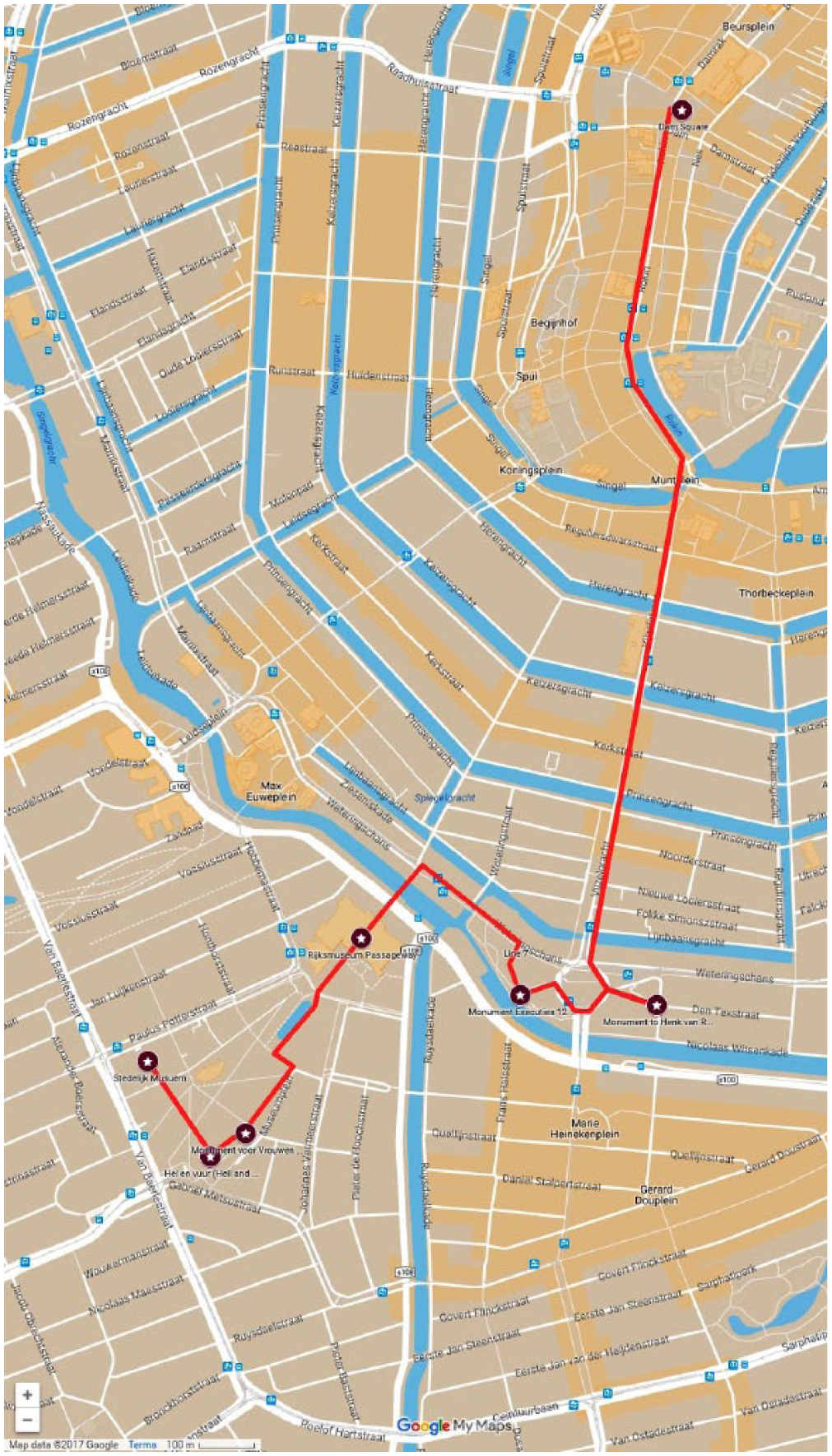
Map of the Silent March route, May 4, 2016.
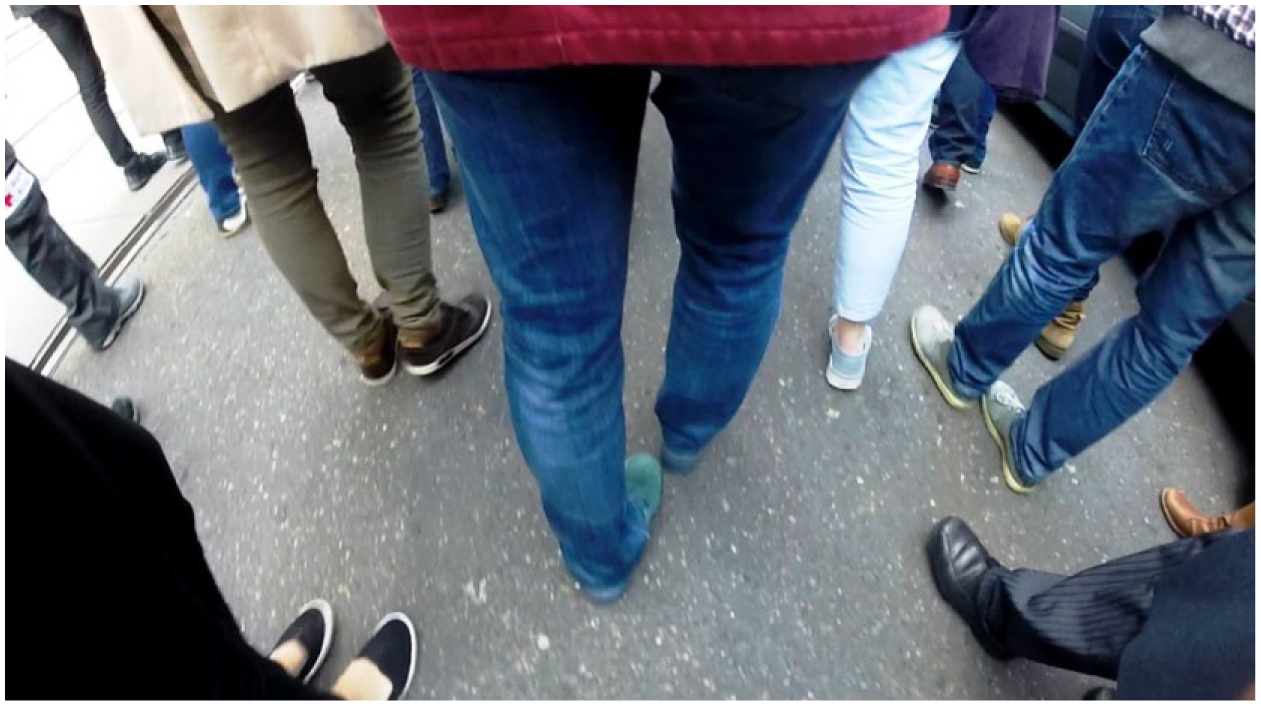
GoPro still of Silent March.
As the Silent March began, our soundwalk commenced. Soundwalks are “concerned with the relationship between the sound walkers and their surrounding sonic environment” (McCartney, 2014, p. 212). While there are numerous variations in how soundwalks can be conducted (see Paquette & McCartney, 2012; and McCartney, 2014, for fuller explanations), we chose the soundwalk to explore the “orientation, dialogue and composition” of the sounds of commemoration (Paquette & McCartney, 2012, p. 138). Butler (2006, p. 905) has stated that soundwalks have “a ‘live’ embodied, active, multisensory way of understanding [the] geographies of time and space.” We audio recorded the Silent March and used our field notes to add thick description. We also employed static and moving imagery to examine how the sounds and the images of the commemorative event intersected (or not). We took these images (video and still) along the route of the march, at the Dam Square during the commemoration service, and during the 2 minutes’ silence. Following Pink (2007, p. 243), we saw walking with video as a tool to sense place, place our sense of place, sensorially make place and make sense of place. Drawing on Vannini and Stewart’s (2017, p. 149) recent work, our video recordings and images allowed for critical examination of how the commemorative space was constructed.
To analyze the data, we used NViVO (Version 11) and Sonic Visualiser (2017) to code themes. In NViVO, we could code across text and image (video and still) sources. Codes were drawn both from identifying repetition in the images and notes—for example, images of flags and the broadcast media were coded into the theme of commemorative spectacle—as well as from literature on collective remembrance of war (a theme in which both authors have expertise). The sound recordings were run through Sonic Visualiser, “an application for viewing and analyzing the contents of music audio files” (Sonic Visualiser, 2017). The application plots the frequency of sound recording over the time enabling the researcher to identify specific sounds (by their differing hertz) in the recording. To analyze the sound files, we listened to and watched distribution of sound from the recordings. Drawing from Mills’s (2005, p. 18) work on auditory archaeology of a historic landscape, we distinguished auditory streams: geophony, those sounds associated with the physical environment; biophony, those sounds associated with the biological environment; and, anthrophony, those sounds associated with people. Using an Excel spreadsheet, for each minute of recording we noted how many times certain sounds were evident within the same minute. Again, following Mills’s (2005, p. 20) worked example, we then combined “the contribution in seconds of each individual auditory stream source . . . to determine the total amount of sound present in each sample.” Using these data, the soundscape of the Silent March was then plotted using a stacked area graph to visualize the distribution of sounds layers across the march. In the discussion that follows we highlight how the data generated from various mobile devices advanced our analysis of the May 4 commemorations, especially through consideration of how the sounds of commemoration reinforce collective nationalism.
Discussion
Amassing a normative spectacle of collective memory
It is well established that national collective remembrance “helps to enhance social integration” and “construct a collective memory” (Beristain, Paez, & González, 2000, p. 119; Drozdzewski, De Nardi, & Waterton, 2016; Johnson, 1999). The events of May 4 in Amsterdam, and in the Netherlands more generally, are no exception. This paper’s key point of departure from this existing standpoint is its examination of the construction of commemorative atmospheres predicated on collective silence and mobility. Silence, instituted both during the Silent March and the national 2 minutes of silence at 8:00 p.m., has been employed as a strategy for collective remembrance. During the Silent March, mobility teams with silence to reinforce notions of collectivity—people move together en masse in silence. Collectivity is what “sticks” (cf. Ahmed, 2010) in national commemoration—it brings otherwise unknown, diverse, and disparate citizens together, either physically by gathering in place at an orchestrated event, or figuratively through temporally organized events that transcend spatial distance, such as the 2 minutes’ silence. Rumination on Dutch involvement and loss during World War II, and the “embodiment of communal memory in those who participate” are the objectives for participant citizens (Casserly, 2014). Participants are provided with the frames of reference for remembrance; during the march the instruction is to be silent, follow the designated route, and stop at the selected memorial landmarks. During the 2 minutes silence, silence is total, broadcast across media channels, with mandatory compliance. In both cases, silence is used as part of the spectacle of memory (Johnson, 1999). Johnson (1999, p. 37) has stated that a “spectacle constructs the spatial and temporal limits to popular understandings of the past.” Johnson (1999, p. 37) has further reasoned that the national public commemoration of war is akin to Roland Barthes’ notion of a public spectacle because it implicates society as a whole in the practice of mourning the dead, an otherwise private and individual occasion.
In the analysis of the photographs and video images taken along the Silent March and during the 2 minutes’ silence at Dam Square, several visual markers were coded into the theme of spectacle. Dutch flags were evident at the starting point of the march, hanging from windows along the route and in Dam Square. The May 4 logo (Figure 3), affixed to power poles, was also prominent on all distributed media. At Dam Square, the import of the event to the nation was heightened by the presence of broadcast media, however, these cameras were all shrouded in black so as to not detract or distract from the commemorative atmosphere created in place, in Dam Square. The black coverings around the camera contrasted starkly with the high visibility vests worn by the police and other security personnel (Figure 4). The fluorescent yellow vests remind participants that this national event requires safeguarding. We both also noted the presence of security personnel in our field notes during the silent march. Danielle noted: “I have the sense that I am being watched. Not just by all the police but by the guys with ear pieces” (field notes, May 4, 2016); Carolyn noted: “plain-clothed security officers stand facing the crowd” (field notes, May 4, 2016). The presence of government and military personnel on stage also imparted the expected atmosphere of officialdom. Cumulatively, the flags, logo, live media, and security and state officials represent individual characters in the assemblage of commemoration. There is a certain level of expectation that these individual components form part of the totality of a national commemorative event, akin to what Mitchell (2003, p. 443) has termed both the “repetition engaged in various commemorative events and rituals” and a “generalised social framework” of war remembrance. Sumartojo (2016, p. 3) has argued that “distinctive commemorative atmospheres imbue these events and help to create and frame their meanings for attendees that are expressed as germane to national identity.” These normative visual markers helped the participants (and us) “make sense of place” and to “create a sense of [commemorative] place” (Pink, 2007, p. 243). By capturing this placemaking en route and in Dam Square, we have been able to retrospectively deconstruct these images and mine them for evidence of those individual components (flags, logos, etc.) that are otherwise enveloped into the totality of the commemorative spectacle.
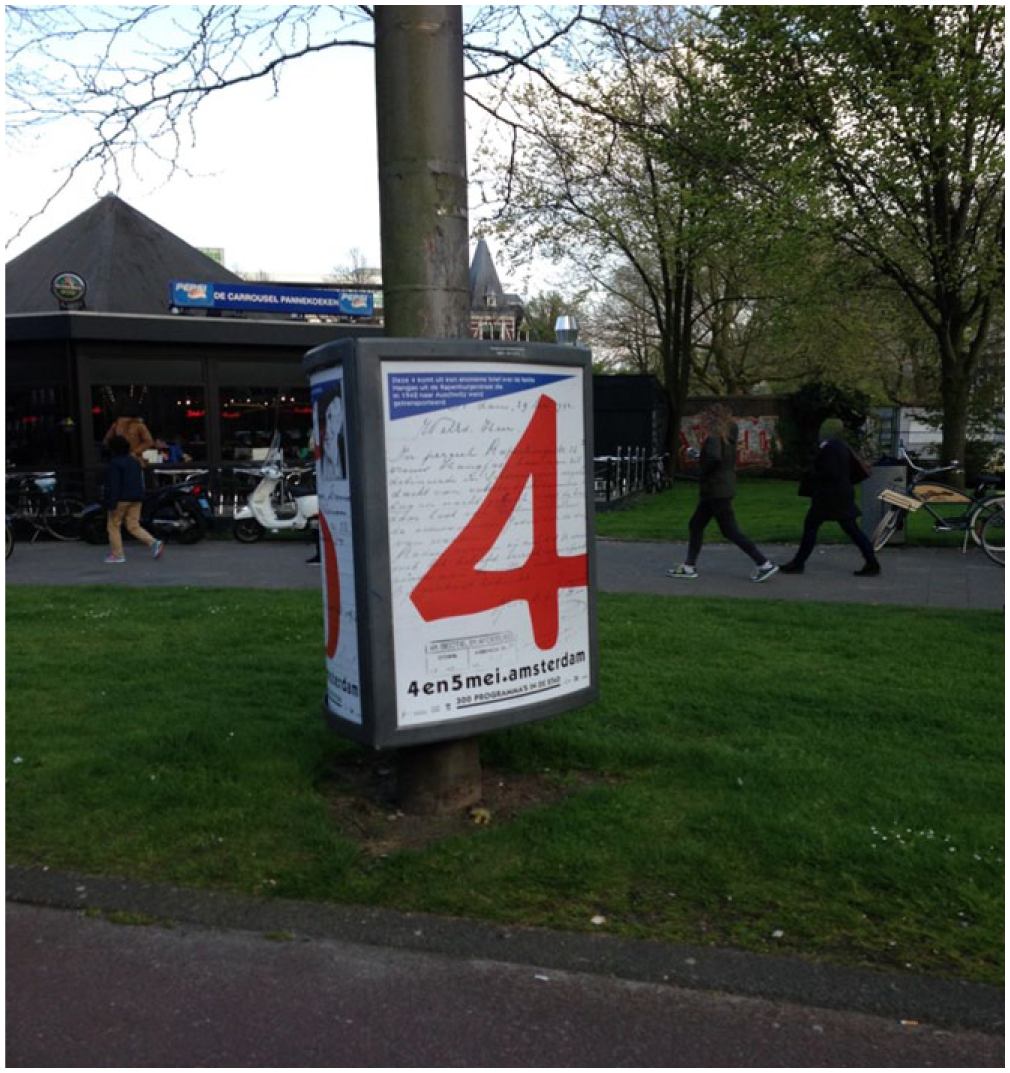
May 4 logo on lamppost along Silent March route.
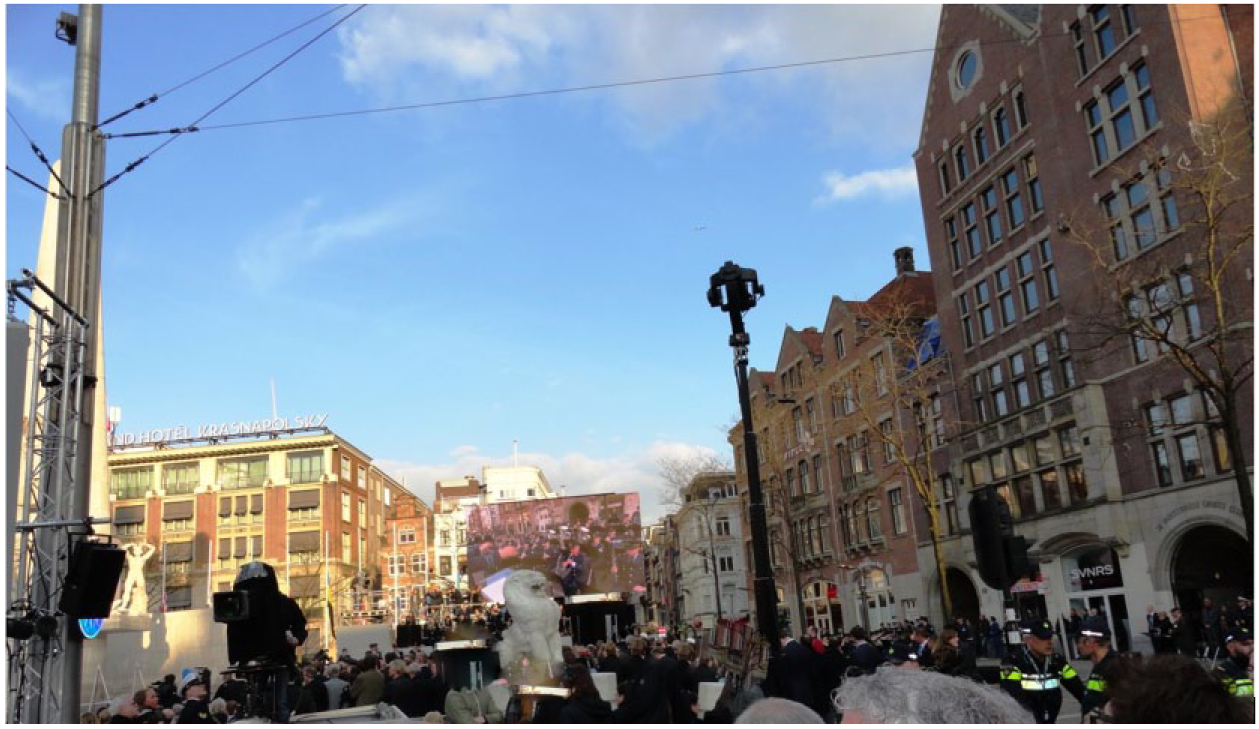
Media and security personnel visible at the Dam Square commemoration.
Recording commemorative silence
The use of silence in war commemoration is not new; typically 2 minute’s silence has been employed to prompt citizens to remember the loss and sacrifice of the nation at war. Brown’s (2012) chronology of the origins of the 2 minutes’ silence on Armistice Day in the United Kingdom, discusses how silence was employed as a means of structurally engineering a moment of collective reflection. During these moments, collective public silence was seen as an opportunity to (re)connect remembrance of the dead (the past) by “marking the legacy of this sacrifice in the present” (Brown, 2012, p. 240). On May 4, silence is variously employed: instituted at the Remembrance of the Dead in Dam Square, 2 minutes of silence is nationally coordinated across airspace, telecommunications signals, and broadcast journalism; during the Silent March, which lasts almost two and half hours, silence is positioned as the cornerstone of commemorative vigilance. In both cases, silence is utilized as part of a wider assemblage of commemoration, as a contributor, if not a vehicle for performing the spectacle of memory. While the 2 minutes’ silence initiated from Dam Square certainly falls within the remit of a more traditional period of public silence, the sustained silence of the Silent March piqued our interest in what such a commemorative event may sound like. Did it, as Ehrenhaus (1988, p. 41) postulated, provide an opportunity for encounter, for “an inward focus towards the personal meaningfulness of the encounter for those involved?” Given that the Silent March was set within an orchestrated assemblage of commemoration, which followed a predetermined narrative line of Dutch war commemoration in its route past memorials to the diversity of Dutch war victims, the purpose of the encounter is clearly an opportunity for the participant to not only think about war, but to also think about the nation. As Brown (2012, p. 240) has argued, the intent of “this private experience [of silence] was to direct thought to a common end.”
We used the results of the sound analysis to examine how different layers of sound contributed to a sense of place (O’Connor, 2008). O’Connor drew from Schafer’s (1977) notion of an acoustic environment that could be read for sound, in a similar way to how humanities scholars “read” the landscape for visual clues (as we did before in identifying the visual markers of spectacle). To read the Silent March’s acoustic environment, we delineated “keynotes” (background sounds), “sound signals” (more distinct foreground sounds), and “soundmarks” (sounds that punctuate keynotes and sound signals and those analogous to the sounds of the local environment), as in O’Connor’s sound analysis. In the discussion that follows we hone in on the first 30 minutes of the Silent March (Figure 5). We do so because during this first part of the march, the march stopped more frequently. This alternation between slow marching and stopping at monuments not only marked variations in sound, but it also meant that the large group shifted between an evenly composed procession and a less defined crowd that stopped and huddled around at designated monuments. Indeed, when departing the Stedelijk Museum meeting spot, the participants were informed by local organizers about the planned route, and handed an A4 brochure with Dutch and English text, with information about locations on the Silent March route (see map in Figure 1). From this meeting spot, the procession crossed the grassy Museumplein to the first stop, the Roma and Sinti monument “Hel en vuur” (“Hell and Fire”), where a trio performed a short, instrumental song while flowers and wreaths were laid. From here, the procession continued to a second monument, for the women who died at the Ravensbrück concentration camp, where further wreathes were laid. The drummers and procession leaders, including Lord Mayor Eberhard van der Laan and a group of children, then led the crowd up to the edge of the park, through the Rijksmuseum passageway, and out to the main street, where police blocked traffic so the procession could pass through and take a right turn along a ring road (Weteringschans) of Amsterdam’s historical center. This first half hour of the Silent March ended with the second last stop on the route, at the 1e Weteringplantsoen park; a monument dedicated to resistance members executed in 1945, where short speeches and poems were read out and flowers were laid. In the final part of the march, the procession passed around the large Weteringcircuit roundabout, including the monument Henk van Randwijk, which includes a line from a poem written on a large, empty black wall. From here, the slow procession filed straight up the major arterial road (Vijzelstraat, Rokin) to reach Dam Square by around 7:45 p.m. (see Figure 1).
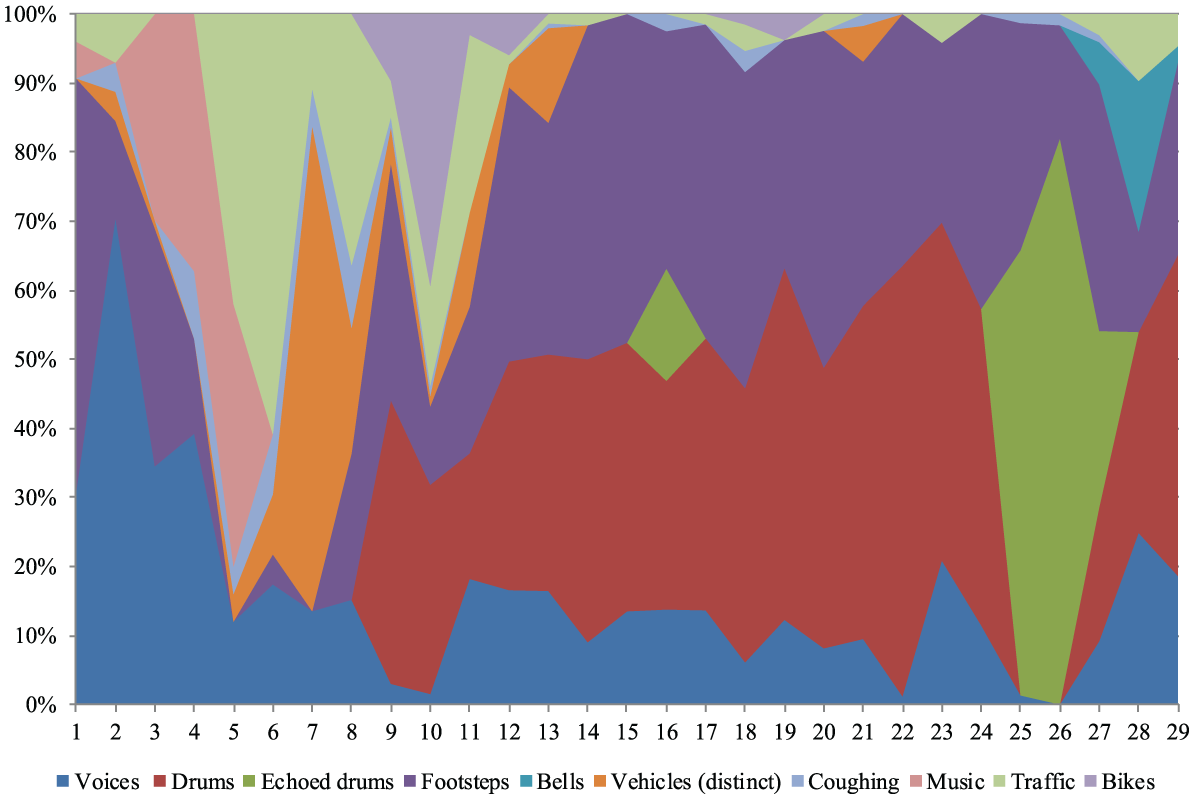
Sound analysis of the first 30 minutes of the Silent March.
Our analysis indicates a soundscape dominated by anthrophonic noise. Only 1.5% of sounds were nonhuman in origin and they were bird calls that produced distinct sound signatures. As Brown (2012, p. 246) pointed out “silence is not really silent.” Rather, the three most dominant human generated sounds were footsteps (32.35%), drums (30.12%), and the voices of marchers (14.50%). While Brown (2012) suggested that coordinated silence results in the background level of ambient noise lowering, in the case of the Silent March, it was the sounds immediately surrounding the marchers and within the column of marchers itself that were the most distinct. The keynote sounds, those associated with the ambient noise, were the traffic (5.04%) and music (2.40%). This background noise reminded marchers that they were walking along everyday urban streets, and that while they were engaged in a specific commemorative practice, the city of Amsterdam—and peak hour traffic—continued beyond the immediate area of the march. Nonetheless, it should be noted that police agents stopped all bikes and scooters around the Silent March, as part of the effort to maintain the “quiet” and reverent ethos of this commemoration. This alteration to the traffic flow is also represented in the minimal intrusion of sound signatures from distinct vehicles, such as motorcycles revving or trams scuttling along the rails. The voices of other marchers (14.50%) were quite muted, but were mostly evident in the first 5 minutes of the march, when shifting from the stage at the Stedelijk Museum to the first memorial site. Initially, the sounds of voices were characterized by discussions about the route, with some preliminary expressions of uncertainty about what was happening. This initial confusion—amidst large numbers of tourists on the Museumplein—dissipated within the first 10 minutes. For the remainder of the recording, the sound analysis shows the presence of intermittent voices, which were the muted sounds of some participants in the march quietly talking and whispering to another nearby person.
The sound signals, as distinct foreground sounds, were predominated by the drum reverberations (30.12%), produced by a row of four, young male drummers in military-style uniform, at the head of the march. The sound analysis shows that the drumming corps was most audible starting from Minute 8, marking movement away from the Museumplein monuments, where a Romani trio played an instrumental mourning song until Minute 6. The sound analysis shows that the sounds produced by this drumming corps were dominant from Minutes 8 to 24 in the recording (Figure 5). During this period, as the procession moved from two monument sites on Museumplein through to the final monument in the Weteringplantsoen, the sounds produced by the drummers offered a noticeable auditory cue to participants, as to the slow, even speed of the march. In her notes at 6:12 p.m., Danielle remarked: “the drum roll is louder now. It is almost compelling people to move forward. To pace along the park” (field notes, May 4, 2016). Watching the video footage during this time frame and reflecting on our observation notes we can correlate the drum beat to the marching pace—“we see people’s footsteps changing to keep in time with the drum” (field notes, May 4, 2016). The other, predominant sound, of footsteps (32.35%), was less audible in the first 10 minutes on the grass-covered Museumplein, but served as an important expression of the Silent March for the remainder of the recording. For example, first we noted “feet on grass” and “shuffle over the grass,” followed by the “soft canter of our feet along the pavement” (field notes, May 4, 2016). Footsteps provided repeated sound signals from participants, and served as an audible confirmation of their own participation within the collective procession. While the sound signal of birds was less prominent in this first part, the sound of bird wings flapping was a prominent sound during the 2-minute silence on Dam Square at 8:00 p.m.
The final category of soundmarks refers to those sounds that act as important markers of place, due to their distinctive meaning for local communities, and function as acoustic equivalents to “landmarks.” In our sound analysis, the most typical soundmark of Amsterdam was its historic clock tower bells tolling at 6:30 p.m. (Garrioch, 2003; Jacobs, 2014). The sound of bells does not overrule the sounds of footsteps, drums, and their echo. But the envelope (attack, sustain, and decay) of the bells gradually builds to a peak and gradually dissipates again, over a 3-minute period. These bells, most likely emanating from the Munttoren in the city center, are among several historic church and clock towers around the center of Amsterdam, which regularly mark 15-, 30-, 45-, and 60-minute intervals, and are on a rotating weekly schedule for a 1-hour carillon program.
The bell tolls signal specific time, location, and proximity within the historic center of Amsterdam, and also return in the 2 minutes’ silence on Dam Square. This soundmark of bells serves as a reminder of the proximity to the historic center, where the Silent March ends, and the “distinctly religious tone” produced by historic bells (Brown, 2012, p. 242) has the potential to reinforce the Silent March’s public act of reverent, commemorative silence, which is sustained over several hours. In our sound analysis, one other intermittent soundmark was the echo produced by drums. The echoing occurred as the march proceeded through the Rijksmuseum passageway. The echo of the drums served as an acoustic cue to the direction and mobility of the march. Duffy, Waitt, and Gibson (2007, p. 7) have noted that “rhythm is an integral part of generating instances within parades where actions and joyful emotions come together to help sustain an affective intensity that unites people.” We felt this intensity from the echoed drums, as Carolyn noted in her field notes: “[the] echo amplifies [the] sense of the crowd, [we] can’t hear footsteps, [the] crowd becomes wider, sense of composition (we are the people), drummers slow down, people film with phones (360 degree pans), then [exit] through the gateway” (field notes, May 4, 2016).
The echoing drums provided a culmination point in the soundscape, akin to a mobilization call for the collective marchers to refocus and march on as they exited the Rijksmuseum passageway. Indeed, as we exited the Rijksmuseum, we moved from marching in contained public spaces (the Museumplein and the Rijksmuseum) to the public streetscape. The reverberation of the drums and the heightened sense of awareness they engendered was both timely and serendipitous; on the street, the marchers became part of the spectacle of memory, traffic was stopped for us, and people watched from the roadside and from the windows above the road as we marched along.
This soundscape reminds us that the Silent March was not marked by an absence in sounds, but rather there are various sound cues that produce the distinct sounds and rhythmic qualities of this collective act of public silence. As Brown (2012, p. 246) has noted, the reduction of ambient noise produces more awareness of other environment sounds: “the silence affords a kind of perceptual heightening which makes us intensely sensitive to the noises that are continuously punctuating and finally breaking the silence.” This heightened awareness of one’s surroundings can serve as much as an enactment of collectivity in the present, oriented to the future, as one of remembrance of the past. Furthermore, as Sumartojo (2016, p. 1) has contended, participants “co-create atmosphere through their actions and responses in commemorative moments, but also because of their anticipation and expectations of the events.” Indeed, the temporal unfolding of the Silent March across the city invokes a buildup of anticipation over a 2-hour period, before the marchers arrive at the “main stage” of national commemoration, in the presence of Dutch royalty, heads of state and military, and national television crews.
Conclusion
Van Dijck (2006, p. 358) has argued that “people become aware of their emotional and affective memories by means of technologies.” The purpose of this paper was to reflect on the potential of mobile methods for memory research, with attention to how such technologies, the mobile devices, assisted in “capturing” commemoration. While being mobile and emplaced in the memory-making on May 4 was certainly constructive to our analysis, we are mindful that mobility research does not always necessitate researchers “move with” and “be with” their subjects. In response to the mobilities turn, Merriman (2014, pp. 182–183) has noted that there is a problematic belief that experimental and improvisational “mobile methods” provide the means to enable the research to get “close to,” “grasp” or witness the here-ness, now-ness and live-ness of particular practices and events—providing some “God-like” position from which the research can gain a more accurate or authentic knowledge of a situation.
We concur with Merriman’s assessment; mixed methods are necessary for mobilities research, as is an attentiveness to stillness, slowness, and boredom in the study of mobilities and movement.
Accordingly, our account here was motivated by the potential of multiple methods (sound recording, mobile photography, GoPro video recording, and note-taking) to encapsulate the commemoration of war in Amsterdam. While there exists literature on the “main stage” commemorations and national broadcasts of 2 minutes’ silence, the Silent March provides an exception both in terms of the absence of qualitative inquiry and in its combination of collective silence and mobility. Rather than suggest that our chosen modes of capture were “more accurate or authentic” than other research, the use of different recording devices and techniques have offered us an opportunity for comparative insights drawn from multiple representations (written notes, still image, and sound and audiovisual recording). The mobile media ethnography explored here serves as a first venture for both authors in combining mobile devices as well as in the chosen commemorative case study. For memory research, the focus on mobility and movement is an important and novel contribution to a field that remains reliant on visual, textual, and discourse analysis, with its development of interview methods generally restricted to seated, indoor situations. For the field of mobile media and communication, in turn, there is a tendency to study verbally dominant (or visual) modes of communication. The commemorative rituals of May 4—and the efforts to encourage a nation-wide “switch off” from mobility and mobile communication—provide a rich site of communicative action, replete with multiple possibilities for investigating collective silence and practices of memory-making in action. The use of the NViVO (Version 11) and Sonic Visualiser (2017) programs, moreover, helped us think and listen differently to the audio recordings from the Silent March. While much memory research increasingly moves towards the incorporation of methods attuned to the affect, embodiment, and encounter of researchers and participants at/in memory sites, it still rarely engages with the role of sound, and indeed silence, in constructing and capturing commemorative atmospheres. Our purposeful attentiveness to the soundscape revealed how silence, keynotes, sound signals, and sound marks, coalesced to reinforce the collective quality of the commemorative performance. An alertness to the soundscape drew attention to the drumrolls, bell tolls, and the acoustic cues of traffic and footsteps—sounds that may have easily folded in back into landscape had we been focused on visual and voice-based cues only. A combined aural and visual representation facilitated the identification of spatial markers and the temporal unfolding of the march, which aided in our disentangling of the Silent March’s acoustic environment.
A key analytic development for both authors has been in discovering alternative methods of “reading” landscape beyond the more visual-textual analyses of cultural, visual, and urban studies we are accustomed to. Listening for/to the sounds of commemoration motivated us to think through other, and often neglected, elements of the constructed memoryscapes. This listening, then, not only reinforced the importance of (re)producing the collective nation but it also highlighted how soundscapes of commemoration are part of a politics of memory—evident in the overwhelming dominance of anthropogenic sounds—and help to buttress certain interpretations of past events to present day place(s). Along the route of the Silent March, certain auditory cues marked our stops at monuments, for example on the Museumsplein and in the Rijksmuesum passageway. There is significant scope to apply similar analysis outside the remit of memory or urban studies, especially for example in work on/with other collective (national) events such as festivals and parades or in studies focused on the experiences of being mobile with a collective group. In our own, and other, research there remains a risk of flattening out the specific acoustic and built environment conditions of the sites; for example, in our research at the sites where the Silent March moved through and stopped. One way of investigating other means of representing the collective atmospheres in further research would be to work with binaural recording devices, or to map the sound analyses geospatially, for instance, by geocoding reference data.
Footnotes
Acknowledgements
The authors would like to thank James Lee for his help guiding our initial analyses using Sonic Visualiser, the anonymous reviewers and the editors of the Special Issue, Lee Humphreys and Jeffrey Boase.
Funding
The author(s) received no financial support for the research, authorship, and/or publication of this article.