




Abstract
Objectives
Heart failure (HF) is a significant global health problem that continues to increase in prevalence, morbidity, and mortality, particularly in aging populations. Relative wall thickness (RWT), an echocardiographic parameter reflecting geometric remodeling of the heart, is easily measurable and may possess prognostic value. This study aimed to evaluate the predictive power of RWT for 5-year mortality in patients with HF.
Methods
In this retrospective observational analysis, a total of 232 individuals diagnosed with acute decompensated heart failure were enrolled. RWT values were calculated using echocardiographic measurements. In this single retrospective cohort, participants were stratified into two subgroups based on their 5-year survival status. Demographic, clinical, laboratory, and echocardiographic parameters were compared between these subgroups
Results
After 5 years of follow-up, 133 patients had died. Patients in the mortality group were significantly older (p = 0.001). The mortality cohort demonstrated a higher prevalence of chronic renal failure, atrial fibrillation, and mitral regurgitation compared with survivors. Echocardiographically, elevated systolic pulmonary artery pressure (sPAP) was associated with mortality (p = 0.009). However, regression analysis did not find sPAP to be statistically significant [95% confidence interval (CI), hazard ratio: 1.047 (0.818-1.340), p:0.7)]. RWT values did not show a significant difference between the groups (0.39 ± 0.13 compared to 0.37 ± 0.06; p = 0.225). Area under the curve for RWT was 0.50 (95% CI: 0.43–0.57), indicating poor predictive power. Kaplan–Meier analysis showed no significant difference in survival between RWT groups (log-Rank:0.984, p: 0.32).
Conclusion
RWT has limited ability to predict 5-year mortality among patients with advanced stages of HF. Age emerged as the strongest independent predictor. RWT should be evaluated in conjunction with multiple clinical and laboratory parameters rather than in isolation when managing HF.
This is a visual representation of the abstract.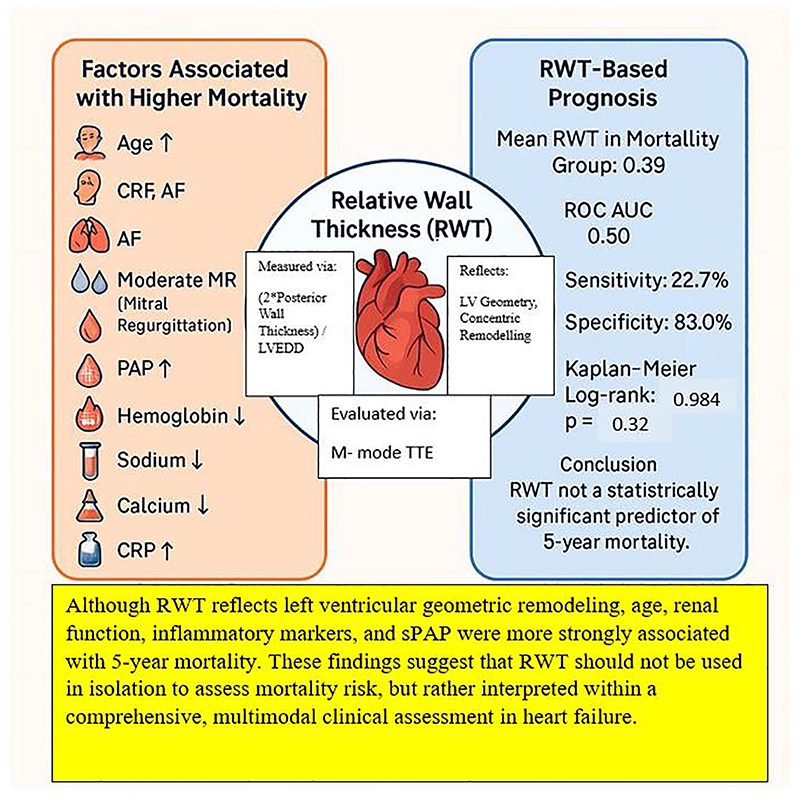
Get full access to this article
View all access options for this article.