




Abstract
Background
It is well-documented that women tend to be worse off post-stroke. They are often frailer, have less independence, lower functionality, increased rates of depression, and overall a lower quality of life. People who have had strokes benefit from rehabilitative support to increase their independence and reduce the risk of stroke reoccurrence. Despite the gender differences in the effects of stroke, interventions explicitly aimed at helping women have not been identified.
Purpose
This systematic review aimed to summarize the effectiveness of the health promoting behavioural interventions for reducing risk factors and improved self-management in women post-stroke, compared to usual care.
Method
Seven databases, Medline (Ovid), CINAHL, PsychInfo, Embase, PubMed, Scopus, and Google Scholar, were reviewed for randomized controlled trials covering post-stroke interventions. The following keywords were used: health promotion, secondary prevention, woman, women, female, sex difference, gender difference, after stroke, and post-stroke.
Results
Ten randomised controlled trials were found. These demonstrated common successful approaches for rehabilitation, but none specifically described health promotion strategies for women. Core components of successful programs appeared to be a structured approach, tailored to clientele and formalised support systems through their carer, family networks, or community engagement. Comprehensive reminder systems were successful for stroke risk reduction.
Conclusion
Women are disproportionately affected by stroke and are often in the frail category. Tailored structured health promotion programs with family and caregiver support combined with a comprehensive reminder system would appear to enable women post-stroke.
Introduction
Stroke was the second major cause of death globally in 2016. 1 The risk of stroke reoccurrence is lowered with a reduction in high blood pressure (BP), reduced smoking, keeping cholesterol within a normal range, and increased physical activity. 2 When post-stroke patients were asked about these risks, only 22% were able to name four risk factors, and 8% were unable to name any. 3 People were reluctant to adopt secondary prevention interventions post-stroke.4,5 Being female is a predictor for worse outcomes in stroke and rehabilitation. Studies show they are more dependent,6,7 their mobility, occupation, and leisure activities are more severely affected,6,8 and they have higher rates of depression and lower quality of life. 9 There are also specific risk factors for women e.g., pregnancy, preeclampsia, gestational diabetes, oral contraceptive use, and hormone replacement therapy. 10 Women also experience atrial fibrillation, diabetes mellitus, and hypertension more than men. 10
There is a need to investigate the effectiveness of health promotion interventions that reduce risk factors post-stroke for gender-specific outcomes. 11 There is evidence that effective health promotion interventions support the growth of self-management; this develops people’s awareness and ability to monitor their condition and choose a lifestyle that maintains a high quality of life. 12 Interventions that focus on improving problem-solving abilities, self-efficacy and resource utilisation show better outcomes. 13 To date, no summary of the effectiveness of health population interventions in this high-risk population group has been located. This study aims to summarize the effectiveness of health promoting behavioural interventions for reducing risk factors and improved self-management in women post-stroke, compared to usual care.
Methods
The search strategy was developed with health librarian assistance. This was conducted through comprehensive searching in Medline (1999–2019) (Supplementary Table 1), PsychInfo, Embase, and CINAHL, with further searching in PubMed, Scopus, and Google Scholar. Reference lists from included studies were reviewed for additional papers. The inclusion criteria were: randomised controlled trials (RCT) in the English language, evaluating health promotion interventions delivered to women, post-stroke as secondary prevention aimed at decreasing risk factors for stroke reoccurrence e.g., normalising blood pressure, cholesterol; reducing smoking rates; improving physical activity, activities of daily living (ADL) and medication adherence. Exclusion criteria included: primary prevention for stroke studies, participants younger than 15 years, and those with ‘transient ischemic attack’ in their definition for stroke.
Two investigators (KT and BL) independently screened titles and abstracts for eligibility based on the PRISMA guidelines. 14 Full-text articles were reviewed for those meeting the initial criteria; then, a discussion was held to reach a consensus on the final studies selected (Figure 1). The Johns Hopkins Nursing Evidence-Based Practice: Model and Guidelines 15 were used to assess the methodological quality of each study by two investigators (KT and BL) independently, and after discussion, a consensus was reached (Table 1). Data were extracted by KT using a table developed by the research team (Table 1). One investigator (BL) cross-checked the extracted data using the full-text of each study for accuracy. Where necessary, additional information was sought directly from authors.
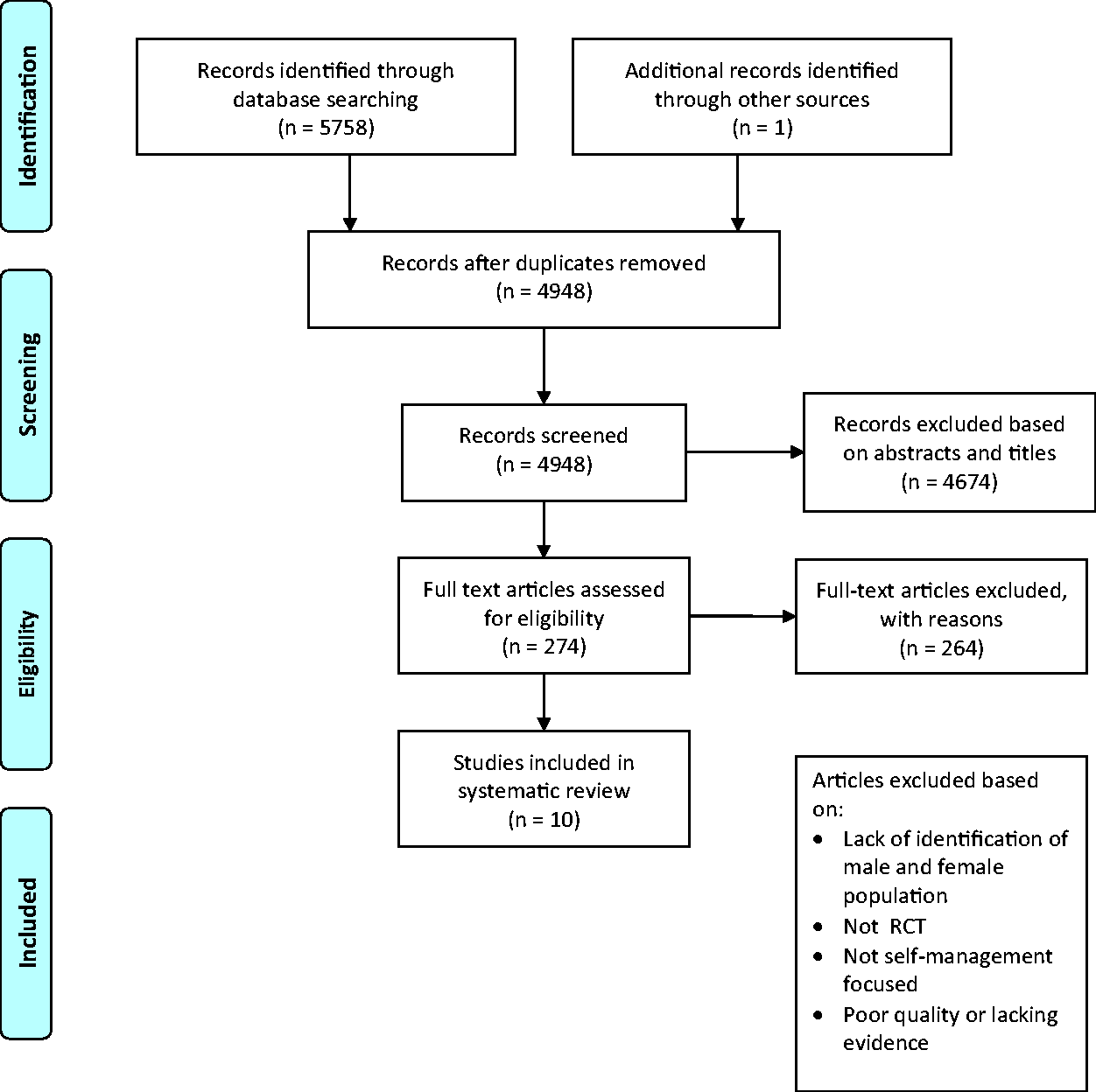
Prisma flow diagram of identification, screening, eligibility and inclusion of articles.
Characteristics and Results of Included Studies.

Abbreviations: ACS=Activity card sort, BIS=Barthel Index Scale, CBT=cognitive behavioural therapy,CDSES=Chronic Disease Self Efficacy Scale, CHAMPS=Community Healthy Activities Model Program for Seniors, CPI=Community Participation indicators, ESRS=Essen Stroke Risk Score, FAI=Frenchay Activities Index, FSS=Fatigue Severity Scale, HPLPII=Health Promoting Lifestyle Profile II, IPAQ=International Physical Activity Questionnaire, LDL=Low Density Lipoprotein, MAS=Motor Assessment Scale, MI=Motivational Interviewing, MMAS =The Morisky Medication Adherence Scale, mRS=modified Rankin Score, NIHSSS=National Institute of Health Stroke severity scale, PBSI=Preference-Based Stroke Index, Physical Component Summary of the Short Form 36 (SF-36), PPT=Physical performance Test, PSSES=Participation Strategies Self efficacy scale, RNL=Reintegration to Normal Living; SIS=Stroke Impact Scale, SMS=Short Message Service, SSEQ=Stroke Self-Efficacy Questionnaire.
A systematic approach was used for the synthesis of findings from the included studies. The characteristics of the studies examining the role of health promotion in the management of women after stroke were examined and presented in a narrative form. The heterogeneity of the studies ruled out meta-analyses. Similarities and differences were compared and grouped according to whether interventions were targeted at reducing risk or improved self-management. Quantitative data were reported in terms of risk reduction (e.g., blood pressure (BP), cholesterol, medication management) and indicators of improved self-management (e.g., ADL, physical activity).
Results
A total of 5758 titles were obtained from searches (Figure 1). Ten studies met the inclusion criteria (Figure 1). There were 3738 participants with ages ranging from 32 to 92 years. The mean age of participants was 67.6 years for nine of the studies. Participants were 43.2% female14–23 and were from diverse ethnic backgrounds (Table 1). No RCT post-stroke health promotion studies specifically targeted women, although all studies included women. Eight studies excluded those with serious comorbidities and those with aphasia/cognitive/psychiatric diagnosis or communication impairment.16–21,23,24 Interventions involved an individualised approach (six RCTs),16–18,22,23,25 or group (3 RCTs)18–20 approach to health promotion. One RCT combined both approaches. 24 (Table 1) Three of the studies targeted reduction in risk factors (e.g., BP, medication adherence),19–21 six on improved self-management (e.g., measured through ADL and physical performance),19–24 and one study targeted both 25 (Table 1). The quality of the RCTs ranged from Level 1B to Level 1 A.
Discussion
This review aimed to source post-stroke health promotion interventions for risk reduction and improve self-efficacy management in women. However, although women after stroke were included in all the studies, no studies explicitly targeted women. The percentage of female participants in all the studies was also low (43.2%). This was may be because eight studies16–21,23,24 had exclusions for those with severe comorbidities and aphasia/cognitive/psychiatric diagnosis or communication impairments, which would eliminate those who were frail. Studies show women are more dependent, and their mobility, occupation, and leisure activities are more severely affected.6–8 So, they are more likely to fall into this category and therefore not be included in these studies. However, two individually targeted interventions, with as few exclusions as possible,22,25 effectively improved participants' ADL and physical performance, implying that their approaches could be useful for the frail while meeting more women's needs post-stroke.
The four studies aimed at reducing risk factors used an individual, home-based approach. Two studies17,18 used a comprehensive reminder system through SMS messaging, and one used MI 16 and were successful in eight weeks, three months, and nine months respectively. The fourth study 25 with few exclusion criteria was unsuccessful at reducing BP or smoking rates, suggesting that interventions to reduce risk factors are also more successful with the less frail. The seven interventions aimed at improving ADL and/or physical performance either used individual or group methodologies in the home or community settings. Six of these programs19–22,24,25 reported significant improvements in both self-efficacy and ADLs. These programs ranged from 3–18 months, and four21,22,24,25 indicated sustained change was possible from 3–12 months after program completion. Core components of successful programs appeared to be a structured approach, tailored to clientele and formalised support systems through their carer, family networks, or community engagement. The study that focussed primarily on individual’s improved physical performance 23 showed that although this significantly improved, it did not improve ADLs.
Combining a comprehensive reminder system through SMS messaging with a structured approach, tailored to clientele and formalised support systems for ADL and physical activity would appear to be a positive step forward. This type of method has been very successful with The Woman’s Wellness after Cancer Program to improve outcomes and reduce risk factors following breast cancer treatment. 26
Strengths and limitations
A systematic search technique was utilised across seven different databases to collect all relevant studies. The key studies selected were RCT studies, a highly effective method for providing evidence, 27 and these ranged from high to good quality. Only four studies evaluated the effectiveness of interventions for reducing risk.
Future research implications
The next step would be to trial a health promotion program using these combined interventions focussing on women after stroke. Further good quality, larger RCTs in this population are also needed.
Conclusion
Women are disproportionately affected by stroke and are often in the frail category. Tailored structured health promotion programs with family and caregiver support combined with a comprehensive reminder system through SMS would appear to enable women post-stroke.
Supplemental Material
sj-pdf-1-cvd-10.1177_20480040211004416 - Supplemental material for Health promotion interventions post-stroke for improving self-management: A systematic review
Supplemental material, sj-pdf-1-cvd-10.1177_20480040211004416 for Health promotion interventions post-stroke for improving self-management: A systematic review by Karenza Taft, Bobbi Laing, Cynthia Wensley, Lorraine Nielsen and Julia Slark in JRSM Cardiovascular Disease
Supplemental Material
sj-pdf-2-cvd-10.1177_20480040211004416 - Supplemental material for Health promotion interventions post-stroke for improving self-management: A systematic review
Supplemental material, sj-pdf-2-cvd-10.1177_20480040211004416 for Health promotion interventions post-stroke for improving self-management: A systematic review by Karenza Taft, Bobbi Laing, Cynthia Wensley, Lorraine Nielsen and Julia Slark in JRSM Cardiovascular Disease
Footnotes
Acknowledgements
None.
Declaration of conflicting interests
The author(s) declared no potential conflicts of interest with respect to the research, authorship, and/or publication of this article.
Funding
The author(s) received no financial support for the research, authorship, and/or publication of this article.
Ethical approval
All authors in the manuscript have agreed for authorship, read and approved the manuscript and given consent for the submission and subsequent publication of the manuscript.
Guarantor
Julia Slark.
Contributorship
Conceptualization: K.T. B.L., J.S.; methodology, KT. B.L., C.W., & L.N.; formal analysis, K.T. B.L., & J.S.; investigation K.T. B.L., & J.S.; resources, K.T. B.L., C.W., & L.N. writing—original draft preparation writing KT. B.L., C.W., & J.S.; and revisions, KT. B.L., C.W., L.N. & J.S.; supervision, J.S. All authors have read and agreed to the published version of the manuscript.

References
Supplementary Material
Please find the following supplemental material available below.
For Open Access articles published under a Creative Commons License, all supplemental material carries the same license as the article it is associated with.
For non-Open Access articles published, all supplemental material carries a non-exclusive license, and permission requests for re-use of supplemental material or any part of supplemental material shall be sent directly to the copyright owner as specified in the copyright notice associated with the article.
