




Abstract
Objective
The aim of this study was to assess the accuracy of washout rate (WOR) analysis for thallium-201 chloride (201Tl) single-photon emission computed tomography myocardial perfusion imaging data acquired using cadmium zinc telluride detectors and a myocardial phantom.
Methods
A myocardial phantom was injected with 10.5 MBq 201Tl, and 10-min acquisitions were performed at 0, 24, 46, and 62 h to accommodate natural radioactive decay over time. Global myocardial WOR (global-WOR) and regional WOR (regional-WOR, left anterior descending artery [LAD], right coronary artery [RCA], and left circumflex artery [LCX]) were analyzed between 0 and 24 h (infarction model), 0 and 46 h (ischemia model), and 0 and 62 h (normal model), respectively. We compared the calculated radioactive decay-rate as a reference standard and phantom imaging WOR (phantom-WOR).
Results
Decay-rate versus phantom-WOR were 20.4% vs. 20.8% (global-WOR), 21.3% (LAD), 21.2% (RCA), and 19.7% (LCX) for the infarction model; 35.4% vs. 35.6% (global-WOR), 35.5% (LAD), 36.2% (RCA), and 35.2% (LCX) for the ischemia model; and 44.5% vs. 45.1% (global-WOR), 45.4% (LAD), 44.7% (RCA), and 43.5% (LCX) for the normal model.
Conclusion
WOR analysis for 201Tl single-photon emission computed tomography myocardial perfusion imaging using cadmium zinc telluride detectors is a reliable analysis method.
Keywords
Introduction
Thallium-201 chloride (201Tl) is widely used as a single-photon emission computed tomography (SPECT) myocardial perfusion imaging (MPI) agent. 201Tl SPECT allows for noninvasive evaluation of coronary artery disease (CAD).1,2
In 201Tl SPECT MPI, regional hypoperfusion can be evaluated using short-axis, vertical long-axis, and horizontal long-axis images. However, global hypoperfusion in myocardial ischemia (balanced ischemia and diffuse abnormal flow reserve) might be underestimated.3,4 Washout rate (WOR) analysis for 201Tl SPECT MPI can help detect abnormalities in patients with apparently normal MPI.5–7 For clinical use, it is important to confirm the accuracy of WOR analysis for 201Tl SPECT MPI.
The aim of this study was to assess the accuracy of WOR analysis for 201Tl SPECT MPI data acquired using cadmium zinc telluride (CZT) detectors and a myocardial phantom.
Methods
A scanner with CZT detectors (D-SPECT cardiac scanner; Spectrum Dynamics, Caesarea, Israel) and a myocardial phantom (RH-2; Kyoto-Kagaku, Kyoto, Japan) were used. The phantom (Figure 1) was injected with 10.5 MBq 201Tl, and 10-min acquisitions were performed at 0, 24, 46, and 62 h to accommodate natural radioactive decay over time. Natural radioactive decay over time was used to calculate radioactivity, and the WOR for the abnormal model was <40%. 8 For the calculation analysis of the basic WOR, the first myocardial counts (stress imaging in clinical cases) and decreased second myocardial counts, due to physiological washout over time (redistribution imaging in clinical cases), were used. In our phantom study, myocardial counts at 24, 46, and 62 h were measured due to natural decay.

Photograph showing the myocardial phantom and thallium-201 chloride (201Tl) injection site (arrow) in the myocardial area (187 mL).
Imaging was conducted using an energy peak and energy window width of 71 keV ± 15%. For all acquisitions, the raw projection data were reconstructed using an iterative maximum likelihood expectation maximization algorithm (ML-EM) using a variant of the ordered-subset expectation maximization algorithm (OS-EM) using three and four iterations and 32 subsets. 9 The WORs were analyzed between 0 and 24 h (infarction model), 0 and 46 h (ischemia model), and 0 and 62 h (normal model) (Figure 2) using the scanner’s software (D-SPECT WOR Software, Spectrum Dynamics, Caesarea, Israel). D-SPECT WOR software decay correction was not employed during WOR analysis in this study, and natural decay was used to calculate the WOR because decay correction underestimates the WOR.
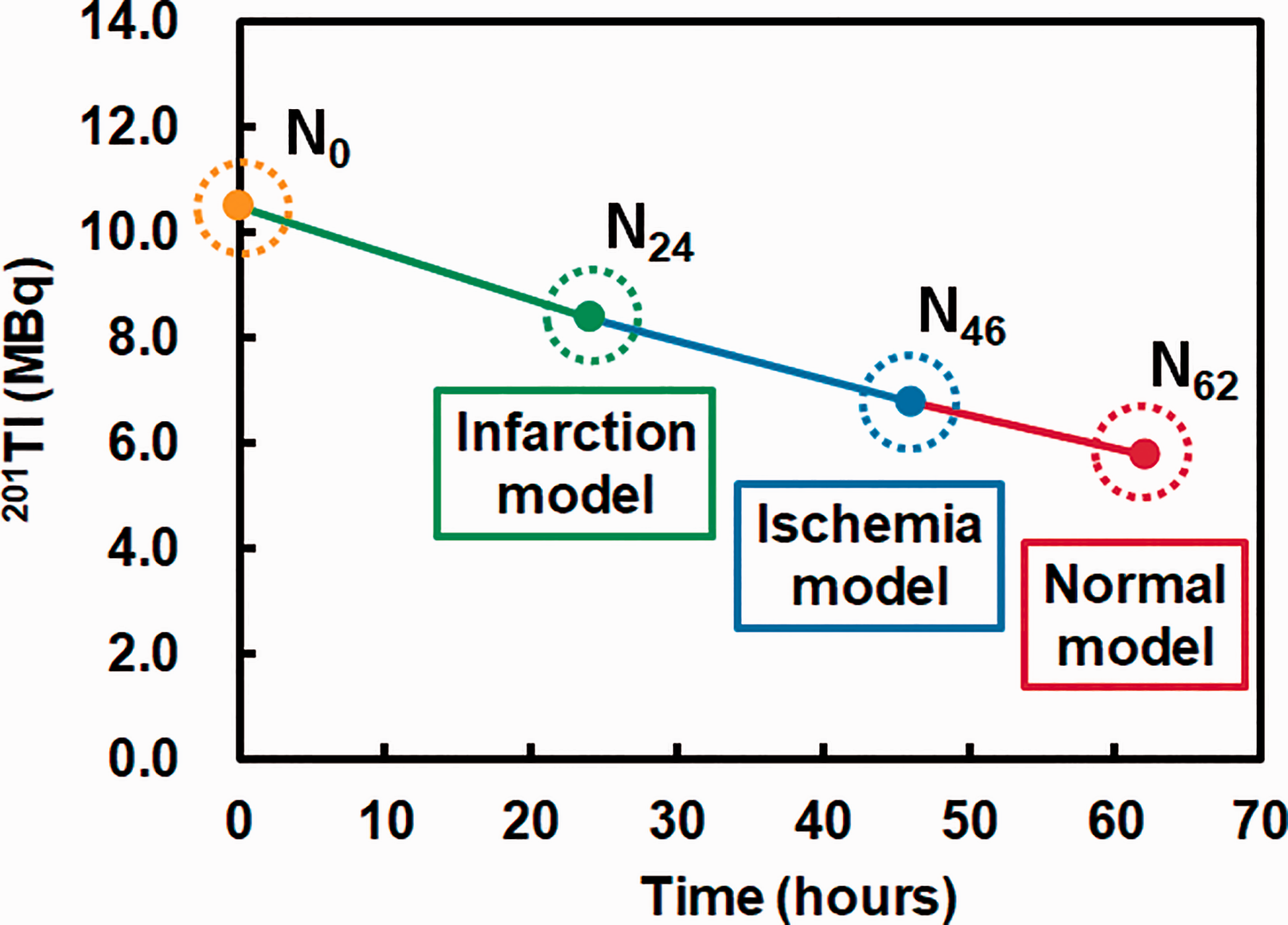
Models of 201Tl for various levels of myocardial blood flow: infarction model (N0–N24), ischemia model (N0–N46), and normal model (N0–N62).
The formula for calculating radioactivity from the images at 0, 24, 46, and 62 h was


The same formula was used to calculate the WOR in all models.
The initial (N0) radioactivity in the myocardial phantom was 10.5 MBq. The 24 h (N24) radioactivity of the myocardial phantom was 8.4 MBq (= N0[1/2]24.00/72.97), 46 h (N46) radioactivity of the myocardial phantom was 6.8 MBq (= N0[1/2]46.00/72.97), and 62 h (N62) radioactivity of the myocardial phantom was 5.8 MBq (= N0[1/2]62.00/72.97). The 0–24 h decay-rate was 20.4% (= [[N0–N24]/N0] × 100), 0–46 h decay-rate was 35.4% (= [[N0–N46]/N0] × 100), and 0–62 h decay-rate was 44.5% (= [[N0–N62]/N0] × 100).8,10
Differences between the decay-rate as a reference standard and the phantom imaging WOR (phantom-WOR) were compared. Phantom-WORs were used for the global myocardial WOR (global-WOR) and coronary artery regions (regional-WOR). All WORs were automatically calculated using the D-SPECT WOR software. Regional-WORs were divided into three main territories: left anterior descending artery (LAD), right coronary artery (RCA), and left circumflex artery (LCX). The left ventricle was divided into 17 segments using the American Heart Association model 11 with the LAD supplying segments 1, 2, 7, 8, 13, 14, and 17; RCA supplying segments 3, 4, 9, 10, and 15; and LCX supplying segments 5, 6, 11, 12, and 16.
Statistical analyses were performed using spreadsheet software (Microsoft Excel 2016, Microsoft Corp., Redmond WA, USA). The error was obtained as the absolute error. It is shown as follows:

Results
The reconstructed myocardial counts were 2.44 million at 0 h, 1.92 million at 24 h, 1.54 million at 46 h, and 1.33 million at 62 h. Decay-rate, phantom-WOR, and absolute error for each model are shown in Tables 1 and 2. Absolute error ranged from 0.2% to 0.6% for global-WOR, and from 0.1% to 1.0% for regional-WOR.
Global-WOR values.
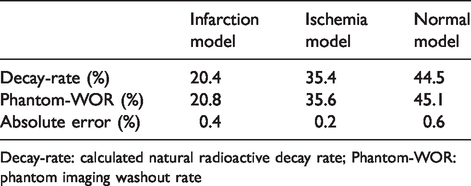
Decay-rate: calculated natural radioactive decay rate; Phantom-WOR: phantom imaging washout rate
Regional-WOR values.

LAD: left anterior descending artery, RCA: right coronary artery, LCX: left circumferential artery, Decay-rate: calculated natural radioactive decay rate; Phantom-WOR: phantom imaging washout rate
Phantom-WOR images are shown in Figure 3.
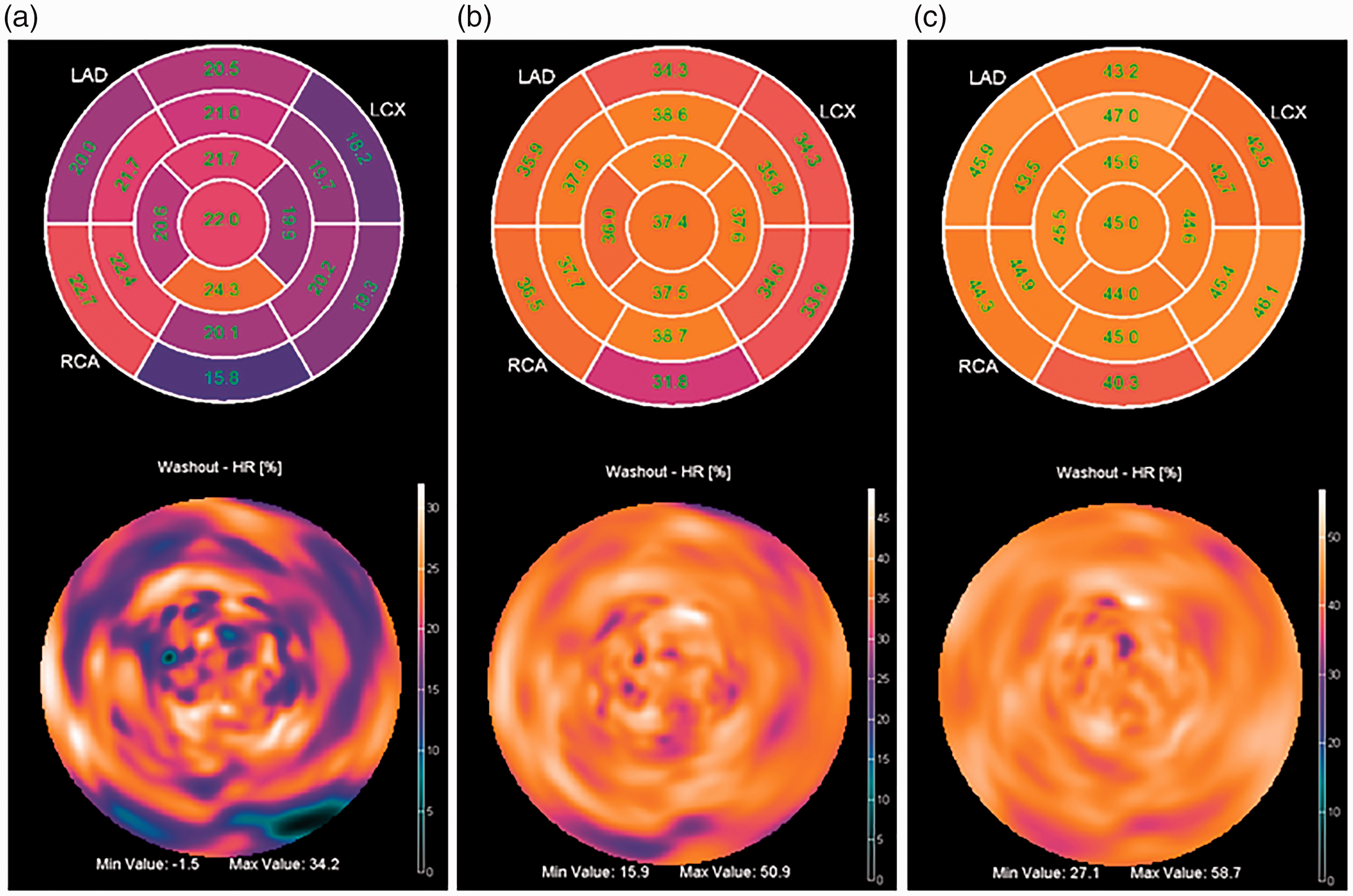
Phantom
Discussion
Recently, dedicated cardiac systems with CZT detectors were introduced in Japan. The improvements in efficiency and resolution allow low-dose imaging protocols, reduce the acquisition time, and permit quantification of the myocardial perfusion reserve using dynamic SPECT images.12–14 201Tl is widely used for SPECT MPI in many Asian countries. 201Tl SPECT MPI WOR is also a valuable tool when diagnosing CAD.7,15 There are methods of calculating WOR from planar and SPECT images.15–17 In this study, we used CZT detectors and a myocardial phantom and assessed the accuracy of WOR analysis for 201Tl SPECT MPI.
We observed the natural radioactive decay that occurs over time and created an infarction model, ischemia model, and normal model. In our previous study, 18 201Tl SPECT MPI required a counts of ≥1.2 million. Therefore, the myocardial counts at 0 h were ≥2.20 million, and at 62 h (used for the normal model) were calculated to be ≥1.20 million, with an acquisition time set to 10-min in this study (to record natural radioactive decay).
In clinical cases, the decrease in reproducibility can be due to repositioning effects between the first and second acquisitions. A previous study showed that reproducibility was unaffected by the myocardial phantom and clinical cases in several instances. 19 In the present study, inaccuracy of misalignment was controlled for by keeping the CZT detectors and the myocardial phantom immobile over acquisitions performed at 24, 46, and 62 h.
We found an absolute error of decay-rate and phantom-WOR for both global-WOR and regional-WOR to be ≤1.0%, with excellent accuracy of the WOR analysis results.
This study elucidated the accuracy of the WOR using the new CZT system. In the future, it is expected to have clinical application in the diagnosis of disease, especially multivessel disease and slightly abnormal myocardial perfusion.
Conclusion
The WOR analysis for 201Tl SPECT MPI using CZT detectors is a reliable analysis method.
Footnotes
Acknowledgements

Contributors
MI and MO researched literature. All authors conceived the report. MI wrote the first draft of the article. All authors reviewed and edited the article and approved the final version.
Declaration of conflicting interests
The author(s) declared no potential conflicts of interest with respect to the research, authorship, and/or publication of this article.
Ethical approval
This work does not contain any studies with human participants or animals.
Funding
The author(s) received no financial support for the research, authorship, and/or publication of this article.
Guarantor
MI.
Informed consent
Not applicable.