



Abstract
Critical civic engagement (CCE) is a pedagogical framework for civic education in urban settings. CCE as a pedagogical approach engages student lived experience, develops critical thinking, and facilitates informed civic action projects. In this phenomenological study of teachers in four urban high schools in a large urban school district, the author seeks to understand how teachers experience the enactment of CCE elements in schools with majority African American or Latinx student populations. The author argues that CCE practices can and should lead to the development of civic identity as a critical outcome for students in contrast to more formal measures of academic achievement. Civic identity is the foundation upon with engagement in public life is built. The study suggests that the enactment of CCE elements provides a powerful learning and identity formation experience for students and a pedagogical process that inspires teachers and their student-centered practices.
Introduction
Civic education disappeared from most American classrooms and the national consciousness in the 1980's. It had long navigated turbulent waters buffeted by emerging and changing political priorities as well as internal curricular debates about what was to be taught and how. Citizens beyond the walls of the schools, however, may never have known that most civic education had been pulled from course offerings. Indeed, when one Illinois legislator was asked for his support of a bill to re-introduce civic education as a statewide mandate, he stated: “You mean, we don’t already teach civics?” Educating students for citizens as core commitment of American public schools had disappeared, but few seemed to notice. In the days following the mob action on the US Capitol on January 6, 2021, people began to take notice. How could an insurrection, built on a lie, take place in the hallowed halls of American democracy? Were schools in part to blame for not educating students about civic participation? Did civic education represent a partial antidote to the ailments of American democracy? (Spiegler, 2021)
The legislator was correct to be mystified at the absence of civic education. Since the founding of the country, the idea of public schools as the institution that would both preserve and strengthen democracy was resonant. “From the earliest days of the Republic, schools accepted the obligation to participate in the building of a nation” (Boyer, 1990, 5). Civic education in one form and orientation or another has most always been with us but moved closed to extinction in the 1980s and 1990s as schools lurched from a commitment to developing citizens to generating test-takers and workers to suit the political, industrial, and corporate neoliberal agenda that launched with the Reagan administration and reached its zenith during the presidency of Donald Trump (Kaestle, 2000; Sleeter, 2015; York and Kirshner, 2015). Successive political regimes in the run-up to the Trump presidency, both Democratic and Republican, followed suit in passing legislation and policy that marginalized civic education through emphasis on standards, standardized assessments, and measures designed to punish schools, school leaders, and teachers, even whole communities, who fell short of stipulated outcomes. That civic education found some resonance among teachers during the last two decades of the 20th century and the first ten years of the 21st century was largely due to the efforts of non-profit civic organizations 1 that provided curriculum, professional development, small grants, and other resources to a limited number of teachers who carried the torch of civic education (Quigley, 1999a). But the 200-year national commitment to civic education in the American journey had virtually disappeared.
It was not until the first years of the 21st century when state educational leaders and civic advocates were convened to re-capture the historic connection between schools and preparation for democracy that civic education experienced a renaissance. During the interregnum, congregations, non-profit civic associations, community organizations, neighborhoods, and families were left with the task of developing the next generation of citizens. Young people were lucky to have more than two courses (often US and World History) in social studies while in high school. During the heyday of civic education students were expected to take two courses in civic education alone. In light of the appallingly meager commitment to democracy education, state delegates from across the nation were invited to Washington, DC, in 2003 and subsequent years to re-commit to civic education (Alliance for Representative Democracy, 2003). Delegations returned to their home states and hammered out plans for civic education in their schools and school districts. The Illinois governor signed a law mandating civic education in 2015 for all high school students, and, importantly, prescribed pedagogical approaches. Today all middle and high school students in Illinois are required to complete at least one semester of civic education.
This study examines the experiences of four veteran, urban high school teachers in a large urban school district whose work to develop young people prepared for the rigors of civic participation spans the first 20 years of the 21st century. These teachers utilize elements of an approach to civic education that I identify as critical civic engagement (Author, 2021). Kirshner et al. (2003) define critical civic engagement as “a complex process…in which youth's civic participation is motivated by their own experience of pressing problems” (p. 2). While forms of critical civic engagement vary, for the purposes of my research, I include the following elements of pedagogy in my understanding of CCE: Engage student lived experience, develop critical thinking skills, and facilitate civic action projects. I propose that these pedagogical approaches taken together can be particularly effective with historically marginalized urban high school students and lead to important outcomes in civic identity development. Civic identity as an outcome is, I argue, far more important to the well-being of a democracy and its institutions than traditional academic measures of grades and standardized assessment scores. Civic identity transcends a narrow focus on self and encompasses what young people care about, how they choose to act on their convictions, and how they connect to public life. These dispositions are connected to a sense of belongingness and purpose. I argue that schools can re-capture the centrality of their role as centers for civic learning and action in order to contribute to the civic identity formation of students necessary for a functioning democracy.
Teachers are a critical part of the civic learning formula. Teachers bring a diverse set of values, commitments, experiences, resources, and orientations that shape their approaches to and practices in a civic education classroom. In their instruction, teachers answer the question whether implicitly or explicitly about the kind of citizen to be developed. Westheimer (2015) argued that most teachers in the United States educate towards the personally responsible citizen—one who attends to the basics of civic responsibility without disrupting the status quo. Teachers in this study, however, answer the question in a different way. Why and how they answer this question and how their approaches impact civic identity development is the subject of this article.
Theoretical framework
I engage conscientization (Freire, 1994) as a theoretical framework for this study. Freire understood that education should begin with the experience of the student, enable students to develop a critical stance toward the history, systems, and institutions of society and position them to work towards social change through reflective action (praxis). I position conscientization in the context of urban high schools and argue that its enactment leads to important civic identity outcomes. Critical urban theory (Brenner, 2008) establishes a specific context for my inquiry, the exosystem (Bronfenbrenner, 1979) of student experience while civic identity, elaborated below, represents where I understand CCE ultimately leads as an important student outcome Figure 1.
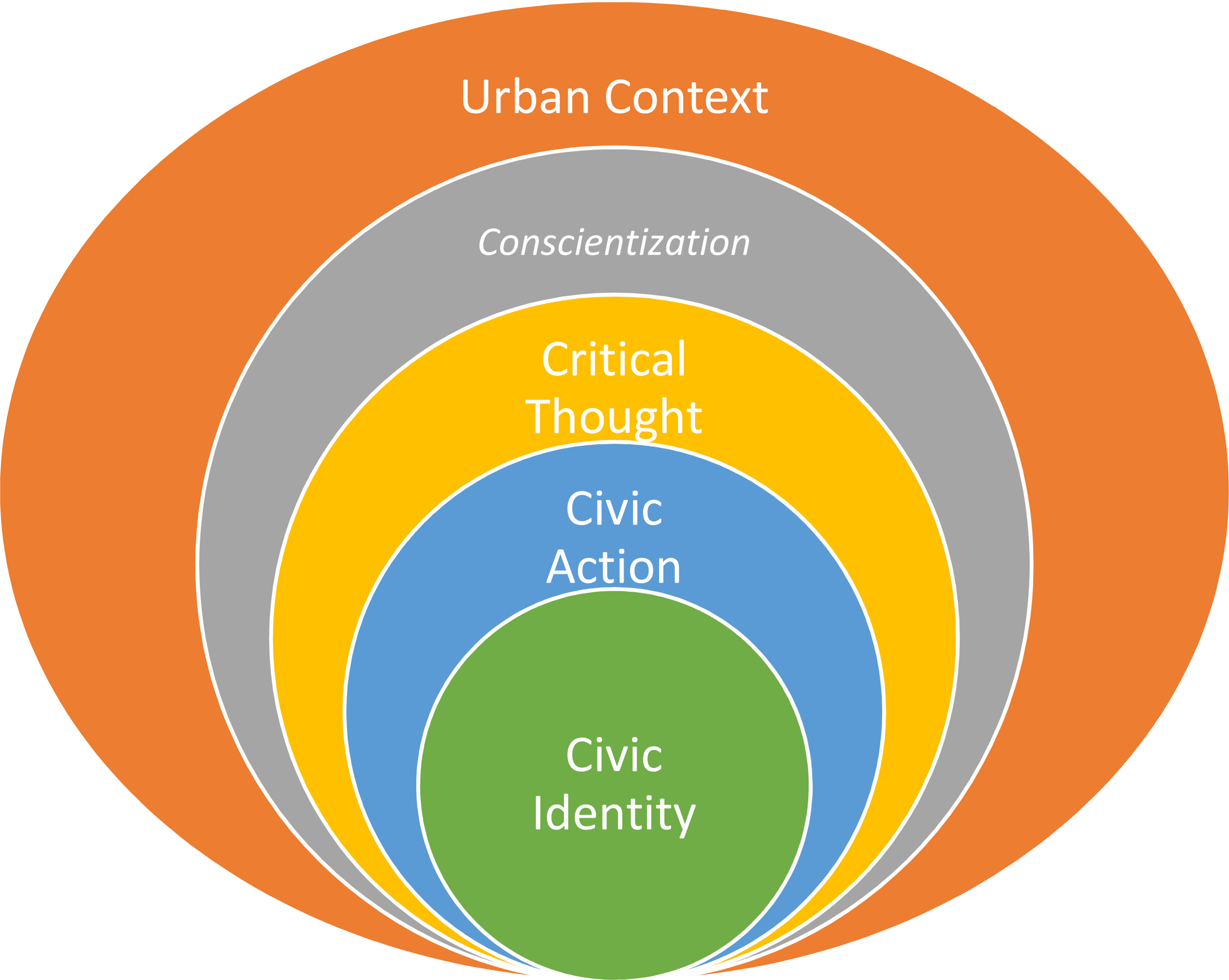
Theoretical framework.
In order to help students achieve conscientization or critical consciousness, teachers must, Freire argued, deviate from banking education. They should instead pose problems that encourage critical thought and collaborative action. Problems are messy, dynamic, contextual, and do not have clear answers or resolutions. They also present an opportunity to engage the lived experience of students, name and interrogate forms of oppression, and seek liberation from oppression in solidarity with others: “Whereas the banking method directly or indirectly reinforces men's fatalistic perception of their situation, the problem-posing method presents this very situation to them as a problem” (Freire, 1994, 66). The process of learning begins then with the lived experiences of students, the problems they experience. From this starting point, students engage in critical thought and action toward critical consciousness, which is liberatory; it enables the student to recognize their reality through a critical prism with the emerging possibility of action toward improved circumstances: “A deepened consciousness of their situation leads people to apprehend that situation as an historical reality susceptible of transformation” (66). Ginwright (2011) argued that the development of critical consciousness is necessary for healing even as it is a way to prepare “African-American youth to confront racism and other forms of oppression” (36). It is not enough, however, to use the technical skills of critical thinking or even to render a critical assessment of society and its history, institutions, and systems. One must also have opportunities to act thoughtfully and reflectively toward social change.
Civic education in urban contexts
However, scholars have documented a ‘civic opportunity gap’ for students attending public schools in urban communities (Flanagan and Levine, 2010; Kahne and Middaugh, 2008a, 2008b; Levinson, 2007; Rubin et al., 2016; Youniss, 2011). The existing civic opportunity gap is largely determined by race, academic track and SES status (Kahne and Middaugh, 2008a; Levinson, 2007). A healthy democracy requires that all citizens have a stake in their social, political, and economic environments and want to participate in shaping the direction of their society. “Our prosperity, liberty, and dignity depend on the healthy maintenance of our democracy. And democracy…depends ultimately on the political wisdom and civic spirit of the people” (Pangle and Pangle, 2000, 21). Participation and access to the tools of participation, therefore, is the lifeblood of democracy.
Without robust and thoughtful participation among all sectors of society, democracy begins to atrophy, and powers devolve to the few. When we consider that wealthier, whiter communities already enjoy a civic participation advantage, the problem of a civic power imbalance is exacerbated when schools across the country do not provide equitable opportunities for all students. Rates of civic participation and engagement rise according to race, wealth, and education: “Unequal political ‘voice’ is a persisting feature of American politics” (Flavin, 2017, 61). “Those who most need power, which is derived from political skills and knowledge, are those who are least likely to gain such knowledge and skills” (Boyte, 2003, 87). When one considers that students in high poverty, marginalized neighborhoods may already come to social studies classrooms feeling a disconnect between civic ideals and the realities they experience, opportunities to engage in meaningful discussion, analysis, reflection, and action are all the more important. However, urban students are likely to have less access to civic learning opportunities and come with more feelings of cynicism and discouragement due to their lived experiences. The civic opportunity gap leads inevitably to a civic achievement and ultimately civic power gap. Elected officials as well as corporate leaders tend to hear from an unrepresentative sample of American society.
Lived experience
Freire positioned student lived experience at the center of critical pedagogy. Subsequent scholarship advanced culturally- and identity-situated pedagogies. Ladson-Billings (1995) posited that “culturally relevant pedagogy teachers utilize students’ culture as a vehicle for learning” (p. 161). Emdin (2016) proposed reality pedagogy as an approach to teaching that begins with the lived experience of urban students and honors and engages their neoindegeneity. Paris and Alim (2017) proposed culturally sustaining pedagogy as a “critical centering of the valued ways of youth and communities of color” (13). Muhammad (2020) argued for an urgency of teaching that is purposeful and centers the development of intellect, criticality, skill-development, and identity of students. These scholars together reflect the urgency of positioning student experience and identity at the heart of a pedagogical approach. Moll and Gonzalez (1994), Yosso (2005), and Esteban-Guitart and Moll (2014) suggested that students don’t simply come with experiences to be curricuralized but funds of knowledge, community cultural wealth, and funds of identity that represent “developed bodies of knowledge and skills essential for household or individual functioning and well-being” (Moll and Gonzalez, 1994, 443). Hauver (2017) suggested that the act of carefully listening to “children's sense making about the civic spaces they already inhabit—taking seriously the local and lived dimensions of children's civic learning—can help us to develop more intentional and inclusive civic education practices” (379). Engaging the lived cultural and civic experiences of students then establishes a learning context that listens to and engages students in liberatory, purposeful practices.
Critical thought
Freire's process of conscientization seeks to identify and deconstruct dominant social and political ideologies and move the locus of the problem from the individual to the institution or system. Individuals are no longer the problem that needs to be fixed; they are agentic actors seeking to change and hold systems accountable. Critical urban theory positions critical theory within a specific context and insists “that another, more democratic, socially just and sustainable form of urbanization is possible, even if such possibilities are currently being suppressed through dominant institutional arrangements, practices, and ideologies” (Brenner, 2008, 198). Further, critical urban theory suggests that social knowledge is embedded and contextualized and that there is space to envision and imagine the possible even as it rejects the limitations of the actual. Applied to the practice of civic education pedagogy, critical urban theory suggests a critique of existing social and political systems as well as the possibility of action toward a renewal of urban realities that are more just and more centered and responsive to the experiences of people and communities.
Bermudez (2014) advanced four intellectual tools to engage in meaningful and purposeful critical reflection: Problem posing, reflective skepticism, multi-perspectivity, and systemic thinking. These tools are critical for the democratic citizen. Dominant systems are exceedingly adept at individualizing social problems in order to place the burdens of society on the individual. The act of critical thinking, however, purposefully recognizes the systemic nature of problems facing urban communities. Critical thinking and reflection can generate agency as current social arrangements come to be understood as but one inadequate possibility. The critically reflective citizen is able to question current realities and propose new solutions to complex social problems. The empowered citizen can move to identify one's own interests and dreams for renewal, recognize the interests of others, and then act toward common purpose and common good. Action is ultimately necessary in this pedagogical project. There is “no reason to foster critical inquiry if there is no reality which we can act upon” (Bermudez, 2014, 115).
Informed civic action
Informed and authentic civic action is an essential element of effective civic education (Boyte, 2003; Duncan-Andrade, 2005; Ginwright, 2011; Hipolito-Delgado and Zion, 2015; Lecompte and Blevins, 2015; Levinson, 2012; Watts and Flanagan, 2007). When students are engaged in “action civics” through their schools, they are learning the knowledge and tools of civic-minded individuals and groups (Lecompte and Blevins, 2015). Effective citizens identify issues that are important to the community, conduct research to better understand the dimensions of the problem, build alliances with individuals and groups, act in thoughtful ways that produce results, and reflect and evaluate on the process. This kind of action civics elevates the work of the citizen from one who is personally responsible to one who acts collectively with others towards more socially just communities (Boyte, 2003; Duncan-Andrade, 2005; Westheimer, 2015).
Duncan-Andrade (2005) and Boyte (2003) proposed that student civic experiences and projects be centered in collective action that confront questions of injustice and move toward collective action that might include issue identification, research, and action projects. Collective action provides an antidote to feelings of powerlessness: “The remedy for powerlessness is experiences of public power, understood as collective action, not individual or personalized care giving” (Boyte, 2003, 91). Collective action builds political knowledge and power, and ultimately, in its critique and action, challenges forms of government and corporate power. York and Kirshner (2015) also argued for a collective civic action toward collective systemic agency as a “constellation of practices that connect the interpersonal work of collective work with a systemic approach to thinking about and taking action” (105). Informed civic action that is collective in orientation can also resist neoliberal ideologies and practices. “Under corporatocracy, education is a resource for national global competition and for private gain, however, a task of education is to help young people learn to connect their own self-interest and future with that of a broad, diverse public” (Sleeter, 2015, 145).
Collective action offers a compelling framework that engages students beyond highly individualized schooling practices toward authentic, meaningful and empowering learning experiences. School administrators and teachers must, however, engage students meaningfully and respectfully and regard students as competent, capable of working collaboratively, and central to the school change process, in order for students to generate a sense of civic agency. Indeed, teachers who enable civic action and “work with students to identify and transform injustices through the curriculum, promote students as agents of change” (Schultz and Oyler, 2006, 426). Informed civic action can provide the opportunity for students to see themselves as civic actors and agents of their own destiny and caring adults in schools can guide, support, and reinforce important learning opportunities toward a deepened sense of civic identity.
Civic identity development
CCE pedagogy can ultimately contribute to a healthy democracy, lead to greater equity, acknowledge and honor diverse forms of civic participation, and it can support a young person's identity formation. Erikson (1968) proposed that the key task of adolescence is to develop a sense of identity in relationship to broader society. Key questions such as “Who am I” and “What is my purpose” are germane to young people as they attempt to develop a strong sense of identity and avoid role confusion. Identity development is to be sure a complex process that continues as a lifelong pursuit, but one that begins and potentially achieves important benchmarks in adolescence when successfully navigated. Youth are emerging from a complex socialization process and beginning to gain awareness of the external and internal forces that have been at work to shape their identity. Adolescence is the time when assumed identities are more fully called into question and unique identities crafted.
Young people approach questions of identity differently, but those who choose to actively engage in the identity construction process often try on various roles in society (Berzonsky, 1997; Marcia, 1966). Young people “who develop a clear sense of identity…are likely to experience greater well-being later in life” (Harrell-Levy, 2014: 99). I position civic identity as an important strand of identity development and an important outcome of quality civic learning experiences. “Civic identity lies at the heart of common notions of citizenship and civic participation” (Hart et al., 2011, 771). Civic identity is a sense of self that leads to action but also builds meaningful connections to community, where young people begin to see themselves in relationship to the public world (Nasir and Kirshner, 2003). Furthermore, as they develop a sense of civic identity, they begin to transcend self in order to see and contribute to a larger cause (Martinez et al., 2012). Growing civic identity then enables young people to connect to their community in public ways, act in meaningful ways, and find ways to become involved in causes that transcend self.
Civic participation is an important opportunity in and reinforces the identity development process. Young people who are more conscious about their identity development are likely to seek out civic opportunities and youth who engage civically are faced with new questions. As they move into civic spaces, they encounter new values, orientations, and commitments, discover new ways of thinking about social issues and how to address them, and make connections and build relationships. Through these experiences, youth are beginning to understand themselves and their world in new ways. Crocetti, Jahromi, and Meeus (2014) suggested that this process includes thinking about existing commitments, conducting in-depth exploration, and reconsidering one's status: “Individuals enter adolescence with a set of commitments in ideological and inter-personal identity domains…and can decide whether to maintain or revise them” (522).
Crocetti et al. (2014) proposed that caring adults in schools can be helpful in supporting identity development by providing opportunities for reflection and critical analysis during this process. For example, African-American high school graduates retrospectively reported important gains in civic identity development through participation in a class providing opportunities for civic participation. Teachers “acted as agents of identity exploration…they purposefully and successfully contributed to the students’ identity development” (Harrell-Levy et al., 2016, 109).
However, young people may come to the process of civic identity development from radically different circumstances and perspectives. Race, gender, class, linguistic, and citizenship inequities may shape how marginalized young people think of themselves and their capacity to impact systems. Further, urban youth of color may not experience social systems as being responsive to their identities, needs, or aspirations and cause ruptures in their civic identity development (DeJaeghere and McCleary, 2010; Rubin, 2007; Salinas and Alarcon, 2016). Social identity statuses are all markers that can impact successful civic identity development and impede a developing sense of belonging, connection, and efficacy. Schools and the state may also essentialize immigrant youth in a process of assimilation and conformity rather than encourage their own unique and dynamic, perhaps hybrid sense of identity. This process of cultural and linguistic assimilation towards a white, middle class ideal disregards the multiple experiences and elements of identity of neoindigenous youth (Emdin, 2016). “These contradictions created ruptures in their identity formation, in which they are made as essentialized others…[while] they attempted to self-make their civic identities as members of communities….” (DeJaeghere and McCleary, 2010, 241).
Yet, civic identity development among youth is also a socially embedded process that can contradict the subjectification efforts of the state and involve self-making, a process that negotiates contested relations of belonging. Though young people of color may not have experienced responsiveness or recognition from social and political systems, they come from communities that embody aspirations for more just urban spaces. Diverse social and cultural experiences inform and shape identity, including civic identity, in ways that more privileged, perhaps mono-cultural communities may not. Engaging lived experiences, supporting critical thought, and facilitating informed action can honor unique cultural experiences, advance complex, hybrid identities, and support a growing sense of engagement and empowerment (DeJaeghere and McCleary, 2010; Rubin, 2006; Salinas and Alarcon, 2016).
History of citizenship education in America
American schools have historically played a critical role in educating for democracy. Early American political leaders Washington, Jefferson and Franklin understood that a central purpose of schooling was to ensure that citizens were well-equipped to “maintain the public good” (Lowham and Lowham, 2015, 2), that skills of democratic citizenship were “taught consciously through schooling….” (Cogan, 1999, 52), and civics would be a cornerstone of public education to be integrated in all facets of the school curriculum (Pangle and Pangle, 2000).
In the 19th century, Horace Mann's common school movement was both a democratic strategy to enable universal access for all young people to the nation's schools—not just the privileged—and an opportunity to develop skills critical for democracy. Mann worked to create schools that were “free, universal, [and] non-sectarian…and sought to create the virtuous republican citizenry needed to sustain American political institutions” (Warder, 2019: np). Schools might “equip [students] to function as citizens in a changing society. In pursuing these goals, schooling in all its aspects became civic education…Mann knew that many of his contemporaries, fearing the horde, favored a narrow dissemination of power to those defined as superior, and he sought to broaden their view” (Warren, 1988, 245–46). Mann understood the dual role of the common school—to grant access to all Americans and to prepare them for citizenship.
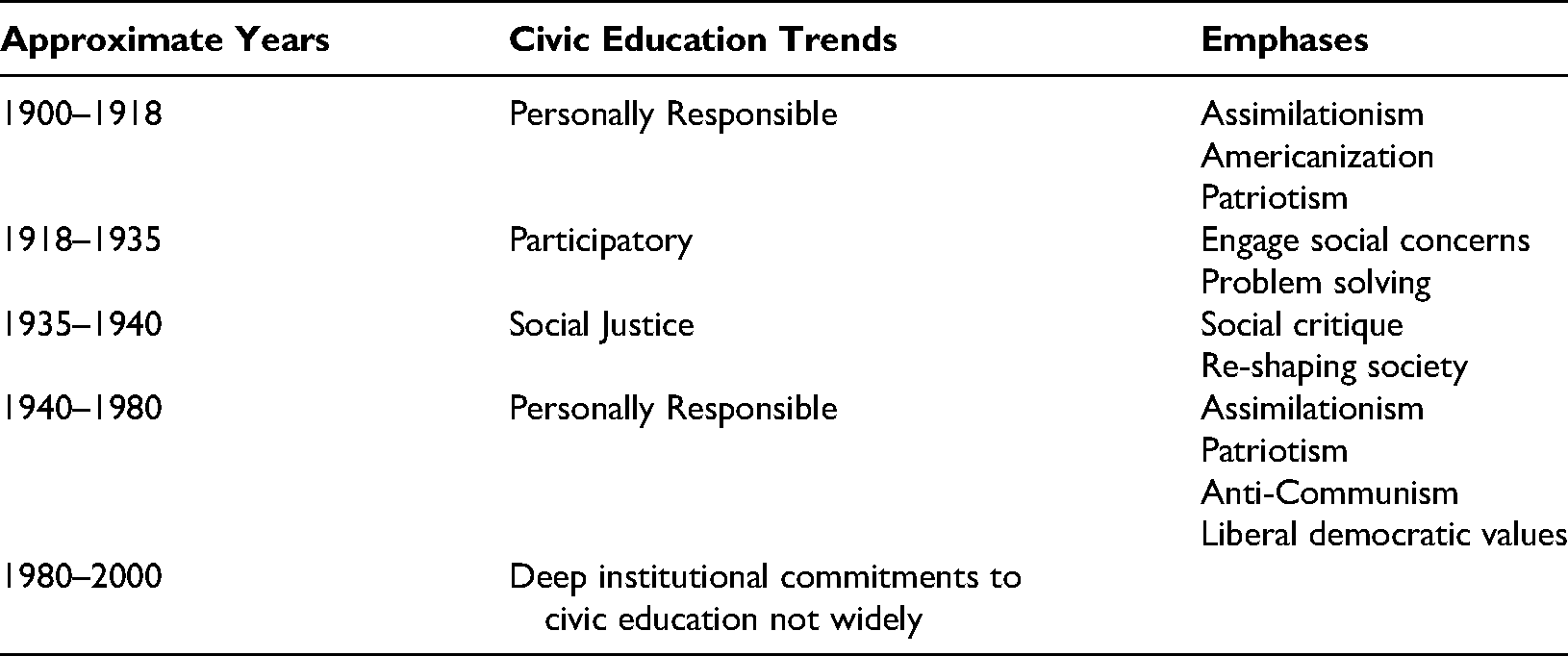
Schooling changed dramatically in the 20th century in response to a range of social, political, and economic pressures, and civic education took on different and oftentimes competing forms. Westheimer and Kahne (2004) proposed a citizen typology—personally responsible, participatory, and social justice oriented—that reflects how civic education in the 20th century has unfolded. Pedagogical practices emphasized alternatively personal responsibility, participation, and social justice orientations. At the turn of the century, schools were expected to integrate growing numbers of immigrants and urban workers towards ideas of love of country, assimilation, and the self-made man (Butts, 1989). Civic education first emerged as a distinct curriculum in 1916 during the progressive movement with an emphasis on participation to solve the problems of society (Cogan, 1999). A social reconstructionist strand of social studies and civic education, embodied in the curricular work of Harold Rugg and theorizing of George Counts in the 1930s and 1940s, presented an emergent social justice orientation in civic education. Reconstructionism presented a critique of society and a critical role for the individual to play: “If schools are to be really effective, they must become centers for the building, and not merely for the contemplation, of our civilization” (Counts, 2009, 48). Society and its systems could be improved if not perfected (Kliebard, 2002). Shortly thereafter, social studies and civic education experienced a retreat from social activism to education for liberal democratic citizenship: …The climate changed from one of questioning American political, social, and economic institutions and focusing on the problems of American society, to one of emphasizing what's right about our institutions…the progressive belief in the perfectibility or improvement of society was dealt a heavy blow of realism by the war (Evans, 2004, 70). …dry portrayals of the formal structure of our federal government, charts on how a bill becomes a law, and sometimes idealized portraits of the heroes of our political history. The most common method of teaching was lecture, and more attention was paid to the memorization of facts, important as that may be, than to inquiry, discussion, and debate (Quigley, 1999b: paragraph 7).
An era of national school reform emerged and persists into the 21st century with an orientation to standards, academic excellence, and economic priorities. However, “the recent dominance of economic purposes in educational rhetoric has led many to advocate a revival of the political purposes of education, emphasizing their distinctness and the urgent necessity that we train citizens, not just workers” (Kaestle, 2000, 51). Civic education re-emerges in the early 21st century sparked by local and national efforts to remind schools of their historic responsibility to prepare students for active and thoughtful participation in democracy (Alliance for Representative Democracy, 2003).
Twentieth century trends in civic education.
Critical civic engagement
Critical civic engagement (CCE) incorporates progressive and reconstructionist strands of civic education theory and practice from the 20th century. CCE is an approach to developing social justice-oriented citizens in urban contexts, builds upon culturally sustaining pedagogies, progressive ideas of student-centered learning and public participation, and reconstructionist ideas of social transformation. First, CCE proposes to engage the lived experience of urban high school students. Insodoing, it argues against assimilationism, essentialization, and universalist approaches to education. CCE proposes that teaching takes place in always unique contexts and that students come into learning spaces with a diverse range of experiences and perspectives that should be recognized, honored, and engaged. Secondly, CCE seeks to develop critical thinking skills. It argues against a unitary understanding of American history, government, and systems and acceptance of the social and political status quo. Instead, CCE presents opportunities for students to engage in critical inquiry to challenge political, economic, and social systems in order that they might be improved or transformed to better the human condition. Finally, CCE encourages thoughtful and informed civic action by students. It argues against simply learning about or contemplating the nature of our society for use later in life. Instead, CCE encourages students to generate projects that are oriented to social transformation by asking challenging questions of society. CCE then is an instructional approach that seeks to educate social justice oriented citizens Figure 2.

Elements of critical civic engagement (CCE).
In our current political context, it is important to note that CCE is not oriented toward felt grievances. Instead, it disrupts prevailing dominant narratives and ideologies. It is a pedagogical approach to be considered and engaged with urban students whose interests have been consistently marginalized and silenced for decades and even centuries. With a focus on diverse classrooms in urban schools, this study examines the experiences of four high school teachers who seek to center students and their experiences, provide opportunities to critically examine current social and political systems and their underlying ideologies, and finally to take informed action in ways that are cognizant of and even seek to undermine these dominant narratives and practices.
Methodology
This study blends a phenomenological approach with an instrumental case study analysis. It explored and sought to understand how teachers in an urban district facilitate and experience critical civic engagement practices with high school students and the extent to which teachers perceive these experiences contribute to civic identity. A phenomenological approach aims to interpret and thus more deeply understand the experience, in this case of teachers using elements of CCE (Van Manen, 2017). The instrumental case study analysis seeks to develop insight into the theory and efficacy of CCE. “In an instrumental case study, the case itself is secondary to understanding a particular phenomenon” (Grandy, 2010, 474). This study engaged four veteran public high school teachers who bring civic education into their classrooms and practice elements of CCE with their students. My goal was to invite teachers in schools that were broadly representative of the diversity of the public school district.
With the exception of one teacher, teachers were interviewed via Zoom due to the Covid-19 virus and the closing of schools. Each interview was one hour in length with the exception of one teacher who was interviewed in person at the school. The interview protocols were semi-structured in nature. Brinkmann (2013) distinguished between the structured, semi-structured, and unstructured interview and finds that semi-structured interviews provide for “utterances that spill beyond the structure [and] are often quite important and even key to understanding answers” provided (18). The purposeful semi-structured interview creates space after the question posed and preliminary response to explore, consider, and potentially reframe the ideas, concepts, and experiences. I audio-recorded each teacher interview, transcribed the interview verbatim, and used open and axial coding to generate and refine emergent themes from the interview. I sought to identify both common and divergent approaches and reflections of teachers to build a broader understanding of how teachers approach, implement, and experience civic education instruction.
Participants
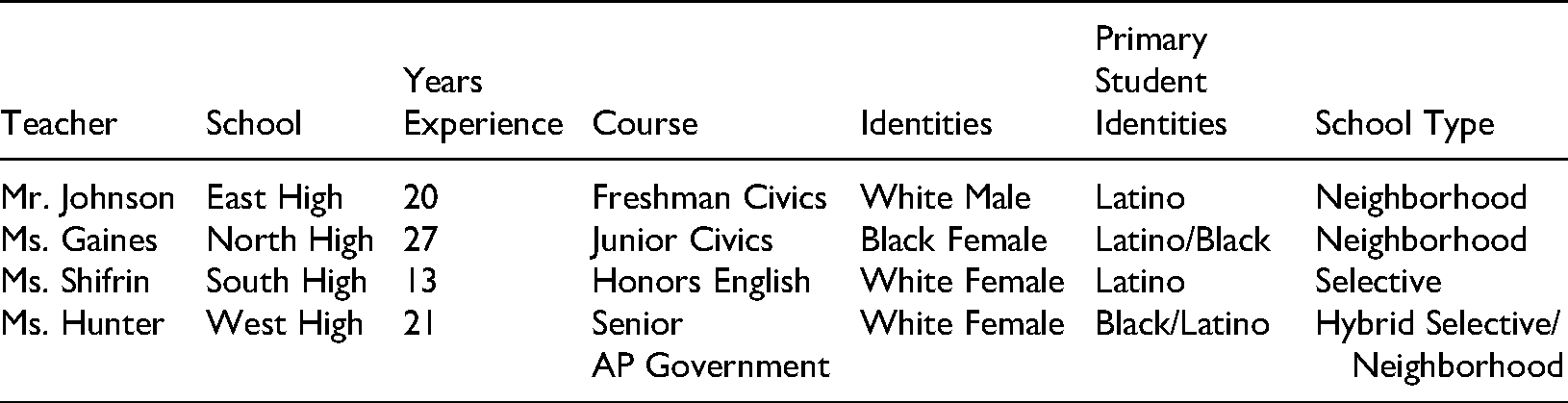
The teachers in this study bring a combined 81 years of teaching and administrative experience to their classrooms. Three of the teachers provide instruction in social studies classrooms. The English teacher has long integrated civic education practices in her classrooms. Three of the teachers have used civic education practices for the majority of their teaching careers, while one began teaching civics recently. The teachers provide instruction in a state that mandates at least one semester of civics instruction and an urban school district that substantively supports civic education practices (professional development, curriculum, community partnerships, networking). Two teachers have chosen to utilize the district-provided curriculum, and two develop their own curriculum. None of the teachers reported feeling limited regarding their pedagogical approaches or the curriculum they choose Table 2.
Participant demographics.
Findings
Shaping the civic educator
Teachers come to the task of civic education with a wide range of experiences, influences, commitments, values, approaches, and supports all of which help to construct what happens in the classroom. Each teacher in this study has participated in and benefited (self-reported) from professional supports provided by their school district, civic organizations, and/or universities that provide professional development, curriculum, networking opportunities with colleagues and community organizations and led or facilitated professional learning for colleagues in the district or at local/national conferences. In acknowledging the benefits of professional development exposure, Ms. Hunter reflected the feelings of other teachers in this study: “It was a whole new world because the first part of my career…for sure was more content focused.” Mr Johnson concurred that professional supports enabled him to develop a more student-centered approach to teaching: “I didn’t do that much during the first half of my career but during the second half, I’ve really focused more on students having that input on what they’re studying.” These thoughts reflect how professional development supports in addition to time in the classroom have transformed their understanding of effective teaching. Teachers moved from a focus on content and teacher as transmitter of knowledge to placing students at the center of the learning experience, enabling student voice and engaging student context and interest Professional development supports enabled them to experience and understand the importance and power of student-centered, project-oriented instruction. Ms. Gaines, who participated in a yearlong, university-provided professional development on project-based learning organized the majority of her curriculum around student projects. In-service professional supports provided by the district were also important in shaping their approach to teaching.
Teachers are also shaped by the values they bring to the classroom. Ms. Shifrin's critical understanding of the world was shaped by Catholic social teaching, which deeply informs her instruction: “We are all informed by the white supremacist frameworks and ideas about why people are in certain conditions.” She brings a critical understanding of social problems that shifts the locus from the individual to the system. Consequently, she seeks to develop a critical understanding of social issues among her students by walking with students in and through their own experiences. Part of that journey is helping students to see and understand the institutional and systemic forces of oppression that are in play: “Some students argue for the value of police in schools; this may be a reflection of the lack of critical analysis” among the students, said Shifrin. Walking with her students is acknowledges their experiences but also challenges their understanding of the root causes of the social inequities they are facing.
Mr Johnson brings a deep belief in the power of education as the way out of poverty. Raised in poverty by a single parent, Johnson communicates to his students the value of education and going to college as a way out of poverty…as it was for him: “Although maybe we have these tough situations, education is definitely the way out.” Mr Johnson sees an important part of his role as educator to inspire students and build their confidence so that they can achieve college. Part of that pathway, for Johnson, is helping his mostly Latino/a students develop a stronger sense of voice in what they are doing and how they are doing it. He sees civic education as an excellent tool to develop voice despite the fact that it's “a tough hill to climb to help them understand that they can have some power when it comes to influencing government, improving their community as well as their individual lives.”
Ms. Hunter's approach to teaching civics is in part shaped and informed by her feelings of cynicism toward our current state of political affairs: “Our politics have crumbled, and our civic discourse has fallen apart nationally.” Working with students towards creating more democratic spaces in schools and classroom learning and through civic action projects, injects energy and purpose into the learning experience (“learning should be empowering”) and generates for her a renewed sense of hope and purpose. Echoing these sentiments, Ms. Shifrin argued for the necessity of student action toward social change: “There is a necessity of building hope and agency into the curriculum, because things can be depressing and disempowering.”
Rooted in their personal and professional experiences, three of the four teachers articulated a clear desire to work towards developing social justice-oriented citizens. Shifrin posed an evocative question: “How can we give students some power and some space to speak their truth? How are we uplifting students in the curriculum? If we talk about racism, we also have to talk about agency, hope, struggle, empowerment.” Her commitments to the students and their uplift reflect the deep commitments to social justice that she and other teachers share for themselves, their students, and their communities. Carrying the value of social justice that they hold for the world readily translates into their pedagogical and curricular approaches that embed student experience, encourage critical thought towards civic action. Ms. Gaines offered an alternative view here: “Not everybody has it in them as a human being to be a social justice oriented citizen, [one who] wants to pound on doors, set up an organization, fundraising, get out there and get the word out, talk to the media….You know it takes a lot to be out there and want to make policy and make change, but some people just want to help, too…But if you can be a participatory citizen, I think that's an amazing outcome.”
Context of teaching
The teachers provided instruction within a district and city where civic education is valued. The local district provides a locally-developed curriculum that is flexible enough to meet the needs of teachers and students. It also provides substantive professional development, technical support, and networking opportunities. In addition to broad support for civic education, state and district officials emphasize engaging controversial issues and participating in civic action, which is reflected in state law. Teachers also experienced little pushback from parents on typical social studies battles.
All four teachers were in school contexts that have high poverty rates and are majority Black or Latino/a. Teaching civics with Latino/a students may mean that a percentage are undocumented and live in perpetual fear of an ICE raid: “They have to be careful for their families and may come with a sense of bias about the government and that maybe it's not working for them,” Gaines stated. Johnson noted that some of his Latino students “are more tentative and you know don’t feel comfortable speaking in front of others or sharing their opinions. Some do have a language barrier….Whenever I talk to parents, it's about are they being respectful.” As stated above, Latino students may be coming to the classroom not having had their cultural and linguistic identities honored, respected, or affirmed, and therefore may have experienced a rupture in the process of identity development (DeJaeghere and McCleary, 2010). Therefore, “social studies classrooms are especially consequential contexts connected to immigrant-origin youth's political development and integration” (Dabach et al., 2018, 335). Similarly, African American students may not come to the civics classroom with a sense that social and political systems work for them.
Curriculum
The use of a particular curriculum in any classroom, not just civic education classrooms, is controversial. The diversity with which school districts, schools, and individual teachers develop or adopt and use curriculum is part of what makes American education both frustrating and intriguing. This school district adopted a middle ground between mandating a civics curriculum and granting teachers autonomy to develop curriculum. The civics curriculum provides structure and stipulates expectations about student experiences, but can be used flexibly. Teachers have room to choose which lessons to use and how to implement the curriculum.
Johnson and Gaines use the district curriculum, which is organized around four broad themes related to power: Foundations of democracy; elections; policy; and social activism (Schmidt and Price, 2020). In each unit, teachers have the option of embedding an action project and are expected to facilitate at least one civic action project during the course. Gaines facilitated multiple projects throughout the academic year: “It's 100% project-based. We learn about an idea or content…in the curriculum and then we develop a project about it so kids can go deeper.” Johnson engaged a wide variety of teaching materials and employed a range of pedagogical approaches through the curriculum such as community building activities like generating their own classroom constitutions, simulations and role plays, structured academic controversy discussions, and civic action projects.
Working collaboratively with a course team, Shifrin used
Critical civic engagement
How did teachers engage elements of CCE? Each of the teachers sought to center student experience in their work. Gaines took “into account lived experiences of students and allow[ed] them to connect with each other and hav[e] conversations and discourse with each other.…I always felt that was the best way versus teaching directly from…a book.” Gaines has become more aware of the need to center student relationships and experiences and be responsive to them. Shifrin also sought to root the curriculum in the lived realities of the students. Curriculum became in part an exploration of the lives of students and that exploration informed the civic action that students took together in their groups. Students chose the issues that most mattered to them and to their communities.
Hunter found that asking students to share their stories with each other was a vital aspect of building community in the classroom. Two structural elements to this process were important. First, establishing community norms together for sharing and discussion and then allowing student stories to go unchallenged. Stories were not up for debate or evaluation. This process reflects a core tenet of critical race theory of honoring lived experiences and recognizing the epistemological value of an individual's story. Milner and Howard (2013) name the pedagogical value of the counter-narrative both as a way to introduce and center the relevance, meaning, and power of marginalized experiences and to explore and understand diverse perspectives in how we tell our collective story. “Narratives are transformational and compelling for both the participants of the story and for the hearers…of them. People come to see themselves situated within the various storylines of events, situations, and experiences” (540). In Hunter's class, students began to see their own storyline, for example, as they thought about their family, community, and their own experience in the electoral process. Students or family members who did not vote, were discouraged from voting, or were not able to vote were ultimately reflected in the election data analyzed by the students. For all of the teachers, student lived experiences constituted an important element of the civic action project. Students were building toward collective action based on their own experiences in school and community.
Enabling and empowering students to think critically and deconstruct the social and political systems that have led to injustices was foundational to each of the four classroom experiences. Bermudez’ enumeration of four critical thinking strategies is a useful framework to explore how teachers enabled critical thinking in these classrooms. For each classroom, posing a problem, or having students engage a problem to engage in their civic action project was central to the learning experience. Hunter, for example, asked students to consider the electoral process and its fairness in her classroom. The problem drove inquiry, analysis and action. Students were challenged to analyze existing electoral data, engage family and community members around voting, and generate their own data at school about student perspectives relative to electoral participation: “They had to push themselves into critical thinking, and they don’t always do that for each other.”
Gaines challenged students to engage in multi-perspectivity: “Look at how they’re treating Black men or look at this summer (referring to the racial uprising in the summer of 2020). Look at how people of color are treated by police that's different or even sentences that people of color get.” The traditional narrative here has been that the accused has done something wrong and therefore deserves the punishment. Gaines was asking her students to peel back the layers of the accepted narrative and examine if it needed deeper inquiry and analysis: “I’m going to challenge you in this classroom to try a different way and to think in a different way.”
In Shifrin's classroom, students were asked to engage in reflective skepticism by analyzing rhetoric so as not to be passively swayed or easily accept and argument or position. This work is exceedingly important in light of the sometimes insidious power of social media in our world today. In their reading of
Each of the teachers challenged students to shift perspectives from considering issues that locate the individual as the source of the problem to the deep historic, institutional and systemic nature of social and political problems. It was not, for example, principally about why individuals do not vote, but what are the historic, institutional, and systemic barriers that keep individuals from voting. It was not placing the blame for poor housing or community conditions at the feet of individuals and their communities but interrogating the systems that have led to segregated and unfair housing. In her classroom analysis of the Declaration on Independence and US Constitution, Gaines placed this question in historical context when she asked students to generate media images: “How can you depict a difference between how different races are treated and how it is related to the statement that all men are created equal?”
Finally, civic action enabled students to put their ideas into action and build essential civic skills. Projects are messy, not linear, difficult to anticipate specific outcomes, and subject to the moods and relationships of the group. But they can begin with the issues that matter to young people and have the potential to engage them deeply in learning that a more distant issue might not. The process of collective action can also build community, and, with reflection, provide deep insights into self and society. Elections drove student action projects in Gaines’ and Hunter's classrooms. As her students moved from content analysis to project development, Hunter pivoted into the role of facilitator and guide. Skeptical at first about having autonomy in the classroom, Hunter's students asked if she truly was going to let them “design this thing….I asked students to create something out of nothing and asked them to talk to their peers about something that might not be cool…Having students design and implement the project keeps me invigorated as an older teacher.” It was a leap of faith, a letting go of control, that enabled Hunter to make the shift and truly empower and allow students to take control of the project. As with any group, the process was not without conflict and dispute along the way. Ultimately, students staged an elections assembly for 400 peers in the days leading up to the state primary election in addition to working individually with campaigns in their community.
Shifrin's project strategy was to have students working in small groups to identify a local issue of concern to them, conduct research, and then facilitate a community education forum on the issue where students both inform and encourage family and community members to take action. Shifrin often engages community partners in this work and finds that the work with an organization deepens the connections between school and community as well as student and community, brings content experts (issue and strategy) into the classroom, and demonstrates for students the kind of work they can do as volunteers, interns, and even professionals. Being able to collaborate, develop and implement a robust, social justice-oriented action project in a classroom during a unit or semester can be challenging precisely because the nature of the issue is deeply embedded in years of oppressive policy and inaction. However, students can educate community members about and encourage participation in more justice-centered policy proposals advanced by environmental, housing, or education advocates.
Johnson worked on two issues with his students: the proposed placement of a toxic industrial facility in the community, a community of color already overburdened by industrial pollution and a proposal to consider ending a contract to situate police officers in the school: “First off, students know what issues they are concerned about and who else in their class is concerned about the same thing….Some of [the work] is educating local people in the community about these issues…and [learning] how do you collaborate with others in a broader sense.” Working on issues that are connected to the lived experiences of students and creating spaces that enable collective action is powerful and meaningful work. The teachers recognized the importance and value of moving the work of the classroom into family and community spaces. Students acting collectively toward common purpose were able to educate, mobilize, and inspire community residents to take action on justice issues themselves.
Student impacts/outcomes
Teachers identified numerous ways that students experienced growth and development through the enactment of elements of critical civic engagement. Importantly, working together on a project of social importance in their own communities was an opportunity to build relationships and develop a sense of belongingness. African-American and Latino/a students in this study may have felt a sense of distrust in our systems of governance or even oppressed by those systems and left them feeling disempowered and discouraged (Rubin, 2006) but having opportunities to build relationships and collaborate with peers and community partner and generate authentic action projects may have contributed towards seeing themselves as agentic actors in civic spaces with others who share similar values and commitments.
Power was a key construct engaged by each teacher. A sense of powerlessness is a common and perhaps pervasive feeling that many urban youth of color experience, particularly in the absence of robust civic engagement opportunities, but, according to Shifrin, “doing something real that extends beyond the classroom is universally impactful or powerful for students.” Gaines suggested that students can “go and teach someone else what power and democracy and how our democracy is made up and how they can participate in democracy.” Acting in communities on issues that are relevant and important and further encouraging and engaging others in civic work can be powerful for students. Uniformly, teachers enthusiastically endorsed schoolwork that extends beyond the classroom and how it was uniquely able to capture the imagination of many of their students.
Teachers reported that as students brainstormed, planned, implemented, evaluated and reflected on their civic work, they were building a robust set of skills. These included communication skills that enable students to participate in political discourse with peers, family, and community members and position them for college work. Students learned how to gather and/or generate data, analyze and respond to it, in so doing they are building critical awareness and even expertise about a particular social or political issue and the systems that are responsible or accountable, and able to articulate clear political stances on these issues. Shifrin's instruction, for example, enabled students to interrogate the causes of social inequity, but it also enabled them to arrive at a deeper understanding of that issue and what it might take to achieve more just responses. These are civic skills as much as they are leadership and professional skills.
Ultimately, each of these skills, habits and dispositions builds toward a sense of civic identity and efficacy as students strive to find a place of belongingness for themselves and a place to enact their sense of civic power. Civic identity is that sense of self that propels one to engage the community and the world with a sense of connection, purpose, and efficacy. It also enables the individual to transcend self and find common purpose with neighbors toward a more equitable, just, and loving community. According to Shifrin, civic identity is “critical awareness—the ability to critically examine society…[and the] ability to act from the recognition that I have some power.” Johnson proposed that students “might not be happy with where they are, but there is some optimism that they can utilize some of the tools that we’re working on, some of the skills to be able to have influence and power.” The scales of power have always tipped precipitously to dominant social identities (gender, race, language, class, education, etc.) in America. This work by teachers in collaboration with their students in urban spaces points to greater access to profound civic experiences, development of important civic skills and dispositions, growing critical awareness, and ultimately a more equitable distribution of power and stronger democracy as students, empowered, move into adulthood in society.
Conclusions
This study sought to illuminate the approaches and experiences of urban teachers who use elements of critical civic engagement in their classrooms toward building civic identity among students. At the founding of the republic, leaders articulated the importance of education for democracy. This initial vision was sustained in various manifestations over the first 200 years of the United States. Broad commitment to those civic ideals was lost beginning in the 1980s as schools found themselves ever more tied to or complicit in neoliberal high stakes testing, school competition and choice, and the corporatization of schooling. Until that time, schools offered various forms of civic education from traditional cultural transmission to progressive participation to social justice-oriented reconstructionism. During the absence of civic education in schools, community organizations, congregations, families, and neighborhoods picked up and sustained the thread of civic engagement. Based on recent experiences, however, it is clearly time to raise the alarm that civic education is urgently needed in our schools. Not just any variety of civic education will engage urban students. I propose that a civic education which builds upon the lived experiences of students, promotes critical thinking about history, systems, and institutions, and facilitates opportunities for informed civic action can engage students meaningfully, purposefully, and in a way that builds civic identity, crucial to long-term participation in our diminishing public spaces.
Of the three elements of CCE, teachers appeared to be very comfortable engaging students in critical inquiry and civic action. They seemed less sure, however, about how they might engage the lived experience of students. Approaches such as culturally responsive pedagogy, culturally sustaining pedagogy, and reality pedagogy are promising approaches, but teachers still struggle with how to implement these strategies in the classroom. One way that all teachers practiced this idea was to ensure that student ideas and interests were central to the civic action project. Teachers also created student-centered spaces that foregrounded student voice were critical to their practice. Finally, each of the teachers named the power of building community among students. Nevertheless, more deeply engaging the experience, race, class, and cultures of the students in intentional and deep ways seemed elusive.
The critical thinking in these classrooms helped students develop a critical consciousness and navigate away from locating the social problem in the individual to recognizing the historic, institutional, ideological and systemic ways that inequities are built and sustained (Sensoy and DiAngelo, 2012). Students learned not just about how the electoral system works; they also learned to analyze and critique the ways in which it disenfranchises. Students learned not just about how people live in poverty but that substandard housing and poverty conditions were created by government policy and business practices. Critical urban theory offers a systemic analysis of our systems while it imagines a transformed urban space that is more inclusive, accessible, and equitable. As students build their skills to critique systems, and of course many students of color come to the classroom directly experiencing the oppression that these systems perpetrate on communities of color, they are learning the language and discourse as well as the tools to address these problems through civic action
Community organizers talk about action being the oxygen for any activist organization. Similarly, both teachers and their students appeared to thrive on civic work that developed student skills, brings students from the classroom to the community and enables students to work collectively toward purposeful outcomes. Muhammad (2020) argues that current pedagogies have no “urgent” purpose. She proposes instead that curriculum “engage students with texts that create social action and cause them to think differently as a result of what they read” (p. 30). What then is the broader purpose of our educational pursuits? Is it to achieve benchmarks within a prescribed set of academic standards to feed the corpotocracy or is it rather to imagine and work together toward a more democratic society that liberates and transforms lives and deconstructs oppressive systems? Teachers in this study were comfortable with and skilled in engaging students in messy, non-linear, open-ended, and purposeful civic action projects. They perceived these projects as skill-building opportunities, chances to engage students beyond the classroom, ways to bring learning to life for students towards building agency and efficacy. They acknowledged that this kind of pedagogical work requires teachers to let go of the control they typically wield in a classroom. The also acknowledged that earlier in their careers it would have been very difficult to walk this pathway with their students. At this stage in their careers, however, it is apparent that this work breathes new life into their practice and, I would suggest, into the American democratic experiment. My hope is that urban schools re-assert their historic responsibility and obligation to prepare students for active and critical participation in American democracy.
Footnotes
Declaration of conflicting interests
The author declared no potential conflicts of interest with respect to the research, authorship, and/or publication of this article.
Funding
The author received no financial support for the research, authorship and/or publication of this article.

Notes
Appendix 1 : Elements and Characteristics of Critical Civic Engagement
Engage student lived experience
Freire (1994)
Moll and Gonzalez (1994)
Ladson-Billings (1995)
Paris (2012)
Emdin (2016)
Esteban-Guitart and Moll (2014)
Kallio (2014)
Hauver (2017)
Cohen et al. (2018)Acknowledge student race, culture, gender, class
Asset-based approaches to students and student learning
Meet students on their turf
Sustain student language and culture
Visibility and transparency between teacher and student
Identify and engage funds of knowledge
Acknowledge and engage funds of identity
Engage student experiences
Engage student perspective and interpretation
Student voice
Student input on curriculum
Engage issues important to students
Listen to student sense-making about civic spaces
Reflection upon student experiences
Develop critical
thinking skills
Freire (1994)
Watts et al. (1999)
Sleeter (2015)
Diemer and Li (2011)
Ginwright (2011)
Rubin (2007)
Scorza et al. (2013)
Bermudez (2014)
Hipolito-Delgado and Zion (2015)
Ramirez et al. (2016)Problem posing
Reflective skepticism
Source analysis
Multi-perspectivity
Critical systems thinking
Analyze and challenge current social conditions
Identify and evaluate arguments
Generate evidence-based arguments
Engage counter narratives
Facilitate civic action projects
Boyte (2003)
Duncan-Andrade (2005)
Schultz and Oyler (2006)
Watts and Flanagan (2007)
Ginwright (2011)
Rubin et al. (2017)
Levinson (2012)
Lecompte and Blevins (2015)
York & Kirshner (2015)Identify issues important to students and community
Action research
Connect self-interest with diverse public interests
Collaboration with peers/ community/organizations
Build skill, efficacy, and dispositions for civic action
Collective action
Diverse forms of active engagement beyond classroom
Critical reflection