



Abstract
The views young people have towards democratic values shape their views in later life. However, the values that are fundamental to democracy, such as majority rule and minority rights, are often competing. This study aims to provide insight into the ways adolescents view democratic issues in which democratic values are competing. To do so, three democratic issues with varying conditions were designed, and discussed during interviews with students in vocational education. The results show that most adolescents consider both democratic values that underlie an issue. Furthermore, as the conditions in which the issues take place were altered during the interviews, adolescents explicitly evaluated different perspectives and starting shifting between both values. The findings of this study show that adolescents’ views on democratic issues are layered, and include considering multiple democratic values and taking account of the conditions in which these are situated.
Keywords
Introduction
Support for democratic values and rejecting antidemocratic ideas among citizens is considered essential for the consolidation of democracy (Almond and Verba, 1963; Dalton and Welzel, 2014; Sigel, 1965). However, adolescents’ democratic views remain a topic of concern among politicians, policymakers, and researchers. For instance, concerns are raised over low voter turnout, political disengagement, and radicalization among adolescents (Galston, 2001; Snell, 2010). Adolescents’ democratic views seem to be associated with their tracking in education: adolescents attending vocational educational tracks typically show lower support for democratic values than their peers in academic tracks (Gaiser et al., 2003; Geboers et al., 2015). In the Netherlands, adolescents generally support democratic values, but show less support for values such as equal rights for ethnic groups and immigrants than their peers in similar countries (Munniksma et al., 2017; Schulz et al., 2010; Schulz et al., 2016).
Most studies concerning adolescents’ support for democratic values are focused on values in isolation from other values rather than in relation to other values (Kranendonk et al., 2019; Thijs et al., 2019). However, conflicts between values, such as majority rule and minority rights, or freedom of speech and non-discrimination, are inherent to a liberal democracy (Mouffe, 2009). For instance, freedom of speech and non-discrimination are two values that can be competing, as freedom of speech might include opinions that are discriminating toward particular groups (Barendt, 2005). For this reason, democratic issues—situations that encompass competing democratic values as well as perspectives on feasible solutions—are inherent to democracy (Flanagan and Christens, 2011; Thomassen, 1995; Van der Meer, 2017). In this regard, it is important that adolescents not only support democratic values, but also develop views on democratic issues that include considering multiple democratic values (Banks, 2004; Mouffe, 2009; Pennock, 1979; Protho and Grigg, 1960; Thomassen, 2007). The development of such views is relevant for individuals, because it enables them to participate as young citizens in a democratic society (Dalton and Welzel, 2014; Sigel, 1965) and for society, because it contributes to the maintenance and strengthening of democracy (Sapiro, 2004; Veugelers, 2019).
Since most studies are focused on democratic values in isolation from other democratic values rather than competing with other values, there is little insight into whether, how and why adolescents make considerations between democratic values when these are competing. Moreover, most of these studies concern students in secondary (vocational) education, and few studies have focused on students in tertiary (vocational) education, which is why insights into the views of adolescents in this age group are lacking. This study aims to provide in-depth insights into the views of adolescents from tertiary vocational education on democratic issues where democratic values are competing.
Development of views on democracy
Because democratic values are often competing, it is considered important for adolescents to develop views on democratic issues that encompass making considerations between the underlying values, instead of solely focusing on one of both values (Helwig and Turiel, 2002; Pennock, 1979). The extent to which students take multiple values into consideration when faced with a democratic issue, can be considered an aspect of the extent to which their views are developed (cf. Daas et al., 2019). This notion is based on the model of moral development by Kohlberg (1984) indicating that individuals make progress through the six stages of moral development through balancing social-value claims. The model indicates that in higher levels of moral reasoning, individuals balance both the importance of democratic decision-making processes and the protection of human rights, for instance in situations when majority vote might result in regulations that hurt the minority group. Moreover, as adolescents grow older, their ability to relate democratic values in complex, conflicting situations further develops (Helwig and Turiel, 2002). The development of such complex views indicates the willingness and capacity to consider democratic issues from different perspectives. In this study, the term ‘democratic issues’ refers to (hypothetical) situations in which democratic values, such as majority rule and minority rights, are competing; the term ‘views’ is used to describe the ways in which adolescents prefer to deal with democratic issues, focusing on the considerations they make between the competing democratic values that underlie an issue.
Adolescence is considered an important phase in the development of views on democracy for two reasons. Firstly, adolescence is a period in which orientations toward democratic and political issues are formed (Erikson, 1968; Hahn, 1998; Jennings et al., 2009; Pacheco, 2008). For instance, adolescents develop orientations toward politics, politicians, and the extent to which they represent the voices and opinions of citizens (Krampen, 2000). Secondly, the democratic and political orientations that are formed during adolescence remain relatively stable throughout an individuals’ life (Inglehart, 1997; Prior, 2010; Putnam, 2000; Sigel, 1989). Early life experiences, for instance with friends or at school, can have a long-lasting impact on a person's views on democracy (Sears and Levy, 2003). Thus, adolescence is considered a particularly relevant phase for research into the development of views on democracy.
Democratic values situated in context
Democracy is based upon values that reflect how citizens in a democratic society (wish to) live together. Values such as majority rule, freedom of speech, and equal representation are considered fundamental to democracy (Almond and Verba, 1963; Inglehart, 1988; Protho and Grigg, 1960; Verba, 2001). Democratic values are often competing: six of those competing values are central in this study. The first set of values are majority rule and minority rights: both rights are fundamental to democracy as they represent popular sovereignty (majority rule) and the protection of minorities (minority rights) but are potentially in conflict with each other, as the majority must also keep in mind the interests of the minority when making decisions that affect everyone (Mouffe, 2009). The second set of values are freedom of speech and non-discrimination: on the one hand citizens in a democratic society should be able to voice their opinions, while on the other hand citizens should be protected from receiving hate or being discriminated against (Shils, 1991). The third set of values are equal political representation and conditional political participation, and these are focused on the idea that all individuals’ perspectives should be represented equally, and the idea that the views of certain groups, for instance those who are more informed, should have more impact on the political process. Both ideas reflect strong traditions in the debate on equal representation (Held, 2006).
Democratic values manifest in different ways: as abstract values—in pure form and isolated from other values—and as specific values—applied in particular situations (McClosky, 1964; Pederson and Odense, 1985; Thomassen, 2007). Research concerning views on democratic values shows that individuals express strong support for values when these are presented on an abstract level (e.g. the general concept of majority rule), but often reconsider their support as values are bound to particular situations (e.g. concrete, context-bound situations in which the rule of the majority does not respect the rights of the minority) (Lawrence, 1976; McClosky, 1964; Protho and Grigg, 1960).
When considering democratic values in particular situations, individuals also seem to alter their views on values as these are presented in varying conditions rather than one single situation. The balance individuals strike between values is influenced by conditions such as time, place, people involved, and the characteristics, arguments, and number of those involved (Helwig and Turiel, 2002; Netherlands Institute for Social Research, 2016; Pillutla and Chen, 1999; Sigel & Hoskin, 1981; Thomassen, 2007; Wang, 1996). This indicates that adolescents’ views on democratic values depend on the conditions in which these values are presented. When evaluating adolescents’ views on democratic issues, it is thus relevant to consider the consequences of changing the conditions in which these are situated.
While reasoning about democratic issues, adolescents use their experiences from everyday life (Nieuwelink et al., 2016). Adolescents will be better able to understand and discuss democratic issues when these concern everyday and meaningful matters, before considering more theoretical matters (Helwig and Turiel, 2002; Nieuwelink et al., 2016; Pintrich, 2003). It is therefore preferable to structure the varying conditions beginning with familiar situations, and subsequently making them increasingly abstract.
Investigating adolescents’ views on competing democratic values
There are only a few studies that provide insight into adolescents’ views on competing democratic values. Research in this area has shown that adolescents generally have strong support for democratic values, such as freedom of speech, free elections, and tolerance (Schulz et al., 2016). Moreover, adolescents are generally positive toward democratic institutions and prefer democratic systems of government over undemocratic alternatives (Helwig, 2006). A recent qualitative study among 40 adolescents showed that the views of adolescents generally include considering multiple (conflicting) democratic values, such as freedom of speech and equal rights (Nieuwelink et al., 2019).
However, further insight into adolescents’ views on competing democratic values is still lacking, due to several methodological reasons. Firstly, studies often have a quantitative design, measuring views through surveys asking respondents to indicate the extent to which they agree with a set of statements using a Likert scale. These measures do not provide adolescents the opportunity to verbalize their reasoning processes, restricting insights into the motivations of adolescents for selecting a particular response (Daas et al., 2016). Secondly, most studies focus on adolescents’ support for each democratic value in isolation, which does not provide insight into their views on situations in which values are competing (Kranendonk et al., 2019). A qualitative approach may provide in-depth insight into adolescents’ views on democratic issues, because this enables adolescents to share their reasoning processes and considerations (Jessie, 2014; Kerr et al., 2009). By presenting democratic issues in which values are competing, adolescents can elaborate on the evaluation made between values when proposing a solution.
Even though views are not directly observable concepts, social psychologists agree that attitudes and views can be inferred from measurable—verbal on nonverbal—responses that reflect positive or negative evaluations of certain objects (e.g. Eagly and Chaiken, 1993; Fishbein and Ajzen, 1975; Oskamp, 1991). In the context of this study, these ‘objects’ concern democratic issues. Due to the fact that solutions to democratic issues are imperfect, discussing these issues prompts adolescents to verbalize their evaluations of the underlying competing democratic values (Kohlberg, 1984). In this approach, individuals react to a hypothetical dilemma, indicating what should be done and justifying this action, and the interviewer elicits their views without interjecting their spontaneous thinking. Research has shown that individuals’ views toward values in these hypothetical issues are related to their views toward real issues (Rest et al., 1974). Discussing democratic issues with adolescents thus provides an account of their views toward underlying competing democratic values.
Through discussing democratic issues with varying conditions, this study aims to gain insight into the views on democratic values of adolescents enrolled in vocational education. This study aims to answer the following research question: What are the views of adolescents in tertiary vocational education on democratic issues consisting of competing democratic values in a variety of conditions?
Methods
Participants
The education system in the Netherlands, the context in which this study takes place, is differentiated. After finishing secondary education, ∼50% of students enroll in tertiary vocational education. Besides vocational subjects, students also attend general subjects, one of which is citizenship education. This is often taught as a subject, though schools are free to choose a cross-curricular approach. For this study, we contacted six teachers of citizenship education in different vocational schools across the country, and asked them to select students who would be willing to take part in the interview. Teachers were asked to select students who varied in their development of citizenship competencies. The 20 students that took part in the interviews were aged 16–19 and enrolled in courses in the fields of healthcare or commerce. All of them were in their first or second year. All students signed a consent form before the interview started. This research proposal was approved by the Ethics Committee of the Faculty of Social and Behavioural Sciences at the University of Amsterdam (2018-CDE-9855).
Adolescents in tertiary vocational education were chosen for several reasons. First, adolescents in vocational education typically show lower support for democratic values than their peers in academic tracks, which is why it is often put forward that the democratic views of these adolescents are problematic (e.g. Converse, 1972; Gaiser et al., 2003; Mounk, 2018). Second, most studies regarding adolescents’ views on democratic values concern students in secondary (vocational) education, and only a few studies have focused on students in tertiary (vocational) education. However, since these adolescents are (close to) voting age, the lack of insight into their views presents a gap in insights into the development of adolescents’ views on democratic values. Third, adolescence is a period in which orientations toward democratic and political issues are formed, and the democratic and political orientations that are formed during adolescence remain relatively stable throughout an individual's life (e.g. Jennings et al., 2009; Pacheco, 2008; Prior, 2010).
Interviews
For this study, three democratic issues were designed by the authors, and discussed with each adolescent by the first author during individual 1 h semi-structured interviews in March 2019 at their schools. The interview guide can be found in the Appendix. The contents of the issues are inspired by assessment instruments in which respondents were presented with statements surrounding social, political, and moral issues, such as the Citizenship Competences Questionnaire (CCQ; Ten Dam et al., 2011), the Defining Issues Test (Rest et al., 1974), and vignettes from the Dutch National Educational Assessment of Judging and Arguing (Wagenaar et al., 2012).
Each democratic issue consists of two competing democratic values (see Table 1 for an overview of the values per issue). The selection of democratic values is based upon research of (young) people's support for democratic values, that illustrates how these specific values can be conflicting (e.g. Kranendonk et al., 2019; Netherlands Institute for Social Research, 2016; Schulz et al., 2016; Ulrich and Wenzel, 2017).
Overview of the three designed and discussed democratic issues; the values, settings, and conditions.
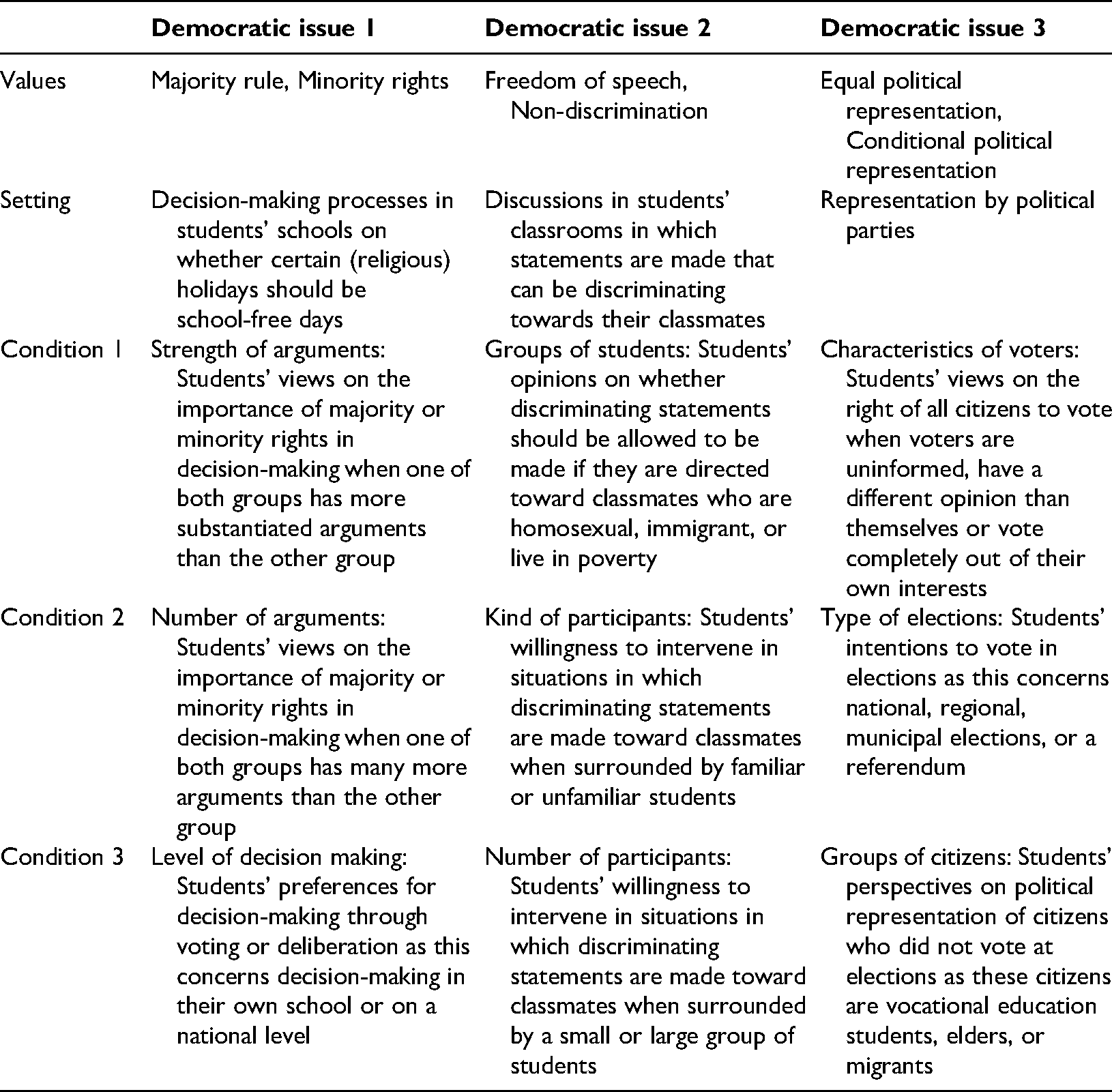
Each democratic issue takes place in a different setting (see Table 1 for an overview of the setting per issue). The first two democratic issues primarily concern settings from everyday life that are concrete and meaningful for students, such as their own classroom, and the third issue takes place in a more abstract and political setting. This draws upon research showing that adolescents are better able to understand democratic issues when a transfer is gradually made from familiar to more theoretical subjects (e.g. Helwig and Turiel, 2002; Nieuwelink et al., 2016; Pintrich, 2003).
The conditions in which the democratic issues take place were altered as the discussion proceeded. For instance, while discussing majority and minority rights, the number of arguments and the strength of arguments of both groups were altered. Each issue contained three conditions that were introduced to alter the setting of the issue (see Table 1 for an overview of the conditions per issue).
At the start of each interview, the outline of the interview was explained to the adolescents. To reduce socially desirable responses, it was emphasized that it is important for the study to be open about their views on democratic issues, even if this meant making statements that they might not make in other places, such as their classroom. It was also stressed that there are no right or wrong answers, because we are interested in their personal views on—and experiences with—democratic issues rather than their knowledge of these issues. Each democratic issue started with a short introduction, followed by some relatively simple questions (e.g. “How important do you think it is to have a school-free day during holidays such as Christmas?”), and later followed by more contextualized questions (e.g. “How would you feel when this school schedules a student free day during Ramadan while the majority of the students does not agree with this decision?”). At the end of the interview, the adolescents were asked to reflect on the experience of being interviewed about their views.
Analysis
The interviews were transcribed, coded, and analyzed. Firstly, we focused on the extent to which adolescents considered both competing democratic values that underlie democratic issues. To do so, the transcripts were coded using labels for the six democratic values: majority rule, minority rights, freedom of speech, non-discrimination, conditional political representation, and equal political representation. Each statement that included a consideration of a democratic value was coded with the concerning label. For example, the statement “When the school organizes an election, they should respect the opinion that belongs to the biggest group of students” was coded with the label “majority rule.” The coded transcripts were then analyzed to evaluate whether each adolescent considered one or both competing values.
Secondly, we focused on the extent to which adolescents expressed differences in their views toward the competing democratic values as the conditions were altered. To do so, the transcripts were coded using labels for the nine conditions (three per democratic issue): strength of arguments, number of arguments, level of decision making, group of students, kind of participants, number of participants, characteristics of voters, type of election, and group of citizens. The fragments were analyzed to describe whether the considerations adolescents expressed toward competing democratic values were different as the conditions were altered.
Results
Democratic issue 1: Majority rule and minority rights
The first democratic issue concerns the democratic values majority rule and minority rights, and addresses decision-making processes in schools on whether certain (religious) holidays should be school-free days. While discussing this issue, most adolescents considered both the rights of the majority and the minority group, and few adolescents strictly focused on the rights of one of either groups. Among the adolescents who considered both democratic values, the conflict between these values became apparent. For instance, while discussing whether their school should give students a school-free day during the end of Ramadan, one of the adolescents mentioned: “I think the majority's interests should be respected in a democracy, but that the minority should also be heard. In this case it means that during the end of Ramadan only the Muslims should have a day off and not the entire school. That would be best.” Among the adolescents who solely focused on one of both values, one argued that the rights of the minority group should always be regarded as more important than those of the majority group: “In my opinion, the smaller group is often ignored, and now they finally have the chance to be heard, so I agree that the school gives a school-free day. (…) Usually when the bigger group does not agree, the school does not account for the smaller group anymore.”
The conditions in which this issue takes place were altered during the interview: first, adolescents were asked to express their views on the importance of majority or minority rights in decision-making when one of both groups has well-substantiated arguments; second, when one of both groups has many more arguments; third, in what way the decision should be made as this concerns decision-making on a national level or in their own school. Most adolescents adapted their views as the first condition changed (‘strength of arguments’), few adapted their views as the second condition changed (‘number of arguments’) and around half adapted their views as the third condition changed (‘level of decision making’). When considering how to reconcile majority rule and minority rights, it appears that adolescents mostly take into account the strength of arguments. As one student put it: “When you strive for something but you don’t have strong arguments, then I don’t think you really strive for anything.”
Generally, adolescents initially argued that their school should prioritize the rights of the majority group, but this changed when asked to consider what if the minority group has well-substantiated arguments. Also, most adolescents initially argued that deliberation is the best way to make collective decisions because this process provides insight into the other person's point of view, but when a large amount of people are involved, voting seemed more feasible because adolescents considered it impractical to debate in large groups. The conversation below demonstrates how one adolescent took the varying conditions into account: When there is a very large group of students that wants something, the school should decide to do so, if the school wants it as well (…). For instance, when 90 students want something, and 10 students want something else, and the school decides what the small group wants, it would cause a lot of unnecessary trouble.
Would it make a difference if the smaller group has many different arguments, and the larger group only has a few arguments? Which group should the school listen to?
Well, that makes a difference. If the smaller group has a long list of good reasons, I would choose their side. So actually, I would choose the smaller group that wants a school-free day during the end of Ramadan.
Imagine the group with fewer arguments having very good arguments, and the group with a lot of arguments having weak arguments. Which group do you think the school should listen to?
In that case, I would clearly choose the other group. If they have more important arguments, it's a completely different story. So actually it depends on the kind of arguments, not the number of arguments.
Democratic issue 2: freedom of speech and non-discrimination
The second democratic issue concerns the democratic values freedom of speech and non-discrimination, and starts from a setting where statements are made during a classroom discussion, which could be considered offensive or discriminating toward students in the class. While discussing this issue, all adolescents considered both competing democratic values. For instance, this quote illustrates how one of the adolescents considers both freedom of speech and non-discrimination: “She has the right to express her opinion, but she makes it very personal. That's why it isn’t really just an opinion anymore, because it is focused on one person. So, people are allowed to express their opinion in general, but not personally towards someone.”
The conditions in which this issue takes place were altered during the interview: first, adolescents were asked to share their opinions on whether statements that might be discriminating should or should not be allowed to be made if they are directed toward different marginalized groups; second, adolescents were asked to discuss their willingness to intervene as this takes place surrounded by familiar or unfamiliar students; and third, adolescents were asked to discuss their willingness to intervene as this takes place surrounded by a small or large group of students. Several adolescents adapted their views as the first condition changed (‘groups of students’), or as the second condition changed (‘kind of participants’) and about half adapted their views as the third condition changed (‘number of participants’). It appears that adolescents mostly take into account the number of participants.
Generally, adolescents initially argued that students should always be able to share their opinion during discussions in classrooms, but later argued that statements that might be discriminating should not be allowed to be made, especially when it is directly addressed towards one of their classmates. Through verbalizing their thought processes it became clear that adolescents tried to strike balance between both underlying values freedom of speech and non-discrimination: She is allowed to have that opinion on people who are transgender. I do not agree with her opinion, but she is allowed to have one.
And do you think she should be allowed to share her opinion in the classroom?
Yes.
And what if there is someone in the classroom who is transgender, do you think she should be allowed to share her opinion in the classroom?
That changes the situation. She should say it in a respectful way.
And what if she shares her opinion in a disrespectful way?
No, in that case, I think she should not be allowed to say it.
(…) And do you think it is justified if the teacher sends her out of the classroom?
It depends… The teacher did say the students were allowed to have a discussion and share their opinion. But if she was really disrespectful, the teacher should send her away.
Democratic issue 3: Conditional political representation and equal political representation
The third, more abstract democratic issue concerns the democratic values conditional political representation and equal political representation, and addresses representation by political parties. Almost all adolescents considered both conditional and equal political representation, and the remaining few focused solely on equal political representation. Statements that were made by adolescents who considered both democratic values illustrate how these values compete. For instance, while discussing whether uninformed citizens should be allowed to vote in elections, one of the adolescents explained: “I do not think a person should vote if they have not thought about who they should vote for. However, when you consider the past, everybody has earned their right to vote. So… I don’t know.”
The conditions in which this issue takes place were altered during the interview: first, adolescents were asked to share their views on the right of all citizens to vote when voters are uninformed, have a different opinion than themselves or vote based completely on their own interests; second, adolescents were asked to share and explain their intentions to vote in different types of elections; and third, adolescents were asked to evaluate the importance of political representation of different groups of citizens who have not voted in elections. Most adolescents adapted their views as the first condition changed (“characteristics of voters”), around half adapted their views as the second condition changed (“type of elections”) and around half adapted their views as the third condition changed (“groups of citizens”). Adolescents mostly took into account the characteristics of voters: “Some people are really serious about voting, and really want a certain political party to win. Others are not serious at all; they do not care which party will rule the country. So maybe these people should not vote at elections, because they are not serious at all.”
Generally, adolescents initially argued that all citizens should be allowed to vote in elections, also when this concerns citizens who have a different opinion than themselves or citizens who vote completely based on their own interests as opposed to collective interests. However, as a situation was proposed in which citizens are uninformed, most adolescents considered it might be better for these citizens not to vote. Around half of the adolescents altered their intention to vote depending on whether it concerned national elections, municipal elections or a referendum. Some adolescents argued municipal election are more important than the national elections because it concerns decisions close to home; others argued these elections are less important because local authorities are less likely to bring about change. The interviews demonstrate how adolescents take into account the varying conditions while discussing this democratic issue:
(…) Do you think it is fair if the government represents the interests of those who have not voted less than the interests of those who have voted in elections?
It was their own choice not to vote. They did have the right to vote, no one told them not to vote. So yes, it is fair because it was their own choice. And what if it concerns vocational education students? Imagine that specifically these students voted less than other groups. Well, this makes it complicated, because many students just turned eighteen, and it is all very new for us. I think students in vocational education do not vote because they do not have enough information. We should be offered more information. So, the government should take these students into account, even if they have not voted.
And what if it concerns the elderly? What if it appeared that many elderly people did not vote at elections, should the government represent their interests?
No. I think, when it concerns adults, they should take responsibility.
So, if they have not voted, it would be fair for the government to represent them less?
Yes.
And one more example. What if it concerns immigrants, what if they have voted less than other groups, how would you feel?
I think they should be more informed as well. Maybe they come from a dictatorship, and they are not used to a democracy, they might not know their rights, they would have to be informed about their voting rights. So, the government should account for them, even if they have not voted.
Findings regarding the entire interviews
Overall, the majority of the interviewed adolescents considered both underlying values while discussing the first issue (majority rule and minority rights) and the third issue (conditional and equal political representation), and all of the interviewed adolescents considered both underlying democratic values while discussing the second democratic issue (freedom of speech and non-discrimination). During the interviews, the democratic values were mostly mentioned implicitly by adolescents: adolescents did not explicitly say they considered certain values, but this became apparent in the answers they gave and the arguments they used. For instance, one of the adolescents mentioned “To me it is important that, in a democracy, all religions are respected, and all individuals are respected.” We code this fragment with the value “non-discrimination” although this value was not named explicitly. Moreover, there were both discrepancies and similarities regarding the democratic values each adolescent emphasized during their interview. For instance, some students emphasized the importance of non-discrimination during all three democratic issues.
Adolescents typically took into account the varying conditions while discussing the first (majority rule–minority rights) and third (equal–conditional political representation) democratic issue. There were no adolescents who altered their views in response to all of the conditions or none of the conditions. Adolescents differed in the extent to which they altered their views in response to the varying conditions: while some only occasionally indicated that the circumstances made them consider things differently, others explicitly took different perspectives into account, and even explicitly mentioned they had changed their mind.
Finally, at the end of the interview, adolescents were asked to reflect on the experience of discussing the democratic issues. In this regard, the majority of them explained that they do not have much experience with discussing issues of this kind in their school, with friends or at home. Additionally, some of them said that they have never discussed or even thought about these issues before. Some of the adolescents further explained that they feel as if their teachers expect their students are not able or not interested enough to discuss these issues. Contrary to these sentiments, all adolescents were positive about the experience of discussing these issues and enjoyed having room to explore and consider their own views regarding these issues. Adolescents also frequently mentioned that they would want to discuss democratic issues more often at school and through that, have the opportunity to voice their opinions.
Conclusion and discussion
The aim of the study was to provide insight into adolescents’ views on democratic values. The research question was: What are the views of adolescents in tertiary vocational education on democratic issues consisting of competing democratic values in a variety of conditions? To answer this question, three democratic issues with varying conditions were designed, and discussed during interviews with adolescents in vocational education. The results show that most adolescents considered the competing democratic values that underlie an issue, and only a few adolescents solely considered one value. For instance, while discussing majority rule and minority rights, most adolescents took into account the rights of both the majority and minority group.
Furthermore, this study shows that adolescents generally take into account the conditions in which democratic issues take place. For instance, adolescents initially mainly focused on the rights of the majority group, but as the conditions changed and it was put forward that the minority group had well-substantiated arguments, adolescents also emphasized the rights of the minority group. As the conditions in which democratic issues take place were altered, adolescents who initially focused on one of both underlying democratic values explicitly evaluated different perspectives and started shifting between both values.
To conclude, this study has shown that adolescents in vocational education are attached to democracy, and their views are generally in line with fundamental democratic values. When introducing diverging viewpoints to a democratic issue, they understand the importance of dealing with these issues by taking into consideration several, potentially competing values. In their views, majorities should take the interests of minorities into account, citizens should be aware of the effect their opinions have on other people, and all citizens should be represented by political parties. We consider this to be a crucial insight in research on adolescents’ democratic views. In current debates, the focus seems to be on majority rule and less on the balance with other values such as minority rights. By considering different viewpoints, these adolescents show a hopeful promise for contributing to a more inclusive democratic culture, contrasting an increasingly polarized political debate.
Before discussing these results in the light of previous studies, we point to some limitations of this study. The first limitation concerns the selection of values. The interviews are based on a total of three sets of competing democratic values that concern both familiar, meaningful subjects as well as more theoretical, abstract subjects. Due to this selection, it was possible to have in-depth discussions with adolescents. However, this study does not provide insight into adolescents’ views on other possible combinations of competing democratic values. Although students showed comparable patterns of evaluations between values in all three democratic issues, these three combinations are only a subset of possible combinations. It could be relevant to investigate whether adolescents also consider competing values regarding other democratic issues. To gain more insight into adolescents’ views on democratic issues, it might therefore be relevant for future research to include designing and discussing democratic issues concerning a broader set of competing democratic values, and focus on the implications of these different sets of values for adolescents’ views.
A second limitation concerns social desirability, which poses a relevant concern in any study on students’ self-reported democratic attitudes (Ten Dam et al., 2013). To prevent adolescents from responding in a manner that is socially desirable rather than sharing their honest views on the democratic issues, at the start of each interview it was emphasized that they were free to be open about their views regardless what these might be. The interviews lasted approximately 1 h, which made it possible for the adolescents to become comfortable with the situation and gradually disclose views that could be challenging for them to share. For instance, while talking about people who are transgender, one of the adolescents mentioned later in the interview: “Personally, I can’t imagine why a girl would want to be a boy. When you are in doubt over whether you want to be a boy, just accept that you are a girl. However, I understand it might be difficult for those people. I find it hard to share my opinion, because I just don’t get it. I try to understand, but I really can’t.” This is an example of a statement that illustrates how adolescents also shared views during the interviews that might be considered unacceptable or politically incorrect by others. Therefore, there are no indications that the findings of the interviews are biased due to social desirability.
The current study contributes, in several ways, to research on adolescents’ democratic views. First, this study shows that adolescents’ views on democratic issues are layered and include considering multiple democratic values. This corresponds with earlier research among students in secondary vocational education that shows these students emphasize consensus and inclusiveness (Nieuwelink et al., 2019). However, the current study concerns adolescents in tertiary education (aged 16–19) who are older than those in the referenced study (aged 13–15). Insight in this age group is particularly relevant because it shows that the democratic views of those in later adolescence, who are close to voting and encounter issues related to politics more in their everyday life than their younger peers, are still layered.
Second, the findings indicating that adolescents’ views on democratic issues include taking into consideration the conditions in which these are situated, are consistent with earlier research indicating that, while discussing civic issues, individuals gradually become more aware of the complexity of these issues, and therefore might reconsider their original statements (Verhue and Roos, 2009). However, the referenced study mainly concerned citizens with an academic educational background. While research regarding political socialization often problematizes the support for democratic values among adolescents in vocational education, the current study shows that the democratic views of those in vocational education are layered and include considering multiple democratic values and taking into consideration the conditions in which these are situated.
Throughout the past decades, it is often problematized in research that particularly adolescents in vocational educational tracks show less support for democratic values than their peers in academic education (e.g. Converse, 1972; Gaiser et al., 2003; Mounk, 2018). For instance, adolescents in academic education are often more positive about democracy and more willing to participate, while those in vocational education are shown to be less interested in the news, show more cynicism about politics and are more critical of their own abilities to make a difference. These studies are generally based on surveys that do not address situations in which multiple values are competing. Our study, however, shows that discussing democratic issues is an approach that provides a different, more complex image of adolescents’ democratic views. Thus, the findings of this study underline that the ways in which democratic views are measured matter, emphasizing the relevance of investigating adolescents’ support for democratic values in coherence and in context.
Finally, the findings show that adolescents experience little room at school to share their views on subjects such as democratic issues. This corresponds with research showing that students in vocational educational tracks generally have less opportunities to learn about, and practice with, aspects of citizenship in an active and critical way than their peers in academic tracks (Eurydice, 2017; Ichilov, 2003; Levinson, 2010). However, the adolescents also mentioned they would appreciate the opportunity to discuss democratic issues more often in the classroom and through that, be able to voice their opinions. Research shows that discussing these kinds of issues with students can have positive effects on their development. Firstly, these conversations stimulate students to take different perspectives into account and find feasible solutions (Nieuwelink et al., 2016; Schuitema, 2008; Verhue and Roos, 2009). Secondly, these conversations can be beneficial for students’ prosocial and moral development (Schuitema et al., 2008), problem-solving abilities (Blatt and Kohlberg, 1975), communication skills (Parker, 1997) and attitudes such as tolerance, respect, and autonomy (Grant, 1996; Hello et al., 2004). Therefore, discussing the democratic issues designed for this study, characterized by gradually confronting adolescents with competing democratic values that are discussed in varying conditions, might be a relevant approach for schools to provide insight into their students’ views on democracy, and for students to express their views on democracy.
Supplemental Material
sj-docx-1-cse-10.1177_20471734211050290 - Supplemental material for All things considered: The views of adolescents in vocational education on competing democratic values
Supplemental material, sj-docx-1-cse-10.1177_20471734211050290 for All things considered: The views of adolescents in vocational education on competing democratic values by Annabel Vaessen, Remmert Daas and Hessel Nieuwelink in Citizenship, Social and Economics Education
Footnotes
Declaration of conflicting interests
The authors declared no potential conflicts of interest with respect to the research, authorship, and/or publication of this article.
Funding
The authors received no financial support for the research, authorship, and/or publication of this article.

Supplemental material
Supplemental material for this article is available online.
Appendix: Interview guide
Democratic issue 1: Majority rule and minority rights
In the Netherlands there are several national public holidays, such as Christmas. All students have school free-days during these holidays. There are also holidays that are not legally recognized. On these days, schools can decide whether their students have a school-free day or not. Currently, the end of Ramadan is not a national public holiday in the Netherlands. Imagine there are students at this school who argue the school should be closed during the end of Ramadan…
Schools can only give a limited number of school-free days a year. When schools give their students a day off during a certain holiday, this could mean their students will not have a day off during another holiday. Imagine this school decides to make the end of Ramadan a school-free day, and decides to abolish another holiday as a school-free day, for instance Ascension Day …
Imagine that most students want a school-free day during Ascension Day and much less students want a school-free day during the end of Ramadan…
Imagine the school has not yet made the decision on whether the end of Ramadan should be a school free-day, because they want to make this decision together with all their students…
Imagine that, during this discussion, the smaller group has a lot of different arguments, and the larger group only has a few arguments…
Let's translate this decision at school to a decision on a national level. Imagine the government wants to decide whether all schools in the country should give their students a school-free day during the end of Ramadan instead of during Ascension Day…
Democratic issue 2: Freedom of speech and non-discrimination
Imagine you are having a conversation with your teacher and classmates during a citizenship lesson about people who are transgender. One of your classmates, Sara, argues that this school should not allow students to look or behave different than the sex that was assigned to them at birth. She says this this is not right and everyone should accept their biological sex…
Imagine there is someone in the classroom, Robin, who is transgender. During the conversation, he mentions that he feels offended by the comments that were made. He asks Sara to stop, but she continues making these comments…
Imagine that before the group discussion started, the teacher explained that all students are free to share their opinions during this group discussion…
Imagine that Sara makes comments that you think are offensive or discriminating and the teacher decides she can no longer be part of the group discussion, and decides to send her out of the classroom…
Democratic issue 3: Equal and conditional political representation
The following national elections in the Netherlands will be held in 2021…
The next questions concern whether or not you think someone should vote in elections…
Voting is not mandatory: people can choose not to vote in elections. If some groups of people in this country do not vote in elections, political parties might take less account of their interests in their campaign plans and/or their policy.
References
Supplementary Material
Please find the following supplemental material available below.
For Open Access articles published under a Creative Commons License, all supplemental material carries the same license as the article it is associated with.
For non-Open Access articles published, all supplemental material carries a non-exclusive license, and permission requests for re-use of supplemental material or any part of supplemental material shall be sent directly to the copyright owner as specified in the copyright notice associated with the article.
