



Abstract
In the Federal Republic of Germany, the cities and municipalities decide which streets are being refurbished, which educational services are offered, or where sewers will be laid. The cities and municipalities have financial resources at their disposal for this purpose. However, these resources are, with a view to Rhineland-Palatinate, insufficient or inadequate for these versatile tasks. The available financial resources are distributed in the municipal parliaments. The local politicians are elected representatives from the general society. Every citizen over 18 years can be elected in order to decide upon the distribution of funds. Yet, parliamentarians require economic knowledge, and a certain competence in economics matters for these decision-making processes. The aim of this study is to determine the degree to which economics and civil education in Germany is able to qualify future local politicians for a local-political mandate. In this context, it is worthy of note that our respondents (N = 263) are not able to consider multilevel consequences of context alterations with regard to the finances of their municipality.
A brief introduction to local self-government in Germany
Municipalities, meaning cities, communities and districts, have a fundamental importance in Germany for the life of citizens. By fulfilling their mandates, municipalities immediately influence the social and economic development of a region, and are, therefore, jointly responsible for the well-being of their citizens. This is a major responsibility for the elected local representatives, though this is often not reflected in the public perception. The municipalities organise the infrastructure for jobs and leisure time, and they often provide these structures themselves. Beginning with electricity supply and road maintenance, to sewage and waste disposal (‘municipal public service’) (Von der Heide, 1999: 128). Local policy decides which street needs to be refurbished, runs museums and creates public spaces, or river banks where citizens can meet without having to consume and pay for drinks. The elected representatives in the municipal parliament discuss every technical and social innovation which needs to be managed in the municipality. They also have to provide financial recourses: e-bikes require charging stations, open Wi-Fi is necessary for smartphones, cross-generational residential projects need property and infrastructure, companies require fast internet even in structurally weak regions.
The municipality or community, both terms are often used synonymously (Naßmacher and Naßmacher, 2007: 10ff.); is highly heterogeneous in Germany. A municipality – with regard to the example of Rhineland-Palatinate – might have a small number of citizens, for example Idelberg in the district Altenkirchen with 64 citizens (state: 01.10.2019), or the opposite such as the capital Mainz with 217.118 citizens (state: 01.10.2019). The socio-economic decision situations in both municipalities could hardly be more different. Nevertheless, they are treated equally in the Federal Republic of Germany in terms of state structure, and this applies to all federal states. Due to this, the spectrum of definitions becomes more apparent.
In 2018, the revenue of the municipalities in Germany amounted to 251.4 billion euro (2017: 246.9 billion euro). Municipalities expect their revenues to remain significantly high until 2020. The Association of German Cities and Municipalities expects revenues of 266.4 billion euros in 2020. However, expenditure in 2018 will amount to 250.1 billion euros (2017: 242.8 billion euros). In 2017 and 2018, therefore, positive financial balances are expected (2017: +4.1 billion euros; 2018: +1.3 billion euros). For 2019, a negative financial balance of EUR −1.1 billion is forecast. From 2020, however, a positive financial balance (EUR 0.6 billion) is forecast (Association of German Municipalities and Towns: 2017, p. 2). Municipalities have a lot of money at their disposal, but in view of the large number of projects, municipal mandate holders must handle the financial resources economically and sustainably.
This is where the contribution comes in and questions the school preparation of future municipal decision-makers in the field of Economics and Civic Education. Therefore, as a first step, studies on civic education of young people in Germany and Europe will be presented before the general qualification of local parliamentarians will be presented and civic education in schools with regard to local politics will be discussed. Subsequently, we present our investigation, which questions Economics Education with regard to the central control element of local politics, the budget.
Citizenship education and the qualification status of local politicians
Research in the field of political education has only been pursuing a decidedly empirical orientation for a few years, and there is little data available for systematic student research in particular (Manzel, 2014; Weißeno, 2014: 105). Performance tests clearly show that a consistent use of technical language excludes discrimination against educationally disadvantaged groups. It also shows, however, that instruction in everyday language favours interested pupils from the educational classes (see Goll et al., 2010; Oberle, 2012; Weißeno and Eck, 2013). There are hardly any meaningful studies on the political competence of German students. However, political competence is not only reflected in knowledge, but also in the motivation to deal with political issues. However, there is a lack of research contributions that focus on the determination of political competence and related graduations (Biedermann and Reichenbach, 2009: 873). The empirical work on the political education of 14-year-olds, which is probably the one that receives the most attention, is the country comparison carried out by the IEA (International Association for the Evaluation Achievement). Core results of the 1999 study were that (1) the political understanding is flawed and average in international comparison with regard to Germany, (2) the understanding of democracy and the associated identification with democracy is stable, (3) the political willingness to participate and political interest are classified as low (Henkenborg, 2005; Oesterreich, 2002). Furthermore Oberle and Forstman (2015), Landwehr (2016) show that conceptual knowledge has a significant impact on personal political values and attitudes.
Reichert (2010) investigated the relation of objective political competences and the subjective assessment of one’s own political competence. The theoretical frame states that at least in early adulthood, only the subjective competence is an important determinant for political participation. Reichert presents a student sample and shows that political knowledge seems to have a stronger effect on voting than subjective political competence. He also identified a complete mediation of political knowledge via subjective political competence (see also the results of Schulz et al., 2010).
Internationally, reference should be made to the Citizenship Education Longitudinal Study project conducted in England, in which a 7-year longitudinal study examined, among other things, the political knowledge and skills of students aged between 11 and 18 (see also Benton et al., 2008). With a view to teaching, Manzel (2017) presents a video study that analyses interaction in the classroom with a view to communicative participation in political education.
A Europe-wide study has been available since 2017. It examines curriculum design with a view to civic education in the countries of the European Union. Citizen education includes ‘knowledge and understanding of the formal institutions and processes of civic life’ (Schulz et al., 2010: 22), but a limitation to the traditional teaching of civics would be a clear underestimation of its breadth and importance. Civic education should, among other things, equip pupils with competences that simultaneously promote their interests as individuals and the interests of the community.
In Germany, a uniform approach applies with regard to the interdisciplinary status of civic education. Although the subjects of the curriculum are determined by the individual Länder, some official documents dealing with human rights education, intercultural education, democracy education, media literacy and historical and political education apply to all Länder, so that civic education is an interdisciplinary feature of the entire education system.
With regard to Rhineland-Palatinate, the political decision-making process and the parliamentary system of government in particular are part of school education. Local politics or the preparation for the assumption of a local political mandate are not part of school curricula. Also with regard to economic issues, the curriculum for the subject of social studies for the upper secondary school in Rhineland-Palatinate provides in principle for an occupation with the topic ‘economics’, but rather in the large political contexts, such as the internal market or the topic of globalisation. In principle, there is no preoccupation with municipal financial policy, municipal policy in general or budgetary policy.
In this respect, it is not surprising that there are no studies on the extent to which school political education qualifies to assume a mandate in a local parliament.
Schwarting (2011: 40) has presented an analysis of a municipality’s budget and good local political decisions. He explains, for example, that the follow-up costs – especially in political decisions in the councils – are hardly taken into account: ‘Even though the external influences on the financial situation are currently highlighted in public discussions, “homemade” problems should not be underestimated’. These homemade problems are related to the economic decision-making capacity of local parliamentarians. Especially the subsequent costs of former municipal investments are frequently responsible for an unbalanced budget of municipalities. And furthermore: ‘These [investments] initially depend on the dimensioning of the institution; some of the budgetary problems can be traced back to the fact that plans were not aligned to the actual demand.’ (Schwarting, 2011: 40). It, therefore, seems necessary to examine whether participants of local politics, especially the elected representatives in the regional authorities, possess adequate knowledge in terms of the municipal budgetary system as well as the socio-economic framework conditions (knowledge and understanding). They also have to be able to assess their own political decisions and especially their consequences (decision-making ability). The question that arises is not whether council members should be further professionalised viz. though the support of fraction members, or in terms of a higher allowance in order to be able to spend enough time for local politics. The point is to better the qualifications of the elected local politicians. Especially with regard to the system change from the (old) cameralistics to the (new) double-entry bookkeeping (Doppik) – at least in Rhineland-Palatinate – there is an increased qualification need. The Landtag of Rhineland-Palatinate arranged a select or special committee (16/1) ‘municipal finances’ in its 16th legislative period, which conducted a consultation regarding the municipal Doppik (Double-entry accounting) in 2013. Commercial double-entry accounting replaced the previous cameralistic budget accounting and now required local politicians in particular to read balance sheets and profit and loss accounts and required an understanding of valuation, for example, of fixed assets, as well as the principle of depreciation. At this point, three essential results (Landtag Rhineland-Palatinate, 2015) should be mentioned here:
The municipal Doppik is currently not suitable as a control instrument for local policy. Especially with regard to the fact that objectives and key figures practically do not matter during budget discussions.
During investment decisions, resulting cost evaluations are, so far, irrelevant.
In order to reach a higher acceptance of the Doppik, the elected council representatives need better training.
In this context, the mayor of Landstuhl formulates that ‘possibilities for a better acceptance are already available, for example, in the form of diverse seminars for voluntary mandate holders. However, they are only rarely recognised. Be it by means of on-site seminars, offered by the municipal academy, or by in-house events with qualified personnel in the municipality on site.’ (Degenhardt, 2013: 4). The mayor of Hagenbach, an association of municipalities, comments similarly: ‘[The Doppik] is not legible and comprehensible for laypersons. [. . .] Transparency and behavioural changes do not take place.’ (Scherrer, 2013: 1). The fact that clearly not only laypersons, but also experts, have difficulties in understanding is demonstrated by the statement from mayor Brandt (city Pirmasens): ‘Although the represented professional groups in the main committee have great expert knowledge, in terms of business accounting, they are still unfamiliar with the municipal Doppik. Those, who already had experiences with business accounting had to get used to this system, [. . .]’ (Brandt, 2013: 7). Even though the external as well as structural influences (might) lead to budget deficits, local politics of the municipalities and cities still relies on qualified and voluntary representatives.
The formulated relation of politics and administration (‘pretended parliament’) by Frey and Naßmacher (1975) is currently rejected – especially in the more recent research debate – but with a brief reference that there has been a professionalisation in large cities. Whether this is applicable to municipalities and cities of Rhineland-Palatinate is doubtful. Studies by Reiser (2006) show, however, that municipal parliaments in the examined 12 larger cities of the Federal Republic of Germany are actually no ‘ratification organs’ (Naßmacher and Naßmacher, 2007: 211), but this does not proof that the municipalities and cities of Rhineland-Palatinate are concerned. At least nearly 98% of the municipalities in Rhineland-Palatinate have less than 10.000 inhabitants, which is far from city status.
Reflecting economic context changes
Parliamentarians, who want to make decisions on a local level, need to be able to reflect changes of economic contexts with regard to municipal finances, and to include this into their decisions. Local-political decision-making ability as an objective is defined as the personal capability to actively and autonomously utilise different possible actions, which arise within socio-economic decision-making situations for local politicians in order to fulfil an order or a task. This always involves independent, creative objectives. Decisions are between every action-decision and the execution of decisions. The inability to make decisions, inter alia, due to insufficient context comprehension, leads to the inability to take actions, or, with regard to the municipal parliament, to the mentioned mentality of a ratification organ (‘pretended parliament’). The comprehension, and associated reflection, of economic context changes, for example, due to an economic downturn, the creation of building areas, or the connection of a municipality to a supra-regional transport network (e.g. motorway), is the basis for local-political shaping skills. This implies, on the one hand, existing knowledge and skills with regard to reading municipal budgets, reading statistics, or independent information research. On the other hand, basic economic understanding is required from municipal participants. All of the mentioned contextual changes have direct and indirect effects on the budget of a municipality. The more diverse socio-economic present and future conditions of a municipality are, the more important becomes the comprehension of these scenarios for the political decision, and the more extensive becomes the required economic competence (Salemi, 2005). It is still unclear to what extend the economics and civic education (according to Levine, 2012; Walker, 1992) in Germany (Weber, 2002 as well as Buck and Geissel, 2009) prepare for a local-political mandate (Torney-Putra et al., 2001 presented an international comparison) as well as for the mentioned economic reflection of contextual changes (Kahne et al., 2000).
Study design and sample
Test instruments
The study consists of three parts (see Figure 1). Besides socio-demographic data, especially data concerning political and local-political interest as well as the motivation of political commitment (see Figure 2) have been collected. Commercial background knowledge has been controlled as a potential distorting mediator (Part 1).
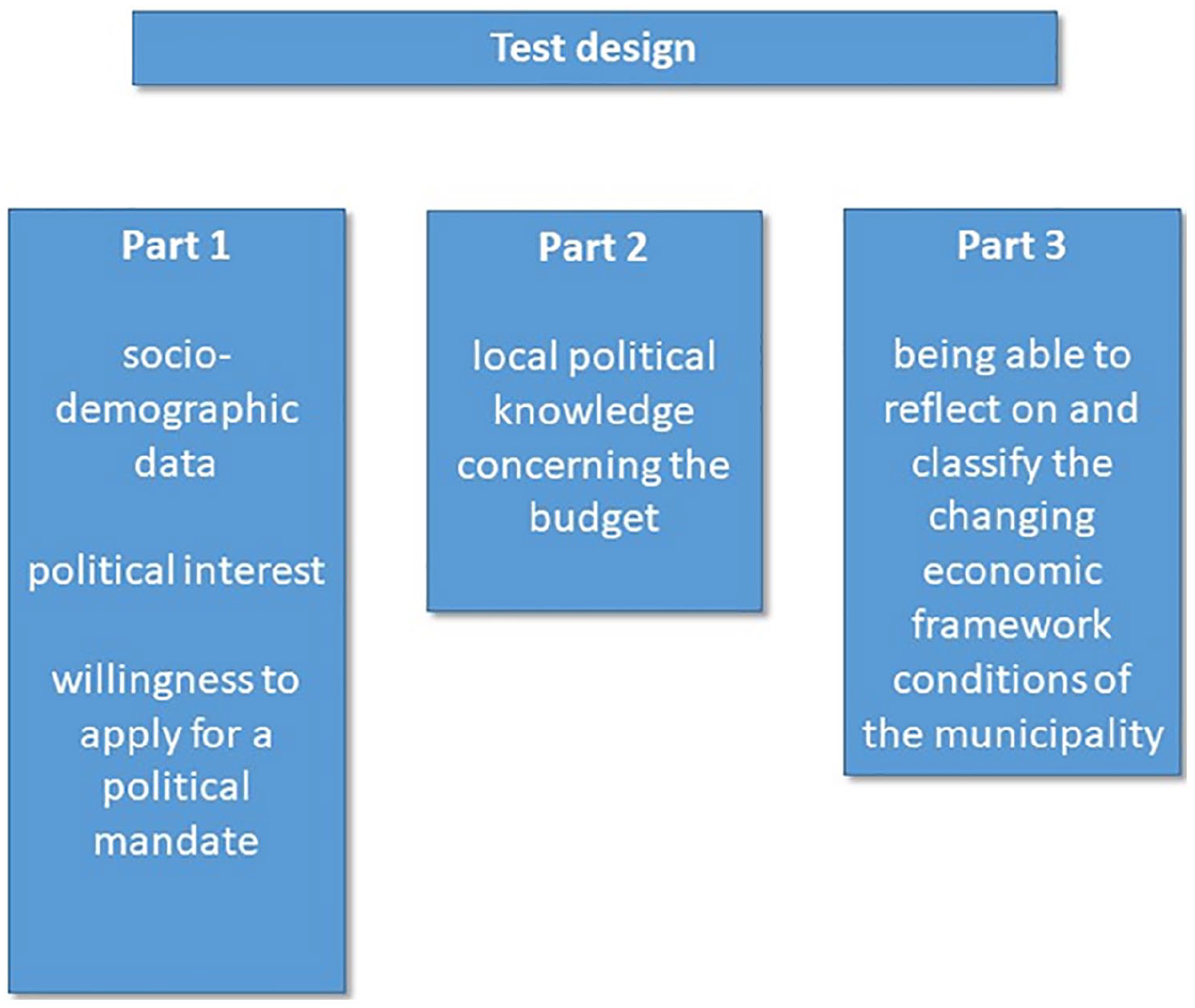
Test design.
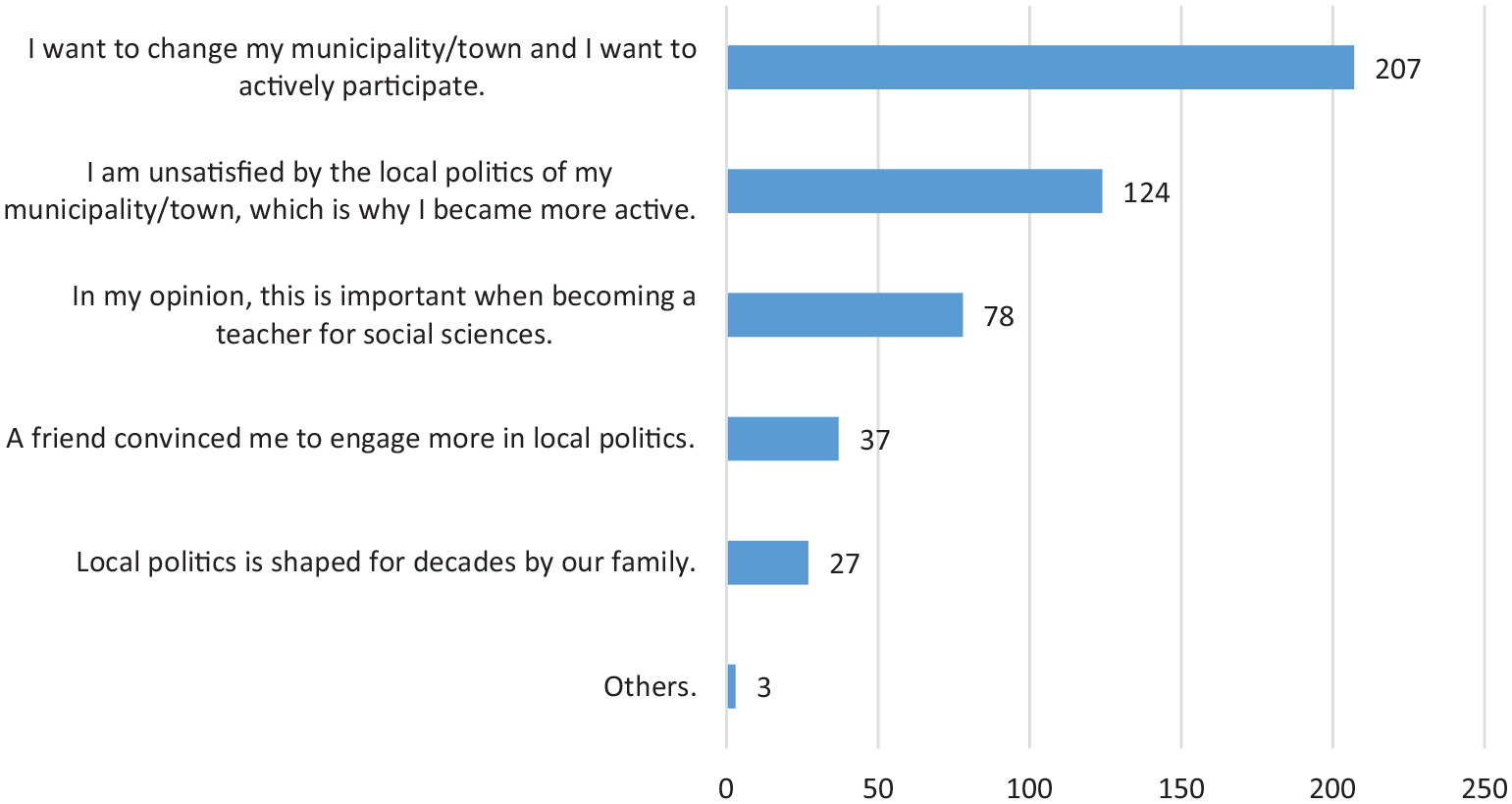
Motivation for a potential municipal political commitment (multiple responses are possible) (own visualisation).
The second part of the test consists of a knowledge test (six items) with questions concerning the budget of a municipality. In order to ensure equal survey conditions, the study participants received a standardised questionnaire and a budget plan as part of the tablet-based study. The task was to mark decision-relevant basics such as revenues, expenses, liquidity loans, or borrowing for investments. The participants also had to specify the multistage and delayed effects on the municipal budget, and therefore demonstrate their economic understanding as a basis for local-political decisions. Possible answers were given; multiple responses were possible. The scenarios involved an economic downturn, a demographic decline in the municipality as a political and economic challenge as well as an enhanced influx of young families due to increasing real estate prices in the near city (Part 3). A total of 54 items were used in the three scenarios.
Sample
Overall 263 students, 165 female and 98 male, participated in the investigation. The average age of the participants was 20.96 years. Eighty-four percent amongst the students aspire to become a teacher, especially with the aim of a teaching profession in the area of social sciences, which is internationally comparable with the subject ‘citizenship education’. The remaining 16% of the participants studied another bachelor.
About 88.59% (233) of the respondents stated that they did not complete a training yet, whereas 11.41% (30) already had a training. In reply to the question whether they attended the subject ‘economics’ at school, only 21.29% (59) stated this correspondingly. Equally, 209 of 263 respondents – or 79.09% – had no basic commercial knowledge. The other 55% who claimed to have commercial knowledge evaluated their own skills with ‘rather good’ (36.36% average), and ‘rather bad’ (30.91%).
It is relevant for the examination, whether the respondents hold a local-political mandate and therefore, possess specific prior knowledge. What is noticeable is that none of the 263 respondents is a member of a local council. Moreover, the number of those who are a member of a party, or an association of voters, is rather low (5.32%). The memberships distribute to the German political parties as follows: SPD (41.66%), CDU (16.66%), FDP (16.66%), Die Linke (8.33%) and others (16.66%). The majority of the respondents (94.68%) are neither a member of a party, nor are they part of an association of voters. Therefore, they are currently neither active in local politics nor in party politics, but the picture changes in view of future political commitment, especially in the area of local politics.
A total of 207 (78.7%) of 263 respondents stated that they are motivated by the desire to participate in local politics in their municipality or city in order to bring about change in the future. For this purpose they would also take on a later mandate. This can be explained by the fact that many students leave their home towns to study and return after graduation or choose a different place of residence and can then imagine becoming involved in local politics at these places and seeking a mandate.
These results correspond with the results of the 17th Shell-study for Germany. Within this youth study, the political attitude and the political views of adolescents are examined since 1953. The results of the study show that more and more adolescents (41%; in 2002, however, only 30%) show political interest (Albert et al., 2015: position 2783). This does not automatically imply the willingness to engage with a political party. What is rather meant are short-term, or one-time opportunities for participation such as, for example, the participation in online petitions.
Therefore, our sample of young adults portrays the life situation as well as the political participation of adolescents in Germany quite accurately. With regard to their interests, a typical picture of German local politics emerges. Although 28% of the respondents recognise the importance of municipal budget and financial politics, they still would not see themselves in such a committee. What is of personal interest is family policy, migration and integration policy, child and youth policy, or social policy.
Results
Economic decision-making ability requires knowledge of the area of decision-making. The budget of the municipality constitutes the basis for the decision to be made. The budget plan illustrates the revenues, payments, investments, but also the borrowing, or the deficit. The respondents received an earning target in a stylised form (21 entries) as well as a financial plan with 34 entries. Already reading the budget plan and naming the line item proved to be difficult. Only 4% of the participants were able to give more than four correct line items. At least 28% were able to give one correct answer, and 30% were not able to orientate themselves in the budget plan at all. At this point it becomes clear that the demands for systematic preparation and training made by Schwarting (2011) and in the hearing of the Rhineland-Palatinate state parliament are more than necessary so that municipal elected representatives can also pursue their political tasks and reflect the sustainability of their decisions.
Besides necessary knowledge, the comprehension of the topic area is relevant with regard to decision-making. Economic, demographic, or social contexts as well, need to be included and reflected in the area of local politics. The political decision-making situations are therefore often complex on this level, and the consequences are frequently multi-tiered and more importantly delayed.
In the first scenario, the problem reads as follows: ‘Due to an economic downturn, the companies in your municipality are significantly under pressure. As a result, many employees lose their jobs. Which concrete effects does this downturn have on your municipal budget?’ In interpreting the political-economical evaluation of this scenario the following aspects need to be considered: One of the main income of the municipalities and cities of the Federal Republic of Germany are municipal trade taxes. Due to an economic downturn, companies and commercial enterprises in a municipality come under pressure. Therefore, their profit will decline. The revenue from trade taxes is, independent of the respective assessment rate of a municipality, depending on the profit of the respective company. An economic downturn will thus lead to a reduction of municipal trade taxes. This direct reference was made by 51% of the participants.
An economic downturn will generally lead to a wave of redundancies amongst the employees (and this is reflected in Figure 3 in the multistage decisions). Here, the duration of the downturn is certainly eminent. During short-term economic downturns, companies make use of short-time allowance in order to keep their employees. However, it could be assumed that the employment relationship of temporary employees, or temporary workers will quickly be ended. In Rhineland-Palatinate, the districts, or independent towns are responsible for social welfare. Therefore, higher social charges will consequently arise, which leads to an increase of district apportionment in order to balance budgetary deficits. Interestingly, the consequences of an economic downturn for the social fund was recognised by only 30% of the respondents. In line with Keynesian anticyclical economic policy, 45% of the respondents assume that additional investment loans are necessary.
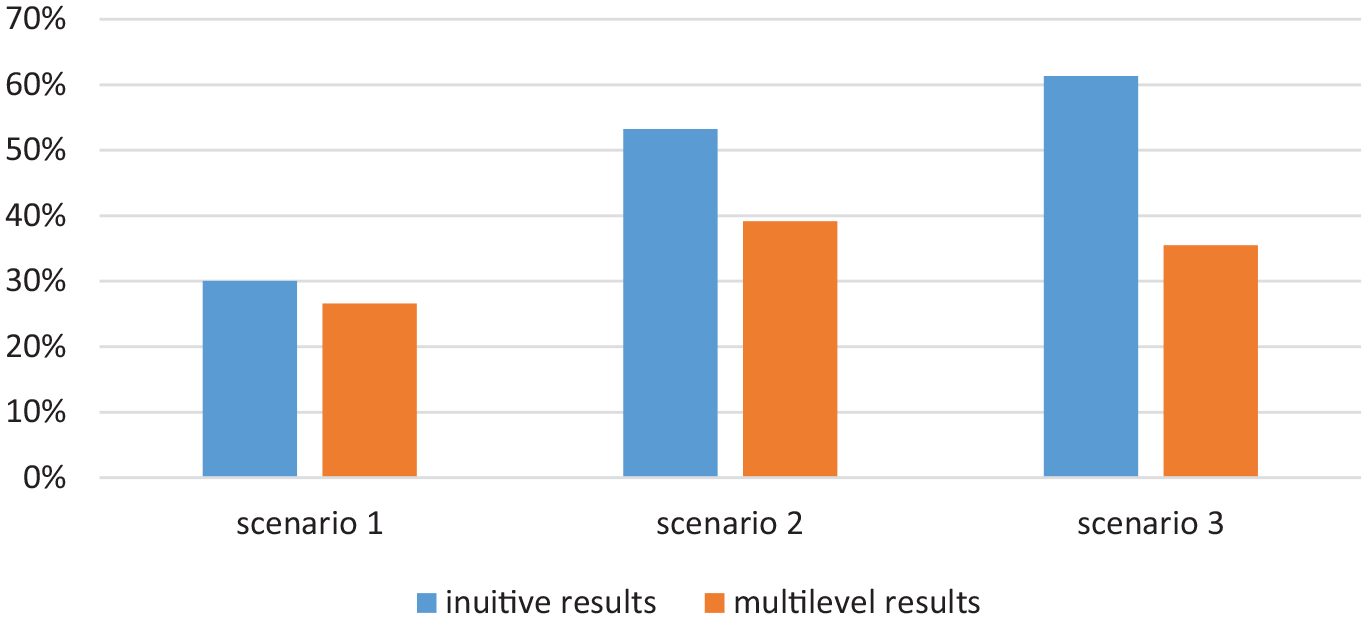
Intuitive and multilevel results in direct comparison (own visualisation).
The focus of the second scenario was the demographic development. Due to a weak demographic forecast, the introductory text says, the average age of the population will increase and the number of young citizens will decline. This will have an impact on the budget. Half of the respondents (53%) rightly recognised that the revenue from the municipal share of the income tax will decline in the medium term. The demographic development leads to the fact that less people are engaged in the working life, and that more pensioners emerge. Pensioners, however, pay only little income taxes. Therefore, the distribution will be lower and the revenue of the municipalities will decline at this point. The respondents were able to comprehend this step.
With regard to multilevel consequences it becomes clear that especially the consideration of the expenses per capita for the municipal properties (only 39% correct answers) pose an economic consequence of the described scenario. When the number of community members decreases, and the number of municipal institutions remains the same, then the costs for such institutions are distributed among fewer citizens. Therefore, the costs per capita consequently increase for municipal institutions.
The last scenario (scenario 3) places your municipality to the suburbs of the regional centre: Due to increasing real estate prices and rents in the regional centre, more and more city dwellers decide on moving to the surrounding areas. The population of your municipality therefore expands, especially because a lot of young families with children moved to your municipality. Seventy-six percent of the respondents correctly see the direct influence on the budget in connection with expenses for childcare as well as higher investments for leisure facilities (69%). The fact that personnel costs increase as well, is only recognised by 40% of the respondents. Whereas the rising utility expenses as well as rising expenses for distribution in kind and other services are concluded by 52% and 42% of the respondents. In-depth consequences for the municipal budget such as, for example, the increase of amortisation of immaterial property, is only identified by nearly 13%. This, however, is a logical consequence of higher investments in the area of childcare, or in the leisure sector (e.g. the construction of nurseries or the first installation of playgrounds).
Conclusion
The study concerning the decision-making ability and the economic reflection competence of future local politicians has shown that the respondents have a political interest on the one hand, and consider to take over a mandate in their municipality in the future. The civic education in Germany was therefore able to establish an interest in taking on municipal responsibility among its citizens, and thus, fulfils its purpose. On the other hand, however, it becomes clear that especially the partially missing budget plan knowledge and the missing economic knowledge lead to the problem that changing contexts, such as an economic downturn, demographic developments, or changing situations in an adjacent municipality were incorrectly, or incompletely assessed by the respondents. Especially multilevel consequences of changing contexts were not correctly assessed (see Figure 3). Therefore, there is need to assure proper qualification in the area of economics education, and with regard to the citizens’ preparation for taking over a local mandate. This is even more essential in terms of the described background of the municipal finances. The obvious deficits regarding the economic reflection capability need reconsideration with a view to curricula and the civic and economic education in Germany. Local self-government, as described in the introduction, is based on economically sustainable decisions, as investments in particular have a long-term impact on the budget and thus on the financial possibilities of local authorities. Civic education must therefore also consider and train the ability of political action to reflect economically with a view to assuming municipal mandates.
Alternatively, a stronger qualification of local politicians or those, who apply for a political mandate, is possible within political adult education. Although the national debt is so far lower due to surpluses in the municipalities and local authority associations in the last 10 years – also in Rhineland-Palatinate – this should not blind us to the fact that the economic situation is largely responsible for the high surpluses. During an economic downturn, the tax revenues of the municipal family will decline again, and the old problems of the unbalanced budget will determine the political agenda of the municipalities again. In addition, this will also not solve the problem of the existing debt. Especially active local politicians need to be able to assess possible (financial) consequences regarding their own decisions. However, the study among the students has clearly shown that there are already deficits when reading a budget, which consequently influence the economic ability to reflect.
The final question is whether, and how school is able to balance this deficit. Considered objectively, this is not possible within the civic education in Germany. Social science education does not teach basics of the Doppik, or the budgetary and financial system, as shown by the example of the curricula of Rhineland-Palatinate. The subject ‘economics education’, which could address these topics, is not present in all federal states and in all school levels due to the education sovereignty of the federal states. The budget of a company or a municipality in Bavaria, Saxony or Thuringia is part of the curriculum of the economics and law school, whereas North Rhine-Westphalia, Hesse or Lower Saxony do without it.
Coming to the result that the schools are not able to fulfil this task, then the focus inevitably should be on a stronger qualification of active local politicians, or possible candidates. Thereby, the political adult education with its focus on economics education receives a fundamental importance. It is necessary to establish specific training offers, which take on the described criticism from the consultation in the Landtag of Rhineland-Palatinate. These offers should also be accessible and should mediate the Doppik comprehensibly, so that policy can be sustainable and not just manage the past. Alternatively – so far there are no approaches in Rhineland-Palatinate – it is possible to offer online seminars as well.
Footnotes
Declaration of conflicting interests
The author(s) declared no potential conflicts of interest with respect to the research, authorship and/or publication of this article.
Funding
The author(s) received no financial support for the research, authorship and/or publication of this article.
