



Abstract
This paper analyses the learning impacts of a social justice learning unit, which was implemented through three lectures in each of two undergraduate teacher education courses in 2017/18 across two semesters. The design of the unit allows for social inquiry and experiential learning in the undergraduate curriculum. A sequential mixed-methods design was adopted, with pre and post questionnaire and interview data gathered from undergraduate students. We argue that learning and applying social justice concepts through group inquiry and other learning activities on social justice related issues, together with an experiential learning site visit, can facilitate the development of understanding of both the concept and application of social justice, a positive perception towards ethnic minorities and a desire for further learning and engagement in the community. This study would be useful for any university educators who want to teach about and for social justice in ways that may help students to develop an increased willingness for community service.
Keywords
Introduction
This paper examines social justice education (SJE) in university-level teacher training at the Education University of Hong Kong. A teaching unit on social justice education was created to help learners become clear-thinking, enlightened and participative citizens (UNESCO, 1998). This unit aims at developing undergraduate students’ ethnocultural empathy towards ethinic minorities and this study evaluates the impact of the unit through using both quantitative and qualitative research tools. There were two repeated learning units of social justice education in one academic year, with each comprising three inquiry-learning sessions of 3 hours plus one 3-hour experiential learning site visit to an ethnic minority community. Students were informed beforehand about the aims, contents and research instruments. Teaching focused on conceptual clarification, fact exploration, issue discussion and student inquiry. There were elements of experiential learning through visits which aimed at helping students to develop empathy (Skolnick et al., 2004). The unit enhanced students’ motivation in learning and our research thus supplements exisiting literature about teaching an integrated teacher education course which includes strategies of inquiry, relationship- and community-building, problem or issue scenarios and discussions (Broom, 2015).
We were aware of a range of approaches to SJE including civics teaching and learning, political socialisation (Niemi and Hepburn, 1995), youth activism (Bishop, 2015) and informal learning in politics (Pinnington and Schugurensky, 2009). Citizenship education in Hong Kong includes various elements, such as learning about rights and responsibilities, virtues, participation, human rights education, education for democracy and service learning for social justice (Leung, 2008). There have been concerns that Hong Kong focuses on promoting moral and personal education (Leung and Yuen, 2012) while squeezing out other elements (e.g. human rights education, education for democracy and education for social justice) (Leung, 2008; Ng and Yuen, 2016). We selected social inquiry and experiential learning as the theoretical and pedagogical underpinnings when developing this example of SJE in our undergraduate curriculum.
Our pre-and-post quantitative evaluation utilised both Course Satisfaction Measures (Moely et al., 2002) and The Scale of Ethnocultural Empathy of Wang et al. (2003) in measuring students’ understandings of and interest in social justice, ability to apply the concepts and their ethno-cultural empathetic attitude. The quantitative evaluation reveals that students developed empathy towards ethnic minorities and increased willingness for a career of community service. The qualitative focus group interviews found that students were impressed by the teaching and application of social justice concepts, and that they were stimulated to reflect upon social issues through having sharing and dialogues with ethnic minorities during the site visit.
Background
There is widespread interest in social justice education (Kragh, 1995; McCowan, 2011; Peterson et al., 2016). However, Hong Kong’s situation is complex. The large scale anti-national education campaign in 2012 opposed the government’s mandatory moral and national education curriculum, which guides schools to develop morality and national identity. In response to the implementation of national education in all government funded schools in 2012, a group of academics and teachers created the Civic Education Guidelines from Civil Society 2012 (Leung et al., 2012), emphasising an open classroom culture, discussion of controversial issues, the exchange of opinions and support for social justice. Meanwhile, in light of the wider context of the relationship with China and various social problems including, for example, income inequality and job insecurities (Lee et al., 2007), there is a need to develop learners’ critical consciousness in support of justice (Freire, 1970; Hong Kong Unison, 2019).
Hong Kong universities have greater academic autonomy than primary and secondary schools which are subjected to day to day monitoring by the school supervisor and management board, and periodic reviews by the government. Developments in post-colonial Hong Kong has, in contrast to other contexts which are influenced by neoliberal pressures, (Olssen and Peters, 2005), allowed for the construction of a space that enables faculty and students to apply social justice perspectives.
A literature review was completed by searching online the keywords ‘social justice’, ‘education’ and ‘social justice education’. Constantine et al. (2007) portrayed social justice as fair and equal distribution of resources, rights and treatment for all. Prilleltensky (2001) emphasised facilitating fair and equitable distribution of bargaining powers, resources and obligations in a society, and taking into account that people’s different powers, needs and the ability to express their wishes. We explored various pedagogies of SJE (e.g. Adams, 2016; Hackman, 2005; Picower, 2012), and believed that social inquiry and experiential learning would be relevant to our aims (Moely et al., 2002). We reviewed SJE research that targeted different types of participants using different methods, including university students (e.g. Moely et al., 2002) and pre-service teachers (e.g. Ginns, 2015), and aimed to contribute to the production of research in non-western higher education contexts.
Cultivating learners’ critical consciousness is crucial. This is ‘is a kind of reading the world rigorously. . .of reading how society works, it is to better understand the problem of interests, the question of power. . .a deeper reading of reality’ (Freire, 1998: 9). It builds learners’ awareness of the social and political factors that contribute to the creation and maintenance of oppression (Adams, 2016). Hackman (2005) stated that SJE aims to ensure that all students have fruitful learning opportunities and gain challenging perspectives of the systems that reinforce inequities. Bell et al. (2016) suggest that SJE not only conveys content, but also engages participants in examining the social identity, power, privilege and structural inequalities in society and their lives. Developing learners’ critical consciousness can increase their awareness of oppressive conditions rather than regarding these conditions as inevitable. Torres-Harding et al. (2012) found that people who hold social justice perspectives tend to be less likely to reject and be resentful of ethnic minorities. Those people who value social justice are more likely to engage in public service and voluntary work. We favoured problem-posing education (Freire, 1970), emphasising that teachers should create an environment of hope, love and trust, encourage learners to act as critical co-investigators, and be involved in teacher-student dialogues. By enabling students to understand the ideological and social elements of practices, we wished to help students analyse systematic oppression and collaborate with them to build a just, equal and peaceful society (Sapp, 2003).
Social justice learning
The first author secured a Teaching Development Grant (TDG). This initiative focused on clarifying social justice concepts through discussion of issues (e.g. ‘race’, economics, environment) and an experiential learning site visit to interact with ethnic minorities, who are mostly Sikhs. The visit includes activities such as on-site workshops on religious and cultural practices, and first hand experience of a temple tour and dialogues with ethnic minorities. The temple tour includes attending religious ceremonies and a walk-around. The dilagoues were arranged with both important leaders of the Sikh temple and also took place informally with occasional interactions with worshippers. This learning unit contained three classes each of 3 hours plus the experiential learning visit. Twenty-seven undergraduate students took the course GEK 1004 Civic Values, Character Formation and Positive Education (course A) and 26 undergraduate students who took the course SSSC3054 Perspectives on Citizenship (course B) were invited to take part in research in October 2017 and February 2018, respectively. The participants came from various undergraduate majors such as general studies, liberal studies, greater China studies, global and environmental studies, science education and Chinese language education. The students are mainly locally born Hong Kong Chinese, as well as some from China, Myanmar and Taiwan, and one locally born Philippinno.
The unit emphasised teaching factual information, historical contextualisation and macro-to-micro content analysis (Hackman, 2005). The course lecturer presented factual information about world poverty (World Bank Group, 2016), with a particular focus on ethnic minorities. The historical contexts of ethnic minorities in Hong Kong were presented and students searched for information about what sort of macro-society and micro-family or personal factors affect their lives. The course design aimed at enabling the students to recognise social injustice, and to develop a sense of empathy for oppressed people (Picower, 2012).
Teaching adopted an open approach (Singh, 1989), allowing students to formulate their own views after conceptual clarification on social justice and applying the concepts into examining real-life issues. The lecturer worked as a ‘nuturing facilitator’ (Lockwood, 1996) by helping students feel free to express and inquire, and to make individual sense of complex issues (Lockwood, 1996). Teacher-student and student-student dialogues allowed interpretations to be developed regarding how power and oppression work in society (Freire, 1970).
A democractic climate and the facilitator’s supportive role often correlate with attitudes and competence that have the potential to foster active citizenship (Blankenship, 1990). The lecturer frequently utilised problem posing activities in each learning cyle, such as problem identification, group discussions, debates, mind maps and presentations to encourage students to showcase their analysis, while maintaining neutrality (Yuen and Leung, 2009) when students expressed their views.
To develop the students’ sense of social justice, questions about the links between globalisation and social justice were attempted (Alam et al., 2011). The students were asked to examine and compare key concepts as problem-posing education. Four areas (see below) were explored.
Economic justice
Hong Kong is one of the world’s most unequal cities regarding income (The Census and Statistics Department, 2017). Students learned about the concepts of economic and distributive justice (Phelps, 1973, 1987) and the tools to measure poverty such as the Gini coefficient. They examined the impacts of rising income and economic inequaility and compared it to that of some global cities (Pérez-Expósito, 2016).
Racial justice
Students were guided to recognise the existence of racial injustice (Garcia, 1996) and examine the academic achievement and career prospects of ethnic minorities in Hong Kong, though we estimate that students are conscious of ethnic minority’s situations. Shelby (2016)’s framework for theorising racial justice was introduced. Learning resources were used to investigate possible reasons for – and solutions to racial injustice – including the roles of the government and NGOs. There was a focus on the official promotion of Chinese language, the work of the NGO Hong Kong Unison (2019) which supports ethnic minorities, and the meaning of institutional barriers (Esping-Andersen, 1990).
Food justice
Students explored Oxfam’s (2013) work that shows approximately one in seven people in the world going hungry every day and approximately 80% of them being small-scale food producers. Over half of the population in more than half of industrialised countries is becoming overweight. This unit enabled students’ examination of global food injustice issues (Alkon and Agyeman, 2011).
Climate justice
Students reviewed international organisations, governments and NGOs. The earth’s climate is changing rapidly, mainly as a result of increases in human-induced greenhouse gases (Edenhofer et al., 2014; Karl and Trenberth, 2003; Oreskes, 2004). The poorest 50% of the world’s population is responsible for just 10% of carbon emissions, whereas the world’s richest 10% produce approximately 50% of all emissions (Oxfam, 2015).
Research hypotheses
We have four hypotheses. First, the participants will obtain significantly higher scores on their self-reports of learning about inequalities after studying social justice concepts and their application.
Second, the students will have a greater empathetic awareness towards ethnic minorities and will demonstrate more positive perceptions of the cultural differences of ethnic minorities. Two subscales of Wang et al. (2003) Scale of Ethno-cultural Empathy were utilised. The test-retest reliability estimates for the two subscales were r = 0.86 (accepting cultural differences) and r = 0.64 (having empathic awareness), which indicated the subscales are stable over time (Wang et al., 2003).
Third, that the participants will show more interest in a career in community/public services work. Torres-Harding et al. (2012) found that people with higher social justice attitudes and behavioural intentions tend to be more interested in public services.
Fourth, because of their unfamiliarity with Hong Kong and when compared with local students, more Mainland Chinese students will be willing to communicate with Southern Asians, and know more about Hong Kong society and social justice after the study unit.
Method
A sequential mixed-methods (Alexander, et al., 2008) evaluation design was used including the collection and analysis of quantitative questionnaire and then qualitative interview data. The students were informed about the research purposes and instruments beforehand and written consent was secured. All interview data were transcribed verbatim for coding analysis.
Quantitative evaluation
Participants
Forty-eight (15 male and 33 female) of the 53 participants submitted both the pre and post-teaching questionnaire. Their mean age was 19.9 years, with SD = 1.38 and range = 19–25. Thirty-two were local Hong Kong Chinese students, 13 were mainland Chinese students who came for full undergraduate study or one-semester exchange, and one was from each of Myanmar, Taiwan and the Philippines. Thirty-six were agnostic or atheist while 12 indicated they are religious (two Protestants, one Buddhist, one Catholic and eight who did not declare). Fourteen participants (29.2%) said that they had learned something about social justice previously; 24 participants (50%) said that they had not; and, 10 participants (20.8%) were unsure.
Measurement
Most of the 31 questionnaire items were the same across the pre and post-teaching questionnaires (see Supplemental Appendix A). The former included a unique question asking whether the participants had previously studied the concepts of social justice. The latter included a unique question requesting participation in a focus group.
The Moely et al. (2002) Course Satisfaction Measures (10 questions) scale was utilised in both questionnaires to compare the students’ learning expectations and reported outcomes. The Scale of Ethnocultural Empathy (SEE) of Wang et al. (2003) was also used in both questionnaires to assess the participants’ ethno-cultural empathetic attitude. A 5-point Likert scale (i.e. 1 = extremely disagree, 2 = disagree somewhat, 3 = neutral, 4 = agree somewhat, 5 = extremely agree) was used with the participants choosing one answer per question. One question (F2) assessed the participants’ perceptions of South Asians using an 11-point Likert scale. Specifically, the participants could choose one answer per question from 0 to 10 (i.e. 0 = extremely negative, 10 = extremely positive). One question (F5) assessed the participants’ knowledge of charities and NGOs. They were asked to indicate whether they had heard about the listed charities and NGOs’ functions, which are related to social participation.
Procedure
The teaching was arranged across two courses, each consisting of 11 lectures, three of which were designated the SJE learning unit (i.e. lectures 3, 4 and 5 each lasting for 3 hours). Teaching strategies included were issue inquiry, video clip analyses, group discussions and group debates for enhancing student participation. The researcher assigned a pre-teaching questionnaire (see Supplemental Appendix A) to the students and explained the research purposes and the research ethics verbally. The questionnaires did not ask for names and were not related to any course assessment, but were used to compare pre-test and post-test scores. The participants were asked to include an identifier code. Completing each questionnaire took approximately 15 minutes. The post-teaching test was held at the end of lecture 5. The whole procedures (pre-test, implement the SJE learning unit including experiential learning, and post-test) were finished within two months to minimise any exogenous effect and to consider any changes in teaching. As a result of students’ feedback about the initial teaching episode, some difference was developed for the second iteration, including giving more time for student reflection and prompting students always to think explicitly about SJE in their daily lives.
Results
Hypothesis 1: Learning enhances social justice understanding
Thirty-four (70.8%) respondents said that they generally benefited from the learning unit; only five (10.4%) said that they did not benefit. Thirty-seven (77.1%) respondents reported changing their perspectives on certain social issues. Only two (4.2%) of the respondents said that they did not change their perspectives. Table 1 shows that at the beginning (five items for Learning about Academic Field and five items for Learning about the Community respectively) a majority had positive course expectations, with average mean scores over 3.5 points (maximum: 5 points) on each scale. The participants mostly agreed that they would gain some academic knowledge and also better understand the community.
Paired-samples test: students’ course satisfaction.

The post-teaching test shows that all 10 item scores had increased (see Table 1). This indicates that the students thought that the impact of studying this learning unit was generally higher than their expectations in terms of learning about the academic field (e.g. deeper understanding and applying the concepts learned in this course) and the community. A paired-samples t-test found three significant results (Pairs 2, 5 and 6) among the 10 pairs: I will learn/learned to apply the concepts from my course to real situations, with t(47) = −2.38, p < 0.05, d = −0.34; I will become/became more interested in a career in community work, with t(46) = −2.25, p < 0.05, d = −0.33; and I will learn/learned about the community, with t(47) = −2.86, p < 0.01, d = −0.41. The descriptive statistics show that most participants realised that their views of certain social issues had changed after this learning unit. Inferential statistics show that they tended towards better-than-expected learning about the community and application of social justice concepts to real-life situations. It is not easy for undergraduate students to apply social justice analyses to complex real-life social situations. The results may be attributed to the multiple teaching methods including experiential learning.
Table 2 shows a two-tailed paired-samples t-test comparing the participants’ understanding of local charities or NGOs between the pre-test and post-test. The results indicate a significant difference between the pre-test (M = 2.88, SD = 1.94) and post-test (M = 3.71, SD = 1.83), with t(47) = −4.20, p < 0.001, d = −0.61. It indicates that the participants’ knowledge increased about some charities and NGOs that are dedicated to social justice, with a Cohen’s effect size value (d = −0.61) that suggests moderate to high practical significance. The large effect size reflects an obvious difference between the pre- and post-test. The first alternative hypothesis indicates that the participants would achieve significantly higher scores on their self-reports of learning about society. Participants’ understanding about the concept of social justice and its application increased, hence providing strong support for the alternative hypothesis. Thus, the null hypothesis is rejected.
Paired-samples test: understanding of local charities or non-governmental organisations.

Hypothesis 2: Learning in actions raises empathic awareness
A two-tailed paired-samples t-test was conducted to compare the students’ levels of empathetic awareness. Three of the four items related to empathetic awareness showed significant results (see Table 3). After completing this unit, participants were significantly more likely to agree that they could recognise that the media often portrays people based on racial or ethnic stereotypes, with t(47) = −2.37, p < 0.05, d = −0.35. The participants were significantly more likely to agree that they could understand how other racial or ethnic groups are systematically oppressed in our society, with t(47) = −3.94, p < 0.001, d = −0.57. The participants were also significantly more likely to agree that they could recognise institutional barriers that discriminate against ethnic groups, with t(47) = −3.22, p < 0.01, d = −0.47. The p-value of the last item of empathetic awareness test was 0.051. Being very close to 0.05, this result can arguably be described as marginally significant. Therefore, participants also tended to agree that they could recognise the differential treatment of racial or ethnic groups, with t(47) = −2.01, p = 0.051, d = −0.29.
Paired-samples test: empathic awareness scale.

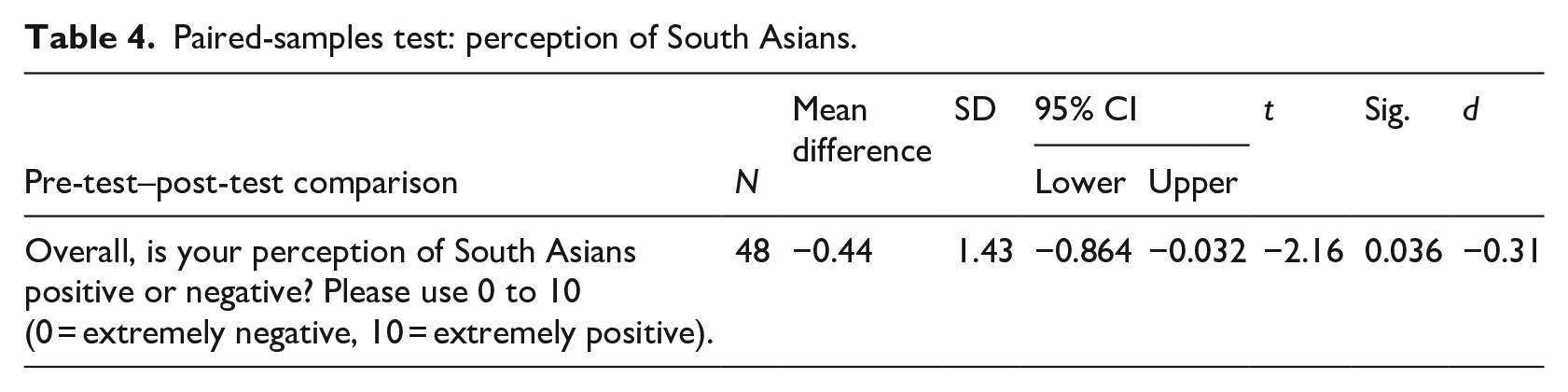
Table 4 found a significant difference in perception of South Asians between the pre-test (M = 6.14, SD = 1.52) and the post-test (M = 6.58, SD = 1.76), with t(47) = −2.16, p < 0.05, d = −0.31. It seems that the students tended to hold a more positive perception of South Asians after completing this learning unit. The second hypothesis claims that the participants would have more empathetic awareness towards ethnic minorities and would be less likely to reject ethnic minorities in society. Participants recognised that the media often portrays people based on racial or ethnic stereotypes and they understood how racial or ethnic groups are systematically ignored or even oppressed. They were also more likely to be aware of cultural and institutional barriers that discriminate against ethnic groups. The students felt they developed more complex understandings about the difficulties that ethnic minorities face. The medium effect size indicates moderate practical significance. One statistically significant result finds that the participants hold more positive perceptions of South Asians. There is strong support for the second alternative hypothesis, thus rejecting the null hypothesis.
Paired-samples test: perception of South Asians.
Hypothesis 3: Increasing willingness to engage in community work
The third alternative hypothesis indicates that the participants would be more interested in community services after finishing this unit. As reported, Table 1 shows a paired-samples t-test and found a significant result (Pair 5) which is: I will become/became more interested in a career in community work, with t(46) = −2.25, p < 0.05, d = −0.33. The quantitative evaluation found a significant positive result which indicates perceiving themselves to be more interested in choosing future careers in community work. Thus, the null hypothesis is rejected.
Hypothesis 4: Greater impact on Mainland Chinese participants
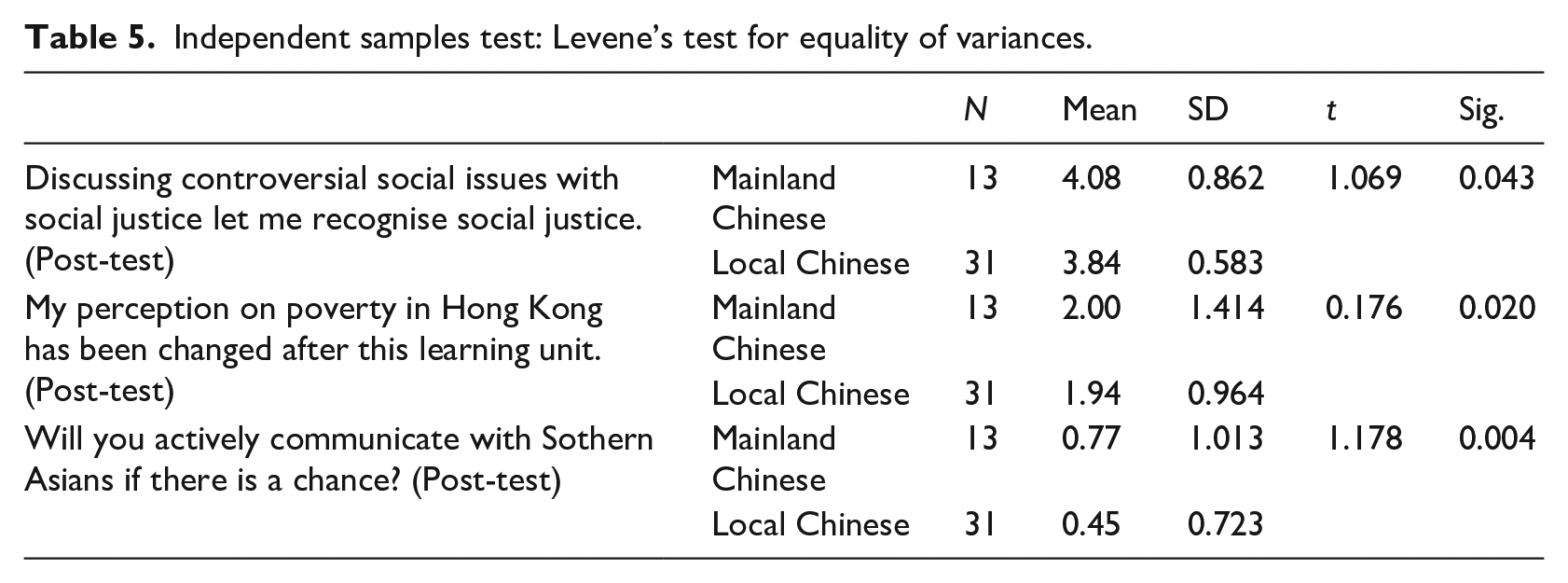
An independent-samples t-test was conducted to compare any difference in the post-test between Mainland Chinese and Local Chinese (see Table 5). Three significant results were found. First, the Mainland Chinese (M = 4.08, SD = 0.862) tended to agree that discussing controversial social issues about social justice let them recognise social justice, comparing to the local Chinese (M = 3.84, SD = 0.583), with t(42) = 1.069, p = 0.043. Second, more Mainland Chinese (M = 2, SD = 1.414) reported that their perception on poverty of Hong Kong has been changed comparing to the local Chinese (M = 1.94, SD = 0.964), with t(42) = 0.176, p = 0.020. Third, Mainland Chinese (M = 0.77, SD = 0.1.013) reported that they were more likely to actively communicate with Sothern Asians if there is a chance to do so, compared with the local Chinese (M = 0.45, SD = 0.723), with t(42) = 0.178, p = 0.004. Comparatively, Mainland Chinese participants tended to believe that they not only learned social issues and theoretical concepts, but they also became willing to communicate with South Asians in action when there is an opportunity to do so. It seems that the study unit exerted a greater impact on Mainland Chinese students than others.
Independent samples test: Levene’s test for equality of variances.
Qualitative evaluation
Two focus groups were conducted to gain the participants’ views, attitudes and perceptions related to this learning unit.
Procedure
The second author led a focus group in the first semester for the four volunteers from course A and held another focus group in the second semester for the two volunteers from course B. The same moderator was used in each case to reduce bias and minimise the problem of different styles (Litosseliti, 2003). The moderator maintained the focus and guided the discussion in an open and interactive atmosphere. Student reflections occurred after the first teaching episode to allow for the action research cycle to show differences in approach.
Participants
The two focus groups included three male and three female undergraduate student interviewees from different ethnic backgrounds. Pseudonyms are used. Focus Group A included four interviewees: Elaine (female, a year 1 exchange student from Beijing), Christian (male, a year 2 local student of Filipino ethnicity), Emy (female, a year 1 exchange student from Shanghai) and Sherry (female, a year 5 local Chinese student). Focus Group B included two interviewees: Alex (male, a year 2 mainland Chinese student) and Tony (male, a year 5 local Chinese student).
Results
New knowledge learnt
All interviewees indicated that they had learned valuable knowledge. Christian, Elaine and Emy (Excerpts 1, 2 and 3) reported that they were impressed by the learning of social justice concepts and that they were stimulated to reflect on key issues. Christian showed an understanding of social justice. Sherry (Excerpt 4) showed interest in further exploring climate justice issues. Sherry (Excerpt 5) spent some time on researching the issue.
Excerpt 1
The most impressive thing is to learn more about how people can be treated fairly. Through some learning activities, we learned that the weaker can be helped by giving more resources, whether from government or NGOs. (Focus Group A, Christian)
Excerpt 2
Because of my background in China, I was wondering what is the difference between equality and justice was and I finally understood the difference. During the lectures and experiential learning, the lecturer used the concepts and I gradually understand them thoroughly. (Focus Group A, Elaine)
Excerpt 3
I think the most impressive part was learning about the genocide and refugees. I knew about genocides in Nanjing. However, I did not know about the refugees in the world . This course gave me new knowledge about refugees and their lives. (Focus Group A, Emy)
Excerpt 4
I am very interested in climate justice and I even started doing some research on it. (Focus Group A, Sherry)
Excerpt 5
I was really interested in learning about climate justice because I had never learnt about it before. There is global climate injustice. However, I had never examined the causes behind it. I studied the issue more, which may have a profound effect on my future and my teaching in schools. (Focus Group A, Sherry)
Enabling different perspectives and widending horizons
Interviewees, for different reasons, agreed that social justice perspectives should be taught in universities in order to widen horizons. Elaine, Christian and Alex (Excerpts 6, 7 and 11) said that they had not learned about social justice before. Christian, Elaine, Emy and Alex (Excerpts 7, 8, 9 and 11) stated that learning social justice helps students widen their horizons and perspectives. Sherry (Excerpt 10) believed that university should develop students’ critical thinking. Perhaps with more teaching experiences of the first author after the first cycle, students learned more effectively in their classroom-based inquiry in second cycle. For example, both Alex (Excerpt 11) and Tony (Excerpt 12) thought that universities should teach for building a better society.
Excerpt 6
I was really surprised when I learned about the situations of asylum seekers. I have not heard about them in China. I was shocked and confused, because it is an inconvenient problem. The visit was really valuable for us. (Focus Group A, Elaine)
Excerpt 7
Learning social justice widens our horizons and multiple perspectives, so as to respect both others and ourselves. (Focus Group A, Christian)
Excerpt 8
It is necessary to teach social justice in university. People seldom judge with a social justice perspective. The lectures taught us about the definition and application of social justice when studying controversial issues from different angles. (Focus Group A, Elaine)
Excerpt 9
Although Hong Kong is an international city, some people still have ethnic stereotypes. Universities should widen students’ horizons. (Focus Group A, Emy)
Excerpt 10
I hope this university teaches students about social justice. Particularly, I suggest that students who study General Studies and Liberal Studies learn about social justice, because they will teach relevant topics to the next generation. (Focus Group A, Sherry)
Excerpt 11
I never learned about the concept of social justice until I studied in university because I was studying in mainland China before. Universities should teach students about social justice. Social justice should exist in a society and learning about social justice is meaningful. (Focus Group B, Alex)
Excerpt 12
It is necessary to teach social justice in university. Universities prepare students to build a better society by teaching unique and deeper knowledge. This is what I expect to learn and cherish. (Focus Group B, Tony)
Positive perceptions
Elaine and Alex (Excerpts 13 and 14) said that they developed more positive perceptions of South Asians. The first author particularly added a few more case studies on ethnic minorities in the second cyle of teaching, and so Tony (Excerpt 16) thought that learning about social justice would make more people find solutions for racial injustice. Although he did not know about Sikhism before he visited the Sikh Temple, he became willing to communicate with ethnic minorities after the visit.
Excerpt 13
I have a more favourable perception of South Asians now, maybe because I have understood them and know more about their culture and hardships. (Focus Group A, Elaine)
Excerpt 14
Learning about social justice can enhance our introspection towards minorties and critical thinking abilities. (Focus Group A, Sherry).
Excerpt 15
I understand more about South Asians and I have a better perception of them, maybe due to the interactions with them. I had no such experience in China (Focus Group B, Alex)
Excerpt 16
I am interested in ethnic minority issues and to know more about South Asian students so that we can build a harmonious society. . . I think the Sikh Temple visit was a great experience and produced positive impact on me. I am more willing to talk to them and find solutions. (Focus Group B, Tony)
Discussion on challenges in studying social justice education
Statistical analysis suggest that students from Mainland China tended to be more impressed by the study unit when compared with local students. The statistical results match with opinions of the interviewees. The interview also showed that the local students and those students from Mainland China had different understandings about social justice issues before starting this learning unit. The local students tended to know about most of the social issues because of their previous secondary school education, but they may have never used a social justice perspective to analyse them. The students from Mainland China tended to ask most questions to clarify facts and about social background during the lectures and had not heard about local social justice issues. An exchange student from Mainland China (May) initially challenged the teacher’s facts and clarifications. But after two weeks, she said she had researched and revised her views. Sally and others from Mainland China said that she felt shocked when she heard some facts and explored the concepts of social justice because she had never learned about them before.
One local student (Fong) said in the second lecture that she had never talked to ethnic minorities in Hong Kong’s communities because she was afraid. However, after the racial justice lecture and the visit to the Sikh temple, she said that she does not fear ethnic minorities anymore.
‘The experiential trip took me to the Sikh Temple. I did not know this place and this religion. I have more understanding about Sikhism because of the trip. After the visit, I met a classmate in a lecture. His hair are always tied and wrapped in a Dastar, and he always wears an iron bracelet. Before the trip, I never communicated with him. But because of the Sikh Temple visit, I know he is a Sikhs and we become friends now’.
Reading about or communicating to people from other cultures is an effective way to raise one’s knowledge and overall cultural acceptance (Williams, 2017). Experiential learning led to students’ interpersonal growth and was beneficial to the students’ intercultural understanding, broadening their horizons and facilitating multi-cultural intergration.
A local Filipino student (Christian) said in the final lecture that this study unit is meaningful for his understanding of ethnic minorities. A majority of participants reported in the questionnaire that they benefited from learning about social justice perspectives and issues. All focus-group interviewees had positive attitudes:
‘Knowing the issue is really valuable for us’, ‘It helps us widen our horizons’, ‘It may have a profound effect on my future teaching’ and ‘We should cherish the opportunity to learn about social justice’.
They used descriptions such as ‘they (ethnic minorities) are kind’, ‘they struggle for their lives’ and ‘they just have different cultures’. All participants agreed that social justice should be taught in university, thus telling much about their thinking about what university should each. Students from Mainland China also favour SJE.
Thus participants now knew more about social injustice issues, gained social justice knowledge and understood more about ethnic minorities. They developed a sense of empathy towards those disadvantaged groups and were motivated to work to reduce injustice. Experiential learning (Skolnick et al., 2004; Torres-Harding et al., 2012) helps learners to develop empathy and understand the feelings and perspectives of others. The Figure 1 illustrates our prosposed model based on our findings.
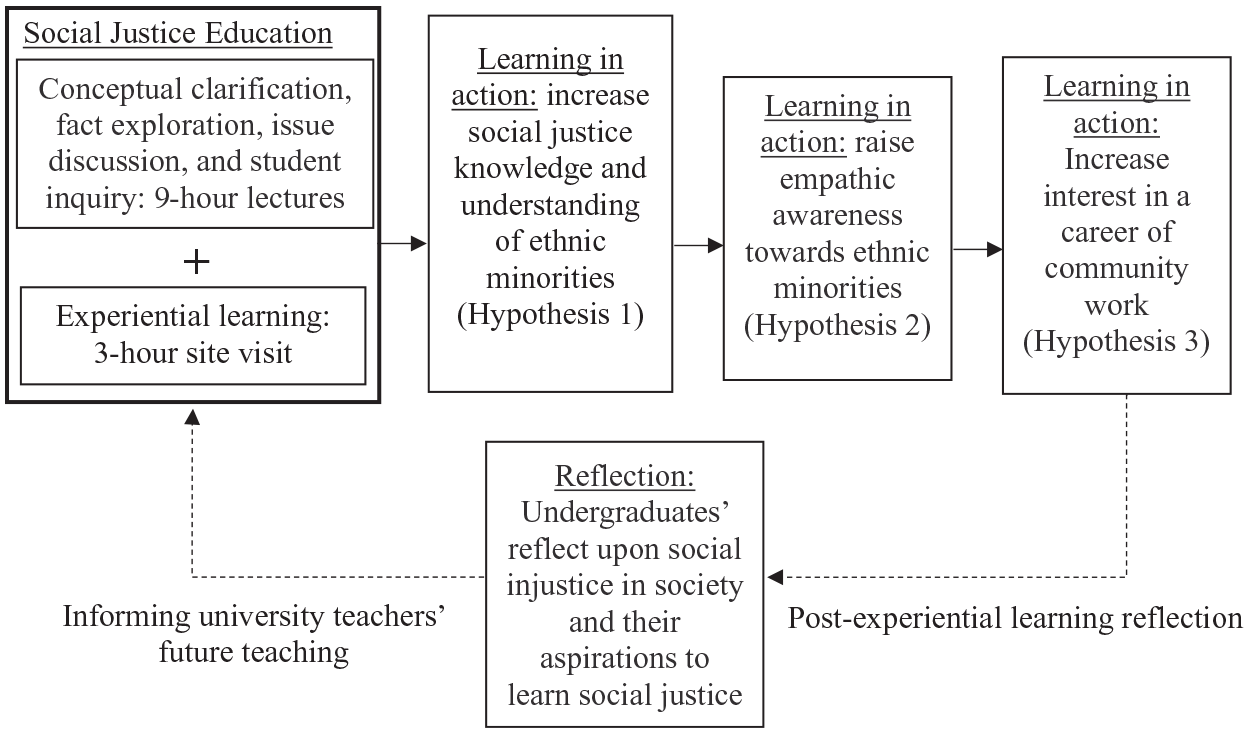
The SJE study unit’s action learning cycle.
About 80% of current and ex-volunteers report that their main reasons for volunteering were to help others and to do meaningful work (Agency and Volunteer Service, 2011). This fits with the current study which finds that learning social justice significantly increase learners’ willingness to volunteer. It could be theorised that after learning in SJE, the learners increased their willingness and realised how they could help others.
The students made suggestions for teaching improvements, for example, expanding lecture time to achieve greater depth, a broader context (e.g. secondary schools), inviting practitioners (e.g. NGO staff) to share practical experience and organising experiential activities (e.g. site visits). Incorporating NGO staff in planning and implementing experiential learning can also be considered. These are all well-taken by the course lecturer in the following academic years.
Future development
The sample size for this project is not large enough for secondary statistical analysis (e.g. to explore connections with ethnicity and religion). Future research could recruit a larger and more representative sample for advanced quantitative analysis, to help in grounded theory formulation (Strauss and Corbin, 1990) in an action research, and developing the pedagogy of action and practice that can increase young people’s motivation for involvement (Wakeman, 2019). The two cycles of SJE that have been researched here only cover classroom-based inquiry and experiential learning. The positive results of developing ethnocultural empathy of university students also persuaded the authors to continue and impove this SJE in the subsequent cohorts of unversity students. This SJE unit made a remarkable impact. These results contributes to SJE research on exploring classroom-based and experiential learning approaches (e.g. Adams, 2016). For our own pedagogy, we believe we helped students to examine identity, power, privilege and structural equality issues in their own lives (Bell et al., 2016).
Conclusion
A social justice teaching unit was taught twice in an undergraduate course including experiential learning visits in two semesters. Several positive student learning results were identified. The quantitative findings reveal that the students’ perceived knowledge of social justice was enhanced, and they developed positive views of ethnic minorities. Students’ willingness to engage in community work increased. The results are generally consistent with previous SJE research and reject the three null hypotheses. We find that SJE is appropriate for the university curriculum and perhaps school education. Finally, it is recommended to improve the SJE by inviting NGOs or community practitioners to share practical experience related to understand social justice through experiential activities.
Highlights
A social justice teaching education (SJE) unit was taught twice in an undergraduate course including experiential learning visit.
The quantitative findings reveal that the students’ perceived knowledge of social justice was enhanced and students’ willingness to engage in community work increased.
The qualitative findings reveal that they developed positive views of ethnic minorities.
The results are generally consistent with previous SJE research but we find that SJE is appropriate for the university curriculum and perhaps school education.
It is recommended to improve the SJE by inviting NGOs or community practitioners to share practical experience related to understand social justice.
Supplemental Material
Appendix_A – Supplemental material for Teaching about and for social justice in teacher education in Hong Kong
Supplemental material, Appendix_A for Teaching about and for social justice in teacher education in Hong Kong by Eric King-Man Chong, Ian Davies and Shun-Shing Pao in Citizenship, Social and Economics Education
Supplemental Material
Highlights – Supplemental material for Teaching about and for social justice in teacher education in Hong Kong
Supplemental material, Highlights for Teaching about and for social justice in teacher education in Hong Kong by Eric King-Man Chong, Ian Davies and Shun-Shing Pao in Citizenship, Social and Economics Education
Footnotes
Declaration of conflicting interests
The author(s) declared no potential conflicts of interest with respect to the research, authorship, and/or publication of this article.
Funding
The author(s) disclosed receipt of the following financial support for the research, authorship and/or publication of this article: This project was supported by the Teaching Development Grant (T0186) of the Education University of Hong Kong at Hong Kong Special Administrative Region of China.

Supplemental material
Supplemental material for this article is available online.
References
Supplementary Material
Please find the following supplemental material available below.
For Open Access articles published under a Creative Commons License, all supplemental material carries the same license as the article it is associated with.
For non-Open Access articles published, all supplemental material carries a non-exclusive license, and permission requests for re-use of supplemental material or any part of supplemental material shall be sent directly to the copyright owner as specified in the copyright notice associated with the article.
