




Abstract
This article will be of interest to anyone wishing to conduct research related to citizenship education in Latin America. It shares the results of a systematic review of empirical studies with the goal of (a) mapping the current research on citizenship education in Latin America and (b) suggesting a research agenda for citizenship education in Latin America. One particular contribution of this article is that it describes research that was previously accessible only to those who read Spanish. Findings include an increase in publications on citizenship education in Latin America since 2000 and show that research is being published on (1) the content of official documents, (2) what happens in educational settings, (3) teachers’ views, (4) students’ views, (5) what influences students’ civic outcomes and (6) students’ civic identities. The final section of the article explores various suggestions for future research.
Introduction
As Quaynor (2012) notes, ‘in recent years, citizenship education has been the subject of much international attention’ (p. 33). Similarly, Torney-Purta (2017) writes, ‘young people’s preparation for civic engagement and participation as citizens is receiving enhanced attention across the world’ (p. vii). Latin America has not escaped this worldwide trend. As Schulz et al. (2018) explain, ‘the need to provide young people with civic and citizenship education has received particular attention across many Latin American countries’ (p. 2).
Although countries in Latin America (and areas within each countries) are very different from one another, they do share commonalities in additional to geographic proximity. For example, they also share similar historical and current struggles: ‘characterized by waves of tumultuous conquest, independence movements, democracy building, and challenges to the historical legacy of colonization and capitalist exploitation’ (Jaramillo, 2017: 357). As a legacy of colonization, this region has large indigenous populations and multiple indigenous languages, but Latin languages (mostly Spanish, and also Portuguese and French) are the official languages and most of the population is Catholic. Latin America as a region provides an interesting context in which to study citizenship education and can provide insights for other societies with similar contexts or challenges, such as democracy building and colonization.
Despite the surge of interest in citizenship education in Latin America mentioned above and key insights experiences from Latin America can provide, I was unable to find a published review of this research. The closest I was able to find was Carole Hahn’s (2010) article reviewing what was known in comparative civics education, which includes a few studies of citizenship education in Latin America. However, it is not a comprehensive review of all empirical studies in Latin America, and does not include more recent studies. Another source is Laura Quaynor’s (2012) review of the literature of citizenship education in post-conflict contexts. While a few Latin American countries are included in this review, it is not a review about citizenship education in Latin America, which was my area of focus.
Therefore, I conducted a systematic review of the literature to explore the following questions: (a) What is the current state of research on citizenship education in Latin America? and (b) What are gaps in this research base or areas that merit further study? I first mapped the research that I found, and then proposed a research agenda that builds on the existing research.
This article will be of interest to anyone wishing to conduct research about citizenship education or related topics in Latin America. The main contributions of this article are mapping the current research, citing each of the articles reviewed at least once and suggesting a research agenda for citizenship education in Latin America. One particular contribution of this article is that it describes research previously accessible only to those who read Spanish.
Data and method
According to Gough et al. (2017), a systematic review includes a methods section that explains in detail how the search for the literature was conducted, how the boundaries of the search were determined, what the criteria of inclusion/exclusion were and how the selected literature was analysed. As Tight (2019) explains, ‘the intent is to be a thorough as possible, so that the researcher can not only identify everything that has been done, but also what has not been done and might, therefore, be prioritised for the future’ (p. 63).
The first step was determining which search string to use. After attempting many options, the best search string – the one used for this research – was the following: (((‘citizenship education’ AND ‘Latin America’) OR ((‘educación para la ciudadanía’ OR ‘educación ciudadana’) AND (‘América Latina’ OR ‘Latinoamérica’))). This search string was used in the Summon database with an initial result of 699 articles.
A scan through titles and abstracts showed that many of these did not fit the criteria for this study: Latin America (not Spain), citizenship education (not other types of education), K-12 education (not higher education), Spanish or English (not Portuguese, due to the language barrier), peer-reviewed journal articles (not other types of texts), empirical (not conceptual, due to time constraints, as presumably the empirical article cite the main conceptual ones) and from 2000 to the present. When reviewing the articles using these criteria, 52 articles were saved to Zotero for analysis.
Many of these articles were in English: thus, I searched in the following Latin American education research journals (which were found by consulting with experts in the field and by following references): Revista Latinoamericana de Ciencias Sociales, Niñez y Juventud; Revista Iberoamericana sobre Calidad, Eficacia y Cambio en Educación; Revista Internacional de Educación para la Justicia Social; Revista Interamericana de Educación para la Democracia; Revista Iberoamericana de Educación; Latinoamericana de Estudios Educativos; Revista Colombiana de Sociología; Educación y Educadores and Revista Estudios Pedagógicos and Perspectiva Educacional. I found nine additional articles by searching these journals. After a reviewing the resulting set of 61 articles again in more depth, it became clear that 11 of these did not fit the inclusion criteria for this review. Thus, my final set was 50 articles, of which 24 were in English and 26 in Spanish.
From Zotero, I extracted the information about the data set into Excel, which provided information about the authors, the year, the title, the publication and the abstract in separate columns. However, the programme made mistakes with most of the articles in Spanish, so I had to complete the information by hand. As a first step, I scanned the articles and took note of country, language, type of study and the main theme. I then created columns for purpose, framework, methods, findings, suggestions for future research, quotes and notes. I read each article thoroughly, highlighted relevant text, took notes and included the information in the Excel sheet, in which I conducted the analyses.
Results
Bibliographical trends
In terms of years of publication, the data clearly show an increase in scholarship on citizenship education in Latin America over time (see Figure 1). There was only one article from the set published before 2006; more than half were published in 2015 to 2016.
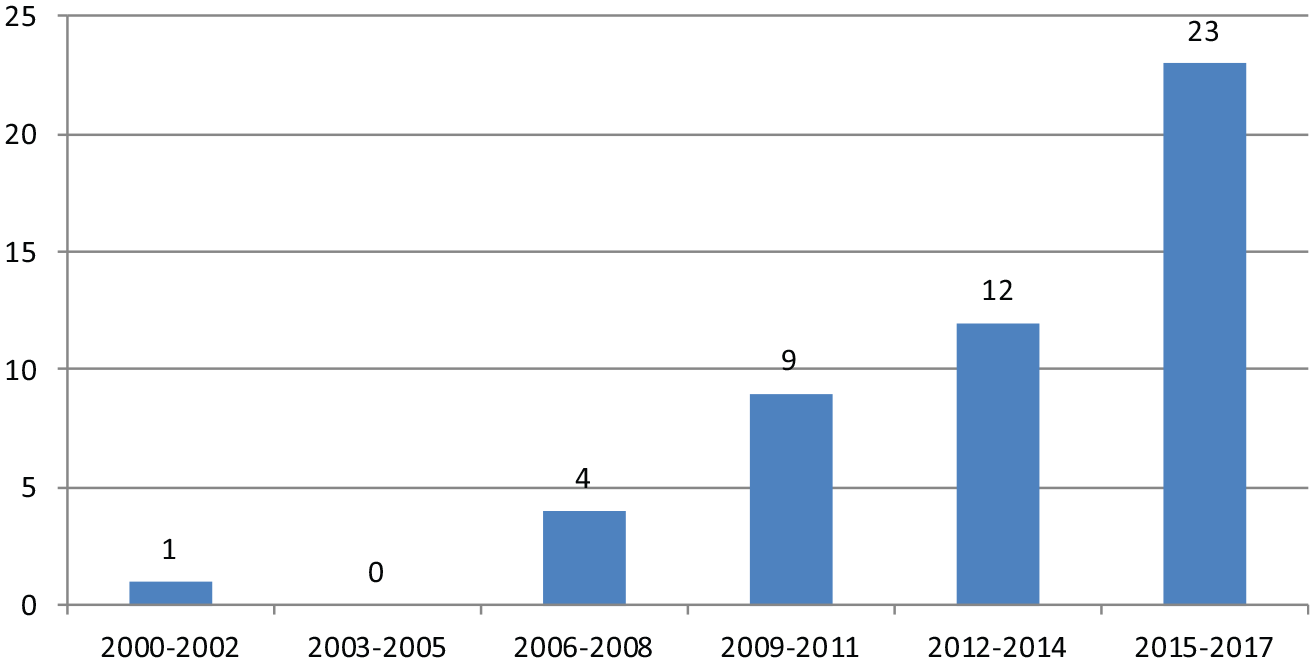
Years of publication.
Figure 2 below shows the number of articles per country. Colombia has the highest number of articles that fit the criteria for this review. There are many articles about citizenship education in Brazil, but they are in Portuguese and thus not included in this review. I found no articles about citizenship education in other countries of Latin America, such as Honduras, Bolivia and Uruguay.
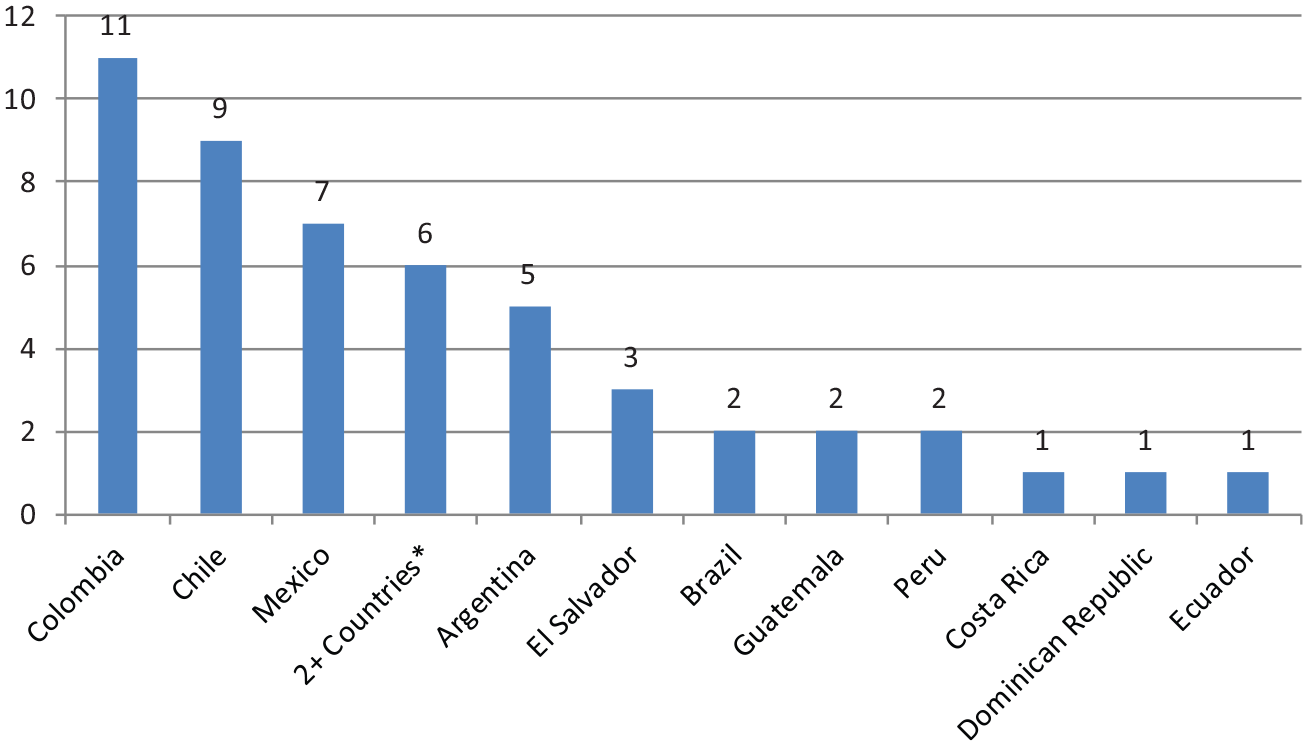
Number of articles by country.
These trends are similar to findings from another review of research literature from Latin America, but on education leadership instead of citizenship education (Flessa et al., 2018): there are many articles about Chile, Mexico, Argentina and Brazil and little or nothing about other countries, such as Ecuador and Nicaragua. The one difference is Colombia. Perhaps Colombia is a leader in work on citizenship education; perhaps this trend is due to some other reason, such as this study’s methodology.
There is a large variation in the journals publishing research about citizenship education in Latina America: most journals only appear once in my data set. However, there are a few journals that published more than one article: Revista Latinoamericana de Ciencias Sociales, Niñez y Juventud published five, Journal of Moral Education published five (this journal had a special issue on citizenship education in Latin America), Estudios Pedagógicos published three and Revista Internacional de Educación para la Justicia Social also published three.
Most of the articles were written by different authors, but there were recurring authors: for example, Martín Bascopé, Macarena Bonhomme, Cristián Cox, Juan Carlos Castillo and Daniel Miranda from Chile co-authored three of the articles in my set. Andrea Dyrness, an American-Costa Rican writing about El Salvador, published three.
I found the most common methodology was qualitative research (n = 14), followed by quantitative research (n = 9). Participatory research (n = 3) and action research (n = 2) were the least common (see Figure 3).
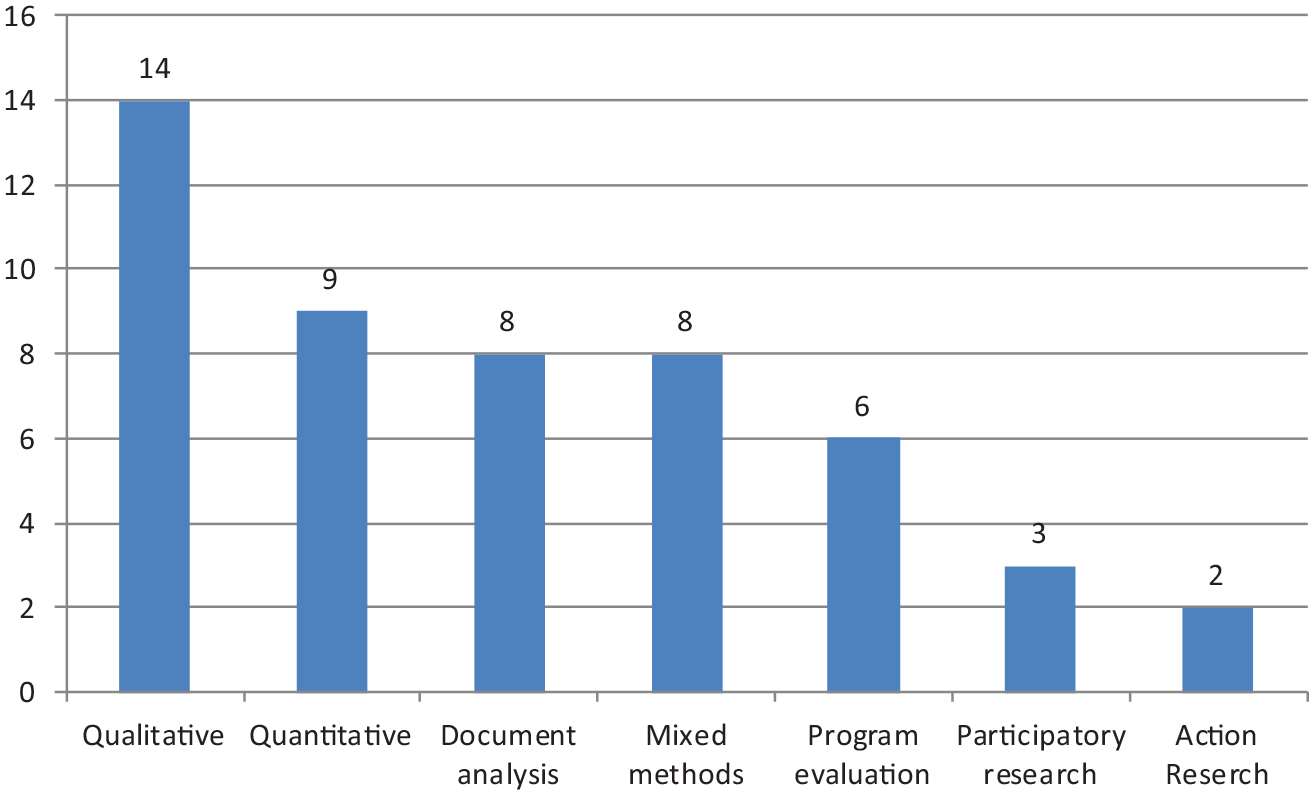
Frequency of research methods.
All of the quantitative studies were about Chile, except for two that were of Chile and several other countries.
Description of the content of the data set
As mentioned in the ‘Introduction’ section, the main research question for this article is as follows: what is the current state of research on citizenship education in Latin America? A short and partial answer to this question are the six themes that emerge from the analysis: research on citizenship education in Latin America focusses on (1) the content of official documents, (2) exploring what happens in educational settings, (3) teachers’ views, (4) students’ views, (5) examining what influences students’ civic outcomes and (6) students’ civic identities. As common in categorization exercises, a few articles fell under two or more categories. I placed them in the category according to their main emphasis. Figure 4 shows the number of studies in each category:
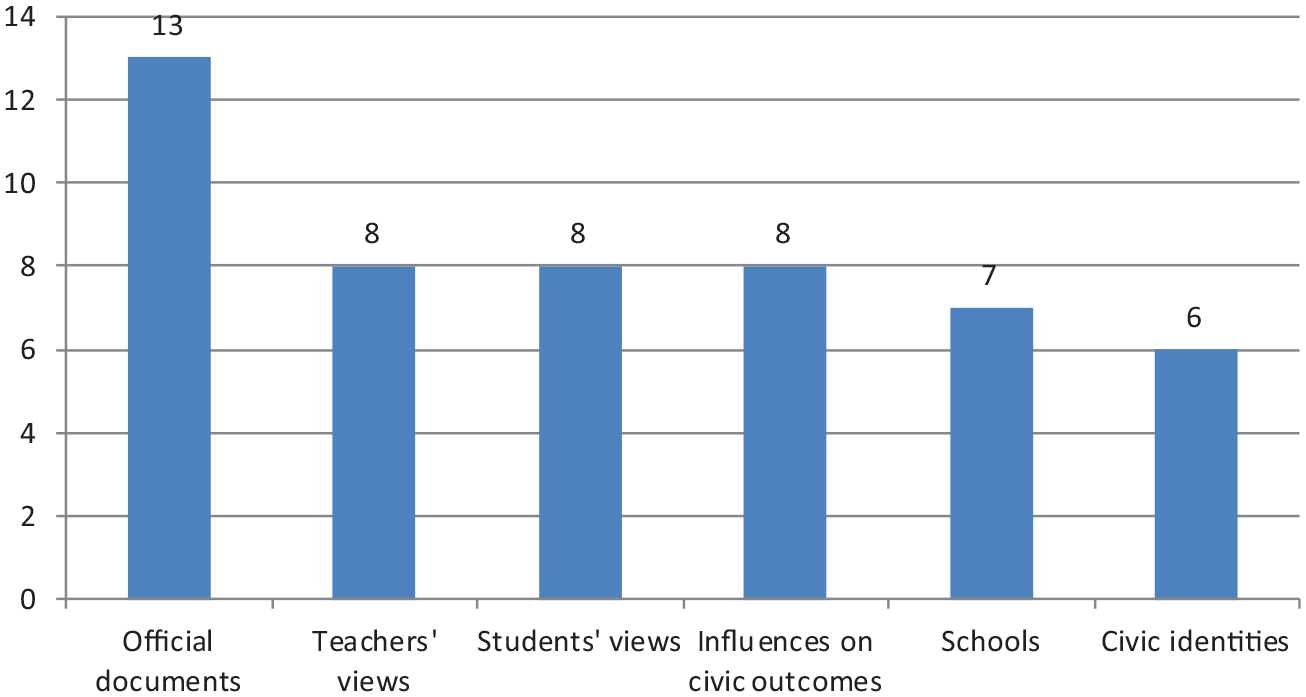
Number of articles in each category.
In what follows, I describe each category, citing each of the 50 articles in this data set at least once.
Official documents
My data set included several studies regarding the content of official education documents: curricula, textbooks, exams, and so on. Taken together, the overarching argument implied from these articles seems to be that both the content of official documents (i.e. curriculum, textbooks, national assessments) and how they are produced matter. In what follows, I synthesize the 13 studies (out of the set of 50) whose focus was mainly on the content of official education documents, except for two articles that focussed more on how official documents are produced.
Muñoz Monsalve (2015) studied the construction of the idea of ‘citizen’ by studying 40 Colombian textbooks from 1910 to 1948. The author argues that textbooks established the ‘modern subject . . . under a Europeanizing racial model of “ideological whiteness” . . . the tutelage of Catholic dogma’ (p. 209, translation by the author). Similarly, De Villeros and Utria Padilla (2015) wrote about the idea of citizenship in Colombian textbooks in 1950 to 1980, arguing that ‘the hierarchies and prejudices inherited from the colonial period regarding race, rank, prestige and status were maintained’ (p. 288).
Jaramillo and Mesa (2009) describe the Colombian Ministry’s citizenship education programme, saying it is organized in the following three categories: (1) peaceful coexistence; (2) democratic participation and responsibility and (3) plurality, identity and enrichment with difference. Similarly, Araújo and Arantes (2009) describe Brazil’s Ethics and Citizenship Education Programme, explaining its dimensions are ethics, human rights, democratic coexistence and social inclusion.
Suárez (2008) analyses changes in the curricula of Costa Rica and Argentina and concludes that ‘notions of citizenship expand to incorporate more sub-national groups, and the conception of citizenship becomes more global’ (p. 496). Astiz (2016) focusses on Argentinean curriculum and textbooks. She concludes that while the curriculum reflects a modern conception (global citizenship, social justice focus), the textbooks remain more traditional (nationalism, maintenance of status quo and a celebration of Argentina being the Latin American country with the most White people of European descendent). Pérez-Expósito (2015) observed a similar trend in the Mexican curriculum: a slow transition in the following directions: from a combination of Catholic morality and civic indoctrination to secularism; from authoritarianism to a commitment with democracy; from ideology to a procedural value education; from nationalism to a balance between localism, nationalism and cosmopolitanism; from cultural homogeneity and male domination to the acknowledgement of cultural diversity and gender equity; and, in the case of secondary education, from adultcentrism to an adolescent-centred orientation. (p. 230)
Pérez-Expósito (2015), however, remains critical of the curriculum, which he argues, depoliticizes students, relying ‘strongly on moral and altruistic motivation . . . deprived of [ ] political meaning’ (p. 232).
Magendzo Kolstrein and Pavez Bravo (2016) analyse the official curricula of Colombia, Costa Rica and Mexico and describe the ways in which they refer to human rights. Bascopé et al. (2015) compare the official curricula (from a database of quotes, Sredecc) and students’ attitudes (from the international citizenship test ICCS 2009, both the main survey and the Latin American Module) for Chile, Colombia, Dominican Republic, Guatemala, Mexico and Panama.
Valdés (2017) analyses evaluation instruments of citizenship education in Chile (national assessment and teacher designed tests). The author questions the value of having so many exam items and tests that require students to remember definitions and concepts. She also suggests that, ‘students know more about what happened in Greece than in our own country’ (p. 271). Also critical of official documents, Plá (2016) analyses how colonialism is presented in history and citizenship education curricula in high school in Mexico, concluding that it does not promote transformation.
Bertely (2007, 2009) writes about intercultural citizenship education. This researcher does not study existing official content: she participates in its creation along with members of indigenous communities.
While previous articles highlighted the importance of the content of official documents, these articles emphasize that the process of creating citizenship education curriculum also needs to be democratic, not just the content.
Exploring what happens in educational settings
There were seven articles (from the set of 50) classified into this category. Taken as a whole, they communicate that (a) citizenship education is learned in a large variety of educational settings and (b) the hidden/implicit curricula, teachers’ beliefs and experiences, and official curricula can conflict.
Two articles described programme evaluations of citizenship education, one in Costa Rica (Fonseca and Bujanda, 2011) and the other in Colombia (Tassara and Zuluaga, 2013). Porto (2016) describes an intercultural and ecological citizenship project in ESL classrooms of grades 5 and 6 in Argentina and Denmark, focussing on the Argentina experiences. Córdoba et al. (2014) write about childhood education in Colombia and trying to teach students to value diversity, in spite of what they described as the biased views of the children’s parents. López et al. (2012) study soccer school in Colombia, arguing it could be a great space in which to learn citizenship if certain aspects of the experience are changed, such as hierarchy and authoritarianism.
Reyes et al. (2013) observed teachers in middle schools in Chile. They suggest power relations are not problematized and nor is the impact of history on the current structure of society explored. They also note that teachers’ treatment of students (chiding them, threatening them, etc.) does not reflect the kind of relationship envisioned for a democracy. They also observe that teachers are themselves subjected to an authoritarian system.
Magendzo and Toledo (2009) explore the moral dilemmas educators in Chile face when teaching the recent history of military regimes and human rights violations. They explain how the official curriculum asks teacher to be neutral and present both sides, while the trials for human rights violations are ongoing. They found that some teachers did not comply, and were clear about their opposition to the military regime. Other teachers complied with the request of neutrality, although in some cases, it seems at great personal cost. Here is an excerpt from the researchers’ field notes: He teaches a class rigorously based on the teaching of history as a subject, presenting differing interpretations of the facts. But immediately afterwards . . . [ ] in a whisper, as if searching for understanding from the researchers, he says, ‘My father was tortured’ (p. 453).
Other times, teachers complied with the mandate of maintaining neutrality, but students pressed them, curious about their views. Teachers responded carefully, conscious of students’ relationship to the conflict. Taken as a whole, these articles suggest that educational settings and teaching matter, and can shape the citizens students become.
Teachers’ views
In this section, I include eight articles that explore teachers’ views and, in some cases, their related actions. Some explore the teachers’ views on students and families of low socio-economic status (SES); others explore the views and knowledge of teachers and pre-service teachers on issues related to democracy.
Oraisón and Pérez (2006, 2009), writing about a school in a context of high poverty in Argentina, found that the teachers viewed parents and students as incapable of participating in decision-making, and thus, the authors argue, the school perpetuates a model of ‘assisted citizenship’ instead of ‘emancipated citizenship’. Conversely, Alucín (2013), exploring a different school in Argentina that was also in a context of high poverty, found that teachers thought students’ circumstances were difficult (rather than seeing the students and their families as deficient). These teachers were flexible, made efforts for students to feel welcome and worked with students and parents to improve the school.
González-Valencia and Santisteban-Fernández (2016) found that although pre-service teachers in Colombia wanted to teach citizenship education, they were not sure how as it was not part of their programme. Cuenca et al. (2016) also study pre-service teachers, but in Peru, and find discrepancies between curriculum expectations and pre-service teacher attitudes: for example, ‘approximately 40% of the teachers think that the poor are poor because they do not try hard enough and . . . they just want to receive help from the Government’ (p. 63, translated by author). Anaya-Rodríguez and Ocampo-Gómez (2016) found that, statistically, teachers in Mexico had a higher level of moral reasoning than high school students.
Also writing about teachers in Mexico, Nieto and Bickmore (2016), find that teachers distrust and blame families. They argued that often ‘citizenship education was [. . .] moralized and individualized’ (p. 122). For example, affecting the school neighbourhood was highly visible industry pollution. Teachers approach to this social problem was to teach students to ‘value nature’ and not to litter, rather than confront the industry or some other action. Burroughs et al. (2008) thought that the characterizations of democracy written by teachers from Latin America (Panama and Peru) seemed influenced by the Catholic religion. Nieto and Bickmore (2016) suggested that the approaches to teaching citizenship education in Mexico were influenced by Neoliberalism: they did not mention the possible influence of Catholicism.
Taken as a whole, this set of articles might argue that teachers’ views will impact their actions and interactions with students, which will in turn influence the type of citizens students become.
Students’ views
Many think of democratic citizenship education as a way of empowering youth to improve society. But what do the students think? These eight articles ask students and youth about their perspectives. Some of the articles ask students for their definition of citizenship and participation, others ask about their views on issues related to democracy, such as equity. Three articles inquired about students’ perceptions of schools, finding that students view their schools as anti-democratic.
López et al. (2011) explore youths’ ideas of citizenship in Colombia, finding that they mainly associated it with participation. Similarly, youth in Mexico highlight participation: they currently engage in community work, saying that their civic engagement opportunities during school and viewing their parents’ civic engagement influenced their choice (Alatorre, 2013). Students in Chile seem to find social movements’ significant aspects of citizenship, more so than participation in the formal political structure (Muñoz Labraña et al., 2010).
Muñoz Labraña et al. (2010) also explore students’ views of others. As an example of their findings, they suggest that girls in Chile seem to hold more positive views of democracy and social justice. In Colombia, Martínez and Quintero-Mejía (2016) explored students’ emotional reactions towards their peers. Chavez (2016) conducted a study Ecuador that has a few components, of which I chose to report on his results related to students’ views. Using questions similar to the international civics test (ICCS, main survey), he finds that students are the least comfortable around ‘homosexuals or lesbians’, ‘people with mental disorders’ and ‘people with AIDS’. Note that ‘homosexuals or lesbians’ is the only item in the question that does not begin with the word ‘people’ and a question about AIDS is placed right next to it. How might this influence students’ perceptions and answers?
A theme present in many studies, but highlighted in the three that follow, is that students perceive schools to be anti-democratic. Oñate et al. (2013) find that students in Chile do not think there is an open climate to express their ideas and opinions in debates. Ravelo-Medina and Radovic-Sendra (2017) report that Chilean students view schools as closed spaces where they have insignificant participation in decision-making and are taught to obey. For the article by Rivera Sepúlveda (2016), I also chose to focus on the students’ views. Students report they have no say in their schools, they take part in no decision-making and they are not listened to. They see the schools as having a rigid hierarchy in which they must obey the principal and teachers, and the teachers must obey the principal. I feel compelled to note that Rivera Sepúlveda (2016) writes about the ‘Caribbean’ Colombia and I was struck by his negative descriptions of the community. Taken as a whole, these articles seem to argue that students’ views and perceptions matter . . . for example, could impact the type of citizen they become.
What influences on students’ civic outcomes
Do schools really have an impact on students’ learning or is citizenship mainly learned in students’ homes? What factors influence students’ civic knowledge or attitudes? The following articles explore factors that influence students’ future voting, positive attitudes towards democracy, civic outcomes, higher acceptance of diversity and trust in governmental institutions.
Using data from ICCS 2009 (authors do not indicate if data are from the Main Survey or the Latin American Module), Castillo et al. (2015) explore different influences on Chilean students’ expected future electoral participation, finding that knowledge of civics and the perception of an open classroom climate have a positive influence. However, the perception of an open classroom climate is less influenced by students’ SES than civic knowledge is. Thus, the researchers suggest that there is a window of opportunity for schools to make a difference in spite of SES differences. Previously, Castillo et al. (2014) conducted a similar study of the influence of SES on Chilean students’ future expected political participation over time using CIVED 1999 and ICCS 2009 (authors do not indicate if data are from the Main Survey or the Latin American Module). They argue that ‘the results support the hypothesis that social origin continues to have a strong influence on students’ attitudes toward political participation’ (p. 140).
Stojnic Chávez (2015) conducted a study in high schools in Peru and found that students’ perceptions about being exposed to democratic participatory activities in school is related to positive attitudes of democracy, even more so than acquiring civic knowledge or being of higher SES. Treviño et al. (2017) use ICCS 2009 data (authors do not indicate if data are from the Main Survey or the Latin American Module) to explore influences of the civic outcomes of students from Chile, Colombia and Mexico. They explore four outcomes: civic knowledge, attitudes, expected political participation and legal protest. They find that ‘although teachers’ practices and attitudes significantly predict students’ civic knowledge, this relationship does not seem relevant for students’ expected participation and students’ attitudes toward diversity’ (p. 604). On the other hand, the school’s democratic environment is related to students’ expected participation and attitudes towards diversity. SES has an influence over civic knowledge and to some extent to attitudes towards diversity. However, it does not have an influence on the expected participation in conventional activities or protests, where students’ ‘civic backgrounds’ are the main influence. Castillo et al. (2015), on the other hand, find that SES does have an impact on students’ expected political participation. However, their measure of expected political participation only considers conventional activities (i.e. voting, joining a political party), only students from Chile and do not measure ‘civic background’. This suggests more research is necessary to further clarify the influences on students’ expected political participation, keeping different types of political participation (protests, voting) in mind.
Caro and Schulz (2012) also use data from ICCS 2009 (it seems from both the Main Survey and the Latin American Module). They explore 10 different hypotheses, trying to find what explains a higher acceptance of diversity for students from Chile, Colombia, Dominican Republic, Guatemala, Mexico and Paraguay. An example of a hypothesis was ‘the learning hypothesis’ that predicted a greater tolerance when students knew more about civics in general and minority issues in particular. The authors find this hypothesis to be true, although it is small part of what explains tolerance.
Other authors statistically studied the influence of civic education, specifically. For example, Fuks and Casalecchi (2012) evaluated the impact of a Youth Parliament programme on youngsters’ confidence levels in the Minas Gerais State Assembly in Brazil. Their results show a substantial increase in confidence levels in the state assembly. Finkel et al. (2000) also examine the issue of trust in government institutions, although in Dominican Republic, and the effect of international donor-supported civic education programmes for adults. They find that the ‘civic education had a direct, negative effect on participants’ levels of institutional trust’ (p. 1851). They explore the question of whether or not civic education should foster trust in government institutions.
Taken as a whole, these studies show that students’ knowledge of civics, perceptions of having an open classroom and school climate, participation in democratic activities in schools, teachers’ practices and attitudes, certain programmes and SES all have an influence of at least one type of citizenship education outcome.
Students’ civic identities
These six articles study students’ civic identities. The overarching argument seems to be that students’ civic identity impacts the role they take in their communities, and the one they plan to take in the future. Thus, citizenship education should consider the ways in which it shapes civic identities, and also the role played by identities students choose for themselves (e.g. a Punk youth identity). In what follows, I explore articles that study identities youth choose for themselves and then articles that study how high schools shape civic identities.
Escovar and Pinilla (2009) studied collective identity in 18 different and varied youth groups and organizations (dance, LGBT rights, religious, scouts, Hip Hop). They write: The hypothesis we hold is that young people’s belonging to a collective endeavour helps to develop their sense of belonging to the community and the nation (p. 1431, translated by the author).
Dyrness and Sepúlveda (2015) also explore identities that youth choose for themselves . . . the possibilities offered to young men in El Salvador adopting homeboy identities.
Other researchers study how schools shape students’ identities. Bellino (2015) explores the ways in which two rural indigenous schools in Guatemala socialize their students into engagement or evasion. In one school, led by the indigenous community, students are encouraged ‘to consider their future role in redressing the cumulative effects of historical injustice, exhorting them to consider goals for social transformation rather than economic mobility’ (p. 547). Students are taught about the armed conflict, about human right violations . . . and that doing nothing is not a neutral stance.
In contrast, the local public school emphasized that students should study hard, obtain professional degrees and get a good job in the city, thus escaping the poverty of the town (the promise of individual social mobilization). Although the armed conflict and human rights violations were also openly discussed in the school, there was a constant message was that engagement was too risky. The researcher reports that the ‘attitude toward noninterventionism was enforced through everyday social interactions and school discipline’ (p. 554).
Dyrness (2012, 2014) conducts a similar study to that of Bellino (2015), but instead of choosing two schools for indigenous students in Guatemala, she studies two schools in El Salvador. One school is an elite private school for the country’s richest and most powerful students; the other is a Church-led school in one of the country’s poorest and most violent neighbourhoods. The author shows ‘how both of these schools reproduce national divisions by socializing students into separate class and political identities’ (Dyrness, 2014: 63). Rubin (2016) conducted a similar study in Guatemala, exploring civic identity in five very different schools. She also finds that schools socialize their students into separate class and political identities, and argues that global models of democratic, multicultural, and human rights education alone are inadequate for creating a new sense of citizenship in a country in which young people’s sense of belonging and their interpretations of the past are deeply connected to how their communities are positioned within a profoundly inequitable power structure. (p. 639)
Taken as a whole, these articles show the various ways that schools and other institutions can help shape young people’s civic identities.
A synthesis of findings
What follows is a synthesis of the broad findings from this set of research:
The quantity of published scholarship on citizenship education in Latin America has increased since the year 2000.
Some countries (such as Colombia and Chile) have several publications; for others (e.g. Bolivia, Honduras), I was not able to find any articles.
A variety of research methods were used, the most being qualitative research.
The research focussed on (1) the content of official documents, (2) what happens in educational settings, (3) teachers’ views, (4) students’ views, (5) what influences students’ civic outcomes and (6) students’ civic identities.
Several themes were present in this group of research, such as:
Official curricula seem to be moving away from traditional civics (e.g. nationalism, homogeneity) towards citizenship education (e.g. more cosmopolitan, diversity). Official curricula often focus on human rights education. Although progressive, citizenship education does not problematize power relations and does not explore the impact of history on the current structure of society. Schools and teachers go about citizenship education in different ways. Teachers do not always have positive views of students and their families, and that seems to affect their actions. Students perceive schools to be anti-democratic . . . a place where they are taught to obey. The perception of being able to participate in discussion of political and social issues in an open classroom climate environment is related to increased expected student participation. Social background is significantly associated with civic outcomes. Students being exposed to democratic participatory activities in school seems to be related to positive attitudes towards democracy, diversity and political participation. Schools socialize students into separate class and political identities.
Findings in light of the two most relevant previous reviews
Quaynor (2012), in her literature review of citizenship education in post-conflict societies, states: ‘Findings common to many studies on citizenship education in post-conflict countries include the avoidance of controversial issues, the unique role of ethnicity, a lack of trust in political parties and authoritarianism’ (p. 33). Although not all countries represented in this review might be defined as ‘post-conflict’ countries, many are and the results of the review generally lend support to Quaynor’s (2012) arguments.
Several studies in this set, most notably the ones about Guatemala, highlight the unique role of ethnicity. Muñoz Labraña et al. (2010) mention the lack of trust Chilean youth have in political parties, and how they prefer to participate in other ways, such as in protests. Several studies referred to authoritarianism, especially highlighting how students feel schools are authoritarian institutions. Based on Magendzo and Toledo’s (2009) work exploring how teachers in Chile taught ‘both sides’ of the country’s recent military regime history, I might argue that in some post-conflict societies, governments take upon themselves manage or control the teaching of controversial issues instead of avoiding them.
In her 2010 overview of research on comparative civics education and proposal of a research agenda, Hahn identifies five testable hypotheses based on her worldwide survey of research: (1) deliberate civic instruction can affect civic knowledge, but does not tend to affect students’ civic attitudes, (2) when civic education is active, participatory and students feel there is an open climate for discussion, they may develop democratic attitudes, (3) the understanding of concepts, such as democracy and citizenship vary with culture, (4) ‘notions of identity are multi-layered, flexible, and complex’ (p. 15) and (5) there are particular challenges for civic education in post-conflict societies.
The research articles from Latin America on citizenship education since the year 2000 provide additional support to the hypotheses that Hahn (2010) proposes. The research about influences on civic outcomes lends support to the first hypothesis (civic instruction influences civic knowledge, not necessarily civic attitudes). A few studies, but especially Stojnic Chávez (2015) and Treviño et al. (2017) lend support to the second hypothesis (by receiving active, participatory education and openly discussing issues, students can develop democratic attitudes). In light of the third hypothesis (concepts such as democracy vary across cultures), this set of research lends support, providing examples of the varying ways that youth in Colombia, Chile and Mexico understand the concept of citizenship (López et al., 2011; Muñoz Labraña et al., 2010). In terms of the fourth hypothesis, some of the research from this data set (i.e. Rubin, 2016) speaks to the various ways students construct their civic identities in relation to their schools. Finally, the research on citizenship education in Latin America also provides support for the fifth hypothesis: ‘implanting civic education in divided and post-conflict societies poses particular challenges’ (Hahn, 2010: 15). For example, Magendzo and Toledo (2009) analyse the moral dilemmas educators in Chile face when teaching the recent history of military regime and human rights violations.
Suggestions for future research
In what follows, I explore suggestions for future research in the field of citizenship education in Latin America in two main types: (1) furthering empirical research and (2) continued mapping of the field of citizenship education in Latin America.
Furthering empirical research
I explore suggestions for future empirical research in citizenship education in Latin America in four main categories: (1) conducting further research on topics about which some research has already been conducted, (2) researching ‘what works’, (3) testing hypotheses and (4) conducting research into ‘new’ topics/questions.
Conducting further research on topics about which some research has already been conducted
As this review has shown, there are certain topics within citizenship education in Latin America that have already been researched to a certain degree, such as students’ civic identities. One possibility for future research is to review the existing research in one of these topics, and continue building that knowledge base.
Researching ‘what works’
Hahn (2010) wrote that the impact of civics education, and a search for the most effective programmes for students as well as for teacher training were also understudied areas. The ICCS studies have included several Latin American countries: researchers interested in this type of work could start by reviewing those studies. Another idea, building upon the research in this review, is to research what ‘works’ in relation to which goal. The studies on students’ civic identities show strikingly different civic goals in different types of schools, which seemed to influence students’ development of very different civic identities.
Testing hypotheses
In Hahn’s (2010) review of a worldwide set of representative research studies on comparative civics education, she proposes five testable hypotheses. This inspired me to re-analyse my findings in search of testable hypotheses. Here are some examples:
Citizenship education curricula worldwide are changing in similar ways: from nation-building to democracy, human rights and peaceful coexistence.
Curriculum impacts students’ civic knowledge and attitudes.
Citizenship education curricula tend not to explore the impact power relations or the impact of history of the current structure of society.
A citizenship education curriculum that explored the impact power relations and the impact of history of the current structure of society would impact students’ civic attitudes and motivation.
Students’ perception of their school as being democratic (or not) impacts their civic attitudes.
Teachers’ views of students and their families influence their actions.
Youth generally prefer to participate in social movements rather than in the formal political structure.
Certain aspects of civic education are less influenced by SES than others (e.g. the perception of an open classroom climate is less influenced by SES than civic knowledge is).
Factors affecting future political participation depend on which type of political participation (formal, informal) is being considered. For example, SES does not equally affect formal and informal political participation.
Citizenship education can also have effects on students that some would consider negative (e.g. reduced trust in government institutions).
For young people, belonging to a collective endeavour develops their sense of belonging to the community and nation. This sense of belonging increases positive civic attitudes and behaviours.
Schools can affect their students’ civic beliefs, participation and attitudes. For example, schools can socialize students into wishing to fight for group rights or evade such struggles (see Bellino, 2015).
Further research could seek to (further) test these or other hypotheses for citizenship education.
Conducting research into ‘new’ topics/questions
Hahn’s (2010) proposed research agenda for comparative education civics highlights many areas of research which she states are understudied, for example, the relationship between gender, race, indigeneity, sexuality and immigration and citizenship education. These are areas also understudied in the data set I analysed, although there were a few studies about indigeneity and citizenship education.
In addition, I found other areas of research that were absent from my data set of studies on citizenship education in Latin America. For example, although student elections are widely held in schools as a means of learning to vote, I found no studies about student elections or about school-wide mechanisms in which students might ‘practice’ democracy. Although some of the articles mentioned school disciplinary policies as being anti-democratic, I found no studies about these policies. Similarly, I found no research on service learning projects, which are widely mandatory for high school students’ graduation. A few of the studies in my data set found that students perceived their schools to be anti-democratic. What are examples of democratic schools in Latin America?
The studies in the set do not mention school districts, school-level leadership or the school as an organization. While there are many studies in my set that use the data from the international test of civics (ICCS), I have read no critical analysis of the test or research about how it is shaping policies and people’s views. I have also not found studies about the influence of international organizations and global policy trends on citizenship education policies in Latin American countries. My synthesis review showed an increase in research on citizenship education since the year 2000: why the surge of interest in citizenship education in Latin America? Is this trend happening elsewhere? What influences this trend?
Continue mapping the field
In this subsection, I explore ways in which future inquiry can continue to map and build the knowledge about citizenship education in Latin America. I propose three areas: (1) building upon this review, (2) mapping the field’s knowledge base and (3) exploring Latin America’s unique contributions.
Building upon this review
There are several ways that this review could be expanded, for example, by including literature from before 2000 or after 2017 and including literature in Portuguese as well. More importantly, this review only included empirical articles. Future work could include a review of the conceptual literature of citizenship education from Latin America. In addition, this review was focussed on the term ‘citizenship education’. However, these types of ideas are also explored using other terms, such as human rights education and peace education. Comparing the concepts and findings from literature using these different terms could be very fruitful. Finally, this review only included peer-reviewed journals, not other types of texts. Reviewing books and grey literature such as research financed by international organizations like UNESCO would be a great contribution.
Mapping the field’s knowledge base
Another area for inquiry would be more in the area of sociology of knowledge: exploring what definitions, frameworks, authors, research paradigms, theories, and so on. Research in citizenship education in Latin America is drawing upon. For example, in some fields, there is an observation in much comparative education work that even though educational research is generated in Latin America or another region of the world, it draws heavily on ‘Western’ theories, frameworks and methods.
Exploring Latin America’s unique contributions
Surely of great interest to both educators within Latin America and also in the rest of the world would be work that sets out to map the unique contributions of research on citizenship education in Latin America, compared with more commonly known and cited literature in citizenship education. What are some ‘lessons’ or ways to thinking to be learned from this region of the world?
Footnotes
Acknowledgements
The author greatly appreciates the thoughtful and inspiring feedback provided by Joseph Flessa, Karen Acton and Gisele Cuglievan.
Declaration of conflicting interests
The author(s) declared no potential conflicts of interest with respect to the research, authorship and/or publication of this article.
Funding
The author(s) disclosed receipt of the following financial support for the research, authorship, and/or publication of this article: This work was supported by the Social Sciences and Humanities Research Council of Canada through a Vanier Scholarship.
