




Abstract
A considerable number of empirical studies argue that economics experts differ from other groups with respect to their public policy preferences and their behavior in certain social dilemmas. Economists are more likely to regard allocation via markets as “fair” than other people and they seem to adjust their behavior and expectations to the actor-model presumed in the elementary neoclassical theory. Some trace back such observations to influences related to the economics education. An alternative view is that economics attracts individuals with preferences that differ from those of non-economists. While the literature on the matter is growing, a comprehensive picture of the nature and sources of the differences has not yet emerged. This article reviews research based on the survey, experimental, and field evidence collected since 1990 to detect, characterize, and explain the differences. It points at some problems inherent to the methodology that dominates the existing research. Primarily, it directs attention to some psychological and social-psychological aspects of training and socializing economists that have not found adequate recognition so far, but should be considered, to better understand the phenomena in question.
Introduction
Laypeople often consider economists’ propositions as morally deficient, because economics experts’ opinions and economic and social policy suggestions frequently seem to incorporate the view that efficiency and equality and common fairness norms are incompatible ideals (cf. Caplan, 2002; Enste et al., 2009; Kirchgässner, 2005; Sapienza and Zingales, 2013). Training in neoclassical theory has also been blamed for educating the type of selfish, dishonest, and distrusting human actor, which is presumed in the basic, reductionist version of neoclassical microeconomics. The deficiencies of the morals and business practices of the financial sector, which have been revealed in the financial crises after 2008, seem to confirm these concerns (Friedman, 2010). Some even point at the economics profession itself and criticize academic economists for insufficient commitment to the common good (Carrick-Hagenbarth and Epstein, 2012; DeMartino, 2011; List et al., 2001).
In response to this, the necessity, use, and meaning of ethics training in business schools (Wörsdörfer, 2014) and the establishment of ethical guidelines for the profession have been discussed (Atkinson, 2011; DeMartino, 2011). Some criticize an overemphasis placed on neoclassical theory in the training of economists. In order to train abilities to a multiperspective, critical judgment and to strengthen the social responsibility and civic engagement of graduates, they advocate the pluralization of the academic curricula (Mearman et al., 2011).
In basic reductionist versions of the neoclassical theory, opportunism prevails and cooperation emerges under conditions of complete contracting only. More extended versions allow the evolution of institutions, trust relations, and strategic cooperation in repeated games. Kinship altruism and reciprocal altruism strengthened the explanatory capabilities of the basic model. But they are usually not a part of the elementary teaching in microeconomics. The same applies to the concept fairness. As a criterion to evaluate the individual behavior and distributive politics, it is clearly important in daily life. But while it is usually associated with value judgments, it can be associated with different meanings. Efforts to define commonly held opinions lead to the definition of various norms of justice and equity, which are based on considerations as those of efficiency, entitlement, or neediness (Irlenbusch, 2003; Schurter and Wilson, 2009). But again, such considerations are not a part of the basic neoclassical thinking.
While the discussion about the economic curriculum continues (cf. Colander, 2007; Coyle, 2012; Decker et al., 2019; Mearman et al., 2016; Morgan, 2015; Thornton, 2017), the question of how people trained in economics “differ” and how this might be related to their education is not answered. Some argue that “economists are born, not made” (Carter and Irons, 1991), as “selfish persons choose to study economics” (Frey and Meier, 2003: 448) or pre-university socialization, class-based interests, or cognitive abilities lead them to develop specific preferences and behavioral patterns. Depending on the outcome of this discussion, we might have to think beyond the amendment of curricula and look for ways to attract individuals into the field that behave and think more in accord with the larger society.
This article reviews the survey, experimental, and field evidence collected in the past three decades. First – in section “Distribution via markets and fairness” – it turns to preferences for modes of distribution and poses three research questions:
RQ 1.1. Do people trained in economics appear to or actually do consider market allocation fair in cases that non-economists do not?
RQ 1.2. If yes, is this associated with a weaker sense of fairness, different understandings of fairness, or different views of the appropriateness of social norms.
RQ 1.3. If R 1.1 and R 1.2 can be answered by saying that people trained in economics deviate from patterns that are more common in society, is this caused by confrontation with economics or by self-selection?
Second, this article reviews contributions to the discussion about relations between training in economics and behavioral patterns that resemble the predictions of basic neoclassical microeconomics. Different types of experiments and opinion surveys have been applied in this discussion. Public goods, dictator, and ultimatum games are reviewed in section “Free riding versus cooperativeness and altruism in games.” Prisoner’s dilemma and trust games and opinion surveys, which explore the values of economists, are discussed in section “Field experiments, field and survey data: are economists less cooperative and altruistic?” Section “Field and survey data: If economists are different, why?” examines analysis of field and survey data that are used to track over time the effects of training in economics on values and behavior. Section “Economists’ expectations from other people” discusses the hypotheses that economists expect other people to behave as presumed by basic neoclassical microeconomics and adjust their behavior to this expectation. The sections concentrate on the following three research questions:
RQ 2.1. Is the behavior in social dilemma of people trained in economics more similar to the predictions of basic neoclassical theory than the behavior of non-economists?
RQ 2.2. If yes, is this motivated by different preferences, different expectations about the behavior of other people, or different views of the appropriateness of specific behavioral norms?
RQ 2.3. There can be a self-selection of individuals that have (1) moral preferences and/or (2) expectations about others, which lead them to prioritize their self-interest. What mechanism(s) is/are responsible for potentially observed differences?
In section “Summary,” some preliminary conclusions follow. Among them is that training in economics is associated with a greater likelihood of accepting market allocation as fair. But this does not apply to all types of goods and situations indifferently. With respect to the behavior of economists in social dilemmas, most of the findings seem to suggest that people trained in economics tend to prioritize their self-interest more than most of the other groups they had been compared with. This seems to apply in the first instance, to situations that are of a clearly “economic” nature. But there is only little evidence that they have different fundamental preferences.
The review will show that the record of empirical observations is inconsistent. Section “Discussion and suggestions for future research” discusses some methodological shortcomings of the existing body of research and some questions for future research are developed. Specific emphasis is placed on some psychological and social-psychological aspects of training economists and moral decision-making that have not found adequate recognition so far. Section “Conclusion” concludes the article.
One point should be noted in advance. If people trained in economics have a specific perspective on distributional matters and the conduct of self-interests, there will often be sound scientific reasons to think as they do. Economics as a discipline has ever been a theoretically and methodologically multifaceted inquiry. If critics attack economics, this is generally not directed against the more multifaceted and sophisticated concepts held by advanced researchers. Most often, the target of criticism is the narrow vision of economics relationships that is conveyed by the core of neoclassical theory and some of the principal texts (cf. Colander, 2018). While the advanced vision of economics is rarely dealt with in undergraduate teaching, neoclassical microeconomics is still the common foundation on which economics education usually builds.
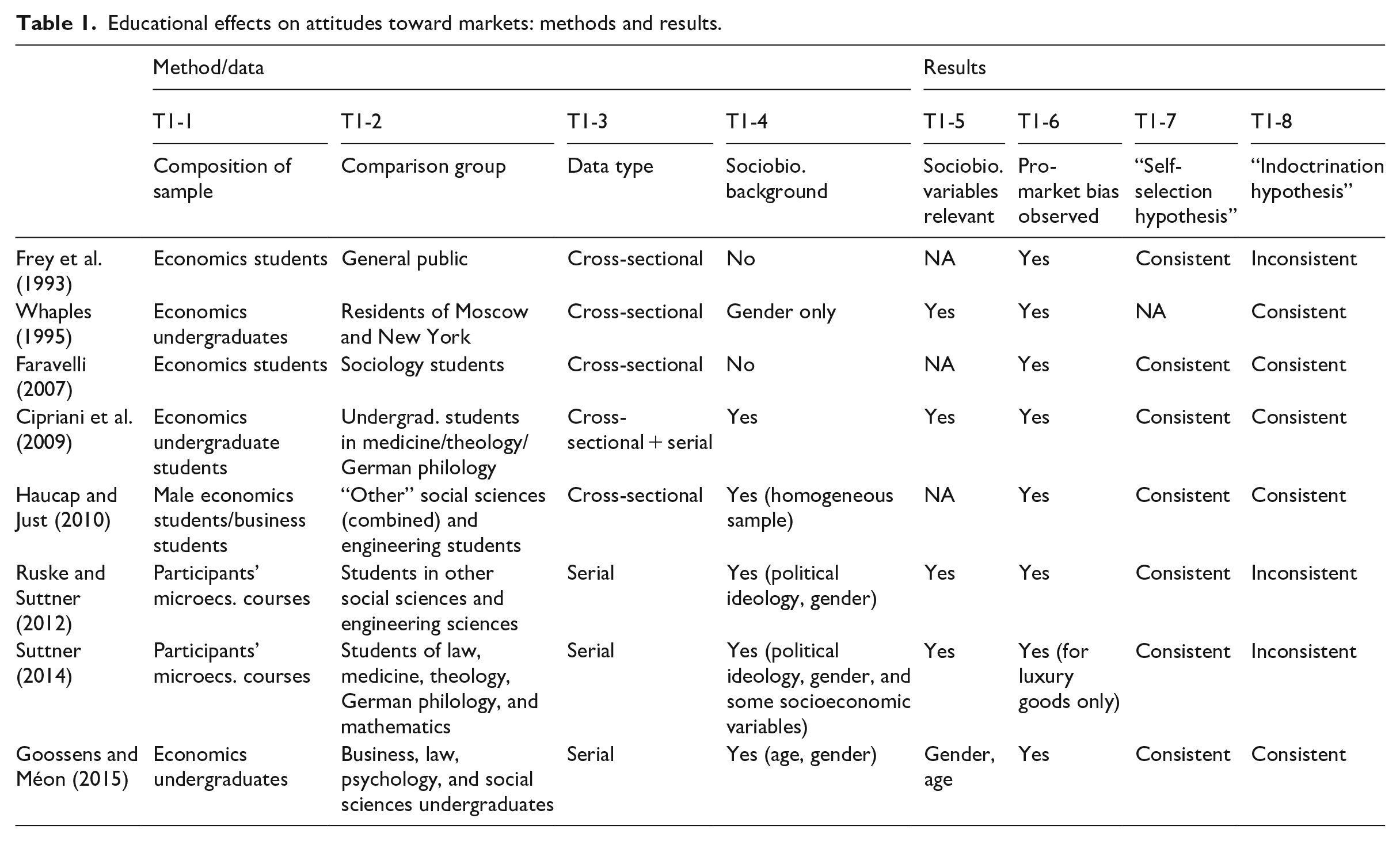
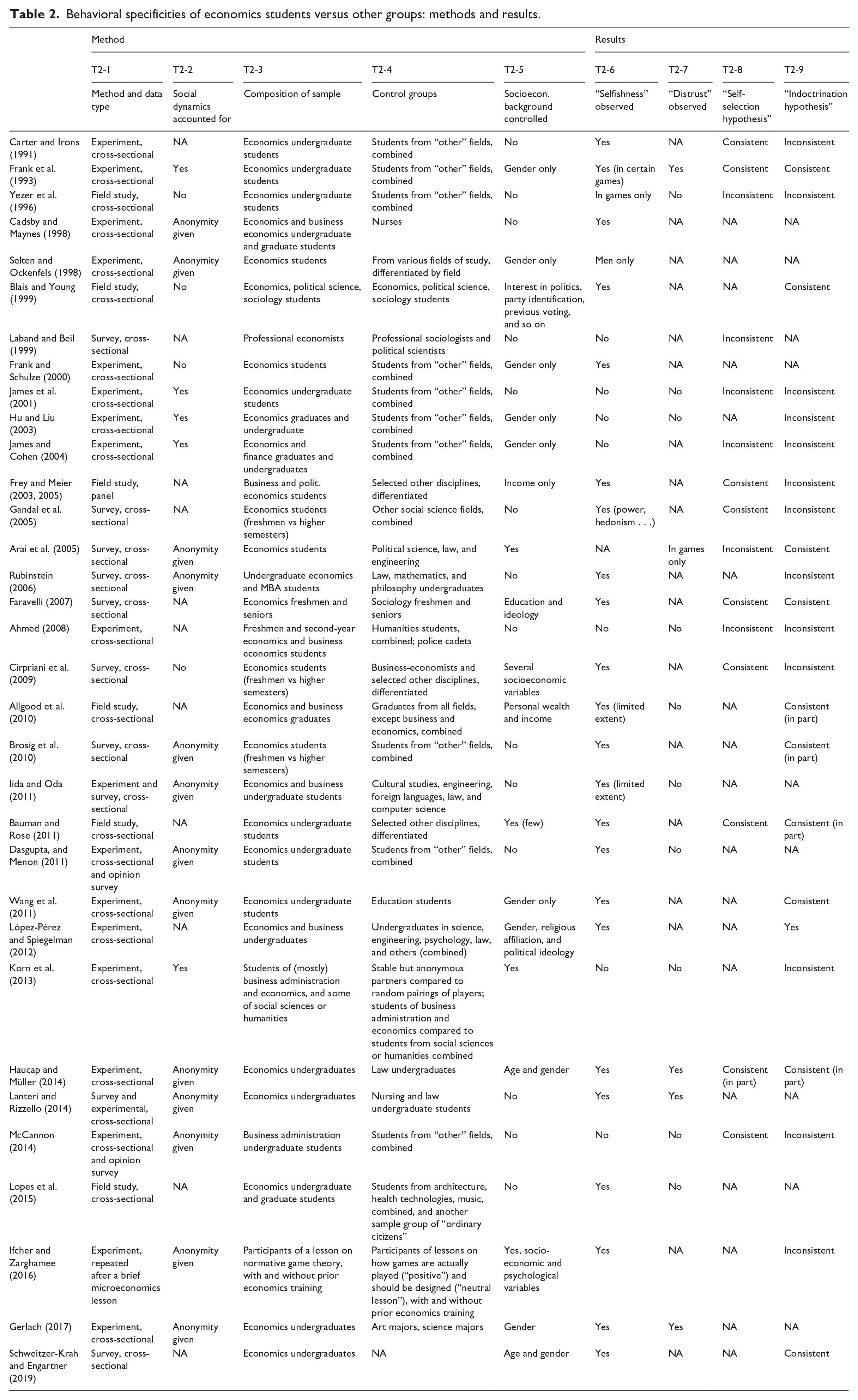
Most of the research in the discussion is conducted with undergraduate students. Some of them received less than one-semester instruction in basic economics and related fields (such as business administration). Often, more or less short-termed effects are measured. Only a few papers consider experienced academic scholars. Even fewer include professionals who graduated in economics and entered the general labor market (see Tables 1 and 2, T1-1, T1-2, T2-1, and T2-2). In view of these limits, the terminology “people trained in economics” is the more appropriate description of the object of investigation – even though sometimes the term “economists” will be used in this article to improve its readability. The investigation reveals the links between some educational experiences and behavioral patterns in specific situations. It results in no general characterization of “economists” and their discipline.
Educational effects on attitudes toward markets: methods and results.
Behavioral specificities of economics students versus other groups: methods and results.
Results
Distribution via markets and fairness
Building on a question set first applied by Kahnemann et al. (1986), several surveys had been conducted among students in economics and other groups in order to find out how they assess different distribution systems in terms of their relative fairness. In the modeled cases, a scarce good is suddenly in excess demand. In all the surveys reviewed here, the majorities of all groups regularly rejected auctioning a good that is evenly needed by everybody. The traditional first-come-first-serve pattern enjoyed the most acceptance. But among people trained in economics, there was regularly more support for the auction than among the other groups. Mixed results emerged with respect to the sources of these preference patterns.
Frey et al. (1993) observed no meaningful difference between freshmen and second-year students in economics and suggested self-selection as the explanation. A similar conclusion was drawn from a regression analysis of cross-sectional data by Ruske and Suttner (2012), after they controlled for age, gender, nationality, and the amount of training in economics. Whaples (1995) also observed self-selection, but exposure to training in economics strengthened economics students’ willingness to accept markets as fair.
Cipriani et al. (2009) included pre-university education and the educational and professional background of the parents. Haucap and Just (2010) queried a sample out of the relatively homogeneous student population in the University of the German Federal Armed Forces in Hamburg (only male students, who will stay in the army for at least 12 years) and controlled for the amount of education in economics the subjects received. Both studies argued that both a self-selection and a “learning” effect play a role. But management students, with less or no training in neoclassical microeconomics, consider auctioning and the resulting price increases less fair or even as unfair as non-economists (Cipriani et al., 2009; cf. Haucap and Just, 2010).
There are several potential explanations for the relatively greater acceptance of market allocation. Among them is that economists tend to decide for efficient rather than fair allocative mechanisms more often than non-economists, because they (Hypothesis 1) value allocative efficiency more than non-economists. They might be (Hypothesis 2) less concerned with fairness. Finally, they might have a (Hypothesis 3) different notion of what is fair in a specific situation.
Hypothesis 1 is supported by most empirical observations. But it needs to be amended. In a dilemma, people trained in economics usually seem to emphasize efficiency (in terms of raising overall welfare, vs equity) more than at least some selected groups of other people (cf. Cipriani et al., 2009; Enste et al., 2009; Fehr et al., 2005; Venetoklis, 2007). They stress the protection of property rights and freedom of contract – important preconditions to market-efficiency – more than laypeople (Haferkamp et al., 2009). The statement that markets are efficient, in terms of making both the parties involved better off, is approved by freshmen in economics and management science more often than by students of psychology, law, or other social sciences. Differences between the freshmen groups seem to be due to self-selection. But they become larger as the students come closer to the end of their studies, and the answers given by economics students become more homogeneous. Changes are not only observed among economics students, and the speed and magnitude of change differs between the disciplines. The most robust evidence is obtained for psychology students. Their confidence in markets diminishes after 1 year of study and remains comparatively low until their final year (Goossens and Méon, 2015).
But some specification is needed because the preference for efficiency apparently tends to be depending on some conditions. Some evidence indicates that students of economics are more sensitive toward the price-elasticity of demand for goods than non-economists. In Suttner’s (2014) opinion survey, a distinction was made between goods with high price-elasticity (i.e. luxury goods) and with low price-elasticity. Economics students (who had no training in rational choice-based microeconomics so far) judged the auctioning of “luxury goods” more fair than non-economists. In the case of “basic goods,” there was little to no difference. After a one-semester microeconomics class with a strong rational choice-orientation the preference for market allocation was significantly stronger in the economics subgroup, with respect to both types of goods. But sensitivity toward the difference between the types of goods persisted. If no differentiation between the types of goods was made in the questionnaire, economists accept market allocation even for goods that can be regarded as basic needs (such as bottled water on a hot day; cf. Cipriani et al., 2009; Frey et al., 1993; Haucap and Just, 2010; Ruske and Suttner, 2012).
Apparently, the set of choices makes an important difference and the context of the decision does as well. If minimal context information is given, economics freshmen are significantly more likely than sociologists to favor solutions to distribution problems that they consider efficient. Studying economics increased the difference further. Perhaps, economics students have a greater tendency to emphasize efficiency “by default” and to frame distributional issues in ways that emphasize the maxim of efficiency in case no information or question posed by the researchers brings up other considerations. Sociologists, by contrast, tend to emphasize common standards of distributional fairness. But when the distribution had been situated in specific contexts, the differences between the two groups seem to disappear (Faravelli, 2007).
But with respect to Hypotheses 2 and 3, the evidence is a little less coherent. Some observe that economics students seem to have difficulties to precisely explicate what they consider to be fair in a given situation (Marwell and Ames, 1981; Wang et al., 2011). But some experimental results suggest that, if compared with sociology students, business students do not differ significantly in terms of the importance they ascribe to justice and fairness, neither with respect to distributional outcomes, nor to the appropriateness of the procedure of distribution (Collett and Childs, 2009). If compared with groups from the sciences and arts and humanities, in an experimental situation, economists do not seem to place less value on fairness and do not seem to hold other notions of fairness. But they are more likely to expect other individuals not to adhere to common fairness norms and consider self-interested choices to be appropriate (Gerlach, 2017).
The evidence reviewed so far is difficult to interpret. Probably, this is due to the fact that most of the empirical research designs do not address that the context, in which a decision is made, might play an important role in its moral evaluation, and that people might embed their value judgments in different presumptions about what context might be given. It is reasonable to consider an entirely voluntary exchange that leaves both parties better off, to be fair. But initial endowments might have been distributed in an unfair manner or exchanges might affect other people negatively (e.g. if goods are sold at dump prices). In this case, the individual exchange conforms only to a rather limited fairness conception and might be considered “locally” or “conditionally” fair, but “globally” unfair. 1 Prioritizing efficiency advantages over distributional fairness might be considered legitimate, or even due, if one presumes that the resulting overall economic gain will benefit everybody more than the “locally” fair solution – but laypeople might interpret their experiences in the field differently. In fact, there are good reasons to believe that laypeople build their views on economic policy matters on systematically other presumptions than people trained in economics (cf. Caplan, 2002; Enste et al., 2009; Kirchgässner, 2005; Sapienza and Zingales, 2013). Finally, there is also the possibility that extensive training in microeconomics, as a specific subject-space, conditions economists to develop this kind of exclusive perspectives on micro-level social interaction – at least as long as no cues are given, which indicate that other perspectives are more desirable.
Free riding versus cooperativeness and altruism in games
Economics students have been observed to give less than non-economist from various disciplines in a “solidarity game” (Selten and Ockenfels, 1998). There is also evidence that students in economics-related disciplines lie more frequently upon reward in experimental games (Childs, 2012; López-Pérez and Spiegelman, 2012). These are examples of non-cooperative behavior that seem to be related to economic education and accord well to the homo economicus-paradigm. But most researchers used dilemma games to explore the effects of training in economics.
In one type of public goods experiment, subjects were provided with an endowment and asked to allocate it between a private and a public account. As all participants are entitled to make use of the public account to the same extent, the socially optimal behavior would be to contribute to the public fund. But in these games, economics students had been more likely to free ride than high-school students (Marwell and Ames, 1981) and defected more than non-economists from various disciplines (Ifcher and Zarghamee, 2016). Economics and business undergraduates defect more often than nurses even if an efficient equilibrium can be reached by cooperation (Cadsby and Maynes, 1998).
Dictator and ultimatum games are another category of experiments applied here. In these experiments, a sum of money is to be divided between two players. In dictator-type experiments the dictator decides on the division. In the ultimatum variant a proposer suggests the division, and a responder then accepts or rejects the offer. In case the responder accepts, the division will take place as proposed; if the proposition is rejected, both players do not earn anything. Very low offers are usually rejected to punish uncooperative behavior. In both categories of games, undergraduate economists, as both dictator and proposer, usually prioritized their own benefit. In the ultimatum variant, they accepted less than students from “other” fields, as the latter more frequently complied with common social norms of fairness and reciprocity (Carter and Irons, 1991; Ifcher and Zarghamee, 2016; Wang et al., 2011).
Field experiments, field, and survey data: Are economists less cooperative and altruistic?
Some argue that economic experiments generate evidence and conclusions that cannot be transferred easily to non-experimental settings and use field data and field experiments instead.
A “lost letter” experiment was conducted by Yezer et al. (1996) in undergraduate classes in economics and other disciplines. When unaware of their role in an experiment, economics students were significantly more likely (56%) than students in other fields (31%) to return an envelope containing US$10 in cash that had secretly been dropped in the classroom before teaching commenced. Accounting and business students, juniors and seniors, also have been observed to be less and economists only a little more likely to cheat in a simulated test than non-economists (Nowell and Laufer, 1997). According to these findings, in the field, economics students do not seem to behave very differently from non-economists.
While the generalizability of the lab results to the field is perhaps problematic, the focus on students as subjects in most of the empirical research is perhaps as well, because students seem to be generally less prosocial and to act more strategically than working adults. This applies to students in economics as well as to those in other fields (Anderson et al., 2013; Belot et al., 2015). But only comparatively few researchers collected data on experienced scholars and other professionals who left university a couple of years ago. Laband and Beil (1999) compared the earnings statistics of the American Economic Association, the American Sociological Association, and the American Political Science Association to what 892 members of these associations voluntarily disclosed about their incomes. They concluded that economists do not seem to be more likely than their colleagues to “cheat” with respect to income-based professional association dues. According to Frank et al. (1993, 1996), 2 they donate a little more, often nothing, to charitable activities or spend a little less than other academic professors with a similar income. But the shortfall was lower than 10% and differences with respect to the time spent on socially beneficial activities – such as voting or prosecuting a student suspected of cheating – were small. Allgood et al. (2010) queried former students that had attended four large public universities in 1976, 1986, or 1996. Only business majors are less likely than general majors to spend time on volunteering. If they do at all, they spend less time than general majors. But there was no correlation between a degree in economics and voting behavior.
Behavioral economists usually prefer the allocation of money as a more reliable indicator of preferences. Monetary resources are treated as constrained, whereas time is not. Thus, the allocation of time might be considered as a less appropriate proxy for preference orderings and provides less reliable evidence than the allocation of money. There are empirically well-founded arguments that both specific lectures and regular training curricula play a role in the outcome of standard lab experiments that represent distributional dilemmas (see Ifcher and Zarghamee, 2016). But outside of experimental settings, and if no money is involved, studying economics is apparently not associated with a weaker concern with other people’s welfare – at least in the long run.
Field and survey data: If economists are different, why?
The preceding discussion concentrates on the differences between people trained in economics and non-economists. It did not ask for the sources of these differences.
Frey and Meier (2003, 2005) and Bauman and Rose (2011) are among the few that use serial longitudinal field data as they observe financial decisions of student groups over extended periods of time. In both the studies, voluntary student donations to social funds that are administered by the universities of Zurich and Washington have been tracked over several semesters to detect changes in the strength of altruistic inclinations.
Frey and Meier observed that entry-level students in economics do not give significantly less than the average of the control groups from other selected fields. A difference emerges in the main stage, when students specialize in economics or business economics. Political economists contribute a little more, business economists less, than other students. As contributions from all students decline over time, there seems to be no evidence for an effect of training in economics. An anonymous survey was conducted among the same student population and indicated that factors such as income situation, attitudes toward the social funds, and political orientation seem to have no significant influence on the donation policy. The lower contribution of business economists is apparently due to self-selection (Frey and Meier, 2003: 46; cf. Bauman and Rose, 2011). Attendance of one or two microeconomics classes does not seem to affect the donation policy of undergraduate students in the United States. But White males of domestic origin are more generous than Black or Asian students and females (Bauman and Rose, 2011).
A closer look at the non-economist groups yields more problematic observations that leave a question mark on the simple self-selection interpretation. In the Bauman and Rose (2011) sample, there seems to be evidence for an indoctrination effect for non-majors, but not for majors. In the Frey and Meier (2003, 2005) sample, the donation policy of entry-level law and veterinary students is not significantly more generous than that of economists. Veterinarians at the main stage of their studies act even more “selfishly” than business economists. In the doctoral stage, lawyers, veterinarians, prospective medical doctors, computer scientists, and even theology students reduce their contributions sharply and donate significantly less than business economists. The latter reduce only slowly, despite the fact that they have self-selected several times into the next stage of their academic career. Moreover, if law and economics and even veterinary medicine really attract almost equally selfish freshmen, the assumption that “selfish persons choose to study economics” (Frey and Meier, 2003: 448) must be amended, as other fields are chosen by selfish people as well. But while freshmen with pre-university economic education are less generous than the comparison groups, they are not specifically likely to self-select into economics (Frey and Meier, 2003: 454). All in all, this evidence provides no too strong support for either the self-selection or the training hypotheses.
The arguments discussed in this article draw more or less on a revealed preference methodology. But some look for other ways to empirically access fundamental preferences and character dispositions, most often with the help of opinion surveys.
German economics students in the fourth semester have been asked to self-assess how their studies changed their abilities, preferences, and character dispositions. Depending on the attribute in question, up to 92 % of the students stated that confrontation with economic theory makes a difference. Roughly, two out of three stated that – for instance – career ambitions and competition orientation had been slightly or strongly enforced. In contrast to that, only 25.5 % believed that they had become more idealistic or more sensitive (18.2 %). Up to 50% found other-regarding preferences and interests enforced. But empathy, helpfulness, and solidarity were the categories least effected, neither positively nor negatively (Schweitzer-Krah and Engartner, 2019). According to these results, studying economics makes a difference. It makes an individual a better homo economicus, but not to the same extent as a weaker zoon politicon. Israeli economics freshmen seem to appraise power, achievement, and hedonism values more and the welfare of society less than peer students in other social sciences. After the first year, minimal changes could be detected (Gandal et al., 2005). If 1 year of training does not make an important difference, self-selection seems to play a role.
While Gandal et al. (2005) surveyed the same individuals repeatedly, the observations made in Schweitzer-Krah and Engartner (2019) are the results of a retrospective self-assessment, which has been conducted after roughly twice the amount of training in economics. Maybe 1 year may be not enough to yield effects in an opinion survey. But there is evidence for short-term effects and the influences of individual courses or lessons. According to Frank et al. (1993), a course taught by an instructor with research interests focused on game theory and emphasizing the prisoner’s dilemma during the lectures makes students less honest and expecting less honesty from others. A class taught by an expert in developmental economics and using mainstream course material had no or a much weaker effect. Wang et al. (2011) detected comparable short-term effects of specific individual lectures. However, Yezer et al. (1996) used the questions applied by Frank et al. (1993) and slightly different methods to tabulate. They found very little indication of less “honesty” or “cooperativeness.”
Economists’ expectations from other people
A potential explanation for some of the incoherencies we observe is that people trained in economics are no more self-interested than many or most non-economists. But they expect other individuals to be self-serving, or they believe that self-serving choices are the appropriate conduct in a given situation. Such expectations can be evoked by cues that are not always controlled in the empirical settings used here, but might have feedback effects on behavior (Frank et al., 1996: 192).
Questionnaires revealed no or only weak differences between people trained in economics and other groups regarding their trust in others in the field (Arai et al., 2005; Dasgupta and Menon, 2011; Lopes et al., 2015). Lopes et al. (2015) observed even stronger trust among economics students than among non-economists but also significantly greater acceptance of various antisocial behaviors, such as free-riding in claiming undue social benefits, tax avoidance, and throwing garbage into the street.
But some experiments seem to verify the hypothesis that economists have less trust in others – at least in game situations. In prisoners’ dilemma games, noncooperation can bring about a higher payoff for each player. Yet, if both players follow the self-interested logic and defect, as implied by basic neoclassical theory, this will lead to a lower payoff for both, than if the two cooperate. Thus, the game provides opportunities to observe preferences for self-interested behavior and expectations toward other individuals.
People trained in economics act heterogeneously in these experiments. In one series, economics undergraduates maximized their benefits more than students in the humanities, though the difference was not significant (Ahmed, 2008). In another series, the choice of major made no difference at all. Instead, the likelihood of cooperation rose, as the students progressed through their studies (James and Cohen, 2004). In a third series, the difference between economics students and non-economists was significant and could be increased by a short lesson on conventional neoclassical game theory (Ifcher and Zarghamee, 2016).
Lanteri and Rizzello (2014) queried their subjects before conducting a series of dilemma games. They observed that economics students indeed expect more defection in social dilemmas from non-economists and from members of their own discipline. When the game was actually conducted, they behaved as expected and as non-economists thought they would. This points to the role of social stereotypes.
The effect of studying economics on trust in others has also been examined by so-called “trust games,” specifically designed to reveal peoples’ expectations about other individuals’ choices. In such games, what is rational for a player depends on his beliefs about what the other will choose. Haucap and Müller (2014) observed that both male and female economics students become less trusting and behave less trustworthy as a result of training in economics. Self-selection of less trusting students seems to play a role only for females. In another trust-game economics, students have not been less trusting, but more likely to privilege their interest over those of cooperating co-players (Dasgupta and Menon, 2011). In Ahmed’s (2008) trust game, they cooperated less than humanities students.
Again, the heterogeneity of the results confuses. It seems as if the morals and expectations of people are more malleable than often assumed. This directs attention to details of the experimental settings that might have an effect on moral decisions but have not been recognized as relevant factors. Unfortunately, most of the experiments reviewed here are not documented well enough to identify them by comparison.
But social interaction plays a role. In a prisoner’s dilemma game, students of business, finance, and economics defect more often than other groups. When they are allowed to communicate prior to the game, defection rates fall (Frank et al., 1993, 1996; James and Cohen, 2004). In case they are allowed to make promises about their behavior differences between economists and non-economists, it might almost vanish (28.6% of economics majors defect vs 25.9% non-majors), even though the promises are not enforceable and considered irrelevant in neoclassical theory (Frank et al., 1993: 166).
These observations support the hypotheses that people trained in economics do not hold significantly different fundamental preferences. If they would, they would not reduce their defection rate down to the level of non-economists, because cooperation creates no advantage in prisoner’s dilemma games. They also do not expect other players to break explicit promises.
In a third-party punishment game, which is a variation of a dictator game, a judge can veto offers he deems to be unfair. But vetoing is not in the material interest of the judges and reduces their income. Undergraduate economists that acted as judges in such a game did not behave differently from other students. This led Gerlach (2017) to conclude that economics students seem to have fairness conceptions quite similar to those of non-economists and that they are no less concerned with fairness. Thus, higher defection rates in social dilemmas are perhaps a result of their belief that others are guided mostly by self-interest – at least in game situations.
Social interaction seems to be a way to change such expectations. Contact hypothesis is a potential explanation for this effect. It argues that repeated social interaction strengthens feelings of psychological or social closeness and can make humans less likely to behave selfishly or to expect such behavior from others. According to Hu and Liu (2003), it might even lead economists to cooperate more than some comparison groups, which is perhaps the result of a greater ability to understand the incentive structure of games (cf. Lattimore, 1992). But according to Korn et al. (2013) and McCannon (2014), confrontation with a regular economics curriculum does not contribute significantly to this ability. Some modest instruction in game theory, to foster strategic abilities immediately prior to the experiment, increased the likelihood of cooperation (Korn et al., 2013). But McCannon (2014) considers rational value-creating cooperation among economists to result from natural dispositions that lead economists to self-select into their field.
The kind of rationality-based cooperation presumed in these arguments does not exclude that people trained in economics have altruistic inclinations or feelings of empathy. But it does not depend on them. It depends on the expectation that co-players will cooperate. Perhaps, rather than to ask whether and how training in economics is associated with specific preferences, a more informative perspective on the matter is to ask how training in economics shapes expectations about other peoples’ behavior and about their expectations.
Summary
Tables T1 and T2 summarize evidence gathered in the last 30 years and give some information about the methods that have been used. Columns T1-1 to T1-8 relate to the discussion about economists’ views on market allocation, columns T2-1 to T2-9 to the alleged “selfishness” and “distrust” of people trained in economics.
As for RQ 1.1, we can conclude that training in economics indeed raises the likelihood of people to accept market allocation as fair in cases non-economists do not.
As for RQ 1.2, there is no evidence for a weaker sense or different understandings of fairness among economists. Future research should examine whether training in neoclassical microeconomics leads them to develop a narrow and exclusive view on micro-level social activity and whether economists tend to hold systematically different presumptions the contexts of individual decisions with an ethical dimension.
As for RQ 1.3, the differences observed with respect to RQ 1.1 and RQ 1.2 are probably the result of an interaction between processes of self-selection and training in economics.
With respect to RQ 2.1, we can conclude that people trained in economics behave more in accordance with the standard paradigms of their discipline in situations that are typically described in economic categories. The experiments reviewed here involve economic decisions (i.e. involve the allocation of money). In most of the less obviously economic decisions (e.g. volunteering), people trained in economics do not seem to be much less concerned with other people’s welfare and no more likely than other people to expect opportunism from other individuals.
As for RQ 2.2, we find that if economists appear to prioritize their self-interest, this is probably at least in part an outcome of their expectations about other peoples, that is, what other peoples’ most likely course of action and expectations are.
Finally, as for RQ 2.3, most empirical evidence seems to be consistent with the self-selection assumption and more than half of the relevant studies – some of them providing high-quality evidence – seem to suggest that there are training effects (see Table 2). Probably both forces play a role.
As shown in Tables 1 and 2, the findings are difficult to add up to a consistent picture. The experimental results are sometimes contradictory or difficult to replicate (cf. Iida and Oda, 2011). The survey and experimental results and field data are occasionally difficult to compare and to evaluate, and they often do not complement each other very well. In part, this is due to a sometimes patchy documentation of experimental settings and to some methodological weaknesses in the applied research designs.
Discussion and suggestions for future research
As methodological weaknesses, I will briefly mention doubts one may have about the representativeness of sample groups and the often somewhat reductionist definition of analytical concepts that often tend to reduce explanans and explanandum to simple dualisms. While these points might be considered to be of a generic nature and applicable to many pieces of empirical research in the social sciences, this article will discuss two other observations more extensively: an insufficient recognition of the role of cognitive frames and a neglect of the interpersonal processes involved in moral decision-making and the formation of frames, believes, and preferences. Considering these points more adequately can help us to develop better targeted empirical approaches and to reduce the inconsistency of empirical results.
Representativeness of sample groups and definition of concepts
At first, in most cases economics students have been compared with students of other disciplines that were apparently more or less arbitrarily chosen and sometimes combined to a single comparison group (see columns T1-1 and T1-2). This methodological strategy does not take account of the fact that these comparison groups might have their own idiosyncratic preferences and patterns of behavior and bias the outcome of the comparison (cf. Lanteri, 2008: 12).
Second, there are good reasons to believe that different schools and faculties/departments may have different effects on the perceptions and preferences of students (Arruñada and Vázquez, 2013; Fischer et al., 2016). But none of the researchers that worked with students acting as subjects in experiments and few of those who queried them in opinion surveys made provisions to effectively control for these influences. Including subjects from more than one school is one possibility (e.g. Allgood et al., 2010; Schweitzer-Krah and Engartner, 2019). There is also usually very little information given about individual lectures or curricula that had been passed by the subjects, while the contents might make a difference (e.g. Blais and Young, 1999; Cipriani et al., 2009; Frank et al., 1993; Ifcher and Zarghamee, 2016; Wang et al., 2011). For instance, practical experience with experiments can have significant and different but durable effects on preferences (Xiao and Houser, 2014).
Third, the representatives of sample groups might suffer from the fact that relatively few of the studies surveyed here account for the potential relevancy variables other than educational choice – in particular cognitive capabilities, gender, and socio-biographical factors, such as pre-university socialization, socioeconomic status or income (see columns T1-3). Caplan and Miller (2010) state that intelligence is the strongest factor making economists think the way they do. But while interest in the relationship between cognitive abilities and economic behavior is on the rise, only one of the research works reviewed here considers this relationship in a serious manner (Cipriani et al., 2009). Gender seems to be another important but under researched behavioral determinant. Males seem to be more likely to accept market-allocation than females (Marcis et al., 2014). Most evidence suggests that females are more cooperative than males (Frank et al., 1993; Hu and Liu, 2003; Selten and Ockenfels, 1998; cf. James et al., 2001) and some argue that self-selection and the effects of education follow gender-specific patterns (Frank and Schulze, 2000; Haucap and Müller, 2014) or make gender differences disappear (Goossens and Méon, 2015; Whaples, 1995).
Self-selection is one of the major explanatory hypothesis. But in only two of the studies, serious attempts were made to go back beyond the freshman status in order to develop a deeper understanding of the relevant mechanism. Frey and Meier (2003, 2005) include pre-university economic education. They find it to have an “indoctrination” effect, making behavior more self-serving, but no effect on the choice of tertiary education. In some contradiction to that, Cipriani et al. (2009) state that family background and the choice of a type of preparatory school play a role in the students’ choice of an academic field and a preference for market allocation (Cipriani et al., 2009: 463). In order to come to more convincing and coherent arguments, we might have to take into account dispositions that lead to choosing economics, while their relation to certain preferences is indirect or even ambivalent. Economics students seem to possess a stronger propensity to think in terms of economic rationality before making their educational choice (Tang and Robinson, 2009), but this is not necessarily related to “selfish” patterns of social behavior. Economics students choose their field because of the career advantages and kudos it offers (Haucap and Heimeshoff, 2014; Webber and Mearman, 2012) and/or because of an interest in social and economic issues. According to Schweitzer-Krah and Engartner (2019), the shares of students whose future career plans are characterized by an interest in individual status and material advancement or by altruistic motives are equally large. Adding to our knowledge about pre-university socialization, or perhaps experiences that accompany the educational careers, could help us to identify more relevant variables and to understand their interaction, in order to make the self-selection explanation more precise and robust.
Fourth, difficulties to explain empirical observations might also result from undercomplex conceptions of the explanans. Dichotomically constructed categories dominate a large part of the past discussion (cf. Laband and Beil, 1999: 99n). But dualisms such as “indoctrination” versus “self-selection,” for instance, exclude the possibility that other forces than training play a role as well as that they interact (cf. Lanteri, 2008: 8). “Selfishness” versus “altruism” or “cooperative” versus “uncooperative” are other dual categorizations that often do not adequately deal with the complexity of moral judgment. To explain human behavior, psychologists mostly conceptualize human morality as a multidimensional system of motivational values that humans apply to select and judge behavioral alternatives that are available to them in different contexts (cf. Schwartz, 1992). Probably, terms such as “market-affine” (Suttner, 2014) “selfish,” or “cooperative” are useful only as a comparative judgment of individual choices in specific contexts. But they do not adequately characterize human actors. An actor whose choice in one situation is considered “selfish,” might be regarded as being “altruistic” in another situation, just because in one situation hedonistic pleasure mattered most to him, in the second a conformist orientation. The usefulness of concepts such as “trust” and “trust in others,” without further specification, can also be questioned. Arai et al. (2005) distinguish between relational and situational trust and measure categories of trust individually, such as trust in other players in game situations, trust in social peers, trust in institutions, and so on. In everyday situations, in most social relations, people trained in economics seem to summon up as much trust as other individuals, but their expectations about other individuals are apparently context-dependent.
A large part of the research reviewed here applies the revealed preference methodology (e.g. Bauman and Rose, 2011; Cipriani et al., 2009; Frey and Meier, 2003, 2005; Rubinstein, 2006) and implicitly or explicitly points at fundamental preferences to explain behavioral differences. But this approach is perhaps not always optimal to provide coherent evidence. As some argue, preferences are not stable, easily measurable entities. It does not even seem likely that people do always have perfect information about their own preferences. They rather infer their preferences by observing their own choices (as in Bénabou and Tirole, 2011) and the choices depend on a number of factors that are not always properly accounted for in many of the pieces of research reviewed here. Only a few researchers seek direct empirical access to the motivational backgrounds of the decisions they observe (Marwell and Ames, 1981; Wang et al., 2011). This may lead to misinterpretations of the results. Dictator games, for instance, do not measure altruistic versus hedonistic motivations. What their outcome indicates is a willingness to conform to what is a perceived social norm of appropriately sharing unearned income (Andreoni and Bernheim, 2009).
This sheds a somewhat different light on some of the experiments reviewed here and on how they are interpreted. Instead of measuring other-regarding preferences, these experiments probably reveal how training in economics is linked to beliefs about the appropriateness of specific social norms in specific situations. Whether such beliefs guide action depends on the way people frame a situation and how they interact with other people. In the following pages, I will expand upon the role of these two points. The section concludes with some remarks about how a proper recognition of these issues can help to deepen our understanding of training in economics and human behavior.
The role of framing effects
With a few exceptions (e.g. Dasgupta and Menon, 2011; Ifcher and Zarghamee, 2016; McCannon, 2014), the experiments reviewed here lack sufficient consideration of the fact that human subjects in experiments do not passively respond to selected stimuli, but tend to interpret cues given to them by the experimenter or the environmental setup and what they might know about the theories underlying the experiment. If, for instance, a game is recognized as a market-like situation, people tend to emphasize their self-interest (Liberman et al., 2004), because in market-like contexts there is broad acceptance of self-interest (Bicchieri, 2006). In social dilemmas, which involve decisions that are clearly identifiable as economic in nature, people compete more than if this dimension is less clear (Pillutla and Chen, 1999). If subjects in an experiment are exposed to objects common to the domain of business (e.g. boardroom tables and briefcases), this increases the cognitive accessibility of the construct of competition and the likelihood that a social interaction would be perceived as less cooperative (Kay et al., 2004).
According to Orne (1962), in an experimental environment, such cues “help define the role of a ‘good experimental subject’ and the responses of the subject are a function of the role that is created” (p. 779). That function is not identical for all players, as they bring heterogeneous belief systems into the experimental situation. The experimenter’s behavior might exert its own influence, because the participants may rely on the experimenter’s behavioral, verbal, or nonverbal cues to conclude what a “good subject” is to do and what makes the experiment successful (Klein et al., 2012).
Individuals with training in microeconomics might develop other assumptions about experimenters’ expectations or interpret cues in ways that differ from those of people without such knowledge. The concept of “cognitive frames” is probably useful to understand how such cues affect behavior. It takes account of the fact that people do not always analyze situations individually. Instead, they try to understand them by choosing a “frame” as a definition or model of it. “Frames” may be culturally coined and socially proliferated, also, of course, through education. They do not affect preferences, but beliefs about other people’s expectations – with feedback effects on behavior.
Some of the experiments reviewed in this article generated empirical observations that can be interpreted as evidence for the relevancy of frames. In all, 31% of the economics undergraduates participating in the experiments conducted by Frank et al. referred only to features of the game itself when explaining their choice of strategy – compared to only 17% of the non-economists. While non-economists “refer more often to their feelings about their partners, aspects of human nature, and so on,” economics students are “inclined to construe the objective of the game in self-interested terms, and therefore they are more likely to refer exclusively to features of the game itself” (Frank et al., 1993: 166). Marwell and Ames (1981) made a similar observation and stated that economics graduate students were not well prepared to explain what is “fair.” As a consequence, they perhaps perceive the experiment as a test of economic rationality and behavioral intelligence, rather than as an effort to reveal their fundamental preferences (cf. Frank and Schulze, 2000).
The importance of frames that people use to categorize situations, and of the cues that make them select specific frames, has been demonstrated by Rubinstein (2006). He took specific issue with the mathematical articulation of arguments in academic economics. Rubinstein queried students enrolled in economics and MBA curricula and in three other fields (law, mathematics, and philosophy) about their behavior in a social dilemma. The participants had to choose between maximizing a fictitious company’s profits and the economic well-being of some of the company’s workers, which they would have to lay off. A key feature of Rubinstein’s setting is that the optional choices were presented in a table in the first round of the experiment. In a second round a profit formula was given, to calculate which policy would generate which profits, before a decision was to be made. Follow-up studies were conducted among several thousand readers of a business daily and among economics graduate students. The experiment revealed a marked difference between economics students and the other groups, including management students, as almost half of the economics students decided for the maximization of profits – versus one-third of the MBA students and even fewer among the other groups. In the second round – although the formula generated outcomes identical to the values represented in the table – three-quarters of the economics students became profit maximizers. An even more surprising result was that the differences between the groups disappeared.
Rubinstein draws two conclusions from these observations. A first is that the MBA program seems to equip students with a more comprehensive understanding of decision-making in the field and awareness about the necessity to balance conflicting interests. This view gains support from observations Cipriani et al. (2009) and Brosig et al. (2010) made, when they repeated parts of Rubinstein’s experiment. Second, Rubinstein (2006) finds support for his intuitive reservations against the description of problems in mathematical terms as this mode of argumentation conceals the “real-life complexity of the situation” (p. C9). The prevailing mode of economic reasoning is to measure the value and welfare effects in terms of money and this may lead to reductionist perceptions of social situations. There is evidence that thoughts about money and an activation of economic schemes make people less sensitive to others’ needs, dampens feelings of empathy, and associates other-regarding preferences with perceptions of unprofessionalism (Molinsky et al., 2012; Vohs et al., 2008). Apparently, the profit formula worked in this way to a greater extent than the table.
Experimental evidence suggests that frames affect mostly beliefs about other people’s actions and expectations (Dreber et al., 2013). The importance of such expectations for economics action has been shown by Brosig et al. (2010), as they observed that economics students became less profit-maximizing, if they had been told to imagine that they would be managers close to retirement. Apparently, they expect to adjust their behavior to the self-interests of a company they run – perhaps in view of their individual self-interests – and more to those of the larger society, in case they expect to leave soon. Thus, people trained in economics might adjust their behavior to the homo economicus paradigm, because they perceive this to be the adequate social norm in the relevant environment. If subjects feel that they are under observation, they tend to orient their choices toward what they perceive as “socially accepted” or “norm-conforming,” as a “wrong answer” might result in disadvantages (e.g. Butler et al., 2011; Yezer et al., 1996).
Training in economics is related to specific expectations. Arai et al. (2005) did not conduct actual experiments, but queried Japanese and Swedish economics undergraduate students about strategies they would pursue in standard structured games. Training in economics appears to raise the expectation to privilege one’s self-interest and (significantly among Japanese and almost significantly among Swedish) the expectation that other individuals do so as well. Lanteri and Rizzello (2014) replicated some of these observations with Italian students. Economists expect more defection in social dilemmas from non-economists and from members of their own discipline. When the game was actually conducted, the economists’ behavior mostly resembled the expectations they had about their own discipline, as well as what non-economists thought about them. If social stereotypes about what an economist usually does are specifically addressed in a game, economists behave more in line with the stereotype – that is, they act more selfishly.
What does this mean to the informative value of experiments or other empirical strategies that are closely linked to micro-economic questions? That is, do the described differences appear only in such settings, because they induce people trained in economics to frame a situation in a way that leads them to behave in accordance with the homo economicus paradigm? Most the experimenters mentioned here use the standard lab settings, and most of these settings are not designed to be generalizable to situations outside the lab. They were designed with the intention to reveal the basic mechanisms and regularities of economic decisions. As some of the experiments used here probably show, being trained in economics can make a difference, because people trained in economics are more likely than other people to adopt frames associated with self-oriented behavior. But they provide no reliable evidence that people trained in economics generally behave more self-serving, distrusting, and so on, in the field. There is considerable evidence that lab results can be predictive of choices in the field. But this predictive capability depends on the similarity of the two settings that must share a number of features (Camerer, 2015).
While there is enough evidence for the relevancy of frames, their role in the phenomena discussed here is rarely recognized and little understood. Various theories have been designed to understand how they influence behavior. The category of theories that has received the most convincing empirical support in recent accounts builds on the idea that frames have little influence on fundamental preferences (Ellingsen et al., 2012). They rather influence beliefs about other peoples’ intentions and expectations. These expectations have feedback effects on their own behavior, as they trigger strong social emotions, such as guilt or shame (Dreber et al., 2013).
Social emotions seem to have much weight in moral decisions. They provide motivations to behave appropriately. Guilt or shame can effectively set limits to the pursuit of extreme self-interest (Wang et al., 2011). Psychological games are a category of experimental settings that build on the assumption that motivation depends on beliefs directly, whereas frames may influence beliefs. Proponents of this view assume that utilitarian perspectives on the subjects’ choice of action explain differences and changes of behavior as a result of frame-based beliefs. They account for the primary motives by trying to measure hedonistic experiences (sensations of guilt or shame, among others). This strategy makes models such as guilt aversion, if integrated in a broader theoretical structure of a “Psychological Game Theory” (Battigalli and Dufwenberg, 2009), a potentially effective approach to get effective empirical access to relationships between frames and motivations. While this strategy is becoming part of the methodological inventory of behavioral economics, it is still absent from the research reviewed here.
It seems likely that people trained in economics have a stronger tendency to “frame” situations associated with economic activity and money in terms of standard microeconomics than other people. It is a question left for future investigations, why social interaction with others apparently mitigates the effect of these mechanisms in a way that aligns expectations about other individuals and perceptions about the appropriateness of norms to patterns common among non-economists.
Interpersonal processes in moral decision-making
A large part of the research in the discussion does not properly account for the role social control and social dynamics play in the training and socialization of economists and their behavior. Rather, it focuses on what education does to the individual, on individual choice, and the motives underlying that choice, with a potential consequence of misleading interpretations of the empirical results.
While this focus was characteristic for most (though not all) research in behavioral economics until the recent past, social psychology has emphasized the relevancy of intersubjective processes on how humans pursue their preferences in situations with an ethical dimension. In moral psychology, a view is emerging that suggests that individuals’ morality is far more malleable than usually accounted for. Interpersonal reasons and the influence of others contribute a lot to this plasticity (Ayal and Gino, 2011). Subjects in structured games – for instance – not only care about the material outcomes of their co-players, when making their choices. They also consider what co-players reveal about their character during the game. They develop feelings of disappointment, anger, and sympathy or antipathy during the game, as they compare their expectations with the actual behavior of their partners. This has effects on their own behavior (cf. Geanakoplos et al., 1989). Considering these aspects appropriately can reduce the amount of incoherency of the empirical results.
Social relations seem to play a role in the relevancy of social norms. There is, for instance, evidence that social norms may have a stronger effect on an individual’s behavior when other individuals, who comply, are perceived to be similar to the individual in terms of social status, character, and so on (see Wenzel, 2005, on the case of tax compliance). Some social situations can make humans neglecting the moral dimension of their own and other peoples’ actions or make them using inappropriate information. The resulting judgments have effects on other people’s choices. People tend to replicate or approve the decisions of members of their social group, while they more often disapprove the choices of outgroup members. Thus, decisions are not always an expression of individual preferences (Moore and Gino, 2013). A feeling of being connected or similar in character to another individual, who engages in selfish or opportunistic behavior, can make people behave more selfishly and less ethically themselves (Gino and Galinsky, 2012). This has not always been properly accounted for in the research reviewed here.
Take, for example, the lost letter experiment designed by Yezer et al. (1996). The experiment was repeated 97 times. But when interpreting the results, the experimenters did not consider the fact that in some cases the decision of whether to return the letter or not was perhaps made by an individual who kept quiet about the matter, while in other cases, the issue was discussed with fellow students or friends. It is unlikely that the outcome of these discussions can be appropriately understood without consideration of the nature of the relationship between the individuals and of the social environment. If a finder of an envelope with money in it intends to keep the money, he is likely to find more approval of his decision among close friends than among fellow students who are psychologically less close to him.
Classroom dynamics and intersubjective processes of opinion formation of the type described above may have been relevant in a number of the experiments and surveys mentioned in this article. But only in a few cases, anonymity precluded influences on individual decisions by others, or efforts had been made to observe them and recognize their relevancy for the experiment’s outcome (see T3-2). While in some cases social control and social norms play a strong role, in other cases they do not. Such effects might be randomly distributed among all subject-groups, independent of their education. But as they are a source of contingent influences, interindividual processes should be controlled to avoid biased results.
Interpersonal processes in the socialization of economists
The interindividual processes just described can play a role in individual decisions. But there are also processes like the definition of standards of communication and reasoning, and generally accepted basic assumptions and so on that are not randomly distributed. As a rule, economists consider themselves members of a profession, that is, at least to some extent, characterized by such standards. Students of economics have reasons to adapt to these standards even if they do not accord well with their fundamental preferences or expectations. Lucey queried Irish economists about their personal values and their attitudes to issues relating to the economy and the role of government, perceptions of their profession, and social, political, ethical, and psychological attributes. He found his colleagues to exhibit a significant degree of cognitive dissonance, because in public and professional environments they advocate issues with which they were personally uncomfortable (Lucey and Delaney, 2007).
While Lucey does not investigate the sources of the dissonance, some hints can be found with Sapienza and Zingales (2013). They compare how “senior faculty at the most elite research universities in the United States” and average Americans respond to questions about major public policy issues. The survey reveals significant differences between the ways the two groups interpret the questions. Professional economists respond in a technical way. They form their opinion on the bases of the standard assumptions of their discipline, understand the questions literally, consider their exact wording, and implied economic assumptions. When forming their opinion, they largely leave out of regard issues that are of importance for average people: commonsense norms of distributional fairness or other social norms and currently relevant public policy issues that are not directly addressed in the question. While average people tended to situate them in the context of their experiences in the field, academic economists engaged with them in a way that is appropriate for an academic discourse.
To more systematically take into account the different intersubjective elements of decision-making, we have to give up the focus on the dualism of “self-selection versus indoctrination” and what training in economics does to the individual. What is needed is an investigation of the mechanisms of incorporating individuals into a profession or academic discipline and how individuals form their preferences and behavior in interaction with the norms, standards of reasoning, and modes of communication that prevail in the respective field. Self-verification theory is perhaps helpful in this regard. It conceptualizes an intersection between social norm theory and social identity theory. Self-verification asserts that human beings want to verify and sustain their existing view of themselves in their social environment. This need affects human behavior, as it motivates us to seek interaction with people who see us as we see ourselves, since they can confirm our self-concept (cf. Leary, 2007). This tendency causes us to be attracted by those groups we expect to verify our self-views, and we adjust to their expectations. This can lead groups of individuals to create and maintain cultures that may deviate from common norms of social conduct, as individuals will seek to remain in the community of those who confirm their positive self-respect. They adapt to standards of communication, modes, or reasoning and they accept assumptions they do not originally support; even preferences can change, as a result of such processes of incorporation.
The change in preferences is poorly understood in the social sciences, in particular, in economics. A number of categories of preference change models exist (cf. Grüne-Yanof and Hansson, 2009). The relation between socialization and preferences is perhaps best understood by a category of models that link norms to mechanisms of consistency preservation. Individuals adjust their behavior to their expectations about what ways of behavior will be approved or disapproved by other individuals. These expectations can have effects on preferences, because behavior can have feedback effects on preferences. Cognitive dissonance theory suggests an explanation for this link (Ariely and Norton, 2007), because people desire to maintain consistency between their actions and their beliefs. If their choice set is constrained, this might have effects on their preferences. Some observations that had been made in structured games support this assumption. Humans consider the given choice set as they make inferences about their preferences. The same decision chosen from different choice sets can form different inferences. In other words, if acceptance of the basic assumptions of economics and its standards of reasoning has an effect on one’s choice set, this might change preferences – even if the action chosen out of the new choice set does not conform to one’s earlier preferences. There are observations that individuals, who engage in strenuous activities, that they would not typically choose, even develop the perception that the activity is attractive, because they desire to bring their actions and beliefs in accord to each other (Axsom and Cooper, 1985).
The formation of the professional culture of academic economists, as well as of businessmen, and so on, is probably not only a question of the adjustment of the individual. Perhaps the attraction-selection-attrition (ASA) cycle is a useful conceptualization of the process. This theory holds that (1) organizations attract individuals whose personality, values, interests, and other attributes are similar to those of the members of the organization, (2) they are more likely to select those who possess knowledge, skills, and abilities that are similar to those of their existing members, and (3) over time, those who do not fit in well are more likely to leave. These three mechanisms will over time make the personal characteristics of those who work for an organization become more similar to each other and lead to the consolidation of organizational culture. The validity of this model has also been proven for educational choice (Boone et al., 2004). Thus, economics forms the people who are incorporated in the discipline and it is formed by these people. The relevant research questions are, for instance, why young students choose and why they are accepted by specific academic programs and why Master and PhD candidates choose specific scientific specializations. Furthermore, why some continue an academic career, or leave for a future in business, administration, or nongovernmental organizations.
Conclusion
First, people trained in economics are more likely to accept market allocation as fair and they emphasize efficiency – in terms of raising the overall welfare effects – in cases that non-economists do not. In some empirical studies, no strong differences have been observed between economists and laypeople in terms of the strength or principal understandings of fairness. At least in some respects, economists seem to have a stronger sensitivity toward contexts in which decisions are to be made than laypeople – at least if adequate cues are given to direct their attention to the matter. But future research may verify that economists tend to limit their ethical evaluation of exchanges to the individual interaction and that common fairness norms build on other assumptions about the context in which decisions are to be made. Second, in everyday-life people trained in economics are probably not much more “selfish” or less interested in other peoples’ welfare than most other people. But the teachings of neoclassical microeconomics and the standards of the discipline, such as the mathematical articulation of arguments that characterizes academic economics, tempt many people to adjust their behavior more to the homo economicus paradigm. This tends to happen at least in situations that are usually linked to the homo economicus paradigm – such as structured games or business contexts. People trained in economics are more likely than other individuals to frame decisions with an ethical dimension in such terms.
The third finding has implications as well, as a dualism between “indoctrination” versus “self-selection” is apparently inappropriate. As both training and self-selection seem to play a role, a reform of curricula should perhaps be flanked by strategies to attract young academics that think and act more in accord with the larger society. But we are not well informed about what attracts recruits into the field who are more representative for the society at large.
This article is not arguing that there is something “wrong” with economics and that people trained in economics should be made thinking like laypeople. If they have a specific perspective on distributional issues – and on potential conflicts between fairness and efficiency or perhaps on the conduct of self-interests – there will often be sound scientific reasons to think as they do. Their contribution to public and interdisciplinary academic discourse is often of merit. But non-economic considerations, particularly intuitive fairness judgments, have a high relevance for laypeople and the public discussion of economic policy matters. Economic reasoning is often not intuitively understood and not accepted by laypeople. As a consequence, economists should look for ways to make their arguments in public more compatible with the lay way of thinking. If economists find acceptance for their arguments, reflexivity has been identified as an important issue in economics (Lehmann-Waffenschmidt and Sandri, 2007). While some have pointed at the shortcomings of the Gross Domestic Product as an instrument in evaluating public policy (Stiglitz et al., 2010), economists’ arguments’ focus on efficiency and on how to increase national income, can eventually make parts of the public and policymakers believe that an increasing national income should be the primary goal for society. Moreover, the judgments of people trained in economics are perhaps also susceptible to biases that reflect their personal values and interests, or those that predominate social milieus they are recruited from or they enter into during their studies or employment – rather than pure scientific consideration. Deepening on our understanding of why economists think the way they do can help to raise sensitivity toward these and related issues.
