




Abstract
The objective of this research is to characterise classroom teaching practices that promote citizenship education by history teachers who were rated as outstanding (maximum) in the Chilean Teacher Evaluation System. Following an interpretive approach and using methods of data collection and analysis from grounded theory, the recordings of 45 teachers’ classes, equivalent to 30 chronological hours, were analysed. Results indicate that although practices favouring citizenship education cannot be classified all the same way, common elements can be observed that promote learning in this field. These were classified into two main levels: a permanent one that manifested in a similar manner among the observed teachers (willingness to educate citizens, generation of an open classroom environment, and monitoring learning through classroom interaction) and a variable one that presented different features among participants (inclusion of citizenship topics and implementation of multiple learning activities). These results aim to disseminate with concrete examples what is being done well in real educational contexts so that actors in different schools, universities and academic systems can incorporate it into their professional work and promote it within their area of action.
Introduction
In recent decades, citizenship education has acquired great importance in democratic countries. Before the appearance of new global social and educational challenges, such as the information society, immigration and political apathy, it had become necessary to rethink the role of the school in the education of citizens around the world (Eurydice, 2017), particularly in the Latin American context, where citizenship education bears an increasing institutional and academic interest, especially with the progressive decline in youth political participation (Cox et al., 2014; García et al., 2017).
In Chile, the phenomena of political and economic corruption led the Ministry of Education to promote changes to the public policy of citizenship education. Law 20911 was approved in 2016, ordering schools to implement a Citizenship Education Plan to be implemented in all school years. This was conceived collaboratively, involving all school system actors. The plan emphasises citizen education, overcoming the traditional approach of civic education focused on political institutions (Biblioteca del Congreso Nacional, 2016). In turn, before the end of 2017, the Ministry of Education presented a proposal to incorporate citizenship education as a compulsory course in the last 2 years of secondary education. Given these changes, it has become necessary to investigate teaching practices promoting citizenship education to understand the level of knowledge and preparation that teachers have on this subject.
In this context, we wanted to investigate the classroom practices of teachers who have been rated outstanding or singled out by the National Teacher Evaluation System. This evaluation is periodic and mandatory for teachers of publicly funded schools. Four instruments are used in this evaluation: teacher portfolio, self-assessment guideline, interview conducted by peer evaluator and third-party reference reports (school principals). The result of this evaluation allows teachers to be categorised into four levels: unsatisfactory, basic, competent and outstanding. The competent level indicates an adequate professional performance and the outstanding highlighted level indicates an exceptional professional performance (Docente Más, 2012). The primary source of information of the study reported here is the teacher portfolio.
Therefore, the objective of this research is to characterise classroom practices that are effective in promoting citizenship education by history, geography and social sciences teachers who have been rated as outstanding in the Teaching Performance Evaluation System of Chile. In this study, participants will be called history teachers as the Ministry of Education mandated that teachers in this area are also responsible for teaching the disciplines of Geography and Social Sciences in a single subject named History, Geography and Social Sciences. History teachers have been selected since traditionally the content of civic education/citizenship education was incorporated in those courses under the current school curriculum (Ministerio de Educación, 2014a).
Studying classroom practices of citizenship education through the use of the results of the National Teacher Evaluation System is intended to promote its formative character. This teaching evaluation system was created in Chile to strengthen and improve the work carried out by school teachers and providing clear and precise comments on the aspects of their pedagogical practices that can be developed. However, the formative use of the results obtained by the teaching evaluation is not a common practice in Chile, as confirmed by the teacher evaluation report prepared on behalf of the Organisation for Economic Co-operation and Development (Santiago et al., 2013). In that report, the construction of knowledge is indicated as a recommendation based on results, whose purpose is to provide support to all teachers, including those rated as outstanding, in order to provide them with tools to reinforce their pedagogical practices.
Frame of reference
The components of citizenship education are complex to define because both the notion of citizenship and its educational elements change over time. Also, they have multiple implications for people’s daily lives and educational systems (Ross and Vinson, 2012). In this regard, there is no single answer about the meanings and purposes of Citizen Education. A possible explanation is that educational systems worldwide tend to implement policies that are reactive to short-term situations (Zúñiga et al., 2015), which difficulties the planning of long-term designs oriented to promote a particular type of society or citizen. This problem has extended data, as more than a century ago, Dewey (1916) discussed how different societies use education as a way to generate social control. Accordingly, he then emphasised that the social function of education does not have a real meaning until the type of society that wants to be shaped has been defined.
However, a fundamental premise of citizenship education, regardless of the context in which it is carried out, is that its promotion should promote the consolidation and extension of individual and democratic rights. Therefore, an education geared towards democracy cannot be conceived separately from an education of and for citizens (Freire, 2004). In this sense, it is necessary to exercise citizenship and put it into practice since citizenship is a production and a political creation (Freire, 2004).
For the Latin American context, European heritage has had an impact on the imagination that citizenship is something that is granted or that is limited to the exercise of duties and rights, which has its educational expression in civic education. So, the historical and current problem is that the notion of citizenship as production has been systematically denied to large masses of the impoverished population. This problem gives school teachers the great responsibility of promoting the production of citizenship for those who have not had the freedom to seize and exercise it.
Citizenship education and its relevance today
As aforementioned, the concept of citizenship is not static but changes according to the historical and cultural context in every moment and place as well as the educational models that promote it (Heater, 2004; Schugurensky, 2010). In the last decades, in the face of the challenges mentioned above, the concept of citizenship in a democratic environment has been evolving. This has occurred in parallel with a new meaning being given to the idea of democracy and citizen participation. Broad concepts (thick or maximalist) have started to gain increasing importance when confronted with more straightforward neoliberal concepts (thin or minimalist).
While thin conceptions have their maximum participatory aspiration in the electoral vote, thick ideas promote the practice of democracy in more diverse social and political contexts. In them, it is possible to find a strong concept of social justice in which education, democracy and citizenship are linked by a critical and participatory aspiration (Carr, 2010; Haste et al., 2017; Schugurensky, 2010). This step implies a complex educational change from civic education, based on the passive knowledge of citizenship and the political and institutional system, to citizenship education, which includes not only learning contents and knowledge but also attitudes, provisions and skills for active and autonomous citizenship practices (Haste et al., 2017; Kerr, 2002).
This paradigm shift to citizenship education has developed in parallel with competency-based teaching and learning throughout Europe and Latin America (DeSeCo, 2005; Eurydice, 2017). Thus, necessary competencies allowing the active exercise of citizenship are currently focused on a set of knowledge, skills and attitudes, such as coexistence and constructive interaction with others while valuing social and cultural diversity; the development of critical reflection skills and source and document management; acting in a socially responsible manner with particular attention to human rights; and active and democratic participation, which implies knowing fundamental social and political concepts (Eurydice, 2017; Ministerio de Educación, 2016).
Citizenship education promotes students to be able to create their ideas and express their opinions, understanding that there are multiple perspectives on moral and social issues and that their point of view is, therefore, only one of the many possible pictures. In this way, students learn to deal with diversity and exercise tolerance (Alivernini and Manganelli, 2011; Geboers et al., 2012; McAvoy and Hess, 2013).
This approach is not only linked to the political domain of citizenship but also has a social role related to volunteering. It also gives confidence to citizens to believe they can make a difference in their social environment and protest against injustices (Haste, 2004; Torney and Purta, 2004). It is committed to exploring and valuing actions to eradicate inequalities, exploitation, violence and marginalisation (Ross and Vinson, 2012). The approach conceives of democracy as an unfinished reality, in constant construction and improvement, which contemplates all areas of life in society and everyday life. It also seeks that students can propose new ways of dealing with the various scientific, social and moral problems found in communities (Brint, 2006).
Teaching practices for citizenship education: Relevance of the context
In the characterisation of what is considered an outstanding teaching practice – also known as high performance, high quality, good practices and effective practices, among others – a distinctive feature is the variety and number of aspects that are considered in this definition, a situation that complicates the task. However, recent investigations have favoured the resolution of this problem through the diagnosis of a number of elements that must be combined when evaluating the characteristics of teaching practices (Ball and Forzani, 2009; Darling-Hammond and Bransford, 2005; Grossman et al., 2009). Hence, it is possible to find several reviews classifying the behaviour that can be observed when teachers promote their students’ learning (Hattie, 2009; Kyriakides, 2013; Marzano, 2003). In the first instance, these investigations indicate that the centre of attention should be what teachers do in their classrooms, that is, in the interactions that occur between teachers and students in promoting knowledge (City et al., 2009; Cohen et al., 2003). There is a consensus that initial teacher training and teaching research have been prioritised to shape what teachers know and think, rather than inquiring about the knowledge they possess on how to teach what they know and how they apply it in their daily practice. This is not a recent trend, as Shulman (1986) identified more than 30 years ago. In this regard, this study investigates what teachers do in their classrooms in order to help make good the lack of research in this field.
At the same time, there is a consensus that teaching quality evaluation is an extremely complex process depending on the context in which it is carried out since teaching and learning processes are limited to a specific context. That is, regardless of the elements the teacher combines, teaching quality is strongly linked to the local and cultural context in which it develops. Consequently, any classification must include and examine these aspects (Martínez et al., 2016). Thus, it is not possible to classify outstanding practices through a single and global definition that applies equally to all teachers.
Moreover, a teacher might have highly effective practices in developing a teaching unit while not being so effective in other subjects (Darling-Hammond et al., 2012). Thus, rather than creating a unique definition of outstanding practices for citizenship education, this study aims to characterise the elements that constitute them, understanding that they are not present in all teachers equally.
Good practices for citizenship education
Before the appearance of this citizenship ideal, which requires mastery and not only knowledge, as well as skills, expertise, attitudes and behaviours, it is necessary to change the model of traditional teaching and learning in the classroom. Thus, although we rely on an important theoretical background to citizen education (in particular, through basic research on conceptions and curricula), there are still few studies of its pedagogical application (Hahn, 2016), specifically of what happens inside the classroom. In general, it is noted that citizenship teaching and learning goes beyond transmitting and acquiring contents, since it must focus on active practice (Puig and Morales, 2015) where students in the classroom can participate, discuss and demonstrate what they have learned in a democratic manner. The key to this is to generate an open and participatory classroom (Avery et al., 2013; Knowles and McCafferty-Wright, 2015) with experimental, collaborative, intercultural, active and contextualised learning (Keating-Chetwynd, 2009).
This way allows students to get used to carrying out participatory activities, such as meetings, making decisions together and for the common good, listening, examining, debating and respecting different points of view, and investigating new data that might provide solutions to social problems, among others (Hahn, 2016). In addition, given the weight that platforms and social networks have started to have in current democracies, digital literacy and the use of new technologies should play a leading role in citizen education (Haste et al., 2017; Kahne et al., 2016).
Therefore, it is required that teachers stay updated by promoting classroom dynamics and generating interaction, participation and reflection through varied activities (Hahn, 2016; Muñoz and Martínez, 2015). They are expected to trust students’ abilities and supervise bringing the knowledge linked to real life, where inquiry-based learning takes centre stage (Aramendi et al., 2018). They are asked to include questions that promote thinking, generate debates and controversies (Colby, 2008; Yamila and Danolo, 2018), and, in doing so, corroborate that they effectively promote relevant, challenging and meaningful learning. After the students answer the initial question, teachers can ask the following questions taken from the students’ content, so that, finally, the students can ask their own questions about the subject in discussion.
In this way, in citizenship education, teachers must assume a guiding role, facilitating students as protagonists, promoting active and contextualised strategies that offer the possibility that deliberation processes are democratic (Cárdenas, 2017). Also, the management of an appropriate classroom climate, open to discussion and participatory, appears as another critical element of effective citizenship education (Hahn, 2016; Hess and McAvoy, 2015; Schulz et al., 2010).
Moreover, schools are also a fundamental component of this education process. They should encourage a change from spaces intended to transmit knowledge to spaces for the increasingly democratic social experience and citizen practice, thus generating programmes that turn the school into a place linked to the community and a promoter of a real and contextualised learning (Abs, 2009; Luengo and Jiménez, 2017).
Current status of citizenship education in the Chilean reality
In its recent history, Chile has experienced a process of democratic development that has been widely valued for its stability. However, it has been noted that it suffers from significant deficits with the growing crisis in political representation, marked by disappointment and low rates of electoral participation (especially among young people), deep criticism of the socio-economic model and a cyclical process of strong citizen protests calling for greater participation, equality and social justice (Jara, 2014; Tezanos-Pinto et al., 2016).
In this socio-political context, the Government of Chile began a project in 2016 whereby each school develops a Citizenship Education Plan, which is currently in the process of being implemented (Ministerio de Educación, 2016). The content of this plan is consistent with the principles outlined above in the international literature referring to the development of citizen education. Its goals include knowing society, politics and institutions; developing active, critical and responsible citizens; respecting social diversity and human rights; and promoting participation and a culture of transparency and integrity. The novelty of the Citizenship Education Plan is that it relies on tools expected to make citizenship education in classrooms and schools visible. These vary from conducting workshops and extra-programmatic activities to having open community centres and promoting democratisation (Ministerio de Educación, 2016), in agreement also with other international experience (Cox, 2010; Eurydice, 2017).
Citizenship education and Chilean history teachers
Although citizenship education has taken a growing leading role in the curriculum development of Chile (Cox and García, 2017), which has resulted in the aforementioned Citizenship Education Plan, studies of its development in history classes in Chile have found important limitations. For example, the disconnect between the intentions of teachers’ citizenship education and their teaching practice has been pointed out, as well as teachers’ lack of understanding of curricular guidelines and their conceptual characteristics in this area, which leads them to act individually, rarely with concrete strategies for citizenship education in their courses (Muñoz et al., 2011; Reyes et al., 2013). In addition, it has been warned that the dynamics of communication and the present activities in history classes do not always favour the development of citizen competences, especially those linked to participation in the classroom or reflective and autonomous thought (Bonhomme et al., 2015; Muñoz and Martínez, 2015).
Finally, it was noted that, while teachers may have updated speeches about teaching history and its purposes in line with the curriculum (to develop historical and critical thinking and train citizens), their pedagogical practices are often anchored to the traditional model, creating a gap between teachers’ thinking and the methods by which students are expected to learn (Bonhomme et al., 2015; Muñoz and Torres, 2014; Reyes et al., 2013; Toledo et al., 2015), a reality that has also been shown in the international context (Evans, 2006; Osler, 2011) where, in addition, it is still warned that the weight of curricula and methodologies are too knowledge-focused at the expense of developing skills and attitudes (Cohen et al., 2015; Westheimer and Kahne, 2004).
Research methodology
Paradigm
To characterise effective practices for citizenship education, it was necessary to develop a study allowing the interpretation of social phenomena. With this objective, we chose the interpretive paradigm since we seek to reveal the different meanings constructed by people in a determined social context (Gubrium and Holstein, 2005). In the interpretive paradigm, the actions and thoughts of the participants have a certain meaning (Schwandt, 2003) and in order to discover it, it is the researcher’s task to understand what people understand and do regarding a certain phenomenon (Litchman, 2010).
Participants
Participants included 45 teachers (men and women) rated as outstanding in the Teaching Performance Evaluation in Chile in the disciplines of history, geography and social sciences between 2012 and 2015. They belonged to different educational establishments in different cities. This evaluation includes, among other instruments, a portfolio consisting of a 40-minute class recording, this being the evaluation tool analysed. It should be noted that the evaluation is mandatory for teachers working in educational establishments receiving state funding. Thus, this study may be considered a source of information on the 45 recordings of classes, equivalent to 30 hours of chronological observation.
Data collection and analysis
The data were collected by observing and analysing class recordings. Following the precepts of the grounded theory, the processes of collecting and analysing information were carried out simultaneously (Charmaz, 2006, 2014; Corbin and Strauss, 2008). The first stage in this analytical method involved collecting, classifying and categorising information (Flick, 2009). Following ethical protocols for scientific research, the authorisation of the Ministry of Education was obtained to analyse the videos of outstanding teachers, who in turn delivered the videos to the research team for a period of 3 months. Each video was watched and transcribed for careful and deep reading.
The analysis began immediately after the reading, and the first set of data were collected following the initial coding technique (Charmaz, 2014). Likewise, comments, observations and questions were recorded as memos. As more information was analysed, this was continuously compared in terms of similarities and differences and was subjected to questioning. In this way, we were able to appreciate regularities in the data when comparing and questioning them in a constant way (Merriam, 2009). After proceeding with the analysis of new videos, the data began to diminish, while codes, notes and diagrams were refined and became increasingly detailed. This process was particularly complex since small sections of the text contained numerous codes. As the analysis proceeded, the initial codes gave way to more analytical categories, following targeted coding technique (Charmaz, 2014).
Results
The aforementioned methodology allowed us to establish five main categories, organised in two levels, characterising common elements of teacher practices that succeed in promoting citizenship education (Figure 1). The first level groups three categories that manifested in a similar manner in all observed teachers, that is to say, they represent permanent elements of their teaching practices. The second level groups the remaining two categories which manifested in different ways in the observed teachers, so they were classified as variable elements of their teaching practices. These categories respond to practices that may have been planned prior to the development of the class or that arose as intentional areas outside formal planning. The following section explains our results. In online Annexe 1, the main categories, code families and codes used are listed.
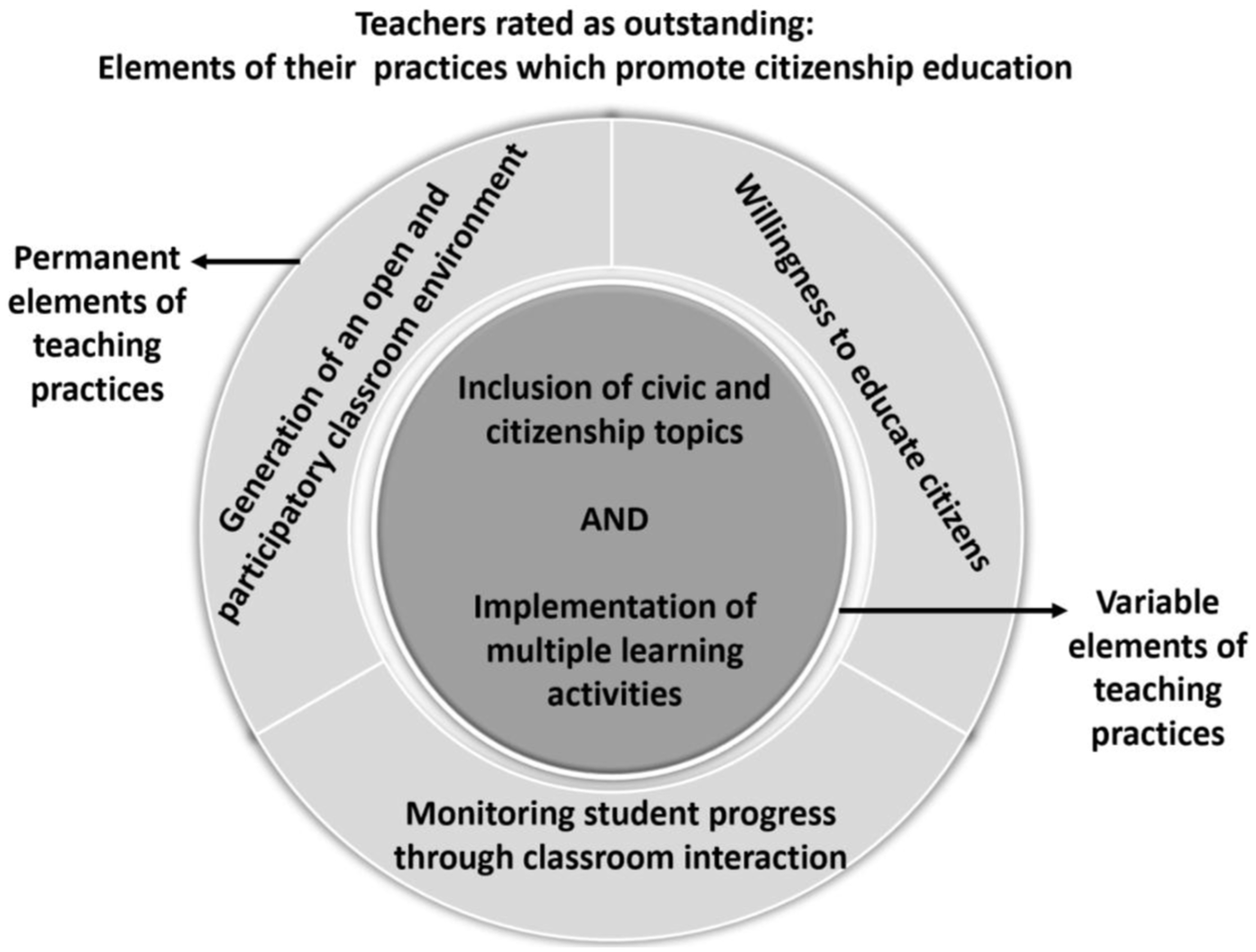
Teachers rated as outstanding: Elements of their practices which promote citizenship education.
Permanent elements of teaching practices
The purpose of teaching: Willingness to educate citizens
A common trait observed in the videos is the explicit indication by teachers that students develop critical thinking, actively participate in their communities today and engage in society in the future. Regardless of study contents, teachers refer to how historical contents are projected and have an impact today, link the study contents with the daily reality of the students and ask them to reflect on them.
The intention to promote critical thinking can be observed in the teaching practices of working with historical sources of various types, in which students must contrast evidence and establish arguments, question the sources of information regarding their origin and the intentions of their authors, read the silence of the sources, and communicate the results of these actions orally or in writing. Extrapolating this to processes of citizenship education, this type of teaching strategy aims at generating critical and informed citizens able to explain their reality using historical and contemporary references.
The willingness of students to participate in the present study is clear from the words of the teachers to motivate students to act in their field, as in-class elections, sports clubs and social events such as marches and demonstrations. Calls for future participation materialise in the formal sphere, such as the electoral processes of political institutions, and on an informal level in the idea that ‘they are someone in life’, that is, once they finish compulsory schooling, they will be honest people striving to contribute positively to the development of the country.
Monitoring student progress through classroom interaction
A common trait among the teachers was the continuous pedagogical interaction established with the students to monitor their learning. In this regard, the teachers led a dialogic process between themselves, the students, the contents and strategies to address them. As a result, they managed to generate instances of dialogue where listening, clarifying and assessing ideas was found essential, taking comprehension and reflection as the ultimate goals for the subjects. To do this, they started asking questions and then, based on the students’ responses, they did not give only monosyllabic answers or repeat the students’ responses. Instead, they generated new questions or redirected questions to other students. This allowed the teachers to verify the students’ understanding of the subject simultaneously and to use errors as an opportunity to learn and promote students’ participation in the class. Examples of this type of interaction are illustrated below.
After watching the video, I want you to tell me what you felt with the music and images that were shown.
The effort of the peasant.
The effort, in what sense?
In the sense that he works the land from sunrise to sunset and does not rest until it bears fruit.
What more can you say?
The conditions in which he works show he is working all the time . . . he does not rest, and he always stays in the sun, he is weakening his body and mind.
He is also reducing the physical effort: Might we say there is a psychological effort as well?
What information did you get from the images?
That allusions are made to laid-off and unemployed men, who do not have anything to eat, receiving breakfast or ‘once’. 1
To which country does it refer?
To the United States.
The images below: What does it represent?
They represent Unemployed families in Chile.
Was there any relation between the situation that the United States was suffering and the one that Chile lived through at that time?
Yes [in chorus].
Although they are distant countries, they had the same problems.
What were the problems?
The aim of this classroom practice, apart from monitoring students’ learning, was a more democratic class open to dialogue. Both are necessary conditions to promote citizenship education. Each time there were prolonged interactions between the teacher and the students, the students who participated were seated in different locations in the classroom and showed interest in following the development of the class.
Generation of an open and participatory classroom environment
Another characteristic of the practices evaluated is related to the speech and actions of the teachers, which favour the generation of a good learning environment. In the recordings, we noted environments of trust, where students are encouraged to express themselves and their points of view and defend them with valid arguments. In other words, it could be appreciated that students were able to argue responsibly, respectfully and tolerantly, taking advantage of the opportunity offered by the teachers to do so. Also, the discussion regarding contingent and controversial issues allowed students to feel and act as citizens in the classroom. Some examples are presented below in which an open and participatory class environment materialised.
Student participation
Is there someone who does not agree with the response of your classmate? Carlos, do you agree?
Yes, I do.
Henríquez, do you agree?
No, I do not.
Why? Share your opinion, please.
Establishing arguments
Perfect, Andrea, your opinion is valuable and contradicts what is being proposed so far, but how do you justify or demonstrate that what you say may be valid? In other words, argue your proposal, please.
The examples that were selected illustrate that the generation of a classroom environment conducive to learning is directly associated with the speech and actions of teachers during the class. It is also linked to providing opportunities for students to learn. The teacher encourages a proper relationship and communication between students, emphasising respect, tolerance, trust and collaboration.
Variable elements of the teaching practices
Inclusion of civic and citizenship topics
The subjects of history, geography and social sciences are propitious to motivating reflection on civic issues and citizens. After all, in the Chilean context, it is required that students understand how men and women lived in the past so that they can extrapolate that understanding to the present time. However, when faced with a single national curriculum full of conceptual contents, this inclusion might be omitted to ensure curricular coverage. Thus, much depends on the willingness of teachers to include them in a premeditated and spontaneous manner in their planning or to omit them completely.
In the observed classes, teachers often included citizens or civic subjects in a planned way, through the generation of questions or reflections beforehand, which materialised in the form of questions written on the board, PowerPoint presentations or work guides given to the students. It was also observed that some issues arose spontaneously in the classroom, which afforded the teachers the opportunity to go into them more deeply.
The civic topics observed related to human rights, political institutions, electoral participation, natural and cultural heritage, and individual liberties. The citizen topics involved the occupation of the territories of indigenous peoples (the Mapuche Conflict), identity and otherness, poverty, economic and social inequality, social justice, new information and communication technologies, social networks, sexism, roles and gender stereotypes.
The remarkable feature of the treatment of these civic and citizen contents is that they were not implemented through repetition or memorisation, but through comprehension and proposed analyses, establishing explicit relationships with the close environment of the students and promoting the development of reflective processes.
Next, we include an example of transcripts of classes whose theme was the ‘Pacification of the Araucanía’, a process carried out by the state in the second half of the nineteenth century to definitively incorporate Mapuche ethnic territories under Chilean sovereignty. The Mapuche are a native people located in southern Chile who fought Spanish conquest and occupation for almost 300 years. Until now, the ‘Mapuche conflict’ or land occupation by the Chilean state and subsequent sale to private holders have not been resolved.
[The students read a primary source, and then the teacher asks aloud]
Is there respect for human rights, according to the Mapuche worldview?
No, because the property was not respected, and violence was used.
In the occupation of Araucanía, there was a lack of respect for the other, since they took by force the lands belonging to them and their ancestors.
And they did not care that for Mapuche people, their land is sacred.
But, could it be the Mapuche people are somewhat to blame for what happened?
Today this topic is much discussed, as their actions still appear in the public opinion; therefore, it is important to discuss this topic today and analyse whether human rights and freedom are being respected. In this regard, what is your opinion about what your schoolmate says; do you think that Mapuche people are somewhat to blame? Before answering I ask you to read the following current news of the topic I brought you and then we will discuss it.
As can be seen in the previous extract, the teacher integrates topics related to human rights and Mapuche identity into his teaching strategy and refers students to national events. This problematising approach is consistent with the ‘new history’ approach where teaching is not conceived as a story but as the emulation of the historian’s job, and students must problematise the events studied, interacting with each other. The above motivates students to participate and pay attention in classes, as it gives them the opportunity to feel involved in their learning processes.
Implementation of multiple learning activities and formulation of problematizing questions
Implementation of multiple learning activities
The battery of teaching and learning activities that teachers use is wide and varied. The above implies that in a single class, we can find different activities with different recipients (individual, pairs, small groups and the class as a whole). Several activities emphasised the development of higher skills over memorisation, at the same time as they included the development of favourable attitudes for citizenship education, such as respect, collaboration, empathy and assertive communication.
At the same time, many of these activities require active learning by students, which helps them to develop critical thinking, since these activities require them to distinguish between fact and opinion, work together, analyse points of view, and discuss and argue on the basis of evidence, among other benefits.
Such activities also allow students to relate conceptual contents with practical elements, and often they were able to extrapolate them to their daily lives or national and international circumstances. In this way, students could give meaning to the contents studied, contributing to their understanding of the present society and the relevance of their participation in it. Among the activities implemented, the following stood out: debates, analyses of audio-visual sources, requests for analysis and reflection, which are exemplified below. Next, we incorporate examples of the implementation of this type of activities.
Adaptation and use of teaching historical sources
All the work we do today is based on documents, on responses from evidence, using sources. Remember that historical sources are evidence we use to reconstruct history. Then, we will respond to the question posed [. . .] we are going to dedicate a group time to this and then share the responses. Not all groups have the same sources. They will have images, texts, and graphics.
Map analysis
We are going to interpret maps to analyse the shape of the Chilean territory, specifically from the occupation of Araucanía. We will see the evolution of the territory from the 19th century up to the present. Thus, we will compare a series of maps that present the changes that Chilean territory suffered as a consequence of its occupation. Then, jointly, we will reach conclusions with regard to the continuity and present changes in the documents.
Use of audio-visual sources
Now we will watch this video, which is about the genocide perpetrated by Nazi Germany. I want you to think: What genocides are currently happening? Why do you believe that this phenomenon occurs? Then, we will discuss the answers and draw conclusions together.
Promotion of students’ own reading skills in history
Here we have a series of letters from Loncos Mapuches [leaders], where several presidents of the time wrote to demand resolutions of their complaints, complaints that so far have not been resolved; I want us to analyse these documents.
Debates
[The teacher poses a problematic situation where the students must submit their point of view about it.]
Yes, I understand your point. We have two different visions. One [. . .] that supports the action of the State, on the other hand, [. . .] a super-legitimate vision, [. . .] those lands are of the Patrón [the boss], the lands belong to him [. . .] and it is unfair to remove them.
You have to keep in mind that there are Patróns and Patróns. Some Patróns exploit their workers, leaving them in the most precarious way possible, [. . .]. There are other Patróns that put their land at their disposal and gave them what belonged to them for working on those.
Then it depends on the Patrón, if you would support him or not. If the Patrón is bad, do we take the lands and if it is good we do not take them? Something like this?
Yes!
I do not agree with what he says; this is in general, it is not about excluding someone who does his job well as Patrón and another who does not, as I think all should be classified as bad.
Although these descriptions are examples of the implementation of different teaching strategies, from their analyses, it can be seen that through them different civic and citizen subjects are problematised, while active learning and participation in classes are encouraged.
Formulation of problematising questions
The teachers could be observed formulating questions in their classroom aimed at generating critical thinking in students, looking for students to reflect, discuss and take a position on controversial or contentious situations, and problematising the content studied. After the students respond to the questions, the teacher can formulate new questions taken from the conclusions of the students.
It is perceived that these questions are planned consciously and intentionally by the teachers (they include them in their class presentations, or they are written; this is material that they hand out), and sometimes they guide the development of the whole class. However, it is not enough just to formulate questions; teachers must also be capable of asking new questions taken from what the students conclude; their main role is to act as mediators in exchanging arguments. Next, some examples that problematise the content that has been taught are shown:
Can young people express themselves freely today? [. . .] Is freedom a human right? [. . .] Is the way in which young people express themselves today correct, for example with marches and demonstrations?
Today we are going to elaborate a question which we are going to answer during the class: Why is the Great Depression considered one of the most terrible crises in history? Might a similar situation happen nowadays?
Should we ignore the laws that we consider ‘bad’ and that harm part of the population? Is it licit to not observe the laws to achieve a specific aim? Is it licit to act as Robin Hood today, taking from the rich to give to the poor?
The formulation of these questions, which follows the problematisation of the studied contents, offers students the opportunity to understand the relativistic character of social knowledge, a collective construct that is in constant reconstruction. In turn, it allows students to realise connections with their local and national reality, understanding that in the school context, the study of the past is intended for students to understand the present and be able to act in it.
As can be seen from the examples above, each category is closely interrelated with the others, so our proposal to divide them might be understood as dividing classroom practices from each other, but it is not, in fact, possible to study one in isolation from the others. For this reason, the coding and categorisation process was extensive, since different codes and categories were assigned to the same text. The amount and types of codes per category can be found in online Annexe 1.
Discussion
The nature of historical knowledge and its relationship with citizenship education
One aspect that favours the existence of the good practices described herein is the competences of history, geography and social science teachers regarding the repertoire of social and political subjects included in the school curriculum. While it is expected that all teachers can encourage citizenship education, it is recognised that teachers in this area are capable of transmitting to their students a comprehensive and reflective concept of citizenship (Rosa and Brescó, 2017). They can raise questions, encourage debate and allow the development of a dynamic of critical thinking, which is fundamental for the civil competencies that are expected to be promoted (Eurydice, 2017; Ministerio de Educación, 2016). From history, the education of citizens implies, according to Giroux (2003), a historical practice which is socially constructed, constantly problematised and rebuilt each generation, so competent teachers in this subject, should be able to discuss with their students the concepts, skills and attitudes related to citizenship education and provide new meanings aimed at the understanding of future generations.
On the contrary, history teachers rated as outstanding have a wealth of activities linked to their discipline which are appropriate for citizenship education. For example, work with sources and map analysis is in tune with developing skills to understand information and critically analyse it (Eurydice, 2017); this is even more true in the case of audio-visual materials, which are used for technological literacy and to decode the digital world in which the students are embedded (Haste et al., 2017).
Citizenship education in the classroom: Interaction as a key element
Contrary to what was observed in other studies of history teachers and citizenship education in Chile (Bonhomme et al., 2015; Muñoz and Martínez, 2015), the teachers rated as outstanding and participating in this study teach from examples, with actions, interactions and speeches that promote respect, tolerance, democratic participation and empathy, and generate an open learning environment, in tune with other successful experiences in citizen education (Hahn, 2016; Schulz et al., 2010).
The way in which teachers interact with their students is key to building learning. The quality of communication exchanges between teacher and students sets the difference in the development of higher cognitive abilities. According to González and León (2009), it is very important that in the relationship between student and teacher, the latter searches, listens, clarifies, promotes and considers students’ ideas when it comes to teaching new contents. In this sense, it is necessary that through their questions and follow-up, teachers encourage students to make comments and welcome them as far as they can to build learning, which was noted in the teachers we evaluated and is in agreement with the recommendations of the literature (Hahn, 2016; Hess and McAvoy, 2015; Muñoz and Martínez, 2015).
Teachers who shape citizens
The study of teaching practices and their effectiveness can be only understood entirely within its context, that is, in the place where these practices are developed (Martínez et al., 2016). In this case, all the teachers who were evaluated work in the Chilean public education system, which welcomes students from the lowest socio-economic strata of the country. Therefore, it can be inferred that they are teachers who are aware of the socio-economic difficulties faced by their students now and most likely in the future. Thus, the desire of these teachers that their students become ‘someone’ leads them to behave as models of participation (Ministerio de Educación, 2014b) and work for the development of critical thinking so that in the future they can act in society, knowing their rights and responsibilities and being able to develop themselves in a neoliberal system of politics and market that, instead of giving opportunities, oppresses them and makes them invisible (Nieto, 2018). In this regard, recent studies have shown that Chilean schools can make a difference by playing a decisive role in citizenship education, in view of their ability to level economic differences and behave as centres in which civic knowledge and participation are encouraged (Castillo et al., 2014a). This is consistent with international studies indicating that teachers have the capacity to act as models of participation, behaviour, and civic and citizen attitudes (Alviar et al., 2008; Hahn, 2016; Martens and Gainous, 2013).
However, there is still a long way to go to make this the norm, since in Chile, the greatest range of civic knowledge and the highest expectation of political participation is found in the country’s highest socio-economic strata (Castillo et al., 2014b; Treviño et al., 2017). This situation is not unique to Chile, and numerous studies have indicated that the level of participation of young people and their knowledge of civic issues are directly proportional to their economic level (Hooghe and Dassonville, 2013; Scholzman et al., 2012 Schulz et al., 2010).
Teacher evaluation and the public policy of citizenship education in Chile
In this study, we have pointed out that teachers rated as outstanding by teacher evaluation in Chile have in their repertoire of classroom practices concrete actions that promote citizenship education. However, we see that the Chilean educational system does not have many instances of places to share or disseminate good practices so that more teachers in the country could develop them. In this regard, it is pertinent to highlight that the large amount of material that is generated every year through the Teacher Evaluation System has become an invaluable resource for the academic world since it allows researchers to conduct investigations aimed at improving the pedagogical practices of education teachers and spread them within the school system. In addition, this allows teacher training centres to revise and improve their teaching approaches and adapt them to the requirements of the school system. While a single observation is not enough to assess the quality of teaching (Martínez et al., 2016), this depends on the context, as what is effective with one subject may not be with another. Thus, we consider the video material provided by the Ministry of Education an opportunity to investigate teaching practices that favour students’ learning, which should be disseminated.
This study was conducted in the context of changes in progress in the public policy of citizen education in Chile. As mentioned before, since 2016, Law 20911 has mandated that schools implement a Citizenship Education Plan that includes the entire educational community. Moreover, in the year 2019, this will have to include citizenship education in the last 2 years of secondary education. From this conjuncture, we wanted to investigate the ways in which teachers considered the ‘best’ in the school system encourage citizenship education since they have received outstanding results in the Evaluation of Teaching Performance.
The dissemination of the results of this study, that is, classroom practices of Chilean teachers promoting citizen education, has become especially relevant after the results of the first study of the implementation of the Citizenship Education Plan carried out by the United Nations Development Program (2018). These results indicate that the vast majority of activities included in the plans are extra-curricular and take place outside the classroom, that is, the schools that were studied do not consider the potential of the classroom (where students spend most of their time) in promoting citizenship education.
Conclusion
The results of this study revealed that teachers rated as outstanding by the teacher evaluation system know strategies to promote citizenship education, which are not related to the specific content of the subject. Thus, these practices can be implemented, beginning in pre-school education without the need to wait to finish secondary education to teach students to be citizens.
This study does not seek to be representative. Rather, since it intentionally selected teachers who have been evaluated highly, it seeks to provide information for future decision making regarding citizenship education in the public policy of Chile. Thus, one of the key points that have been previously discussed is that citizenship education should not be perceived only in terms of its disciplinary content or in its traditional approach linked to political institutions, that is, it must be conceived as a way of teaching the class in many different respects. The type of pedagogical interaction and the environment of the classroom that is generated, for example, are important. Teachers should encourage the development of tolerance, participation, dialogue, inclusion, respect and collaboration so that their students can practice live citizenship in their own classroom (Avery et al., 2013; Cárdenas, 2017). This allows history, geography and social science teachers not to be the only persons responsible for promoting it, as has been the case so far and as is expected by the new public policy.
Before concluding, it is necessary to establish two important limitations of this study. First is the small number of cases presented, which is explained by the small number of teachers rated as outstanding in these areas each year. Also, the Ministry of Education did not keep records of outstanding teachers before 2012, as at that time they used a technology that has since become obsolete (video cassettes), on the basis of an official resolution to this effect. Second, the nature of the research question, referring to studying practices that promote citizenship education, does not allow this study to present practices that do not necessarily contribute to promoting citizenship education which was shown by the teachers evaluated. Hence, this study seeks to show what teachers are doing well without making an entire characterisation of the classroom practices of teachers rated as outstanding, which is the subject of another article currently under review.
We consider it necessary for the Ministry of Education of Chile to generate prescriptions and monitoring processes (such as improving workshops or implementing courses) so that educational establishments are properly prepared to promote citizenship education from pre-school to the secondary level in all disciplines. Every year, the Ministry convenes workshops in schools to reflect on the results obtained from high-impact standardised measures or to disseminate changes to be implemented in the school system. Thus, these measures should also be taken to improve teachers’ understanding of citizenship education and how to promote it inside and outside the classroom. In this regard, studying practices that promote citizenship education has enormous potential for providing feedback to improve initial teacher education and the processes of continuing education.
Supplemental Material
ANEXX_1 – Supplemental material for Teachers’ classroom practices for citizenship education: Experiences of teachers rated as outstanding
Supplemental material, ANEXX_1 for Teachers’ classroom practices for citizenship education: Experiences of teachers rated as outstanding by Carmen Gloria Zúñiga, Priscila Cárdenas, Rosendo Martínez and Laura Valledor in Citizenship, Social and Economics Education
Footnotes
Funding
The author(s) disclosed receipt of the following financial support for the research, authorship and/or publication of this article: This research has been funded by the National Commission of Science and Technology of Chile (CONICYT), through the project FONDECYT 11150165 Effective teaching practices of outstanding teachers of History, Geography and Social Sciences.

Supplemental material
Supplemental material for this article is available online.
Notes
References
Supplementary Material
Please find the following supplemental material available below.
For Open Access articles published under a Creative Commons License, all supplemental material carries the same license as the article it is associated with.
For non-Open Access articles published, all supplemental material carries a non-exclusive license, and permission requests for re-use of supplemental material or any part of supplemental material shall be sent directly to the copyright owner as specified in the copyright notice associated with the article.
