




Abstract
Germany’s economic order is labelled ‘Social Market Economy’ in order to indicate that the economic system has both an economic and a social dimension. Its purpose is to reconcile efficiency goals and social responsibility. The concept of the Social Market Economy is based on central values such as freedom or justice. Under the label Social Market Economy, Germany has become an extensive social welfare system. However, the acceptance of this economic system has decreased over the last two decades. Especially in the eyes of young citizens, the value of justice is no longer upheld in Germany. Competition as an organising principle of economy is no longer esteemed but considered a threat and freedom has lost appreciation as a value. The goal of the study is to find out what the conception of Social Market Economy among first year undergraduate students looks like. In the context of the educational reconstruction model, we compared the students’ conceptions to professional assumptions in order to create a new pedagogical structure. The method is a qualitative approach, analysing students’ essays on Social Market Economy and its values. During the study, we found out that young people’s attitudes towards the economy and values highly correlate with their cognitive knowledge and education.
Introduction
In 2012, one of the biggest German opinion research institutes headlined ‘Social Market Economy: Accepted Model with Functional Weaknesses’. 1 Only 49% of the respondents are ‘altogether’ satisfied or very satisfied with the economic order in Germany. Another 50% are unsatisfied. 2
According to Infratest dimap, 65% of the respondents consider the Social Market Economy as the best model for Germany. In all, 67% believe the Social Market Economy was decisive for the current positive economic situation in Germany. However, 52% also believe that the Social Market Economy is the reason for injustice in Germany. To make it brief, a slight majority of the Germans question the fairness of the Social Market Economy. This, however, is opposed to the acknowledged high performance of The Social Market Economy in economic areas and to its general appreciation (‘best model’). This appreciation can also be seen in the current survey findings of Allensbach – Institut für Demoskopie (2012). According to these findings, 43% of the Germans currently have a ‘high opinion’ about The Social Market Economy and only 27% have a ‘low opinion’. The remaining 30% are either indifferent or do not have any opinion about the economic system in which they live. However, this has not always been the case in the past 10 years. In 2010, three quarters of all German citizens found their economic system unjust and only 31% had a good opinion about it. 3 If even in prosperous times the crisis of value and sense persists, the question is in how far cognitive aspects play a role in the crisis and possibly worsen it. Is it only about dimensions of survey and opinion research that try to depict and describe public opinion or should we examine causal links between influence factors as well as attitudes and opinions, namely, what factors impact the crisis of purpose of the Social Market Economy in Germany?
First indications of influence factors come from the empiric-psychological methods that Kaminski et al. (2007) used in their study about attitudes towards the Social Market Economy (Kaminski et al., 2007). By means of their correlation study, they are able to prove that the respondents’ attitudes towards the Social Market Economy are all the more positive, the more they know about economics. The following correlations indicate this as well:
The more the respondents know about the Social Market Economy and its alternatives – free enterprise economy and centrally planned economy;
The more economic systems they know;
The more deeply they are interested in economic questions, the more positive is their attitude towards the Social Market Economy.
Stronger correlations only occurred for respondents who have a very positive attitude towards democracy, who are patriotic and proud of common goods or who have a deep trust in the state and its performance. Experiments conducted after the survey prove that economic knowledge and more interest can influence the attitude towards the Social Market Economy in the short term as well as in the long term. Therefore, a design was developed in which the test persons took crash courses which provided them with information about different economic systems. The information led to significantly positive attitude changes. Also, the concurrent in-depth interviews indicate the possible basic problem of the Social Market Economy.
Is the frequently debated crisis of purpose of the Social Market Economy based on a crisis of knowledge transfer? A closer look at the Allensbach survey data indicates this as well. There was a considerable difference between East and West German opinions in the evaluation of the German economic system:
The problems of the acceptance of market economy in Germany were low as long as income and employment increased at a high rate and relative losers were considerered winners on a larger scale. The direct comparison with the less successful centrally planned economy of the German Democratic Republic (GDR) additionally stabilized the market system.
4
This can be explained by the fact that since 1990, the relative advantage of the Social Market Economy as well as the experience of its benefits has decreased significantly (Sauerland, 2013: 13) and by the fact that education processes have not counterbalanced the missing direct comparison of centrally planned economies and the Social Market Economy. The fact that the acceptance increased again in 2012 may again lead to a new experience: Compared to other European market economy systems, Germany’s market economy has proved itself as the best. Both interpretations support the thesis that there is a lack in economic education in the area of economic systems because the better the comprehension – especially of the complex connections in an economic system – the better, ceteris paribus, the acceptance.
This article focuses on first year undergraduate students. We investigate in how far the crisis of value and sense is a crisis of knowledge transfer that can be traced back to the school system and economic education in Germany. Since the article’s question is predominantly concerned with teaching methodologies and since it is supposed to contribute to overcoming the knowledge transfer crisis, the scientific principle of ‘educational reconstruction’ is used and taken as a structuring basis for the article. It is based on the notion of ‘Conceptual Change’ (Scott et al., 1997) that leads to a new structuring of teaching methodologies. Therefore, we qualitatively gathered students’ everyday ideas (Kattmann, 2004: 44) and analysed them quantitatively as well as qualitatively based on an analysis of the professional basis of the Social Market Economy (Gropengießer, 2001: 33; Siebert, 2004). In the outlook, we present suggestions for a new structuring of teaching methods of the content field by comparing both perspectives.
The model of educational reconstruction
According to constructivist epistemological theories, learning does not mean the reproduction of what is given but the creation of one’s own theories (Piaget, 1950; Von Glasersfeld, 1989). The social-constructivist point of view that was taken into consideration here, just like the classic constructivist one, comprises a broad spectrum of ‘varieties’; they range from phenomenologist perspectives of learning (Linder, 1993; Marton, 1986) to the approaches of Vygotsky (1997) and the soviet historico-cultural school to approaches that – rather undifferentiated – can be characterised by ‘situated cognitivism’ (Hennessy, 1993). The latter take up the results of socio-constructivist studies on knowledge genesis in scientific communities (Knorr-Cetina, 1981) and on everyday mathematics and science (Brown et al., 1989; Lave and Wenger, 1991). Furthermore, there are increasing efforts in the teaching methodologies of sciences to combine socio-constructivist positions and approaches about changes in conceptions (Vosniadou, 1996) that Schuhen (2010) applied to economics education. They are oriented towards an ‘inclusive’ point of view (Duit and Treagust, 1998). It has been shown (e.g. Duit et al., 1998; Schuhen, 2010; Stadler and Duit, 1997) that not only pre-instructional conceptions about the scientific content that is going to be taught influences learning in groups, but that social and material situations also influence the construction of knowledge in groups.
This is why the conceptions of reality of science and everyday life are considered equal in the context of the educational reconstruction model (Kukla, 2000). Everyday life at school, however, is usually dominated by the subject-specific clarification. Lessons are developed based on their contents and are oriented towards professional goals. The model of educational reconstruction (Duit et al., 2005) attempts to balance the central elements of teaching. It is based on the idea that scientific statements cannot be included in class without proper reflection but need to be educationally reconstructed and enriched with authentic real life complexity (Viiri and Savinainen, 2008) (Figure 1).
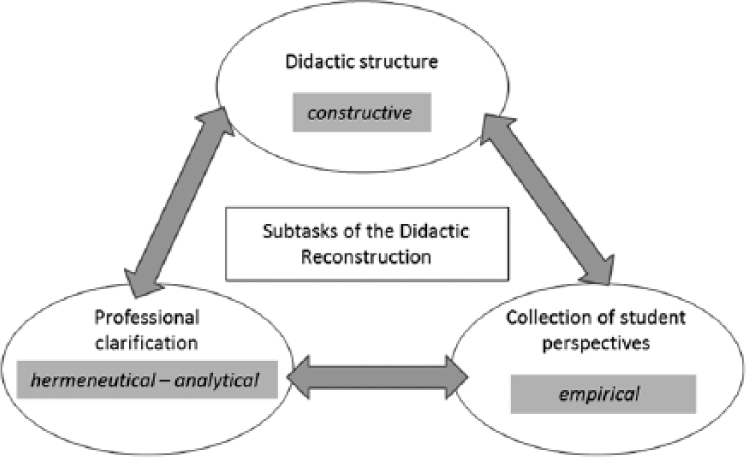
Subtasks of the Didactic Reconstruction.
Educational reconstruction aims at the interdependence of subject-related and pedagogic aspects and at the re-establishment of meanings as it is necessary in the case of the Social Market Economy according to the initial hypothesis. The connection between hermeneutic-analytical research for subject-related clarification that comprises methodologically controlled scientific statements, conceptions and historic presentations and an empiric study on everyday conceptions of students can and should lead to a new form of learning and teaching in class. In conceptual change approaches, the students’ everyday conceptions were qualitatively assessed and assigned to categories. In order to explain variations in acceptance, declarative knowledge (know what), procedural knowledge (know how) and strategic knowledge (mental models) should be made visible in a process of decontextualisation and deconstruction of perceptions and cognitive patterns (Bransford et al., 2000). Taking a glance at the data from a qualitative point of view is necessary because a sole quantitative analysis only shows the know what. Not everyone who is able to name parts of sample responses such as ‘pricing’ or ‘basic value of freedom’ is also able to use them correctly and meaningfully in a line of argument.
It is the task of didactic structuring to recursively establish a context between the economics and learner constructs (Research desideratum chapter 5). It is an attempt to bring together empiricism and theory in a systematic manner. The statements of the subject-related clarification constitute the theoretic target area of teaching that should be reached by the empirically given students’ perspectives because rational arguments by themselves frequently do not lead to the acquisition of scientific notions.
The students understand them but were not convinced of them (Jung, 1987). However, with regard to the role of affective aspects in conceptual change processes, the state of research has up to now not been recorded sufficiently, especially concerning economics education. There are merely initial attempts to record the interaction of the cognitive with the affective in that kind of processes (Kaminski et al., 2007) (Figure 2).
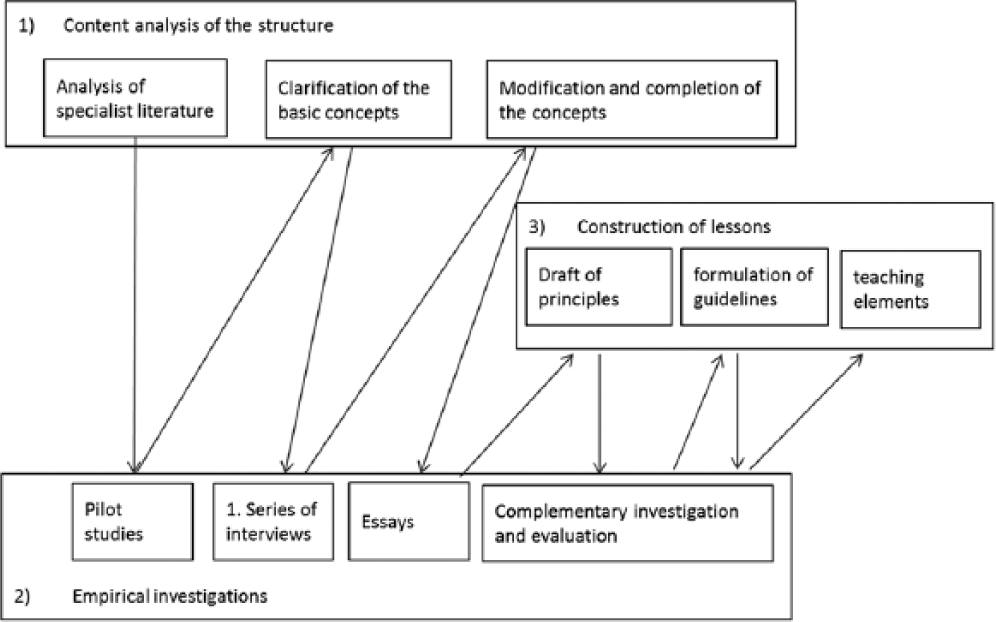
Research Approach.
The conception of the Social Market Economy in Germany
The post-war years in Germany were marked by widespread hardship. Devastation of infrastructure and of companies as a result of the war and the influx of several million refugees led to hunger, poverty, unemployment and pessimism among the populace. It was clear to the leading decision-makers – West German politicians and officials of the Allied Powers, notably of the United States and the United Kingdom – that only a quick reconstruction would solve these problems and stabilise the country (Turner, 1989).
The “Zeitgeist” of the economic policy was characterised by the belief in the necessity of the public control of economic processes. This applied to Germany and the United Kingdom as well as to large parts of the United States. In contrast, reform-minded West German politicians – most prominent among them was Ludwig Erhard, who eventually became economic secretary – favoured a market-based solution. With the currency reform, the introduction of the Deutsche Mark (DM) and largely free prices of consumer goods through the ‘Leitsätzegesetz’, an expansive economic development was introduced. It was later referred to as the ‘economic miracle’ (‘Wirtschaftswunder’) from which almost the entire population benefited (Van Hook, 2004). Consequently, the acceptance of the economic policy was high.
The new concept of economic policy in the Federal Republic of Germany rejected the public interventionism of the interwar period as well as economic liberalism of the nineteenth century. Instead, an efficient market order was to be combined with the principles of social responsibility (Nicholls, 2000). The term ‘Social Market Economy’ was introduced by Alfred Müller-Armack. Until today, it has remained diffuse in substance and is accentuated differently. A connection between efficiency, social adjustment, freedom and consensus is common to all interpretations. What is crucial for the understanding and the teaching of the concept of the Social Market Economy is its reference to values and its roots in the social structure of society (‘Economy of Values’: Goldschmidt, 2008). However, it was not until the German unification and the unification treaty of 1989 that the principles of the Social Market Economy have first been legally codified (Figure 3).
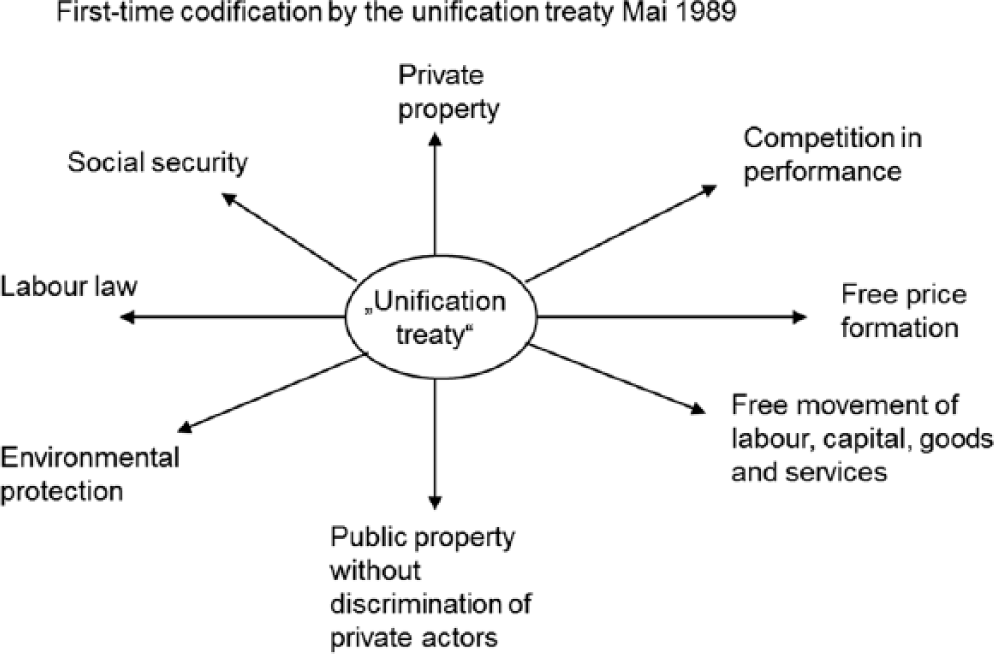
Unification Treaty.
One of the most essential characteristics of the Social Market Economy is its adaptability to various conditions. The objective can be best explained by a quotation of one of its founding fathers Müller-Armack (1956 [1966]). It is ‘to combine the principle of freedom in the market with the principle of social balancing’ 5 in order to create the frequently quoted ‘prosperity through competition’ (Erhard). This is why the basic structures were purposely established as an open system based on a value system.
The economic thoughts of the human being are in the centre (Dickertmann and Piel, 2002). Individual needs, available resources and the relative scarcity of resources lead to allocation problems that are solved decentralised by the coordination mechanism of the market. Suppliers and consumers compete with each other and try to adapt their individual plans to those of the opposite party. In a system of this kind, prices represent the degree of scarcity of a good or service and show the individual willingness to pay a certain price. The Social Market Economy assumes that payment is an incentive for individual performance and profits are a risk premium for the capital employed. The drive for technical progress in order to manufacture at lower prices or to develop new products arises from price competition.
If private households are not able to provide for their own secured livelihood, according to the Social Market Economy, a redistribution by the state should take place. This is justified by the state’s motivation to protect its people and the resulting task of securing social freedom. Furthermore, the welfare state imperative calls for an additional redistribution for the purpose of social protection and finds expression in the basic social values and in a redistribution-oriented organisation of the taxation system.
An occurring lack of effectiveness, for example, due to limited information can lead to uneconomical market outcomes (market failure) that need to be corrected by means of regulatory and process intervention by the state. First, this correction function is applied by the competition law. Second, lacks in the supply of goods can occur such as in the case of public goods. In this case, a decentralised coordination can also be suboptimal due to free riders. The same goes for external effects. If members of future generations do not yet have a chance to stand in for their interests, the state is asked to take action (e.g. with regard on the environment). The state has to counteract these lacks of effectiveness with the design of an institutional frame and with a further development of the economic and social order, on one hand, and with a process control on the revenue side, especially on the taxes and expenses side, for example, transfers and subventions, on the other hand.
The basic values that build the foundation of that order are fundamental to the development of the Social Market Economy. The term ‘basic values’ is not defined consistently. It may encompass rights, moral principles, virtues or institutions. In this article, we define basic societal values as higher ranking notions of what is preferable in society. They represent the basic consensus in an open and pluralistic society. They are universally valid and therefore have to be specified anew in every subsystem of society, for example, in public education, in the public health system or in social policy.
Together with interests and efficiency, basic values impact the institutional structure of the economy and the society because their specifications belong to the foundation of these very institutions. The basic values are as follows:
Freedom. According to Isaiah Berlin (1958 [1969]), we distinguish between two concepts of liberty: negative liberty (‘freedom from’) and positive liberty (‘freedom to’). Negative liberty means the absence of disproportionate coercion as in Hobbes’ concept. In addition, positive liberty includes the liberty to realise one’s own decisions. Both can come into conflict with each other when the state restricts negative liberties in order to enforce positive liberties.
With respect to basic needs, positive liberty is an inevitable goal of a socially responsible economic order, since the cynism of a negative liberty encompassing the ‘liberty to starve to death’ would arise otherwise.
Justice. The basic value of justice can be analogously interpreted just as the basic value of liberty in two respects: with respect to formal justice, it is about equal treatment for equal conduct, for example, as equality before the law. Finally, it comes down to the prohibition of discrimination. With respect to material justice, a redistribution of income and assets is carried out when equal treatment leads to unequal economic results. Both concepts of justice can conflict with each other in the same manner as the concepts of liberty. In the Social Market Economy, procedural justice is preferred which stands for equal treatment of equal conduct. However, market outcomes can be adjusted for social policy reasons.
Security. Without security, society would be a ‘war of every man against every man’ (Hobbes). Economic security means that the individual does not have to face the destruction of his or her economic background but that he or she can plan his or her future in advance. If security is altered by restricting the scope of action, security comes into conflict with liberty.
Progress. Progress is a result of the addition and application of knowledge. Economically, progress is reflected in new products and new production methods. Economic progress creates alternative sources of income, but at the same time endangers the economic security of those negatively impacted. This process of creative destruction (Marx, Sombart and Schumpeter) therefore leads to conflicts of values within the Social Market Economy.
Students’ conceptions
Study design and random sample
The study is based on essays (see study design) that were written by 219 first-year undergraduate students within a time of 30 minutes. We purposely did not survey pupils because the currently existing data stem from former pupils with a homogeneous qualification – an entrance qualification for higher education.
The task was as follows:
According to many newspaper articles, the Social Market Economy finds itself in a crisis. (1) What is the significance of the Social Market Economy and what is its task? (2) What are the constitutive elements of the Social Market Economy in your opinion?
In order to portray the students’ conceptions of the Social Market Economy as comprehensively as possible, we chose a two-step design for the analysis. First, the essays were evaluated quantitatively, in order to give an overview concerning the content areas that were mentioned in the essays. The results point to the didactic structuring that follows.
The qualitative evaluation is done according to the concept of the structuring content analysis (Mayring, 2008) and with the aid of the software MAXQDA. A list with all relevant technical codes can be found in Appendix 1 (‘Categories for the main run’). With regard to the category system, parts of the text are extracted systematically and recursively. Gathering epistemological conceptions about the Social Market Economy is in this case similar to the methodological principle of interpretation. The difficulty for the interpreters is to differentiate between the ‘variation in the students’ conceptions of a phenomenon and the variation in the students’ language in expressing their conceptions’ (Anderberg et al., 2008; detailed in Marton and Pang, 2008: 545). This also becomes clear in the qualitative analysis in section ‘Qualitative analysis: What conceptions about the economic system in Germany were mentioned in the essays?’.
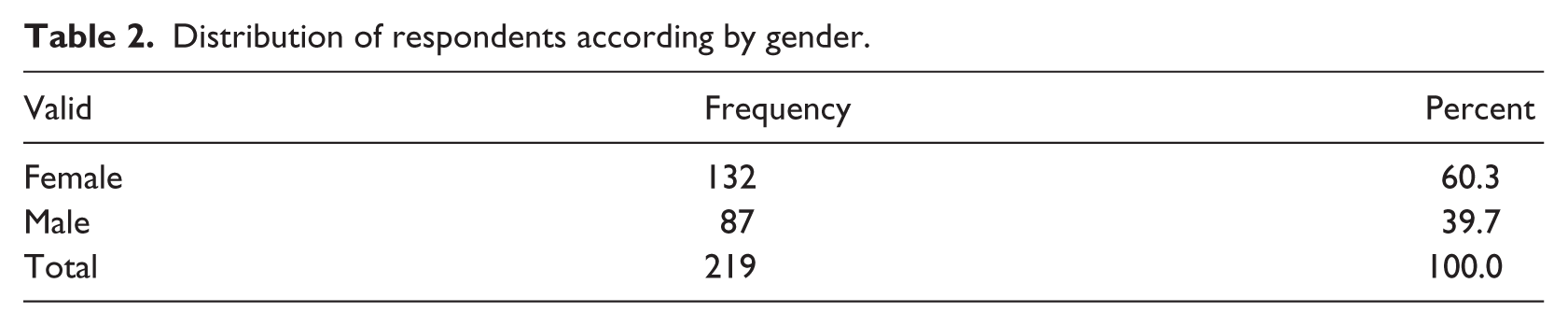
The group of respondents has the following characteristics: Most students of the random sample aim at teacher training in the social sciences (119). In all, 83 are not from social sciences (see Appendix 2) and 21 respondents completed a commercial training. The average age of the group is between 20 and 22; 132 respondents are female and 87 are male.
Quantitative analysis of the essays
Considering the ‘know what’ level of the three categories of the Social Market Economy, it becomes obvious that there are declarative knowledge gaps in all areas. With regard to contents, the categories are only covered by 7% and 14%. What is mostly represented throughout the essays is the category of fundamental rights. Their content areas were mentioned in up to 13.7% of the essays. Particularly, the different kinds of freedom are mentioned more often than other aspects in the context of the Social Market Economy (Figure 4).
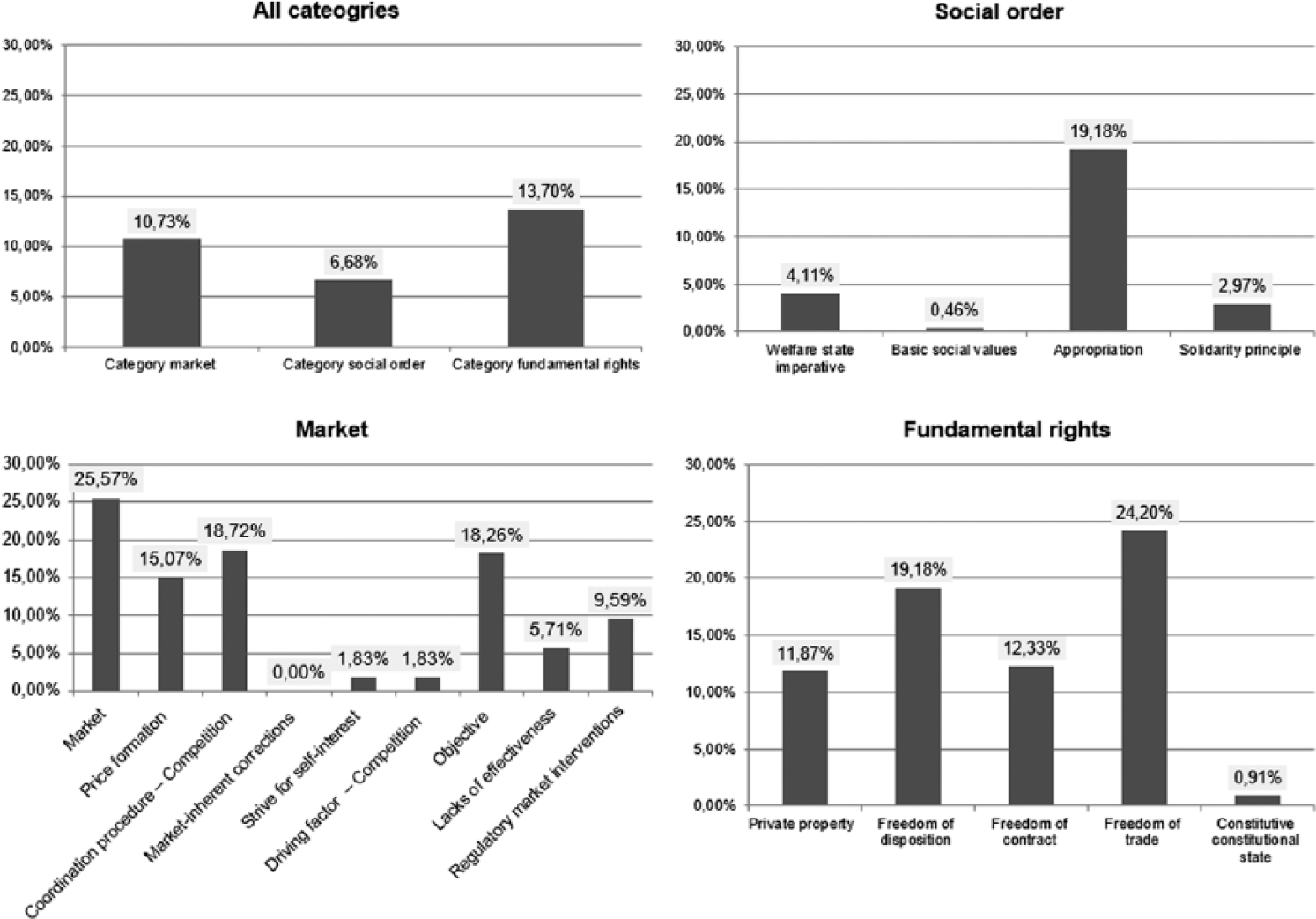
Quantitative analysis.
A look at each of the categories provides a detailed impression of the aspects that the students least link to the idea of the Social Market Economy. With regard to the market, there are inherent corrections, the strive for self-interest, as well as competition as a driving force field for the market. Other aspects such as the constitutional state, social fundamental rights or the idea of social solidarity that stem from other categories are not linked to the German economic system. The results of the quantitative analysis reveal significant gaps. This becomes especially obvious when directly comparing the students’ individual performances. Therefore, the respondents’ percentages were extracted from the codified answers and classified into three levels (level 1 = 0%, no knowledge; level 2 = less than 50%; level 3 = more than 50%). Depending on the category, the system shows that between 40% and 80% of the students are not able to explain essential elements of the German economic system. There are no significant differences resulting from age or gender. The fact that some students have completed a commercial training or the students’ number of semesters studied did not have a significant impact on the results either. Therefore, we assume that there is a general problem in teaching the contents (Figure 5).
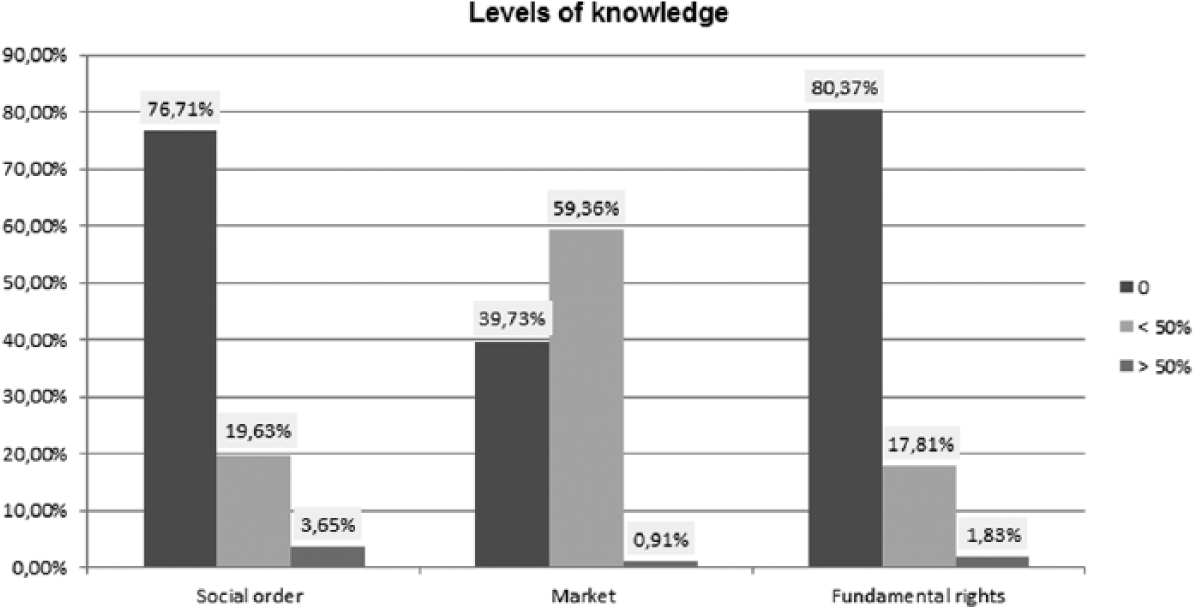
Levels of knowledge.
Qualitative analysis: What conceptions about the economic system in Germany were mentioned in the essays?
A look at the conceptions mentioned in the essays gives further evidence that a new didactic structuring of the content field is necessary. Fragmentary ideas as well as inaccurate argumentations and beliefs within the notions in the essays make this clear. Thus, one-third of the random sample mentions markets as fundamental elements of the Social Market Economy. However, the notion of the market situation and its processes is clearly divided into two blocks. On one hand, there are the ‘regulators’ who consider the state as a central executive body in the Social Market Economy. On the basis of several quotations, it becomes clear that they assume that the Social Market Economy organises the allocation of goods in the market, namely, to suppliers and consumers. The price is no longer determined by supply and demand but the Social Market Economy intervenes. According to the ‘regulators’, the allocation of goods is the most important task of the Social Market Economy. However, it does not always become clear whether the allocation results from the coordination principle at the basis of the Market or whether it comes about due to an intervention of the state: ‘In case there is less demand than supply, the prices have to go down, and suppliers suffer a loss. Supply and demand have to be in balance in order for the market to work’. It is only rarely directly stated as in ‘The Social Market Economy is managed by one central institution’. The ‘regulators’’ basic problem is that they usually know that coordination in the market happens through price formation, but that they can only intuitively imagine an institution (state/government) that regulates the market. Thus, 22 students consider the distribution of goods and affordable products as the main goal of the economic order and of economic policy. In this respect, the focus on the private household that is usually used for comparison in the students’ argumentation becomes very clear. From this point of view, the distribution of goods and revenues is the most important function of the Social Market Economy. It is in fact true that on a family level, this works best with one person centrally organising and distributing the goods.
The fact that the Social Market Economy prefers a decentralised allocation of goods and considers the market the place for the coordination of goods according to prices is only explicitly mentioned in 20% of the essays. However, when coordination according to prices is mentioned, it is always accompanied by the claim for fair prices. Only one essay explicitly mentions the price as an indicator for scarcity:
The Social Market Economy is supposed to lead to the greatest possible prosperity for everyone. The Social Market Economy should ensure that the population is provided with goods and services. In this context, the price is an indicator for scarcity. The Social Market Economy combines Free Market Economy with social aspects (redistribution of the wealth attained).
The students’ notion of competition is similarly ambiguous. Only 10 essays mention competition as a constitutive element of a market economy system. Among 23% of the students, the assumption prevails that the competitive order has the significance of a framework for the Social Market Economy to ensure – with the aid of institutions such as the Federal Cartel Office – that the market principle is not affected by lacks of effectiveness. For the acceptance of the Social Market Economy, however, the relative benefit mentioned in the beginning is essential. Yet, if only the regulating function of a competitive order is mentioned and the idea of competition to promote innovation is neglected, this could be another proof that initial hypothesis that the crisis of purpose of the Social Market Economy is based on a crisis of knowledge transfer is true.
Only 15% of the essays mention the goals that are supposed to be accomplished by the Social Market Economy. It seems to be inexplicit why the Federal Republic chose this specific economic order. In the students’ opinion, the main goal of the Social Market Economy is to alleviate the negative results of capitalism with social security (‘Capitalism is supposed to be defused’). No one mentions the actual goals such as the striving to ensure individual existence and economic freedom by means of personal wealth as well as the protection of social peace. Therefore, vital elements of the economic system which could explain possible acceptance problems are missing. The fact that only 12% of the students mention the value of freedom (freedom of trade, freedom of contract, freedom of consumption or freedom of choice of occupation) as an essential element of the German economic system shows that the subjective and reflective benefit of the granted rights of freedom does not become obvious.
This can be traced back if systems are compared, for example, to the system of the command economy in the former German Democratic Republic (GDR). This comparison appears to have taken place in some cases. Seven students differentiate between the Social Market Economy, on one hand, and pure market economy, planned economy and ‘Darwinism’ on the other hand.
These economic systems or economic approaches which correspond to the spirit of the time are considered unfair. For the Social Market Economy, it is a request to be more fair than those systems mentioned before. However, only two students believe that the Social Market Economy actually meets this requirement (see also Institut für Demoskopie Allensbach et al., 2010: 18). With regard to the contents, a comparison can be seen:
unlike the command economy where the price for a good and its output level are planned, the Social Market Economy is based on supply and demand; supply and demand also determine the price of a product; the price rises with rising demand.
However, the ideas about the planned economy are not always correct: ‘The Social Market Economy is the successor of the planned economy. Its task is to form a stable market in which everyone has the opportunity to operate’.
If freedom of choice is not recognised as a benefit, perhaps the supply of goods can serve as an element to promote the acceptance of Social Market Economy. This aspect only appears once in the essays, revealing that the relative benefit of the German economic order is not clearly established in the students’ minds. The Social Market Economy is regarded as the regulator of a free market economy. A total of 15 essays point out that the state has to intervene in the market when social justice and equal opportunities are endangered. Therefore, prosperity, social security, prevention of exploitation and support of the disadvantaged are mentioned as aims of the social system.
Other focuses are occupational safety, dismissal protection, the role of unions, vacation arrangement, secured pensions, social responsibility of employers and education for everyone. According to the students, the state is responsible for social security. Only in 12 essays solidarity is mentioned as a unifying element. The role of the principle of subsidiarity, which is a general principle in political thinking and also an organising principle of the Social Market Economy, is only mentioned twice, but it cannot be explained.
Implications for subject-related pedagogic structuring and redesigning of the material
If it becomes clear that declarative knowledge components (see the results of the three categories) can frequently not be linked to the idea of the Social Market Economy when teaching about the economic system, and if incomplete or incorrect individual constructions prevail in the explanation of notions, then this can be considered as an indicator for a general teaching problem in the German school system.
The key medium in German schools is still the textbook. In their analysis, Hofmann et al. (2012) show that the content fields of the economic system are usually explained by text excerpts from the founding fathers. In many cases, the excerpts are not appropriate to give the students a comprehensive introduction to basic elements of the economic order. One explanation could be that the excerpts are partly arbitrarily chosen and taken from common university textbooks for first-year students. They take a look at the relationship between market and state on a theoretical and abstract level, which makes an active discovering and experience-based approach to the fundamentals of the economic system more difficult (Schuhen and Weyland, 2011). Furthermore, according to Hofmann et al. (2012), neither textbook gives a cohesive and clear image of the economic system. Student orientation with situated and problem-solving tasks can hardly be found. Instead, reading comprehension tasks dominate, which require the reproduction of what has been read before.
If students had a direct and experience-based introduction to the socio-economic environment, on one hand, action-oriented learning as well as learning in authentic situations might correct the distorted perception of economic phenomena. On the other hand, this requires a critical and deep examination of economic theories (e.g. the theory of market structures). Teaching economic policy does not end on the level of presentation but economic experiments and simulation games concerning the economic order could make teaching and acting in economic contexts more dynamic. Thus, the game does not stop after one has come to know the rules and the basic constants of the economic system but the moves are played and experienced within the rules and the results can be reflected and discussed. The acceptance crisis that used to be the initial definition of the problem no longer only concerns the question whether or not the rules of the game of the economy are accepted. From a pedagogic point of view, this question comes too soon if students did not yet have a chance to plan their own moves within the rules and to experience the results. Only if the sense of an economic system becomes something that students can experience for themselves, acceptance will be promoted and will grow.
Footnotes
Appendix 1
Appendix 2
Distribution of respondents according by gender.
| Valid | Frequency | Percent |
|---|---|---|
| Female | 132 | 60.3 |
| Male | 87 | 39.7 |
| Total | 219 | 100.0 |
Declaration of Conflicting Interests
The author(s) declared no potential conflicts of interest with respect to the research, authorship, and/or publication of this article.
Funding
The author(s) received no financial support for the research, authorship and/or publication of this article.