




Abstract
This study aims to describe the effect of implementing Civic Education policies in a university on the development of students’ sense of nationalism and patriotism; this is analysed from the perspective of Edward III’s public policy implementation dimension and employs a quantitative approach based on the descriptive verification method. The findings show that the implementation of Civic Education policies at a university influences students’ sense of nationalism and patriotism. The degree of influence is low due to several critical factors, which include the following: (1) the development of Civic Education material is delegated to each university or to the lecturers teaching the subject; thus, materials do not consistently focus on content related to patriotism and nationalism and (2) policies are ineffectively implemented in the dimensions of (a) communication, as they are not ideally communicated; (b) resources, as lecturers have varied competencies without consistent academic backgrounds; (c) disposition, as the implementers lack commitment because of the limited number of educators compared to the number of students; and (d) bureaucratic structure, as this varies by university, resulting in failed unity of command and bureaucratic fragmentation.
Introduction
Across the different educational systems, there is significant variety in the degree to which Civic Education is standardized (Eurydice, 2012; Hahn, 1999, 2010; Hooghe and Claes, 2009; Torney-Purta et al., 1999). Although standardization is good, at times, it can have undesirable side effects, such as teaching to attain a high rating, investing more in students who are performing just below the satisfactory level – the so-called ‘quick gains’ – at the cost of the best and worst performers, increased grade retention, increased learning pressure and less positive attitudes from students towards learning (Amrein and Berliner, 2003; Carnoy and Loeb, 2002; Jürges and Schneider, 2010; Reback, 2008). However, it has also been demonstrated that centralization in an educational system decreases the impact of the school in terms of the amount learned by students, leading to more equal educational outcomes (Horn, 2009; Van de Werfhorst and Mijs, 2010; Wössmann et al., 2009).
In line with these opinions, to strengthen the presence of Civic Education in Indonesia, government has issued several policies for the implementation of Civic Education in schools and universities. The formal legal foundation of Civic Education in Indonesia includes Regulation No. 20/2003 on the National Education System and Regulation No. 12/2012 on Higher Education: Clause 37, article (2) of Regulation No. 20/2003 on National Education System jo., Clause 35, article (3) of Regulation No. 12/2012 on Higher Education states that the curricula of higher education should include ‘… Civic Education …’. Clause 35, article (3), point c of Regulation No. 12/2012 explains that
what is called Civic Education is an education of topics covering Pancasila, the 1945 Constitution of Indonesia, the Republic of Indonesia, and the concept of Bhinneka Tunggal Ika (unity in diversity), and to shape the Students into Citizens who possess nationalism and patriotism.
These regulations are congruent with the statement that ‘a good citizenship education curriculum should enable one to identify or give the meaning or significance to human and non-human things on the planet such as ideas or concepts including patriotism, majority and minority rights, civil society, and constitutionalism’ (Olibie and Akudolu, 2013: 99). Moreover, Cogan and Derricott (1998) state that ‘a good citizen, by contrast, not only lives decently in his or her private life but is also committed to participation in public life’ (p. 4). In the context of social life, the lives of students attending school are essentially a process of social education to prepare them to be the future citizens (Somantri, 2001).
A previous study on Civic Education focuses on 1 July 1997, when the sovereignty of Hong Kong was transferred to the People’s Republic of China. The developed Basic Law of Hong Kong is a quasi-constitutional document that delineates the framework of the political system. Hong Kong became a Special Administrative Region of the People’s Republic of China, with a high degree of autonomy in all matters except foreign affairs and defence. However, Hong Kong’s policy changed, and its autonomy gradually ebbed away. Economic and political crises in the aftermath of 1997, cultural conservatism, ideological nationalism and political patriotism were introduced as official hegemony by the ruling party to express loyalty to the Chinese government. Officials played a key role in creating a national identity in Hong Kong. The curricula for school subjects were revised to help pupils understand and appreciate their Chinese cultural heritage and the workings of the economic and political system of the People’s Republic of China. However, this was not an easy task, and it has continued to cause controversy in Hong Kong (Steven, 2014: 177).
Problem of the research
The policy of teaching Civic Education at every level of education in Indonesia is not a novel concept. The expression of ideas in Civic Education can be found in different forms and under different names. However, the use of the epistemology of Civic Education in Indonesia as education in a new discipline has only been found in Somantri’s (2001) academic paper entitled ‘Menggagas Pembaharuan Pendidikan IPS’ translated as ‘Innovations in Social Studies Education’ and in Winataputra’s (2001) dissertation entitled ‘Jati Diri Pendidikan Kewarganegaraan sebagai Wahana Sistemik Pendidikan Demokrasi’ translated as ‘The Identity of Civic Education as the Media of Systemic Democracy Education’ (Sapriya, 2007: 619), and as in many other countries, Civic Education in Indonesia remains optional, fragmented, poorly resourced, lacking in theoretical basis and taught by reluctant or poorly trained teachers (Rowe, 2000: 201). This is because some of the specific programmes adopted in the name of citizenship education seem much more likely to indoctrinate than to educate (Sears and Hughes, 2006: 9). Hence, the interest in the citizenship education outcomes has of recent increased (Eurydice, 2012; Marieke and Waslander, 2007).
Research focus
Civic Education – promoted through the refinement of standards and the empowerment of implementable policy, both formal and legal (Regulations No. 20/2003 and No. 12/2012) and curricular (Muhajir and Khatimah, 2013) – is expected to develop the character of the Indonesian people, particularly their sense of nationalism and patriotism. Based on this consideration, the author of this article is interested in analysing the effect of Civic Education policy implementation in a university on students’ sense of nationalism and patriotism.
Methodology of research
This study employs a quantitative approach. Data are collected using the survey method. This method is used to obtain data from a natural setting; however, when collecting data using the survey, the researcher employed several techniques, including the questionnaire, a test and structured interviews (Sugiyono, 2009: 13).
The study combines descriptive and verification methods to gather secondary data on the effect of Civic Education policy implementation at a university on students’ sense of nationalism and patriotism. The source of data is responses to a questionnaire about the effect of Civic Education policy implementation at a university on students’ sense of nationalism and patriotism; these questionnaires were administered at 10 universities in Indonesia, which the researcher regards as representing the diversity of universities and their students.
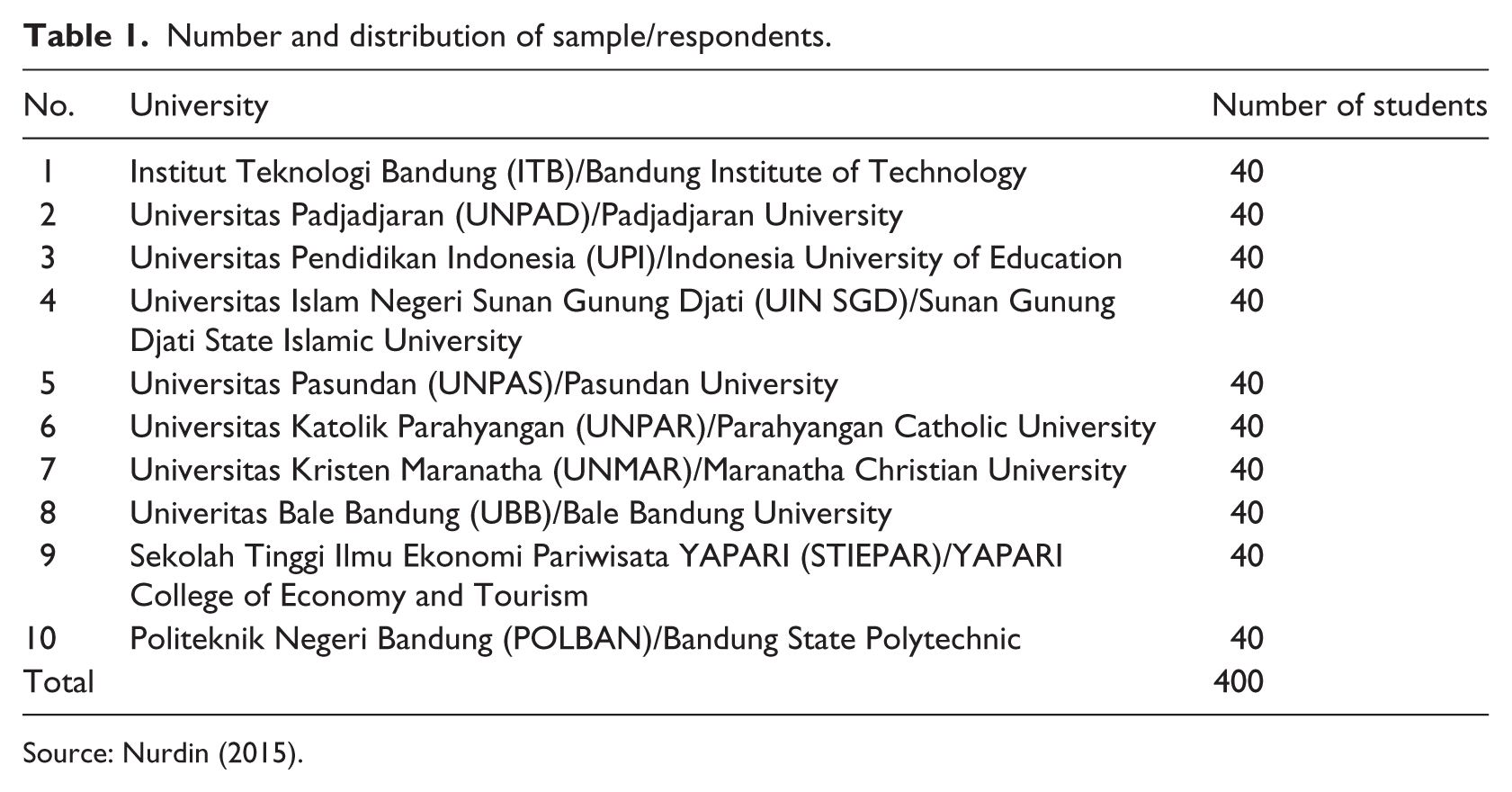
The respondents are students who studied Civic Education at their university. The sample was set at 400 people (40 students from each of 10 universities) using a quota sampling technique. A detailed description of the respondents is displayed in Table 1.
Number and distribution of sample/respondents.
Source: Nurdin (2015).
Data were gathered using (1) a questionnaire, (2) observation, (3) interviews and (4) a document study. The data collection in this study is cross-sectional, that is, a study conducted on certain objects at a certain point in time. The primary and secondary data collected were analysed using multiple-regression techniques with the aid of SPSS 20.0 for Windows and Minitab.
Results of research
Based on a calculation of the questionnaire responses using SPSS 20 and Minitab, there is no missing data from any of the universities, which means that the analysis can proceed to the next step. There were 40 student respondents from each university, resulting in a total of 400 respondents, and all questions are valid.
From the normality test, it is found that normality is satisfied if the test result is not significant, given a significance rate of 0.05. In contrast, if the result is significant, the normality requirement is not satisfied. The significance of the test result is determined based on the significance value (Sig.). The test reveals that the significance values of all universities are <0.05, indicating that the sample is from a normally distributed population.
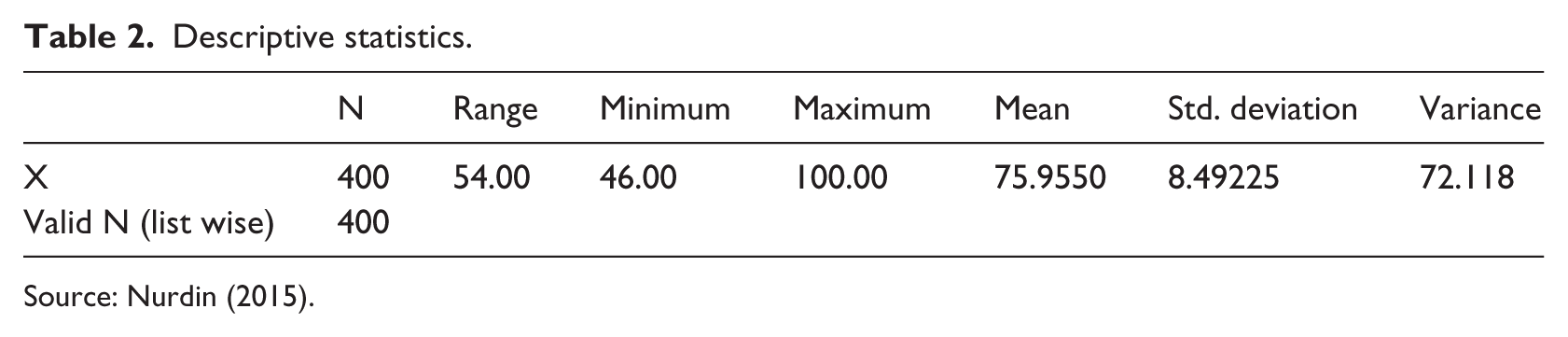
From the data in Table 2, it can be seen that a mean score of 75.9550 is found based on all 400 respondents. The variance is 72.118, standard deviation is 8.49225, the minimum score is 46, the maximum score of 100, and the range or difference between the maximum and minimum score is 54.
Descriptive statistics.
Source: Nurdin (2015).
Meanwhile, from the output of the One Sample Statistics table of SPSS, it can be seen that the number of respondents/data (N) is 400, with an overall mean score of 75.96 ≈ 76 respondents. The standard deviation, showing heterogeneity of the data, is 8.492 and the standard error of the mean is 0.45. The standard error of the mean reflects the mean distribution of samples on the overall mean (Table 3).
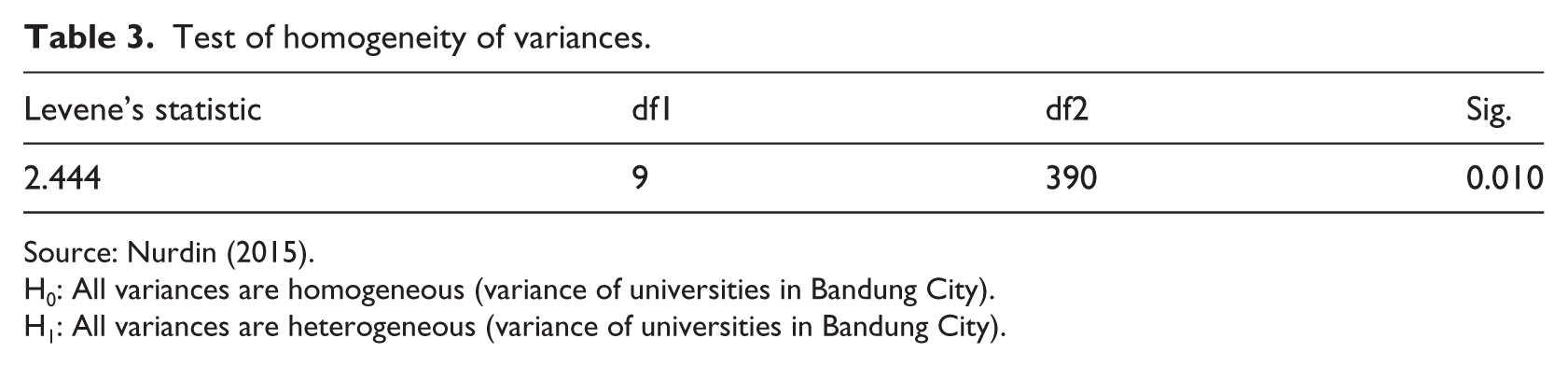
Test of homogeneity of variances.
Source: Nurdin (2015).
H0: All variances are homogeneous (variance of universities in Bandung City).
H1: All variances are heterogeneous (variance of universities in Bandung City).
Because the probability score (significance) is 0.10, which is greater than 0.05, H0 is accepted. This means that the 10 variances are homogeneous (variance of universities in Bandung City).
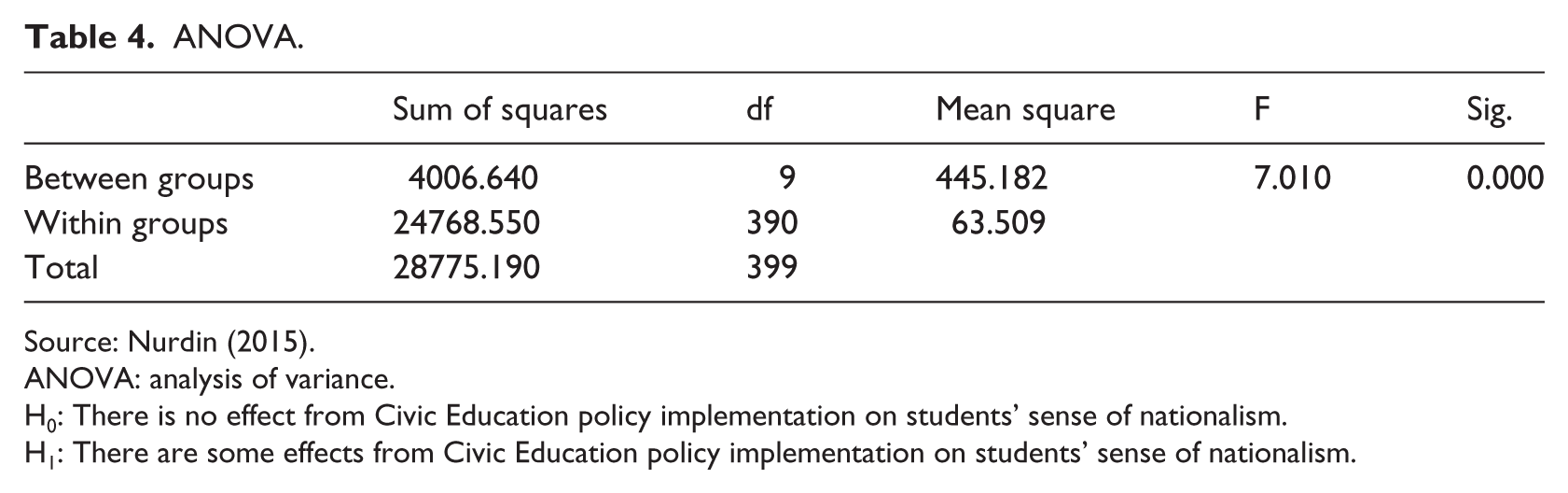
As displayed in Table 4, in the Sig. column, the p value is 0.000. Therefore, at a significance level of 0.05, H0 is rejected and H1 is accepted; there are some effects from Civic Education policy implementation at a university on students’ sense of nationalism in Indonesia.
ANOVA.
Source: Nurdin (2015).
ANOVA: analysis of variance.
H0: There is no effect from Civic Education policy implementation on students’ sense of nationalism.
H1: There are some effects from Civic Education policy implementation on students’ sense of nationalism.
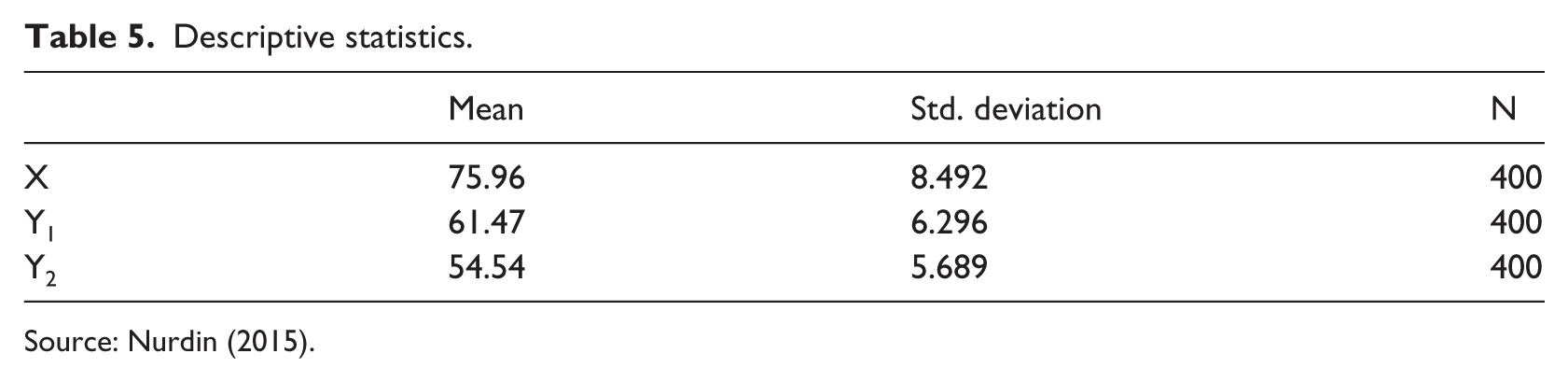
Table 5 indicates that the mean of the X variable is 75.96 with a standard deviation of 8.492, while the mean scores of Y1 and Y2 are 61.47 and 54.54, respectively, with standard deviations of 6.296 and 5.689, respectively.
Descriptive statistics.
Source: Nurdin (2015).
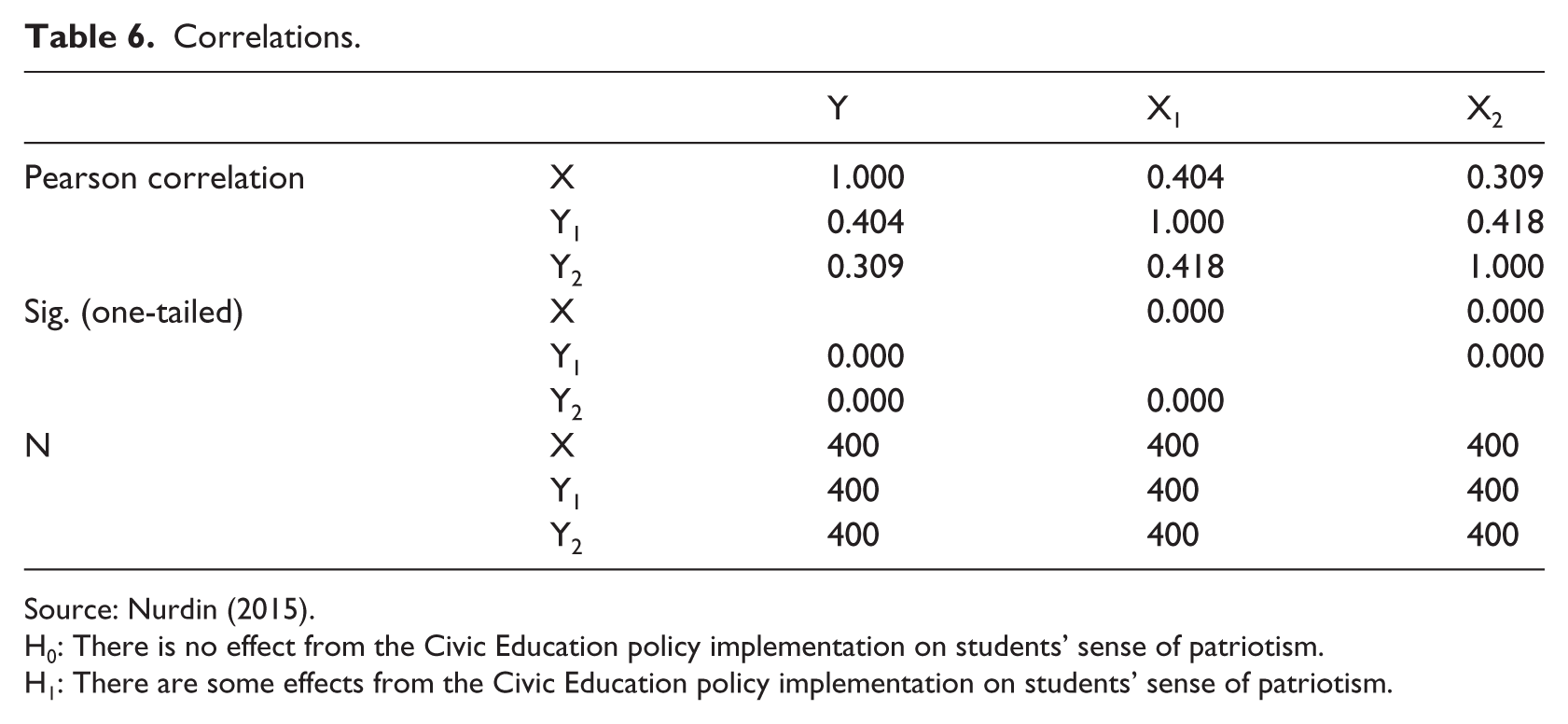
Based on Table 6, the correlation between X and Y1 variables is 0.404, indicating a positive relationship. The correlation between the X and Y2 variables of 0.309 also shows a positive relationship.
Correlations.
Source: Nurdin (2015).
H0: There is no effect from the Civic Education policy implementation on students’ sense of patriotism.
H1: There are some effects from the Civic Education policy implementation on students’ sense of patriotism.
Sig. 0.000 < 0.05 indicates that H0 is rejected; there are some effects from the Civic Education policy implementation on the development of students’ sense of nationalism and patriotism in Indonesia.
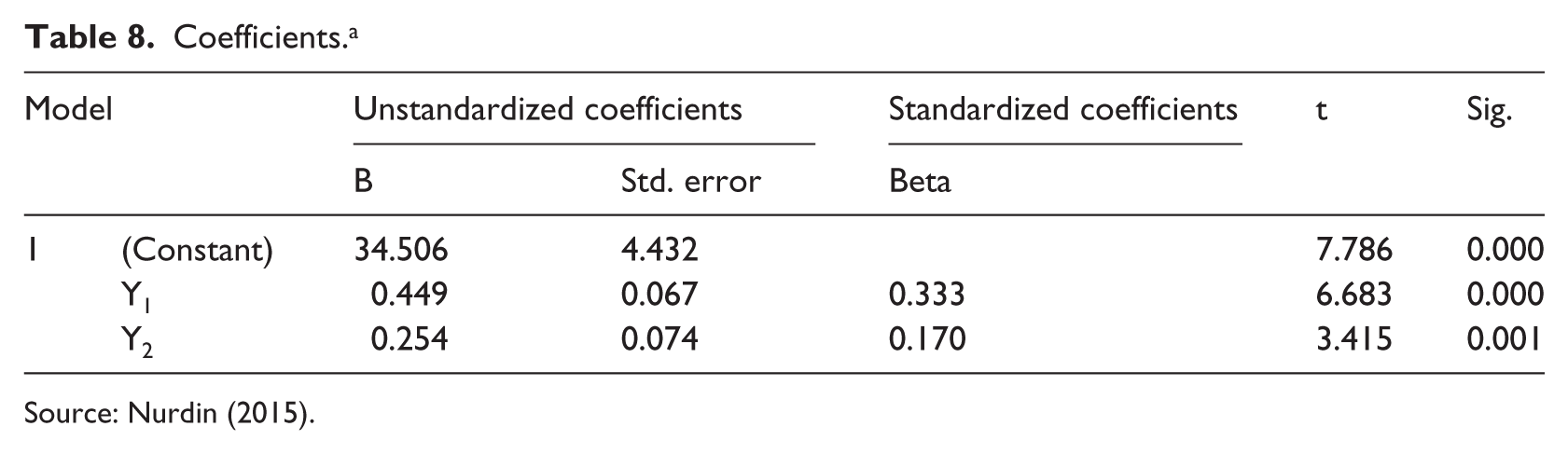
The degree of contribution from Civic Education policy implementation on students’ sense of nationalism is 33.3%, while the remaining 66.7% is influenced by other dimensions beyond the scope of this study. Meanwhile, the contribution of the Civic Education policy implementation on students’ sense of patriotism is 17%, while the remaining 83% is influenced by other dimensions beyond the scope of this study.
Discussion
The SPSS analysis found a Pearson correlation of 0.418, indicating the existence of a significant relationship between Civic Education policy implementation and students’ sense of nationalism and patriotism in Indonesia. The relationship is very strong, as indicated by a correlation value close to +1. With p value/Sig. of 0.00 < 0.05, it can be concluded that there is a significant correlation between the two variables.
This result is congruent with the evidence from the field, as stated in Clause 37, article (2), point b of Regulation No. 20/2003 jo. The Description of Clause 35, article (3), point c of Regulation No. 12/2012, explains that the aim of Civic Education is to develop a sense of nationalism and patriotism. From this perspective, Civic Education courses at universities will produce a student body that possesses a strong sense of nationalism and patriotism, and the students will be prepared to be good citizens and work based on this spirit.
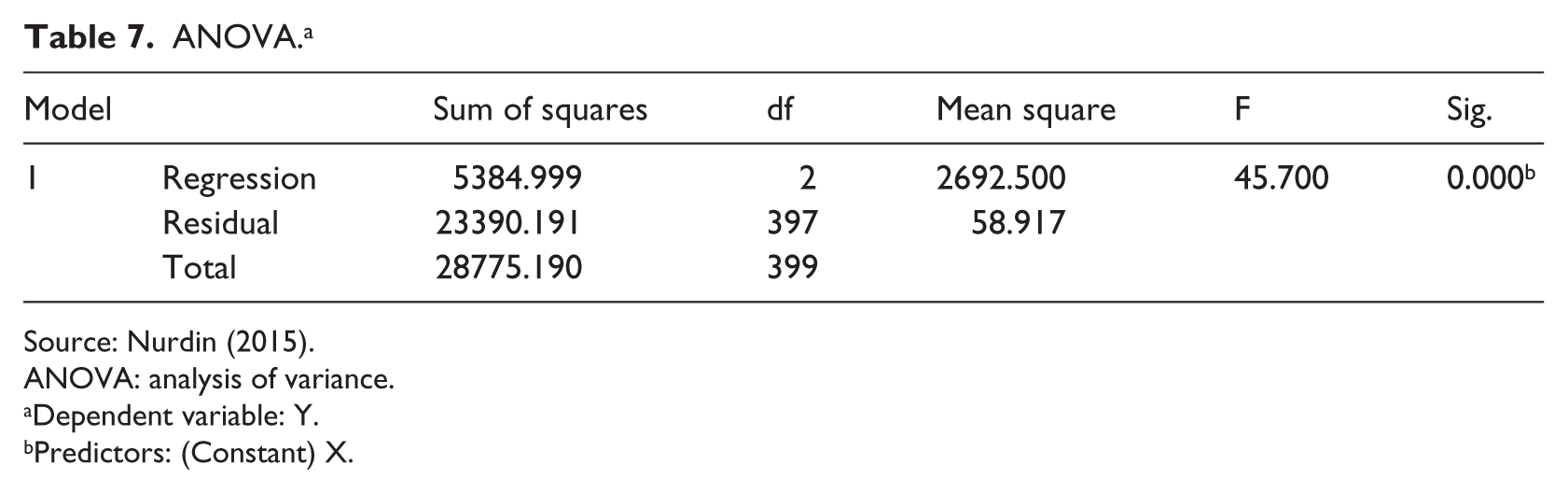
As shown in Table 7, the analysis of variance (ANOVA) calculation found some effects from Civic Education policy implementation on the development of students’ sense of nationalism and patriotism in Indonesia. This finding is in line with the findings of Abudu and Fuseini (2014). Their results show that the experimental group’s level of awareness of their rights as citizens, their responsibilities as citizens, democratic values, the electoral process, the need to engage in community service, the principal economic and social policies of the nation, and the operation of the government is higher compared to that of the control group. The results showed that there is a significant difference between people with citizenship education and those without in terms of their level of awareness of civic issues and of their desire to engage in community service (Abudu and Fuseini, 2014: 264). These results indicate that implementing Civic Education can have effects that are congruent with those policies, materials and resources that focus on the understanding of citizenship (Civic Education). This conclusion is further supported by a study in Nigeria that states that the demonstration of civic values and skills is a necessary foundation for a strong nation. Civic Education inculcates the norms and ideas of democratic and patriotic living in citizens and teaches equity, justice, responsibility, freedom, patriotism, honesty and obedience to rules and regulations. One reason that Nigeria has not experienced enduring peace and national integration after 100 years of existence is the lack of emphasis this country places on Civic Education. The teaching of Civic Education has not been given the necessary status in Nigerian school programmes, with negative effects on the values and civic engagement of Nigerian citizens (Falade and Adeyami, 2015: 117).
ANOVA. a
Source: Nurdin (2015).
ANOVA: analysis of variance.
Dependent variable: Y.
Predictors: (Constant) X.
Indonesia, as a nation with rich natural resources, vast areas and a multi-ethnic population, faces various potential problems. Civic Education has a strategic advantage in preventing such issues in that it instils nationalism and patriotism in students to strengthen the integrity of the nation. In an analysis of nationalism, it is helpful to understand the concept of a nation and how it relates to a multi-ethnic city-state (Ortmann, 2009: 25). Nationalism is a term generally used to describe two phenomena: first, the attitude taken by members of a nation when they care about their national identity and second, the actions taken by members of a nation when seeking to sustain self-determination (Ubaku et al., 2014: 55). In the words of Nwabuogu (2004), nationalism is defined as ‘strong devotion to one’s own country, patriotic feelings, efforts, principles … a consciousness on the part of individuals or groups of members in a nation, or a desire to advance the strength, liberty or prosperity of a nation’ (p. 4). Chikendu (2004) understands nationalism as ‘… a sentiment and activity directed towards the creation of a nation and the attainment of independent statehood’ (p. 48).
Coefficients.a
Source: Nurdin (2015).
The process of nationalism has three stages: (1) the stirring stage, in which a nation recognizes itself as a nation under the pressure of combating foreign ideas and ways of life; (2) the centre-piece nationalism stage, in which the nation undergoes the struggle and fight for independence; and (3) the consolidation stage, in which the nation focuses on economic consolidation (Minogue, 1967: 29). There are various types of nationalism, depending on the dominant factor of influence – economy, politics, culture or other factors – as follows: (1) risorgimento nationalism, that is, nationalism emerging from the bottom, is usually initiated by educated people – modernists, liberals and democratic-leaning people – who encourage normative integration in their territories as a liberal and democratic nation state. Another factor promoting risorgimento nationalism is the economy, such as economic development from an agricultural to an industrial society; (2) Revival nationalism is developed in response to other nations’ oppression; and (3) Integral nationalism encourages the integration of all aspects of national life to oppose other oppressing nations (Hall, 1993: 1–2).
In the context of this study, the key to nationalism is supreme loyalty towards a nation. This loyalty emerges from the awareness of a collective identity that is different from that of other groups. In most cases, the collective identity is composed of a shared heritage, language or culture. However, these are not the most substantial elements; the most important aspect of nationalism is ‘the willingness to unite’. Therefore, ‘nation’ is an ever-changing, dynamic concept rather than fixed. Nationalism does not necessarily grow in a multi-ethnic, multi-lingual, multi-cultural or multi-religion society. The concept is reflected in the material taught in Civic Education: the four factors unite in the lecturer’s lessons. This role is in line with Bennett (2008), who contends that the ‘educators … who design Civic Education programs … can benefit from learning how generational social identities and political preference formation are changing so that they can design more engaging Civic Education models’ (p. 12).
In addition to developing a sense of nationalism, Civic Education can also cultivate a sense of patriotism. As nationalism takes root as devotion towards one’s nation, patriotism can also grow in an individual. Patriotism implies one’s readiness to defend one’s nation based on the spirit of unity, independence, humanity, pride, the future success and so on. There are two reasons for patriotism: value-based patriotism and egocentric patriotism. Value-based patriotism refers to one’s loyalty and devotion to one’s nation stemming from factors that benefit its citizens, such as economic achievements or other important national features. In value-based patriotism, the citizens are not sincere in their devotion and loyalty to their country because their actions are oriented towards the interests and benefits that they may receive from the nation. In contrast, egocentric patriotism refers to devotion and loyalty to a nation simply because the citizen is truly devoted, and not because of what the nation can give him. Based on this classification, it can be concluded that egocentric patriotism is true patriotism. Individuals possessing this type of patriotism will take any action for their nation without expecting any reward (Primoratz, 2002: 443–457).
It is clear that in the educational systems of China and Japan, patriotism is incorporated in the form of the Patriotism Education Base. In Japan, the establishment of such a base has been viewed with a great deal of suspicion. In Japanese, the Chinese characters for ‘base’ used here denote a military base; to Japanese ears, the phrase ‘Patriotism Education Base’ evokes images of a military installation where people receive patriotism-centred education (Kondo and Wu, 2011: 27). The nature of patriotism as an educational goal in schools in China has undergone major transformations over the course of the economic reforms that began in 1978 and gained momentum in the 1990s. Specifically, the principle underpinning patriotism has changed from socialism to nationalism (Kondo and Wu, 2011: 24). China’s school system has courses in political subjects for students at every stage of their education, from primary school through university (Kondo and Wu, 2011: 24).
In its 1983 Ideas on Strengthening Education to Promote Patriotism, the Propaganda Department stated,
We must, through patriotism-centred education, cultivate among the public and young people an awareness of themselves as patriots. Furthermore, by building upon that foundation, it is important that we extend the level of ideological and political education and develop patriots into communists. (He, 1998: 2108)
In contrast, in 1994, the CCCPC included the following in the Outlines of Patriotic Educational Environment. He (1998: 3680) also mentions that in contrast to the in 1994 discussions of the CCCPC included the Outlines of Patriotic Educational Environment: The purpose of patriotism-centred education is to strengthen a sense of national identity and power of the unity of people, instill a sense of self-respect and pride as a people … direct the patriotic sentiments of the people so that they contribute towards the unification, prosperity, and strengthening of the homeland, create socialist citizens with ideals, morals, culture and discipline, and unite for the common ideals of the people. (He, 1998: 3680)
This condition greatly differs from the concept of Civic Education in Indonesian universities, which emphasizes nationalism and patriotism only at the theoretical/conceptual level.
Referring to Clause 35, article (3) of the Regulation No. 12/2012, the government intends to implement Civic Education policies to instil nationalism and patriotism in university students. Public Civic Education policies need to be implemented, supported by Dye (1984) who states that ‘public policy is whatever governments choose to do or not to do’ (p. 1). He further states that policies may address a wide variety of substantive areas – defence, energy, the environment, foreign affairs, education, welfare, police, highways, taxation, housing, social security, health, economic opportunity, urban development, inflation and recession, and so on (Dye, 1984: 1-3). In this regard, Anderson (1984: 3) argues that public policy is a series of activities with particular objectives that are followed and implemented by an actor or actors to solve certain problems. However, no matter how well public policy is formulated, its success depends on effective implementation. As Edward (1980) notes, ‘even a brilliant policy implemented may fail to achieve the goals of its designer’ (p. 1); clearly, the development of students’ sense of nationalism and patriotism depends greatly on the successful implementation of Civic Education policies at universities. The following Table 9 includes the conceptions of Civic Education for various types of nations.
Conceptions of civic education – a comparison.
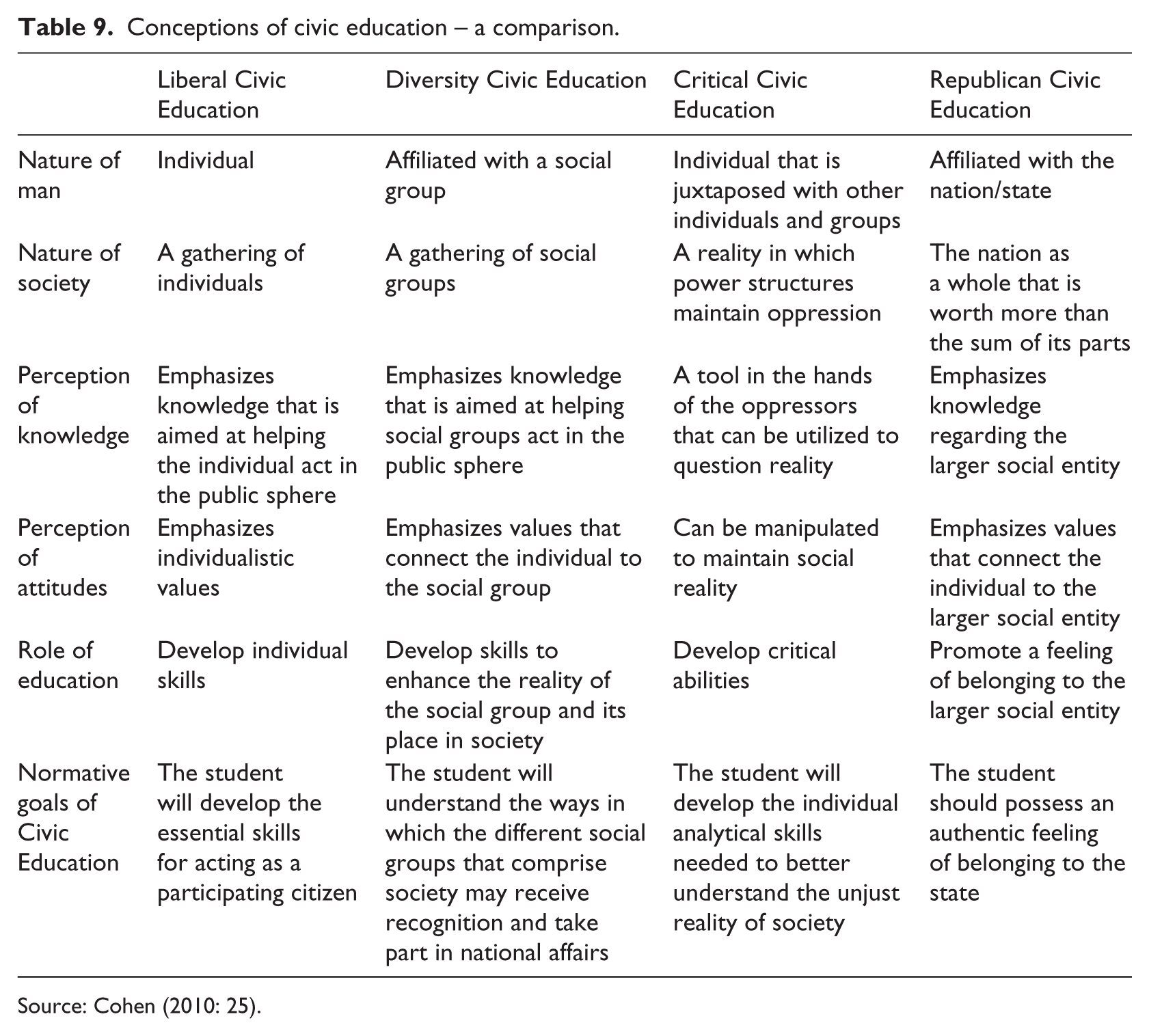
Source: Cohen (2010: 25).
Based on the table, the concept of Civic Education in Indonesia appears closest to the republican conception. With this understanding, the author intends to identify the effectiveness of Civic Education policy implementation at universities, with emphasis on students’ sense of nationalism and patriotism. It is assumed that students’ sense of nationalism and patriotism awareness is affected by the implementation of Civic Education policies at universities. However, regardless of how well-formulated a policy is, it is useless if it is not effectively implemented; this observation is in line with Edward (1980), who states, ‘… however, even a brilliant policy poorly implemented may fail to achieve the goals of its designers’ (p. 1). In this study, policy implementation is interpreted as described by Jeffrey L. Pressman and Aaron B. Wildavsky, in Jones (1984): ‘Implementation may be viewed as a process of interaction between the setting of goals and the actions geared to achieving them …’ (p. 165). In the same vein, Walter Williams in Jones (1984) argues that ‘the most pressing implementation problem is that of moving from a decision to operations in such a way’ (p. 165).
To analyse the result of the implementation, the author used the theory of Edward III. In the implementation of a policy, several conditions need to be considered to ensure its success. Edward (1980: 9) proposes that an analysis of policy implementation should be preceded by two questions: (1) What are the prerequisites of a successful policy implementation? (2) What are the primary obstacles to policy implementation? Edward (1980) states that ‘… four critical factors or variables in implementing public policy [are]: communication, resources, dispositions or attitudes, and bureaucratic structure’ (pp. 9–12). These four factors or dimensions have direct or indirect influence on the successful policy implementation (Edward, 1980: 148), as displayed in Figure 1.
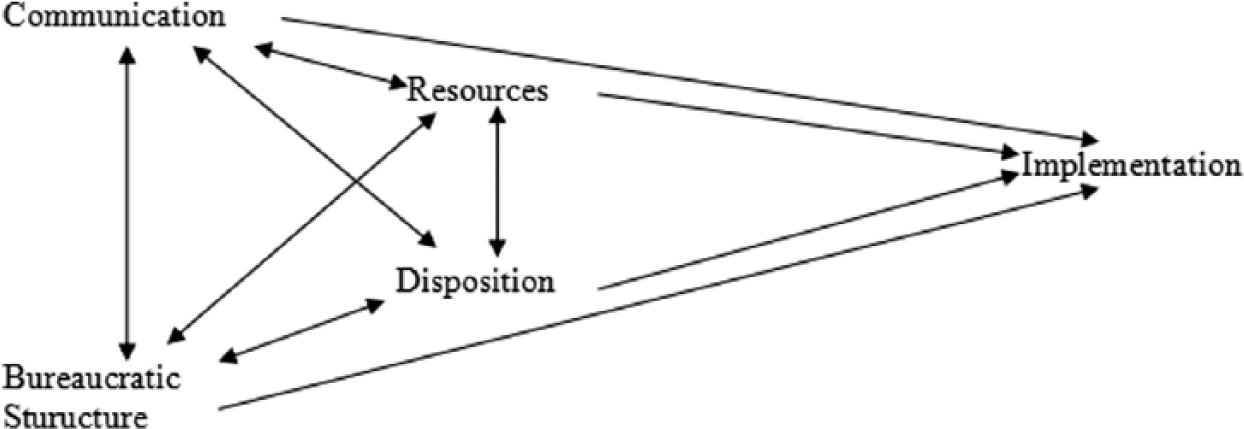
Direct and indirect impacts on implementation.
In the dimension of communication, policy implementation requires accurate communication that is also accurately understood by the implementers. For a policy to be implemented correctly, the direction of implementation should be received clearly. Unclear direction will result in confusion on the part of the implementers concerning what should be done, which may lead them to use their own discretion (Edward, 1980: 17). In Indonesia, it can be argued that effective communication between policy makers and the lecturers – who are implementing the programme – is lacking regarding Civic Education’s focus on nationalism and patriotism. The government fully delegates the development of materials and the management of classes to the universities, which give full authority to the lecturers. This is where the confusion begins. In consequence, there are varied perceptions regarding the implementation of public policy, particularly in terms of developing students’ sense of nationalism and patriotism.
The next dimension is the resources to implement public policy. Resources consist of staff, information, policy, authority and facilities, and affect the success of policy implementation (Edward, 1980: 53–78). Capable staff, selected based on their competencies and skills and supported by directors to provide the necessary services, determine the effectiveness of policy implementation (Edward, 1980: 10–11). Therefore, the development of students’ sense of nationalism and patriotism greatly depends on the professionalism of the educators. Concerning this point, Clause 10, article (2) of Higher Education Directorate General’s Decree No. 43/Dikti/Kep/2006 (2006) clearly states the requirements for being a lecturer for Civic Education: (1) having a master’s degree in National Defence or in Social Studies Education, Social Studies, Cultural Studies, Philosophy or Law with special training in Civic Education; (2) should no lecturer with a master’s degree be available, those with bachelor’s degrees in Social Studies Education, Social Studies, Cultural Studies, Philosophy, Law and other disciplines with sufficient knowledge of Civic Education and special training in Civic Education or graduates of the Civic Education Educators College can be appointed by the university with special consideration of their academic background, work experience and personal integrity as educators. These criteria for Civic Education lecturers reflect the potential variety of resources and the distance from the ideal standard. Moreover, the special training programme has been discontinued for some time, although many elderly lecturers have retired and new educators have been recruited. These factors will surely affect the success of the Civic Education policy implementation in improving students’ sense of nationalism and patriotism in a university setting.
The third dimension of policy implementation is the dimension of disposition (Edward, 1980: 11). Regarding this dimension, Nugroho (2014) states that ‘disposition has to do with the willingness of the implementers to carry out the public policy. Skills alone are insufficient without the willingness and commitment to implement the policy’ (p. 673). In other words, the success of Civic Education policy implementation in developing students’ sense of nationalism and patriotism depends on the willingness and commitment of the educators to perform their role. However, in many large universities, particularly those included in this study, the ratio of educators to students who enrol in Civic Education classes is not proportional. Most large universities in Indonesia do not have enough Civic Education professors, and many lecturers have excessive teaching responsibilities, which weakens their commitment to developing students’ sense of nationalism and patriotism. Success in developing feelings of nationalism and patriotism also depends on the students’ ability to understand the essence of the Civic Education materials they study; the process of internalizing values differs from one individual to another. Kuzio’s study found that when nationalism operates through liberalism, conservatism or social-democracy, it can co-exist within Western civic states. Civic nationalism (sometimes also called state nationalism or patriotism) is also often defined as encompassing all three of these ideological trends (Kuzio, 2002: 135). Civic nationalism is a form of nationalism in which the state derives political legitimacy from the active participation of its citizenry based on the degree to which it represents the will of the people (Ubaku et al., 2014: 55). Civic (or state) nationalism is sometimes defined as patriotism because of the negative connotations that have accompanied the term ‘nationalism’ since the 1930s. Freeden (1998) prefers to use the term ‘patriotism’ because it moderates the national idea ‘and is located adjacent to core, universal liberal concepts such as liberty, limited government, and participatory self-government’ (p. 764).
The framework developed by Kohn (1944), in which Western civic nationalism differs in origin, essence and form from Eastern ethnic nationalism, was until recently the standard framework used to understand nationalism. Kohn’s static framework argued that Western states were civic in nature from their inception in the late eighteenth century. Kohn believed that Western nationalism was inherently different because it evolved in conjunction with civic rights and was therefore civic (i.e. democratic). He argued that civic nationalism owed more to territorial factors than to ethno-cultural factors and was inclusive in the sense of allowing anybody within the given territory of a nation state to become a citizen regardless of ethnicity, race or gender. The civic nationalism that developed in Kohn’s West was individualistic, liberal, rational and cosmopolitan. The rise of nationalism within Kohn’s (1944) West ‘was preceded by the formation of the future national state, or … coincided with it’ (pp. 329–330). In the East, in contrast, nationalism was not tied to liberty and was developed prior to the formation of a state. Kohn’s study of nationalism has been used as a framework by many scholars in the field and has only been questioned in recent years (Kaufmann, 1999). Eastern nationalism is defined by the Kohn school as backward-looking, prone to conflict, tribal, irrational and primitive because it focuses its energy on building a new national identity and is tied to religion, language and nationality. It lacks ‘high culture’ and therefore focuses on ethno-cultural issues (Gellner, 1983; Smith, 1996).
The dimension considered by Edward III’s bureaucratic structure relates to the suitability of the organization or institution. Nugroho (2014: 673) stated that policies are often ineffectively implemented because of a lack of coordination and cooperation between the state and/or governmental institutions. Considering the bureaucracy of Civic Education (Hahn, 2010) implementation, each university is autonomous in determining the type and form of the institution/organization/work unit responsible for managing the subject. Consequently, the bureaucracy of Civic Education implementation generally varies; some universities have a department, others have Technical Implementation Units and so on. The position of these institutions/work units within the university as an organization also differs; some are directly under the purview of the Vice-Rector for Academic Affairs, others are under the purview of the Faculty Dean and others are managed by Department Heads. This bureaucratic structure results in failed unity in command – from the central policy makers who formulate and legitimize (adopt) the policies to those who implement the Civic Education programme to develop the students’ sense of nationalism and patriotism. Hence, failed unity results in ‘bureaucratic fragmentation, since it makes the process of implementation ineffective’ (Nugroho, 2014: 673).
The bureaucratic structures for Civic Education policy implementation vary greatly and are not standardized. This will affect the success of implementing (even causing unsuccessful implementation) Civic Education policies in developing students’ sense of nationalism and patriotism in a university setting.
The degree to which Civic Education policy implementation contributes to students’ sense of nationalism is 33.3%, while the remaining 66.7% is influenced by dimensions beyond the scope of this study. Meanwhile, the contribution of Civic Education policy implementation on students’ sense of patriotism is 17%, with again the remaining 83% being influenced by dimensions beyond the scope of this study.
Conclusion
These findings show that Civic Education policy implementation at a university has some effect on students’ sense of nationalism and patriotism. The degree of the effect is low, however, due to several critical factors, including (1) the delegation of Civic Education material development to each university or to the lecturers teaching the subject, implying that patriotism and nationalism may not always be the main focus, and (2) the ineffective implementation of policies along the dimensions of (a) communication, as they are not ideally communicated; (b) resources, as the lecturers have varied competencies and lack a consistent academic background; (c) disposition, as those implementing policy lack commitment because the number of educators is insufficient given the number of students; and (d) the bureaucratic structure, which varies between universities such that the unity of command fails and bureaucratic fragmentation occurs.
The implication of these findings is that to achieve a significant increase in students’ sense of nationalism and patriotism as a direct consequence of implementing the Civic Education policy at a university, policies need to be revised or reformulated, particularly in terms of the dimensions of communication, resources, the attitudes and commitment of those implementing the policy and the bureaucratic structure of the institutions. Furthermore, formulation of a nationally standardized curriculum for Civic Education, especially for the content that relates to nationalism and patriotism, is needed. Such standardization will not compromise university autonomy because Civic Education is an exception in the authority/discretion given to the central government, as mandated by the 2012 Higher Education Regulation. Developing curriculum content development will serve as a reference for implementing Civic Education programmes at each university.
Footnotes
Acknowledgements
I take this opportunity to thank all friends, who guided me on how to write this article. I also thank the Editor and Reviewers of Citizenship, Social and Economics Education for their constructive comments regarding the structure and content of the manuscript. Finally, I take this very opportune moment to thank the Leadership of Universitas Pendidikan Indonesia, which through its Continuous Professional Development Programme has actively supported Academic Publication of its staff including myself.
Declaration of Conflicting Interests
The author(s) declared no potential conflicts of interest with respect to the research, authorship, and/or publication of this article.
Funding
The author(s) disclosed receipt of the following financial support for the research, authorship, and/or publication of this article: Universitas Pendidikan Indonesia provided financial support to the authors for the research of this article.