




Abstract
More and more programs of citizenship education in Germany (and other countries) tend to advance democratic citizenship through social learning in communities. A strong emphasis is put on social engagement to get young people involved in politics as well as to teach them participation. A qualitative analysis of selected German social learning programs shows that it is not given that students independently evaluate the political contexts of social problems. Nevertheless, these programs, which try to encourage democratic citizenship, are more characterized by behavioral goals and the aspiration to attain a prosocial attitude change than by aiming at democratic behavior. For an “activating state,” personal responsibility seems to be more important than critical analysis and truly political participation. This article attempts to shed light on key structural shortcomings and problems that are the origin of young people’s apolitical perceptions of community work and common practices of service learning. The goal is to develop a conception of citizenship education that leads from social to political learning.
Introduction
Public discussions on citizenship and citizenship education regularly focus on an alleged political frustration of young people. Concerns about youth can be detected in this discussion: They are accused of being disengaged (Putnam, 2000), uninterested (Patterson, 2002), and apathetic (Lawless and Fox, 2015). These diagnoses are seen as problematic for the reproduction of the democratic political system, which relies on the democratic participation of its citizens (Ballinger, 2006: 22). A lot of literature points to the problem of decreasing participation of young people in traditional participation forms like voting and party membership (Wattenberg, 2007). Bessant et al. (2016) note, Concern about youth disengagement led to claims that young people were no longer skilled or motivated enough to become citizens or to engage in politics, or that key institutions like families, schools and community-based organizations were failing to cultivate basic civic dispositions and skills. (p. 273)
To address these concerns, schools are requested to develop pedagogic programs, which promote “democratic” values and skills. These are mostly described as the willingness to cooperate and to assume social responsibility in society. Against the background of the “narrative of disengagement” (Bessant et al., 2016: 274), German school programs and curricula have focused more and more on educational concepts of community learning (e.g. service learning). Those concepts are based on social experiences of students, which for one thing are supposed to benefit their social learning, for another thing often claim to achieve political learning in addition to it. The basic idea of these concepts is that young people are politically disinterested but still motivated to engage in social ways. Their hope is that political learning and political participation can tie up on this social engagement. For social sciences as a school subject, the question arises whether and on which conditions political learning can be attached to social experience and social learning of students. 1
I follow up this question with the help of a qualitative study. On the basis of this study, it is possible to formulate conditions of a transfer from social to political learning and to outline a concept of political learning, which is built on social experiences of students.
Before this will be done, I first describe German school programs, which want to stimulate political learning of students by social experiences. Furthermore, I point to the societal context of this social engagement by analyzing the function of this engagement during times of dismantling of the welfare state (e.g. in Great Britain and Germany). I then present a project of an institution of non-formal political education. In Germany, political learning is institutionally organized in school as its own school subject (“formale politische Bildung”) 2 and outside of school in non-formal political educational institutions (“non-formale politische Bildung”). The presented project is characterized by a cooperation of both of these institutions (schools and institutions of non-formal citizenship education) and the attempt to connect social learning and social experiences of students with political reflection and political learning. Within this project, I was able to collect empirical data, which hint at the possibility of a connection between social and political learning. After that, I report some exemplary results of the study, which have a significant influence on the connection of social and political learning. Finally, I expose three key success factors of a transfer from social to political learning. They form a basis of a concept of citizenship education.
Social and political learning through social (voluntary) engagement?
There has been a debate about political and democratic education in Germany (Massing, 2010; Röken, 2011: 169–236) for at least 10 years. A claim of critics of conventional formal citizenship education is that it focuses on institutional political learning and neglects the level of acting of students. The goal of this so-called “Pedagogy of Democracy” (“Demokratiepädagogik”) (Beutel et al., 2013; Edelstein, 2014), which is suggested as an alternative to conventional citizenship education, is to enable students to make democratic experiences in schools and their communities. Thereafter, it is criticized that social science as a school subject concentrates on teaching political knowledge to the students while it leaves out the possibilities to make democratic values tangible (Himmelmann, 2004: 6). Therefore, the pedagogy of democracy wants to expand the learning arena, which is a new approach for political learning in Germany. Actually, political learning in schools is organized in a very cognitive way. Real actions, social as political, do not play a major role. The goals of pedagogy of democracy are to supply places where students are able to make social experiences in schools and communities. Therefore, different pedagogic concepts are used: class councils, dispute settlements, and service learning. Together they are integrated in school programs like “Learning and Living Democracy” (“Demokratie lernen und leben”) (Edelstein and Fauser, 2001), which were carried out at schools throughout Germany.
Service learning is probably the most used and best known of those concepts (Jacoby, 2015). It is characterized by an intersection of learning and doing. The basis of service learning is that students should make a service in the community. In context of this service, they acquire knowledge, which is related to the service. The students should cover a need in the community with their service. From the perspective of mostly German service learning authors, the following example illustrates a successful learning process: Primary school children practice emphasized reading in school. They organize reading days in the public library because such events for children were reduced from the city for financial reasons (Seifert and Nagy, 2014). By taking a critical look, the service can be considered as a substitute for public funding of cultural offerings: The students fill in for the city and make an offer available because the city is just no longer able or willing to finance cultural offerings.
In addition to service learning, in Germany, a social internship is carried out at many schools. As part of these social internships, students mostly visit social services for 2 weeks to help there. The goals of these social internships are to promote the development of social skills (like empathy, cooperation, respect). Additionally, it is hoped that students would develop a willingness to assume social responsibility. As mentioned above, both programs are also thought to be a counteraction to a negative trend in society: the disenchantment of young people with politics. The belief is that if young people have positive experiences with involvement in the community (e.g. social engagement in a care home), they get interested in political topics and the willingness to political engagement would increase (Wohnig, 2014: 101–102). In theory, a lot of these German programs rest on the assumption of an automatic transfer from social to political learning (Edelstein and Fauser, 2001: 30).
Interestingly, these hopes of German service learning authors (Seifert and Zentner, 2013) are based on empirical studies of Youniss and Yates (1997), which found that the development of students involved in service projects are subject to “clear changes” (Youniss, 2006: 184). Together with Heinz Reinders, Youniss summarizes that “community Service […] can help adolescents to generate a social and moral point of view, help them to experience effectiveness in prosocial behaviour, and prepare the soil for civic engagement in adulthood” (Reinders and Youniss, 2006: 203–204).
It seems necessary to point to a problem when it comes to the topic of political learning: Obviously, there is a difference between civic and political engagement because the former is often associated with charity. The fact that social services are suitable to build up a willingness to engage in a civic way does not automatically mean that the willingness and the ability to engage politically increase. Youniss (2007) also points to this problem: Not all services are so [well] designed and programs vary in how pointedly they are politically orientated […] much of service is focused on charity, or the act of giving accompanied by feelings of sympathy for recipients. These programs, despite the good they do, are unlikely to generate civic involvement as one would not expect a youth to vote or protest, because they helps an autistic child acquire an athletic skill. If a political outcome is desired, then service ought to be designed to deal explicitly with the political dimension of the matter at hand. (p. 230)
A look at published descriptions of German service learning projects shows that they mostly aren’t designed in such a political way.
3
This thesis is supported by a study of the author from 2011 in which 14 service learning projects were analyzed. The study shows that none of these projects is intentionally designed in a political way (Wohnig, 2011). This might be one explanation to the result of an evaluation of the pedagogic program “Life and Learn Democracy”: Students who joined projects like class councils or service learning didn’t show an increase in democratic competences like the ability to take other perspectives, empathy, or the self-concept of own political competences. Neither an increase in experiences with political engagement nor an increase in the willingness to political engagement (Abs et al., 2007) was found. Tatjana Zimenkova (2013) describes the reasons for these results: However, the participants are not asked to reflect on their opportunities within the system of education, their citizens’ rights and powerlessness or power to change the disadvantages of the system. They are supposed to accept the system as it is and perform additional voluntary activities in order to compensate for failures of the system with regard to their individual cases. (p. 176)
Already in 1998, John W. Eby summed up for American service learning projects: Students tend to reflect on service-learning primarily in egocentric terms. […] They frequently reflect on changes in personal attitudes such as decreases in racism and increases in empathy for persons in need. This is important. But reflection must also include critical analysis and understanding of theoretical issues, service strategies, social change, agency policies, social policies, and community structure. (p. 7)
In addition to these objections against an automatic transfer from social experiences to political learning and political engagement, another central problem of theory and practice of programs, which are based on social engagement, can be established. This problem is mostly not reflected by the actors because the social engagement is seen as an innovative and motivating chance for learning (e.g. democratic values or political knowledge): Voluntary engagement in society always has a political component, it is never entirely social; it operates in a social and political field, which is characterized by a massive transformation; the dismantling of the welfare state takes place under neoliberal portents (Pierson, 1994). Large efforts are done by governments and civil society organizations to transform the welfare state from a providing state to an activating state. It’s an answer (a modus of crisis management) to the economic crisis and closely linked to the crisis of the welfare state. The activating state constitutes the answer to these crises (Lessenich, 2015: 119). It is embedded into an ideology of activating, which aim at the subjects. To be more precise, this dismantling of the welfare state is accompanied by an activation of the society. The requirement of the state is, for example, in Germany or the United Kingdom that everyone should get involved socially. This is justified by the thought pattern: “There Is No Alternative” (Margaret Thatcher). Because of the strapped budget situation of the state, citizens should take over the responsibility for the provision of welfare (Haß and Serrano-Velarde, 2015). The responsible authority for social welfare changes: from the state to individuals (Lessenich, 2011): In the activating welfare state, society constitutes itself as a subject that aims for a socially compatible behavior of its subjects – as it attempts to inscribe the social as their point of reference for action. The activation of individuals’ socially responsible proactivity marks the establishment of a new pattern of welfare-state socialisation, which, as it were, refers subjects uno actu to the responsibility for themselves as well as for the wider social community. (Lessenich, 2015: 130–131)
The change in the relation between the people and the state finds expression in state programs, for example, the “National citizen service” in the United Kingdom: “The use of volunteering organisations, charities and businesses to deliver NCS raises further questions about the commercialisation and consumerisation of citizenship as third-party providers mediate, incentivise and reshape the relationship between the state and young citizens” (Mycock and Tonge, 2011: 65). The activating state must be seen as a governmental program which aims at the activation of three factors: personal responsibility, activity for society, and autonomy of the individual. Latter is used to mobilize the controlled activity of the individuals for society, so it must no longer be restrained. The paradox is that the individuals feel autonomous while they are doing a subjectivation of the paradigm of activating. They mustn’t be autonomous; they have to think and know active (Lessenich, 2015: 133).
This perception leads to one consequence for the school subject of social science: With the demand to facilitate political learning followed by social experiences, the societal and political context of social engagement requires a critical political analysis of the student’s voluntary engagement field – this means the transformation of welfare state into an activating state. 4 Otherwise pedagogic programs which rest upon social engagement are in danger of reproducing the paradigm of activating. I will reflect this point in the presentation of the study results and the key success factors.
Project and study: Social engagement and political education
In reply to the conclusion that social engagement does not automatically lead to political learning and political engagement, which is proved by some other studies (Oser and Biedermann, 2007; Reinhardt, 2009), a model project was established in Germany (Götz et al., 2015). The study from which the following results are taken was conducted within the framework of this model project which was located at an institution of non-formal political education from 2011 to 2013. Key element of the project was a cooperative arrangement between schools and non-formal education institutions. Students doing a social internship organized by the school follow these up politically in a 2-day workshop of institutions of non-formal education. The aim of these workshops was that the students reflect on the political, structural, and institutional backgrounds of their social and voluntary engagement (Götz, 2015).
The study is based on the methodology of reconstructive social research (Bohnsack, 2007). The main sources of empirical material are participatory observation and partially structured problem-focused interviews. Participatory observation was done in preparation for the social internship in school, during the social internships and in the non-formal follow-up workshops. Problem-focused interviews were conducted with the teachers who provided the social internship (length of interview approx. 30 minutes) and the students who participated in the non-formal follow-up workshops (length of interview approx. 15 minutes). Table 1 presents the collected data in the three phases of the project.
Collected data.
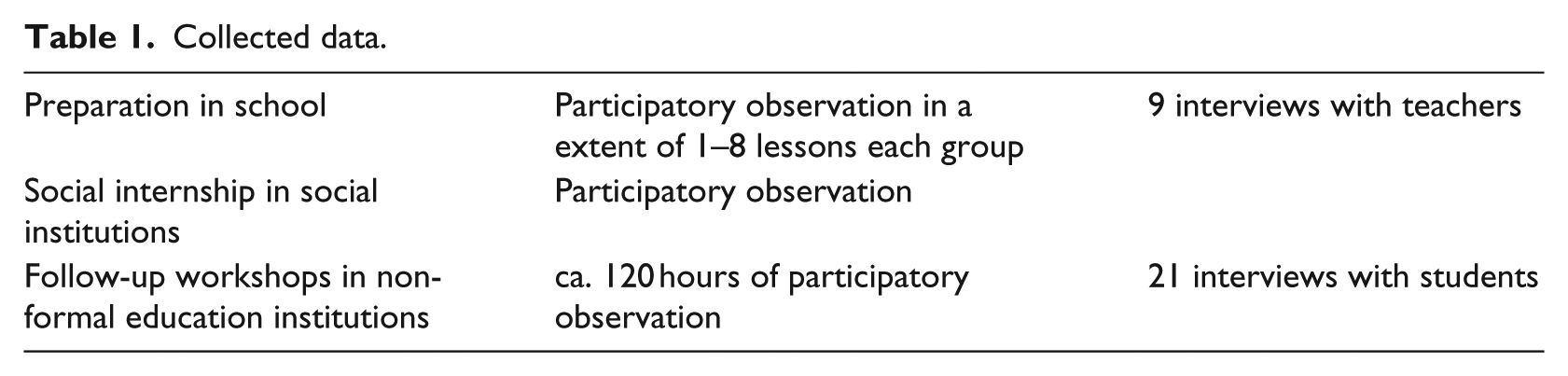
The sample includes 11 groups of students, which participated in the workshop of non-formal political education institutions. At the time the study was conducted, the students were aged between 13 and 20 years and visited various types of schools. The oldest did an education to become a social assistant at a vocational school. The sample of the study is illustrated in Table 2.
Sample.
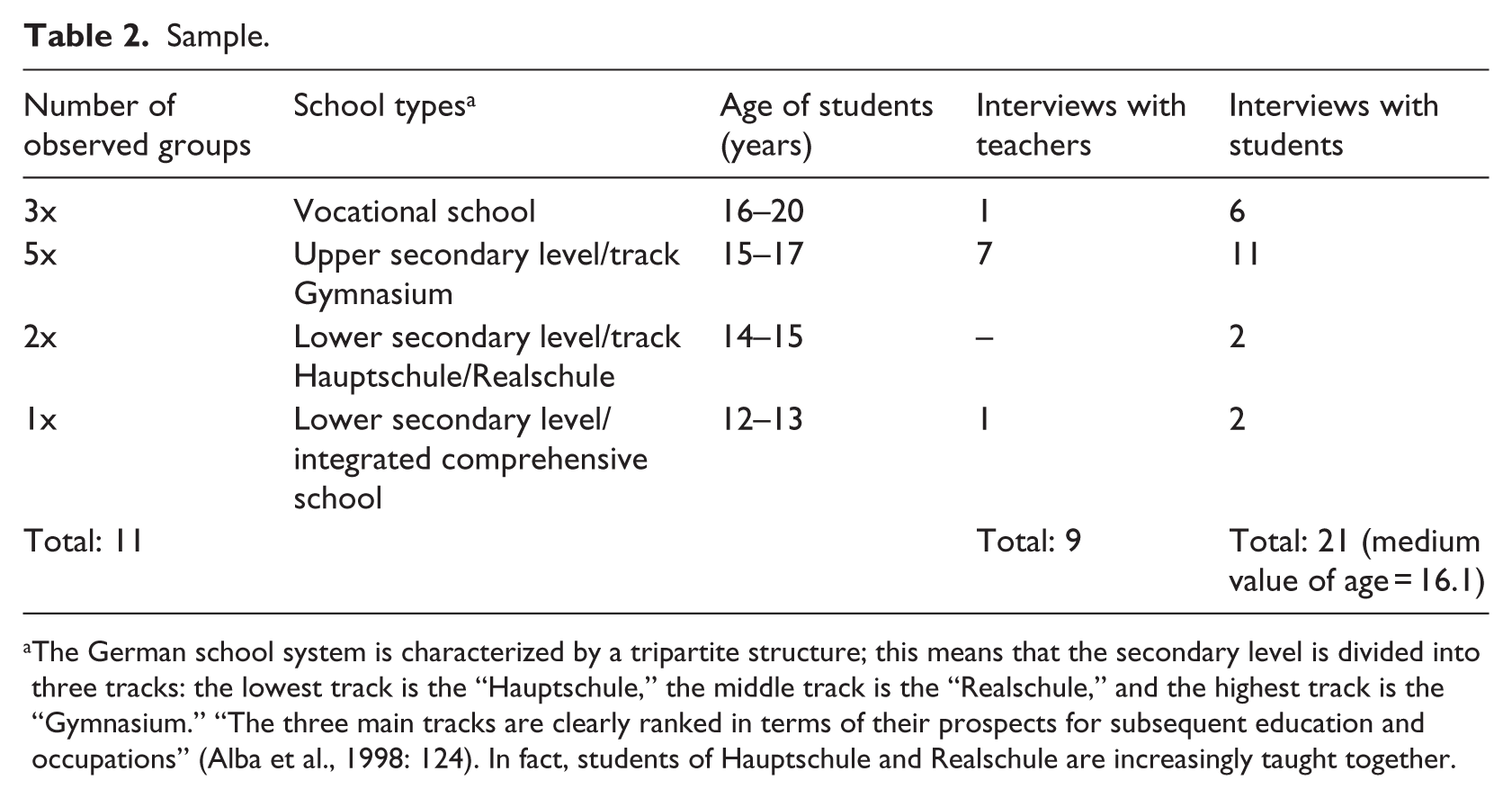
The German school system is characterized by a tripartite structure; this means that the secondary level is divided into three tracks: the lowest track is the “Hauptschule,” the middle track is the “Realschule,” and the highest track is the “Gymnasium.” “The three main tracks are clearly ranked in terms of their prospects for subsequent education and occupations” (Alba et al., 1998: 124). In fact, students of Hauptschule and Realschule are increasingly taught together.
One advice concerning gender: The number of girls and boys who participated at the project is balanced with the exception of the vocational schools where almost only girls participated at the follow-up workshops. This can be explained by their social-assistant training course, which is traditionally mainly attended by girls.
Results of the study: Chances and barriers for political learning
In the following, some central results of the study are presented which influence the development of a didactics of citizenship education for schools and non-formal political education institutions. The results are presented with different focuses: While sections “Social experiences help to form social skills” and “From social experience to political judgment – A chance for political learning” deal with the effects of social experiences of students and the learning process from social experiences to a political judgment and political participation of students, sections “Political helplessness: Barrier and chance for political learning” and “A risk of learning methods which are based on social engagement” focus on problems of a transfer from social experiences to political learning. The problems can be described as “political helplessness” of students and the risk of a reproduction of the ideology of the activating state through social internships. In section “Limitations of schools and chances of non-formal political education,” the role of the institutions (formal vs non-formal) on the possibilities of attaching political learning and political participation to social engagement is analyzed.
Social experiences help to form social skills
The qualitative analyses prove that students form social competences through their social engagement. This also occurs without a pedagogic accompaniment. The effects of social experiences in social internship can be summarized into four points:
An individual social behavior change takes place. The students notice a changing personal attitude toward people in need for themselves. A lot of students report dropping the reluctance they had when they were thinking about disabled people or dealing with the elderly in care homes: And well, often I felt a kind of disgust [towards old people, AW], well that’s a thing some have. And, [… the social internship, AW] in the social sector has really helped me. Now, I think, I approach these kinds of people very differently.
5
The students also encounter poverty within the social sector. They realize that there are actually people living below the poverty line in society. The students show a high degree of concern about that.
The students recognize and identify individual and societal prejudices. This is followed by an individual change of these prejudices. One student says she was able “to realize that not all homeless people are somehow evil or strange and that it’s actually really extreme what they had to go through.” As a result of that and because students realize that the prejudices are a societal phenomenon, they demand to be educated about the reasons for societal prejudices.
Because of their experiences with social engagement, the will of students to social and voluntary engagement increases. This means that the hope of service learning protagonists is hereby confirmed. On the other hand, the willingness to social engagement does not result from a political process of learning even if this attitude has political implications. I will return to this matter in section “A risk of learning methods which are based on social engagement.”
The fact that these positive social learning processes are stimulated without pedagogic efforts but through social experiences alone is considered positive by the teachers. On this basis, they describe social learning as superior to political learning. This has negative effects on the assessment that is described as “negative” by almost all teachers interviewed, while “the social” is associated with positive characteristics. One teacher describes her fears that would arise if the social internship was politicized: “I’m afraid that […] ethical and social aspects could be ignored along the way, because politically it’s often only looked at from a historical point of view.” Another teacher refers to negative properties of politicians, which can be found in public discourse: “Well, when it comes to politics I always have this kind of feeling: ‘Oh these are unpleasant, strange, very eloquent people’.” These are some reasons why most of the teachers prefer to support the social dimension of the social internship: “I wouldn’t say that this [the social internship, AW] is or has primarily a political dimension, but it’s rather first of all about serving your neighbor.”
From social experience to political judgment – A chance for political learning
Apart from the described social effects, students identify issues in their social engagement that refer to political problems. The students are usually not aware of these political problems; they don’t carry out an analysis by their own. This insight is confirmed by other studies: “It seems clear from the result of this critical narrative inquiry that the critical thinking, analysis of root causes and structural inequalities, and perspective transformation characteristic of anti-foundational service-learning […] will not occur automatically for most students” (Jones et al., 2013: 235). However, the students make observations, which could represent an access to political learning. Therefore, they need a politic-didactic accompaniment.
The observed political problems refer to current political conflicts. These conflicts are as follows: a shortage of specialists in care-work (e.g. care homes), low recognition in society for care-work (this manifests itself, for example, in little pay), or the dismantling of the welfare state. If students observe political problems inspired by their social experiences, political learning can tie up on this. An example of a learning process of 15-year-old Gymnasium students shows how this can be done. This learning process leads from the social experience to political participation of students. It can be described in three phases:
Phase 1: Reflection and criticism
The workshop began with a reflection on the social internship with key questions which relate to the social experiences. After that, all students of this group were able to express their criticism with regard to social institutions (in this case, there is not enough nursing staff in care homes) and they were able to identify political problems in their social experiences. This means that on the basis of their own experience and political awareness of the problem, the students were able to give various and sophisticated reasons for the skills shortage, such as “bad working conditions,” prejudices against this career path, as well as society’s lack to promote the positive aspects of the nursing profession. In this way, they were also able to formulate topics on their own that were of interest to them for further work in the seminar.
Phase 2: Problem analysis
The students carried out an independent analysis of the political problem which they had identified by their own criticism in phase 1. In order to analyze the problem, students needed to acquire knowledge. On the basis of that political knowledge, the students were able to formulate a political judgment. The students’ presentation of their analysis results shows that they conducted a systematic and thorough political analysis concerning the problems of skills shortage. They were able to support their statements with numbers, “facts” they had researched and link them to scientific data. In this way, they were able to give reasons for the skills shortage: Well, another point was that the people [nursing professionals, AW] just earn considerably less. Well, in Germany people earn on average, like around 40.000 [euros, AW]. Well, that’s the case at the moment. [A, AW]nurse, a trained professional, earns less than half of this, so 1.400, 1.700 [euros, AW] gross per month.
Phase 3: Actors talk – political participation
At the end of every non-formal workshop, a discussion with actors and experts of social sector was held. In this case, the students articulated their judgment on the problem in a discussion with the management of a care home and a politician (in this case, a county commissioner).
The students were able to relate to the results of their policy analysis. It should be noted that the students acted with self-confidence because they could resort to their acquired knowledge. In the discussion, they contradicted the view of the actors and experts and proved their opinion with their researched facts: One problem that we just spotted is that the reputation of nursing professionals, partly also of educators, in such inclusive institutions […] is very bad. That there is an image problem. How would you evaluate this, well, from the perspective of your staff?
The following passage shows that the students’ political analysis of the issue has a positive effect on their self-confidence and their ability to participate in discussions with actors:
Well, I’ve […] always had a lot of respect for people who work in this sector. And I actually almost only know people who feel that way.
Yeah, but the question is why there are so few nursing professionals. Well, we heard of numbers that show that in some institutions where some of our people […] did [their social internship, AW] sometimes four our six nursing professionals look after 60 patients. How does this happen? Why is that the case? What about your institutions?
This passage clearly shows that the student is not happy with the manager’s personal evaluation of the issue and that he doubts her based on his knowledge about skills shortage; this reaction is due to the problems described before (the nursing profession being unattractive due to bad reputation, low pay, and low opinion on the training). He uses the experiences of fellow students during their internship in the social sector to clarify.
Even the politician invited by the pedagogue of the non-formal workshop is directly confronted with the question on how he thinks the shortage of nursing staff could be tackled: One student asked him, “What would be your specific approach, as a politician, to, like, change this? So that these jobs in the caring sector become more attractive to people?”
Political helplessness: Barrier and chance for political learning
Students often feel political helplessness because of their negative experiences with political participation. In one case, students articulated their indignation to reflect their social experiences politically. Their argument was “Decision-makers are not interested in what we are thinking.” They emphasized their indignation by reporting a negative experience with participation in school. The school management invited the students for an interview. The students were supposed to have the possibility to wish what they would like to have in school. After the students had desired balls to play at the schoolyard, they were promised that they would get this: At school we always have this reunion [with the school administration, in which we can tell them what we need, AW]. And they say, “Yes, we’ll get benches for the school and balls and then we actually don’t get anything.”
However, this wish remained unfulfilled even when the students repeated it at the next interview. This negative experience is transferred on big politics. Their message is, “No one is interested in what we are thinking and what we are saying. It makes no sense to articulate our opinion in school or in the political discourses.” Again, it seems pointless for the students to participate because their voice has no weight for the policymakers: Nobody cares about it anyway if you say something. Everybody is listening and then they say, ‘We cannot do anything about it’. Or you get empty promises. Why are we even discussing this?
This could be described as “political disenchantment.” It is caused by systemic and institutional, not by individual subjective reasons. It is the task of citizenship education to reflect these experiences of political helplessness. Furthermore, it seems necessary to teach knowledge about existing possibilities for political participation and to ask whether these opportunities are sufficient. Students of social assistance learned about the presence of unions at the non-formal workshop at first. As they discovered the task of “their” union, they developed an interest to engage and learn more about the union’s work.
Something similar applies to the knowledge about the discussion concerning the pay of nursing staff: And the thing […] about the pay [of nursing staff, AW] – I did not really notice it during the practical work. [B]ecause it’s not really covered in school. I think we should just get more information on it in school.
That relates to James Sloam, who did focus groups with non-activist young people. He describes them as generally politically interested even though they do not have enough knowledge about how politics works. To him, this seems to be a reason for what he called “the feeling of powerlessness” of young people: Young people are interested in politics, but not in the political process, though their interest is not matched by a deep understanding of how things work. This hampers debate and discussion of the issues, but also acts as a barrier to participation in conventional politics, and adds to the feeling of powerlessness and disconnection from the political process. Institutional changes are important, but can only go so far without parallel changes in political culture. The answer lies in a combination of better information and education, greater integrity and more engagement from key (local and national) political actors, and more effort to engage young people (especially at the local level) and listen to issues that really concern them. (Sloam, 2007: 565)
A risk of learning methods which are based on social engagement
The qualitative analysis of programs like service learning or social internships shows that it is not common among students to discuss political reasons of identified problems. The aims of these programs, which try to encourage democratic citizenship, are characterized more through charity than democracy (Westheimer, 2008) because they focus on the assumption of individual responsibility. If it is the goal of citizenship education to build up democratic competences, it must be defined what those competences are. A democratic citizen is not distinguished unilaterally by the ability to assume individual responsibility. Instead, it is also necessary that a democratic citizen is able to think critically about politics, to analyze political problems and that they should be in a position to be able to take action on ideas they believe in to help improve society.
Joel Westheimer (2008) also notes, Interestingly, many large-scale evaluations of school-based programs showcase the same penchant for avoiding critical thinking and moral engagement with controversial issues. Research and evaluation of educational programs also reflect this individual-character based conception of personally responsible citizenship. (p. 21)
Such school programs ignore the democratic way of political action. Again, Westheimer (2008) notes, “They ignore other possible levers for ethical and engaged action in a democracy – participation in social movements, for example, or efforts to shape government policy on behalf of those in need” (p. 22).
Without a political reflection, students tend to focus on an individual solution for observed political problems. One student who did her social internship in a homeless shelter reflects on his or her own possibilities to confront with the social problem of poverty: “I think the only thing we can do, if we have for example old toys or clothes, is to drop them off there [clothing shops or shelters for homeless people, AW].”
Nearly all students who participated at the workshops of non-formal education base their arguments on the social thought pattern: If everyone helps, the problems can be solved. The solution for political problems consists in individual assumption of responsibility not in a political analysis and political engagement. This thought pattern can be observed in a dialogue between the pedagogue of the non-formal workshop and the students:
Do you think that they [the institutions, AW] have to do more or would there have to be more people like you who more or less work on a voluntary basis.
More people would have to work on a voluntary basis.
This attitude is the result of the positive experience, which the students gather in their social internship. They get a lot of praise from people in need, they experience social self-efficacy, and they see that their voluntary engagement helps. From these experiences, the students conclude that all people should get involved socially to solve social and political problems. If there is no political reflection of these experiences, the conclusion of students would be as follows: The state is not able to afford social benefits anymore and there is no alternative to this thought pattern. This lack of alternatives is why an analysis of political structures makes no sense to students. The only alternative they realize and which is in their horizon of experience is more voluntary social engagement. Doing politics appears as counterproductive: doing social internships as a part of a solution for identified problems in the social sector. The result is a reproduction of the ideology of the activating state.
Limitations of schools and chances of non-formal political education
A central proposition of the research is that there is no political preparation of social internship in schools although there is an expectation that these social internships can counteract political disinterest of students. Interestingly, many problems for political learning in addition to social engagement are identified by the students themselves. Mostly, they refer to institutional reasons, meaning schools and their teachers. Surprisingly, the students for their part describe the negative self-attributions of their teachers as reasons for a missing or insufficient political reflection of their social experiences in schools. The teachers express their lack of political skills and constraints of the institution “school” as main reasons for preferring social learning instead of political learning. In contrast to these negative assessments, the students describe positive effects of non-formal political education on their learning processes: Students don’t feel limited by a curriculum as they do in school. Following up, there is no strict time restriction in the workshops, so the students are able to work in an expansive way. Various student statements support this impression: “Well, here [in the extracurricular follow-up seminar, AW] you deal with a topic more thoroughly and in social-studies class everything is very superficial.”
Almost all students describe the possibility to have an intensive analysis of a topic as a chance to reflect their social internship and to open up new approaches. These all are reasons for students to feel being taken seriously.
While contrasting these experiences of learning with the claims addressed to their social science classes which students articulated it can be shown that one main student thought pattern is that they want to get enlightened by schools about society. Students of social assistants claim an analysis of the reasons for the low reputation of employees in the social sector. Students of a ninth grade want to broach the issue of “Food Banks,” their effects on society, and their relation to social statehood. These students’ claims result from the experiences of a critical analysis of their social internship they made in the workshop of non-formal political education. They prove that political learning can tie up on social experiences if these are processed with a politic-didactic instruction. Against the background of institutional boundaries in schools, it is useful to establish more cooperation with institutions of non-formal education (Wohnig, 2016a). In order to ensure that political learning within the scope of social internships can also take place in schools, teachers must show the will to provide the necessary time budget.
Key success factors of a transfer from social to political learning
These findings lead us to the key success factors of a transfer from social to political learning. Some points are already indicated above. The main question for citizenship education in this case is how political learning of students can be arranged in schools. As a result of the study, it is possible to formulate key success factors of a transfer from social to political learning. In the following, I will outline the three main factors. 6
(a) The starting point and condition of a transfer from social to political learning is a critical review of the current hegemonic paradigm of “voluntary engagement” and the underlying ideological paradigm of the activating welfare state.
Citizenship education has one main critical task which aims at triggering the students’ interest in sociopolitical engagement: In times of converting the welfare state from a providing state into an activating state, it has to be the duty of citizenship education (as a school subject) to analyze the political and ideological interests of the conception of citizenship democracy and voluntary engagement. There is a connection between the state support of voluntary engagement (the activation of society) and the dismantling of the welfare state. Such an analysis should help young people to figure out political alternatives and how to participate in a political way. Such a procedure could counteract a social development of depoliticization like Boyte (2003) describes for educational institutions: Today, educational institutions which will be crucial for the reconstruction of politics in productive terms and for the education of citizens in the skills and habits of dealing with a world roiling with diversity are largely removed from the fray. The predominant language of civic engagement itself is service, not politics. (p. 5)
Education for democracy aims at the education of citizens. In the English-language literature, we typically come across terms such “good citizen” (Dalton, 2008; Van Deth, 2014), which is not used in Germany yet. Nevertheless, it is striking that similar characteristics are meant in the German debate when education for democracy is discussed. This, too, is about educating democratic citizens. An often neglected but still very important question is what concept of citizenship is used and which values are connected with this. To ask this question means to realize that it is not enough to argue that democratic values are as important as traditional academic priorities. We must also ask what kind of values. What political and ideological interests are embedded in or are easily attached to varied conceptions of citizenship? (Westheimer and Kahne, 2004: 21)
Joel Westheimer and Joseph Kahne (2004) investigated school programs “which aim to strengthen democracy through civic education, service learning, and other pedagogies” (p. 1). They found – similar to the presented study – that the kinds of goals and practices commonly represented in curricula that hope to foster democratic citizenship usually have more to do with voluntarism, charity, and obedience than with democracy. In other words, “good citizenship” to many educators means listening to authority figures, dressing neatly, being nice to neighbors, and helping out at a soup kitchen – not grappling with the kinds of social policy decisions that every citizen in a democratic society needs to learn how to do. (Westheimer, 2008: 19)
It seems necessary to realize the political and ideological basics of citizenship conceptions. Similarly, it must be discussed what the goals of democratic education are. Normally, the main task of the German school subject social science is described as teaching political contents (like the functioning of political institutions) and political knowledge. Furthermore, students should get help to acquire a proper capacity for political judgment and to empower them to participate politically. Joel Westheimer also formulates three goals which are based on three visions of citizenship, which are “the personally responsible citizen; the participatory citizen; and the justice oriented citizen” (Westheimer and Kahne, 2004: 3). He found that most programs of citizenship education focus on the personal responsible citizen. Tatjana Zimenkova has analyzed German service learning programs. From her analysis, she deduces the responsible community citizen as a main type: A person who understands her citizenship responsibility in filling in social services gabs: she is capable of reflecting on the state’s powerlessness in certain areas of societal co-existence and acts voluntarily because of this responsibility in order to improve community life. The citizen thus supports the state. […] Taking on the state’s responsibilities in order to fill in social gabs, she can only use her activities to support the state’s development in the given direction. (Zimenkova, 2013: 183–184)
According to that, Westheimer (2008) points out, I am only suggesting that personally responsible citizenship is only a partial response. We also need citizens to be able to talk about visions of the good society and think critically about policies that help or hinder their goals. And we need citizens who can take action on ideas they believe in to help improve society. (p. 26)
For Westheimer (2004), it is important that citizenship education is able to “encourage dissent and critique of current policies” (p. 231).
This definition of goals can be linked to concepts of politics which emphasize pluralistic democracy as a permanent conflict like Chantal Mouffe does in her political theory. “The political” is defined through antagonism not through consensus as it is in liberal theory. 7 To Mouffe this hegemonic liberal thinking, which entails disallowance of the antagonistic society, is a reason for depolitization of society. 8 She requests a political model of antagonism. This means “a we/they relation where the conflicting parties, although acknowledging that there is no rational solution to their conflict, nevertheless recognize the legitimacy of their opponents. They are ‘adversaries’ not enemies” (Mouffe, 2005: 20).
(b) Schools ensure a systematic analysis of political problems from the voluntary engagement context.
The students recognize grievances during their voluntary engagement which refer to political problems. It is the task of citizenship education to reflect on these political problems. Otherwise, there is the risk that students react purely socially and reproduce the ideological paradigm of the activating welfare state. Citizenship education must create a space that allows a critical analysis of problems through critical political engagement in the current political conflicts. If it is possible to organize collective social engagement in schools, it should at least be possible to reflect on political possibilities for exertion of influence. This seems necessary because discussion and research is necessary on the tasks of citizenship education if students do not settle for a theoretical analysis of discovered social and political problems but also develop needs to engage in a political way after a conscientious and detailed thematic work. As described, this could be a discussion with actors and politicians. It is also conceivable that students want to get in direct political action outside the school or that which leaves the boundaries of the school – an engagement which can influence the political discussion in the community, for example, through participation in a demonstration. However, the focus of social science in school is on requiring skills to vote because voting is seen as the main characteristic of a duty citizen. This is expressed in discussions in social science. There is a debate about introducing compulsory voting (electoral duty). Chris Ballinger (2006) relates to the Australian Youth Electoral Study which stresses that a “true democracy requires active citizens who are committed to making that democracy work. This means that citizens often engage in political behaviour not because it is compulsory, but because they want to, often for the common good” (p. 96). The change of participation forms of youth, which is, for example, described by Bessant (2014), often isn’t reflected. It seems to be important to realize the transformation from duty citizenship to engaged citizenship, which is expressed by changing practices of participation (Dalton, 2008: 92). 9
Ideally, the political analysis is made in preparation for the social internship in schools. Otherwise the experiences of being needed and the positive effects of their volunteer work can be a barrier of a “conscientious reflection” (Madsen Camacho, 2004: 41), which Madsen Camacho describes as the main challenge of service learning. Results of the study show that the students tend to transfer their individual positive experiences with volunteer engagement to the societal level. An analysis of the socially and political aspects of volunteer work in preparation for the engagement could politicize this setting. Highly simplified in terms: You only see what you know. With the knowledge of structural backgrounds of political problems, the experiences of students in social internships can be recognized and analyzed in a political way.
A preparing political analysis should generate questions which can be followed by students. A systematic group of questions as a guide and structure to analyze political problems could be as follows:
Why is society as it is? Measured by applicable norms, Is it good or bad as it is?
How should it be?
Who decides? Who is decided about?
Who or what prevents that it will get better or different?
What must be done that it will get better or different?
Who has an interest that it remains the way it is? Who has an interest in change? (“cui bono?”)
Who has to join forces to achieve change?
Asking and answering these questions means to deal with a concept of democracy which is characterized by alternatives in a conflictual society like Mouffe defined it. This can be seen as part of a response to the paradigm of disenchantment with politics. For the success of political learning, it is essential to ask and work on these questions. Teachers should ensure that there is space and time in the preparation phase to formulate these questions. It’s their task to enunciate these questions if the students do not. Likewise, it must be ensured there is enough time after the social internship to edit the questions on the basis of the student’s observations and to integrate them into a political analysis of the found problem.
(c) Teachers are working on their own subjective political concepts and promote the political dimension of social internship in all three phases.
The political dimension of social internships is often unaware to the teachers. The political aspect and much more “politics” often express themselves as something negative, whereas the area of “social” has a positive connotation. The result is a preference of social issues and of social learning. To facilitate political learning, the teachers must recognize the relevance of social internship for political learning. The social internship should be seen as a social and political experience- and learning field. The teachers need arrangements in the form of short training programs that enable learning processes which reveal the political dimension of social internships (Wohnig, 2015: 73–74).
Epilogue
If political learning should tie up on social experiences, these must be reflected politically. It sounds absurd, but what is necessary is a “politicization” of political learning in and outside of schools: Social experiences help to form social skills and they can be an opener for political learning, especially because students have subjective experiences, which influence their interests to achieve on an issue. This positive subjective learning access can lead to political participation. It is motivated by a political analysis to appropriate knowledge and by personal consternation in experiencing social and political problems and their consequences to people’s life. Tatjana Zimenkova (2013) points to the importance of an education like that: Even given the functional and pragmatic motivation of a state to educate citizens who support and provide the legitimacy of democratic order, is it really functional to educate disempowered citizens, who are ready for voluntary actions but not skilled for political participation or equipped to face the inevitable broken promise of democracy? Or does this shift from political to private participation actually increase the citizens’ disenchantment because it is a further broken promise? (p. 187)
In fact the study also points to the problem of subjectivizing the ideology of the activating state through positive experiences with social interventions in political problem fields. This can be seen as an outdated because of hegemonic neoliberal socially thought patterns. This is pretended to be without alternative and signifies the opposite of acting politically. It must be discussed whether programs like service learning and citizenship concepts which focus on individual responsibility are suitable to build up political learning, political judgments, and political participation of students. Harry C. Boyte (2003) concludes, We need to change the now dominant view of civic learning as community service or service learning, if we are to develop the political sensibilities of our students. Organizing involves understanding education as about transformation, the “reworking” of ourselves and our contexts. An organizing approach is what we need to develop, if we are to think and act politically. (p. 12)
Footnotes
Declaration of Conflicting Interests
The author(s) declared no potential conflicts of interest with respect to the research, authorship, and/or publication of this article.
Funding
The author received no financial support for the research, authorship, and/or publication of this article.