




Abstract
In my keynote at the International Association for Citizenship, Social and Economics Education (IACSEE) Conference in July 2015, I will focus on participation and decision-making as key competences for democracy. I analyse with standardized videography how these both competences are realized in classroom interaction.
Preliminary notes
When we are talking about Civic Education or ‘Politische Bildung’ as we call it in German, I would like to give you a brief introduction in the official statements to Civic Education and the German school system. At the homepage of the Federal Ministry of the Interior, you will find under the header ‘Society and the Constitution’ the following statements on Civic Education: Civic education is an essential part of democracy. Since the Federal Republic of Germany was first founded, civic education has evolved into an independent task with two main objectives: to ensure that individuals have the knowledge and skills they need to form independent opinions and make informed decisions. to enable them to reflect on their own situation, recognize and meet their own responsibilities to society and play an active role in social and political processes. Civic education in Germany is non-partisan and neutral, but not impartial; it is grounded in the values and interpretation of democracy found in our Constitution, the Basic Law. Civic education should start precisely where social consensus in a democracy is threatened. (Bundesministerium des Inneren, 2016)
So let me point out four basic assumptions: (1) Civic Education is stressed as essential for democracy. (2) Knowledge and skills are necessary, what leads us to the debate about competence. (3) The citizens are expected to make reflective decisions and to some effort play an active role. The focus is on communicative participation and civic engagement. (4) Civic Education should be neutral, but is based on democratic values: the normative impetus is the bottom-line of Civic Education. Keep these four ideas in mind, I will come back to them later on.
In Germany, education lies under the responsibility of the federal states. So every federal state can accentuate its own ideas of education. The responsible ministers and senators of the federal states work together in the Secretariat of the Standing Conference of the Ministers of Education and Cultural Affairs of the federal states in Germany. This organization has the following tasks:
To secure the comparability of the school certificates and degrees;
To develop standards to ensure the quality in school education and higher education as well as standards in job trainings;
To promote the cooperation of institutions around education, science and culture.
So what does this mean for Civic Education in the 16 different federal states? You see a broad mixture of what is understood under the umbrella of Civic Education, and even in one federal state, there are differences in Civic Education between school forms like secondary modern school or grammar school (Gymnasium (GY)) (Illustration 1).
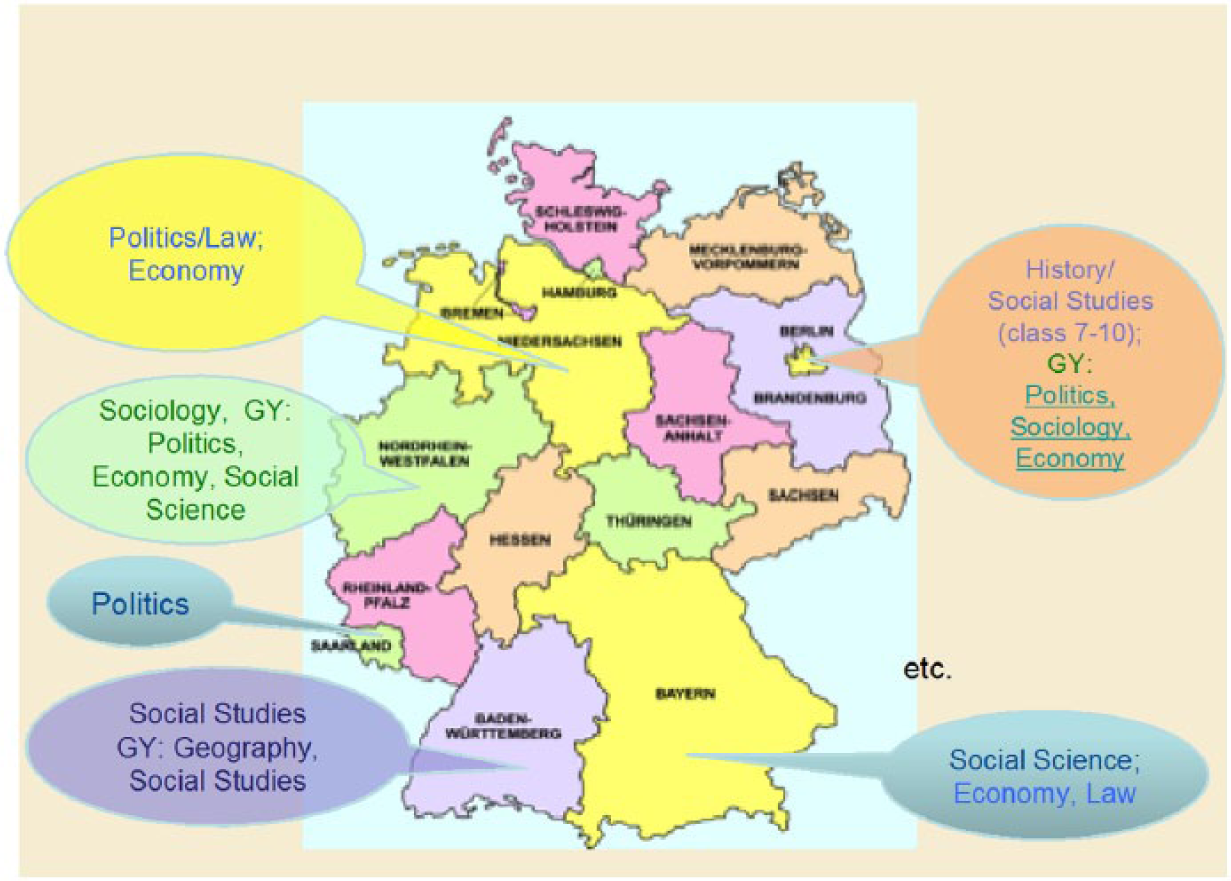
Civic Education lessons in the Federal Republic of Germany.
Furthermore, Civic Education in Germany is not a main subject in school. The timetable at school sets limitations for classroom lessons, for example, main subjects such as Math, German or English are held 5 hours a week in every grade, whereas small subjects such as Music or Civic Education are held at least 2 hours a week and not constantly in every grade, for example, at the grammar school in North Rhine-Westphalia:
Fifth grade: 2 hours Politics, 5 hours Math, 5 hours German;
Sixth grade: 0 hours Politics, 5 hours Math, 5 hours German;
Seventh grade: 0 hours Politics, 5 hours Math, 5 hours German;
Eighth grade: 2 hours Politics, 5 hours Math, 5 hours German.
But on the other hand, in every subject, political maturity and discourse competences are postulated in the curricula. So even if there are few lessons for Civic Education, overall each subject delivers ‘something in that direction’. But what means ‘something’? And what does it say about the importance of an own subject? This could be answered with a focus on the contents. The German secondary school system is very stratified and differs between cognitive levels: Hauptschule und Realschule (HS/RS, secondary modern school), Gesamtschule (comprehensive school, GS), GY (grammar school). In each school form, you will find elements of Civic Education in other subjects:
HS. Working Study (‘Arbeitslehre’): participation in society, responsibility, development of political maturity, reflected judgement and informed decision-making;
HS. German: participation in culture, society and economy, informed decision-making based on the analysis of different positions, convincing statements of one’s own position, argumentation;
RS. Biology: value education, empathy, solidarity, responsibility to create a democratic society, saving the basics of life, sustainable development;
GS. Latin: value education, argumentation, cultural interrelationship;
GY. Maths: argumentation and communication (plausibility, argumentation chains);
GY. Politics/Economy: mature und responsible participation in society, democratic decision-making, understanding values underlying the basic law, argumentation and so on.
You can look at the basic assumptions I made in my preliminary notes negatively and lament on the marginal status of Civic Education in the German school system. Or you can think positively about what should be done in Civic Education during the 2 hours per week. Therefore, you need to concentrate on the core.
What is the core of civic education? Theoretical background
There are different answers, expectedly. I prefer the model of political competences that Detjen et al. developed in 2012. Weißeno (2016) himself criticizes that it is the only theoretical model in Civic Education about the learning process in the didactics of social sciences until now (p. 162). It has its theoretical ground in the psychology of learning and in the political science discipline. There are four dimensions in which students could gain competences during schooling: knowledge, participation, decision-making and motivation/attitudes. In my keynote, I concentrate on the two dimensions – decision-making and participation.
Participation
What does participation mean at all? The research on participation is not consistent about terms and definitions. Is this institutionalized participation such as work in political parties or participation in elections (voting)? Or more unconventional participation organized via social media (Flash Mob, Facebook, twitter)? Is it meant as consumer participation with boycott on products or even the use of violence? In reference to Conge (1988) and Fox (2014), Van Deth (2014) defines participation along four features: First, political participation is depicted as an activity (or ‘action’) – simply watching television, visiting websites or claiming to be interested in politics does not constitute participation. Second, political participation is understood as something done by people in their role as citizens, not as, say, politicians or professional lobbyists. Third, political participation should be voluntary and not enforced by law, rules or threats. A fourth common aspect is that political participation deals with government, politics or the state in a broad sense of these words (‘political system’, ‘policy process’) and that it is neither restricted to specific phases (such as policy making, or the input side of the political system) nor to specific levels or areas (such as national elections or contacts with public representatives and officials. (p. 351f)
In this definition, Van Deth states clearly the activity behind participation. In teaching politics in classroom, this demand is hardly to be satisfied. Going to school is no free act in Germany, but obligatory by law up to the eighth grade. So participation in school is not voluntary. To go on a strike together with their students, for example, for better educational conditions, is also forbidden for teachers by law (Art. 33, paragraph 5, German Constitution). Students learn to vote in school via the elections of a classroom representative, or the student council, but in the school itself their influence and power is very limited. Is political participation possible at school?
The limited possibilities are addressed from Oser and Biedermann (2006) also for Switzerland: (1) Students can participate significant more in their families than in school and (2) They are not involved in decision-making processes in school about topics which influence prima facie their life (p. 25).
So due the other kind of ‘participation’ in school, I refer to the modelling of Detjen et al. (2012). Participation includes the cognitive dimension ‘knowledge’ and a communicative dimension, which is also driven by emotions. Students need to know all forms of participation and how one can participate. The communicative dimension is divided into four facets: articulation, argumentation, bargaining and decision-making (p. 66f).
Participation understood as real action in the political sphere seems difficult to realize in the school context, but students can simulate political action via role-plays like talk shows or pro-con-debates. Grounded on these aspects, teaching participation via Civic Education at school has in my opinion three goals:
To promote/foster classroom discussions;
To teach students how to articulate one’s interest and to argue;
And how to make their own decisions based on reasoning and argumentation.
Decision-making
The last point leads us to the terminus decision-making: What does it mean? In the political sphere, decision-making means the political solution, someone in a powerful position makes after bargaining with other political actors. Something complete different is the personal judgement of a citizen about a political issue in Germany called ‘Politische Urteilsbildung’. This is tricky. In the international literature, you will find several wordings and concepts behind reasoning, judgement and decision-making. In the German debate about reasoning or decision-making, the wordings also differ slightly but no civic educator would regret that ‘Politische Urteilsfähigkeit’ is one of the most important issues of Civic Education. Let me explain this more deeply. The aim for ‘Political Urteilsbildung’ refers to Germany’s recent history of 1945 and 1989. Pupils/citizens should be (critical) thinking individuals who do not follow demagogic leaders, but make their own rational choice and judgement about political issues. Therefore, the competence for reasoning and decision-making should be strengthened in school. But are free opinions and political decisions the same?
What is commonly understood under the term private opinion? The characteristics of an opinion are to be
Spontaneous and unreasoned;
Emotional;
Subjective;
Not generalizable;
Single edged, not differentiated.
To get clearer the difference between the common use of private opinion and a scientific definition of judgement, I cite the learning psychologists (Betsch et al., 2012). Judgement, as the psychologists of learning understand it, means to connect all information between an objective fact with a personal value to a judgement about the issue. The judgement is determined from subjective values and attitudes but also from objective facts. Judgement is closely connected to decision-making. Let me show you the steps with an example:
Marc watches TV, where a flood disaster is shown at a region nearby.
One main reason for flood has been seen in the closing of areas due to housing and river regulation.
Marc is personally interested in consequences of the climate change. He knows about the finite of natural sources and something about parties and their political programmes, for example, the Green Party in Germany is in favour of ecological building, sustainable development and so on.
In Marc’s community, the next election is to come. His own voting decision is affected of his own environmentally awareness (sustainable development as a political value) and the fear of another flood disaster.
Back to general, there are five steps towards a decision according to learning psychologists:
Subjective selection of information;
Previous knowledge/expectations;
Content knowledge/concepts/mental structures;
Categorization;
Integration of information.
The decision is the product of a reasoning process: a value scale is used to judge an issue/object (Betsch et al., 2012: 12).
At this point, we enter the sphere of political decisions again. Let us have a look how these are defined in the mentioned model of political competence from Detjen et al. (2012). Political decision-making is defined as a process, in which a person adds a political value on a value scale towards a political issue (graduation of values). Decision-making needs a free space for discourse and reasoning, but also knowledge. In difference to a subjective opinion, a political judgement or decision raises the claim of objective truth (p. 51f). The formal logic gives criteria for judging the argumentation underlying a decision, for example, propositions logical junctions.
Arendt (1985) criticizes that opinions, which state objective facts or draw a conclusion out of facts in the sphere of politics or society are no political decisions (p. 96). Political judgements need a value-oriented statement in favour of the common good (Hermenau, 1999: 24) and take position in favour or against the political argumentation or even make a decision. To link the competence of decision-making to the competence of participation, political decisions are seen as necessary for political action.
The modelling of the dimension ‘Political Urteilsbildung’ with the differentiation into five facets could be also understood from the necessity to formulate tasks, which students should solve. For example, the first task is to get information about a political topic, to collect facts and bring them together, maybe also to compare different dealings or solutions with a problem. The next (supposed higher) step is to think about the pros and cons concerning the problem and after that to take a position that is not only an accidentally choice but also well grounded in a reasonable argumentation.
I will make an example: Marc is following the debate about a Greek exit since 8 months, and he is happy about a possible Greek exit out of the European Union (EU).
He doesn’t argue, but only state his opinion. ‘It is time that Greece is going to be out’.
So no one knows why he thinks this is a good solution.
His girlfriend Lisa is arguing that the European system with its economical guidelines does not offer Greece a chance to get rid of their debts. So with the political value of autonomy, sovereignty and freedom of the Greek, Marc is in favour of the exit whereas Lisa who stresses the common idea of Europe might be disappointed that the EU members did not find a solution to reduce the debts. At this example, you see clearly that the first statement is just a private opinion whereas the other both are value-based judgements.
This is what the Civic Education wants to foster in classroom lessons, and therefore, the politic didactics differ between free opinion and political decision.
Manzel and Weißeno (2016) developed the competence model from Detjen et al. further on and offer a descriptive model, in which argumentation and decision-making are based in domain-specific knowledge. The decision-making competence also incorporates domain-unspecific influences such as metacognitive strategies or rules of decision-making as well as individual factors. In dissociation from models of the natural sciences or the socioscientific issue (SSI) research, individual norms and moral aspects were separated from political values, common knowledge in daily life from domain-specific knowledge (Illustration 2).
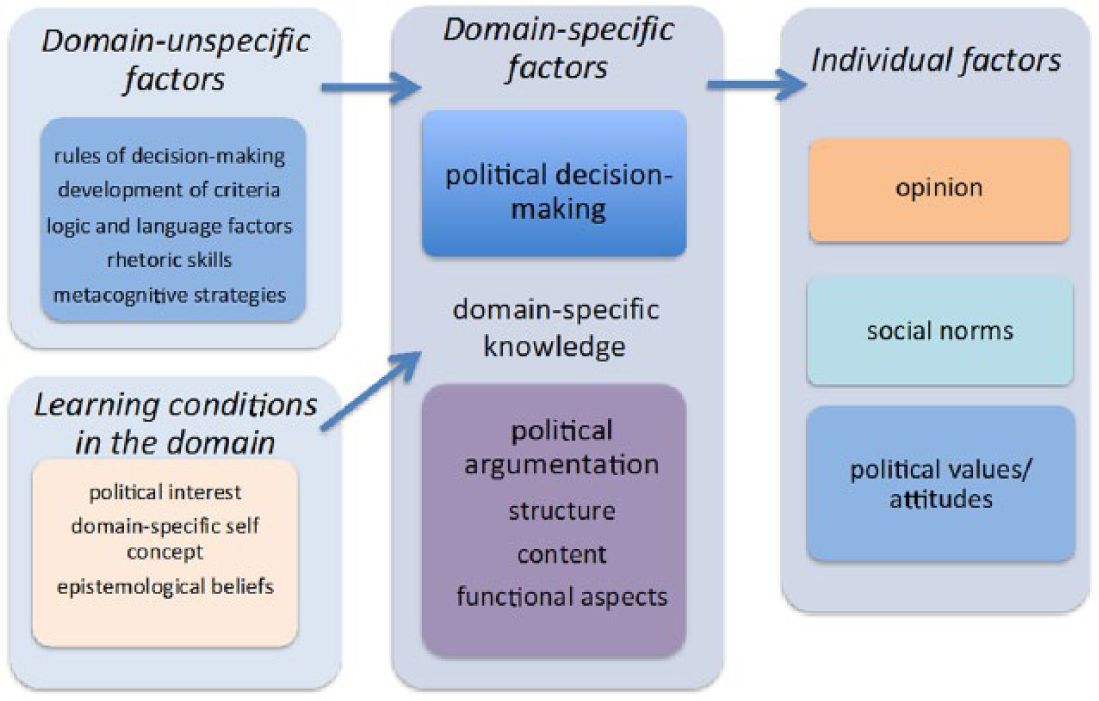
Model of political judgement and influencing factors (own graphic).
The judgement in political or social science lessons differs from the ordinary opinion in daily life. One can express his/her view on a topic or issue plainspoken. But in school, it is necessary to incorporate and reflect facts, values and norms in one’s argumentation and judgement. A controversial dispute based on knowledge can be assessed in classroom. The competence of decision-making can differ from one’s own political opinions. Therefore, beliefs and opinions can be identical with the political judgement, but they don’t essentially need to. Only the linkage between the facts and values, a lesson in politics or social sciences is dealing with, allows the distinction of a judgement from an opinion.
In the research of the political didactics, it is assumed that a fact-based argumentation and political judgement have an influence towards individual factors. Oesterreich (2002), Oberle and Forstmann (2015), Landwehr (2016) show that conceptual knowledge has a significant impact on personal political values and attitudes.
Communicative participation in classroom interaction – Empirical findings
After that theoretical framework, I would like to show you some empirical findings out of our video studies at the University of Duisburg-Essen concerning communicative participation. In our video study, we want to get some insight into what is really happening in classroom interaction. There are several empirical studies on knowledge, political interest and self-concepts (e.g. Weißeno et al., 2014), but there is a blind spot on the things going on in real Civic Education lessons. The underlying assumption of my hypothesis is that in classroom, role-plays offer the opportunity to practise articulation and argumentation as steps towards political decision-making. The results concerning a gender gap differ in research, so there is no consistent picture on gender effects. Slightly the same results were seen in studies with focus on ethnicity. A different language background, for example, due to migration, shows negative impacts on the development of competences or knowledge (Artelt et al., 2004; Organisation for Economic Co-operation and Development (OECD), 2007; Röll and Schilling, 2012). This is also true to political knowledge as the Politisches Wissen zur Demokratie von Schülerinnen und Schülern mit und ohne Migrationshintergrund [Political Knowledge of pupils with and without immigration background] (POWIS) study (Goll et al., 2010) points out. So the following questions of interest are as follows: (1) To which effort do students participate in communication situations in classroom? (2) How are they involved in discussions emotionally? (3) Are there differences due to gender or ethnicity in the willing to participate? (4) How is participation linked to knowledge and self-concepts?
I hypothesize that there is a gap between
The emotionality in argumentations;
Forms of interaction (plenum vs role play);
That the interest in politics and one’s self-concept do have an impact at the will to participate in classroom interaction.
What is my theoretical background on emotion? Emotions are underlying rational arguments. Political issues do not exist in a vacuum but in social context within society. Emotions are also framed culturally (Pring, 2015). Citizens do think but also feel. So emotion is not to be neglected in a decision-making process. Psychologists define the learning process as cognitive, social and emotive. Emotions in classroom are an important motivational driver, but also important for one’s self-concept and the learning success (e.g. Heckhausen and Heckhausen, 2010; Wild et al., 2006). But maybe there is another ‘kind of other’ emotion in public school than in private life out of school. Especially in political role-plays, it is not proven if the feelings are authentic or simulated. Regarding emotion and gender generally, there were found differences between boys and girls (Bradley and Corwyn, 2002; Egloff and Schmukle, 2004; Schienle et al., 2002). But there is a blind spot on emotion of girls and boys with and without migration experiences in communication processes in classroom in Civic Education lessons.
The Video Study II focuses on argumentation and communicative interaction. Gronostay (2015, 2016) is analysing argumentation processes in 10 grammar school classes (eighth grade) in North Rhine-Westphalia. The students are sitting in a fishbowl, articulating and arguing around the topic ‘Should the Nationalist Party (NPD) in Germany be forbidden?’ The fishbowl is a discussion method, where some people sit inside a discussion circle and bring in their arguments. Other pupils sit outside watching the inner circle, they can get into it every time and make their statement, and vice versa. To catch the students’ involvement, standardized videography is an adequate method. We filmed 4 hours of each class to the same topic with standardizes material. The speeches were analysed turn-based with the tool Videograph from the Leibniz-Institut für die Pädagogik der Naturwissenschaften und Mathematik (IPN), Kiel. There are low-inferent coding (number and time of statements in seconds) and high-inferent coding (emotionality within argumentation). According to the qualitative content analysis (Mayring, 2010), we developed a category system with a guideline how to analyse emotion within argumentation. In all, 40% of the material is analysed from three independent rater, the interrater reliability at the high-inferent coding is acceptable with Cohen’́s kappa >.70. Additionally, there is a quantitative analysis with a standardized questionnaire to self-concept, learning motivation and interest in politics.
The sample of this explorative study contains only five classes with N = 136 students attending each of the four lessons. This means an amount of 20 videos, each 45 minutes with two different settings – plenum and fishbowl. This unfortunately reduces the N down to 39 because students should participate in both forms. The speaker identification is 100%, but the validity is very limited due to the number of participants.
Emotion was rated along the verbal skills (cadence of prose, word choice, rhetoric …) and the expressions of the students (facial expression, gesture, posture, tone). We cannot be sure that this is authentic emotion; it is only the visible involvement and participation in the recorded Civic Education lessons.
The four basic emotions we analyse are fear/anxiety (A), fun/interest (F), sadness/disappointment (T) and anger/rage (W). For example, W: ‘… it’s not ok what they are doing and therefore the NPD party should be forbidden!’ (256m) or F: ‘Yes, it could come to > {laughs} < to rumour. That would escalate’ (S252w).
The questionnaire contains Likert-scaled items around self-concept (SKP; four items, α = .76), learning motivation in Civic Education (LMP; four items, α = .87) and interest in politics (PI; two items, α = .68): for example, ‘I like to provoke others in political debates’ or ‘I like Civic Education lessons’.
Descriptive and probabilistic results
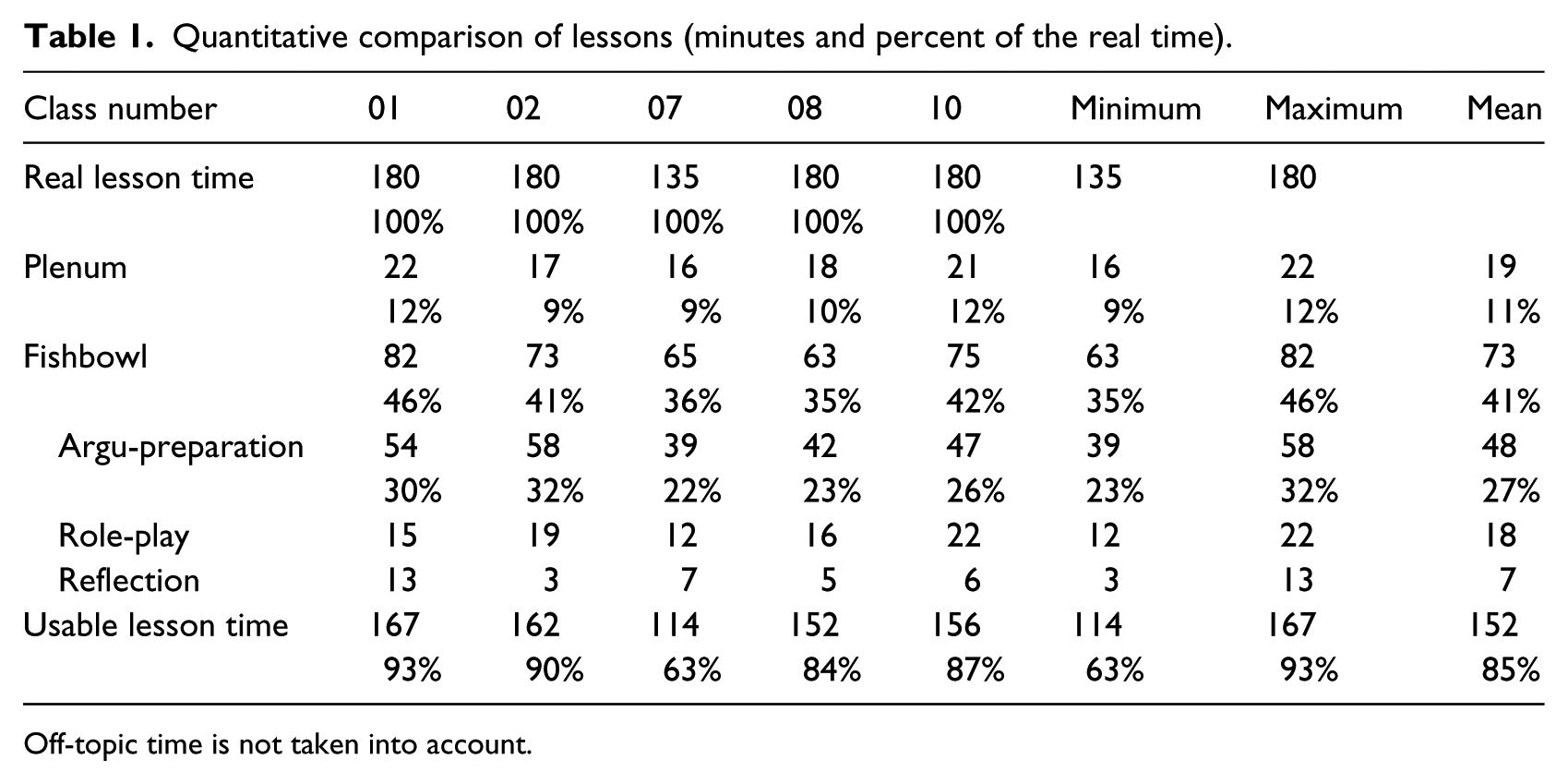
In Table 1, you see that the lesson time expended on the teacher–student interaction in plenum as well as the discussion in the fishbowl differs between the five classes. The minimum time used for the role-play in the fishbowl is 12 minutes, the maximum time amounts to 22 minutes. The time used for reflection with a mean of 7 minutes is quite short in comparison with the real lesson time of 180 minutes.
Quantitative comparison of lessons (minutes and percent of the real time).
Off-topic time is not taken into account.
If you look at the classes itself (Table 2), the composition regarding gender, immigration background and the participation of the students, you will find an interesting picture. Gender is almost balanced with a mean of 10 (girls) and 13 (boys), exceptional class 2, but the number of students with immigration background varies much more between a minimum of 3 and a maximum of 12 students in a class. The participation rates also fall apart between the classes with minimum 18.5% and maximum 61.1%. Overall, the number of non-participating students is high (exceptional class 2). A gender gap could be interpreted at a first glance with a maximum of participating girls of 4 and boys of 8. Also students with an immigration background do participate between 0 up to 4. But the t-tests on gender were not significant and therefore did not allow such interpretations. T-tests on immigration background were not possible due to the downsized sample.
Gender, immigration background and participation (percent of the real time).
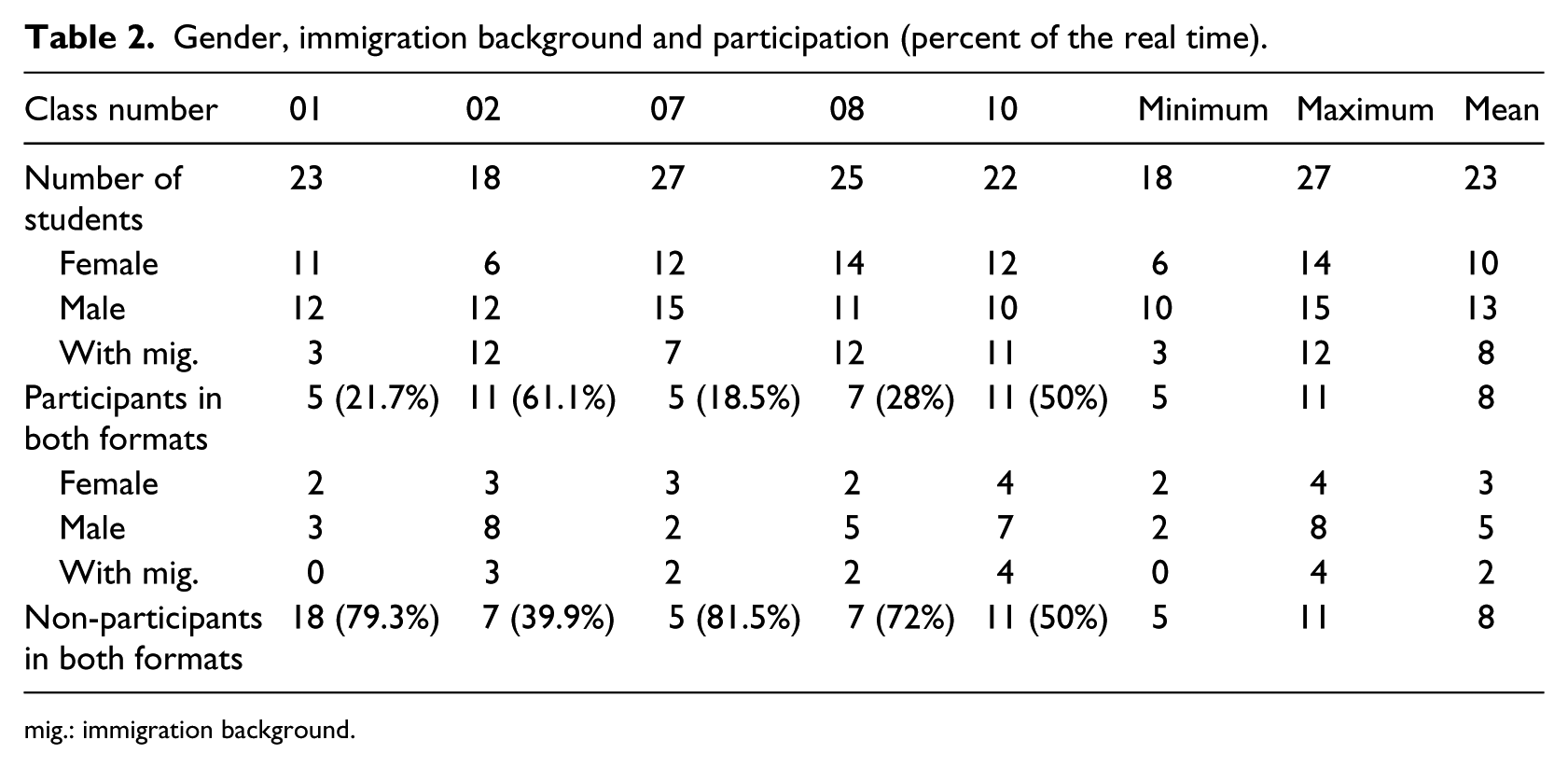
mig.: immigration background.
At the next step, we will have a closer look to emotions. We compare each turn (n = about 300 turns, 100% speaker identification) of the students who did attend in both formats: plenum and fishbowl. Graphs 1 and 2 show the diverging emotionality.
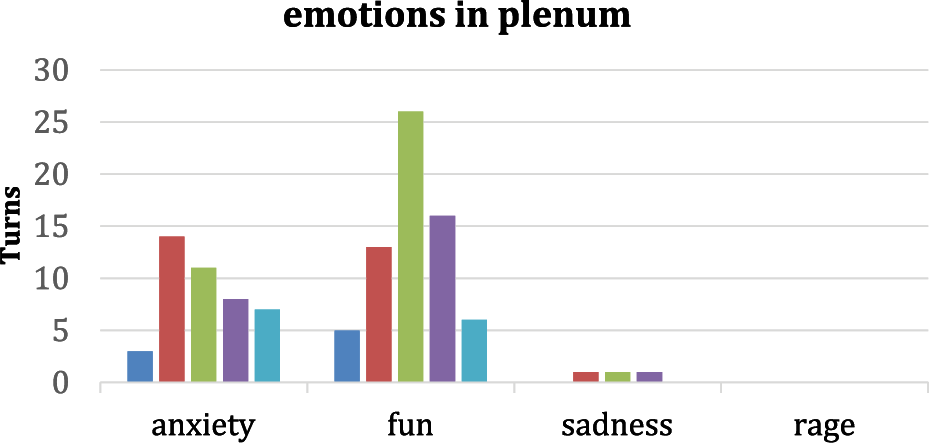
Emotionality in the plenum.
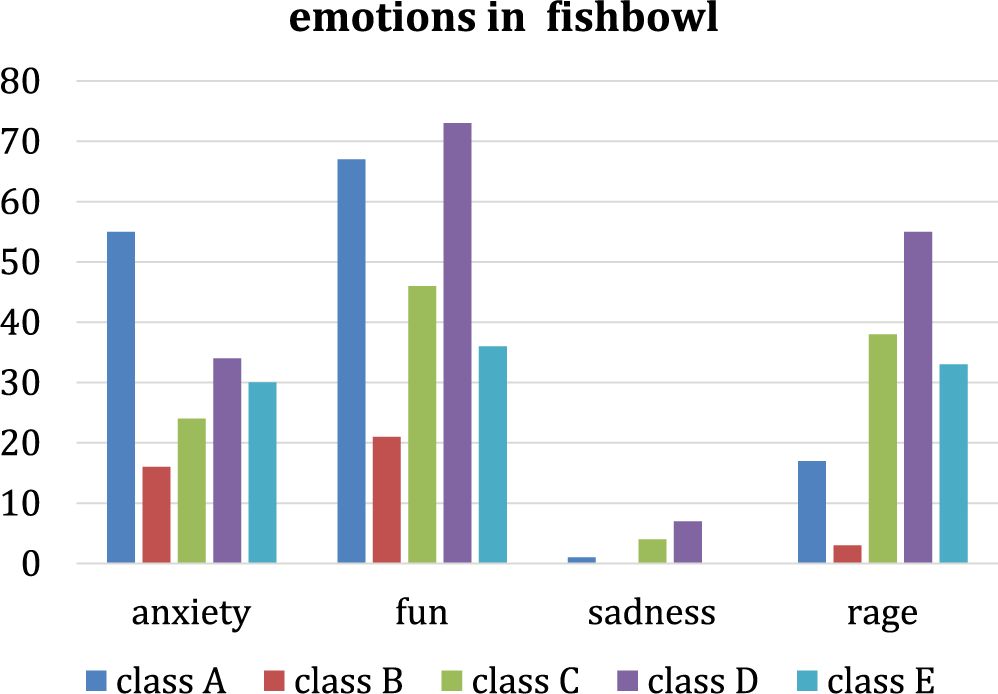
Emotionality in the fishbowl.
Overall, the emotion ‘fun/interest’ rises more than twice from the plenum to the fishbowl, even when this slightly differs between the classes. The emotional facet ‘anxiety/fear’ also doubles in some classes. The emotion ‘sadness/disappointment’ keeps almost at the same level. The emotion ‘anger/rage’ does appear in the fishbowl at first. Even if there are visible differences between the both settings (plenum, fishbowl) regarding emotionality, there are no significant differences in the t-test concerning the emotionality between boys and girls.
The descriptive analysis of the standardized questionnaire to self-concept, learning motivation and interest in politics shows two expected results (Table 3). Boys have a stronger self-concept in politics than girls and a higher learning motivation. Unexpectedly, the girls’ interest in politics is with 3.5 higher than the boys with 3.1. But the variance is quite large and the sample small, so these results have to be taken with a pinch of salt.
Results of the questionnaire on self-concept, learning motivation and interest in politics (N = 39).
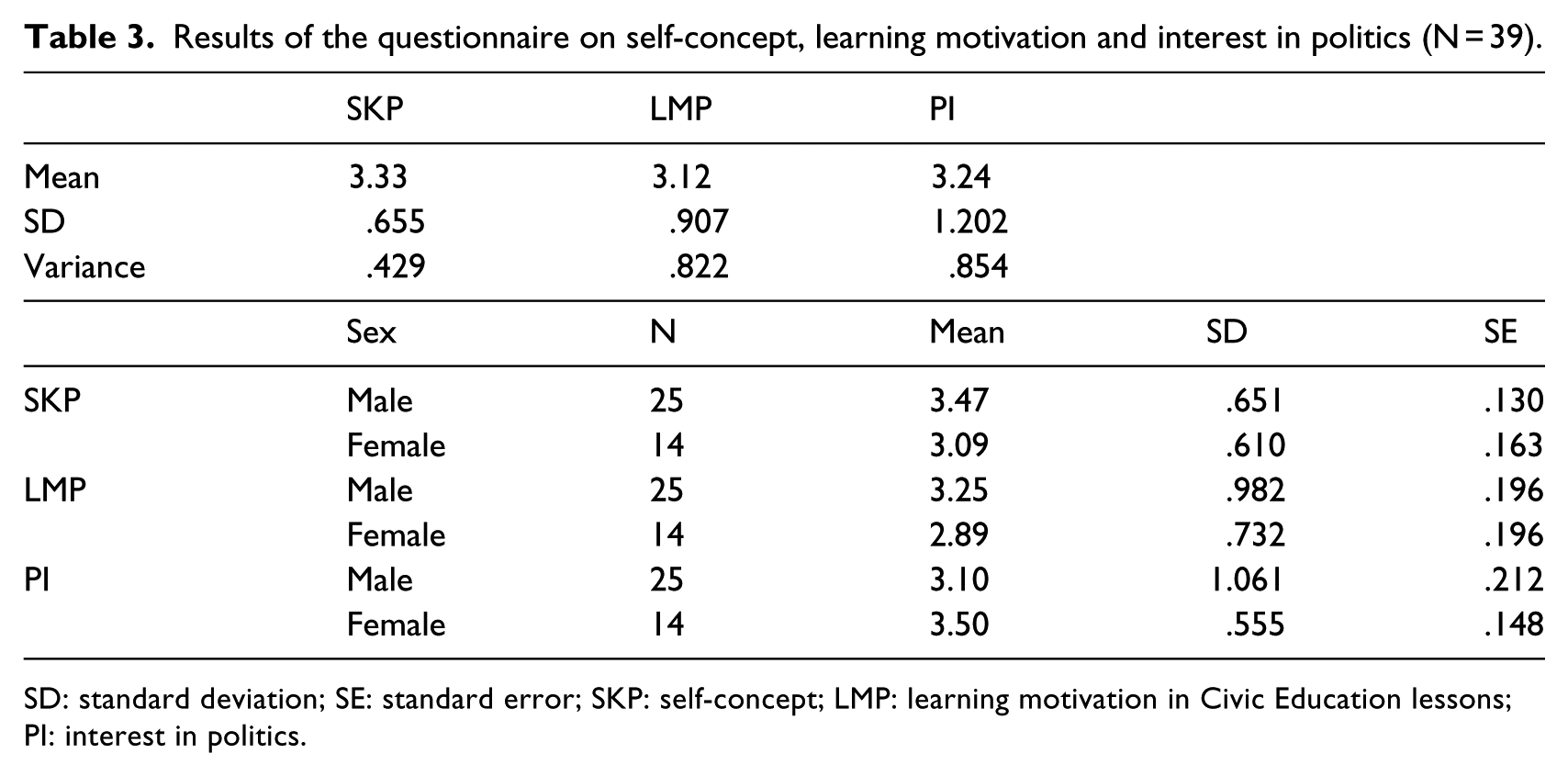
SD: standard deviation; SE: standard error; SKP: self-concept; LMP: learning motivation in Civic Education lessons; PI: interest in politics.
The t-test on gender shows no significant differences between girls and boys regarding learning motivation and political interest, but a low significance on self-concept with T(37) = 1.791, p < .05. A t-test over immigration background is not possible due to the even more downsized sample (N = 7).
At least we correlate the items on self-concept, learning motivation and political interest with the four emotions (Table 4).
Correlations between self-concept, motivation and interest in politics.
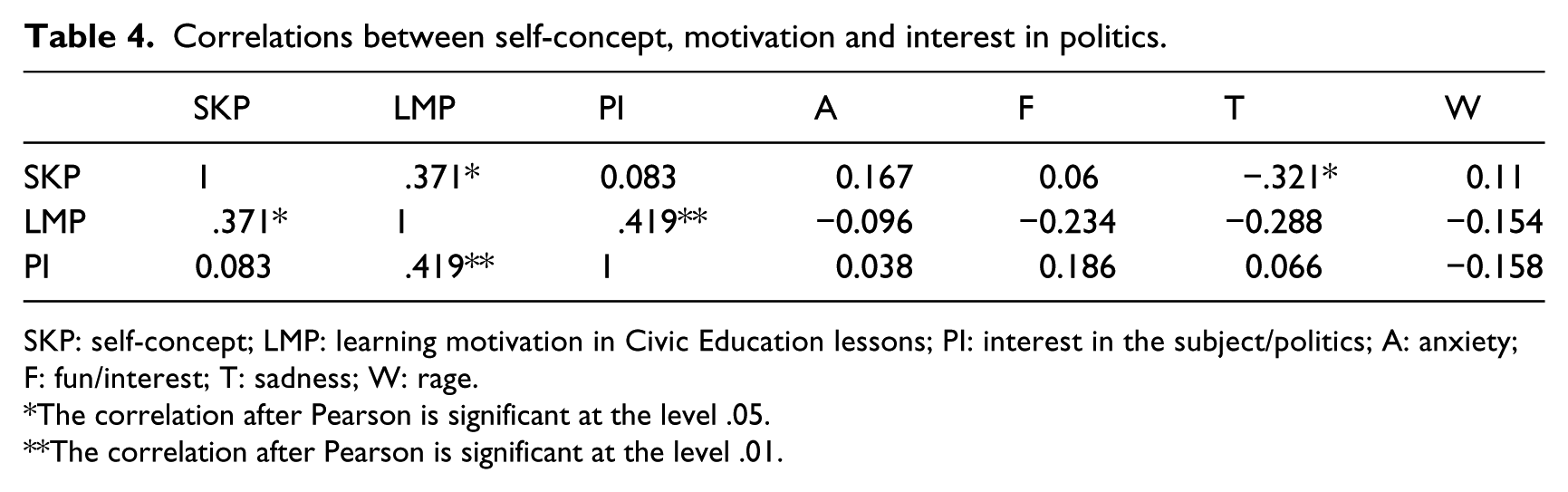
SKP: self-concept; LMP: learning motivation in Civic Education lessons; PI: interest in the subject/politics; A: anxiety; F: fun/interest; T: sadness; W: rage.
The correlation after Pearson is significant at the level .05.
The correlation after Pearson is significant at the level .01.
The self-concept correlates low with the learning motivation in Civic Education (r = .371, p < . 05). The learning motivation correlates moderate with the interest in politics (r = .419, p < .01). Only the emotion ‘sadness/disappointment’ correlates negatively with the self-concept (r = −.321, p < .05).
Summary and further prospects
To sum up the findings, gender is no significant factor in communicative interaction in Civic Education lessons. All pupils know different rhetorical styles they use accordingly to the situation. Due to emotional involvement, there is no gap between girls and boys. This differs from finding in Maths. The degree of emotional participation differs in all five classes, but it increases in all classes in the role-play setting. The fun increases but also anxiety. Rage first shows up in the fishbowl discussions. The negative correlation between sadness and self-concept could be explained by the connection between a positive emotion and a strong self-concept and a negative emotion and a week self-concept (e.g. Heckhausen and Heckhausen, 2010). If we take into account that the self-concept of girls is proven to be significant lower than of boys, the hypothesis could be, that there could be an indirect effect of the self-concept on girls’ participation. The self-concept correlates low with the learning motivation in Civic Education. The learning motivation correlates moderate with the interest in politics. There could be hypothesized a negative impact on girls as well. But this has to be proven with a larger sample.
Simple conclusions cannot be drawn out of this explorative study. It is necessary to get granular on what participation means in classroom. Some open questions are left:
Why do so few students participate actively in the discussions? (18% up to maximum 50%)
And why are their speeches so short? (1 second – average 28.3 seconds in plenum/1.6 minute in fishbowl?)
Are the silent students also participating through interested listening? Or are they bored or somewhere else with their thoughts?
Students get involved cognitive and emotive in the discussion about the party denial. Rage shows up first in the fishbowl/role-play. My hypothesis is, that motivation, political interest and self-concept as well as knowledge and personal characteristics (e.g. extrovert/introvert) influence much more the participation in classroom interaction as gender or the immigrant background does. This has to be proven in further studies.
What do we need? We need more theoretical work as well as empirical studies (Manzel, 2012). Together with Weißeno, I developed a theoretic model of decision-making (Manzel and Weißeno, 2016). The model allows assessing the quality of domain-specific argumentation and decision-making. It helps to differ between a daily opinion and a political reasoning process in school. First studies indicate the validity of the assumed structure.
But we also need a theoretical model of participation in school: Is classroom interaction the only participating form for students? These models had to be proven in reality. We need inventory studies on argumentation as a base for judgements and decision-making. We need studies to inquire how students tell their own opinion and which perspectives and values they take into account. We need inventory studies with different settings to promote participation in classroom. Last but not least, we need long-term studies on the connection between participation in classroom and private participation outside school. Still, there is a lot to do!
Footnotes
Declaration of Conflicting Interests
The author(s) declared no potential conflicts of interest with respect to the research, authorship, and/or publication of this article.
Funding
The author(s) received no financial support for the research, authorship and/or publication of this article.