




Abstract
Civic education is considered as a way to nurture good citizens who work to develop the polity. However, in real politics, education often mirrors instead of shaping the political development. Reviewing civic education of Hong Kong from a historical development perspective, this article explains that civic education has for long been used a tool of governance by the political regimes. This was true not only during the days of colonial rule but is also that after the reversion of sovereignty in 1997. Manipulating civic education as a tool of governance can have far-reaching consequence. In the case of Hong Kong’s civic education, the problems due to neglect, deliberate suppression, and twisting around in different historical phases created the problem for the future. Hong Kong’s civic education is now stuck in a quagmire, and preparing young people to face the sociopolitical challenges becomes increasingly difficult. Finally, this article makes suggestions for reforming civic education in Hong Kong. To conduct this study, a mixed methodology was adopted which comprised both literature review and qualitative interviews with civic education teachers and teachers of the subject Liberal Studies. Selective discourses of the teachers are reported to inform the understanding of the discussion.
Introduction
This article explains that civic education in Hong Kong has for long been manipulated as a tool of governance. It argues that when civic education is not sought in its own right, young people may not be able to meet the challenges sociopolitical changes pose. Indeed, each time when civic education was twisted around to serve the agenda of the ruling elite, a long-term deficiency was created. As a result, civic education has become incapable of preparing the young people of Hong Kong to face the dual challenges after the change of sovereignty in 1997, namely, making informed judgment over politics and political reforms and developing a form of critical national identity with understanding both of achievement and drawbacks the nation has. The article ends with a discussion about how civic education can be reformed to overcome the problems inherited from the past.
Design of this study
This study used a mixed methodology. The research work comprised both literature review and qualitative interviews. The historical development of Hong Kong’s civic education was studied by analyzing pertinent published works. Major official civic education documents in Hong Kong’s civic education history were critically reviewed with the help of commentaries made in the academic literature. This allowed the researcher to understand the civic education history of Hong Kong from both the standpoints of the authorities, as well as to review its nature, scope, and shortfalls from a critical perspective. From this analysis, the researcher comes to the initial conclusion that civic education in Hong Kong, by being twisted and thwarted to serve the agenda of different ruling elites, fails to prepare young people to face the challenge after the change of sovereignty in 1997, namely making informed judgment over politics and political reforms and developing a form of critical national identity with understanding both of achievement and drawbacks the nation has.
Instead of just researching and drawing up conclusion by his own analysis of literature, the researcher has dialogs with civic education teachers in order to confirm or modify arguments he made as well as to pick up any new arguments he could have missed. This required the researcher to carry out interviews with serving civic education teachers, details of which are hereby outlined. Two focus group interviews with 35 serving civic education teachers were conducted. The teachers were participants in the civic education training program the researcher conducted. There were teachers from both sexes and teachers working in primary and secondary schools. All teachers interviewed are indeed experienced civic education teachers, with various length of service. Some are indeed panel chairs of civic education in their schools. As Liberal Studies (LS) has become a compulsory subject for all senior secondary students and it requires students to analyze controversial social issues, five LS teachers were also invited to attend individual interviews to share their views about the contribution of LS to civic education. These LS teachers are teachers the researchers have contact with. So, all in all, the sampling method adopted was convenience sampling with purpose. When such interviews were carried out, the protocol of the Hong Kong Institute of Education was adhered to for enhancing reliability of data and this included
Non-disclosure of the respondents’ name;
Non-disclosure to the public of the soundtrack of the interview;
Non-disclosure of the name of the school in which the respondent works;
Pull out at will in case of excessive sensitivity.
In the course of dialogs, the interviewees can freely answer the questions the researcher prepared. They were also encouraged to pick up issues not asked that they deemed important. This semi-open structure helped to open up data the researcher needed.
Literature review
Hong Kong’s civic education manipulated as a tool of governance
Political consideration and the need of governance have determined the development of civic education in Hong Kong. What follows is a brief account of Hong Kong’s civic education development when she moved along her historical course marked particularly by colonization and subsequent reunification with China.
Hong Kong was established as a colony as a result of treaties reached after the defeat of China by Britain in the nineteenth century. During the days as a British colony (1840–1997), the British colonial administration was overwhelmingly concerned with stability and legitimacy which was understandable as 98% of the population was ethnically Chinese.
The political struggle between the Nationalist Party of Taiwan and the Communist Party of Mainland China from 1949 to mid-1960s magnified the social tension in the colony as schools affiliated with these parties were not just hostile to the other but were promoting nationalism to their students through their civic education programs. In such a context, civic education of a political nature was considered explosive and a threat, and the colonial government resolutely depoliticized schools (Morris and Chan, 1997; Morris and Sweeting, 1991). All teaching of politics and the discussion of political issues were suppressed. Social awareness and concern about current issues and policy debates were discouraged in favor of academic pursuit. This depoliticizing trend continued till the end of 1970s. The Cultural Revolution of China (1966–1976) and the chaos it brought to Hong Kong in mid-1960s made the colonial government even more determined in its depoliticization course. Morris (1992), for instance, explained how Education Regulation No. 96 cited below, which was withdrawn only in mid 1980s, effectively curtailed any form of political education in schools:
No instruction, education, entertainment, recreation or propaganda or activity of any kind which, in the opinion of the Director, is any way of a political or party political nature, and prejudicial to the public interest or the welfare of the pupils or of education generally or contrary to the approved syllabus, shall be permitted upon any school premises or upon the occasion of any school activity. (pp. 102–103)
The Sino–British Agreement reached in 1984 restored China with sovereignty over Hong Kong on 1 July 1997. Hong Kong people were promised self-rule and a government constituted by elections. There was much pressure from the public for reforming civic education under such political reality. In 1985, the Guidelines on Civic Education in Schools (Curriculum Development Committee (CDC), 1985) (hereafter called 1985 Guidelines) was released. However, it was conservative and weak in its political content (Leung and Lau, 1999; Tse, 1997). National identity was played down. The colonial government also didn’t really make a real effort to implement such civic education either (Morris, 1992).
In 1996, the new Guidelines on Civic Education in Schools (CDC, 1996) (hereafter called 1996 Guidelines) was issued. Civic education started to call for the understanding of politics and government as well as the learning for democracy (Leung et al., 2000). This was sensible given that the development of representative government in preparation of self-rule was underway. However, the fact that the colonial government chose to release the 1996 Guidelines as late as in the last year of colonial rule actually guaranteed that it could have little effect. There could be many reasons for this procrastination. But it was obvious that the democratization reforms initiated by the last Governor, Chris Patten, had attracted fierce attacks from Beijing. There was thus immense political pressure on the colonial government, and reining in the pace of and popular demand for democratization could be a way to stave off further trouble.
The change in sovereignty in 1997 ushered in a new government handpicked by Beijing, and the concern has shifted to promoting national identity and patriotism (CDC, 2000, 2012; Education Commission of the HKSAR (EC), 2000; Yuen and Mok, 2014). What’s more, in view of the difference in political affiliation and the critical view some Hong Kong people have on communist rule in China, the new regime in Hong Kong wants to implement a national education program in which national bond and emotional tie are the foci, and they are grounded in such factors as common origin, national achievement, and appreciation. An impact resulting from this new direction the new regime chose is found in the space for free discussion of critical political issues particularly when it becomes critical. This became evident in occasions such as the recent debate pertaining to the role of the senior secondary subject “Liberal Studies” where students are asked to critically examine political and social issues. A fierce debate indeed flared up when the government tried to introduce a mandatory moral and national education subject. Worries about indoctrination and popular resentment finally led to the subject’s abortion (Ngai et al., 2014).
The outline above explains how, in different historical phases, civic education was manipulated as a tool of governance. In this article, we argue that the twists and reigning backs finally work to hamper Hong Kong’s civic education and that it becomes now difficult for it to prepare young people to face their challenges in the twenty-first century. Unlike during the colonial era that Hong Kong was taken as a borrowed place in borrowed time where people considered themselves living in a refuge and were concerned primarily with making enough money, now it becomes clear that two important challenges Hongkongers have to face are how to build up a democratic government and how to adapt to a hitherto non-existing civic identity, namely national identity. Whether these dual challenges can be addressed in Hong Kong’s schools will be picked up in the subsequent discussion. But for the time being, we should now turn to have a look at the literature about how civic education is related to the issue of national identity and the building up of a democratic society as this will inform the understanding of the discussion.
Civic education supportive of a democratic society
There is broad-based agreement in the literature that civic education is needed to prepare students to live in a democratic system. However, the exact nature of such civic education is contentious. While some call for democratic school governance to give students the lived experience of democratic institutions (Power and Scott, 2004; Raby, 2008; Yuen and Leung, 2010), a widely supported proposition also emerges that young people in a democratic system should be aware of the controversial sociopolitical issues and acquire such training as to confront the divergent views relating to the issues. It is hoped that the students should be able to make informed judgments (Hess, 2004; Westheimer and Kahne, 2004). In the United Kingdom, for instance, the teaching of controversial issues was already listed as a part of the education for citizenship and the teaching of democracy in schools in 1998 (DfEE and QCA, 1998). In the United States, Shiveley (2014) also explained that school subjects, like that of Social Studies that deal with controversial issues, have been important for nurturing young people to make reasoned decisions on public matters.
Encouraging students to discuss sociopolitical issues in schools alone indeed doesn’t suffice to nurture young people to be members of a democratic system. In the current literature about civic education and democracy, apart from independent thinking, there is indeed an emphasis on civility when divergence of views is confronted. Being rude, harsh, and condescending are not making youth ready to be useful members in a democratic system (Boyd, 2006; Shils, 1992). Moore (2012) deplored that the decline of civility in public discourses and those among students and saw it as alarming. Accordingly, teacher should have an obligation to model such civility and nurture such virtue among their students. Shukla (2014) argued that forsaking civility will result in social discord. Demands on appropriate attitudes to discuss controversial issues are abound in the literature. DfEE and QCA (1998) asked for negotiation, accommodation, and consideration of contrary views with an open mindset while Shiveley (2014) asked for ability to compromise, open-mindedness, and appreciation of differences. Oxfam (2006), on the other hand, considered as important such ground rules and attributes as no interrupting to the airing of opposite viewpoints, use of appropriate language in dialog, and showing of respect and willingness to listen others’ views.
The above is important in the present Hong Kong context as Hong Kong, according to the Basic Law, is on the path to developing a representative government; and that the public of Hong Kong, particularly the young generation, have become more vocal in controversial social issues.
Civic education and the issue of national identity
Johnson and Morris (2010) explained that historically civic education was linked with the construction of a common (national) identity. Civic education often aims at cultivating people’s knowledge about the nation state and instilling a sense of national identity and loyalty to nation. This can make civic education contentious as nation is an emotional unit (Anderson, 1991; He and Guo, 2000; Yuen and Byram, 2007). Promoting emotional tie, unlike that of teaching of knowledge, is necessarily subjective and may not even be agreeable to everyone, particularly as the extreme form of it were found in modern history to be affiliated to totalitarian regimes and jingoism.
It should be reminded here that current literature, while accepting the fact that civic education can help in promoting national identification, has stayed vigilant about possible malpractices in the process. Kymlicka (2001) cautioned about possible whitewashing and national glorification. Leung (2003) picked up such possible risks as preaching obedience, docility, and deference to authority. On the other hand, Vickers (2005) argued that education for national identity can be a process in which national history and myths are taught in selective and biased manner.
Civic education and the promotion of national identity have indeed attracted researchers’ attention after 1997. Fung (2004) mentioned that Hong Kong people after 1997 needed to develop a dual Hong Kong–China identity. However, although there is a clear focus by the post-1997 Hong Kong government to take the promoting of national identity as an important item in the education agenda, it has proved to be a difficult task. Kam (2012) explained that adding China elements to the curriculum can actually contribute to the ambiguous identity of the students. The government’s attempt to implement national education subject in Hong Kong schools met with strong resistance from the people when some teaching materials were found to be biased and that resulted in the withdrawal of the subject. Kan (2012) argued that the activism seen in the case of the national education controversy actually stemmed from reaction against red indoctrination. On the other hand, Chan and Chan (2014) explained by the term “liberal patriotism” that Hong Kong people’s love of the motherland is in fact qualified by adherence to liberal democratic values.
Hong Kong’s civic education caught in a quagmire
Stepping into the twenty-first century, Hong Kong’s civic education is stuck in a quagmire as it is ridden with problems that came in its course of development when it was manipulated by the ruling elites simply as a tool of governance. Table 1 summarizes how the problems were created in different historical epochs. Problems discussed in this section were informed by the literature review reported earlier and by the data the researcher collected from interviews with teachers.
Historical phases: government concern, policies, and problems created.
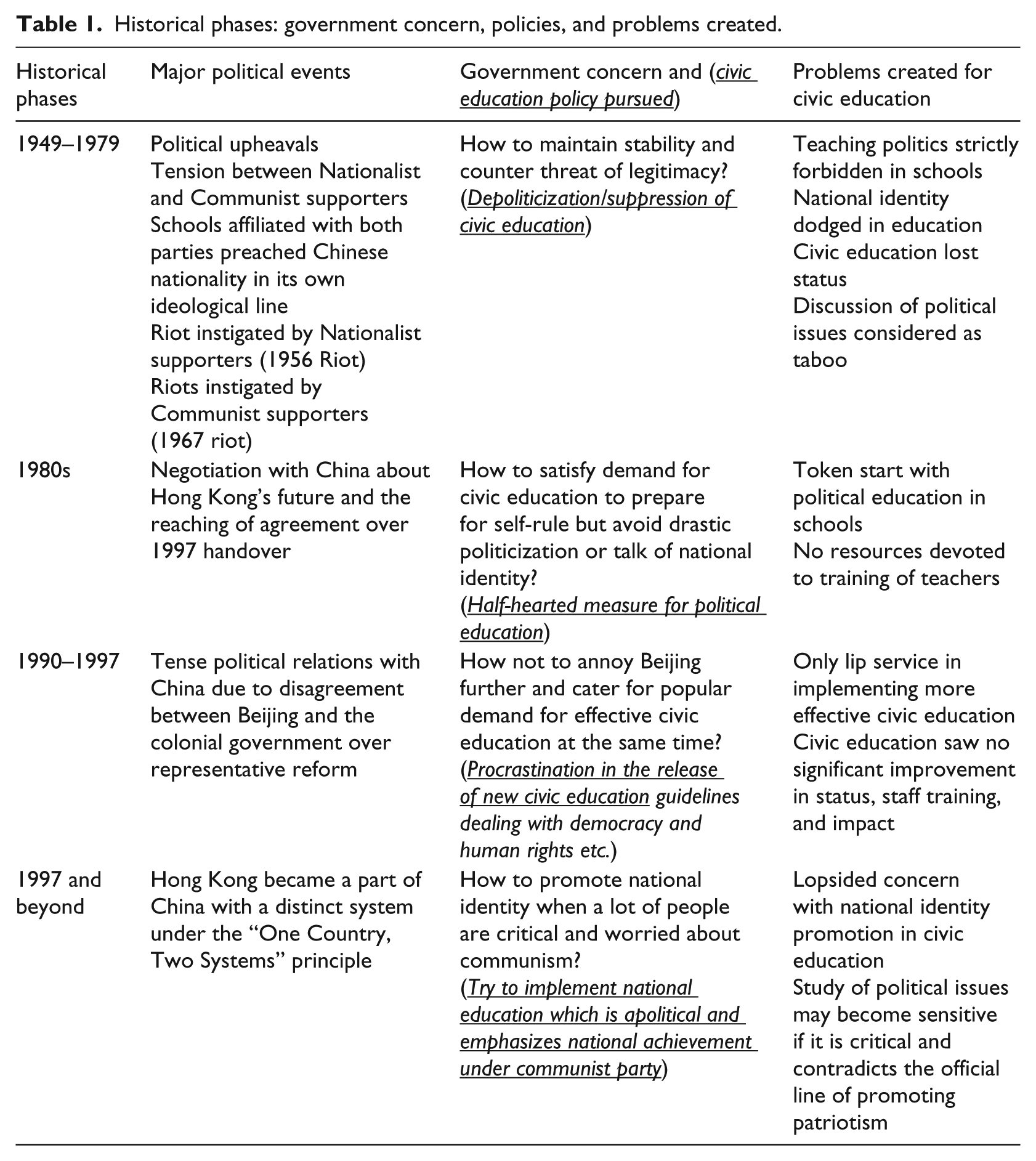
The problems of Hong Kong’s civic education outlined in Table 1 need to be organized and further explained, and to this we now turn. Teachers’ discourses collected in the interviews of this study will be quoted to substantiate the arguments.
Lackluster civic education
Lack of status, identity, and even presence
Civic education was deliberately suppressed by the colonial government since 1950s to counter the threat to legitimacy and stability. The impetus given to it in 1980s and 1990s was largely nominal. The scenario didn’t change after 1997 although the new government wants to imbue a sense of national identity among the students. All in all, civic education is a weak discipline with low status and little abilities to compete for resources in school. Thus, schools normally do not set up a civic education subject with own time slots in the timetable. Besides, civic education is often mingled with moral education with the latter being the main body. Civic education has no assessment result and doesn’t contribute to the overall portfolio of the students when promotion is considered. Civic education responsibilities, unlike leadership in an academic subject, are not leading to any promotion.
The discourses from different civic education teachers reported below are representatives of the teachers’ views and best illustrate the lack of status and identity of civic education in schools:
My school only emphasizes academic subjects as only their results count (for the reputation of the school). Civic education is not one of them. It is there (in the school’s programs) but the school also makes sure it doesn’t disturb the academic subjects. It (civic education) is definitely unimportant. We don’t even give a single lesson to it in our timetable. In my school, civic education is implemented by a team comprising both teachers doing civic education and those doing moral education with the latter as majority.
When I asked the civic education teachers to rate the importance of civic education (10 = highest possible; 1 = lowest possible), the average score was only 3.
Insufficient staff training
A teacher in my focus group interview narrated, “Teachers responsible for teaching civic education are mostly not well trained or untrained and they do not have much political awareness.” This was quickly endorsed by other teachers in the focus group. A number of factors contribute to this. Civic education training has never been a mandatory part of professional training leading to certification. The colonial government, and its successor after 1997, didn’t really invest in training of civic education teachers. The low status civic education doesn’t make principals support serving staff to take up long training programs. The fact that civic education leadership in itself is not a promotional position for teachers further weakens the teachers’ incentive to be trained.
Poverty of political education
Depoliticization of civic education and of schools during colonial rule was done to restore political order out of chaos. But this policy was not effectively withdrawn even after the turbulent time during colonial rule, and this greatly hampered the capacity of schools to deliver political knowledge to students. Students receiving school education in the long period from 1950s to 1990s actually didn’t really learn anything about politics in schools. From them, it should be remembered, the main body of the present teaching force is derived. Due to this, the teachers’ repertoire of political knowledge, even if they want to implement the teaching of politics, is always in doubt. There is a need to carry out massive teacher training program. But as the previous section already indicated, this never took place.
When asked, “In general do you find civic education teachers know politics enough to handle political topics in civic education?,” all civic education teachers indicated that they are under-equipped for the task. When asked to rate “How prepared you think teachers are in handling political discussion in class (10 = highest possible; 1 = lowest possible),” the average score of all teachers was 3.3. This proved dismal as teachers of civic education nowadays are now expected to lead their students to make sense out of the controversies relating to the development of political reforms.
Angst about discussing controversial public issues
Uneasiness of schools when confronted with discussion of controversial public issues of a political nature is most understandable as it was a lesson from history. As previously explained, for a long time (1950s–1980s), a school could be shut down for doing it. It is worth looking at the issue again now that the prohibitive education regulation is gone. Does it mean that the political sensitivity tradition of school is over? It is interesting to note the following teacher discourses gathered in the course of this study. They indeed point to the continuation of the conservative political ethos in schools:
My school has got more than 30 years as history, teachers in the middle age are conservative and don’t really want to deal with social issues (of a political nature) because they are potentially troublesome. They also don’t talk much about the issues among themselves. It depends (on the teachers). But, by the way, due to the religious background (of my school) there is a notice from management that teachers need to be neutral about politics.
The teacher discourses reported above indeed aren’t that of a surprise particularly, as explained earlier, the main body of the present teaching force was actually educated in schools during the depoliticized era that ended only with the 1980s.
It should be noted that a subject called LS was set up when Hong Kong adopted a 3 + 3 + 4 secondary system after 1997. All senior secondary students now need to study the subject and get a pass in the public examination before getting a place in the universities. Indeed, LS does require students to look at controversial issues, including political issues. Will the angst we have been discussing have an impact upon such teaching?
Five LS teachers from different schools were invited to share their views. The findings show that discussion of political issues is implemented by most teachers in lessons. The fact that the formal curriculum of LS and the public examination requires such discussion allows most teachers to conduct the discussion in class unperturbed. However, the LS teachers also explained that they are just doing an “academic study” and as such discussion is expected to stop with the ring of the bell. One teacher indeed explained to us that in his case, the school didn’t allow the use of certain “radical” newspapers as source of information. Another teacher told us that during the “Umbrella Movement,” that took place at the end of 2014, some parents did call the principal expressing concern about possible involvement of their children in the movement. This for a time created a tense atmosphere as the LS teacher was teaching controversial issues and politics, including the Umbrella Movement itself.
The national identity complex
Another deficiency resulting from Hong Kong’s civic education development is that of national identity nurturing. During the colonial days, it was deliberately suppressed to stave off such problems as possible resentment against colonial rule and the conflicts arising from different allegiance of the local Chinese people. The unwillingness to grant people in the colony full British citizenship status, including right of abode in Britain, further precluded the option of nurturing a new British national identity among the local people. British colonial rulers, on the other hand, chose to forge a new Hongkongers identity among the local Chinese. School education helped students to see themselves only as city residents. China became a cultural entity, and discussion about connection was largely limited to traditional heritage like art and celebrations of seasonal festivals and so on. Modern Chinese history after Qing Dynasty was played down. The attempt to erase national identity was remarkably successful against the colonial government’s ability to work out stability and economic miracle in Hong Kong during the post-war years. Under British rule, Hong Kong developed a sound administrative structure without serious threat of corruption, and a judicial system based on rule of law was constructed. Social welfare and human right protection also saw significant progress since the 1970s with the coming of Governor Sir MacLehose who assumed office in 1971. These and the development of a Western style education system help to explain why Hongkongers, unlike their compatriots in the Mainland, are actually pro-Western in their conception when it comes to such matters as democracy, rule of law, human rights, and so on. Many of them also view the system and practices in the Mainland with much suspicion. Hongkongers’ sensitivity to possible red indoctrination and their insistence on liberal democratic principle in the understanding of patriotism was reported in the literature review. Against this background, promoting national identity is bound to be thorny and must be handled on slippery ground. It can easily be explosive if national identity promotion is perceived to be an attempt to erase Hongkongers’ identity and the institutions that brought her success in the past. The resentment could be serious if the national education drive is perceived to be a direct transplant of the practices and values prevailing in the Mainland.
How the problems manifested themselves
Problems with civic education sometime can be kept latent. In the colonial days, for example, this was deliberately done with remarkable success. Hongkongers then were successfully encouraged to make their economic fortune, thinking themselves as residents in an economic city, and leaving governance to the colonial government under the Governor. However, with the change of sovereignty, the scenario changed, and the latent problems have now been front-staged.
Representative reforms
Building up a representative government has become an inevitable task for Hong Kong people as the Joint Declaration reached in 1984 for the return of Hong Kong to China stipulated specifically that there will be self-rule by Hong Kong people. The Basic Law, the mini constitution of Hong Kong, further stipulated that the ultimate goal is to have both the chief executive and the legislature returned by universal suffrage. However, the pathway to the building up of a representative government has proved to be both thorny and contentious. The conservative attitude of Beijing, the reservation of the local business, and finally the complicated constitutional background for such development, all make the representative reform highly controversial. The Umbrella Movement mentioned earlier was in fact directed against a conservative reform blueprint China coined. Against such background, Hong Kong has now been caught in a row over politics. People are split between political views which can result in bitter stand-offs. Young people are involved in such controversies in massive scale. While the independent judgment of the young people in the political division should be respected, whether their decisions and participation are informed by knowledge and open-mindedness will be important to civic educators. This concern is not without ground given the discussion of political education poverty just discussed.
Civic education teachers interviewed in this study were asked whether they thought their students knew politics enough to support their political judgment and engagement. All the teachers indeed answered negatively. When asked to rate out of 1–10 (10 = highest possible; 1 = lowest possible), the average score of all teachers was as low as 2.5. Three pertinent quotes reported below help to illustrate the teachers’ worries:
Actually, political interests of the students are sporadic and short-termed. They can be aroused by issues that the society is deeply concerned. Their concern doesn’t last long and their reaction usually is superficial and emotion-driven. Most students are not aware of what really happen in the society. Those who are involved in the recent political movement only follow their peers and they are easily influenced by the others. No (they don’t know the political background of the issues well), and even now when the students need to take Liberal Studies, it doesn’t mean they know politics well or judge the issues critically.
National identity issue
The British colonial government was also very successful during its rule to play down any discussion of national identity which as explained before was both a cause of embarrassment and a source of threat. The literature review already explained how the colonial government didn’t allow the teaching of national identity to take off in its civic education policies. The scenario however was completely reversed in 1997 as the sine qua non for dodging national identity dissipated completely. The handover gave Hong Kong people (with Chinese decent) full national identity. At the same time, the central government of China is anxious to promote national identification among Hong Kong people. Indeed, promoting national identity and patriotism have been pursued as the foremost objectives in Hong Kong’s civic education after 1997. Anxiety and resentment were unleashed when the national identification program the government pursued was perceived to be merging the concept of state with party in an indoctrinatory flavor – a notion upheld in the mainland. The mass demonstration in Hong Kong that led to the withdrawal of the proposed compulsory moral and national education subject in schools could best be interpreted as a vote against a top-down national education program. In a way, this showed the determination locally to retain the freedom of thinking an important part of Hongkongers’ core value developed from the past.
On the other hand, the heightened stage of vigilance against unacceptable national education may also create a spill-over effect against work by civic education teachers who want students to know more of their country in a fair and unbiased way. Yuen and Mok (2014) reported from the research done with a number of prize-winning civic education teachers in Hong Kong that there is now a tendency by the rejectionists to equate any form of civic education aiming at knowing their own country and building up an emotional tie with her as indoctrination. Such accusation, according to the teachers interviewed, can easily be picked up and magnified by some mass media and that proves deterring to many schools. In the interviews conducted with civic education teachers in this study, the teachers confirmed this heightened state of public suspicion they now have to work with. Some of them expressed that they are now doing a thankless work no matter how impartial they are in leading their students to learn about China. On top of this, they also expressed that they are now lost in the row and they need a clearer direction about how a healthy form of national identification should be promoted in civic education.
The way forward – some preliminary thoughts about reforms
Civic education in Hong Kong may need major reforms if the problems inherited from the past and exposed by the present challenges are to be tackled. A thorough study will be needed to work out a new blueprint for the purpose. What follows are simply some tentative thoughts about the direction of the reforms.
First, political education, not the preaching of a certain ideology, but of general political knowledge and how real democratic political systems work should be included in the curriculum. Caution should be taken here that while political concepts and principles must be taught, they can’t be productive if not at the same time that students learn about how real politics work and how negotiation and compromise can be reached to help the reconciliation of conflicts. These can only be learnt from reference to the working out of real political systems.
Second, national identity nurturing need not be avoided but the substance of national identity and the education related with it requires much better discussion and consensus. National identity should be considered as an important form of civic identities; but at the same time, it should never be understood as preemptive of other forms of civic identities that can co-exist with it, including identities at local, regional, and global levels. Heater’s (1990) conception of multilevel civic identity can be a useful reference in this regard.
That Hong Kong plays an important part as a member in the Asian and the global community is obvious and is imperative for taking civic identities at regional and world level seriously. The “One Country, Two Systems” principle, on the other hand, does emphasize the preservation of uniqueness of Hong Kong upon unification. The Hongkongers’ identity, if it is understood as identifying with a special social system and its core values, should be well grounded and should not be taken as the antithesis of the national identity, that is, being citizens of China. In the new civic education, it is good if students can understand their civic identities at different levels in a comprehensive way. In dealing with national identity, the concerns discussed in the literature review such as possible whitewashing, excessive national glorification, and so on should be avoided. However, we shouldn’t stop at this, but should help the students reflect therefrom how the different identities may interact, including how contradictions may arise from conflict between local, national, regional, and global interests, from differences between local, national, and global values, and so on. Independent judgment of the students should be respected while civic education should ensure that such judgment is informed. Knowledge both of national and world histories and of the development of universal human rights and values are important in the process. Students should learn about their own country and should be exposed to both achievements and problems of China and other nations. Attitudes such as being open-minded, civil, analytical, and so on must be nurtured. The skills of verifying different claims, negotiation, balancing contrary views, and that of articulation and so on are also essential.
Third, civic education cannot be an underdog and taught by teachers without training if it is to yield effect. Timeslots, teacher training, and promotion prospect for civic education teachers should be considered in a favorable light. Tertiary institutions should play an active role, not just in offering teacher training programs but also in forging research partnership with the school community. Tertiary institutions can be a powerful support for schools when schools design their unique civic education policies, implement relevant programs, and try out possible innovations.
In terms of implementation, a school-based, bottom-up approach is preferred for two reasons – first, it will reduce the worry about a centrally directed program that can be deemed indoctrinatory; and second, it allows a school to use what it has to do with what its students need. The school-based program can vary in form and content between schools. Different opportunities of learning – independent civic education subject, cross-curriculum experience, extra-curricular activities, school ethos, and so on – can be tapped and, in combination if needed, to bring out the desired learning outcome.
Last, but not the least, schools should understand that the discussion of controversial issues shouldn’t be dodged as such heated debates by students will be picked up outside classroom if not allowed inside (Campbell, 2007). Instead, when such debates involve the teachers, the teachers should know how to play the role of a neutral chair (DfEE and QCA, 1998; Stenhouse, 1975). Such neutral chairs aren’t without judgment of their own but will insist on presenting both sides of an argument in an unbiased way. He will be like a referee in a football game. It is also important that students also learn from the debate process how to remain peaceful, open-minded and how to express own views with respect to those with unlike minds (Shils, 1992). If these can be achieved, there is a more solid ground for the building up of democracy in Hong Kong – a way of life Hongkongers cherish.
Conclusion
This article argues that civic education of Hong Kong is now in a quagmire because it was manipulated as a tool of governance by the ruling elites in different historical periods to consolidate their position. It now needs a major overhaul, comprising seeking new direction and impetus, to help Hong Kong to face her new challenges. Some suggestions for reforms are also made at the end of the discussion. However, it should be pointed out a new blueprint of civic education is only a necessary but not a sufficient condition for improvement. Real improvement can only come about when we can build up an environment supported by a number of facilitating factors. This is shown by Figure 1.
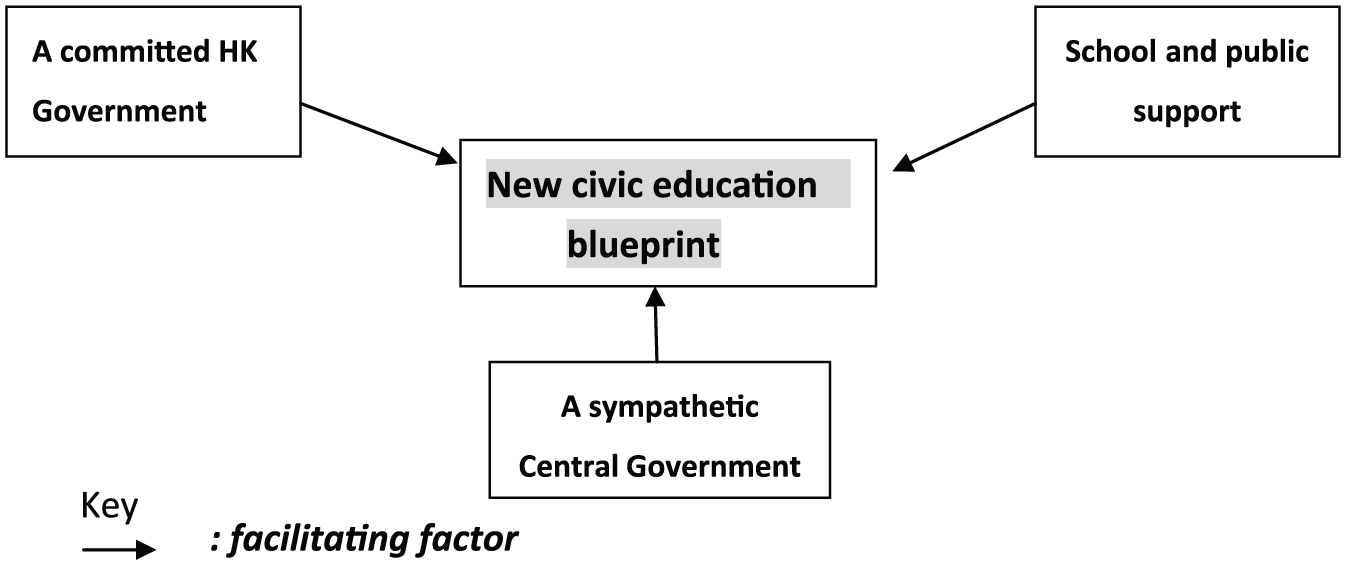
Supportive environment for civic education changes.
First, the public in general and the school sector, in particular, must be committed to such changes the new blueprint is to bring about. Second, the central government of China needs to understand that under the unique situation of Hong Kong as promised by the “One country, Two systems” principle, Hong Kong can have its own version of civic education distinct from that of the mainland. The success of Hong Kong in building up a unique system in return will strengthen the attraction of the “One country, Two systems” principle as a formula of reunification. Third, the government of Hong Kong needs to fulfill its duty provided for by the Basic Law to make its own education policies that can effectively address the problems Hong Kong has. In the case of civic education, this may imply on the one hand investment in resources and staff training, and on the other hand, taking up a liberal attitude to schools and teachers when they work out their civic education program. None of these facilitating factors can come about easily but a reasonable blueprint for civic education that addresses the needs of the students, balance different interests, and make sense educationally must be a first step. It needs to be followed by a lot of promotion, professional sharing, even policy lobbying, and so on. In working out such a blueprint, a top-down bureaucratic approach is not to work. Instead, what is required is a bottom-up approach involving, apart from the government, such parties as civic education experts, school teachers, students, parents, the civil society, and so on. Instead of having another set of official guidelines or another government-prescribed subject, a platform for deliberation and negotiation between these parties should be set up to iron out differences and to work out an agreeable draft based on consensus.
Footnotes
Declaration of Conflicting Interests
The author(s) declared no potential conflicts of interest with respect to the research, authorship, and/or publication of this article.
Funding
The author(s) received no financial support for the research, authorship, and/or publication of this article.