




Abstract
The concept of citizenship is mainly viewed as a Western construct. This article argues an understanding of citizenship education in China not only simply as a grounding in schooling and procedural knowledge of systems of Chinese government but, more broadly, whether in schools or society, whether in China or overseas, that develops dispositions, characters, and knowledge that reflect out who those Chinese young generation are? Democracy is a sensitive topic in China, and it can reflect a complex relationship between citizens and the government. This article, from the Chinese perspective, compares and contrasts the Chinese view of citizenship. It reveals a complex, sometimes contradictory relationship between the individual and state, which is deeply rooted in Chinese culture and context, and provide a critical reflection on Chinese citizens. In conclusion, this researcher calls for a greater commitment to, and a more nuanced understanding of, citizenship education in China.
Citizens? What is a citizen?
What is the difference between a citizen and a natural person? Is it a citizen rather than a natural person, who should take responsibility? I don’t know …
That word people have is political orientation, not the citizen.
A citizen is a person recognized and accepted by a country; people have political colours.
Citizens seems to have more rights than people.
Right. A criminal can be a citizen but not belong to the people; in contrast, a criminal is an enemy of the people.
Ok. I admit that actually the concept of citizen does not have an opposite side but the concept of people does have an opposite. So we can say people and citizens are different in political terms. In other words, people have the relationship of distinguishing an enemy from themselves. Do citizens have an opposite term of reference, maybe un-citizens or a savage? In a word, citizen is defined more in terms of nationality whilst people are defined more from a political point of view.
There is no concept and boundary in terms of people, say, those people who followed Chairman Mao during the civil war seventy years ago are people, and then one day, if Chairman Mao did not like you then you were considered an enemy of the people.
Similarly, the definition of a citizen cannot change unless you want to change it, so you are either a citizen or you are considered to be a criminal who could be deprived of political rights for life.
That kind of criminal should be also counted as a citizen because they cannot be deprived of nationality.
That complex dialogue of “who is a citizen in China” was from my research participants, who have received higher education at a Chinese university and are conducting their doctoral research in New Zealand. This article explores the conception of “citizenship” and “people,” and how a group of Chinese young students understand themselves in overseas. I argue that, for these young Chinese students, coming to terms with who they are has a great deal to do with how they reflect their Chinese citizens’ identity in Western society. My research reports on the tensions these youth face as they observe Western political activities, like protesting on the street and criticizing the Chinese Communist Party (CCP), and they live in a mutli-culture society, which affect how they think about citizenship and belonging.
Citizenship education in China
In Western context, either explicitly or implicitly, some scholars may hold a view that citizenship in China is out of the question. And there is a widespread belief that citizenship should build on human rights, democracy, and individualism (Crawford and Foster, 2000: 170–182; Heater, 2004; Lee and 李榮安, 2004; Print and Saha, 2007; Sears, 2009: 143–158; Weil, 2001: 17–35). However, from the viewpoint of Mainland China context, such criteria for assessing citizenship do not necessarily exist, because of their collectivist experience, authoritarianism, and harmony. Nonetheless, the 17th National Congress of the CCP emphasized that “We need to step up education about citizenship and establish socialist concepts of democracy, the rule of law, freedom, equality, equity and justice.”(Hu, 2007).
“Set up education about citizenship” in Chinese government’s plan bases on Chinese social society reality, combines with Chinese history experience in practice, and learns from the experience and achievements of citizenship education of other countries. But Chinese government don’t believe there is only one single and absolute citizenship education mode in the world that is universally applicable. So, citizenship education in the Congress has a different meaning from Western countries.
It is based on a democratic mode that exhibits with Chinese characteristics, history, and social practice. Thus, citizenship depends on how Chinese interpret and use the term and it is unlikely, given the practical and empirical limitations of social life, that we will ever be able to leave all our particular interests and experiences aside in order to coincide with a universal view. The closest definition with respect to citizenship education in China would include political education, ideological education, and moral education (Lee et al., 2008: 139–157). With global changes and trends, China is not shy of supporting the terminology of Western “citizenship” in the school curriculum, government policy, and academic discourse. This article presents a different interpretation in terms of the basic issues of citizenship, which is rarely discussed in China.
Citizens and people
In the opening quote, my participants discussed the difference between citizens and people. Indeed, the word for citizens translated in Chinese is “公民”; “公” which refers to an affiliated relationship with state, “public” and “state-owned”; “民” is people, and this is significant. China has no social or political indicators for citizenship in its history that as rich and mature as that of Western society. China has a conception of people, as participants, as previously discussed at the beginning of this article. The meaning of people is more descriptive in Chinese politics, more so than citizens, which was a concept introduced to China in the early 1900s.
In the late 1910s to the early 1920s, students at schools across the lower Yangzi region formed student self-government associations with the goal of preparing to become citizens of the republic. For them, moral regulation and active self-discipline, rather than individual freedom and the expression of self-interest, were fundamental to republican politics and this was imbued with the notion of “citizenship.”
However, the dream of “republic citizens” was substituted for “people” by the People’s Republic of China in 1949, a year after the coming to power of the CCP. Since then, the conception of people has been deeply rooted in Chinese hearts and minds. As one of my participants explained the term “people, has political colour,” it affiliates with the body politic, rather than with a general sense of State relationships. The term “citizen” itself became sensitive and could not easily be used (Liu, 2005) on the grounds that it implied connections with Western democracy. Individualism and liberalism represented threats to the CCP, as we noted in the reaction to the Tiananmen Square Incident in 1989. So how is democracy interpreted in a Chinese context?
“As far as the government is a good government, it is democratic”
The word democracy translated in Chinese is “民主,” and in terms of a literal understanding, “民” refers to “people” and “主” means “making decisions,” therefore combining the two words to signify people who are making decisions or the people who are the masters of the country implies the meaning of democracy in a Chinese context.
Historically, since the CCP came into power, it could be said that the Chinese people have become the masters of the country. In China, during times when feudalism was the rule of the day, in retrospect, millions of peasants subordinated to their landlords, and they were only able to acquire the very basic necessities of life. This time period lasted 2000 years. Most imperial courts believed that if their people were well-fed, the empire would be stable and peaceful. As a Chinese saying goes, “food is the paramount necessity of the people.” It was not until 1949, that the CCP returned the land to the vast majority of peasants. Statistics revealed that 700 million mu of land (1 mu is .0667 ha) and various means of production were redistributed among 300 million peasants who had been without any land before (Land Reform and Collectivization, 2014). As a result, this provided substantial relief in terms of food provisions to the Chinese peasants, who historically had never owned land previously, and this development automatically imbued them with great appreciation for the CCP.
Hence, most Chinese people consider democracy that “as far as the government is a good government, it is democratic” (Lee and 李榮安, 2004). From their perspective, it does not matter who rules and in what way the country is ruled, as far as the Chinese can find themselves in a situation where they can live their lives, maintain their relationships, and pursue their personal development, life will be fine, that is, unless their living conditions become intolerable.
However, from a Western perspective, feeding people cannot compensate for their basic human rights and it also cannot equate to genuine freedom of expression and ability to debate and discuss important social issues. Rorty (1989) argues that human rights are a product of advanced economic and social order, rather than an invention of the liberal left or a natural condition of humanity. Even so, it is not a completely valid argument in the Chinese context. In China, unity and social stability are the foundation for developing an advanced economy and building social order. The most important political value for the Chinese is unity and it is about maintaining Chinese civilization, which had developed 2000 years ago (Fukuyama, 2014). And, there is a survey that shows that the majority of students in China expected that democracy would lead to social chaos (Chan, 1999: 381–403). As the population has reached to around 1.4 billion, it is impractical for the Chinese government to practice democracy as Western democrats have advocated that each individual has the freedom to vote or argue with each other. To make it clear, I draw a diagram of the relationship between democracy and the economy in terms of the Chinese belief system as shown in Figure 1.
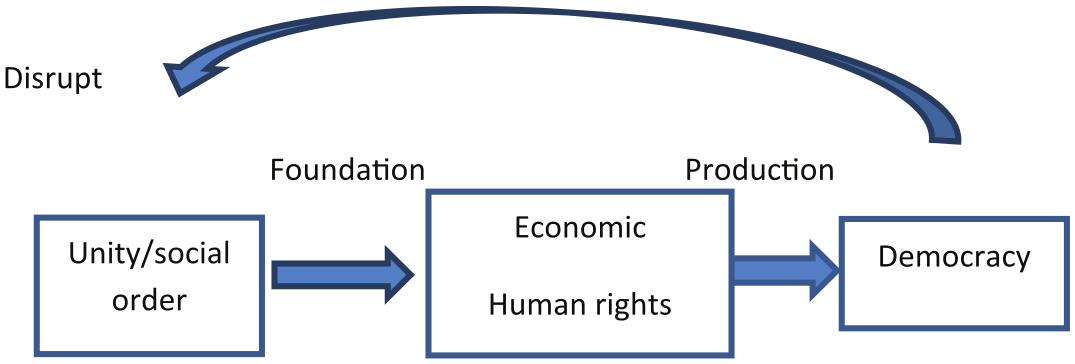
The relationship between democracy and economics in the Chinese context.
Substance democracy
From the diagram, suffice it to say that in Chinese culture an ideology exists regarding the relationship between democracy and social unity/economic development. Mouffe (2000) believes that stability and order are more likely to result from compromising among interests than from mobilizing people toward an illusory consensus on the common good (p. 82). In China, it is a kind of substance democracy that Chinese people have to toward “an illusory consensus with the government” or to render to “maintain a harmonious society” with social development as long as the government provides them with a wealthy and stable life. This exhibits the Chinese character of democracy and Chinese people learned from their experienced life-threatening conditions in history.
Substance democracy, from its literal understanding, we can sense it more underscore material rather than democracy, but it reflects a disposition of Chinese with the government. Leung’s (2004: 116–130) research shows that the particularity of human rights, especially the right to enough food to eat in order to live as the most essential human right in China and only the CCP can feed the 1.4 billion Chinese people. And he says,
Notwithstanding its many deficiencies, the Chinese government has ensured the world’s fastest growing economy and vastly improved living standards for most people. According to the Pew Research Centre, 82 percent of Chinese surveyed in 2012 felt optimistic about their future, topping all other countries surveyed.
It explicates the background of the substance democracy in China that the current government from working on the satisfaction of basic human necessities life had won the support and trust of the people. To some extent, Chinese are inclined to “China is good without democracy.”
To make it clear, there are Lin, Xia, Ma, Yan, and Jing, five participants from my research, who have revealed their thinking of democracy and China:
China is good without democracy. If everyone votes a project, it is unable to finish in five or ten years.
At least, we have high working efficiency.
It depends on the different stage of development.
Right, China will practice democracy on the condition of declining population. At this moment, it is impossible.
China has 1.4 billion; I cannot imagine everybody protesting on the street …
Compared with the old times, the policy is more open than before.
All of them are at the same sides with Xia.
Government is adjusting …
Slowly making progress, right?
Right!
Lin Seems thought of something …
A Kiwi asked me a question about when China can realize democracy? I replied saying I had no idea. He believes democracy is good because you have certain rights and so on. Even so, another friend says China is amazing! These are very different observations because usually what I hear is more about the negative side of China. Then he explained the reason he believed China is amazing is because in China there was a bleacher with a perfect design that was finished in two years and to contrast, New Zealand’s bleacher has not been finished in eight years! Then when the first guy heard this, he kept silent. At last, all of us remained silent. I think China will develop faster without democracy.
In our daily life, we are not involved too much with democracy.
The most manifest characteristic about democracy is free speech and protesting on the street.
In China, whilst I thought New Zealand was a democratic country, I found I was not completely correct, on the grounds that you have to report to police when you are going to protest on street.
Democracy needs an economic foundation. How we can talk about democracy if 1.4 billion people live in hunger?
I think that we are witnessing the development of an ongoing historical process. For example, in the UK, this is a country that has experienced a constitutional monarchy. At that time, where was democracy?
Once democracy meet with efficiency, democracy is not more important in Chinese mind. Considering Chinese social reality, economic development is the priority, substantial and significant policy in social construction after the founding of People’s Republic China. Those five participants are congruent with the social background that “China is good without democracy” now. As one of the participants believe that “Democracy needs an economic foundation. How we can talk about democracy if 1.4 billion people live in hunger, which I have elaborated the relationship between ‘democracy and economic’ above.” However, it also has a deep relation with Chinese culture-harmonious and Chinese history. Below, I will first present what is the difference between democracy in China and Western context, and then the cultural background of substance democracy in China that is considered. In the final section, characters of Chinese citizens.
Substance democracy versus Western democracy
There is a tension between the old democratic principles “power should be exercised by the people” (Mouffe, 2000) in China and the liberal discourse emphasized the value of individual liberty and human rights in the West. Many liberals and Democrats were aware of the conflict between the liberal tradition constituted by the rule of law or the respect of individual liberty, and the democratic tradition composed by popular sovereignty.
For example, Schmitt stands on the side of the democratic tradition that the central concept of democracy is not “humanity” but the “people.” As he states,
In the domain of the political, people do not face each other as abstractions but as politically interested and politically determined persons, as citizens, governors or governed, politically allied or opponents, in any case, therefore, in political categories. In the sphere of the political, one cannot abstract out what is political, leaving only universal human equality. (Mouffe, 2000: 34)
Similarly, in regard to Chinese substance democracy that an individual Chinese citizen cannot abstract out the Chinese political situation, he or she is endowed and referred to as the “people” by the government as it calls for consensus in deference to Chinese political ideology. Nevertheless, Mouffe (2000) proffers that “a rational consensus could ever be achieved where such tension would be eliminated, and to realize that pluralist democratic politics consists in pragmatic, precarious and necessarily unstable forms of negotiating its constitutive paradox” (p. 11). She believes that the difference is the condition of the possibility of constituting unity and totality thus we should oppose a conception of democracy that is far from aiming at consensus and transparency and believes that a well-functioning democracy calls for a confrontation between democratic political positions, and this requires real debates about possible alternatives (Mouffe, 2000: 113).
Overall, her concern is that while consensus is indeed necessary, it must be accompanied by dissent. Her main ideas correspond with Wittgenstein (1958) who says,
we have got on to the slippery ice where there is no friction and so in a certain sense the conditions are ideal, but also, just because of that, we are unable to walk: so we need friction. Back to the rough ground. (p. 46)
Indeed, both express the principle that the free and unconstrained public deliberation of all on matters of common concern is a conceptual impossibility. Hence, we come to the idea regarding an understanding of democracy as “agonistic pluralism explain” (Mouffe, 2000: 14) and we need the forms of argumentation to keep life going on.
Mouffe’s model of democracy that envisages its realization represents a form of an ideal argumentation, as a task conceived as infinite, to be sure, yet which has nevertheless a clearly defined shape of democracy. This is lacking in Chinese substance democracy. However, in reality, it falls into a theory of Buridan’s ass – a common variant of the paradox substitutes two identical piles of hay for the hay and water; the ass, unable to choose between the two, dies of hunger – if we follow Mouffe’s logic in reality by arguing it as a motivation of the society, then we will die as the ass, because we bounded with rationality, uncertainty, complexity and will never be completely able to make the best decision by exhaustible arguing and debate. As the starving ass, we must make a choice in order to avoid being frozen in endless doubt and arguing. Otherwise, we might die in reality. As one of the participants refuted as mentioned above, China is good without democracy. If everyone votes on a project, it is unable to finish in five or ten years!
To tackle the ass’ straits, we should put the emphasis on the types of practical uses and not on the forms of argumentation. In Wittgenstein’s view, to agree on the definition of a term is not enough, and we need agreement in the way we use it. Hence, although democracy is a belief, it is a way of living, or of assessing ones’ life (Ludwig, 1980: 85). In China, substance democracy works as it functions as a representative of the people in terms of creating a climate whereby unity and social stability are the Chinese top concern in politics.
In theory, social stability, or social harmony in the Chinese meaning, keeps the society in peace, ensures the economic growth, and needs a strong state to maintain and preserve. And there is a proposition that the authority and legitimacy of the state is a function of democracy. Actually, the Chinese state enjoys more legitimacy in politics and more authority among the Chinese than is true with any Western state (Fukuyama, 2014).
That conventional understanding traces to Max Weber’s account of legitimacy. To Weber (2009), legitimacy maintains stability because a faith in a particular social order is more likely to produce regularities that are more stable than those from the pursuit of self-interest or rule following (p. 124). In China, we can sense from the views of the participants that – “Government is adjusting … Slowly making progress, right?” – the Chinese state has an invaluable prominent role in the people’s mind even though it has many issues of corruption and problems in terms of human rights.
Social stability in China replaces human rights, which is emphasized by the CCP serves to maintain social stability (Weiwen) as a source of political legitimacy. Concurrently, that faith in keeping social order is deeply instilled in Chinese culture, in politics, and it is also manifested in Chinese harmonious culture.
Harmony as a source of legitimacy in China
In the 17th Party Congress in 2007, stability maintenance, as a basic condition for realizing substance democracy, acquired a new significance under the slogan of “harmonious society,” a leitmotif lying at the core of Chinese philosophy (Jintao, 2005). This faith in harmony, in the interactions between the individualism and collectivism, leads the individual to be an active being and plays an important role in Chinese culture and society, in accordance with its origins from its relationship with nature. This is a core point in Chinese culture.
With the development of society, the Chinese people have been adopting this philosophy in the societal and political sphere to grapple with human relationships. The aim of maintaining harmony explains why Chinese common people have long supported their allegiance to the ruling class over the past 2000 years, because they wanted to maintain a harmonious relationship with the governor as long as they can live, unless the situation becomes intolerable, so it does not matter who rules and in what way the country is ruled. Whereas China’s socialist market economy is the second largest economy by nominal gross domestic product (GDP) (World Bank, 2015) in the world, economic development proves that sustaining a harmonious society is the right policy in accordance with people’s needs in terms of their material conditions, while at the same time the legitimacy of harmony is strengthened in Mainland China and it plays a role in Chinese social structures by “providing stability and meaning to social behavior and has attained a high degree of resilience” (Scott, 1995: 33).
Even so, harmony as a positive still places pressure on the Chinese people to cultivate a compliant ethos and to live in harmony with others even if one’s individuality is threatened:
I was helpless to see it happened-a tragic story in his life-in front of my eyes. Except heartache and familiar this kind of things, I cannot do anything at the bottom of society.
From one of my participants, a Chinese doctoral student expressed in the interview that he could not argue with the government after he suffered from what could be considered a social injustice. Chinese culture taught him a life skill that is to learn, suffer, and be tolerant:
I will share a true story with you regarding how social inequality tends to suppress vulnerable groups. My brother-in-law’s brother’s wife was going to give birth to their second child a few years ago. This breached the one-child policy. That brother brought his family to avoid the supervisors of the One-child policy. Unfortunately, the supervisor found they had gone out of their hometown in order to have the second child and warned that the brother’s father was asking the family to come back otherwise they would pull down their houses. The brother’s father is an honest, uneducated old man.
In China, if anyone breaks the law of one-child policy, the family would get forfeit from the government. The forfeit is around thousands Yuan to over 10,000 around depending the local government. If the people unable to pay it then they would suffer losing job or houses:
This family is so poor that just only have a small house. Inside the house, there is nothing. His son didn’t come back. Who knows why? The supervisor brought three or four brawny men and an excavator to his house. Held by the beefy man, the old man could not do anything, he only stared dazedly at his house collapsed on the ground in one second, at that same, the hope of his life was smashed into pieces. Can you imagine their life having been so hard and harsh, and still to having to suffer further by having their only property destroyed. The worst thing was that the old man was diagnosed with lung cancer a few days later and died very soon after that. The son witnessed the death of his father and because he felt so guilty he finally committed suicide. Most of the relatives were laughing at this poor family because they did not understand the feeling of the house that was pulled down. They had no response to the old man’s death because they thought it was a natural due to his age. When the young man died, the towns’ people suddenly realized that they had not had the completely story of about the family. Then, the community reasoned things out with the supervisors and the family got one hundred thousand as a compensation for their tragedy.
This is a complicated and sad story that reveals an abnormal “harmonious” society. The uneducated town people keeps a harmonious relationship with the government by obeying the law of one-child policy and by agreeing with the government that the houses should be pulled down for the family breaks the law. Harmonious should be in a role of scaffolding of the Chinese stability society ideally. But excessive pursuit of harmonious would lead in tragic for Chinese people. The town’s people looked on the house was pulling down without any sympathy with this poor old man’s family. No one helped them at that moment. While those town’s people stood at the same side with the government until the young son suicide that they realized something was wrong:
It did happen. I cried when I heard that story. Many people don’t understand the harsh life of marginalized groups. As the victims were not highly educated they thought it was their bad luck. They never ever thought it was due to a problem with the policy or the government. Those residing in the more poor areas are more like that. There is a saying in China that Chinese person is not so significant.
In Chinese culture, it is worship with collectivism that individual is not important as the participant says “Chinese person is not so significant.” And in this story, those town’s people showed off a cruel, indifferent, and inhuman disposition. I don’t believe China is a collectivism, but relationism, society in nowadays.
Relationism
In regard to the background of the philosophy of harmony in China, relationism is an attribute of citizenship in China. De Bary argues that the paradigm of collectivism and individualism is not helpful in understanding the position of the individual in the Chinese context, as Chinese society is “relationalist,” neither individualistic nor collectivist (Lee and 李榮安, 2004). Relations bridge the interactions between the individual and the collective. To some extent, it depends on the situation that a Chinese could be very collectivist under a discourse of authority, let’s say, culture revolution. Along these lines, one of the Chinese doctoral students made a strong and powerful statement in terms of his relationship with the country:
Let me tell you one thing. While going through customs, I hold my passport, which is a red color, so it is different from other colorful passports. I know my passport is red and this means I am of Chinese heritage and have Chinese blood. There was no feeling about this in China until I got off the airplane and saw my passport, a name card imprinted on my body that I come from China. I cannot find words to express that feeling until I came across other Chinese students, who had the same feeling, excited slapping their thighs: “right, it was that feeling.” So, belonging there, I will go back to my motherland no matter if it is good or bad and no matter where I was. My relationship with China is like a flower in the garden.
He cleared his voice, saying it word by word. In a position of bonding himself with Chinese culture and Chinese identity, his affection for China reached a patriotic resonance similar to other Chinese students. However, leaving that discourse, for example, after emigration, a Chinese person can become surprisingly individualistic (Lee and 李榮安, 2004). For example,
Now I can do for myself something that I like and I don’t care how others look at me. I can choose to change my major if I don’t like it, and I don’t care that other people may ask why I gave up my former major. Or I don’t need to force myself to acquire a skills certificate to please my parents. In New Zealand, I have learned everyone has his life thinking, each on his own. I did not know how to achieve my self-worth as an individual and what I exactly needed but was just told by my parents since I was a child that I should make a lot of money. As to why I needed to make money, I did not know. Is it necessary for me to make lots of money? I did not know. How I was going to spend the money if I made it, I did not know. What I was living for, I did not know.
Although the guy was happy to be out of China for a chance to find himself, yet he didn’t realize what he has just mentioned as noted above could be considered as a strongly individualistic statement. And even though he sensed that all his wishes, efforts, dreams, and ambitions were motivated by the people he surrounded himself with in China he still has an active affiliation with the country:
what do you think when others say that China doesn’t have citizens?
I don’t say things like that. I am Chinese. I am from a country that is named China. To have Chinese nationality means to have many social benefits. At least, China provides much public welfare, for example, you have the right to accept education, is this not the biggest social welfare from your point of view? My relationship with China is: one honors all and one damns all. First, I have a grateful heart to China, and I regard China in the highest esteem just like my parents who brought me up and fed me since I was a child. We all belong to the Han nationality. There is no doubt that I love China as I love my parents, in the same sense. Secondly, we should make an objective assessment of China as we evaluate our parents who have their own merits and demerits.
While on one hand, he showed the freedom of the individual by knowing what he is looking for in the rest of his life and, on the other hand, he conveyed affection for China overcoming other countries around the world. Behind the paradoxical thinking is the mentality of relationism, based on harmony, which is a very significant philosophy for Chinese. From the point of view of relationism, balancing with government, society, and community, Chinese have the characteristics of citizenship: loyalty, obedience, and patriotism. They cannot change their routine because it is costly and challenging under the stability and harmony of social order, even though they are overseas in a country with a completely different social and political context. Collectivism is not a right label for Chinese, but relativism can reflect Chinese harmonious culture. Therefore, Western media, thought or influence in terms of citizenship, as an external pressure, may be partial, inconsistent, or short-lived.
Conclusion
From the above discussion, as Figure 2 shows, citizenship in China is mediated by the ideology of harmony. It has not been eliminated by Western culture and values but remains effects in a role of citizenship education in China, which is an important way of sustaining and ensuring that future citizens have the Chinese characters of citizens – relationism, as my participants reflected.
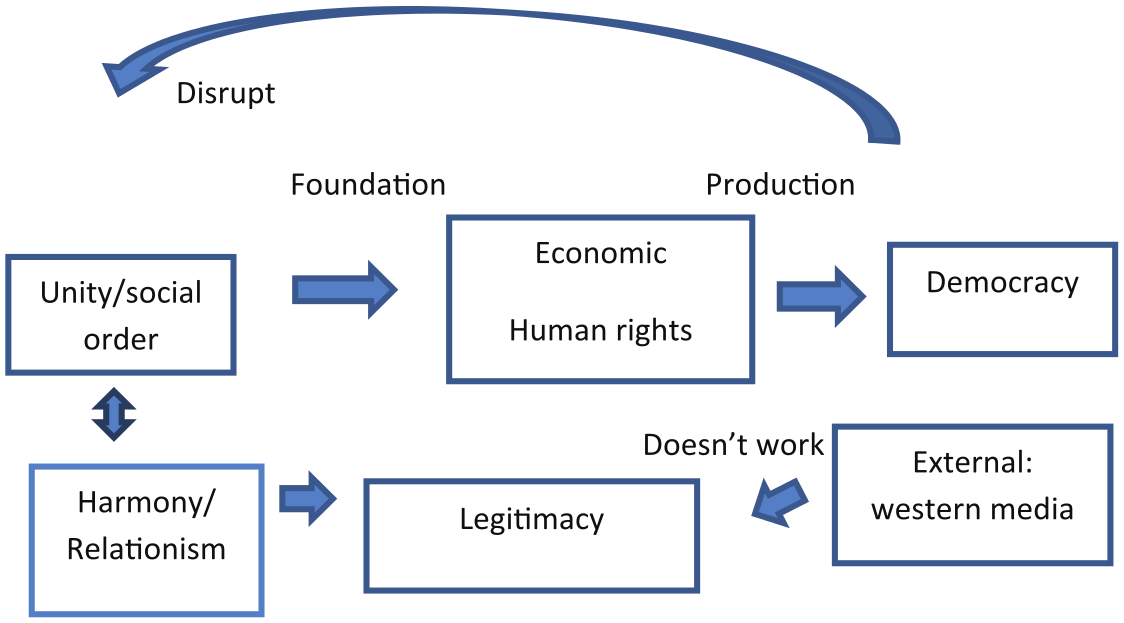
Citizenship education in China: a relationship between democracy and Chinese culture.
It also reveals a complex picture of conflicting forces in forming a Chinese person as a citizen. These forces include Chinese traditional culture, ideology of communalism, Western media, and Western society and so forth, which constitute Chinese citizens’ actions in society. Harmony plays a role of integrating these forces in this picture of Chinese citizens.
“As far as the government is a good government, it is democratic” is one of the countenances of citizenship education in China from democracy perspective. The more we explore, the more we found China has the substance democracy rather than Western democracy for its social causes. On this vine, we found the traditional harmonious culture balances the relationship between economic development and democracy. “Relationism” as a character of Chinese citizen is come out of at the end of this article.
My view above all is not impeccable and my aim is not to define what citizenship is in the Western context or Eastern culture, rather it is to discover how a Chinese person responds to his or her social environment in and around a complex society and to take off the cover of “citizen” to know who he or she is. Relationism is a key to open the door of a “citizen” in the Chinese context.
As one of the largest states in the world, citizenship education in China cannot be confined within the boundaries of its nation-state. It must become transnational. One aspect I must make clear is an agreement reached by the Chinese about maintaining social stability as a secondary consequence in order to compromise and retain a good relationship with the government. This is a process in Chinese social development. Nonetheless, individual interests might subordinate to the authorities. Hovering between individualism and collectivism, liberal democracy, and traditional democratic, Chinese citizens choose relativism and traditional democratic in the political arena in the Chinese social context. Perfect democracy is an ideal and should be conceived as good that exists only as long as it cannot be reached.
Footnotes
Acknowledgements
The author is grateful to Professor Saville Kushner and Dr Marek Tesar for their critical and constructive comments on an earlier draft of this article.
Declaration of Conflicting Interests
The author(s) declared no potential conflicts of interest with respect to the research, authorship, and/or publication of this article.
Funding
The author(s) disclosed receipt of the following financial support for the research, authorship, and/or publication of this article: This work was supported by the Chinese Scholarship Council.