




Abstract
The article gives a review of the investigations publicised in the scientific papers of various countries, which reveal the increase in social closure and analyse the problematic conception of social withdrawal; introduces the theoretical (ideal) model of a socially integral teaching/learning environment in the classroom; uncovers its impact on the behaviour of the learners who tend to socially withdraw; discusses their understanding of integral teaching/learning environment as well as the value and possibilities that such an environment provides them to help become active, which is authentically based on their own wording of this understanding and experience acquired while implementing the above-mentioned model in the classroom; and submits their thoughts about socially integral teaching/learning environment, its impact on their state of mind in the classroom and their willingness to learn and participate in class activities.
Introduction
Nowadays, due to rapid change in our economic and social lives, human relations are extremely strained. The young generation reacts to these strains particularly painfully, as in order to get successfully involved into the active rhythm of life while functioning in society, young people have to orient themselves in the social environment. They have to be able to communicate, deal with conflicts and understand the impact of the assumed or granted social roles on their behaviour.
As the world is marching towards a more knowledgeable society, an individual has to function in the changing surroundings that enhance these new requirements. On one hand, technologies become more effective and the amount of knowledge increases. On the other hand, polarisation of the society increases and social withdrawal becomes deeper (Hargreaves, 2003).
The study of scientific papers implies that nowadays the relevance of investigating learners’ social issues and the assistance provided to them is increasing. The research of the scientists of various countries reveals that the idea of studying learners’ social withdrawal is rapidly spreading. However, in Lithuania, a lack of research investigating the problem of learners’ social withdrawal and ways of solving it in the classroom is greatly felt. The majority of Lithuanian investigators focus on general social pedagogical assistance to learners, analyse separate aspects of providing support or concentrate on external problematic behaviour such as disobedience, hyperactivity, which impedes concentration, or aggressiveness. However, learners’ problematic inner behaviour in the classroom such as depression, anxiety, withdrawal, unwillingness to communicate or isolation tends to be analysed more from the psychological point of view. Although these issues have often been discussed in recent years (while implementing the education reform, the development of learners’ social competence is considered to be one of the priority objectives; Education Guidelines, 2002), no investigations of the phenomenon of socially withdrawn learners and the possibilities of empowering them to engage in active learning in the classroom as well as participation in social activities have been found in the works of Lithuanian researchers. On one hand, this phenomenon is of great concern for teachers and makes them constantly query how they should deal with learners who do not communicate, refuse to perform the tasks assigned to the group, do not participate in joint class activities, are extremely withdrawn, isolated and live as if in a different world. On the other hand, the learners who unconsciously use withdrawal as a way of adaptation in the school fail to learn to become active members of the society in the future. In this respect, a relevant issue is the teaching/learning environment in the classroom that would ensure the opportunity for all learners to become actively involved in the process of teaching/learning and participate in joint class activities.
Thus, the problem of empowering the learners who tend to socially withdraw to actively participate during classes and overcome social withdrawal while learning, which is little investigated (and in the context of limited resources is quite untouched, especially in Lithuania), arises. While getting engaged in the active rhythm of life, a contemporary maturing young person has to be able to orient in the social situations he or she gets into while living and functioning in the society. Nowadays the aim of learning is not only effective interception of knowledge but also working in a group, making effective individual and group decisions, and learning to manoeuvre in the social reality. This triggers a need to develop a holistic socially integral teaching/learning environment (SITLE) in the classroom, based on the paradigm of cooperative learning. In this context, the problem of the research is formulated by the question what learning environment governs the participation of all learners, including socially withdrawn, in joint class activities while learning and making decisions that are significant to the class, and how the learners who tend to socially withdraw comprehend the SITLE in the classroom in terms of its value and the provided opportunities to become active.
The subject matter of the research is the impact of the SITLE in the classroom on the learners who tend to socially withdraw. The aim of the research is to reveal the impact of the SITLE in the classroom on the learners who tend to socially withdraw.
The objectives of the research are as follows:
To present the model of SITLE in the classroom.
Uncover the attitude of the learners who tend to socially withdraw towards SITLE in the classroom and the opportunities it provides to get engaged in the process of teaching/learning and joint class activities.
The method of the research is the study of scientific papers and semi-structured interview. The data have been processed by the method of content analysis.
Theoretical insights (foundations) of the model of the SITLE in the classroom
While designing the model of SITLE in the classroom for the learners to be empowered to overcome social withdrawal while learning and participating in joint class activities, social, psychological and pedagogical aspects of the environment mentioned have been taken into account.
The study of the social aspects is based on the following theories:
Theoretical provisions of the social constructivism stating that values and viewpoints have a social basis. Every society constructs its own definition of reality and other concepts related to it (Berger and Luckmann, 1999).
Theories of the social capital that include such features of social life as nets, norms and trust, which empower the participants to act in a more effective way in order to reach joint aims (Coleman, 2005; Gendron, 2004).
The pedagogical aspects of the SITLE in the classroom are based on the following theories:
Theories of cooperative learning, which include the strategies of group and team learning, developing the autonomy of group members, respecting other persons and engaging in the process of decision making while solving interpersonal and social problems and so on (Šiaučiukienė, 1997; Teresevičienė and Gendviliene, 2000);
Theories of converged development, which emphasise the uniqueness of the personality, education directed towards the process (open system education), the importance of open interaction between an individual and his or her environment as well as the significance of the mutual impact and interdependence that are characteristics of such an interaction (Grendstad, 1996).
The psychological aspects of the SITLE in the classroom are based on the following theories:
Theories of psychosocial development of the personality, which emphasise life-long formation of the personality that is facing the environment and communicating with others and define psychosocial crises (problems) of the stages of personality development as well as the ways of solving them as a vital process that determines further direction of personality development, its quality and social adaptation (Eriksonas, 2004).
Theories of group structure and dynamics, which emphasise interaction and transaction as essential processes determining purposefulness of expanding group activities (Berne, 2001).
Having discussed the participants in the process of creating the SITLE in the classroom, their activities, functions, responsibility and interrelations having distinguished the main stages of the process and discussed the levels of the SITLE in the classroom on the theoretical basis, a theoretical (ideal) model of the SITLE in the classroom has been constructed, which defines the stages of creating the SITLE in the classroom, its levels, main participants, their functions and activities, basic norms, aims and anticipated outcomes (Figure 1).
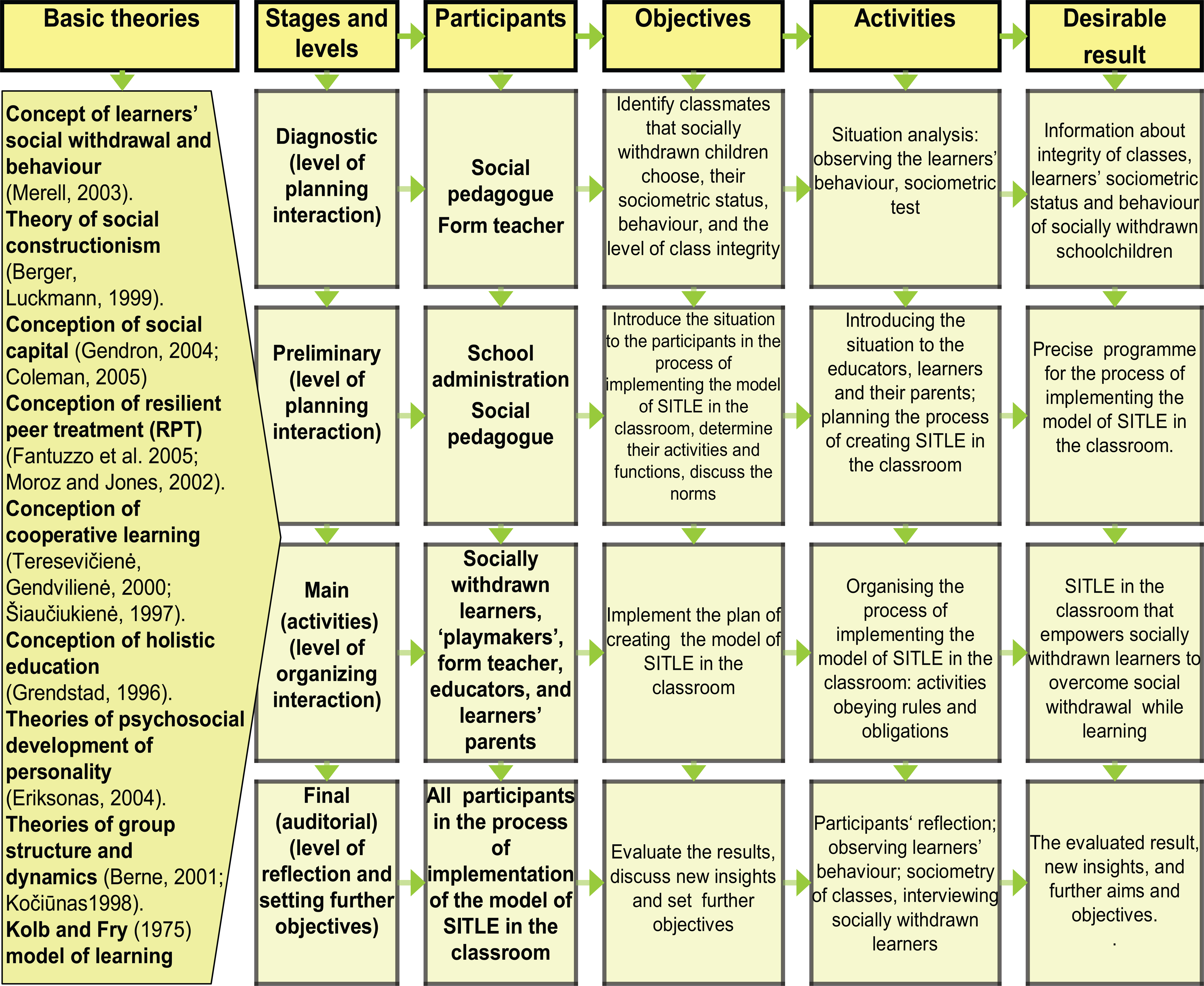
The model of SITLE in the classroom.
The implementation of the model was supposed to create the SITLE in the classroom, which should empower socially withdrawn learners to overcome social withdrawal and actively participate in the process of teaching/learning and joint class activities. In an ideal case, the implementation of the model of the SITLE in the classroom was supposed to completely solve the problem of learners’ social withdrawal. However, it was understood that the implementation of this model in a particular school and in a particular class is a specific process that depends on the situation in the school and in the class that is ascertained at the first (diagnostic) stage of the model.
Twenty experts shared their opinion about the model. Taking into account the results of the expert survey, the model was improved (Figure 2 with alterations presented in different colour in italic).
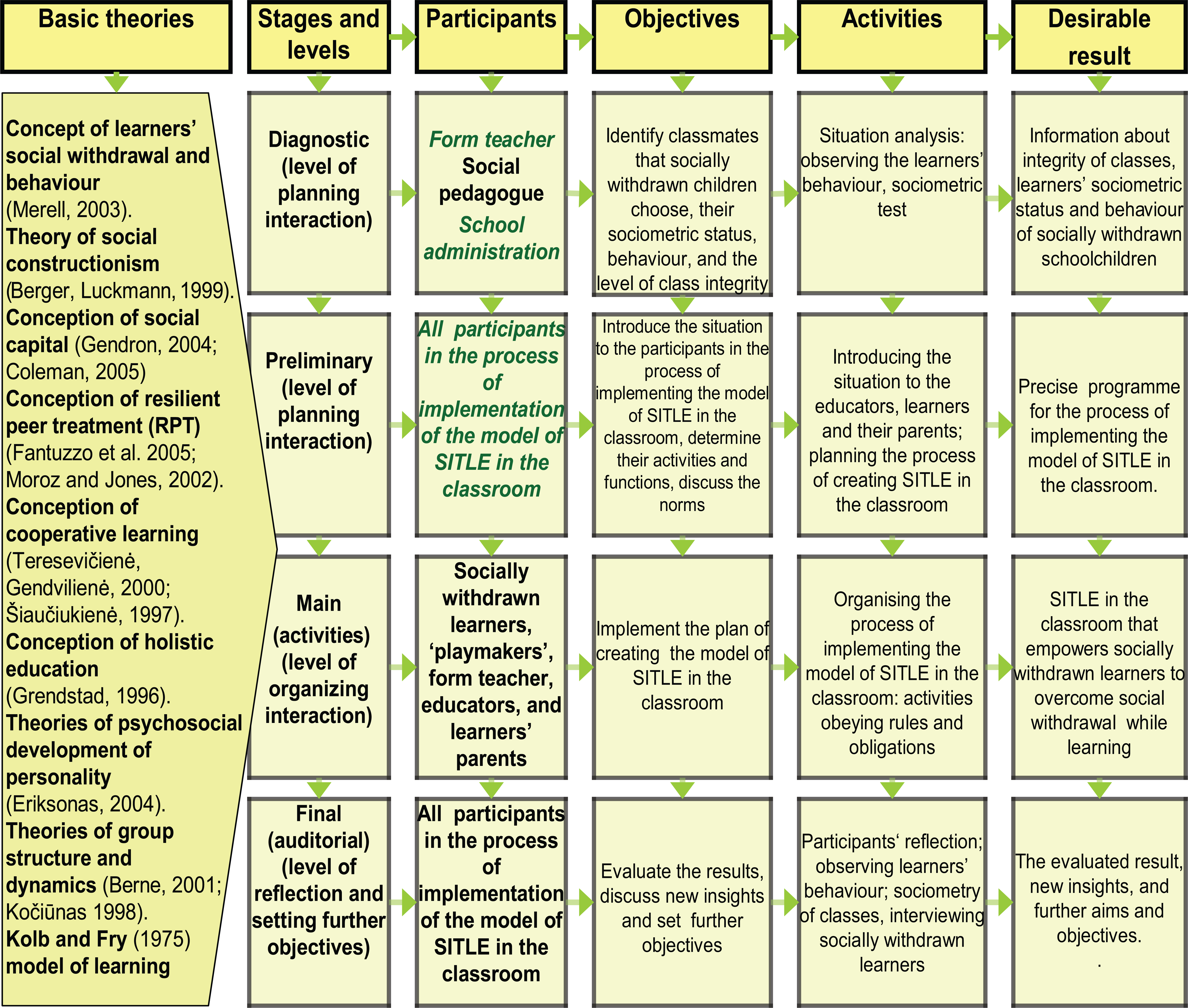
The improved model of SITLE in the classroom.
The adjusted and supplemented theoretical (ideal) model of SITLE in the classroom was ready for its implementation to help solve the problem of children’s social withdrawal.
The methodology of the research
The interview method, one of the ways of conducting surveys that is included into the group of observation methods, was chosen in order to complement the data of observation of the respondents, five socially withdrawn learners (aged 11–12 years) who participated in the investigation and uncovered their experience as well as their own conception of an appropriate learning environment in the classroom.
The interview was conducted a year after the implementation of the model of the SITLE in the classroom, at the same time when the third sociometric test of learners’ classes was performed. The stages of the interview were defined following the recommendations of I. Luobikiene (2005) and K. Kardelis (2005) regarding organisation of an interview.
The questions of the interview were formulated so that they would determine the usefulness of the SITLE in the classroom from the point of view of socially withdrawn learners. The respondents were asked to describe the changes noticed in the relations among learners in the class, the way they felt in the class, their relationships with teachers as well as the changes related to them personally and their experience. In addition, the learners were asked to express their opinion about the positive and negative aspects of the changes noticed.
The time of the interview was agreed upon with the participants in the process of creating the SITLE in the classroom beforehand. The interview was conducted with each learner separately. Later, the data were analysed and interpreted separately and systemised.
As the respondents and the researcher knew each other already, there was no need to get acquainted and provide detailed explanation of the aim of the research at the beginning of the interview.
The sequence of the questions depended on the course of the conversation. Each respondent was interviewed separately, and each interview was audio-recorded.
The study of the interview materials was performed using the method of content analysis by identifying categories and subcategories. While interpreting the data, an attempt was made to uncover the experience of socially withdrawn learners and identify the value of the SITLE in the classroom from the point of view of the respondents.
The results of the empirical research regarding the attitude of socially withdrawn learners towards SITLE in the classroom (five case studies) and their interpretation
In order to investigate the impact of the process of creation of the SITLE in the classroom on socially withdrawn learners, a semi-structured interview was conducted with five X-and-Y formers who tend to socially withdraw. The interview was conducted one school year after the SITLE in the classroom model had been implemented. The method of content analysis helped to identify content categories and subcategories that define the most significant aspects of the experience of socially withdrawn learners and their conception of the SITLE in the classroom itself as well as the impact of the process of creating the SITLE in the classroom. Having performed the content analysis of the observation, 7 categories, with 25 subcategories, were distinguished (Table 1).
The results of the interview with socially withdrawn learners: categories and subcategories (n = 5).
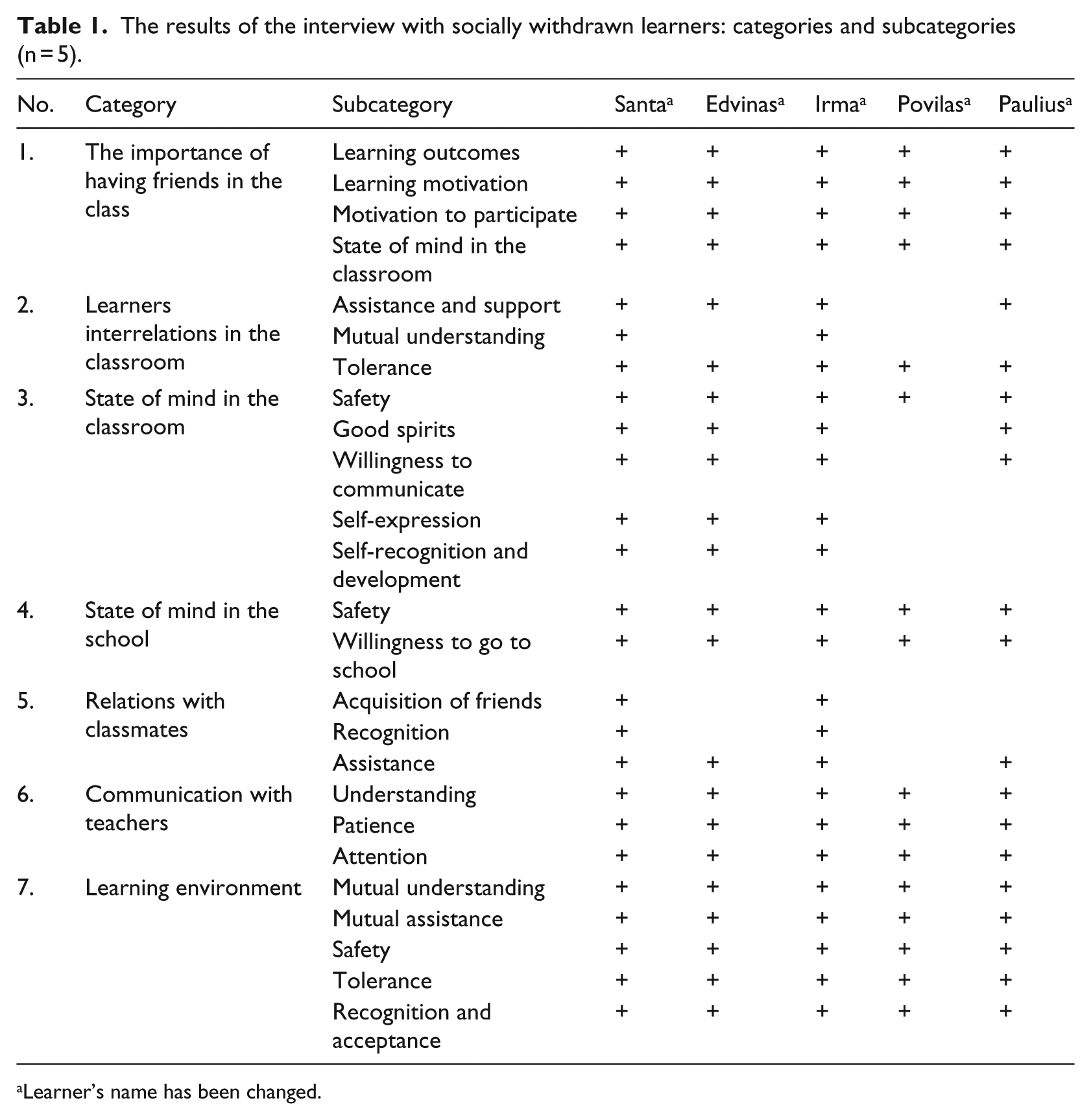
Learner’s name has been changed.
The study of Santa’s experience
While analysing the results of the interview with Santa, it has been stated that in the girl’s opinion it is very important to have friends in the class or at least one good friend.
Before the implementation of the model
During the interview, Santa told that when she did not have a single friend in the class, she learnt worse and it was not because it was more difficult. She simply did not want to learn (<…> why should I take pains to do something if nobody ever cares; if I didn’t understand something, I used to do nothing as I didn’t dare to ask for an explanation neither teachers nor classmates). Santa stated that she did not want to do homework, she felt bad in the class and she was frightened to speak as she was afraid that someone would sneer at her (<…> it’s better not to say anything and keep quiet so that nobody notices you rather than let them laugh at you <…>). While talking about interrelations of her classmates, Santa said that there had been a lot of disagreement among them, they had often been cross with each other and the lessons had been noisy and unpleasant (<…> maybe they just wanted to show off, I don’t know, but they nicknamed and pushed you all the time <…>). Santa said that the environment had been not just unpleasant and unsafe, it had also made her unwilling to learn and attend lessons.
After the implementation of the model
When asked to compare her state of mind before and at the moment of the interview, Santa said that she felt safer, calmer, more often she was in good mood, she was not afraid and sometimes was even anxious to communicate with classmates. She found it easier and more daring to express her ideas, she felt that she was heard by others and she did not have to make herself go to school in the morning. The girl also stated that she felt safer not only in her class but also in the school, as she was always surrounded by her classmates who seemed to be her true friends (this year I even want to go to school, <…> I feel well, very well, like with true friends). Santa told she had some good friends among the girls, she felt accepted by her classmates, she knew that she would always be assisted and was not afraid that somebody would mock at her. The study of the interview materials revealed that the girl not only started to feel safer but also got to know her own features she had not been aware of (<…> I understood that I am also able to express my opinion. Now I know that in order to be acknowledged I do not necessarily have to be the same as others. I appeared capable of being an organiser <…>). The girl maintained that the classmates started to chasten each other and remind one another that in case no one felt ill at ease, everyone would feel better (<…> when somebody starts to manifest, Modestas 1 usually immediately calms him/her down). When asked to tell about communication with teachers, Santa said that she started feeling more attention from them. In her opinion, now teachers are more tolerant and attentive to her, and they seem to understand her more (they do not interrupt me when I am speaking, more often ask if I understand everything). On the other hand, Santa admits that teachers’ behaviour with her has not changed a lot as teachers used to be benevolent earlier as well (<…> It was not their (teachers’ 2 ) fault that I refused to answer their questions and was often afraid. When I was asked a question, I couldn’t just start explaining during the lesson that in case I did not know the correct answer I was afraid to say something).
In order to ascertain the features of the most suitable learning environment for her, Santa was asked to imagine that she has got powers to change anything in the class for her and her classmates to feel best and for the learning environment to be most suitable. When asked what learning environment in her opinion was the best, Santa named the feeling of safety as the most significant factor. The girl emphasised that the most important thing is to feel safe and have nothing and nobody to be afraid of, so tolerance becomes of great importance and everybody has to be tolerant, including classmates, teachers and parents. In Santa’s opinion, it is also important for the parents to be tolerant to friends and know them (when your parents do not like your friends and do not allow communicating with them, you feel very bad, and in this way your friends do not like your parents <…>, <…> and they do not like them because they do not know them and think that they will make bad influence <…>). The girl argues that, in her opinion, another significant feature of a suitable learning environment is the feeling of recognition and acceptance. It is important for everybody to understand others and try to help them. Santa thinks that it is very difficult to learn, be active and participate when you see that classmates do not accept and recognise you (<…> when you feel that everybody considers you to be different, you are scared to talk in their (classmates’ 3 ) presence, and teachers think that you do not know).
The study of Edvinas’ experience
While analysing the results of the interview with Edvinas, it has been revealed that in the boy’s opinion it is also very important to have friends in the class, or at least one good friend, and this has some influence on learning motivation as well as willingness to participate in class activities.
Before the implementation of the model
During the interview, Edvinas told that earlier he sat at his desk alone, nobody talked to him during breaks and he was too shy to talk to somebody himself (<…> they (classmates 4 ) are all joking, doing something, laughing; I didn’t want to participate, felt ill at ease. Nobody associates, nobody talks to you, <…> to start first, no, I can’t do that). While talking about interrelations of his classmates, Edvinas said that earlier there had been a lot of disagreement among them, they had often been cross with each other, so the lessons had been noisy and unpleasant (<…> they nicknamed and pushed each other, disagreed with teachers <…>. Yes, a lot of children did that; <…>I don’t like this, no, it’s not teachers’ fault). Edvinas’ story made it obvious that due to the above-mentioned atmosphere, the learner felt unpleasant, unsafe and ill at ease and very often had no inclination to learn and attend lessons (<…> I didn’t want, but used to make myself to sit in all lessons; this is not pleasant when you are always all alone and nobody associates with you <…>).
After the implementation of the model
When asked to compare his state of mind earlier and at the moment of the interview, Edvinas told that at that time he liked being with the class, more frequently he was in good mood, his classmates invited him to join them and he shared his desk with Modestas. 5 He thought that it was because of Modestas that his classmates communicated with him more willingly (<…> everybody wants to be friends with Modestas, but he said he wanted to sit with me at one desk, now all his friends are my friends as well). Edvinas stated that he did not find it difficult to approach a classmate and talk to him any longer. The boy said that he felt safer not only in his class but also in the school, as he was always surrounded by his classmates whom he considered to be his true friends (<…> yes, I come up to them, and I am not afraid, as I know that they are my friends). The study of the interview materials reveals that the learner feels to be accepted by his classmates and knows that he can always hope for assistance and get it; he is not afraid that somebody from his class will mock at him. Like Santa, Edvinas maintained that the classmates started to chasten each other and remind one another that in case no one felt ill at ease, everybody got on well and were not cross, everyone would feel better. When asked to tell about communication with teachers, Edvinas, like Santa, said that he felt more attention from them. However, the boy noted that teachers had been benevolent before as well.
In order to ascertain the features of the most suitable learning environment for him, Edvinas was also asked to imagine that he has got powers to change anything in the class for him and his classmates to feel best and for the learning environment to be most suitable. Thus, when asked what learning environment in his opinion was the best, Edvinas also distinguished the feeling of safety. The boy maintained that the most important thing is to feel safe and have nothing and nobody to be afraid of. Thus, it is very important for everybody to be tolerant of others, understand others and try to help. In Edvinas’ opinion, it is very important to know that you have friends among classmates, feel that you are accepted and recognised (<…> it is very difficult when nobody invites you anywhere, and you yourself are too shy to put yourself forward; it seems that there is no inclination <…>; <…> and later the inclination disappears for real).
The study of Irma’s experience
The data of the interview with Irma also reveal that it is very important to have friends in the class (if you have no friends in the class, you neither want to learn nor go to school. You do everything just because you have to).
Before the implementation of the model
During the interview, Irma told that earlier she sat alone at her desk, did not have any good friends and it seemed to her that nobody noticed her (<…> I thought that nobody cared whether I was there or not. Actually, I wasn’t bothered by what they thought). Irma stated that she used to be unwilling to participate in class events and trips (<…> I didn’t want to do anything together with them (my classmates 6 ), and I didn’t want to go on any excursions. I don’t know why, maybe because I felt no pleasure, nobody associated with me). She felt ill at ease in the class, found it uncomfortable to answer teachers’ questions, talk before the class and express her opinion (<…> why should I say something if nobody cares <…>; <…> I don’t know, it was unpleasant to me). While talking about interrelations of her classmates, Irma shared Santa’s opinion. She said that earlier there had been a lot of disagreement among her classmates, they had often been cross with each other and the environment during lessons had been noisy and unpleasant. She felt ill at ease and it was difficult for her to learn.
After the implementation of the model
When asked to compare her state of mind earlier and at the moment of the interview, Irma stated that she felt safer, calmer; more often she was in good mood, she was not afraid and sometimes was even anxious to communicate with classmates. She found it easier and more daring to express her ideas, she felt that she was heard by others and wanted to go school. The girl also stated that she felt safer not only in her class but also in the school, as she was always surrounded by her classmates who seemed to be her true friends (I feel well now both in the class and at school <…>). Santa told she had more than one good friend among the girls and she felt accepted by her classmates (nobody knew I can play the guitar <…>. No, I couldn’t have told them earlier, no, no, no, by no means. How could I blow my own trumpet <…>. It was Ieva who told everybody <…>. She learnt about it when we were doing homework together at my place last year <…>. She encouraged me and wanted to listen to me play. Now I feel OK about it, but at first I was angry that Ieva told this <…> I don’t know, maybe I was afraid <…>). She was sure she would always be assisted and was not afraid that somebody would mock at her. Like Santa and Edvinas, Irma also maintained that the classmates started to chasten each other and remind one another that in case no one felt ill at ease, everybody got on well and were not cross, everyone would feel better. When asked to tell about communication with teachers, the girl said that she started feeling more attention from them. However, she noted that teachers had been benevolent earlier as well.
When asked what learning environment in her opinion was the best, Irma, like other socially withdrawn learners, also distinguished the feeling of safety as the most significant. According to the girl, it is very important for everybody to feel safe, not to be afraid of anybody or anything. It is also important for everybody to be tolerant of others, accept, recognise and understand others, and try to help. While talking about the role of parents, Irma shared Santa’s opinion. She stated that parents’ opinion about her friends and their behaviour when friends come visit her at home are very significant to her relations with them (<…> I was very glad that Ieva liked my mother). In Irma’s opinion an important feature of a suitable learning environment is the feeling of recognition and acceptance. She maintained that it was very difficult to learn and be active when you kept thinking that you were not accepted and recognised by your classmates (<…> when I thought that they (classmates 7 ) do not like me, I felt ill at ease. I used to avoid to speak in front of the class, and usually did not say a word. It is very difficult when you know the answer, but you can’t speak just because you are nervous, and teachers think you don’t know the answer).
The study of Povilas’ experience
The data of the materials of the interview with Povilas reveal that the boy’s opinion about relations with classmates is the same as that of other learners who tend to socially withdraw. In Povilas’ opinion, having friends among classmates means that every day your state of mind is good, you are provided with an opportunity to get engaged in certain activities with them, perform certain tasks and learn together.
Before the implementation of the model
Povilas said that he had never had a friend among his classmates. He sat at his desk alone and nobody spoke to him during breaks, so he did not enjoy going to school and he did not want to learn (<…> certainly, it’s nice when you have friends in the class. When nobody associates, you don’t even want to go to school. Earlier I didn’t learn <…>, I don’t know <…>, I didn’t want). While talking about interrelations of his classmates, Povilas stated that his class was not very friendly. His classmates often were cross with each other and opposed teachers (<…> if the boys did not like something, they immediately started fighting; they nickname girls, quarrel with teachers <…>. Almost all of the boys behaved like this. <…> I don’t know, most probably they wanted to show off). Povilas’ story made it obvious that due to the above-mentioned atmosphere, the learner felt unpleasant, unsafe and ill at ease, and very often had no inclination to learn and attend lessons (<…> it’s unpleasant, it’s better when everybody is in good terms. Well, sometimes I used to leave classes <…>, it’s not pleasant when you are all alone all the time and nobody associates with you <…>).
After the implementation of the model
When asked to compare his state of mind earlier and at the moment of the interview, Povilas told that at that time he liked being with the class, more frequently he was in good mood, his classmates invited him to join them and he shared his desk with Tomas 8 (<…> now all his friends are my friends as well. They often invite me everywhere <…>. Yes, it was Tomas who suggested sitting together at one desk. Me? I would never dare <…>. I don’t know, somehow (long silence 9 )…. Yes, I wanted to, but I didn’t allow myself). Povilas stated that still he was not courageous enough to come up and talk to classmates or propose to do something together. The boy said that at the moment he felt better and safer as he was invited to join classmates, associated with. He does not talk much himself, but he likes being with other boys of the class, whom he considers to be true friends (<…> yes, I come up to them myself, I am not scared as I know that they are my friends). The study of the data of the interview with Povilas revealed that the learner felt accepted by his classmates, knew that he would always be supported and was not afraid that somebody in the class would laugh at him. Povilas, like other socially withdrawn learners of X class, maintained that classmates started to chasten each other. When asked to tell about communication with teachers, Povilas stated that he felt more attention from them. However, the boy noted that teachers had not been indifferent to him, had paid enough attention and had been benevolent earlier as well.
When asked what learning environment in his opinion was the best, Povilas, like the aforementioned learners, also distinguished the feeling of safety as the most important factor. The boy maintained that it is very important to feel safe and not to be afraid of anything or anyone. Thus, it is very important for everybody to be tolerant of others, understand others and try to help. In Povilas’ opinion, it is important to know that you have friends among classmates and feel that you are accepted and recognised (<…> of course, it was sad to stay aloof when all the others communicated. Well, I used not to pay attention, simply stayed alone. Yes, I used to join when I was invited. Yes, I like being invited <…>. I do not invite anybody myself. Well, I don’t know, I don’t know how to do it <…>). When asked to imagine that he has got powers to create the most suitable learning environment for him, Povilas assured that he would not change anything. He would rather change his own features (<…>now everything is OK in the class, everybody is friendly. I would not change anything. <…> I would like to do something to be more courageous myself, not to get red and not to get worried. I would do something that would make me similar to Mindaugas 10 or Tomas 11 ).
The study of Paulius’ experience
While analysing the results of the interview with Paulius, it has been stated that in the boy’s opinion, it is also very important to have friends in the class, or at least one good friend, and this has some influence on learning motivation as well as willingness to participate in class activities.
Before the implementation of the model
During the interview, Paulius told that earlier he sat at his desk alone, nobody talked to him during breaks and he was too shy to start conversation first (<…> they (the boys 12 ) didn’t associate with me, <…> Yes, most often I was alone, and sat at my desk alone. Povilas also didn’t communicate with anybody, but he missed classes very often. Povilas didn’t participate in any activities either. Maybe he didn’t want <…>. I also had no inclination as didn’t like it). While talking about interrelations of his classmates, Paulius, like Povilas, said that earlier there had been a lot of disagreement among them and they had often been cross with each other. Paulius’ story made it obvious that due to the above-mentioned atmosphere, the learner felt unsafe and ill at ease, and very often had no inclination to learn and attend lessons (<…> Povilas used to miss classes, but I attended them. No I didn’t want to sit in the class, but I used to do it <…>).
After the implementation of the model
When asked to compare his state of mind earlier and at the moment of the interview, Paulius told that at that time he liked being with the class, more frequently he was in good mood, his classmates invited him to join them and that year he shared his desk with Mindaugas. 13 He thought that it was because of Mindaugas that everybody invited him to join as a lot of classmates wanted to be friends with Mindaugas (<…> all of them (boys 14 ) listen to Mindaugas, and he also communicates with girls best). Paulius stated that at present it was easier for him to approach classmates and talk to them. The study of the interview materials reveals that the learner feels to be accepted by his classmates and knows that he can always get assistance, and he is not afraid that somebody from his class will mock at him. When asked to tell about communication with teachers, Paulius said that he had always been in good relation with teachers and they had always been benevolent in his regard.
When asked what learning environment he would create if he had magic powers, Paulius confessed that first of all he wanted to be braver and less sensitive himself. He defined the feeling of safety as a very significant thing. Paulius maintained that the most important thing is to feel safe and not to be afraid of anything or anyone. Thus, it is very important for everybody to be tolerant of others, understand others and try to help. In Paulius’ opinion, it is very important to know that you have friends among classmates and feel that you are accepted and recognised. As a special positive aspect, the boy identified the possibility of communication with classmates by visiting each other at home, doing homework together and communicating with classmates’ parents.
Summing-up the data of the interviews with socially withdrawn learners, it can be stated that
The socially withdrawn learners who participated in the investigation unanimously emphasised the importance of a friend among classmates and his or her impact on good emotional state in the classroom, learning outcomes as well as motivation to learn and participate in class activities.
The implementation of the model of the SITLE in the classroom had a positive impact on learners’ interrelations, which was manifested by assistance and support, better mutual understanding and tolerance.
Learners’ experience proves that the implementation of the model of the SITLE in the classroom had a positive impact on their state of mind, that is, strengthened the feeling of safety, preconditioned positive changes in spirits as well as willingness to communicate. Some of the learners were empowered to express their opinion and gained better self-awareness.
The implementation of the model of the SITLE in the classroom had a positive impact on socially withdrawn learners’ state of mind, that is, their feeling of safety and motivation to attend school.
During the process of the implementation of the model of the SITLE in the classroom, socially withdrawn learners made friends in the class, they felt they were accepted and liked by classmates, they found more courage to show initiative and join class activities themselves.
During the process of the implementation of the model of the SITLE in the classroom, socially withdrawn learners gained more attention, understanding and patience on the part of their teachers; they were more confident during feedback and while performing the tasks assigned.
From socially withdrawn learners’ point of view, the most suitable learning environment in the classroom has to ensure the feeling of safety, the sense that you are accepted and encourage mutual understanding and support. Tolerance between learners and educators should prevail, whereas outside the school, parents’ tolerance, understanding and support are of great importance.
In the opinion of socially withdrawn learners, the greatest value of the SITLE in the classroom is that learner’s interrelations became stronger: they acquired friends among classmates, they feel assistance and support, there is better mutual understanding and they are more tolerant. The state of mind of socially withdrawn learners became better, which is indicated by stronger feeling of safety, motivation to attend school, willingness to communicate, the feeling that you can express your own opinion and show initiative while joining classroom activities as well as possibility for self-recognition.
Conclusion
The qualitative study of the experience of socially withdrawn learners has revealed that in the opinion of socially withdrawn learners who participated in the investigation, the valuable outcomes of creating SITLE in the classroom are as follows:
Increased communication among learners, which manifests in assistance and support, better mutual understanding and tolerance;
Better state of mind of socially withdrawn learners, which manifests in an increased sense of safety and motivation to attend school;
Acquisition of friends among classmates and the feeling of having become an integral part of the class;
Positive changes in mood, the resulting desire to communicate and the feeling of being able to express one’s own opinion and show initiative while joining peer activities;
Opportunity for self-recognition.
From the point of view of socially withdrawn learners, the most suitable learning environment in the classroom should provide the sense of safety and the feeling of being accepted as well as promote mutual understanding and assistance. Tolerance between learners and teachers should prevail, whereas outside the school, parents’ tolerance, understanding and support are of great importance.
The study of the data of the interviews with socially withdrawn learners revealed that from the social–psychological point of view, there has been a valuable change in the strategy of adaptation of the aforementioned learners to the environment, the change from the unconsciously learned and passive defence-based withdrawal to the conscious decision-based participation.
The problem of the research is defined by the queries: what kind of learning environment augurs active participation of all learners, including the socially withdrawn, in class activities while learning and making decisions significant for the whole class and how learners who tend to socially withdraw comprehend SITLE in the classroom from the point of view of its value and provided possibilities to be an active participant.
The model of the SITLE in the classroom is a relative image that characterises the ideal case. The ideal case is understood here as a universal model of the SITLE in the classroom constructed on the theoretical basis. It defines the stages of creating the SITLE in the classroom, its levels, main participants, their functions and activities, basic norms, aims and the anticipated outcomes. The implementation of the model should create the SITLE in the classroom which should empower socially withdrawn learners to overcome dissociation and actively participate in the process of teaching/learning and joint class activities. In an ideal case, the implementation of the model of the SITLE in the classroom should solve the problem of learners’ social withdrawal. In every particular case, that is, while implementing theoretical (ideal) model of the SITLE in the classroom in a particular school and in a particular class, it is a specific process that depends on the situation in the school and in the class that is ascertained at the first (diagnostic) stage of the model.
In order to investigate the impact of the process of implementing the model of the SITLE in the classroom on the socially withdrawn children, their experience and conception of socially integral learning environment (the SITLE), the method of semi-structured group interview was applied in a year after the model had been implemented.
Summing-up the data of the survey of socially withdrawn learners, it can be stated that
The socially withdrawn learners who participated in the investigation unanimously emphasised the importance of a friend among classmates and the impact on good emotional state in the classroom, academic results as well as motivation to learn and participate in class activities.
Implementation of the model of the SITLE in the classroom had a positive impact on learners’ interrelations, which was manifested by assistance and support, better mutual understanding and tolerance.
Learners’ experience proves that the implementation of the model of the SITLE in the classroom had a positive impact on their state of mind, that is, strengthened their feeling of safety, preconditioned positive changes in spirits and willingness to communicate. Some of the learners were empowered to express their opinion and better self-actualise themselves.
Implementation of the model of the SITLE in the classroom had a positive impact on socially withdrawn learners’ state of mind, that is, their feeling of safety and motivation to attend school.
In the process of implementing the model of the SITLE in the classroom, socially withdrawn learners made friends in the class, they felt they were accepted and liked by peers, they found more courage to show initiative and join the class activities.
In the process of implementing the model of the SITLE in the classroom, socially withdrawn learners received more attention, understanding and patience on the part of educators; they were more confident during feedback and while performing the assigned tasks.
From socially withdrawn learners’ point of view, the most suitable learning environment in the classroom has to ensure the feeling of safety, the sense that you are accepted and encourage mutual understanding and support. There should be tolerance between learners and educators, whereas outside the school, parents’ tolerance, understanding and support are of great importance.
From the point of view of socially withdrawn learners, the greatest value of the SITLE in the classroom is that learner’s interrelations became stronger, which is indicated by acquiring friends among classmates, assistance and support as well as better mutual understanding and tolerance. The emotional state of socially withdrawn learners became better, which is indicated by stronger feeling of safety, motivation to attend school, willingness to communicate, the feeling that you can express your own opinion and show initiative while joining classroom activities as well as possibility for self-recognition.
Footnotes
Funding
The author(s) received no financial support for the research, authorship, and/or publication of this article.