




Abstract
This article concerns the interpretation of a semester-long email mentoring correspondence related to social studies teaching between the two authors. Analysis interpreted the mentee’s growth along O’Malley’s stages of professional reflection. The analysis found that the mentoring process fostered the mentee’s establishment of professional identity through a negotiation of individual goals within professional expectations. This experience informs the literature with regard to the promise it holds for professional training of teacher educators, its successes in building professional community, and the safety of this method for providing critical performance feedback.
Keywords
Mentoring represents a reciprocal learning process by which experts guide apprentices to new professional status and receive current information about professional theory and practice. We describe the outcomes of a professional mentoring experience related to social studies teaching. In its broadest form, mentoring may occur at any stage of one’s personal and professional journey. We construe mentoring as the natural outgrowth of relationships cultivated through previous teacher–student experiences, not simply a process that engenders mentee completion of an educational opportunity.
In this article, we communicate the outcomes of a research self-study that interpreted the patterns of reflection within an exchange of email correspondences. The first author (T.L.), a recently tenured associate professor, viewed the project as an opportunity to re-conceptualize or refine his teaching. The emails concerned T.L.’s teaching of an elementary social studies methods course. He employed a teaching approach that was observed as a student in D.M.G.’s graduate level social studies methods course approximately 10 years prior to the email exchange. He initially applied it through his co-teaching the course with D.M.G. at the time of his degree conferment, before joining the faculty of his professional home. D.M.G., a mature full professor, considered the project an opportunity to assist a former student and ongoing collaborator.
Literature
The literature described concerns several areas. It differentiates professional development in education from that which occurs in other professions. Then, it considers elements of mentor–mentee relationships and the factors that shape their successes. Finally, a brief consideration of the expectations for mentor and mentee contributions toward fostering successful mentoring relationships occurs.
Professional differences
The field of education, teacher education particularly, differs from other professions in its developmental processes. Ronfeldt and Grossman (2008) observed the differences that occur in shaping of professional identities. For example, those trained in the medical and accounting professions generally have little leeway in the following procedures for their fields. Labaree (2008) differentiated these institutions between preparation and academic purposed institutions. This situation relates to a system of teacher preparers who possess different interpretations of the purpose for teacher preparation through a system that has evolved as mechanism to control social growth (Labaree, 2008; Lucey & Lorsbach, 2012).
Grossman et al. (2001) argue that teachers suffer from a lack of professional community. In part, this situation relates to institutional professional developmental opportunities that fail to build relationships among co-workers. The volunteer nature of participation creates for division between attendees and nonattendees. Developing a strong mentor–mentee relationship represents one approach to providing educators effective development in their professional environments.
Mentees need to sense sincerity within their mentors to experience success. Within higher education, the extent to which mentees view mentors’ interest in the process relates to their perceptions of outcomes from the experience. Allen and Eby’s (2008) analysis of formally paired mentors and mentees found a significant relationship between mentee perceptions of faculty mentoring commitments measured by (1) mentors’ self-reported level of commitment, (2) mentees’ perception of the relationship outcomes, (3) mentees’ perceptions of mentors’ time commitment, (4) mentees’ perceptions of the process representing a time burden to mentors, and (5) mentee satisfaction with mentoring experiences. The researchers also found that mentees were more satisfied when they perceived mentors as committed to the process.
While mentors’ knowledge of their processes provides a foundation for success, the relationship with the mentee is an important determinant of positive outcomes. Lechuga (2011) found mentoring comprised four purposeful areas: advising, instructing, professional employment, and socialization. These processes serve to teach mentees, through experiences, the process for acclimating to higher education. Such efforts may not represent formal strategies for performing their responsibilities yet provide the personal accommodations for ensuring their mentees’ success. These processes may also be viewed by prospective mentees as signs of commitment that may support informal relationships. Bell and Treleaven (2011) studied a program designed to partner mentees with mentors and found that (1) mentees preferred private-guided pairing, rather than open “mixer” type environments; (2) mentee selection of mentors related to previous informal contacts; and (3) mentees appreciated guidance from advisors or “brokers” who reviewed their preferences and directed them to informally pursue mentors who fit their profile needs.
In summary, the preceding literature indicates that commitment and perceptions are essential to lasting relationships. Enabling mentee selection of mentors and providing for mentee support during the mentoring experience often leads to positive mentoring outcomes.
Mentor–mentee expectations
University faculty and students agree that mentor communication, academic assistance, socio-emotional support, and establishing a good relationship contribute to the building of strong mentoring relationships (Edwards and Gordon, 2006). Tähtinen et al.’s (2011) presumption that a mentor’s responsibility for directing the mentor–mentee relationship may have relevance in business and other more rigid academic fields; however, education’s focus on learner needs may cause the field to position the role of mentors differently. Edwards and Gordon (2006) found that faculty, alumni, and students considered mentors and mentees as responsible for pursuit of intellectual engagement. Respondents perceived mentors as expected to provide mentees with the freedom of decision making while providing critical feedback in the process as well as building positive relationships. Edwards and Gordon (2006) found little difference in mentoring perceptions between doctoral students who were in their coursework and those working on their dissertations.
The reviewed literature indicates that mentoring guides professional growth that requires commitment and cooperation. These elements provide a model relationship that both parties may apply in their professional and social experiences. The mentoring relationship represents a form of professional community for application into teaching. Grossman et al. (2001) observed the presence of three elements for building teacher community: group identity or norms, negotiation of differences, and responsibility for growth. Within education, mentoring maintains a social relationship that allows for negotiation of conflict that may occur between individual identity and environmental expectations. This study examined and highlighted the processes within mentor–mentee communications to better interpret their shaping of professional growth.
Theoretical framework
This research is based on the scholarly work of Gary O’Malley (2007). The stages of professional reflection found in O’Malley’s work (as discussed below) appeared to be stated in sufficient broadness such that they were readily adaptable to the professional stages that either participant occupied. These letters reveal a series of four professional reflective stages (which we observed and labeled as: (1) forward thinking – beginning one’s professional career; (2) professional surveillance – observing the nature of one’s practice within the professional context; (3) professional evaluation – recognizing the dialogues that define the professional climate and pronouncing one’s position; (4) retrospective thinking – recognizing one’s professional agenda and organizing its instillment in one’s students) that present a professional life cycle that a mentoring process continues. While mentoring may occur during the early stage of one’s career, limited experiences or opportunities for development of professional awareness impair the ability to fully guide mentees through a broad range of circumstances.
T.L. recognized the classroom accomplishments of his former professor and program chair and sought to recalibrate his teaching efforts within the pedagogical frameworks offered in his prior learning experiences under D.M.G. As a recently promoted senior faculty member, T.L. (i.e. the mentee) simultaneously occupied two of O’Malley’s (2007) professional stages. Through one lens, he occupied a position of stage 2, professional surveillance. Occurring in his sixth year out from his terminal degree, the exchange provided an opportunity to inquire about instructional activity processes within the pre-preparation contexts. Through another lens, he experienced a view of stage 3, professional evaluation. As a former federal regulator and financial representative, he recognized the broader socio-political economic climate that contextualized schooling and teacher preparation and drew from this background to interpret his professional climate. Thus, he negotiated the tensions between the narrow and broad views of social studies teaching and attempted to reconcile efforts to instill an appreciation for both these views within his students.
D.M.G. served as an informal mentor during the T.L.’s graduate studies and years as a junior faculty member. In this role, he encouraged development and dissemination of scholarship, supported the mentee’s position search, and provided guidance to negotiate the new professional setting.
Methodology
Context
The communication exchanges occurred in the spring of the mentee’s eighth year out from his doctoral degree. The mentoring communications resulted from the mentee’s need to clarify his instructional identity through reconciliation of the different professional emphases afforded by the contexts for teacher preparation at his home institution (an urban institution in the mid-Southern portion of the United States that prepared teachers for both a low-income urban district and a high-income suburban community) and his professional setting (an institution with a large enrollment located in a mid-sized community that prepared teachers mostly for suburban communities).
The campus-based 15-week elementary social studies methods course taught by the mentee occurred on the included 4 weeks of candidates’ field experiences. The students were assigned by the clinical placement office to various sites within a 45-mile radius of the campus to fulfill their field obligations. The course proceeded in the following sequence: classroom 4 weeks–field 1 week–classroom 5 weeks–field 3 weeks–classroom 2 weeks.
The authors chose to communicate via emails because they represent a form of long-distance communication that lends itself to both reflective deliberation and spontaneity. By pursuing a deliberate schedule that balanced participants’ origination and receipt of information, an environment was created that respected each other’s professional obligations, balanced the responsibilities to the project, and ensured regular participation, either through reading or reflecting upon the communications. The emails provided a convenient form of data that could be coded both through open processes and those guided by theory.
The communication exchange resulted from T.L.’s invitation to participate in this dialogue with the stated objective of examining his teaching. It also aimed to provide genuine communications to confirm the patterns of career development indicated in O’Malley (2007) and to discuss some of the difficulties, such as social studies marginalization in field experiences, faced by elementary social studies teacher educators. Both the T.L. and D.M.G. maintained professional contact and communication after T.L.’s completion of his graduate studies. These shared professional experiences generated commitment to the project (Poteat et al., 2009). Their ongoing past and present collaborations offered evidence that both held persistent tendencies with long-term goals that bonded them as committed professionals and lent themselves to a meaningful collaboration (Finkel et al., 2002).
The authors agreed to correspond by email each week with the authors alternating weeks. They set no conditions as to form, length, or content of the email communications. The correspondence lasted for 16 weeks, with each author sending eight emails. T.L. initiated the reflections through a correspondence a week before the commencement of the first-class meeting of the semester. This reflection provided information about the syllabus and served to provide a background to the course and related policies and procedures. Table 1 provides information regarding the length of each communication and the average word count for the combined 16 emails. Figure 1 depicts the trends and relationships associated with these two series of word counts.
Word count for each reflection and mean count for project.

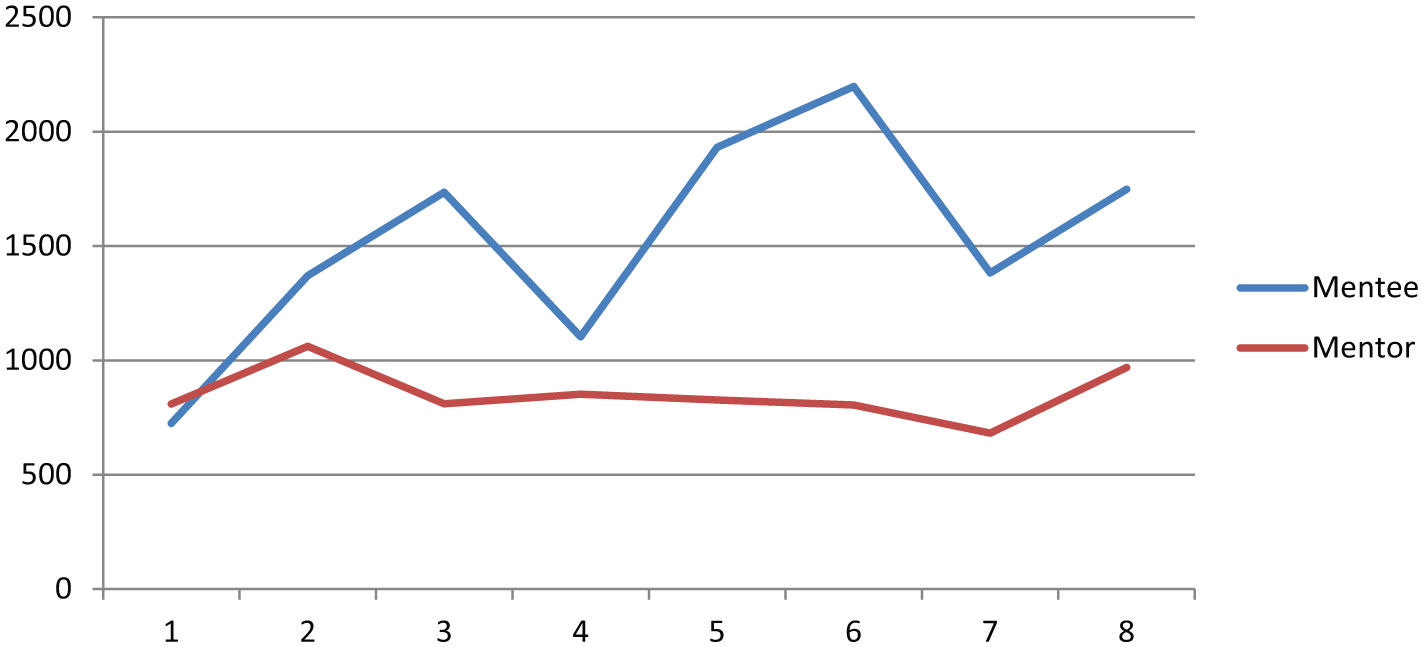
Graphical depiction of word counts for mentor and mentee.
Analysis
T.L. coded the reflections for evidence of presence within the stages indicated by O’Malley, with attention to Bullough and Pinnegar’s (2001) guidelines for correspondence-based scholarship. Each correspondence represented a unit of analysis. The analysis interpreted patterns of change in professional attitude in the correspondence exchange. D.M.G. reviewed results of these efforts and confirmed and/or modified based on his own analysis. In the findings and discussion provided below, we strive to provide an “inside look at participants’ thinking and feeling” through “coherence and structure … that … provide argumentation and convincing evidence” (Bullough and Pinnegar, 2001: 19). The vehicle for these pursuits was to “select, frame, arrange, and footnote the correspondence in ways that demonstrate wholeness” while “revealing and interrogat(ing) the relationships, contradictions, and limits of the views presented” (p. 20). Thus, we explored the complications or tensions that define academic and social studies teaching and attempted to widen the body of the literature that they shaped.
Findings
Our findings describe two broad themes that emerged through this analysis: (1) the mentee’s transition from a sense of course adaption to ownership and (2) the mentee’s development of personal identity. These themes support the mentee’s transition from O’Malley’s (2007) stage 1, forward thinking, to stage 3, professional evaluation. The mentor’s oscillation between professional evaluation (stage 3) and retrospective (stage 4) provided a consistency of guidance that allowed for the mentee’s professional development.
The depiction of the trends in word counts for each participant shown in Figure 1 illustrates the supporting nature of the mentor’s processes. The mentor provided concise and disciplined guidance that allowed for the mentee’s liberal exploration of matters of interest.
Table 2 presents the stages of development that were evident in each reflection. We acknowledge that an imprecise nature of weighting could occur in the accounting for the variability of stages evident in a reflection. The larger range in word count for the mentee’s reflections is representative of various exploratory introspections. The mentor provided a small word count range, which signified tolerant precision in guidance. The table discloses the stages that are evident in each reflection.
Stages of professional development (O’Malley, 2007) realized in each reflection.

The reflections of the mentee revealed an expanding vision of the course at the outset and completion of the semester. These visions of the course, in its learned and renewed forms, sandwiched reflections that concerned instructional technicalities and student performances. The mentor’s responses support by offering context to the mentees’ views, guiding him to a deeper vision of practice. This guidance affirmed the mentee’s responsibility to recognize the association of instructional decisions with the broader social science. The mentor instilled this deeper vision by reminding the mentee of the need to appreciate students’ perspectives while providing boundaries for tolerance. His emails modeled this process by responding to mentee topics of reflection in a precise manner that explained the point of view although a positive process provided supporting examples. For the findings section, T.L. is mentioned as the mentee and D.M.G. as the mentor. Thus, the mentor allowed the mentee to experience the professional growth as determined by the mentee’s expressed needs. By setting boundaries through the form and nature of communication, the mentor conveys a standard for professional practice. The following sections describe the mentee’s professional growth within these boundaries.
Transition in teaching conception from course adaption to assumption of ownership
The mentor’s responses offered support by providing context to T.L.’s reflections, guiding him to a broader vision of practice that enabled his vision of the responsibility for recognizing the association of instructional decisions with the broader social scheme. From the mentee’s view, the reflections documented a change in his view of the course. The transition with an interpretation of the course in relationship to the instruction model provided transitioned to analysis and lamentations about the student performances and evolved to a critical reflection about the course that yielded ideas for revision.
Referenced standard
The initial reflection, which described the course preparations and syllabus, referenced the present course in relationship to his experience as a student over a decade before. The observation that syllabus “contains much more detail and substance from that provided in your class … you planned for students to focus on the substance of the learning during the learning period and not get caught up in the particulars of requirements” (personal communication, 13 January 2012) indicates that the learning experience provided the standard or example for evaluating the teaching experience.
This reference to the course as standard recurred in the second reflection, with regard to the tool designed to hold students accountable for readings. “As with your class, I use the mind map to tell my life story, model a tool for student introductions, and provide … an example before they document their reading assignments” (personal communication, 25 January 2012). A mind map is basically similar to a concept map, except that the mind map involves more flexibility, allowing for multiple topics along a strand and connections to topics within and outside the map. This reflection conveyed additional depth to the purpose of the device:
It illustrates the association of history with the present and the patterns of behavior that generations repeat. (It) serves as an (illustrative devise that shows) the depth of identity that young learners bring to the classroom and the importance of teachers realizing their students as narratives, rather than bodies behind names on the desks. (Personal communication, 25 January 2012)
This reflection describes the extension of the learning tool to a teaching tool that pushes students to think deeply about course content. As a tool to provide accountability for students’ reading, the mind map offers an opportunity to examine relationships among themes within the readings and to evaluate them through discussions with peers. It also avails the learners the opportunity to look beyond the form of their accountability documentation and realize the depth of reading substance to their responsibility.
The mentor provided a broader vision of the context for the model course and its modification to fit changing environments. Particularly, modifications involved changing the tools for ensuring reading accountability:
Your mind mapping activity supports and achieves its intended purpose. However, I have not used that activity for several semesters … When I used the mind mapping strategy, it was for the purpose of ensuring that the students complete the assigned reading prior to attending class and for discussing the chapter content in small group settings in class. Currently I use chapter quizzes and discussion questions that are completed online. (Personal correspondence, 30 January 2012)
Thus, the mentor informed the mentee that the model course also represented process that evolved in relationship to its environment. The model of the past was not the same as the course in the present. This disclosure provided the mentee with the realization that the standard providing the basis for teaching represented a temporary experience that was relevant for his developmental needs at that time.
The mentee’s dependency on the course model for professional validation diminished through the development of the justification for his course in its own right. For example, the first reflection involved a discussion of the course that derived from a comparison of syllabi. “The document contains more detail and substance from that provided in your class” (personal correspondence, 13 January 2012). By the time of the third reflection, a reference to the mentor’s course serves as a link to illustrate the pedagogical similarities between the two communicants:
I remember a collage activity from your course, though don’t appear to have the notes to support it. I think that this touches on a point that I convey to my students, which concerns the memories of experiences versus conversations. (Personal correspondence, 9 February 2012)
The last identification of a connection to the mentor’s course occurred in the mentee’s fourth reflection. The reference occurred in the discussion of an activity modification:
The first activity concerned a social dilemma wherein a youth observes circumstances associated with a possible bullying incident and needs to decide how to respond. The activity derived from your activity, which concerned the Ordeal of the Explorers. It invites conversations about the importance of laws and civic responsibility, yet encourages dialogues about possible injustice that unfair laws may impose. (Personal correspondence, 23 February 2012)
The above comment both references to the mentor course, as it was experienced by the mentee and informs about how the mentee adapted the structure of the activity to fit the needs of the present course. Thus, it provided a reciprocal teaching and learning moment.
The mentee’s fifth reflection represented the first reflection that that did not reference the mentor’s model course or modification of related activities. This reflection occurred at the conclusion of four sessions that preceded students’ 3-week clinical experience.
Development of professional identity
Subsequent mentee correspondences became more reflective, expressing his feelings about the teaching experience while explaining the rationales for the processes at play. These exchanges present a caricature of the mentee through the emotions that guide the rationale for his teaching. As the reflection process became less referent and more analytical, a clear sense of frustration with students and their resistance to critical deep thinking about the learning presented itself. This concern appeared in a dilemma about whether to post a lecture about Bloom’s taxonomy at the course website for student reference or to use class time to draw student focus on the material:
My indecision relates to the patterns of responses to class activities and my concerns about whether they will realize the hidden curriculum at play … (in reference to an activity-based session) (the students) generally had difficulty realizing the technical elements of the activities that prompted their successes. While one student volunteered “multiple intelligences” as a reason behind the processes, her response indicates a tendency for students to pull catch phrases to explain their professional processes … It is possible that students are not yet thinking abstractly about the learning because they don’t have the experience … Sometimes (more) than halfway through, a student always seems to say “I finally realized what you’re getting us to do.” The light goes on and they get the message about social studies teaching. (Personal correspondence, 9 February 2012)
In the reply, D.M.G. recognized the disconnection between the instructor and students and put it directly:
… You need to realize and accept that you have above average analytical, abstract thinking, and creative skills. It is not surprising that it takes your students a little longer to get to (realize what they’re doing.) You need to be patient with them. This type of “learning/schooling” is a new paradigm for most of them. (Personal correspondence, 13 February 2012)
This communication created a broader notion of teaching on several levels. First, it fostered a wider notion of thinking skills. The students came to the course from a perspective of learning that involved their acceptance and replication of skills and concepts presented to them, without deviation. This course required time for students to realize that the expectation did not require replication of presented concepts; it involved the development of thinking processes to enable conversation about them.
Second, it reinforced the idea that students were learning new skills. This teaching process, however, occurred through modeling, rather than direct teaching. The results of this indirect learning process take time to realize. Third, it related instructional decisions to student needs. Although the students learned this form of thinking through modeling, the mentee needed to employ direct communications to inform them of this process.
The response also extended the classroom experience to a professional context. The methods course connected to the candidates’ professional settings by presenting learning themes counterintuitive to those presented in candidates’ previous experiences and their clinical sites. Rather than simply diagnosing student behaviors, teachers should interpret their causes. The candidates needed time to reconcile the classroom and field instructional differences because their experiential preparations and clinical experiences did not model strategies espoused in the course.
Finally, the response conveyed difficulties of preparation. This method of teaching did not generate immediate results. Students needed time to experience the different approach to thinking, to struggle with it, and receive encouragement in its pursuit. Preparations for this type of teaching required an appreciation for unscripted spontaneity that employed positive feedback to validate candidates’ patterns of thought. In essence, the teaching process was developing a genuine community that valued, rather than avoided, tension (Grossman et al., 2001).
It also illuminated the contrasting professional preparations of the two individuals. The mentee had been prepared for a professional career in a college of business with a course of study that included a significant amount of liberal arts exposure. Combined with graduate studies that emphasized teaching theory and practice, along with social studies content, this blending of curricula prompted a critically minded, broad-conception approach to thinking, which was cultivated through professional experience in a regulatory position and financial representation before transitioning into teaching and higher education. The mentor served as a life-long educator in both elementary and post-secondary settings, through which he developed and mastered the balance of discipline, structure, and encouragement. While the mentee struggled with the orientation, conceptual, and perceptual gap between him and his students, the mentor drew from his experience to recognize the nature of the difference and communicate it in a positive manner.
Thus, the process shaped T.L.’s professional identity in several fashions. First, through disclosure and affirmation of higher level thinking skills, the mentee realized reasons for conflicted feelings of his students and gained a sense of teacher mastery toward his methods. Second, his mentor’s view and explanation of the situation modeled the importance of viewing the big picture of his classroom processes. Third, the mentor altered the affective framework that underlay the thinking for the mentee’s frustration, prompting consideration of thinking skills that may not have been realized and explaining how they could be used to optimize students’ learning.
Tension between professional surveillance and professional evaluation
Subsequent to D.M.G.’s revelation of T.L.’s creative abilities, the reflections about concerns over student development and struggles persisted; however, they differed from earlier reflections in that (1) points of reference related previous iterations of his own course, rather than referring back to the provided model, and (2) concerns about student performance extended to contexts of the teaching profession and their influences on interpretations of teaching, rather than responses to class experiences. As such, the reflections assumed elements from two of O’Malley’s (2007) professional development stages, relating to both individual and professional tensions of the current profession along with the professional evaluation through the cumulative experiences. These changes represented an anchoring within the stages of professional scrutiny and self-assessment.
Connecting with prior semesters
As the mentee referenced to the mentor’s model course less, he utilized previous course iterations to explain different instructional structures from those that were taught. Subsequent discussions drew from mentee’s previous courses at his institution as references for current semester activities. For example, concerning facilitation of a panel discussion about religious topics, the mentee made the following observation:
In recent years, I’ve invited a series of priests to discuss the issue, but opted for a panel after a student expressed concern about religious bias. The effort to bring in religious experts … takes me out of the spotlight as a content expert and provides a range of views from experts in diverse faiths. (Personal correspondence, 13 March 2012)
Comparisons also related to assignment tools. For example, with regard to a template for lesson plans, the mentee commented,
The template used contains much less detail than those that I’ve previously utilized. The emphasis is on the rationale, with my stressing that students should be able to defend their lessons to their administrators and their parents. While the lesson does require disclosure of the relevant standards, I inform students that (standards) are not the reasons for the learning and that teacher should be able to articulate the importance of the learning in a meaningful way. (Personal correspondence, 13 March 2012)
Through both curricular and instructional tools, the mentee developed his professional identity as an educator who pushed his students to be teachers who think about their practice within a social or political process. His professional standard to prepare them to defend creative classroom dialogues designed to evoke democratic processes that prompt higher level critical social thinking drove the rationale for the reflection. Thus, in maturing as a professional, the mentee sought depth rather than activities that motivate student learning. The mentee sought a classroom of intrinsic motivation wherein students appreciated themselves for developing their individual teaching strengths.
Extension of student concerns
Unlike prior expressions of concerns about students, which simply lamented their inabilities to perform, reflections about student performance extended analysis of worries to professional contexts. For example, in assessing lesson plans developed for an assignment that concerned the citizenship values associated with banned and censored texts, it was mentioned that “… concerns related to the students’ general resistance to adapt ideals and strategies presented in the course. Instead, they seem intent on finding cute activities or materials and shaping course assignments to fit their preferences” (personal correspondence, 31 March 2012). The reflection continued to express the following ideas:
I wonder to what extent this situation is indicative of our students being products of the teaching environment that I am teaching them to challenge … our students have grown up in an education setting that emphasized mathematics and literacy in early grades … when receiving an assignment that requires some elements of imprecision, many students do not respond well … They could not draw from their prior funds of knowledge to come up with activities that meet the expectations for the course. (Personal correspondence, 31 March 2012)
This reflection provides context and application to the classroom challenge. The difficulty relates to more than the simple absence of students’ creativity. It extends the concern to expose possible causes and interpret the systemic problem of which the classroom situation represents a symptom. In reply, the mentor affirms this view and recommends use of direct instruction to inform students about this need to develop broad instructional conceptions within candidates:
too often in their field experiences these prospective teachers see teachers teaching pp. 35 – 39 simply because those pages come after p. 34. They don’t see teachers identifying an overall chapter objective/big idea. They see teachers involve the students in activities that don’t really lead to a discovery or understanding of the big idea. (Personal correspondence, 6 April 2012)
In another example, contained in the final reflection, the mentee observed, with regard to problem-solving, that
Students observed (in their clinical classrooms) difficulties reconciling the information to create solutions that benefited all parties … this situation, in part, results from experiences where parents or teachers solve problems for children/students in ways that determine winners and losers, rather than solutions where all benefit … I wonder if my course would benefit from the presentation of this chapter earlier in the semester. Would students realize the relevance of these issues before their clinical experiences, understanding and trying to apply problem-solving steps without personal references? Perhaps the solution may be in presenting the chapter after students’ first week of field experience. (Personal correspondence, 17 May 2012)
In this reflection, rather than simply lamenting an obstacle to the teaching process, he offers potential for improvement during subsequent semesters. The mentor’s reply contextualized the problem by relating the situation to class discussions as a method for offering information about a possible cause for the situation. The exchange illustrates the mentee’s progression to O’Malley’s stage 4. He recognized his professional agenda and considers how future modifications of the course would instill this purpose for learning in the students.
Vision of mentor transitioned from that of teacher to that of a colleague
The mentee’s perception of the professional relationship changed from one of a teacher or professor to that of a colleague or collaborator. This transformation evolved through conversations that focused on comparisons to the mentor’s course to those that related to the mentee’s course.
In his final correspondence, the mentor contrasted the two courses. The mentee used the activities in his course to stimulate candidates’ engagement in critical thinking about social participation and expressed frustration over the resistance of students to accept such opportunities. While the mentor used the activities as opportunities to foster students’ higher level thinking about their social responsibilities and those of their students:
The focus of your class seems to focus on democracy in action – producing citizens that actively participate in their democratic society. That is good and that is one of the overarching goals of the social studies. However, in my classes I also stress the importance of good democratic citizenship. (Personal correspondence, 22 May 2012)
For T.L., as mentee, it vividly contrasted his course from the mentor’s by labeling his identity as a methods instructor and clearly distinguishing his course ideals from the mentor’s. For the mentor, it affirmed the professional accomplishment of his former student while identifying the evolution of his teaching since the mentee’s enrollment in his course.
The distinction relates to the individuals and their patterns of preparation. The mentee, prepared through a liberal arts supported business background, interprets social studies methods teaching as a process for preparing teachers to develop responsible, participatory, and justice-oriented citizens (Westheimer and Kahne, 2004) who are proactive in their pursuit and application of democracy. The mentor, a professional educator, emphasizes an approach to citizenship that concerns civic responsibility and participation.
Discussion
The reflections described herein relate the importance of professional dialogue for validating one’s identity and stimulating intrinsic motivation. A sense of professional worth emerged through recognition of achievement in the mentee’s own right, not through an external standard. Research finds that teacher practices and self-reflections tend to vary based on external standards such as standardized testing (Heafner et al., 2006; Lucey & Meyer, 2013). However, the professional development that occurred through this communication exchange involved individualized benefits, rather than growth that conformed to an imposed standard.
This experience informs the literature with regard to the promise it holds for professional training of social studies educators, its successes in building professional community, and the safety of this method for providing critical performance feedback. The participants deepened professional community that originated from their professor–student relationship. This community developed through regular communication that required each party’s commitment (Allen and Eby, 2008), yet the caring nature of the communication also contributes to the sense of community. Each party expressed appreciation for each other’s professional skills and/or talents. The teaching process employed less of a formally rigorous approach and involved an unpressured supporting process that built the mentee’s confidence to develop his professional identity (Bell and Treleaven, 2011). This approach created a safe method for critical feedback that provided the mentee with confidence to interpret as guiding, rather than judgmental.
This approach increased the mentee’s receptivity to the mentor’s suggested use of direct teaching to guide students’ awareness and negotiation of conformist professional environments. Such direct teaching efforts could be furthered through encouragement of students’ use of strategies, such as Pinto et al.’s (2012) instructional remodeling. Such pursuits could motivate candidates’ critical analysis of existent lessons to develop instructional strategies that prompt students’ deeper thinking about social topics.
The experience illustrates the value of shared reflection for professional development. Research (e.g. Camicia and Read, 2011) documents the advantages of shared classroom writing experiences to broaden student thinking, and we found similar benefits in professional collaboration between adults as well. As a process designed to deliberately nurture professional growth, mentored reflection offers the mutual benefits of affirming professional development through an outside perspective that has been created through an inside view.
Conclusion
This study found that through shared professional reflection, the mentee benefitted from course adaptation to ownership and affirmation of his professional identity. Through this process, the mentee negotiated a professional tension between individual goals and professional expectations. The mentor’s reflections facilitated this transition through positive and authentic feedback that also served a model for viewing the teaching experience.
This project illustrates the value of reflective mentoring processes that involve elements of self-selection. While the outcomes of this project may relate to the mentor and mentee being higher education faculty who had maintained subsequent contact to their shared university experience, the results of this project convey the value of reflective writing and self-selection in mentoring processes. Such elements allow for more open and candid communications that provide for the growth of both participants. Additional studies should consider whether the outcomes of such reflective mentoring processes may differ for pairings of faculty with students or with other faculty at the same institution.
Footnotes
Acknowledgements
The authors greatly appreciate the time and efforts of Dr Nancy Latham, Dr Elizabeth S White, and other anonymous reviewers for providing their thoughts about previous versions of this paper.
Funding
The author(s) received no financial support for the research, authorship, and/or publication of this article.