



Abstract
While storytelling has emerged as a focal area of interest within public relations, its potential as a methodology for including multicultural or marginalised voices in knowledge co-production remains underexplored. Through a critical review of fields that have actively used storytelling methods, this paper establishes storytelling as a methodology––a scientific approach to developing reflective, dynamic accounts of lived experiences through a constructivist rationale, a participatory lens, and an intersectional analysis of power dynamics. It presents a four-stage storytelling approach––design, conduct, sensemaking, and curation—each integrating essential elements and ethical considerations. Using an example study to illustrate its application, this study highlights both the strengths and challenges of the storytelling methodology. The paper makes a significant methodological contribution to public relations, advocating for a move from extractive methods toward a co-constructive and emancipatory approach to reimagining alternative forms of scholarship.
Introduction
Storytelling is seen as the core of public relations (Elmer, 2011). Public relations practitioners are commonly known as storytellers, with capabilities to craft narratives and discourses that advance employers’ interests, thereby legitimising their own professional identity in the field (Kantola, 2016). Given its wide-ranging benefits from generating publicity, fostering relationships, imparting values, persuading and engaging stakeholders, storytelling has gained traction across various public relations subfields (e.g., brand marketing, internal communication, CSR) (Lane, 2023). Also, it plays a key role in activism and advocacy to promote political agendas, human rights, and social justice, “making the implicit explicit, the hidden seen, the unformed formed, and the confusing clear” (Wang and Geale, 2015: 196). Critical scholars (e.g., Elmer, 2011; Ihlen and Van Ruler, 2009) argue that it is through storytelling that private and public interests are contested in the battlefield of meanings, with the prevailing narratives defined by the most powerful party.
The burgeoning scholarship has largely positioned storytelling as a public relations strategy, communication mode, and influence tactic, where whiteness (invisible white supremacy) determines whose stories get told, in what frames, and who benefits from them (Brekke et al., 2021). While minority and marginalised voices may be included, most storytelling research is produced by scholars based in Western institutions, written in English, and by nature, exploitative to those it seeks to represent. Extractive storytelling, even when intended for advocacy, risks misrepresenting or under-representing the powerless, reinforcing stereotypes and hegemonic ideologies (Erwin 2020). Public relations, however, is supposed to be a fluid and evolving field that embraces diverse subjectivities and narratives, rather than perpetuating the marginalisation of those with less power (Edwards, 2015).
Against this backdrop, this paper advocates using storytelling as a methodology grounded in constructivism—one that decentralises dominant voices but fosters alternative meanings and intersubjectivities, contributing to the decolonisation of public relations. Storytelling in various forms (e.g., oral, visual, digital, arts-based) offers a participatory platform for sharing diverse lived experiences that are often difficult to capture through traditional methods like interviews (Yan et al., 2021). Despite its broad applications in other disciplines (e.g., design, health, creative industries), storytelling remains underexplored as a methodology in public relations. Moreover, as a shared legacy across cultures, storytelling empowers multicultural groups (e.g., those with limited English proficiency) to represent themselves beyond reductive narratives or imagery (Gonzales et al., 2023). Rethinking storytelling as a methodology thus brings critical value to public relations largely dominated by quantitative paradigms (Iannacone, 2024).
This paper begins by reviewing the use of storytelling across various fields before applying it to public relations through a case study. It outlines a four-stage process—design, conduct, sensemaking, and curation—each underpinned by ethical considerations. It introduces the multi-actor dynamism in storytelling, revealing the complex entanglements among researchers, multicultural participants, and cultural facilitators who serve as ‘intermediaries’ providing linguistic, moral, and emotional support (McQueenie et al., 2024). Unlike other public relations studies that treat stories/narratives as ‘data’ extracted from interviews or content analysis (e.g., Arceneaux, 2022, 2024), this paper positions storytelling as a culturally sensitive and dynamic approach to co-creating reflective accounts of lived experiences. By recognising the interplay among multiple actors (i.e., researchers, participants, intermediaries) as knowledge agents, this study challenges historically extractive research practices (Patterson et al., 2023) and thus advances a participatory, bottom-up approach to building emancipatory scholarship.
Literature review
Storytelling shares the methodological root with narrative inquiry, both grounded in social constructivism—viewing reality as socially constructed, multi-dimensional, and everchanging (Gergen and Gergen, 2014). Both involve reflective accounts of lived or historical experiences and typically include three elements: characters, plots (beginning, middle, end), and causal links enabling inference (Hou, 2023). However, narrative inquiry focuses on the researcher’s interpretation of others’ stories (D’Cruz et al., 2020), whereas storytelling is more relational and participatory—an intersubjective exchange among storytellers (participants), listeners (researchers), and intermediaries (e.g., cultural facilitators). Sensemaking of storytelling is thus co-constructed, shaped by intersectional experiences of all involved. The following literature first reviews storytelling methods explicitly used across other fields, followed by examining their applications in public relations and distinguishing them from conventional interviews.
Storytelling methods in other fields
Storytelling has widely been used as a scientific approach across various disciplines (e.g., arts, health, social justice) for its recognised strengths. By nurturing self-expression, storytelling enables participants to exercise agency in representing and advocating for themselves, rather than being passive recipients of others’ pronouncements (often of their problems and deficits) (Heron and Steckley 2020). Participants’ subjectivities in storytelling can be invaluable to subvert traditional expertise, unsettle what is (un)known, while introducing new avenues for emancipatory knowledge-building. Even when recounting negative experiences that may trigger emotional tolls, storytelling, if thoughtfully designed (e.g., using arts-based healing), offers therapeutical potential to help participants rebuild a constructive relationship with reality.
Moreover, storytelling is seen as an accessible, culturally sensitive approach to fostering social inclusion, drawing on diverse storytelling legacies across cultures. It empowers multicultural participants to transcend text-based communications, mitigate language barriers, and potentially disrupt dominant narratives with those resonating with their identities (Gattenhof et al., 2021). To support multicultural or vulnerable participants’ engagement, some research (e.g., Brekke et al., 2021; Gonzales et al., 2023; Yan et al., 2021) introduced an intermediary mechanism by involving cultural facilitators, who share participants’ language, culture, or lived experiences. Intermediaries play a vital role across all research phases, from participant recruitment, data collection, to co-constructed sensemaking (McQueenie et al., 2024). In this context, storytelling evokes a complex entanglement between researchers, intermediaries, and participants, with each bringing their own subjectivity to knowledge co-production.
The literature identifies four main types of storytelling methods, each replete with culturally diverse forms and genres: (1) Digital storytelling (DST). As an emerging co-creative method, the ‘classic’ DST is a participatory, workshop-based approach that guides participants to create short autobiographical videos, films, or documentaries (Gattenhof et al., 2021). With the support of cultural and/or technical facilitators, participants use digital tools (e.g., computers, cameras, editing software) to craft stories featuring their voiceovers based on story scripts, along with soundtrack, videos, and photographs. (2) Narrative storytelling (oral or written). As a widely used method, narrative storytelling captures participant lived experiences verbally or textually in their own words. In addition to commonly used life stories, diaries, and blogs, different cultures own unique forms, such as Indigenous Australian’s yarning (Gattenhof et al., 2021), Kichwa dream-sharing and testimonies (Noroña, 2024), and Algonquin Anishinaabekwewag’s (Anishinaabe women) oral history (Patterson et al., 2023). (3) Visual storytelling. It collects stories through a single or a combination of visuals such as photographs, images, infographics, maps, and games. It allows participants to create “visual representation of a concept, experience, or belief” (Copeland and Agosto, 2012: p. 514) especially for complex or abstract ideas that are hard to express in words alone. (4) Arts-based storytelling. It allows participants to share experiences in creative arts ranging from drawing, songwriting, dance, and theatre performance. For example, Bowles (2017) finds African storytelling as an established art form used by griots (traditional storytellers) to share folktales and teach life lessons. Gaspar da Silva (2023) identifies embroidery as a powerful means for women to safely express subversive ideas and resist patriarchy and oppression.
Despite its inclusive potential, storytelling poses practical and ethical challenges in implementation. One major issue is the demand for time and resources. Storytelling requires sustained engagement, and researchers often face difficulties in accessing, building trust with, and retaining (multicultural) participants, especially when communities experience ‘consultation fatigue’ from repeated demands by different researchers or agencies. Further, storytelling provokes more nuanced power dynamics than traditional methods where researchers typically control the process. In storytelling, complex interplay arises between researchers, participants (especially with multicultural backgrounds), and intermediaries (Brekke et al., 2021). Analysing multiple forms of storytelling data (e.g., texts, visuals, artefacts, audio-visuals) presents an additional challenge of balancing the authenticity of original accounts with the need for rigorous, analytical frames.
Also, ethical issues become foregrounded in storytelling research. For example, participants with limited English who rely on cultural facilitators may struggle to give meaningful consent. As Couser (2004) cautions, “the greater the vulnerability or dependency of the subject, the higher the ethical stakes, and the more urgent the need for ethical scrutiny” (p. xii). To prevent (re)traumatisation, a culturally safe environment and appropriate support mechanisms are essential (Mpofu-Mketwa et al., 2023). DST scholars (e.g., Gruson-Wood et al., 2024; Yan et al., 2021) further recommend shared ownership of stories by allowing participants to control, edit, and distribute their narratives for self-advocacy. Ultimately, storytelling engages researchers in a continual ethical negotiation, “with the larger questions of how to care for persons in the research and how to share their stories in meaningful and ethical ways” (Schulz et al., 1997: p. 483).
Storytelling in public relations research
Compared to other disciplines that have actively adopted storytelling methods, public relations has shown limited engagement with this participatory approach to developing alternative, decolonising scholarship. To date, most public relations studies position storytelling as a communication mode or an influence tactic to serve organisational purposes such as employee engagement (Gill, 2015) and CSR initiatives (Coombs and Holladay, 2018). Kantola (2016) analysed how public relations consultants used storytelling as a lobbying tactic to legitimise its occupation in politics, while Ortiz Juarez-Paz (2017) examined story-based advocacy for raising awareness and driving social change through activist public relations. On an organisational level, Lane (2023) proposed organisational storytelling as a way of developing and disseminating key messages through narration involving people, the organisation, the past, and visions for persuasive impact.
Nevertheless, critical scholars have increasingly called to shift away from organisation/corporate-centred storytelling, also known as ‘organisation self-storying’ (Sandham, 2025), to developing narratives representing diverse and marginalised voices within discursive space that historically silences them. Situated in a larger citizenship context, Munshi and Kurian (2020) examined resistance narratives led by historically marginalised publics, challenging the status quo in pursuit of environmental justice. Grounded in listening theory, Lim et al. (2023) examined whether the LGBTQ voices can potentially shape managerial decision-making. Targeting at-risk youth in welfare homes in Singapore, Lee (2015) explored the potential of public relations for discursive empowerment of this marginalised group in nation building. All these efforts mark an important step toward cultivating multivocality in public relations scholarship.
Building on this momentum, scholars have identified the role of both formal (e.g., practitioners within organisations) and informal public relations actors (e.g., civil and grassroot activists) in harnessing storytelling to promote diversity, equity, and inclusion (DEI) at organisational and societal levels. For example, some studies emphasised that organisations, especially the public relations department and executives, should play the role of ‘strategic storytellers’ (Yue et al., 2025) to address historically excluded subcultures (e.g., LGBTQ) and advance DEI efforts (Lim et al., 2023). Others identify the informal public relations undertaken by activists and protestors, allied with ordinary citizens, to promote social change through actively devising narratives, imagery, and rhetorical frameworks (Ciszek, 2017). By incorporating diverse and marginalised voices, public relations can better represent the under-represented and build relationships with and among these groups (Munshi and Kurian, 2020).
Despite the popularity of storytelling as a communication strategy, limited empirical studies have explored its methodological potential for public relations research. In a case study of Irish public diplomacy campaign, Arceneaux (2022) drew on strategic narrative analysis (SNA) from international relations studies to understand both individual and collective narratives within broader strategic communication. His later study used content analysis to gather narratives from Canadian, Irish, and Norwegian government public relations campaigns to evaluate the narrative effectiveness in coherence, fidelity, and continuity (Arceneaux, 2024). Another example is Ortiz Juarez-Paz’s (2017) study, which employed storytelling to document struggles of undocumented immigrants in the U.S., showing how marginalised identities resist dominant narratives. Like Elmer (2011), Juarez-Paz emphasised storytelling as a radical approach to reframing public relations, rather than simply serving public relations purposes.
Insights from these studies prompt rethinking storytelling as a methodology for public relations. While the field has become independent, it still needs progress in both theories and methodologies, as well as in the consistency with which researchers apply diverse approaches (Toledano, 2017). Historically, public relations scholarship has been dominated by the positivist paradigm, with quantitative methods being the mainstream for collecting numerical data and identifying patterns. As digital technologies and computational methods prevail, the reliance on big data and algorithms has reinforced the positivist dominance (Iannacone, 2024). While quantitative approaches are effective for analysing and establishing causal relationships, their linear focus and assumption of stability may fall short in addressing the growing complexity and fluidity of contemporary communication practices.
Therefore, it is beneficial to refocus on qualitative approaches especially storytelling that offers in-depth insights into lived experiences and subjective agency, making it particularly valuable in a postmodern world. As digital media continue to democratise information, traditional control structures within institutions are weakening, allowing alternative narratives to emerge. Storytelling enables a nuanced understanding of these shifting realities by capturing the dynamic processes through which meaning is socially (re)constructed. More importantly, it brings critical awareness to the epistemic injustice and knowledge hierarchies where marginalised participants are often seen as less credible and knowledgeable due to their neglect and subjugation as knowers (Fricker, 2007). In this sense, storytelling holds significant methodological potential to amplify multicultural voices and foster more reflexive, participatory research that benefits its communities of inquiry.
Storytelling versus interview
One tendency identified from literature is that much research, while taking an interest in storytelling, relies on other methods (e.g., interviews, documents, social media posts) to collect story/narrative data. This overlooks storytelling as a dynamic, socially co-constructed process shaped by multiple influences (i.e., from researchers, participants, and intermediaries, if present). As Gattenhof et al. (2021) point out, the iterative and collaborative process of recounting, interpreting, and presenting stories is just as significant as stories (outcome/data). The conflation of storytelling with interviews, also called narrative interviews elsewhere (Riessman, 2008; Squire et al., 2013), could be somewhat attributed to the lack of clear understanding and guidance to differentiate their applications. Therefore, it is important to clarify how they are interrelated yet distinct.
Both storytelling and interviews explore lived experiences and meaning-making in real-life settings. They involve eliciting narratives from the researcher-researched interaction. Following an open-ended, interactive style, researchers encourage participants to narrate experiences in their own words, either through guiding frames in (semi-)structured interviews or a more fluid storytelling process (Riessman, 2008). Both entail rapport-building to develop trust with participants by showing interest, curiosity, and a commitment to listening and understanding their life world. Both frequently employ a range of projective and elicitation techniques from written, visual, to physical prompts, to stimulate deep-seated beliefs and opinions or generate cultural talk that participants may not even be fully conscious of (Daymon and Holloway, 2011).
However, storytelling and interviews differ in several fundamental ways. First, their rationale of design and planning is distinct. Despite variations across interview methods (e.g., structured, semi-structured, unstructured), they are purposefully driven by the researcher’s agenda, with clearly layered questions and prompts to elicit responses within a broader framework (Squire et al., 2013). In essence, interviews are issue-focused, gathering information to address the researcher’s inquiry. In contrast, storytelling embeds ‘co-design’ thinking, creating an improvisational space for participants to share identity-informed experiences (Wang and Geale, 2015). Given the focus on participants’ voices and the inherent creativity and diversity in storytelling, participants can choose their preferred medium, style, and theme of storytelling. Also, storytelling serves as a means of catharsis, allowing participants to express sensitive feelings that may not surface in formal interviews (D’Cruz et al., 2020). In essence, storytelling is a co-inquiry with people rather than on people.
Second, their levels of participant agency and power dynamics differ. In interviews, especially those conducted by Western-trained academics with multicultural participants, power hierarchy is manifested in the researcher’s expert position (Gattenhof et al., 2021). The question-style interviews give participants limited autonomy to express themselves freely. In seemingly ‘professional conversations’, some participants may tailor responses to align with what they believe the researcher wants to hear. However, storytelling is inherently more agentic. It enables participants to exercise greater self-awareness and subjectivity by deciding how to present themselves and what to include or omit, thereby fostering a stronger sense of ownership over stories (Brekke et al., 2021). Power relations in storytelling become more dynamic and fluid among all involved—those (re)telling, listening to, and facilitating stories— rendering the final narratives products of continual negotiation and co-construction.
Third, the analytical depth and reflexivity vary between the two methods. Interviews often follow thematic analysis, where transcripts are fractured into segments of text (codes) and then grouped into themes within a broader framework (Riessman, 2008). While effective for synthesising findings, it can easily fragment participants’ narratives, potentially diluting individuality or under-representing diverse voices. However, storytelling requires a more multi-layered, cyclical approach to analysing textual, visual, and narrative dimensions to capture both the individuality and complexity of a life world. This process, called ‘storying stories’ (McCormack, 2004), underscores the intersubjectivities (e.g., among researchers, intermediaries, participants) in producing ‘interpretive stories’. Therefore, storytelling requires greater reflexivity to consider how each contributor plays a role in shaping the narrative, thus aligned with social constructivism.
Besides, storytelling presents more complex ethical challenges than interviews as explained earlier. Nevertheless, storytelling holds emancipatory potential to foster greater participant agency, generate deeper understandings of lived experiences, and imagine alternative solutions to social issues under investigation. As public relations continues to evolve, storytelling offers a compelling means of amplifying diverse and marginalised voices, who can equally contribute as knowledge agents, thus mitigating the entrenched epistemic injustice within the whiteness-dominating field (Edwards, 2015). In this regard, what follows seeks to establish storytelling as a scientific, participatory methodology, introducing a triangular relationship and a four-stage process with ethical considerations for each stage.
Storytelling as a methodology: Relationships, processes, and ethics
To synthesise the literature, this section develops storytelling as a methodology—a scientific, participatory approach to developing reflective accounts of lived experiences, grounded in constructivism, attuned to power dynamics, and facilitated through a four-stage, ethically informed process that promote knowledge co-production. Given the absence of a one-size-fits-all model, the methodology presented here is intended as a guiding, rather than prescriptive or exhaustive, framework for fostering agency and intersubjectivity in meaning co-construction. It shifts the researcher’s mindset from doing research on or even for participants to collaborating with them as co-inquirers.
Essentially, storytelling is a relational exchange and thus should be seen as a collaborative and contextualised achievement (Erwin, 2020). Recognising its capacity to enable diverse voices, this study foregrounds a complex, triangular relationship between participants (i.e., storytellers from multicultural backgrounds), researchers, and when necessary, facilitators (intermediaries) who provide linguistic or cultural support (see Figure 1). Within this triangle, each actor not only contributes to research but also builds connections with Self and Others (Gruson-Wood et al., 2024). Their intersubjectivities, shaped by varying worldviews, identities, experiences, and emotions, influence both the storytelling process and its outcomes. The inclusion of multicultural voices, not just in the stories told but also through interaction across all research phases, is crucial to developing inclusive, alternative forms of scholarship. A multi-actor triangular relationship in storytelling.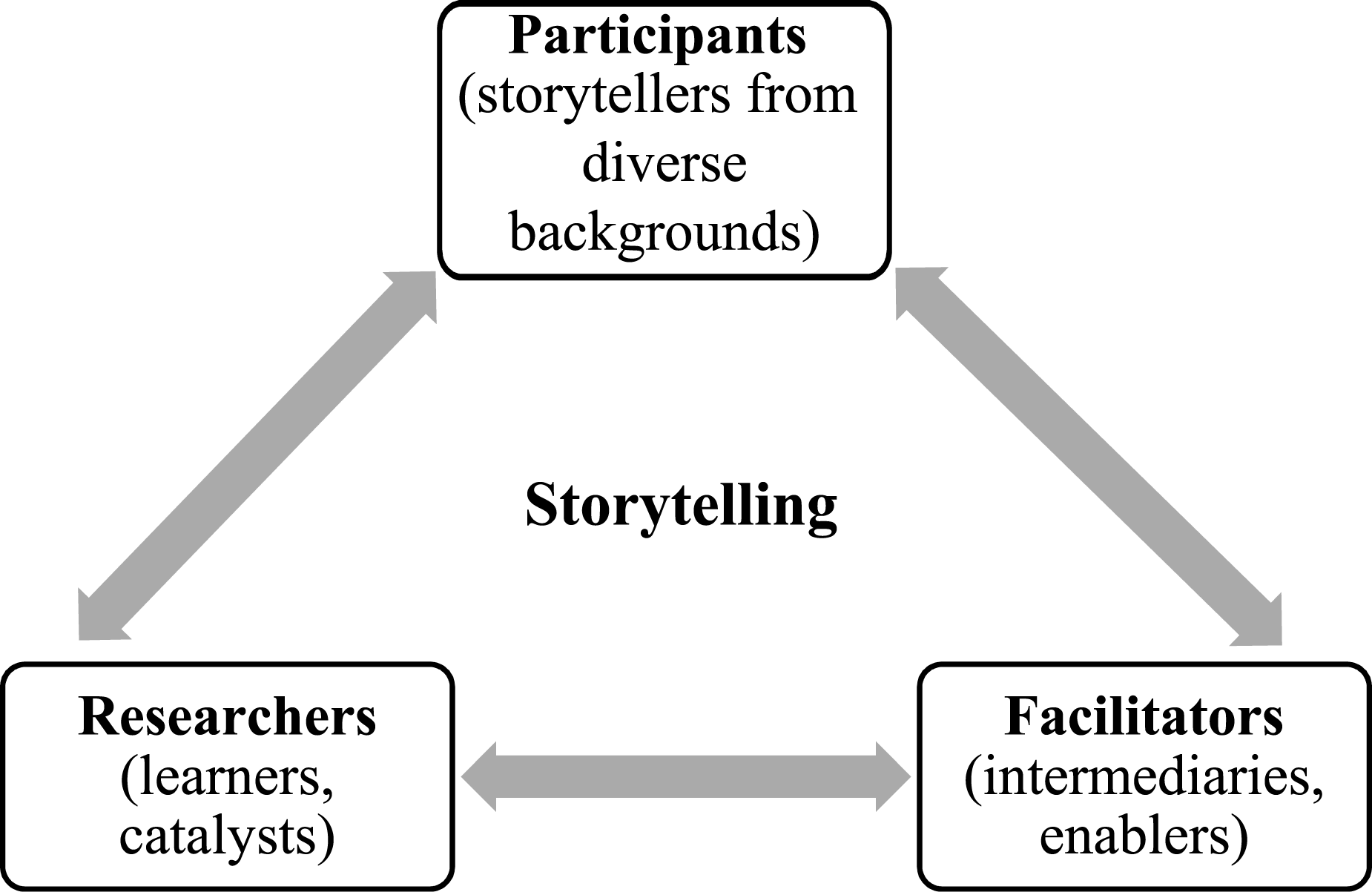
As shown in Figure 1, participants, especially storytellers from multicultural backgrounds, provide original accounts of lived experiences imbued with meaning. While exercising agency in narrating, their recounting and the eventual representation of their stories could be shaped by researchers, facilitators, and in group storytelling settings, other participants (Heron and Steckley, 2020). Researchers, by consciously repositioning themselves from traditional experts to catalysts and learners, can help reduce power/knowledge hierarchy, create opportunities of dialogue, and uncover subjugated forms of knowledge. While often discouraged from emotional engagement, researchers who share personal experiences and stories can help participants open. As Norona (2024) reflected, when she shared a dream during storytelling, Kichwa women reciprocated by revealing their reality at a deeper, emotional level. Facilitators, acting as intermediaries and enablers, shape storytelling in multiple ways from building rapport between researchers and participants, mediating potential conflicts, to perhaps intervening in storytelling through translation or direct guidance (Brekke et al., 2021).
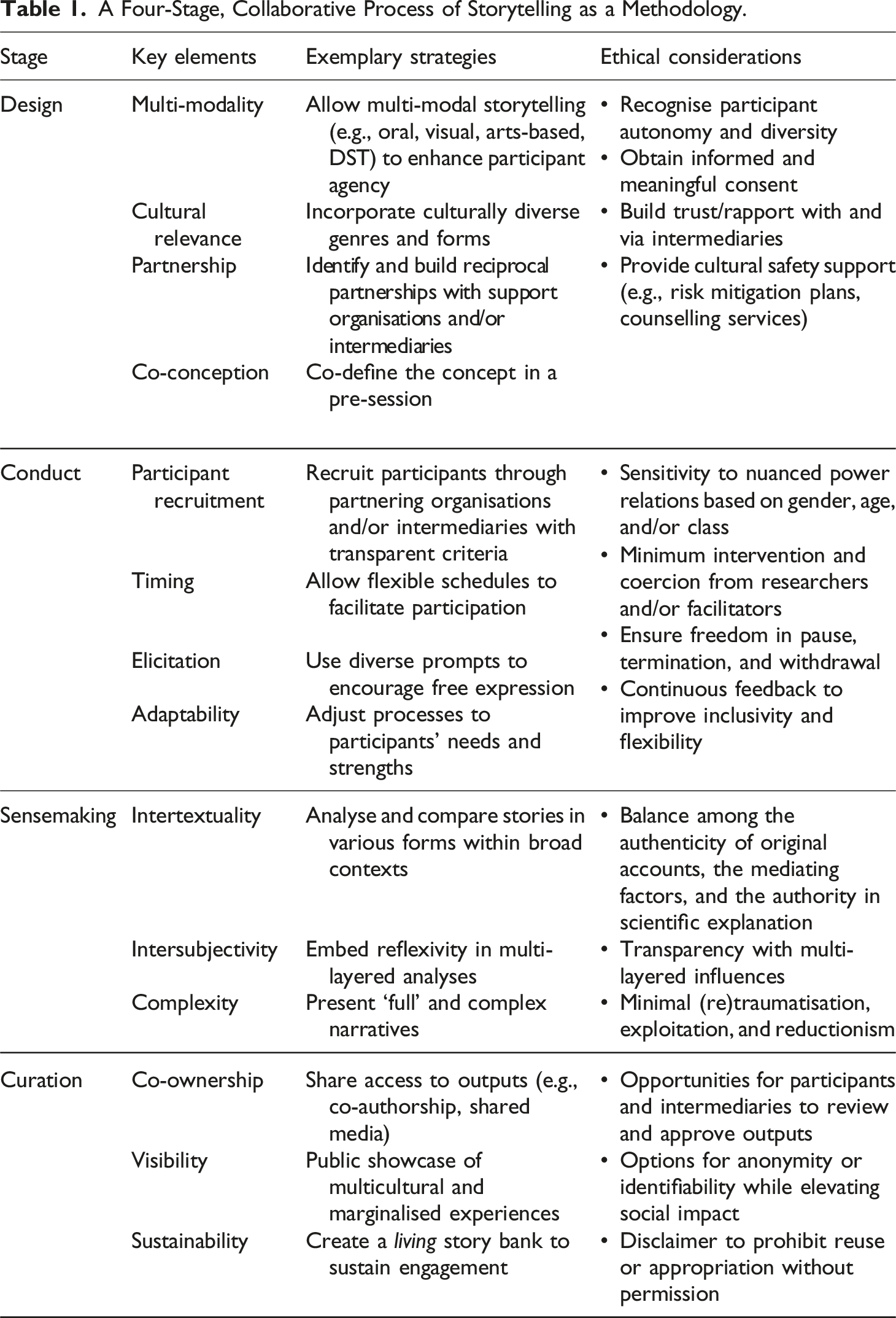
A Four-Stage, Collaborative Process of Storytelling as a Methodology.
Design
To maximise participatory storytelling, its design should remain open and accessible especially for non-native English speakers from multicultural backgrounds. This involves considering multi-modality, allowing participants to choose preferred medium (e.g., verbal, visual, digital, arts-based) that not only facilitates storytelling but also offers therapeutic potential. Cultural relevance can be enhanced by incorporating culturally appropriate storytelling genres and forms. Reciprocal partnerships with supporting organisations (e.g., community groups) are vital to develop networks that identify and recruit facilitators (intermediaries) and/or participants (Gattenhof et al., 2021). To avoid unreflective storytelling, it will be beneficial to organise a co-conception pre-session where targeted participants and intermediaries can co-define the concept, aligning everyone’s expectations (Mpofu-Mketwa et al., 2023).
Ethical considerations at this stage emphasise recognising participant autonomy and diversity, and reciprocating partners, intermediaries, and all involved with mutually benefits. Securing informed and meaningful consent through accessible means (e.g., translated documents, facilitators’ guidance) is essential while disclosing privacy terms and potential risks. It is crucial to build trust and rapport with participants through transparent communication or leveraging credibility of intermediaries, while cultural safety support (e.g., free counselling services) is provided (Gonzales et al., 2023).
Conduct
Storytelling unfolds in non-linear, improvisational ways. Participant recruitment can be entrusted to partnering organisations and/or intermediaries, making it a collective decision based on transparent criteria and disclosure of any conflicting interests (Gattenhof et al., 2021). Allowing flexible timing for participants, many of whom juggle multiple commitments, will enhance participation and disrupt the neoliberal logic of ‘on-time’ productivity (Patterson et al., 2023). To foster natural and authentic storytelling, diverse elicitation techniques such as vignettes, visual prompts, and mood boards can be applied (Daymon and Holloway, 2011). Alternatively, story seeding—collecting story seeds from pre-story space—can help participants to develop stories (Brekke et al., 2021). Processes and techniques need to be adapted to participants’ needs and strengths to promote engagement.
Ethical considerations should prioritise sensitivity to nuanced power relations, with minimum intervention and coercion from researchers and/or facilitators. In cultures with age- or gender-based hierarchies, young participants may defer to older facilitators, while women may struggle to speak openly before male facilitators. As such, mediation and motivation are required from experienced researchers to enable inclusive participation and positive exchange (Brekke et al., 2021). Nevertheless, participants should still feel free to pause, terminate, or withdraw at any point. In addition, seeking regular feedback from participants and intermediaries can effectively improve research inclusivity and adaptability.
Sensemaking
Due to multi-actor interplay in storytelling, the analysis and sensemaking of story data pose significant challenges. Such processes should be seen as layered interpretive and co-creative. Intertextuality provides a useful lens for analysing and comparing written, oral, visual, and multimedia narratives across diverse socio-cultural contexts. Intersubjectivity requires multi-dimensional reflexivity: for example, analysing how participants’ subjectivities shape their storytelling approaches, how facilitators’ positionalities influence their mediation, and how researchers’ outlooks drive the interpretation of those interactions. As a socially (co-)constructed product, the ‘interpretive story’ should embody the complexity of narratives, encompassing both factual and emotive, tacit and hidden, and destructive and empowering dimensions (Erwin 2020).
Accordingly, ethical considerations in sensemaking should centre on how to preserve the authenticity of participants’ storytelling, while accounting for the intermediary role of facilitators and the interpretive authority of researchers. Although the balance between maintaining original accounts and deliberately representing marginalised or vulnerable publics remains contested, Atkinson and Delamont (2006) caution that “unreflective and uncritical use of narratives may not be a route to the authentic self” (p.166). As such, full transparency is essential to reveal multiple influences on meaning-making (see Levitt et al., 2017 for a full discussion on fidelity to subject and utility in achieving goals). When presenting findings, care ethics (caring for human rights and wellbeing) (Hou and Johnston, 2024) are encouraged to minimise re-traumatising, exploitative, and reductive representations.
Curation
Since storytelling can be both scientific and artistic, curation serves as an additional step to amplify its social impact. While researchers have traditionally controlled data and outputs, co-ownership is highly recommended to storytelling projects, granting participants access to co-editing or co-authoring outputs (e.g., individual stories, shared media) (Patterson et al., 2023). For projects aimed at awareness-raising and social change, it is worth elevating visibility through open data-sharing or public showcases while ensuring privacy agreements. Additionally, sustainability is an important dimension of the storytelling methodology, for instance, by creating a ‘living’ story bank or crowdsourcing platform to foster ongoing participant engagement and collaboration.
This creative stage demands thoughtful ethical considerations. For example, co-ownership involves giving participants and intermediaries the chance to review and approve outputs. Although anonymity is encouraged to protect participants in sensitive contexts (e.g., discrimination, racism), scholars contend that anonymity may further silence already marginalised voices (Mpofu-Mketwa et al., 2023; Ortiz Juarez-paz, 2017). It is, therefore, critical to offer participants with open-ended choices regarding how they wish to be identified. When stories are made public, it is essential to make a disclaimer that co-created stories cannot be reused without permission. Ultimately, storytelling as a methodology is both systematic and ethically complex. Across all stages, the guiding principle is to maximise participation and agency by making storytelling a dialogic space where diverse voices are heard and strategies to mitigate, if not eliminate, power hierarchies are co-created. The next section uses a case study to illustrate its practical application.
An example study
The example study is drawn from a multi-year funded project that seeks to understand the lived experiences of Australia’s multicultural, especially ethnic minority, communities, who have been grappling with systematic, disaster-related inequalities ranging from language barriers, cultural disconnect, and limited social and institutional support. As historically underserved populations within Australia’s emergency management systems, their voices have rarely been heard or incorporated into emergency service design and critical resource investment (Hou, 2023). The study thus responds to the growing call for advancing DEI and social justice in public relations by exploring alternative, more equitable approaches to disaster risk communication. Based on national population statistics (ABS, 2025) and access to local communities in the regional city of Cairns, the study targeted seven ethnic groups: Nepalese, Chinese, Congolese, Colombian, Japanese, Filipino, and Indonesian.
Design
From the outset, we intend the project to be as participatory and emancipatory as possible. Referring to Table 1, we purposefully adopted multi-modal storytelling, offering participants a ‘repertoire’ of methods including oral, written, and visual storytelling at the individual level (Phase 1), and digital and arts-based storytelling at the collective/workshop level (Phase 2). Such multi-modality enhanced accessibility for multicultural participants at varying educational and literacy levels. In individual sessions, we provided a temporal storytelling prompt to facilitate narration of lived experiences before, during, and after a disaster event. In co-creative storytelling workshops, group activities (e.g., audio-video recording, Canva drawing, visual mapping) were devised to imagine disaster-resilient futures for multicultural communities. Examples of diverse storytelling genres such as Chinese ancient legends, Japanese animations, and African dance videos were prepared as elicitation materials.
To build a strong participatory foundation, the project developed trusting, reciprocal partnerships with local organisations including the council, social service agencies, multicultural associations, and educational institutions. These partners, united by a shared vision of supporting culturally and linguistically diverse communities, contributed throughout the project, particularly by helping identify and recruit community leaders as cultural facilitators, a vital ‘intermediary’ mechanism for community engagement. Together, we agreed on the criteria of selecting intermediaries: community leaders who are bi-/multi-lingual, well-connected to their cultural groups, and familiar with disaster risk communication. Ultimately, seven cultural facilitators were recruited, each leading one of the targeted ethnic groups.
A co-conception workshop was held to train cultural facilitators, incorporate their input to research design, and explore culturally specific ethical considerations beyond the approved ethics protocol. This pre-session developed a shared understanding of our collaborative roles, facilitation strategies, and mutual feedback checkpoints to refine the process. With facilitators, we co-developed transparent criteria and approach to recruiting participants. We also conducted role-play, simulative storytelling sessions, where a researcher, a facilitator, and a participant were present simultaneously. These exercises helped anticipate potential challenges and identify effective strategies for facilitation or intervention. At the end, facilitators expressed increased confidence and embraced the project’s fluid and improvisational nature, saying “let’s find a way” and “it will work out”.
Conduct
Following the (co-)design phase, the project purposively recruited participants (storytellers) from each ethnic group who had experienced disasters in Australia and were willing to share stories in their own ways. About half spoke English as an additional language, while others required translations. To obtain their meaningful consent, participants were briefed through either the project’s information package or cultural facilitators’ interpretations to ensure full understanding. Logistics (e.g., timing, location) were negotiated with participants to create a sense of safety. Drawing on Table 1, we used various ‘icebreakers’ (e.g., small talk, visual prompts, cultural examples) to facilitate individual storytelling (Phase 1), while Phase 2 engaged a seasoned digital producer, bound by a confidentiality agreement, to facilitate group storytelling.
The storytelling process was adapted to suit each participant’s abilities and preferences. For those less confident in verbal storytelling, we encouraged visual forms of expression such as chat bubbles or paper sketches. For those more expressive, we stepped back, listened actively, and made space. Notably, participants’ stories were often fragmented, emotive, and performed rather than emerging as neat narratives. For example, when recounting an earthquake, an African participant leapt up and used vivid body movements, resembling a theatre performance, so that even without understanding his language, the researcher could still feel the urgency and panic. These moments reminded us that storytelling is not just about words; it is also about movement, emotion, and presence.
Navigating power dynamics proved challenging in this project. In non-English sessions, researchers/we had to relinquish traditional authority, relying on facilitators for mediation. While this shift helped redistribute power, it also introduced new dynamics. Sometimes, storytelling drifted into a Q&A format, prompting gentle reminders to facilitators to maintain a natural flow. Where entrenched social hierarchies (e.g., age- or gender-based) surfaced, we intervened to recentre on the participant/storyteller’s voice. Occasionally, when emotions became overwhelming, sessions were paused or respectfully concluded to prioritise participant wellbeing. Throughout, we learned that storytelling is a deeply relational and affective practice. Rather than striving for orderliness, we embraced its messiness, recognising that meaning emerges from connection and interaction.
Sensemaking
Our sensemaking of story data followed an iterative, negotiated process, applying extensive analytical and triangulation skills. We began by examining the intertextuality across various forms of story data including transcripts of recordings, written materials (e.g., participants’ diaries), visuals (e.g., images, symbols), video clips, and artworks (e.g., drawings) to discover both convergency and divergency in narrative development. We sought to understand how these diverse lived experiences reveal disaster-related inequalities and alternative, culturally grounded approaches to resilience-building among multicultural communities. Our analysis moved between different angles including ‘what’ (story content), ‘how’ (storytelling process), and ‘how the ‘how’ shapes the ‘what’ moment-by-moment’.
Multi-level reflexivity was embedded in understanding the intersubjectivities emerging from the research-facilitator-participant interplay (Figure 1). At the participant level, we examined how storytellers’ intersectional identities (e.g., personal, cultural, social attributes) shaped their articulation of disaster experiences in Australia. At the facilitator level, our observation notes documented their interactions with participants, helping to understand how facilitators’ presence and mediation subtly influenced storytelling trajectories. At the researcher level, reflexivity became an inwardly turned lens: we questioned our assumptions, positions of authority, and relationships with both intermediaries and participants that informed every analytical choice. We acknowledge that the final narrative, albeit co-constructed, may still be mediated through our interpretive lens and could never fully represent these communities. Yet, through our intersubjective approach, combined with multiple validation checkpoints (e.g., member-checking transcripts, co-reviewing story outputs), we endeavoured to balance participants’ authentic voices with a coherent narrative presentation. Overall, our data analysis focused on credibility and trustworthiness, rather than reliability and validity (Daymon and Holloway, 2011).
The complexity of sensemaking enabled us to develop a ‘full’ story, one that may not always showcase ‘unity’ or ‘togetherness’ across multicultural communities but rather reflect the rich ‘heterogeneity’ and ‘nuances’ of lived experiences, cultural practices, and emotions in disaster contexts. For example, while social capital proved vital across multicultural communities, the ways it was cultivated and activated varied significantly. In addition, our sensemaking was not solely about surfacing structural inequities but also recognising self-agency. We paid close attention to moments of uplift and mutual empowerment, where collectivism or intergenerational power emerged to support vulnerable members (e.g., elders, newcomers) through ‘network-of-care’ during emergencies.
Curation
Collective decisions were made with participants and intermediaries to curate the storytelling outputs. For individual storytelling, we provided each participant and their facilitator with access to review, edit, and approve their stories (e.g., transcripts). For workshop-based storytelling, participants and facilitators hold joint ownership of collaborative outputs (e.g., shared media/video clips, co-created artworks). Our ethics protocol offered participants open choices regarding whether they wanted their identities, images, or artefacts shared in publications and/or public showcases (e.g., a ‘virtual gallery’ hosted on the project website 1 ). This collaborative approach has not only amplified their voices for social impact but also respected individual boundaries. Some participants even volunteered to share updates on future disaster experiences, helping to sustain our storytelling ‘pipeline’.
Enhanced learnings and critical reflections
Applying storytelling to this example study has deepened our understanding of the lived experiences of multicultural, and often marginalised, groups in disaster contexts, who have frequently been under-/mis-represented in mainstream narratives as ‘victims’ or ‘villains’ (e.g., during COVID-19) (Hou, 2023). While this paper cannot present the full empirical findings (see Hou et al., 2025), the storytelling methodology proved invaluable in generating and capturing data that was rich in content, diverse in perspective, and expressive in form.
The complex narratives and counter-narratives surfaced through the process revealed the exclusion and inequity embedded in dominant emergency communications, policies, and social infrastructures. Yet, they also illuminated how multicultural communities draw on self-strength, collective power, and cultural legacy to build self-resilience and empowerment. Being transformed from reactive ‘informants’ to active ‘co-inquirers’, the project participants contributed new epistemological insights that challenge the prevailing ‘deficit’ model of disaster risk communication, one that prioritises top-down information dissemination and technocratic ‘management’ (Hou, 2023). Notably, their accounts highlighted rich cultural norms (e.g., collectivism, spiritual connection, place-(re)making) that offer alternative pathways to democratise, diversify, and innovate disaster communication ecosystems. Their nuanced insights invite reimagination of resilience as culturally and historically embedded practices, rather than a prescriptive checklist for achieving a ‘standardised’ model.
In addition, the co-produced, creative storytelling outputs ranging from personal resilience stories, hand-drawings, video clips, Canva posters, and future-imagining fantasies (see https://research.qut.edu.au/dmrc/projects/empowering-cald-communities-in-disasters/) helped to translate the research findings into forms accessible and compelling to broad stakeholders, from policymakers to general publics. They also added an experiential element that scientific/academic representations often lack. Some artworks, such as those illustrating cyclone preparedness or emergency kit assembly, serve not only as culturally resonant learning tools but also as catalysts for cross-cultural collaboration in emergency contexts. These outputs encourage broader societal reflection on shared responsibility and the pursuit of disaster justice. In this sense, the storytelling methodology enhanced the social relevance and impact of the research, disrupting the dichotomy between academia and community (Rice and Mundel, 2018) by enabling meaningful knowledge co-production among all involved in research (Figure 1).
Nevertheless, implementing this methodology was indeed laden with practical and ethical challenges. Managing power dynamics remains a persistent difficulty. Researchers needed to balance rapport-building with emotional distancing, especially when engaging deeply with participants’ stories. Navigating these dynamics became more complex when storytelling occurred in languages other than English, requiring reliance on cultural facilitators. Unlike trained researchers, facilitators may lack sensitivity to their hierarchical influence over participants or strategies to play their intermediary role. Similar power differentials extended into data analysis where researchers inevitably took the lead in framing. Recognising this, we treated the process of storytelling as an equally valuable site of meaning-making as its outputs, acknowledging the ‘(re)storied nature of all knowledge claims’ (Rice and Mundel, 2018, p. 215).
As testified in this project, storytelling is time- and resource-intensive, requiring ongoing commitments from all involved. Ethical challenges vary contextually and culturally, necessitating continual refinement through open dialogue with participants and facilitators. In our case, incentives were provided to both facilitators and participants to compensate for their time and input as approved by ethics and supported by literature (Patterson et al., 2023). However, projects without funding may need to explore alternative ways to maintain participant engagement and commitment.
Discussion and conclusion
Public relations has developed into a robust discipline over the past four decades, yet its methodological advancement remains limited (Toledano, 2017). While the field increasingly claims storytelling as a key area of interest (Kent, 2015; Lane, 2023) and a core communication strategy (Coombs, 2018; Kantola, 2016), it has seldom explored storytelling as a methodology. Most empirical studies either treat storytelling as self-evident or rely on traditional methods (e.g., interviews, content analysis) to extract ‘stories’ as data (e.g., Arceneaux, 2022, 2024), without engaging with the participatory, agentic nature of storytelling or its intersection with power dynamics among storytellers, facilitators, listeners, and interpreters (D’Cruz et al., 2020; McCormack, 2004). This paper positions stories not merely as data, but as researcher–researched ‘living connections’ that, in turn, shape both research processes and outcomes. Drawing on storytelling applications in other fields (e.g., arts, design, creative industries) and insights from an example study, it presents storytelling as a methodology: a scientific approach to developing reflective accounts of lived experiences, grounded in constructivism, situated within evolving power relations, and facilitated through multi-modal participation and a four-stage ethical framework, all contributing to knowledge co-production.
As demonstrated, participatory storytelling exceeds other extractive methods in reducing communication barriers to research (often colonised by English, written texts) (Gattenhof et al., 2021) and creating a space of agency and subjectivity, where participants can represent themselves without externally imposed frames. Provided with diverse modes (e.g., oral, visual, artistic) of self-expression, multicultural or marginalised populations are empowered to voice subversive views and resist dominant narratives (Brekke et al., 2021). Such agentic storytelling can thus decolonise public relations by bringing diverse voices into ‘the public domain of knowledge’ (Gruson-wood et al., 2024). This is especially important given the growing interest in DEI within public relations, which seeks to move away from organisation/corporate-centred discourses to human rights, civic engagement, and social justice (Ciszek, 2017). By transforming participants from passive respondents within extractive methods (Patterson et al., 2023) to active co-inquirers and knowledge agents, the storytelling methodology mitigates ‘epistemic injustice’ (Fricker, 2007), integrating voices historically excluded from mainstream scholarship.
Further, power dynamics and intersectional experiences involved in storytelling, as depicted in Figure 1 and Table 1, reveal how this approach can decolonise public relations by recognising culturally sensitive, bottom-up influence from participants. As a socially constructed space, storytelling enables participating actors to not only contribute through their own roles but also make collective decisions across stages (e.g., design, conduct, sensemaking, curation), continuously negotiating meanings in relation to each other. Their dynamic interplay highlights storytelling as a decolonial, feminist approach to knowledge creation—a participatory, bottom-up process that privileges participant/community-generated knowledge over traditional expertise. In public relations where storytelling is often framed as a tool for meaning-making without addressing power dynamics (Elmer, 2011), our storytelling methodology stands out as a ‘human science approach’ (Wang and Geale, 2015). By promoting power-sensitive engagement, our storytelling methodology amplifies bottom-up influence essential to envisioning new forms of public relations knowledge.
Nevertheless, this study also identifies practical and ethical challenges in applying storytelling. Echoing prior findings (e.g., Brekke et al., 2021), it confirms that storytelling requires significant time and resources to develop and maintain relationships with participants, particularly those from multicultural backgrounds and unfamiliar with Western research norms. While financial incentives can boost participation (Patterson et al., 2023), this study recommends partnering with organisations and leveraging support networks to enlist (cultural) facilitators (e.g., community leaders) as ‘intermediaries’ (McQueenie et al., 2024) between researchers and participants. However, involving intermediaries also complicates the process, including how to obtain participants’ informed consent with facilitators’ translations, equipping facilitators with necessary skills, and reconciling intersubjectivities for ethical, authentic sensemaking. Additionally, this study advocates for shared ownership and stewardship of storytelling outputs, both academically (e.g., co-authored narratives) and publicly (e.g., shared media). Managing storytelling ethics extends beyond consent forms to navigating shared responsibilities and decision-making in a culturally appropriate manner.
Overall, this paper is among the first to theorise storytelling as a systematic, scientific methodology, significantly advancing public relations methods. Departing from traditionally extractive approaches that impose frameworks on participants (Patterson et al., 2023), storytelling nurtures participatory agency in self-representation and advocacy. Unlike prevailing public relations methods seeking large-scale, quantitative data, storytelling prioritises subjective and reflective accounts of lived experiences, fostering diverse, alternative perspectives to decolonise the white-centred public relations field (Edwards, 2015). Storytelling holds vast potential for producing participant-/community-oriented scholarship, aligning with the field’s growing commitment to social impact and justice. Moreover, storytelling’s capacity to capture complexity and transformation offers a powerful tool for postcolonial and postmodern public relations research. The introduction of ‘intermediaries’ exemplifies how to build trust and engage multicultural participants in knowledge co-production. In essence, the storytelling methodology repositions diverse voices at the centre, fostering a more inclusive foundation for public relations scholarship.
Practically, the storytelling methodology presented here offers guidance for navigating this participatory approach in the real world. Though not prescriptive, the four stages (design, conduct, sensemaking, and curation) assist researchers in developing a customisable storytelling approach that aligns with participants’ needs, available resources, and context-specific ethics. The methodology’s actionable strategies and techniques, spanning partnership building, participant recruitment, elicitation, and resource curation, provide a useful guide throughout. The multi-actor dynamism in storytelling encourages researchers to balance multiple interests and expectations, fostering a safe, collaborative, and trust-based environment for all involved. Beyond disaster risk communication, future empirical studies are encouraged to explore and assess the potential of this methodology across public relations subfields, while refining strategies to address shared practical and ethical challenges. This paper serves as a stepping stone in advancing the qualitative lexicon within public relations and invites ongoing methodological contributions to this evolving field.
Footnotes
Acknowledgements
The author gratefully acknowledges the contributions of partner organisations, the research team, and all community participants.
Declaration of conflicting interests
The author(s) declared no potential conflicts of interest with respect to the research, authorship, and/or publication of this article.
Funding
This project received assistance provided by the Australian and Queensland Governments under the Queensland Resilience and Risk Reduction Fund (QUT.0002.2122M.RFA).
Ethical approval
This research was conducted according to The National Statement on Ethical Conduct in Human Research (2023) and approved by the University Human Research Ethics Committee (UHREC), Queensland University of Technology with Approval Number 7046.
