




Abstract
While the Australian PR discipline and industry has acknowledged the demographic realities of multiculturalism, it has yet to critically interrogate multiculturalism as an ideological concept, contested discourse and politicised practice. This paper addresses this gap by investigating how public relations (PR) practitioners and culturally and linguistically diverse (CALD) stakeholders in the Victorian government and multicultural sectors understand multiculturalism. It situates PR practice, and PR practitioners, within broader theoretical perspectives on Australian multiculturalism. In doing so, this paper contributes to knowledge in two ways: firstly, by identifying the significant deficits in existing Australian PR scholarship on multiculturalism; and secondly, by building bridges to new approaches and engaging with contemporary research and theories of multiculturalism. To this end, this paper opens up and extends the PR discipline’s ability to better engage with, and contribute to, ongoing contemporary debates on Australian multiculturalism.
Keywords
Introduction
While the Australian PR discipline and industry has acknowledged the demographic realities of multiculturalism, it has yet to critically interrogate multiculturalism as an ideological concept, contested discourse and politicised practice. Despite being recognised as a key challenge facing the Australian PR industry (Singh and Smyth, 1999: 388), multiculturalism has been slow to emerge as an area of research within the country’s PR discipline. As early as 1999, Raveena Singh and Rosaleen Smyth (1999: 388) identified Australia’s increasingly multicultural population as one of the critical issues facing the PR industry. Singh and Smyth (1999: 388) further warned that Australia’s increasing cultural diversity will mean that ‘there are challenges for and demand from professional public relations.’ Over 20 years later, Singh and Smyth’s warnings remain not only relevant but have taken on an increased urgency in light of the recent empirical data (Australian Bureau of Statistics, 2022) showing the continued growth in Australia’s culturally and linguistically diverse population. The 2021 Census (Australian Bureau of Statistics, 2022) revealed that almost half of Australians have a parent born overseas (48.2%) and more than a quarter (27.6%) were born overseas. These statistics strongly suggest that culturally and linguistically diverse (CALD) communities 1 are a growing key audience for Australian PR practitioners and the organisations they work for.
This paper addresses this critical gap in PR scholarship by investigating how multiculturalism is understood by PR practitioners and CALD stakeholders involved in multicultural communications in the Victorian government and multicultural sectors. The first section of this defines some key concepts and briefly reviews the limited and fragmented nature of Australian PR scholarship on multiculturalism. In the second section, I draw from a small-scale exploratory study to examine how Australian multiculturalism is understood by practitioners and CALD stakeholders through a social justice lens and framed within an ethnic rights model (Jayasuriya, 1987). The last section discusses the implications of this study for Australian PR scholarship, as well as the PR discipline more broadly. I argue that adopting a social justice lens is critical to shifting PR scholarship away from prescriptive concepts of Australian multiculturalism, which reflect a mere acknowledgement of cultural diversity, towards engaging with multiculturalism as a structural framework for CALD communities to exercise their rights to recognition and redistributive equality. To this end, this paper makes an original contribution to knowledge in two ways: first, by identifying the significant deficits in existing Australian PR scholarship on multiculturalism; and second, by building bridges to new approaches and engaging with contemporary research and theories of multiculturalism and social justice.
Defining the shifting dynamics of Australian multiculturalism as a policy framework
Before discussing the findings of this study, it is necessary to briefly define two key concepts used in this paper: ‘Australian multiculturalism’ and ‘social justice.’
Since its inception in the 1970s, multiculturalism has been a controversial concept that has been subject to intense ongoing debate (Koleth, 2010; Mansouri and Modood, 2021; Mansouri, 2015). While it is beyond the scope of this paper to present a detailed history of Australian multiculturalism (see e.g., Lopez 2000; Moran 2017), I will briefly outline its development as a government policy by highlighting its different phases. This overview functions as a conceptual frame for situating the perspectives of the participants in this study within the broader context of Australian multicultural policy and exposing the underlying values embedded within their understandings of multiculturalism.
In the early 1970s, Australia became one of the first countries to adopt an official policy of multiculturalism which recognised the cultural diversity of immigrants who settled in Australia (Ho, 2013: 31). Multiculturalism was important because it signalled a policy shift away from assimilation (1940s, 1950s) and integration (1960s) towards a culturally pluralist approach to responding to the increasing mass migration of people to Australia following World War II (Koleth, 2010: 4). In her historical overview, Christina Ho (2013: 31) identified three key phases in the evolution of Australian multiculturalism as a policy: social justice, productive diversity and social cohesion. As these three phases of multiculturalism form an important contextual frame for this paper, the following is a brief outline of each phase: • The social justice phase (1970s and 1980s) of Australian multiculturalism focused on addressing socio-economic inequalities faced by migrants. Guided by the Galbally Report (1978), there was an emphasis during this period on not only providing services to migrants but also issues of equal access and equal opportunity. • The productive diversity phase (1980s and 1990s) resulted in a significant shift in Australian multicultural policy away from social justice towards an emphasis on the ‘economic benefits of cultural diversity’ (Ho, 2013: 35). In the context of the increasing globalisation and economic engagement with Asia, cultural diversity became redefined as a national economic ‘asset’ (Ho, 2013: 35) and multiculturalism was viewed as being beneficial to all Australian society and not just migrants. • In the social cohesion phase (2000s – present), multiculturalism was reframed as a ‘mainstream’ issue as a result of broader global anxieties about terrorism following the September 11 2001, US terrorist attacks and the War on Terror (Ho, 2013: 38). As a result, this phase marked a significant shift away from the focus on the rights of CALD communities towards a government policy of ensuring social cohesion and harmony in Australian society.
This brief historical overview illuminates the underlying values and ideological positions, ranging from ethnic rights, neoliberalism and social harmony, that are entwined with multiculturalism (Ho, 2013: 31). The shifting types of policy objectives outlined above reflect the fact that multiculturalism is a concept deeply embedded in regulatory and social processes as well as a political discourse of competing ideas around cultural diversity and national identity (Castles et al., 1992; Jupp, 2011). Given that Australian multiculturalism in its current form is an entrenched government framework for ensuring social cohesion and harmony, there is a growing imperative to better understand the role of PR, and PR practitioners, in influencing and shaping its meanings and values.
Within this broad overview, it is important to point out that Australian multiculturalism as a government policy was never meant to include First Nations societies. Indeed, as Jakubowicz (2006: 260) observed, ‘Indigenous leaders saw multiculturalism as a problem for the invaders and settlers - not for the original people.’ In this light, historian Ann Curthoys (2000) pointed to the often fraught and ‘uneasy conversation’ between multiculturalism and Indigenous rights and the problematic framing of both these interests under the broader concept of ‘cultural diversity’ by academics and policymakers. As such, I argue that multiculturalism and indigeneity in the Australian PR discipline should be understood and analysed as ‘two distinct yet connected’ intellectual and public discourses. While outside the scope of this paper, it should be noted that scholars have productively begun exploring First Nation perspectives in PR within Australia (Synnott, 2012). Where these two areas of research are interconnected, they both seek to diversify Australian PR theory and practice as well as further our understanding of PR as a societal relationship and function.
The term social justice, like multiculturalism, is contested and there are a multitude of meanings and definitions in social theory, policy and practice (Craig, 2007; Craig et al., 2008; Theophanous, 1994). For this paper, social justice is defined within an Australian multicultural context as a rights-based structural framework for CALD communities to assert their rights to cultural identity, access services and advocate for broader representation within society. This definition draws from key policy documents such as the Galbally Report (1978), the Jupp Report (1986) and the National Agenda for a Multicultural Australia (National Agenda) (1989) and is also supported by the significant body of scholarship (Ho, 2013; Jakubowicz, 1989; Jayasuriya, 1987; Koleth, 2010; Theophanous, 1994) on Australian multiculturalism.
Having thus defined two key concepts used in this paper, the following section presents a review of the limited and fragmented nature of Australian PR scholarship on multiculturalism and highlights some significant deficits in knowledge.
Mapping communicative blind spots
In one of the first academic articles to directly address multiculturalism, Jim Macnamara (2004: 323) described multiculturalism as a ‘communication blind spot’ and highlighted the paucity of research on multiculturalism and multicultural communications within the PR discipline. Macnamara (2004: 325) validated Debashish Munshi’s (1999: 44) criticism that PR suffers from a ‘Western myopia’ by acknowledging that leading Australian PR textbooks, including his own, did not contain any sections on multiculturalism or cross-cultural communication. This weakness was further highlighted by scholars such as Marianne Sison (2010, 2016), Renato Ravenna (2005) and Katharina Wolf (2016). Taken together, these scholars’ writings serve to highlight the considerable gaps in knowledge on Australian multiculturalism across PR as a scholarly discipline and field of practice. Since these scholars’ critiques, multiculturalism has continued to remain a neglected and marginalised area of knowledge in the Australian PR discipline compared with other closely related disciplines such as marketing (Wilkinson and Cheng, 1999; Noble and Camit, 2005; Condie, 1997).
In reviewing the limited and fragmentary PR literature, multiculturalism remains almost invisible and marginalised in important areas of knowledge production, such as PR education (Chia, 2009; Macnamara, 2004; Sison, 2016; Ravenna, 2005) and history. Despite recent calls for a ‘rethinking’ (Fitch, 2016) of Australian PR history, multiculturalism is also largely omitted from historical accounts or constructed narratives of PR practice. Typically, when multiculturalism has been addressed in Australian PR historical narratives it has often been framed as an ‘issue’ or a ‘problem’ that PR practitioners need to manage or overcome (Macnamara and Crawford, 2013). These distortions and absences reveal that the contemporary re-mappings of Australian PR history have yet to situate Australian PR within the broader context of multiculturalism, or adequately trace the context of its historical development beyond largely corporate and institutional sites of practice.
Australian multiculturalism
Furthermore, these omissions of multiculturalism from key domains of PR knowledge production are troubling when viewed against the extensive scholarship (Moran, 2017; Jakubowicz and Ho, 2013; Lopez, 2000) detailing, since the 1970s, how multiculturalism as a concept and policy has significantly shaped and influenced Australia’s social, cultural and political landscape. As several scholars (O’Regan, 1994; Moran, 2017; Munshi, 1999) noted, issues of cultural difference, national identity and the contested relationship between immigrants and Indigenous Australians were a key part of the political and cultural agenda in Australia during the 1980s and 1990s. The paucity of PR scholarship on multiculturalism during this period suggests that the Australian PR discipline was largely absent from these broader interdisciplinary debates on cultural diversity, identity and difference (Castles et al., 1992; Hage, 1998), taking place at that time. This absence may also reflect the insularity of the Australian PR discipline, which has been critiqued for producing a narrow body of scholarship that does not engage with other disciplines (Hatherell and Bartlett, 2005). As a result, the communicative context of multiculturalism is an underexplored dimension in both Australian PR (Macnamara, 2004: 323) and the broader interdisciplinary scholarship on multiculturalism (Mansouri et al., 2017: 8).
In contrast to the Australian context, there is a much larger and broader body of US scholarship examining the implications of multiculturalism for PR theory and practice. From the 1990s onwards, multiculturalism was explored across various strands of US PR scholarship, including theory (Banks, 1995, 2000), practice (Sheng, 1995; Mundy, 2015; Martinez, 2007), education (Kern-Foxworth, 1989; Sriramesh, 2003; Pompper, 2005). US PR scholar Krishnamurthy Sriramesh (2003), was one of the earliest voices in the PR discipline to call for the ‘dire need’ for multiculturalism in PR education. Echoing Sriramesh, US PR scholar Stephen Banks (2000: ix) observed that mainstream PR scholarship and practice has paid very little attention to multiculturalism and the ‘predicaments of culturally diverse populations.’ As Banks (2000, p. 4) noted, the International Association of Business Communicators (IABC) Research Foundation’s influential ‘Excellence Project’ (Grunig et al., 1992) did not contain any reference or acknowledgement of multiculturalism, in either theory or practice. While it has been almost 20 years since Banks made these astute observations, his critique of the paucity of PR scholarship on multiculturalism is still relevant and applicable to contemporary Australian PR discipline.
Several scholars, working outside the US context, have also critiqued the tendency of the PR discipline towards analysing multiculturalism through the framework of the ‘other’ (Munshi and McKie, 2001; Edwards, 2011; Munshi, 1999). Debashish Munshi and David McKie (2001: 16) argued that multiculturalism was generally represented in PR textbooks in ‘demarcated’ sections with an emphasis on the ‘the need to communicate effectively with selected ‘other’ groups such as Latinos, African-Americans and Asians without acknowledging how the power to set the communication agenda remains in Western hands.’ As a result of what Munshi (1999: 40) called the ‘dominant managerial framework,’ CALD communities have effectively become ‘othered’ and defined as the objects of communicative practice rather than active subjects in their own rights.
On the whole, Australian PR scholars have tended to ignore the discursive complexities of multiculturalism addressed by these critical PR scholars (Munshi and McKie, 2001; Edwards, 2011; Munshi, 1999). This lack of engagement with the broader critical scholarship is reflected by PR scholars relying on governmental policy statements to define multiculturalism (Sison, 2010), or resorting to broad descriptive generalisations, such as: ‘Australianness has become increasingly synonymous with multiculturalism’ (Wolf, 2016: 74). As a result, the dominance of such prescriptive and descriptive modes of analysis has meant that Australian PR scholars have yet to interrogate multiculturalism fully as an ideological concept, contested discourse and politicised practice.
The emphasis in Australian PR scholarship on global comparative approaches (Sison, 2010; Ravenna, 2005) to multiculturalism, which focuses on the communications activities of large corporations (Macnamara, 2004) has also meant that there has been little critical analysis within a local context. For example, both Sison (2010) and Ravenna (2005) emphasised global PR practice as the key driver for increasing awareness of multiculturalism in PR practice. Such framings of multiculturalism within a global context are limiting because they construct a binary where multiculturalism is always situated as ‘over there’ rather than ‘right here.’ As Sriramesh (2012: 11) observed, such binaries create a ghettoising effect where critical discussions of multiculturalism are framed exclusively within the realm of ‘global PR.’ One result of this global focus is that there has, to date, been little attention paid to PR’s role in the construction and representation of multiculturalism within a local Australian context. However, it is important to note that in taking this perspective, I am not suggesting that researchers should ignore the increasingly complex intersections between the global and local, or the growing diasporic nature of multicultural communities (Sison, 2017). Instead, Australian PR scholars must start examining the local context of these intersections and recognise that the homogenising effects of globalisation can often take place alongside the increasing diversification and fragmentation of local communities (Banks, 2000: 104).
In the following section, I present the findings from a small-scale exploratory study that addresses this gap in the scholarship by focusing on how multiculturalism is understood within the localised context of PR practice in Victoria, Australia. In doing so, this paper investigates one particular blind spot in Australian PR: the attention to the social justice dimensions of multiculturalism.
Methodology: Investigating multiculturalism as a concept, cultural value and socio-political context
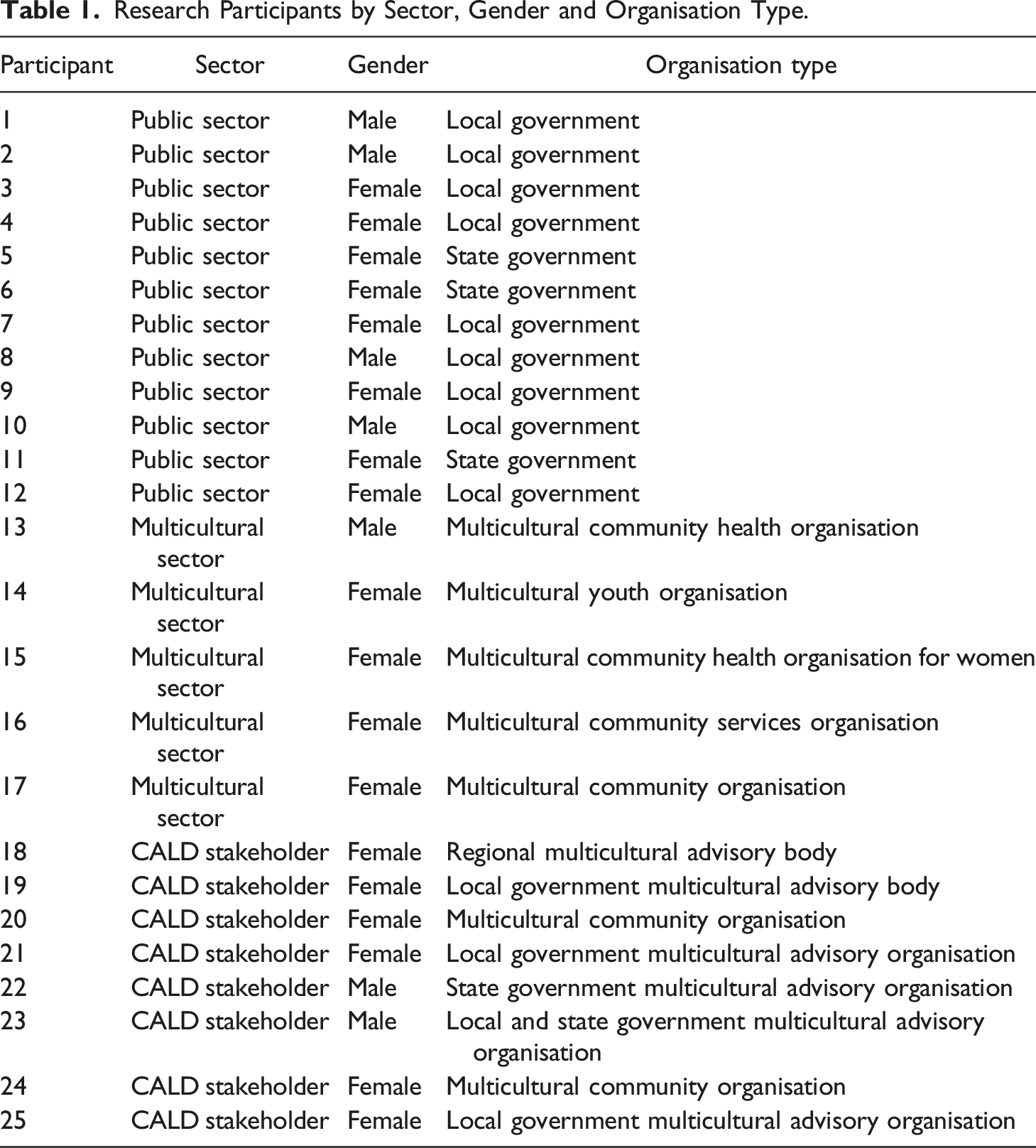
This paper draws on an exploratory PhD study, which involved in-depth semi-structured one-to-one interviews lasting between 60 and 90 min with 25 participants. Central to this study, was establishing how PR practitioners and CALD stakeholders in the Victorian government and multicultural sectors understood multiculturalism. The three groups of participants were:
(1) PR practitioners working in the Victorian Government
The first group of participants recruited were practitioners who worked in communication roles in the Victorian government sector, which included both state and local levels. These participants were selected because of their communications expertise and experience and were either currently working in the government sector in Victoria or had done so in the past 2 years. As a result of the recruitment activities, in-depth semi-structured interviews were conducted with a total of 12 PR practitioners working in communication roles in the Victorian government sector.
PR practitioners working in the multicultural sector
The second group of participants were practitioners who worked in communications roles in the multicultural sector, or who had done so in the past 2 years. These participants were selected because they were involved in developing communication campaigns that target CALD communities and worked with these communities as stakeholders. For this study, the ‘multicultural sector’ was defined broadly to include any type of community-based organisation that provided direct services to CALD communities or advocated on their behalf to different levels of government. As a result of the recruitment activities, in-depth semi-structured interviews were conducted with a total of five participants working in communication roles in multicultural community organisations in Victoria. The range of organisations included a metropolitan-based community health organisation, a multicultural organisation that provided services and advocated on behalf of young people from migrant and refugee backgrounds and a regional multicultural community service organisation.
CALD stakeholders
Research Participants by Sector, Gender and Organisation Type.
Locating the research in the state of Victoria and the public sector context
This study focused on the state of Victoria because it is the most culturally diverse state in Australia and one of the highest proportions of overseas-born people who come from non-main English-speaking countries (Australian Bureau of Statistics, 2022). As well as a culturally diverse population, multiculturalism has a strong social, political and cultural history in Victoria (Koleth, 2010; Lentini et al., 2009). Indeed, Victoria is considered by many scholars (Lentini et al., 2009: 14) to be at the forefront of the development and strengthening of multicultural policies often in the face of increasing federal hostility. In 2004, the Victorian government enshrined the principles of multiculturalism in law with the establishment of Multicultural Victoria Act (2004), which is also supported by a range of other legislation including the Equal Opportunity Act 1995 (Vic), the Racial and Religious Tolerance Act 2001 (Vic) and the Charter of Human Rights and Responsibilities Act (2006) (Vic) (Koleth, 2010: 20). More recently, the Victorian government (2017) reiterated its support for multiculturalism with the release of a new Multiculturalism Policy Statement, Victorian. And proud of it. As a result of these factors, multiculturalism is a concept and policy that is strongly embedded within the fabric of Victorian law, culture and society.
The centrality of multiculturalism as a policy within the Victorian public sector is evidenced by the Victorian government’s Multicultural Communication Policy 2011; State Government of Victoria (2011), which placed an obligation on PR practitioners to include communication with CALD communities in any Victorian government-funded campaigns. The Multicultural Communication Policy 2011; State Government of Victoria (2011) stated that government departments and agencies must spend a minimum of five per cent of their communications campaign expenditure on multicultural media. In 2019, this standalone policy was incorporated into the Victorian Government Advertising and Government Communications Guidelines under the subsection Communicating with Multicultural Victorians. The same existing obligations of the five per cent media spend carried over.
Within this context, multiculturalism as a Victorian Government policy has a direct impact on PR practitioners working in the public sector. Thus, for public sector practitioners the capacity to engage with CALD communities and understand multicultural communication practices is a relevant and increasingly important part of their PR practice. As such, PR practitioners’ understandings of multiculturalism, and how this translates into effective practice, can have broader societal impacts. The ability of CALD communities to access government-funded services and programs is often dependent on access to information. As well as these access and equity issues, public sector PR can also affect the government’s ability to implement culturally inclusive policies and programs. Thus, public sector PR practice, therefore, offers a critical local site for exploring and analysing the role of PR as a society and relationship function.
Locating the public relations researcher as an ‘insider’ and ‘outsider’
In qualitative research, several scholars (Daymon and Holloway 2010; Denzin and Lincoln, 2008; Liamputtong 2009) argued that reflexivity is critical because the researcher is the actual ‘instrument’ of data collection and analysis. As Stuart Hall (1990, p. 222) noted: ‘We all write and speak from a particular place and time, from a history and a culture which is specific.’ Hall’s comments suggest that reflexivity may thus require researchers to not only situate themselves in their own research but also constantly interrogate the very position(s) from which they speak and write from.
What, then, are the particular positions from which I am speaking and writing? In addressing this question, I will reflect on how the personal and professional interweave to critically shape and influence this study. This research came about through my own experiences as a PR practitioner working in the Victorian government and community sectors. During my time as a practitioner, I was struck by how ill-prepared my graduate-level public relations education was in terms of providing me with the knowledge and skills to work in multicultural environments. Upon reflection, it was clear that multiculturalism and multicultural communications were critical dimensions missing from my post-graduate Australian PR education. In the absence of any PR industry education, I found myself drawing on my academic background in cultural studies as well as my own lived experiences as a first-generation Asian-Australian migrant to make sense of multicultural communications as a field of practice.
My professional identity as a practitioner also plays a critical role in shaping and influencing the position from which I write and speak. Conducting qualitative research into one’s own industry, as well as being supported by that industry via a scholarship, raises what I suggest are a set of challenging epistemological questions around positionality: Are you an insider looking out, or an outsider looking in? Can you inhabit both positions? This inside/outside dynamic is further complicated by the ongoing tensions and debates about the relationship between PR research and practice. As Vardeman-Winter (2014, p. 103) observed, PR researchers have ‘loyalties to two often-conflicting groups: to the publics we hope the information will lend some empowering insight, and to the practitioners, who need to conduct business with strategy and efficiency.’ During the process of conducting this research, I came to recognise that these ‘loyalties’ often placed the PR researcher in the fraught epistemological position of being both an insider and outsider within the PR industry.
Adopting a qualitative methodology through thematic analysis
A qualitative research methodology, using thematic analysis (Braun and Clarke, 2006), was adopted in this study because it allowed for an inductive exploration of the underlying values and beliefs embedded within participants’ perspectives of multiculturalism. Another sound basis for selecting a qualitative methodology is to respond to the current gap in PR scholarship of interpretive research that explores practitioners’ understandings and subjective experiences of public relations (Hodges, 2006; Daymon and Holloway, 2010). Within the context of Australia, there has also been a paucity of research to date examining how PR practitioners understand the concept and policy settings of multiculturalism and apply it in their PR practice.
A combination of convenience, purposeful and snowball sampling (Liamputtong, 2009: 11) was used to recruit participants because the researcher resides in Victoria and has worked as a PR practitioner in Victoria. Liamputtong (2009: 11) defines purposive sampling as the ‘deliberate selection of specific individuals, events or settings because of the crucial information they can provide that cannot be obtained so well through other channels.’ Snowball sampling, on the other hand, is described as the non-random sampling technique where participants are invited to recruit people they know to the study and through these recommendations and referrals, a larger group of participants in the target population is reached (Tenzek, 2017: 1614). The adoption of these sampling techniques reflected the fact that the study’s sample size was not intended to be a representative one.
Scope and limitations
There are two limitations that may be applied to this study: firstly, its single focus on Victoria and the public sector, and secondly, the sample size of 25 participants. The findings of this study may not be generalisable within an international context because of the study’s scope: the Victorian government and multicultural sector and Australian PR practice. The sample size may seem relatively small but this should be weighed against the fact that there was an intensive focus on selecting information-rich participants who have a detailed experience and knowledge of multiculturalism within a communicative context. It should also be noted that another limitation is that this study did not include the private sector/corporate PR practice. While the private sector does engage in communications practices that target CALD communities, these practices are usually focused on the marketing of goods and services. Though the outcomes of this study may have implications for the corporate sector, such as around issues of cultural diversity and voice, I suggest that understanding multicultural communication practices within the corporate sector is a separate area for future research
Having outlined the methodology, the following section outlines the key findings of this study and discusses the implications for Australian PR scholarship, as well as the PR discipline more broadly.
Conceptualising multiculturalism as a ‘kaleidoscope’
‘Multiculturalism is like a kaleidoscope — when you keep rotating it, it changes shape, it looks different.’ (Participant 17, PR practitioner, multicultural sector)
In this study, participants were asked to reflect on the meaning of multiculturalism and their understanding of the term in relation to their communications roles. One of the more interesting descriptions of multiculturalism is offered by Participant 17, a practitioner working in a multicultural advocacy organisation. In the epigraph above, Participant 17 described multiculturalism as a ‘kaleidoscope’ and observed that: ‘when you keep rotating it, it changes shape, it looks different.’ The metaphor of a kaleidoscope (Pieterse, 2001: 393) used by this participant offers an apt way to understand multiculturalism because it underscores its shifting and dynamic nature. In contrast to the commonplace one-dimensional understanding of the term, the metaphor of the kaleidoscope used by Participant 17 is valuable because it enables us to think about multiculturalism as a socially constructed concept that is always refracted through a particular lens and multiple perspectives. Thus, rather than a fixed and static view, the kaleidoscope highlights the fluid, iterative and elusive nature of multiculturalism
Indeed, one of the main findings of this study is that there is a spectrum of divergent understandings of multiculturalism from these participants involved in multicultural communications in the government and multicultural sectors. Broadly speaking, this study identifies five different ways that the concept of Australian multiculturalism is understood and applied: 1) as a descriptive concept, 2) as a prescriptive framework, 3) as a contested discourse, 4) as a rights-based framework and 5) as a set of material practices connected to the multicultural sector. These five different understandings are the anchor points of this paper and form the structural framework for the following analysis of how multiculturalism is understood within the communicative context of PR practice. In the following section, I situate these participants’ kaleidoscopic understandings of Australian multiculturalism within the broader context of the different phases of Australian multicultural policy outlined earlier to unpack the competing ideas and values embedded within these perspectives.
Descriptive understandings: ‘melting-pot’ or ‘mosaic’?
One of the core values underpinning Australian multiculturalism as a policy is the recognition and respect for Australia’s culturally diverse population and society (Ho, 2013: 31). In this study, this value is reflected by the descriptive understandings of multiculturalism that emphasizes its empirical dimensions. For many participants, ‘multiculturalism’ is understood primarily as a descriptive term that reflects the demographic reality of Australia’s culturally diverse population and its immigrant history. For many PR practitioners working in the government sector, multiculturalism is framed within the practical context of understanding the cultural diversity of their audience. As Participant 12, a practitioner working in local government, explained, multiculturalism is ‘about cultural diversity in our community and being aware of the different people in our community.’ There was an interesting contrast between, practitioners working in the government sector tended to describe Australia as a cultural ‘melting pot,’ while CALD stakeholders preferred the metaphor of a ‘cultural mosaic.’ These different views about the most appropriate way to describe the cultural diversity of Australia’s population underscores not only the shifting and contested language of multiculturalism but also its inherently ideological nature. In this light, these participant perspectives are important because they highlight another aspect of multiculturalism that is often elided over in Australian PR scholarship: its discursive dimensions. As such, this study reveals that the terms used by practitioners such as ‘melting pot’ and ‘cultural mosaic’ to describe cultural diversity are not neutral concepts, but instead reflective of normative values about how society should be organised (Lopez, 2000: 446).
Prescriptive policy framework for social cohesion: ‘framework for communities’
The understanding of multiculturalism as a prescriptive framework for strengthening social cohesion was a dominant theme across all three participant groups and underscored its public policy dimensions. The intersection between official multicultural policies and communications practice was expressed through the use of words like ‘integration,’ ‘inclusion’ and ‘social cohesion’ by participants in this study. As Participant 15, a practitioner who worked in the multicultural sector, explained: multiculturalism was ‘about creating a framework for communities from different cultures to maintain an identity and also be able to cohabitate.’ This point of social cohesion is also underscored by Participant 3, a practitioner who worked in the local government sector, who described multiculturalism as being about ‘people from all walks of life integrating and coming together to live cohesively in a community and I guess not be isolated in their own bubbles, as we see in some communities.’ The words used by these practitioners reflect an understanding of multiculturalism as a prescriptive model for social cohesion and as a normative ideal for social harmony (Ho, 2013; Moran and Mallman, 2019).
The descriptive and prescriptive understandings outlined above are also the dominant ways in which PR scholarship has engaged with Australian multiculturalism. As I discussed, Australian PR scholars have often relied on prescriptive government policy statements (Sison, 2010) or broad descriptive generalisations about social cohesion (Wolf, 2016: 74) in their discussions of Australian multiculturalism. In the following section, I examine three understandings in this study that challenge this narrow scope in Australian PR scholarship by presenting a more critical view of multiculturalism as an ideological concept, contested discourse and politicised practice.
Contested and divisive discourse: ‘It’s just become an ‘us and them’’
In contrast to the descriptive and prescriptive understandings, several participants offered a more critical understanding of multiculturalism as a contested and often divisive public discourse. In his interview Participant 2, a practitioner working in local government, drew particular attention to the discursive nature of multiculturalism as a socially constructed term. According to Participant 2, there was a distinction between those who viewed multiculturalism as a divisive policy and those, like himself, who saw it as a ‘force for social cohesion.’ In his comments, Participant two paints a much more complex and contested picture of multiculturalism than apparent in descriptive or prescriptive understandings of the term. Moreover, his comments are interesting because they highlight how multiculturalism is a concept, discourse and practice that can be ‘mobilised’ (Gunew, 1997: 37) by different actors and for varying interests. The participant’s insights are important because they address another critical dimension of multiculturalism that is largely absent from the existing Australian PR scholarship; namely, the understanding of multiculturalism as a socially constructed concept embedded in a highly politicised public discourse (Moran, 2011; Mansouri, 2015). Significantly, this study revealed that many practitioners were alert to these societal tensions and the fraught and politicised nature of the public discourse on multiculturalism. The ideological dimensions of multiculturalism are also reflected in participants’ understanding of multiculturalism as a rights-based framework, which l will now address.
Rights-based framework: ‘The right to your self-actualisation and self-identity’
A key finding of this study is that Australian multiculturalism is principally understood by participants in this study through a social justice lens (Jakubowicz, 1989; Jayasuriya, 1987; Ho, 2013), and via an ethnic rights model (Jayasuriya, 1987). Indeed, a connective theme in this study is the emphasis of participants, particularly CALD stakeholders and practitioners working in the multicultural sector, on the social justice dimensions of Australian multiculturalism. This social justice lens is best summed up by Participant 24, a CALD stakeholder, who stated that multiculturalism is about ‘being accepted like everyone else and having equal opportunities.’ This point was further emphasised by Participant 18, a CALD stakeholder, who stated: that multiculturalism is ‘about the services, the laws, the structures, it’s about representation on power structures, boards and council.’ These two comments suggest that instead of a prescriptive policy, participants understood multiculturalism as a rights-based framework for CALD communities to assert their cultural identities, access services and address social inequalities.
Therefore, despite the shift in contemporary official multicultural policy towards social cohesion (Jakubowicz, 1989; Ho, 2013), this study suggests that social justice forms a strong and deeply embedded value within participants’ understandings of multiculturalism. Underscoring this concept of multiculturalism as a rights-based framework is the distinction that many participants drew between ‘mainstream’ and CALD perspectives. As Participant 17, a practitioner in the multicultural sector, observed: ‘there is a disconnect between policy definitions and objectives of that policy, with, how the community sees itself, and what the community wants for itself.’
Furthermore, Participant 18 pointed out that multiculturalism is about the “right to your self-actualisation and self-identity,” and should be distinguished from “mainstream” views that focus on “integration and tokenism.” Taken together, these participants’ comments are valuable because they point to one problematic aspect of ‘official’ (Stratton, 2017) multiculturalism: its tendency to ignore the actual perspectives and voices of CALD communities. A compelling illustration of this is offered by Participant 22, a CALD stakeholder, who described multiculturalism as ‘something that I’ve always had an aspiration for, it’s almost like a dream, it’s beautiful and to me, it’s everything.’ Further on, he suggested that multiculturalism was not something ‘tokenistic’ but one of the main ‘threads in the fabric’ of Australian society and that ‘multiculturalism is not a minority, we are the majority if you look at the statistics.’ Such comments reveal that multiculturalism plays a central and significant role in both the personal and professional identities of participants. They also suggest that for these participants, multiculturalism is understood as something tangible and concrete; something that has a material impact on their own lives and the lives of the communities they represent or work with.
Practice and sector: Aspiration or reality?
The materiality of multiculturalism is also addressed by participants who drew a sharp distinction between the ideas of multiculturalism as a policy and its real-world application as a practice. As Participant 17, a practitioner working in the multicultural sector, observed, there is a ‘difference between how multiculturalism is defined and understood, to [sic] how it’s practiced.’ Several participants offered critical views of the multicultural sector by highlighting issues around representation, gender and power relations. The gendered nature of the multicultural sector and the lack of a ‘feminist lens’ was addressed by Participant 15, who explained that ‘multicultural organisations or ethno-specifics often tend to not have a feminist lens or gender lens and tend to be led by men.’ Her comments are interesting because they point to not only the gendered relations of power within the multicultural sector but also the precarious position of women within the practice of multiculturalism. These participants’ comments reveal a level of self-reflexivity, as well as empirical knowledge about the complexities of multiculturalism as a practice and sector, that has thus far been a missing dimension in Australian PR scholarship. Their insights are valuable because they expose the complex interplay between people, institutions and structures that give meaning to multiculturalism as both a concept and a practice (Werbner, 2012). Their critiques of multiculturalism are reflective of the broader scholarship (Ho, 2013; Jakubowicz, 1989; Mansouri et al., 2017) around the limitations of the Australian multicultural sector.
In summary, this section has situated these participants’ broad spectrum of understandings of multiculturalism within the broader context of the different phases of Australian multicultural policy. It is significant to note that for many participants multiculturalism has more than one meaning and as a result, there is often a blurring and tension between these five different types of understandings outlined in this paper. One key point of tension revealed in this study is the contrast between participants who understood multiculturalism from a prescriptive perspective and those who viewed multiculturalism, through a social justice lens, as a rights-based framework for CALD communities. The prescriptive understanding focuses on ‘ensuring social cohesion among a diverse population,’ while the rights-based framework focuses on addressing social inequalities in CALD communities (Ho 2013: p. 38). Moreover, what these tensions reveal is that the five different understandings of multiculturalism outlined here do not exist in harmony, but are instead reflective of the competing ideas and values embedded within the “many discourses of multiculturalism” (Moran 2017: p. 269).
In unpacking the underlying ideas and values that are embedded within these divergent understandings of multiculturalism, the findings revealed that participants in this study predominantly understood multiculturalism through a social justice lens as a rights-based framework for CALD communities to assert their cultural identities, access services and address social inequality. In the following section, I consider the implications of understanding multiculturalism through a social justice lens for Australian PR scholarship and practice.
Implications for PR scholarship: challenging the productive diversity lens
The findings of this study highlight several missing dimensions within the existing PR scholarship on Australian multiculturalism: the contested nature of multiculturalism as a discourse, its centrality as a rights-based framework for CALD communities and the distinction between multiculturalism as a policy and practice. In this light, the insights of the participants in this study have broader implications for Australian PR scholarship and practice which are explored in the next section of this paper.
A significant implication of these participants’ kaleidoscopic understandings of multiculturalism is that they challenge the dominance of the ‘productive diversity’ (Ho, 2013: 37) lens by exposing the critical limitations of engaging with multiculturalism through such a narrow neoliberal frame. As I noted, Australian PR scholars tend to adopt a market society and economic lens that prioritises the business value of cultural diversity as a commodity or business asset to be ‘maximised’ (Wolf, 2016: 63). For example, Wolf (2016, p. 63) quoted multinational consulting company KPMG’s proposition that Australia’s ‘multicultural characteristics’ should be drawn and maximised for business benefits as economic power shifts to Asia. Wolf’s comments are illustrative of how Australian multiculturalism was linked, in the 1980s and 1990s, to the rise of neoliberalism, globalisation and the emphasis on the economic benefits of cultural diversity (Ho, 2013; Moran, 2017; Smits, 2011). What is significant about the findings of this study is the marked absence of this productivity lens, with only one participant in this study framing her understanding of multiculturalism through such an economic lens. In her discussion of the value of multiculturalism, Participant 12, a practitioner working in the local government sector, suggested that Australia needs to ‘capitalise on its cultural diversity as an asset.’ In contrast, the majority of participants offered a broader socio-cultural lens on multiculturalism framed around values like social justice and social cohesion. This finding may reflect the fact that participants in this study are drawn from the public sector where, as I noted, multiculturalism is a deeply embedded policy and prescriptive framework for managing cultural diversity.
To return to the metaphor of the kaleidoscope, the findings of this study suggest that Australian PR scholarship is still unable to rotate and shift away from a productive diversity lens on multiculturalism. Most recently, an argument has been mounted that PR is deeply and inextricably entwined in the neoliberal project and that consequently it is time for research in ‘public relations from critical perspectives to reflect on how we are, wittingly or unwittingly, perpetuating and privileging the very practices and interests we claim, or aim, to subvert’ (Demetrious and Surma, 2019: 108). This study suggests that PR’s reliance on a productive diversity lens may have resulted in an understanding of multiculturalism that is too narrow in scope and lacking in critical self-reflexivity. Indeed, one clear issue with adopting such a narrow lens is tends to ignore the broader societal implications of multiculturalism, such as its social justice dimensions, and address the PR industry’s broader ethical and social responsibilities to cultural diversity. As observed earlier, the PR discipline has largely been absent from the broader interdisciplinary debates on Australian multiculturalism which have been a central and ongoing concern in contemporary academic, public and political discourse (Ang and Stratton, 1998; Mansouri et al., 2017; Colic-Peisker and Farquharson, 2011). In contrast to the PR discipline’s absence, the findings reveal that it is PR practitioners and CALD stakeholders in this study who are critically engaging with some of the fraught and contested issues within contemporary multicultural discourse. Thus, these participants’ critical voices offer a critical path for PR scholars to shift beyond these neoliberal confines and towards a crucial engagement with the social justice dimensions of Australian multiculturalism.
Adopting a social justice lens to PR scholarship and practice
Adopting a social justice lens is critical because it enables PR scholarship to shift away from prescriptive concepts of multiculturalism, which reflect a mere acknowledgement of cultural diversity, towards engaging with multiculturalism as a structural framework for CALD communities to exercise their rights to recognition and redistributive equality. In his interview, Participant 22, a CALD stakeholder from the multicultural sector, posed the following question: ‘How can we bring out the voice of the voiceless communities so that they can be part of the bigger society, but also participate and contribute and that their contributions are being recognised?’ His question is significant because it reveals just how central the concept of social justice is to these participants’ understandings of multiculturalism. Refracted through a social justice lens, multiculturalism is understood by these participants as a structural framework for not only legitimising the presence of CALD communities but also for advancing their interests within Australian society (Pardy and Lee, 2011: 312).
In this light, the attention to social justice is valuable because it offers PR scholars a macro-level understanding of Australian multiculturalism that engages with its broader socio-cultural and political implications. This macro perspective is a counterpoint to the dominant descriptive (Wolf, 2016) and prescriptive (Sison, 2010) modes of analysing multiculturalism within existing Australian PR scholarship. These sources have tended to focus on an organisational and global context, thereby overlooking the significant societal and local contexts of PR practice. The social justice lens, on the other hand, reveals how communicative practices like PR, and PR practitioners themselves, are imbricated within broader societal relationships of power that can render invisible the voices of CALD communities and their calls for recognition and redistributive justice (Werbner, 2012: 200). As such, the attention to social justice offers a way for PR to address the issues relevant to current Australian policy settings (Effeney et al., 2015; Boese and Phillips, 2015; Mansouri et al., 2017) and as a corollary raise some challenging questions about the tenor of the relationship between PR practices and CALD communities.
Within a practical context, the findings of this study extend our knowledge of how multiculturalism is applied and translated into PR practice through a social justice lens. Underlying the findings of this study is the urgent call made by participants such as Participant 22 to transform communicative practices, such as PR so that they can better engage with and recognise CALD communities as equal and active participants and subjects in the communicative process. In this light, these participants’ insights are important because they go some ways to address the broader issues of power, structure and agency within the communicative practices that have often been elided in Australian PR scholarship. As Munshi and McKie (2001) argued, PR’s emphasis on effective communication with ‘others’ often ignored the very structural issues of power – that is, the recognition that the communicative agenda still largely remains in Western hands. This study highlights that adopting a social justice lens may be one critical way forward for Australian PR to develop communicative practices that are responsive to, and reflective of, the voices of CALD communities. Refracted through a social justice lens, these participants’ voices challenge the dominant narratives of PR that place CALD communities as the objects of communicative theory and practice, rather than cultural agents in their own right. This notion of agency is highlighted by Leitch and Neilson (2001: 137), who argued that publics ‘are not fixed categories waiting to be identified but rather are constructed and reconstructed through the discourses in which they participate.’ As I have noted, PR has often viewed CALD communities as the ‘other’ and as target publics that need to be managed or simply ignored (Macnamara, 2004; Munshi, 1999). These participants’ voices are significant because they construct an alternate space that positions multiculturalism at the centre, rather than the margins, of Australian PR scholarship and practice.
Trajectories for future research
The exploratory nature of this paper, combined with the limited and fragmentary nature of existing Australian PR research, means that there are many unexplored areas of research. One valuable area for further research is to investigate how multiculturalism is understood, experienced and enacted by practitioners in different sites of practice in Australia. For example, is multiculturalism still principally understood through a productivity lens by practitioners working in the corporate sector? This type of empirical research would contribute to a richer and fuller picture of the relationship between multiculturalism and PR practice in Australia. Another important area for future research is to better understand the relationship, tensions and possible contradictions between social justice, multiculturalism and PR practice. Within a broader context, the focus on social is important because it can offer scholars a constructive way to ‘stretch the boundaries’ (Golombisky, 2015: 390) of PR towards new areas of enquiry. How is social justice as a concrete concept applied or translated into multicultural PR practice? What would a PR discipline and practice informed by a social justice lens look like? Furthermore, could a social justice agenda enable PR practitioners to recognise and advocate for CALD communities as equal and active participants in the communicative process? Addressing such questions is important if PR, as a professional practice and disciplinary field, is to continue to engage in and contribute to the ongoing global debates on multiculturalism and the politics of recognition, redistribution and representation (Werbner, 2012; Lister, 2008; Dreher, 2009; Thompson, 2005).
Conclusion
Several critical PR scholars (L'Etang and Pieczka, 2006; Dutta et al., 2012; Munshi and McKie, 2001) have identified the need for more diverse voices in contemporary PR scholarship and practice. To bring about change in the PR discipline, Debashish Munshi (1999: 46) argued that we must not only listen to the ‘voice of the other,’ but also engage with ‘other disciplines as well as other peoples.’ So, who are the ‘other voices’ who have been marginalised and omitted from Australian PR scholarship and practice? Addressing this question, this paper illustrates how PR practitioners and CALD stakeholders involved in multicultural communications practice at the local level have been missing voices in PR research on Australian multiculturalism. Invisible and/or absent, these practitioners and CALD stakeholders have not had an active voice or representation within mainstream PR discourse. Therefore, what do the voices of the participants in this study say about the relationship between Australian multiculturalism and PR practice? The voices of these participants expose not only the paucity of knowledge around a growing area of professional practice that engages with the wider Australian community but also raise significant questions about the ongoing relevance of mainstream PR. Furthermore, their voices highlight the need for PR scholars to engage with Australian multiculturalism from a social justice lens and develop more ethnically diverse and culturally inclusive communicative practices, which in turn can build stronger multicultural competencies – and cultural reflexivity – in the Australian PR discipline.
Footnotes
Declaration of conflicting interests
The author(s) declared no potential conflicts of interest with respect to the research, authorship, and/or publication of this article.
Funding
The author(s) received no financial support for the research, authorship, and/or publication of this article.
