




Abstract
This article examines Facebook posts in Botswana to determine how government public relations (PR) practitioners used language to help protect the reputation of two state-owned agencies during times of crisis. For insufficiently prepared PR practitioners, crises can quickly become complex owing to the proliferation of social media which has dramatically reshaped crisis communication in non-Western, multicultural contexts. While crisis communication has drawn more scholarly interest, the way the Botswana Government use language to maintain power and legitimacy during emergencies represents a fresh case study. We use Critical Discourse Analysis (CDA) in our scrutiny of the Botswana Development Corporation (BDC) crisis of 2011, and the Botswana Railways (BR) crisis of 2019. The analysis reveals a corporate ideology of economic development used as an underlying manipulative and propagandistic form of organized persuasive communication (OPC) strategy aimed at establishing and maintaining power. The article also demonstrates how, via this strategy, the government uses state power to galvanize support and mobilize audiences to rally behind state-owned organizations.
Keywords
Introduction
Building and maintaining power over publics ‘distinguishes governments from other social actors during crisis communication’ (Zhao, 2018: 346). A clear risk to reputation (Coombs, 2009) owing to the viral nature of social media, crises can quickly spiral out of control and pose unforeseen challenges for unprepared PR practitioners (Lehmberg and Hicks, 2018). Here, we explore how the Botswana Government PR machinery used Facebook to maintain power and establish legitimacy during two crises. Unlike previous studies which generally ignore ‘processes of language use’ in social media during disasters (Hampton and Shalin, 2017: 505), we consider how the Botswana Government and state-owned agencies use linguistic devices to protect their reputations. We use two case studies - the Botswana Development Corporation (BDC) crisis of 2011 and the 2019 Botswana Railways (BR) crisis – to explore linguistic framing within Facebook posts and to show how language establishes, develops, and maintains power during emergencies.
The Botswana Government, as a majority shareholder in both the BDC and BR, was responsible for both organizations’ crisis communication. The BDC is a state-owned enterprise (SOE) and is pivotal in the country’s economic, industrial, and commercial diversification by providing financial assistance to investors with commercially viable projects. It invested in the BDC Fengyue Glass Manufacturing Project which collapsed in 2011 because of embezzlement and corruption. Like the BDC, the BR is state-owned, and since the 1990s, its reputation has been marred by train derailments, poor infrastructure and bad governance (Motshegwa et al., 2017). Accordingly, this study aims to investigate how government PR practitioners used language to maintain power, and examining such language helps ‘chart the balance of power relations between parties involved with them’ (Jacobs, 1999: 2). We use critical discourse analysis (CDA) to demonstrate how the government establishes legitimacy and exerts power.
Crisis communication
Crisis communication has been defined as the ‘collection, processing and dissemination of information required to address a crisis situation’ (Coombs, 2010: 20). While associated literature remains pigeon-holed into crisis management within most of its Western-authored scholarship (Walaski, 2011), more recently, the field has become international (Lehmberg and Hicks, 2018). From strides in the development of theoretical frameworks (Benoit, 2013; Coombs, 2004) to the use of social media during crises (Austin et al., 2012; Du Plessis, 2018; Lin et al., 2016; Roshan et al., 2016), crisis communication scholarship has continued to grow. Scholarship on crisis communications in Africa has also been developing, particularly in South Africa, where an initial focus on strategic communication and public relations (Wassserman and Hyde-Clarke, 2016) has now expanded into more specific crisis studies such as how the government used a professional and nuanced approach to stakeholder communications during COVID-19 (John et al., 2022) but could have focused further on emotional messaging (Wiese and Van Der Westhuzien, 2023), or how social media should be embedded in strategic crisis communication planning (Chiotia et al., 2022). Studies focusing on Africa often highlight cultural aspects of crisis communications, for example, the implications of high-power distance and respect for authority in Ghana (Kwansah-Aido, 2017) or the importance of culture, ethnicity and religion in Nigeria over accuracy and the timeliness of information (George, 2016, 2017). At present, however, seemingly little or no research has focused on Botswana.
On the other hand, a crisis is ‘a potentially negative outcome affecting an organization’ (Coombs, 2010: 18). Major crises concern governments, as they may sound a ‘democracy alarm’ if not well handled (Christensen and Lægreid 2016). A study of US Government leadership during a wildfire crisis, for example, suggests that leaders should demonstrate ‘crisis perceptiveness, humility, flexibility, presence, and cooperation’ (Liu et al., 2020: 128). Demonstrating leadership remains challenging, as the government requires positive outcomes from crisis communication, and governments can influence publics to achieve positive outcomes through ‘purposeful strategic communication’, alongside their ‘warnings, restrictions, and recommendations’ (Svenbro and Wester, 2023: 54).
There is growing scholarly interest in discovering how governments construct authority to disseminate information during emergencies (Svenbro and Wester, 2023; Zhao, 2018). However, this authority is now threatened since ‘everyone with a smart phone can share information of emerging events as they unfold’ (Rees, 2020: 107). Research examining crisis communication during COVID-19 suggests that although some government practices in handling crises are not systematic, most have the professionalism to manage crises and ‘save the publics from disinformation’ (Kusumaningrum and Aryani, 2020: 162). The way government PR practitioners disseminate information during crises can affect publics’ trust in their institutions and lead to the ‘formation of social panic’ (Zhou et al., 2023: 2). One way to prevent such panic and loss of trust is to develop good policies accompanied by the right information (Kusumaningrum and Aryani, 2020).
Communicating crises through Facebook
The use and management of social media in crisis situations is a growth scholarship area, as it focuses on how social media has become dominant in modern communciations, with organizations expected to engage quickly and professionally across various platforms (Coombs, 2017; Zheng et al., 2018) with the added complication of unwelcome and difficult content being shared by sources outside and inside organizations (Du Plessis, 2018; Fearn-Banks, 2017). Social media allows many to quickly post, comment and share information, potentially causing irreparable harm to passive or inactive organizations (Austin et al., 2012; Zheng et al., 2018).
Accordingly, social media content itself can intensify reputational threats when the content ‘becomes the form of crisis’ (Rees, 2020: 119). Put differently, when social media content takes on a crisis-like form, it threatens an organization's reputation, potentially damaging its image and credibility. This study focuses on government crisis communication in Botswana and considers how reputation can be affected by information posted on Facebook (Ye and Cheong, 2017). Ji et al. (2017) looked at how stakeholders assign favourable or unfavourable reputations to organizations on social media and as such, Rees (2020: 120) concludes that reputation management must incorporate ‘strategic social media activities’ throughout the crisis, and that organizations should ‘deal with the speed and emotionally charged reactions that social media facilitates.’
Social media is pivotal in supporting crisis communications and the management of stakeholders who are keen to share user-generated content (Ye and Ki, 2017; Pintér, 2018). The Social-Mediated Crisis Communication Model (SMCC) (Jin and Liu, 2010) shows how social media content creators can support information-finding and emotional venting during crises. Active users usually communicate more frequently during a crisis, and their posts can amplify and provide emotional context for organizational messages (Zhao et al., 2018), particularly if they are favorably disposed towards an organization (Coombs and Holladay, 2014). But while research confirms the power of social media, it also highlights that not all communities have access to it (Rasmussen and Ihlen, 2017). Organizations using social media effectively in crisis situations use experts to establish credibility (Lin et al., 2016), post updates, respond to stakeholder concerns quickly and sympathetically (Roshan et al., 2016), and use a collaborative, conversational, and empathetic voice (Crijns et al., 2017).
Facebook remains a dominant and effective social media platform for crisis communication (Atkinson et al., 2021). A study of BP’s Facebook content during the Deepwater Horizon Oil Spill crisis, for example, revealed that information and accommodative messages, supported by reputation bolstering, were received more positively than defensive communications (Ye and Ki, 2017). Audiences were sceptical of third-party endorsements, preferring to hear from the organization itself (Ye and Ki, 2017).
Accordingly, sending messages on Facebook during a crisis is important. For example, posts from individual footballers after the early elimination of Germany from the 2018 FIFA World Cup received fewer angry reactions than those posted by the team itself, with players positioned as victims of bad management and poor strategies (Utz et al., 2021). During natural disasters, Facebook can provide ‘clear and unambiguous information from trusted sources about risk and safety’ (Atkinson et al., 2021). During the Australian bushfires in 2019/20, Facebook was used as a one-way communication channel by emergency services and did not encourage participation or collaboration, thus missing an opportunity to position the Australian government as ‘open, accountable, and responsive’ (Atkinson et al., 2021). A study of the Ghanaian Ministry of Information COVID-19 communications also found that Facebook was used to broadcast information and identified authorities as inactive in the lively Facebook commentary following their messages (Ansah, 2022). Thus, missing the opportunity to manage the debate enabled other actors to answer questions and determine the narrative.
Linguistic strategy of manipulation
Linguistic manipulation is useful for political leadership and organizations to maintain power (Searing, 1995). Manipulation is a discourse strategy used by ‘speakers to affect the thought, and indirectly the actions of the recipients’ (Jasim and Mustafa, 2020: 426) and power relations shape strategy ‘through discursive and material practices, leading to the production of objects and subjects that align with the strategy’ (Hardy and Thomas, 2014: 320). As such, it seems reasonable to suggest that linguistic strategies are important for governments to maintain power during emergencies because they use these strategies to take advantage of the victims ‘emotional vulnerability and/or face needs’ (Sorlin, 2017: 132).
Berariu and Peterlicean (2020: 19) examined how the choice of linguistic devices can manipulate audience emotions and attitudes ‘according to social, cultural and political context.’ For example, they concluded that to persuade the public to obey the rules during COVID-19, UK and Romanian governments had to use ‘appropriate linguistic choices to manipulate feelings of trust, responsibility, and national pride’ (Berariu and Peterlicean, 2020: 19). In their study investigating manipulation strategies, Jasim and Mustafa (2020: 426) concluded that lexicalisation in speeches affected the recipients’ minds and that ‘positive self-presentation’ and ‘negative other-presentation’ represent the ‘central umbrella under which manipulation can exist and work freely in their two speeches to affect their recipients' minds.’
The organized persuasive communication
Propaganda plays a different role in communication (Fawkes 2017) to maintain power, as it is often deliberate, in systematic (Jowett, 2006), and ideological ways (Gass and Seiter, 2018) to manipulate and exploit audiences (Soules, 2015). On the other hand, persuasion is intentional and aims to influence one’s ‘state of mind’ but significantly giving the audience freedom to comply (Fawkes, 2017: 231), respond, reject and shape opinions (Russell and Lamme, 2016). For example, a study examining the social and political persuasive styles employed by the Pakistani Premier’s speeches found that he ‘successfully dominated through sociological and persuasive power sourcing the meaning-making structures of power’ (Iqbal et al., 2021: 13).
Grunig and Hunt’s (1984) model of public relations practice conceives propaganda as one-way persuasive communication while also conceptualizing a more ideological two-way symmetrical communication process that viewed two-way communication as optimal. Bakir et al. (2019) contemporise this with a continuum of Organised Persuasive Communication (OPC) with consensual dialogical communication at one end, and coercive non-consensual propaganda at the other. Consensual dialogical communication rests on the public freely giving their consent, while non-consensual OPC rests on ‘deception’, ‘incentivization’, and ‘coercion’ (Bakir et al., 2019: 321). While OPC is ‘essential to the exercise of power at the national level’ (Bakir et al., 2019: 311), we argue that studying OPC in the Global South might require a nuanced understanding from the way language is manipulatively used to maintain power, especially in contexts like Botswana, due to diverse political, cultural, and organizational settings. Botswana is a multi-ethnic and multi-tribal country with diverse cultures (Chebanne, 2016), and the government uses the Kgotla system, a pre-colonial town hall-style assembly where leaders and communities dialogue over national discourse (Lekorwe, 2011), for its public relations (Simon, 2023) and information sharing with communities (Thakadu and Tau, 2012). On the other hand, the government and its entities also use Facebook as a political communication and ‘mobilizing tool’ (Masilo and Seabo, 2015: 118).
Critical realism and CDA
Our epistemological approach is one of critical realism, apposite and well established within both organizational studies (Al-Amoudi and Willmott, 2011) and communications research (Couldry, 2008). This approach seeks to identify ways in which meaning is developed, before examining the influences and motivations behind such meaning making. Accordingly, our study considers organizational crises affecting government entities (BDC and BR), how PR practitioners used language on Facebook, and why they responded to these crises as they did. Our overarching aim to determine what might represent good PR practice in this crisis context with a view to positively inform future practice also resonates with critical realism’s emancipatory intentions (Alvesson and Sköldberg, 2010).
Critical realism sequentially informs our methodological choice of critical discourse analysis (CDA) (Cruickshank, 2012; Scotland, 2012). CDA determines how language develops and maintains power and ideology, however we recognise that other approaches might also be valuable here, with Rhetorical Discourse Analysis (RDA) chief among them. While RDA considers persuasive elements within text (Lloyd, 2018), our focus here is on how these two organizations in Botswana responded to “emotionally charged reactions” (Rees, 2020: 12) in an attempt to maintain control and supress dissent. Accordingly, we chose CDA as it seeks to demonstrate how “elites, institutions or groups” develop and re-establish their dominance (Van Dijk, 1993). More specifically here, CDA facilitates the understanding of how language was used to manipulate by the Botswana Government during the BDC and BR crises.
CDA is regularly conceptualised as incorporating a “toolbox” or “toolkit” (Machin and Mayr, 2012) and the selection of specific, appropriate tools is a well-established application of this analytical method (see e.g., Thomas, 2019; Thomas and Turnbull, 2017). The analytical techniques – or “tools” within the CDA “toolbox” - that we adopt here to show how government PR practitioners leveraged their advantage in aspects of the OPC continuum are lexical choices, abstraction, functional honorifics, and nomination.
Lexical choice is the selection of words that can shape the interpretation of discourse (Poole, 2015). For example, the Swedish government’s response to COVID-19 was considered different from the rest of the Scandinavian nations and Europe because of the way it framed the pandemic as a ‘danger’, upgrading the risk of contagion to ‘very high’ and later recommending that people over 70 ‘limit contact’ (Petridou, 2020: 152). People in different countries reacted differently because of the word choices of their respective governments.
Abstraction enables authors to replace specific details with broader concepts to manipulate audiences (Machin and Mayr, 2012: 219). Menegatti and Rubini (2013: 603) suggest that research has not examined how messages can be tailored to the levels of audience characteristics to obtain their agreement. While there is a consensus that organizational communication transforms ideas into action by influencing or persuading the audience, Menegatti and Rubini (2013: 605) have concluded that abstraction is a tool used ‘to achieve that goal.’
Manipulation often becomes effective through honorifics, in which social actors are addressed using titles, and nomination, where actors are identified in terms of their names, making it ‘sound more personal’ (Machin and Mayr, 2012: 81). Honorifics are ‘face-saving mechanisms’ enabling social actors to express their relationships with audiences in a ‘highly coded, respectful, and polite manner’ (Agyekum 2003: 373). Power-based honorifics reveal power determined by social class, age, gender, and profession, with superiority and inferiority established to create psychological distance between the interlocutors (Agyekum, 2003: 274–275). As such, people are represented in organizational discourse through functional honorifics, suggesting seniority or hierarchy (Takekuro, 2006: 401) or to ‘index respect’ (Ohashi, 2018: 40). As such, social actors can manipulate their audience by demonstrating their dominant social standing respectfully.
Accordingly, this study asks the following questions:
How are lexical choices, abstraction, honorifics and nomination used to propagate organizational ideologies in the BDC and BR crises?
How did PR practitioners use linguistic manipulation strategy to maintain power during BDC and BR emergencies?
To what extent does the Government of Botswana reflect best practices in crisis communication and use the manipulative propagandistic forms of organized persuasive communication to establish and maintain power?
Research method
Overview of the Facebook sources used in the analysis.
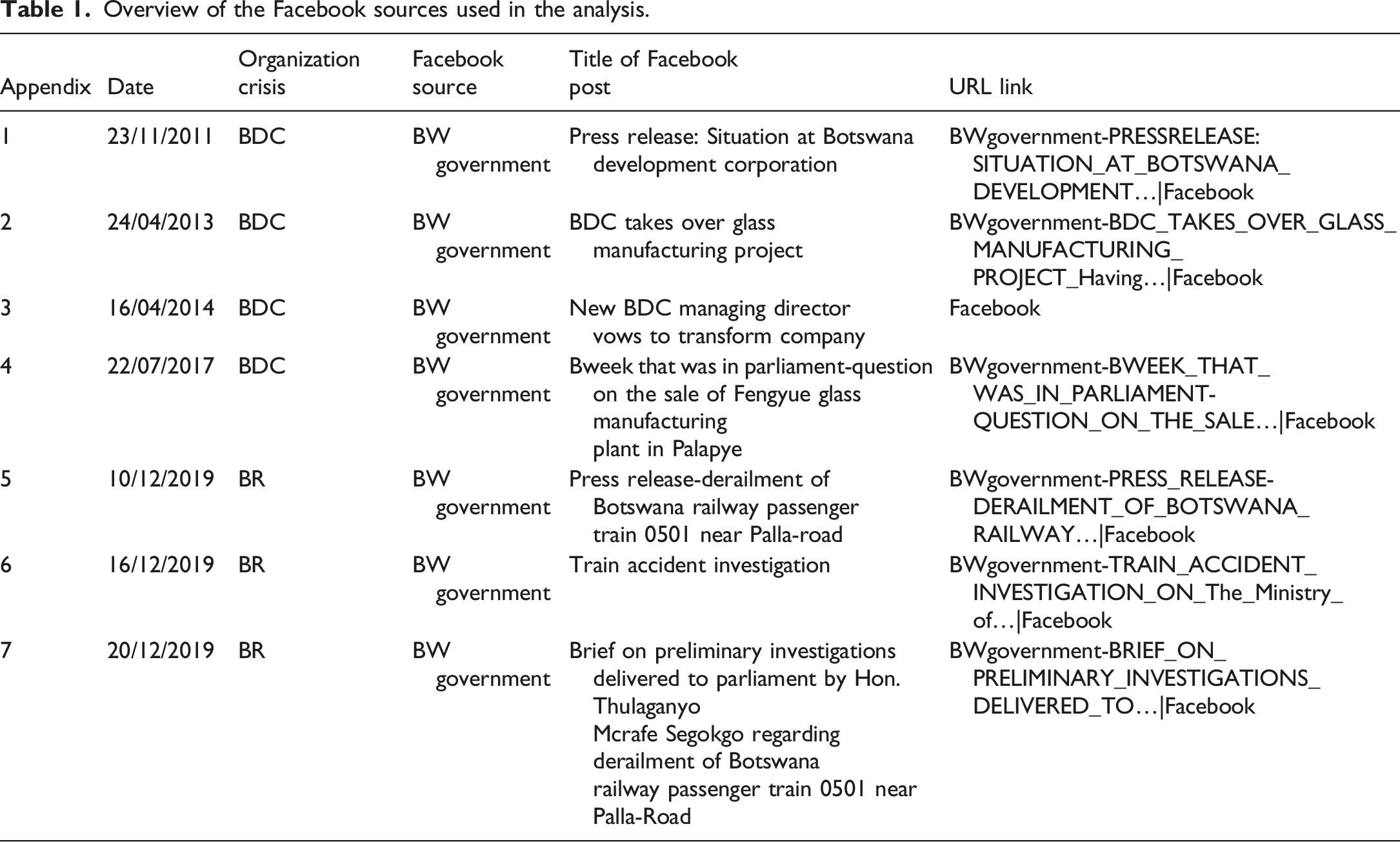
This small qualitative sample was selected as apposite for deeper analysis and representative of the organizations’ key messages and linguistic approach. Such deep examination may involve a small number of texts, even ‘just one or two’ (Machin and Mayr 2012: 207). Our focus is on not only what the organizations said, but ‘where, when, why, by who and to whom’ the messages were communicated (Thomas and Turnbull 2017: 934). As such, we do not consider audience reaction. We chose Facebook because of its wide use in Botswana, with 75% of the country’s total population engaging with it as of May 2022 (Statcounter, 2022). Furthermore, while there have been valuable insights into how organizations negotiate crises on Facebook (Huang and DiStaso, 2020), little attention has been given to how organizations manipulatively use language on the platform in sub-Saharan African corporations to maintain power during emergencies.
CDA is appropriate here because it helps expose ‘opaque ideologies, socio-cultural values, and power relations’ (Punch, 2005: 224). Other studies in these regions have used different approaches, such as quantitative analysis and case studies, but given the critical role of language in crisis messages on Facebook, CDA appropriately unpacks ideologically loaded texts, thus making sense of the ‘selective version of reality’ (Thomas and Turnbull, 2017: 936). This analysis employs a tailored version of Fairclough’s multilevel CDA framework (see Figure 1), outlining the ideology, context, and text levels of social interaction (Fairclough, 1995). CDA three-dimensional framework (adapted from Fairclough 1995).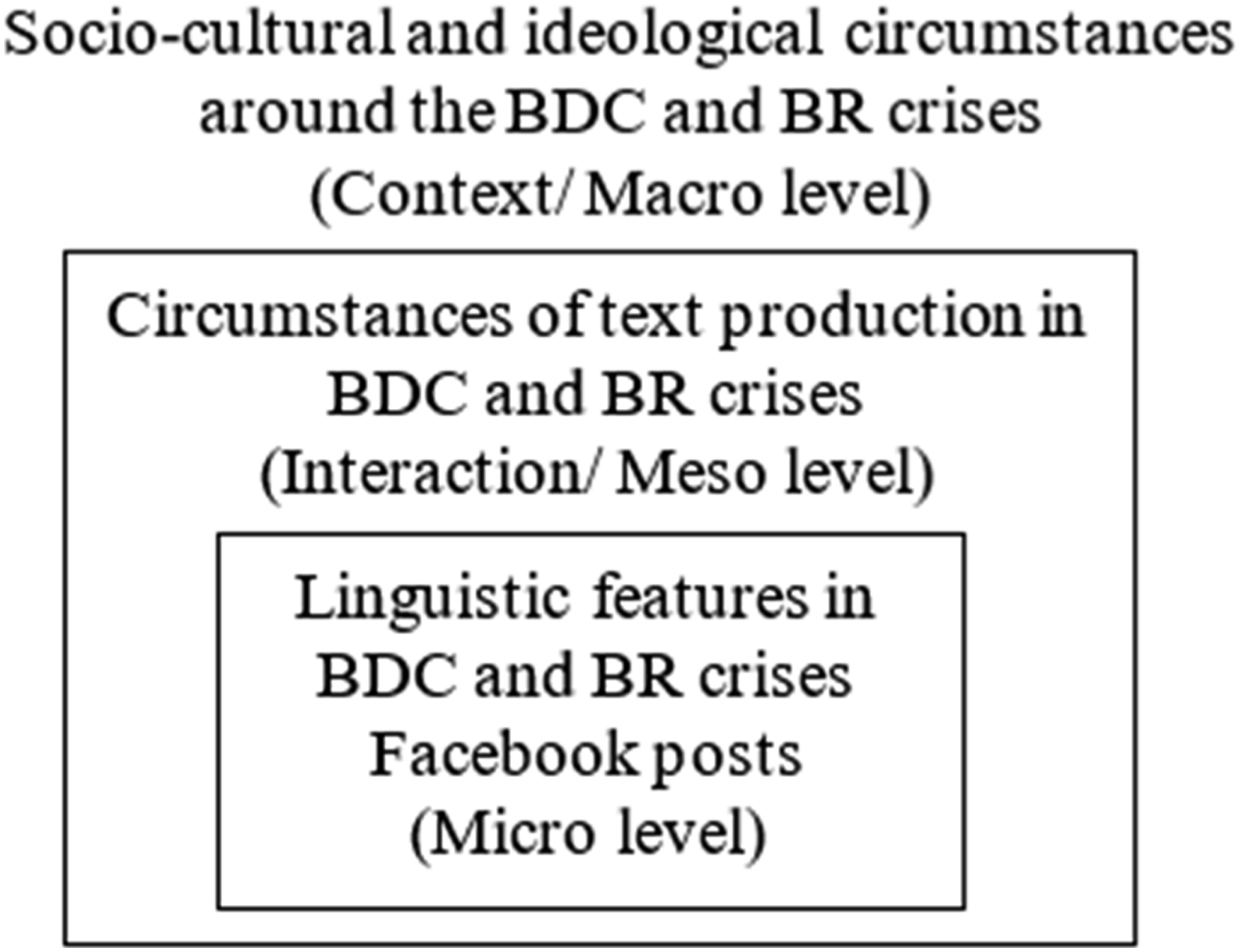
In Figure 1, the “macro” level considers the broader sociocultural and ideological circumstances around the BDC and BR crises. At this level, we examine how an organization’s culture and financial interests influence how PR practitioners frame their corporate narratives. We also establish that the master frame of economic development affects the production of crisis messages, although this is more implicit in the BR crisis.
Our analysis then shifts to the “meso” level to consider discourse practices and circumstances that influence the production of Facebook posts and the transmission of information to audiences. At the “micro” level, we consider linguistic devices and how organizations use language to manipulate the public to sympathize and reduce perceptions of responsibility.
Significant word selections
Figure 2 shows the themes emerging from the analysis of 4 linguistic devices (lexical choices, abstraction, honorifics and nomination) using CDA. The analysis began by examining organizations’ lexical choices in Facebook posts, and in sum, the choice of words projected an ideology of economic development that seemed difficult to challenge, and in the process, elevated the organizations to a dominant position of power over the audience. The selected words were set to strategically shape the audience’s interpretations of the crises, ‘setting up semantic reverberations that the antennae of alert listeners or readers will pick up’ (Poole, 2015: 36). Since the government managed all the crisis communications for BDC and BR, state power played an essential role in both situations. Themes emerging from the critical discourse analysis of BDC and BR Facebook posts.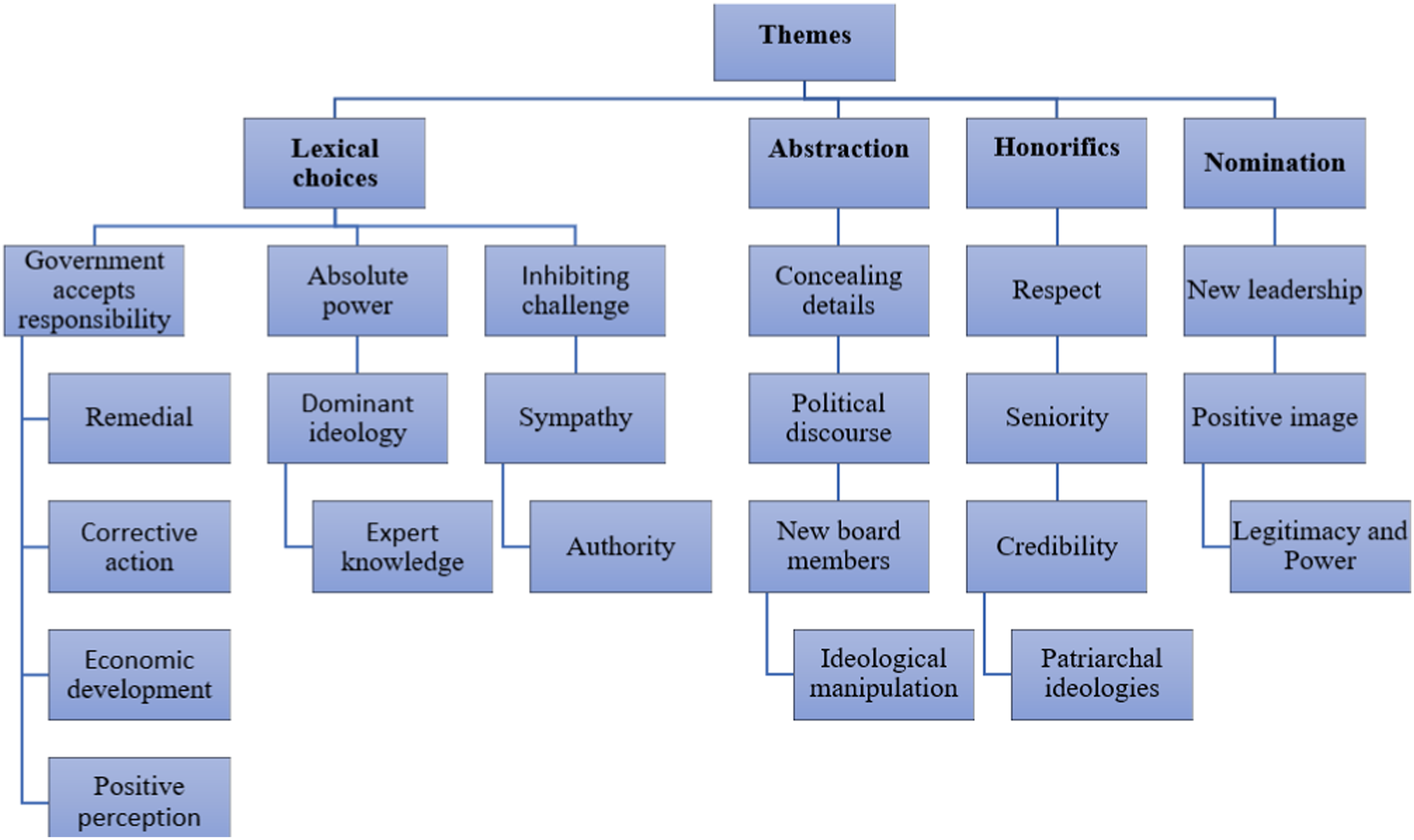
The words or phrases selected during the BDC crisis include “sole shareholder” and “stewardship” (Table 1, Appendix 1), “capital investment” and “job creation” (Table 1, Appendix 2), “transformation” (Table 1, Appendix 3), and “pioneering growth” (Appendix 4). For example, when the BDC crisis began, the government posted a press release on its Facebook page stating that ‘…the Government as the sole shareholder, took steps aimed at restoring much-needed stability…’ (Table 1, Appendix 1). The phrase “sole shareholder” appeared in a post demonstrating corrective action showing that the organization ‘accepts responsibility and promises remedial and possibly preventive actions’ (Dutta and Pullig, 2011: 1282). This phrase strategically suggests that the government controls the corporation. It seems that this corrective strategy aims to manipulate the audience by emphasizing what El-Nashar (2015: 566) termed ‘our good things and their bad things’ to defend the BDC against allegations of corporate malfeasance and corruption, while isolating executives implicated in the crisis.
Furthermore, word choice is ‘often ideologically based’ (He and Zhou, 2015: 2358). As such, it seems that the government suggested that organizations contribute to economic development which is unsurprising, since the government strongly advocates economic growth and uses these stories as part of an ‘exercise of power over subordinate and subjugated groups’ (Machin and Mayr 2012: 25). For example, in the initial Facebook post (Table 1, Appendix 1), the government continued to highlight the BDC’s ‘…stewardship in the affairs of the corporation, having regard to the critical role played by Botswana Development Corporation in the achievement of economic development of this country.’ Here, the government uses words ideologically designed to dominate and develop some sense that the corporation should not be challenged because of its wider economic contribution. The word “stewardship” seeks to influence audience perceptions that the corporation has a more arms-length relationship with economic development and that the audience should not “shoot the messenger.” This narrative seems likely to appeal to the audience, because some are employed by businesses funded by the BDC. As such, the narrative galvanizes support for the organization and mobilizes the audience to rally behind them, instead of attacking it on social media. It seems reasonable to conclude that these words strategically helped the organization achieve its agenda.
Moreover, the phrases “capital investment” and “job creation” (see Table 1, Appendix 2) elevates the government/BDC to absolute power because they can provide solutions for ordinary citizens. The government promotes the BDC track record to give the impression that the organization cares about public welfare. The need to address unemployment is exemplar of how the government uses language to make it difficult ‘to question the dominant ideology’ (Thomas and Wareing, 1999: 34). As such, the government’s lexical choices indicate the organization's power to eradicate unemployment.
Other word choices suggest the organizations possess expert knowledge. For example, one Facebook post portrays the new BDC managing director as a specialist and on a ‘mission to transform his company’ (Table 1, Appendix 3). In another post indicating corrective action, the government uses “transform” to suggest that the new boss is more trustworthy and knowledgeable than the last. Accordingly, it seems reasonable to conclude that the intention was to portray the government as recruiting the right people to prevent future crises and to restore trust.
Furthermore, the phrase “pioneering growth” (Table 1, Appendix 4) presents the BDC as an engine of economic development. Since Botswana’s economy has grown to the degree and it is now a middle-income nation, the phrase reminds us that the BDC played a crucial role in improving people’s lives and so perhaps should not be challenged. These words, therefore, might strategically restrain the audience from militancy because the corporation had contributed to the prosperity.
Our analysis also considers the government’s lexical choices in manipulating Facebook audiences. Combining the two strategies (corrective action and regret) and selected words, the government projects the BR as the epitome of good governance. For example, after the accident, the government posted that ‘…the passengers were safely evacuated from the scene and buses were hired to take them to their respective destinations’ (Table 1, Appendix 5). Again, perhaps this inhibits the audience from challenging the organization’s legitimacy and ethical performance. There were fewer comments against this post and an absence of the audience challenging the organization, making it reasonable to suggest that the language choices might stymie audiences from challenging organizations in crises.
The Facebook post continued with the announcement of the death of the two crew members, explaining that: ‘it is with deep regret that two crew members lost their lives during the accident…’ (Table 1, Appendix 5). The phrase “deep regret” suggests that the organization feels the same pain as the audience and the statement about withholding details until “next of kin have been notified” indicates the BR’s adherence to proper procedure. As such, all such phrases might be said to strategically manipulate audiences to believe that organizations speak the same language as them and deserve some sympathy.
Abstraction as a tool for manipulation
It seems that the organizations used language to conceal details, and indeed, abstraction is common within political discourse where specific facts are backgrounded or concealed. So we examined what government PR practitioners may have hidden within Facebook posts about the BDC and BR crises, and the purpose that this might have served.
During the BDC crisis, the government announced new board members, but obscured the identities of retired board members accused of wrongdoing. It seems that the government purposefully concealed these names so as not to alarm the audience and to avoid deflecting attention away from the economic development narrative. The identities of the new board members were publicly available, but retired directors were not. The phrase ‘…who replace three board members, who have been retired as Directors’ (Table 1, Appendix 1), is an example of abstraction because it obscures the identities of the retired directors and the reason for their dismissal. Notably, ‘retired’ also protects their reputation.
On the other hand, the post explicitly reveals the identity of the new directors who are reputable and respected corporate leaders. For example, Blackie Marole was the former managing director of the Debswana diamond mining company and Serwalo Tumelo was the former Permanent Secretary at the then Ministry of Finance and Development Planning, under which the BDC sits. The message is that the government’s intervention in appointing respected corporate leaders would quickly meet stakeholder expectations.
The same technique was used in explaining that ‘following a valuation of the assets as explained above, the plant, power plant and railway spur were sold…’ (Table 1, Appendix 4). This post was a response to a parliamentary question about the liquidation and the sale of the glass factory. The assistant minister of investment trade and industry, Mr. Biggie Butale, addressed parliament and his response was posted on Facebook. In doing so, he concealed the cost of each asset (land, plant, power station, and railway line) instead of providing the total cost of P54,382,000.00 (equivalent to £3.5 million) for all assets, potentially avoiding questions as to why some assets fetched less. The concealment of the buyers’ identities – more abstraction - is significant. Perhaps the public would have been aggrieved if buyers were part of the ruling elite.
Abstraction featured again in the BR crisis when the government announced that two crew members and one passenger sustained injuries and were hospitalized (Table 1, Appendix 5). ‘Sustained injuries’ conceals details, perhaps to avoid shocking or alarming the audience. The message influences the audience to believe that only a few passengers suffered injuries, but of course this does not absolve the organization from wrongdoing. Hence it seems the organization used abstraction to maintain calm among the audience.
Persuasion through functional honorifics and nomination
In both crises, the government named senior officials to dominate and influence Facebook audiences. Names are represented differently in political discourse, with functional honorifics suggesting seniority or a role requiring respect (Agyekum, 2003), whereas nomination refers to the naming of participants. Both functional honorifics and nomination are linguistic techniques through which ‘underlying ideological processes behind names can be assessed’ (Ononye and Osunbade, 2015: 93).
In an earlier example of appointing a new board (Table 1, Appendix 1), the government used the names of board members to perhaps persuade the audience to believe that the government made the best decision regarding leadership to steer the BDC out of trouble. Accordingly, the board members are labelled on the basis of ‘ideologies and perspectives of the one who gave the label’ (El-Nashar, 2015: 597). For example, Blackie Marole and Tumelo Serwalo are famous in Botswana’s corporate circles, and their credibility might strategically evoke sympathy for the organization. Although less meaningful for international audiences, the two figures were popular and respected locally because of their track record in contributing to the country's economic development. Therefore, it seems that their names would help to restore public confidence in the BDC.
Additionally, honorifics denote gender, with ‘Messrs’ referring to the three new board members reinforcing the idea that the male characters are the strongest and powerful in Botswana, and able to deal with difficult situations. While hugely contested, the government’s Facebook discourse suggests that Botswana is a patriarchal society, and this resonates with Gürkan and Serttaş (2017: 406)’s observation that men in patriarchal ideologies are often regarded as having ‘no flaws’.
Post-crisis, the government used the same technique (nomination) including functional honorifics to develop legitimacy. Here, functional honorifics (titles) index seniority (Ohashi, 2018). For example, in one post, the government explained how they had parted with the Shanghai Fengyue Glass Manufacturing Company and assumed total control of the project (Table 1, Appendix 2). The government uses Gomolemo Zimona’s title ‘BDC Spokesperson’ to suggest a degree of seniority and since he was addressing the community, hosting the glass project and detailing the corrective measures being taken to manage the crisis, his title reflects a ‘social role and position relative to the addressee’ (Ohashi, 2018: 40). Since the message came from a high-ranking, rather than a junior official, it appears more appealing even to Facebook audiences who did not attend community meetings.
In an earlier example, the government mentioned that ‘the new BDC managing director Mr Bashi Gaetsaloe is on a mission to transform his company’ (Table 1, Appendix 3). In doing so, the government effectively used functional honorifics and nomination to drive the positive, “new broom” narrative. Additionally, this post helped the audience formulate an affirmative image of the organization and rebuild trust. Through using titles and names, the developed message is that the BDC has been rescued and is now in capable hands.
The government used this technique during the BR crisis to denote legitimacy and power. On the day of the rail accident, the government posted that senior government officials visited the scene and hospital to commiserate with the grieving and injured (Table 1, Appendix 5). The minister's entourage comprised the Botswana Railways Board Chairperson, Mr Adolf Hirschfeld; Botswana Railways Chief Executive Officer, Mr Leonard Makwinja; and Acting Permanent Secretary in the Ministry of Transport and Communication, Mr Garekwe Mojaphoko. These are high-ranking officials commanding respect - the BR CEO is not at the same level of importance and power as the minister, and would not have carried the same weight. Perhaps involving him would have even been perceived as arrogant and condescending. Those involved might have felt more comforted to receive a guest of the minister’s stature, and his visit conforms to Botswana’s culture and humanistic ethos of respect and manners (Livingston, 2011). It seems that discourses featuring high-ranking officials attract more respect from Facebook’s audience in Botswana and consequently, using them might influence the audience to reduce the extent of crisis responsibility toward the organization. Therefore, the use of functional honorifics and nomination was purposeful to maintain power and inhibit audiences from challenging BR.
Throughout, we used Bakir et al. (2019)’s manipulative propagandistic form of OPC as a theoretical framework to establish the extent to which the government used strategic (one-way) consensual persuasion or manipulative propagandistic forms of OPC to maintain power over Facebook audiences during the BDC and BR crises, and we summarise our analysis as follows: • Lexical choices demonstrate how the government used strategic (one-way) consensual persuasion or manipulative propagandistic forms of OPC to promote its corporate ideology of economic development to establish and maintain power. • Abstraction complements lexical choices when demonstrating how the government manipulatively used political language to obscure, generalize, and conceal specific facts to attract sympathy and deter audiences from attacking the organization. • Functional honorifics and nomination demonstrate how the government manipulatively used naming strategies to ‘covert goals to influence readers’ views’ (Ononye and Osunbade, 2015: 93) and to inhibit them from challenging organizations in crisis.
Discussion and conclusion
Our focus on government crisis communication in Botswana begins to address the oversight in critically analyzing discourse in non-Western crisis contexts. This specifically highlights the interpretation of corporate narratives on Facebook, and we highlight the sometimes-questionable collaboration between governments and corporations to minimize reputational damage. This unmasks an underlying corporate ideology of economic development that the Botswana government propagated through strategic (one-way) consensual persuasion and manipulative propagandistic forms of OPC (Bakir et al., 2019) during the BDC and BR emergencies. This bolstering narrative has previously been found to be effective in a preventative crisis situation, but only when accompanied by accommodation strategies (Ye and Ki, 2017). While there is a considerable difference between the two crises and Facebook usage might have changed or advanced, it seems that the government did not learn or develop its social media crisis communications from one crisis to the other.
RQ1 asked: How are lexical choices, abstraction, honorifics and nomination used to propagate organizational ideologies in the BDC and BR crises? We conclude that in setting an agenda of economic development and foregrounding the BDC and BR’s wider contributions to economic growth, the government manipulatively used linguistic features to establish and maintain power, thereby dominating the audience and minimising criticism, even if legitimate. The discourse used in Facebook posts ‘appeared as a shared value, common sense, and challenging to question’ (Jones and Wareing 1999: 34), and this was supported effectively by using expert names to establish credibility (Lin et al., 2016). It seems the government effectively used Bakir et al. (2019)’s strategic consensual persuasion and non-consensual (propaganda) to maintain power and organizational ideologies.
RQ2 asked: How did PR practitioners use linguistic manipulation strategy to maintain power during BDC and BR emergencies? We conclude that the choice of words, concealing details, and using titles and names strategically manipulated Facebook audiences to hinder them from challenging organizations in crises. Such a position of power potentially influenced audiences to believe that the government had more legitimacy to bring order to the BDC and the BR and exemplified Ye and Ki (2017)’s notion that in crisis contexts, clear Facebook messaging directly from the organization is neccessary. We suggest that government PR practitioners’ language was effective in manipulating the audience in the short term, although this approach potentially has negative consequences on the public’s future perceptions of the organization’s integrity and credibility. It also misses the interactive opportunities Facebook provides for engagement, dialogue, and relationship building (Fearn-Banks, 2017). It seems Bakir et al. (2019)’s consensual form of OPC was not effective in these posts because the government uses the Kgotla system for dialogical consensual communication and information sharing (Lekorwe, 2011; Simon, 2023; Thakadu and Tau, 2012). As such, the focus on economic development ideology and the language of government fiscal policy failed to embrace a collaborative, conversational style, and did not convey the human empathy that typifies best practice on Facebook (Crijns et al., 2017). Accordingly, there was less audience interaction with Facebook content during the two crises, reducing the amount and quality of the feedback on corporate performance. The Botswana Government thereby missed opportunities to engage and respond, echoing the findings of similar authority-citizen crisis communications studies (Atkinson et al., 2021; Roshan et al., 2016).
RQ3 asked: To what extent does the Government of Botswana reflect best practices in crisis communication and use manipulative propagandistic form of organized persuasive communication strategy to establish and maintain power? We conclude that although both the BDC and BR maintained the dominant corrective response strategy, their manipulative propagandistic forms of OPC, as suggested by Bakir et al. (2019), as well as the damage-limitation approach successfully helped the government to establish and maintain power. It seems that this strategy assisted the government in diminishing crisis responsibility on the organizations in trouble, but probably not without impacting their subsequent interaction with Facebook users. We argue that Bakir et al. (2019)’s OPC model remains robust but requires a nuanced understanding of how language is used in a non-Western context due to the region’s diverse socio-political, cultural and organizational factors. We conclude that this OPC manifested in government Facebook communication during the BDC and BR crises and is ‘essential to the exercise of power at national and global levels’ (Bakir et al., 2019: 311). Government officials in Botswana were found to use a traditional broadcast communication methodology rather than a more contemporary approach to crisis communications management. While the government crisis communication proved successful, the Facebook language and content are primarily manipulative, developing a specific framing of the situation through one-way asymmetrical communications and failing to utilise the dialogical opportunities Facebook provides, and in particular, losing an opportunity to harness the reach and power of user-generated content from social media users (Ye and Ki, 2017). While effective in the short term, the Botswana Government may be missing out on long-term reputational building opportunities and failing to future proof in a changing communication environment in which dialogue, relationship building, and engagement are increasingly important (Eriksson, 2018). As indicated, the dominant manipulative discourse was effective in the social context where there is respect for officials and officialdom and within an effectively monopolistic state-controlled structure for the glass and railway industries. Interestingly, however, Botswana also has a culture of dialogue through its Kgotla, a village communications system involving face-to-face assemblies to debate and consensually agree on important matters. This could be explored as a way of developing current crisis PR, enabling the kind of dialogical approach favoured in modern crisis communications practice (Eriksson, 2018). However, we also conclude that the less ethical and propagandistic language organizations use often gets implicated in corporate short-termism without future regard for what Facebook users will say about the same corporations once the crisis has passed. As such, we advocate Bakir et al. (2019)’s persuasive dialogical consensual communication strategy when using language to protect corporate reputation worldwide.
Implications
This research might benefit PR practitioners globally because social media can transform local crises into international ones, forcing them to manage emergencies across different cultures. This research contributes to the internationalization of crisis communication scholarship by focusing on the under-researched context of Botswana. Communication studies reflecting global contexts are essential as trade becomes transboundary, and many transnational organizations must better understand the contexts in which they are operating. Understanding these contexts can help crisis managers to select and use appropriate strategies to mitigate reputational harm. We support the view that communication theories such as Bakir et al. (2019)’s OPC are relevant to government crisis communication in Botswana. Further research into how other governments across the sub-Sahara region apply OPC in their crisis communication on social media might contribute to further development of this theory.
Footnotes
Declaration of conflicting interests
The author(s) declared no potential conflicts of interest with respect to the research, authorship, and/or publication of this article.
Funding
The author(s) disclosed receipt of the following financial support for the research, authorship, and/or publication of this article: This work was supported by the Commonwealth Scholarship Commission in the UK.
