




Abstract
This case study examines Marca Chile’s nation branding campaign “Chile Que te Quiero” (Chile, I Really Love You). The campaign, that ran between 2016 and 2018, aimed to facilitate dialogue among Chileans around their shared national symbols, traditions, and cultural artifacts to cocreate meaning around their nation brand. In this article, we propose that professionals working in nation branding campaigns should act as facilitators of dialogue among different publics within a country to find points of convergence and divergence around what constitutes the identity of their nation. The key role of dialogue and cocreation of meaning within public relations scholarship is explored.
Introduction and literature review
Between 2018 and 2019, Elqui Valley, located in the Coquimbo Region in Chile, was selected by The New York Times and Lonely Planet among the best places to visit in the world in 2019 (52 Places to Go in 2019, 2019; Carter, 2018). Both outlets highlighted the privileged geographic location of the valley for tourists to see a full solar eclipse that took place in July of 2019. Aside from attracting tourism, this valley is also a symbol of pride among Chileans who live in the Coquimbo Region. Within this valley, Chileans identify the mining industry and the town of Vicuña, where Gabriela Mistral was born (a Chilean poet who won the Nobel Prize of Literature in 1945) as important elements of the culture and identity of the Coquimbo Region. Although the Elqui Valley has been identified as a clear attraction for international tourists, it is also an important representation of the culture and identity of one of the 16 regions that constitute Chile.
The aforementioned icons were identified by Chileans as symbols of pride and national identity through a nation branding campaign named “Chile Que te Quiero” (Chile, I Really Love You). The campaign ran between 2016 and 2018 and was implemented by Marca Chile, a public-private institution tasked with enhancing the reputation of the country abroad. This office has traditionally focused its efforts in the development and implementation of marketing and communication campaigns to promote Chile internationally, which is consistent with the country’s “open economy” strategy to attract business to the nation (Jiménez-Martínez, 2013). “Chile Que te Quiero” was the first effort to promote the nation brand of Chile to Chileans, aiming to trigger feelings of pride and national belonging among them. The campaign’s final goal was to turn Chileans into brand ambassadors for their country among foreigners visiting their country either for tourism or business purposes (La Prensa Austral, 2016).
This paper explores the impact of this campaign, focusing on the role of national identity and public relations—particularly drawing from the concepts of dialogue (Kent and Taylor, 2002) and cocreation of meaning (Botan and Taylor, 2004)—to interpret its attempt to “brand Chile” to Chileans. Traditionally, nation branding has been studied as a practice that targets international audiences to attract tourism, foster exports, and enhance foreign direct investment in the nation (Anholt, 2002). Contrary to that approach, this campaign ran on a constant appeal to national identity through the establishment of relationships between different actors and organizations of the country to construct meaning around their national brand. Through this campaign, Marca Chile attempted to facilitate dialogue among different groups of Chileans to cocreate a more representative nation brand. The implications of these concepts to this specific campaign are explored in this study.
Branding a nation for external purposes
As it was previously outlined, nation branding has been defined as the execution of marketing principles to brand a country, aiming to generate a pleasant image in the minds of a determined set of targeted publics with specific political, economic, or cultural reasons. Simon Anholt, an independent policy advisor to foreign governments on this matter, published in 2002 an article in which he stated, “the intelligent and judicious application of marketing and branding techniques upon countries can be a powerful force for global wealth distribution and cultural as well as economic development” (Anholt, 2002: 59). Even though Anholt has shied away from that approach in the last few years, proposing now that countries should focus on public policy actions that foster international cooperation to turn them into “good” countries (Anholt, 2020), nation branding was first conceived with a business mindset. Because of its marketing focus, several scholars have criticized nation branding due to its commercialist and capitalist nature (Aronczyk, 2013; Kaneva, 2011).
Critical-cultural scholars argue that these practices only represent what a closed circle of people within a country decide the image of their nation will be—mainly people in government positions working in nation branding projects, or committees of public and private parties deciding the content of these campaigns. Browning (2013) said that these commissions are usually dominated by business interests that often engage in attempts to “superficially democratize the brand creation process” (Browning, 2013: 205). These attempts end up being futile because national identities are multifaceted, heterogenous, and contested (Bonikowski, 2017). Nation branding campaigns have also been criticized for using stereotypes to brand the nation, misrepresenting the authentic image of a country to please an international gaze (Aronczyk, 2013; Ståhlberg and Bolin, 2016; Kaneva, 2017). These scholars are less interested in advancing theories or models to inform the practice of nation branding and its applied science. Instead, they propose a critique to nation branding and attempt to formulate a counter-argument to the perspectives previously discussed. They do so by connecting constructivist ideas of nationhood and analyzing nation branding as a discourse of national identity, culture, and governance (Kaneva, 2011).
Aronczyk (2013) expanded many of Kaneva’s arguments in the book Branding the Nation: The Global Business of National Identity. The key premise in this book emphasized that in the late 1990s and early 2000s, different governments started hiring the services of a group of branding and marketing experts to aid them in the creation and execution of nation branding campaigns. Aronczyk referred to these experts as members of the “transnational-promotional class” (TPC). She criticized their efforts, arguing that they had an instrumentalist view focused on exploiting the countries’ economic profile. Aronczyk called in her research for a constructivist view of the nation, stating that the brand of a nation is not what the TPC or a specific government determines. The identity of a country is composed of the deeds and actions of all different types of actors within a nation, which is far from being a cohesive and coherent construct.
Contrary to the aforementioned argument, other scholars have proposed that even though nation branding campaigns mainly have an economic focus, they could also allow people to reflect on their national belonging and identity (Varga, 2013). These campaigns could also serve as important venues to reflect and think about who and what they are as a country. For example, Pamment and Cassinger (2018) explored the case of a campaign launched by a Swedish tourism association, called The Swedish Number. This campaign developed a smartphone app to enable international audiences to call a random Swedish telephone number and be connected to a Swedish citizen to ask questions about their country. Citizen participation was at the core of this initiative, since Swedish citizens directly answered questions about what it is like to visit and live in their country. Through this case study, the authors suggested that the engagement with campaigns like these can not only be more effective, but also more inclusive. In this case, who represented the image of what Sweden’s most noble characteristics and identity are were the citizens of the country, and not a group of elites in the government or private sector. In their own words, “[w]e suggest that participation in these kind of exercises could also act as a means to make sense of national communities, as it provides an arena (or playground) for engaging with nationalist tropes, values and identities” (p. 571).
A similar campaign ran in Peru in 2011. Lossio Chá vez (2014) reported the efforts of PromPerú, the government institution tasked with disseminating the country’s reputation abroad, to promote its nation brand to internal audiences. In 2011, the organization recorded a video in the little town of Peru, Nebraska, in the United States. In the ad, Peruvians showed “Peruvian-Americans” (Nebraskans) how to “be Peruvian” by teaching them about Peruvian dances, music, and food. The campaign’s endgoal was to inspire feelings of pride among Peruvians, arguing that they also had “something to teach” to Americans—and that they should also be proud of their cultural heritage. Lossio Chá vez (2014) was critical with the campaign, contending that the ad was a simple simulacrum that portrayed an image of something that did not truly exist in contemporary Peru—meaning that the video was a simple fantasy that showed an unrealistic image of the country. However, he also stated that “fantasies are the support of our reality, and therefore, necessary” (p. 35). In that sense, the author argued that this campaign still served to pose a reflection on what was the national identity of Peru, and how different sectors within a country contributed to that branded identity. In this paper, we argue that this cocreation process can be fostered through the establishment of relationships and dialogue among different publics within a nation. Through these relationships, a more diverse idea of the nation can be elevated, shifting the focus from a marketing standpoint to a public relations perspective.
Public relations and national identity’s role in nation branding
The aforementioned campaigns bring in many elements that can be traced back to the public relations literature. Relationships are at the core of public relations research (Ferguson, 2018) and several studies have explored the connections between nation branding and public relations research (Szondi, 2010; Fitzpatrick et al., 2013). Both in the Swedish and Peruvian cases, the organizations tasked with developing nation branding campaigns established relationships with different stakeholders to cocreate meaning around the branded identities of their countries. In that sense, the public relations literature can become of special significance to the implementation of more inclusive nation branding efforts. An interpretative and constructivist perspective in public relations sees relationships as a “state of flux that defies measurement and is idiosyncratic to the situation at hand” (Curtin, 2012: 40). Public relations is conceived as a practice that is fluid and complex (Gower, 2006). For the specific case of nation branding, we argue that a constructivist perspective on public relations becomes more valuable. Within this setting, relationships are not necessarily “measured” with the goal to attract foreigners to a country, but serve as venues in which different stakeholders engage in the cocreation process from their specific political, economic and cultural standpoints.
Given the context, scholars have advocated for cocreational (Botan and Taylor, 2004) as well as rhetorical perspectives (Heath and Frandsen, 2008) when analyzing relationships within a public relations context. Botan and Taylor (2004) discussed that, as a discipline, the excellence theory has led public relations to be traditionally understood as a technical area. A cocreational perspective to public relations views publics as cocreators of meaning. Communication and relationships are what make it possible for different publics to agree on these shared meanings, interpretations, and goals about specific subjects. In a similar manner, Heath and Frandsen (2008) called for a rhetorical perspective, focused on the relationships between different actors with regards to specific contexts. Those relationships enable varying partners to find and define shared meaning. They heavily relied on rhetorical theory to stress the fact that societies negotiate meaning through cocreated messages. Taylor and Kent (2006) suggested that as a discipline, public relations can serve as a means for establishing relationships between the government and citizens to cocreate meaning about their national identity. These authors argued that communication can serve as a tool for nation building, which creates and maintains relationships. National building, national identity, and national unity are all maintained through strategic communication efforts.
Taylor (2009) emphasized the concept of “civil society” in public relations research, which creates the necessary conditions that allow individuals and groups of people to advocate on behalf of their own goals. In that cocreation process, public relations provides the “language and other symbolic forms to inform, persuade, and to build identification and coalitions” (p. 83). Although the cocreation approach emphasizes the role of dialogue among members of civil society, scholars have questioned how power gets distributed among publics within that society (Dozier and Lauzen, 2000; Edwards, 2006). Dutta-Bergman (2005) argued that as a concept, civil society lacks to address who embodies a society, particularly when Western approaches to public relations are applied in what he classified as “Third World” countries. He called scholars to take a “subaltern” approach to public relations research, which views “subaltern participants” (or publics) as those who have been traditionally left outside of civil society by those in power. Through a cocreation approach to public relations, engagement efforts with subaltern publics should take into consideration who takes power over others in society.
Despite these critiques, we argue that a constructivist view of public relations provides useful theoretical foundations to interpret nation branding campaigns that aim to generate dialogue between different citizens of a country. Traditionally, nation branding has studied the societal effects associated with a nation feeling compelled to promote a pleasant image of itself to international audiences. However, critics of nation branding have said that these campaigns do not portray the true face of a nation because they are usually run to please an international gaze (Kaneva, 2017). These campaigns are also run by nation branding committees that unilaterally decide what are the main messages that define a country to those global audiences (Widler, 2007). Their messages mainly have an economic or transactional appeal. However, we argue that a cocreational approach to nation branding defies these critics. Instead of having nation branding offices designing campaigns that do not represent a completely accurate picture of what a country has to offer to the world, we propose that these offices should act as facilitators of dialogue for people to discuss what are the elements and icons that constitute their national identity. Building upon the work of Botan and Taylor (2004), we propose that a cocreational approach to nation branding could enable different actors from society to discuss the elements that should be featured in these campaigns.
Internal nation branding: A focus on Chile
So far, this literature review analyzed nation branding’s main ideals, and some of the critics of this practice. However, instead of focusing on how these promotional efforts impact foreign publics, this study will explore how concepts related to national identity are formed and adopted internally, and the role of public relations in this process. To do so, we present the specific case of Chile with the campaign “Chile Que te Quiero” (Chile, I Really Love You). The campaign was developed by the Marca Chile, a public-private institution that works in the execution of international communication campaigns for Chile’s nation brand. This is the only campaign that they have implemented in their existence since 2008 to directly appeal to Chileans.
As it was mentioned in the introduction, “Chile Que te Quiero” ran between 2016 and 2018. In 2016, Marca Chile toured 14 regions of the country to execute what they called “cocreation focus groups” to foster dialogue among different regional stakeholders, and discuss with them what were the elements that best defined their regional and overall Chilean identity. These workshops physically gathered a total of 1401 people, ranging from local entrepreneurs, representatives of civil society groups that were relevant to each region, private companies and trade associations, among other actors. In 2017, Marca Chile created a website (www.chilequetequiero.cl) to launch a campaign and validate with the Chilean population the top five icons of pride per region in the country. The campaign was launched and executed in September 2017––the month in which the country celebrates its national holiday. The campaign, which was advertised using Facebook, Twitter, and Google Ads, gathered a total of 66,596 votes. Finally, in 2018, Marca Chile organized in different regions of the country an artistic exhibition with drawn maps depicting the most voted elements per region of the 16 regions of the country. These exhibitions brought together people to learn more about their region and learn about other parts of the country as well.
This campaign presents a unique opportunity to evaluate how concepts such as dialogue and cocreation of meaning, which come from the public relations literature, can be applied to the nation branding field. Given this situation, we propose a cocreational approach to nation branding, posing the following research questions based on the “Chile Que te Quiero” campaign: RQ1: What were the communication strategies employed by Marca Chile to foster dialogue among different Chilean key actors and organizations aiming to cocreate meaning around their national identity? RQ2: How did Chileans interact with these strategic communication efforts employed by Marca Chile? RQ3: In what ways can dialogue and models for cocreation of meaning inform the evaluation of the impact of this campaign?
Methods
To address these research questions, we conducted eight in-depth interviews and a qualitative content analysis of 19 Facebook posts published by Marca Chile in September of 2017 to advertise the campaign. Other elements, such as reports submitted by external agencies that worked with Marca Chile between 2016 and 2018, were also examined. For this case study, interview data were used to analyze the different strategies executed by Marca Chile and their affiliated partners in the “Chile Que te Quiero” campaign to reunite different Chilean key actors and organizations in the different stages of the campaign. These data were particularly useful to address RQ1 and RQ3. Facebook data were used to interpret how Chileans responded to the campaign, aiming to address RQ2. The reports by external agencies served as a complement to triangulate key insights drawn from the interviews and social media posts analysis.
In-depth interviews’ data
Informants.
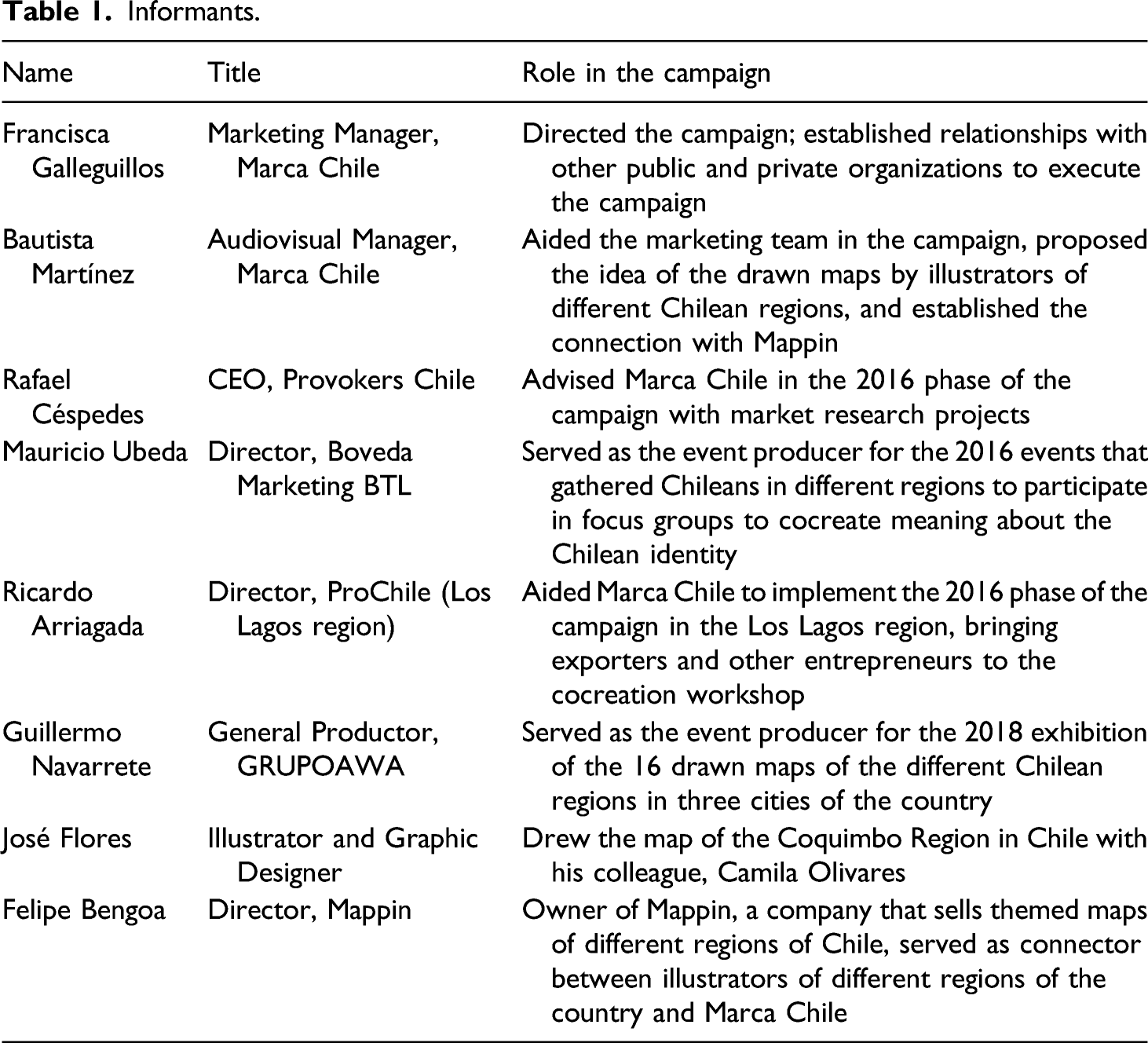
We also corresponded via email with other informants. To complement the interview data, we analyzed reports submitted by the different subsidiaries with which Marca Chile worked throughout the campaign—GRUPOAWA (event production agency in 2018) and Provokers (market research agency in 2016).
We systematically analyzed transcripts through Miles, Huberman, and Saldaña’s (2020) data analysis procedures: data reduction, data display, and conclusion drawing/verification. Interview transcripts were coded, line-by-line, during the data reduction phase. Then, we merged related codes into common themes and clustered the data into several themes to enable systematic collection and comparison.
Facebook data
To address RQ2, we qualitatively coded comments posted by people on 19 Facebook posts by Marca Chile between September 8 and 29 September 2017. These posts were used to draw people to the “Chile Que te Quiero” website and vote for the most representative icons to them per region. The 19 posts represented a wide variety of regions in Chile. They all had a picture of a place or element of pride in the region (identified in the 2016 cocreation workshops) and a description of the icon, outlining its ties to Chilean identity. Although the final 2017 campaign gathered more than 60,000 votes, we decided to take this qualitative approach to gain finer insights on the reactions and comments of common citizens and non-elites about the elements that were recognized as identitarian to the region and overall country. To analyze the data, we used the techniques of close reading and interpretation to illuminate these posts that represent socially constructed realities (Kuckartz, 2014; Brummett, 2019). The findings of this analysis are outlined in the following section.
Results: In-depth interviews
Using the main theoretical concepts outlined in the literature review, we identified two main themes that emerged in the interviews data: (1) the role of dialogue in the cocreation of meaning around a national brand and (2) the value of national identity in nation branding campaigns. Below is a summary of each theme’s relevance, as well as the data that support them.
Dialogue/Cocreation of meaning around a nation brand
As it was previously noted, in 2016, Marca Chile organized cocreation focus groups in 14 regions of the country to foster dialogue among different sectors of society to make sense of what were the elements that best defined their regional and overall Chilean identity. These workshops gathered more than 1400 people. Rafael Cespedes, CEO of Provokers, reflected on the success of these initial focus groups: The original objective was to look for elements of pride to boost them communicationally [abroad]… But they [Marca Chile] never imagined how relevant it was going to be for the locals who participated [in the cocreation focus groups]… that they could also opt to appropriate the [nation] brand locally. (R Céspedes 2019, personal communication, 16 September).
This quote emphasizes that Marca Chile did not decide what was representative per region, but it was the feedback of the people. Marca Chile only facilitated a space for dialogue between people. This dialogue is what made the campaign more successful because Chileans felt integrated into the cocreation process and were able to adopt the nation brand as theirs. Francisca Galleguillos from Marca Chile reinforced this idea, looking back to the 2017 phase of the campaign—the social media campaign: …people had the option to qualify for a prize... we had 12 prizes in total for this contest. But we realized that after we launched the contest and everything, that people were not interested in the prizes... what they wanted was to enhance what they liked about where they lived. And the campaign effectively evoked pride (F Galleguillos 2019, personal communication, 2 August).
In that sense, this quote supports the idea that even though there was a prize to be won, the prize was not the primary motivator for participation; rather, people engaged with the campaign to have a say on whether an icon was representative to their region or not. In her interview, Galleguillos recalled a specific example that supported this insight. She talked about the Roca Kiosk, which is a local store in the city of Punta Arenas in southern Chile that sells banana milk and local sandwiches made of local produce. Galleguillos is from Santiago, the capital of Chile. Based on her own experiences traveling to the Magallanes Region, she thought beforehand that the most voted icons would merely be touristic spots. But for people in the Magallanes region, the Roca Kiosk was as important as other international attractions, such as Torres del Paine, to represent their local identity. This fact surprised her. She said: In Punta Arenas, well, in the Magallanes Region, the first icon [that was mentioned as most representative] was always Torres del Paine. But people on social media started asking why the Roca kiosk was not there. (…) I knew the Roca kiosk, but not to put it as an icon, because for me it was just a local store... but, people requested it so much that we had to include it as one of the options for people to vote. We put it in the contest, and can you believe me that it took second place after Torres del Paine? And then, I think that the icons represent well what local identity is, and not what we might believe is their identity. That is the difference with other projects. (F Galleguillos 2019, personal communication, 2 August).
People in Magallanes, the furthest region to the south in Chile, organically engaged with the campaign and were active cocreators of meaning about their regional and national identity.
With the feedback from the people gathered in the 2016 focus groups and the 2017 social media campaign, Marca Chile commissioned in 2018 the design of regional maps of Chile to Mappin, a graphic design agency. Mappin was charged to reach out to illustrators throughout the country to draw the maps of the 16 regions of Chile. Felipe Bengoa, director and owner of Mappin, described that in the illustrated maps business it is really important to take into consideration the feedback of the people, and make them active members of the creative process. In his own words: That has been the Mappin experiment (…) how to communicate that the map is a form of belonging, that you belong to a territory, and that you like it, and that you are proud of that territory... regardless of whether it is a city, Latin America, or the planet. There are different perspectives here. But it is entertaining what happens, that people feel part of the map because the map says something about them, so to speak. (F Bengoa 2019, personal communication, 1 November).
This quote supports the idea that just as the focus groups and the social media campaign had done, Marca Chile used these maps to make people part of the cocreation process of the Chilean identity and its nation brand. In the campaign, the maps functioned as a venue for Chileans to reflect on their identity as a country. One of the designers of one of the maps used in the campaign accentuated this point: What we do [with the maps] is to emphasize the things that people do not observe in their day to day. So this causes people to value what is around them. Because people don't take it into account [in their daily lives]. For example, they say, La Recova [a touristic attraction in the Coquimbo region in Chile]... and they don't take it seriously, or they don't see the value that a foreigner could give to it when visiting Chile. (J Flores 2019; personal communication, 1 November).
The value of national identity for nation branding campaigns
All of the aforementioned quotes are supported by one big idea: for this specific campaign, national identity is what informed the nation brand of Chile. Chileans felt a close connection to the campaign because it strongly appealed to one level of their identities—their national identity. In the next quote, Rafael Cespedes, CEO of Provokers, reflected on how important were the 2016 cocreation focus groups to the people of Atacama, a region in Northern Chile. These workshops allowed them to reflect on regional elements that had been traditionally neglected in tourism guidebooks of the region. In his own words: The Giant of Atacama was not in any of the Iquique tourism guidebooks. It was not something that was communicated outward to visit. In fact, it is still hard to find that they [tourism guidebooks] promote it so much. But for locals, it was important. People considered that there was an entire touristic route of the Atacama Giant that had never been enhanced. So, for them there was a whole mystique, a story, there was a lot of work to do around this icon that was identified and valued [by local people]. (R Céspedes 2019, personal communication, 16 September).
This quote is supported by the initial goals of the campaign, which were to let people from different regions to speak about what best represented them. Reflecting on the 2017 phase of the campaign (the national social media contest), Francisca Galleguillos from Marca Chile said: That is what this social media contest highlighted, since citizens had the power to say what it represents their region, and not just what is touristy, or what is attractive. Then, objective number one was fulfilled, which was to raise the identity icons of each of the regions in the voice of the same [people of these] regions. That was the main objective. Now, the criticism was always like, ‘all these messages come from Santiago, it is very centralist’... there is always the criticism that ‘you impose things on us that we don’t consider’ [to be identitarian]. So, this campaign did not take that approach. That is the difference. (F Galleguillos, 2019, personal communication, 2 August).
In the final part of the quote, Galleguillos recognized that one of the most common critics of the locals (or citizens) is that these campaigns many times leave behind the true opinions of the people. Marca Chile’s headquarters are in Santiago, the capital of the country. In an effort to engage with all the regions of the nation, Marca Chile did well in getting out of their offices by truly seeking to engage with people of the country.
Results: 2017 social media campaign data
Most voted icons per region.
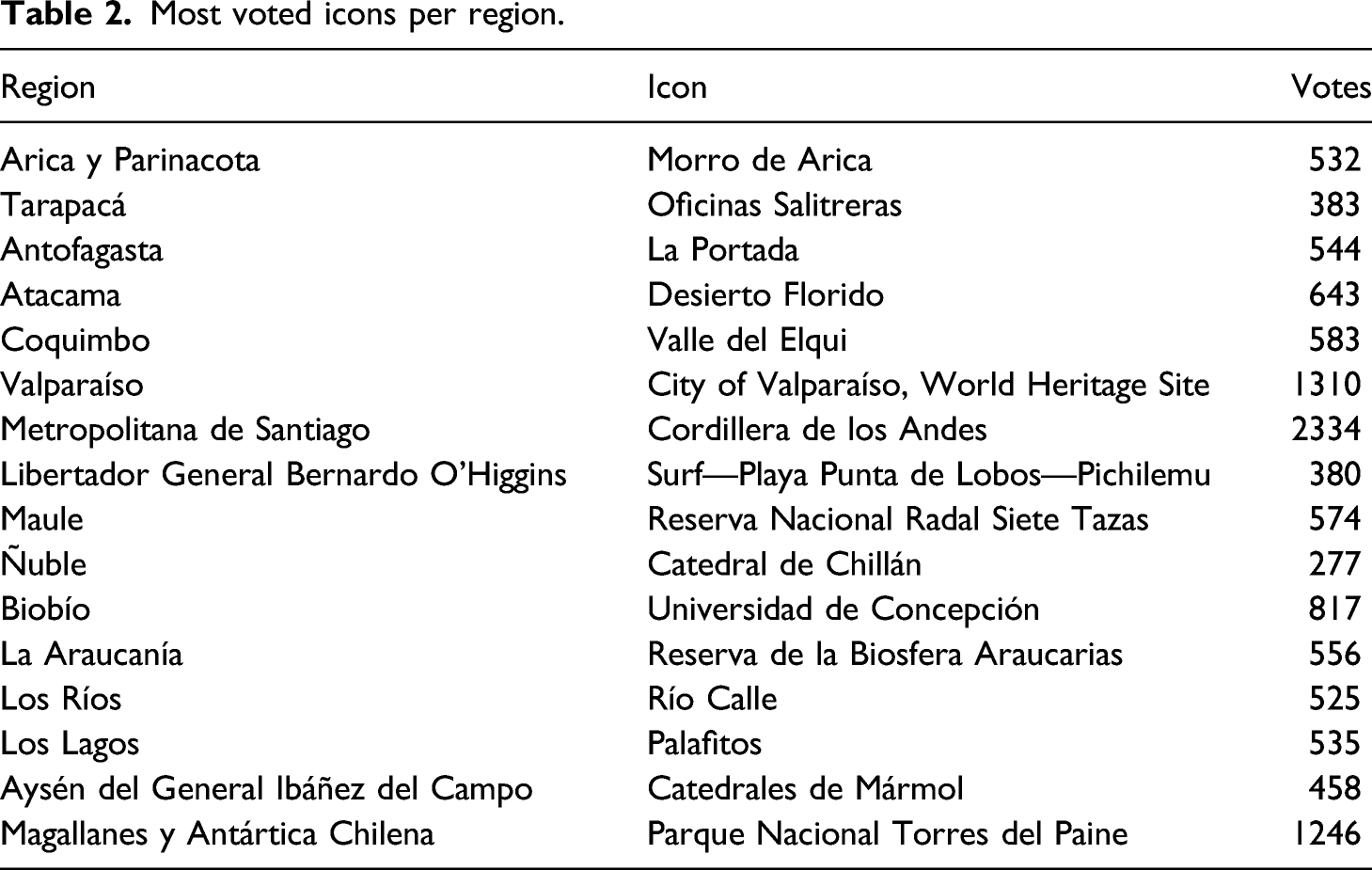
Marca Chile used Google Ads, Facebook and Twitter to refer people to their contest website. Specifically with Facebook, they geo-targeted people in the 16 regions of the country with ads that had specific pictures of icons and places that were recognized as part of the region’s identity in the 2016’s phase of the campaign (cocreation workshops). Their goal was to have people from different regions vote for their specific region’s identity icons. This means that the Facebook posts per region were most likely written by local people. That is why we decided to analyze these posts––with the goal to gain more detailed insights on their reactions to the overall campaign.
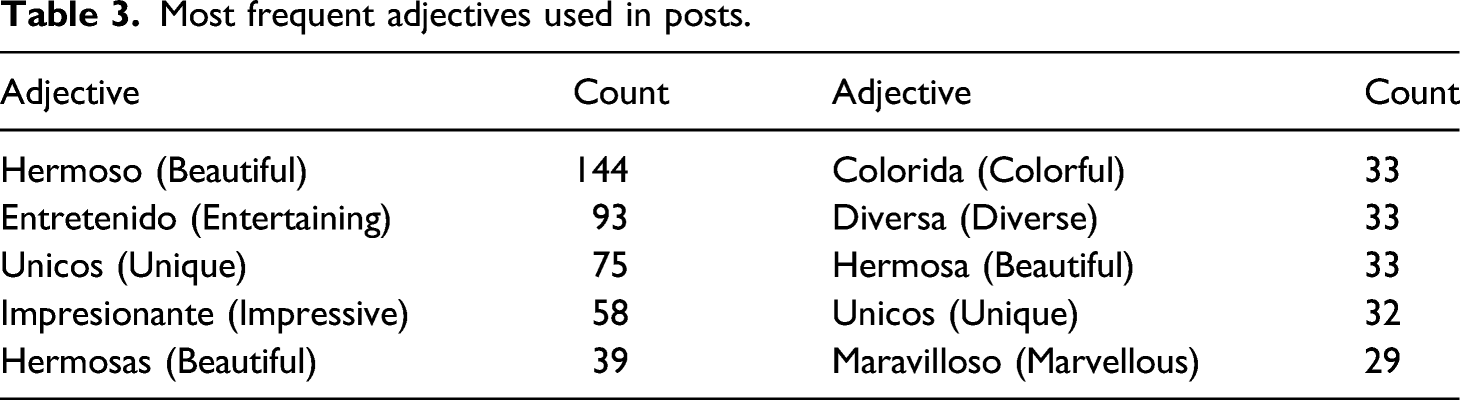
Most frequent adjectives used in posts.
Qualitative analysis of Facebook data.
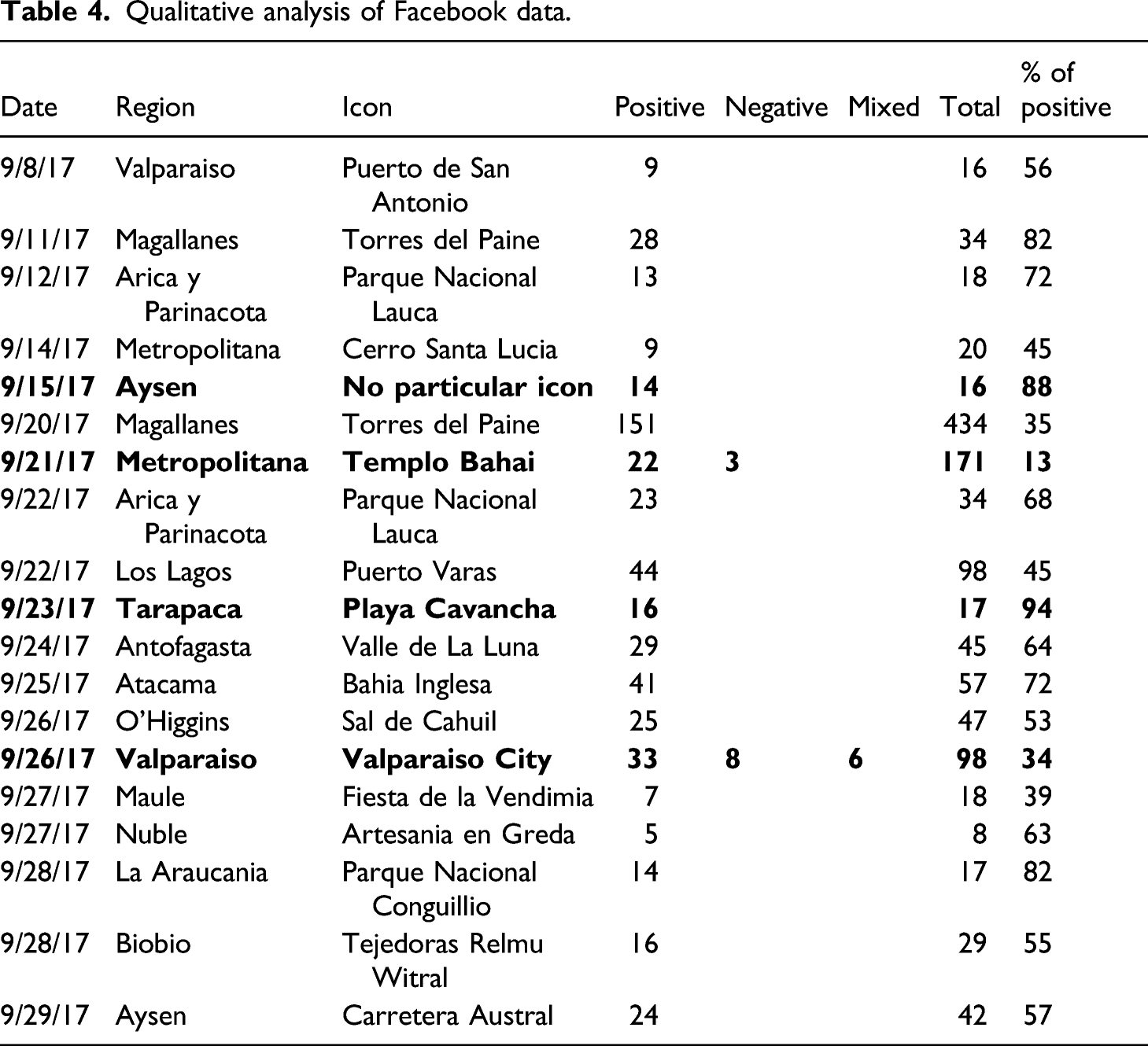
The table summarizes the date for each post; the region and the icon featured in the post; and the positive, negative, mixed, and total number of comments per post. We calculated the percentage of positive posts by dividing the number of positive posts with the number of total posts. A total of 1219 comments were qualitatively analyzed. Out of that number, 523 were considered to have a positive connotation, 11 had a negative connotation, and six were classified as mixed (meaning that the comment had both positive and negative connotations). 679 comments were classified as neutral. Most of the times, these neutral comments were just posts by users tagging others for them to check out the campaign.
Our analysis focuses on four particular posts: two considered to have the highest percentage of positive content, and other two with the lowest percentages. The posts of September 15 and September 23 from the Aysen and Tarapaca regions, respectively, pose an interesting case. They were both identified with the highest percentages of positive content (88% and 94%, respectively). However, in both cases, the number of total comments was low (16 and 17 comments) making it easier to reach a higher percentage. For the Aysen post in particular, there was not a particular icon depicted but a generic picture of a natural landscape (see picture). The Tarapaca post depicted a beach. These are both natural landscapes without a specific connection with people or artifacts created by people. In fact, the depicted pictures are from landscapes that arguably could have been found anywhere in the world. There is not a strong connection to an element that could only be found in Chile. The picture used to draw votes to the contest to select icons for the Aysen Region in Chile is shown in Figure 1. Aysen Region Post. This image was posted to draw people to vote for the most representative icons in the Aysen Region in Chile. Reprinted from Marca Chile’s Facebook page. 15 September 2017.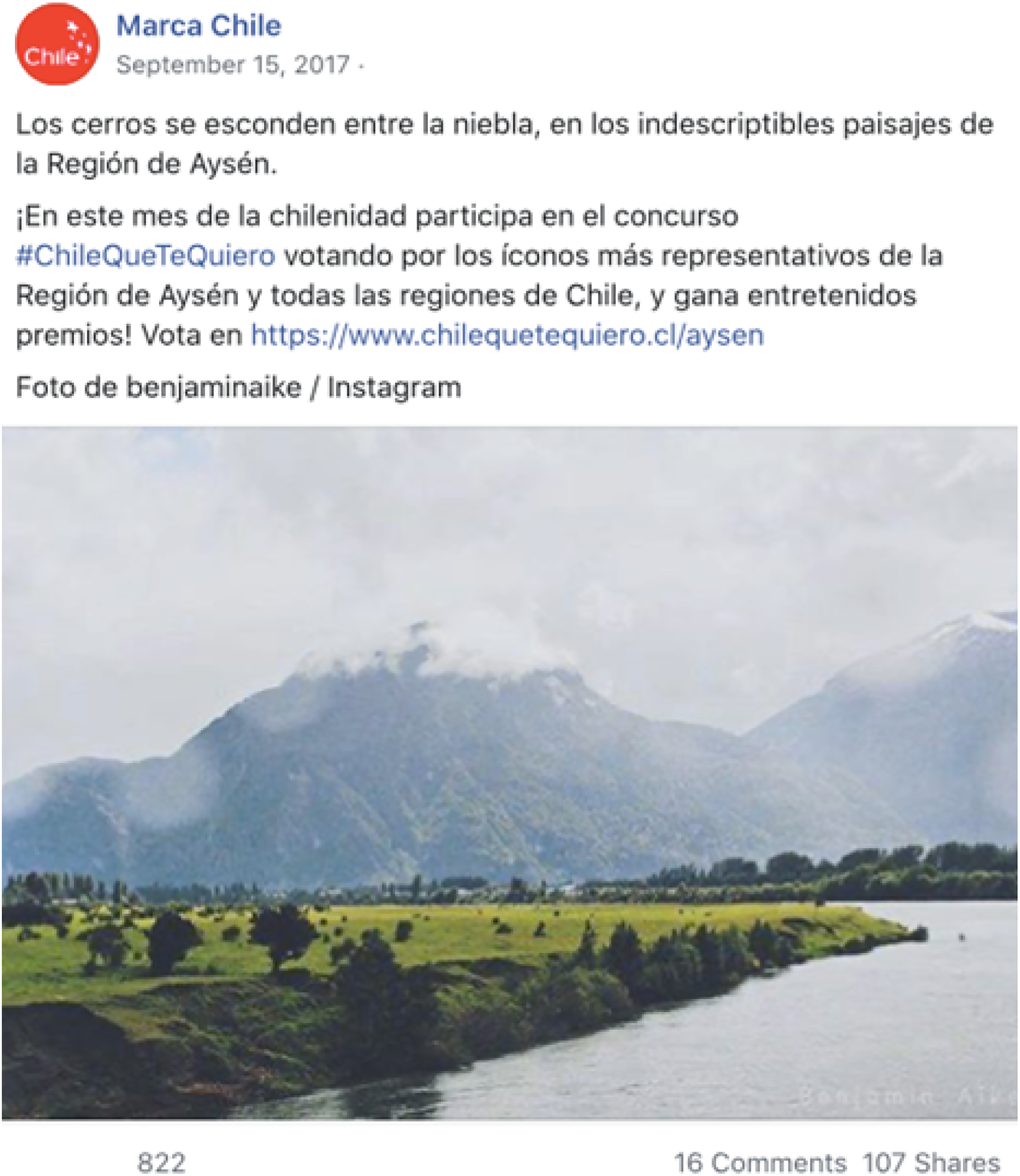
The posts that rated the lowest on positivity were from September 21 and September 26 (Metropolitana and Valparaiso regions, with 13% and 34%, respectively). The post from the Metropolitana region had 22 positive and three negative comments, out of a total of 171 comments. The icon shown was the Baha’i Temple, which was built in 2010 (Figure 2). Metropolitana Region Post. This image was posted to draw people to vote for the most representative icons in the Metropolitana Region in Chile. Reprinted from Marca Chile’s Facebook page. 21 September 2017.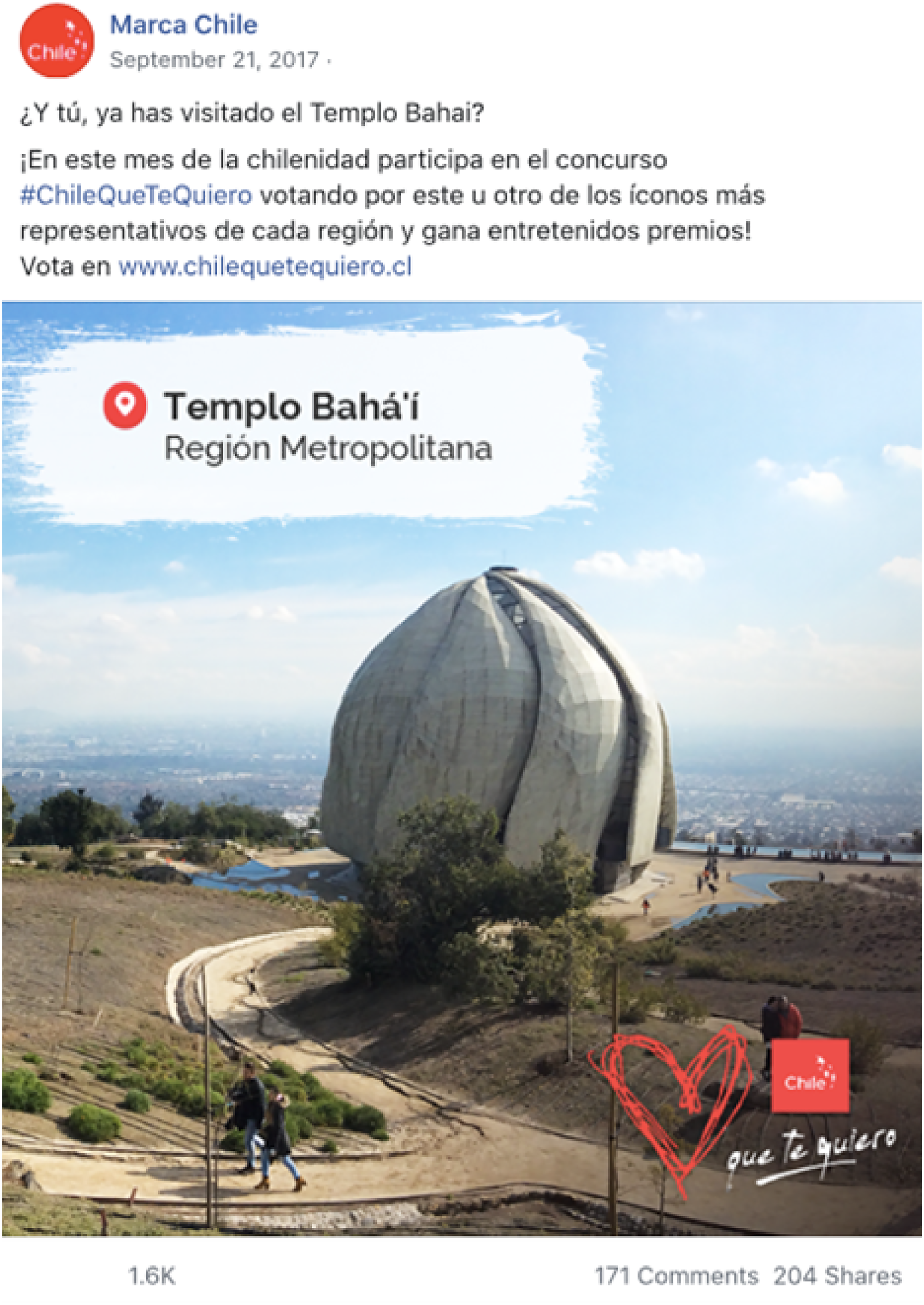
Many users commented that the temple posed an interesting activity for people wanting to see Santiago from the top of a hill. Indeed, the temple allows visitors to enjoy a full view of the city and its surroundings. However, some users also questioned if the temple was a true representation of Chile, a traditionally Catholic nation—and Baha’i is an Iranian religion (Sigmund, 1986). For example, one user said: “Which of its faces [referring to the temple] represents Chile? Is it a museum? Or a ruka [a traditional indigeneous house type]?” In the post, there is a clear debate on whether the temple is indeed part of the Chilean heritage. The following comment debates that position, stating: “Beyond with the fact that you may agree or not with the religion that is prayed to in this temple, you should visit it anyway and see the incredible architecture of it, specially from the inside to above… I am not an expert in the field but it is worth to check it out!”
The post of September 26, of the Valparaiso region, depicted the city of Valparaiso, which was a UNESCO World Heritage Site in 2003. This post had an interesting combination of positive, negative, and mixed comments. For example, one user said: “Unfortunately it is dirty, but dirty… dirty streets, sidewalks, marked buildings, everything in bad shape… and nobody does anything. I did not like it the last time I visited.” In opposition, another user said: “Valparaiso is beautiful, but culture is needed from the people, and specially that the municipality takes action and invests in bettering my Valparaiso.” Another user commented: “The best for my land and my Valparaiso, which is were I grew up. I love my beautiful Chile.”
The qualitative analysis of the posts led us to conclude that in the instances where a picture of a natural landscape of Chile was depicted (mountains, beaches, or lakes) people tended to agree on how nature and the geography of Chile constituted an important part of the Chilean identity. Indeed, in February of 2020, Marca Chile launched a study that reported that 92% of Chileans were most proud of the geography and diversity of natural landscapes of the country (Estudio Orgullo Chileno - Imagen de Chile, 2020). This could also be seen with the icons of pride selected by Chileans in the 2017 phase of the campaign, on which the most voted symbols were historical-touristic or nature-based touristic attractions. However, that pride did not translate into areas where more divergence of opinions could occur. For example, the construction of the Baha’i Temple or how Valparaiso can be considered by some Chileans as dirty are not the areas with highest pride rankings. These areas are vastly influenced by human creation and interaction as opposed to being considered natural wonders. In the discussion section, we problematize the role of institutions such as Marca Chile, and how they must deal with issues where consensus cannot be reached within citizens of the country.
Discussion and conclusion
Both the interviews and social media data provided interesting insights that need to be further explained. First, from the perspective of dialogue and cocreation in public relations, it could be argued that this specific nation branding campaign was executed well. It attempted to move away from the top-down approach that other scholars have criticized about nation branding (Kaneva, 2011; Ståhlberg and Bolin, 2016) by giving the power to the citizens of Chile to collectively decide on the elements that best defined their national identity. The campaign did not have the goal to please an international gaze (Kaneva, 2017) but to open conversations around national and cultural identity. The campaign fostered dialogue among different stakeholders from its beginning in 2016 by establishing relationships with different groups within the different regions of Chile—entrepreneurs, artists, and local leaders, among others. In this process, Marca Chile established relationships with local governments and different institutions of the national government to reach different publics with their campaign. The 2017 phase of the campaign crystallized this dialogue process, going from mere dialogue to cocreation of meaning around the nation brand of Chile. This was done with the feedback of the thousands of citizens who voted for the most representative icons to them in their region through Facebook. Finally, the 2018 phase of the campaign brought together all of that feedback with a set of maps that were displayed in several exhibitions throughout the country in an attempt to integrate the most amount of people in discussions about the Chilean identity. More importantly, the campaign also focused on the internal promotion of messages that best define the identity of a country, proposing a cocreational approach to nation branding. In this cocreation process, the voice of the citizens of the country is what was most valued, not what the practitioners from Marca Chile decided to be identitarian. Throughout this entire campaign, the officers from Marca Chile acted as facilitators of dialogue, fostering the cocreation of meaning around the nation brand of Chile. From a public relations perspective, the campaign followed all of the recommended protocols in dialogue and cocreation of meaning (Botan and Taylor, 2004; Kent and Taylor, 2002).
Dutta-Bergman (2005) called public relations research to question how dialogue in civil society addresses issues of power, particularly with “subaltern” publics. Although a cocreation approach to nation branding is novel in its attempts to bring in different members of society to the creation of a nation brand, it is also undeniable that certain organizations will hold more power over other members of society. Even though informants reflected on their attempts to bring in as many voices to the table as possible, power issues may be even located outside of their spheres of influence. One of those spheres could be political circles that address specific social issues that, most of the times, go beyond the control of organizations like Marca Chile. For example, the Chilean government has traditionally had a delicate relationship with members of different indigeneous communities within Chile. Richards (2010) reported how the Concertacion coalition, which governed Chile between 1990 and 2010, openly supported major development projects that were deemed as necessary to grow the Chilean economy. In a quest to open the Chilean economy to the world, foreign companies built massive projects on land that historically belonged to indigeneous communities. Richards (2010) called the period between 1990 and 2010 as one of “multicultural neoliberalism,” on which the Chilean government aimed to concile its neoliberal interests with those of indigeneous communities. Under that context, the government “displayed an appreciation of cultural and ethnic diversity as long as that diversity did not challenge the traditional notions of nation, the unitary state, and corporate interests” (Haughney, 2012: 203). This is troubling for entities tasked with nation branding campaigns that take a cocreational approach to their efforts. As Labarca (2017) stated, nation branding and public diplomacy should earn the trust of their foreign publics that decode these campaigns. Under the context of this study, we argue that these organizations should also aim to earn the trust of the internal audiences (the citizens of a country) that they invite to participate in the cocreation of these campaigns.
Because of this, it is still unclear the role that organizations such as Marca Chile should play when it comes to dealing with more difficult power issues that are also part of the identity they attempt to represent through a nation brand. The comments on the posts of the social media campaign regarding nature or the geographic characteristics of the country (such as beaches, lakes, mountains, or forests) tended to be more positive. This most likely occurred because with nature, there are few points of contention that would need to be further discussed. Nature tends to be static and as long as it serves the needs of the people (either as a touristic spot or just a beautiful postcard) will remain as a neutral topic among people. However, when it comes to elements of the identity of a country in which there is not a strong consensus, such as religion or the manner in which a city should be kept, dialogue turns into contested dialogue among people. Some of the social media commenters criticized that the Baha’i temple is not a true representation of the Chilean identity. Others said that the dirtiness of Valparaiso, a site occupied by humans—as opposed to an isolated beach or mountain—did not represent an element of pride. This is troubling, since national identity is never fixed, but multifaceted, heterogenous, and contested (Bonikowski, 2017) and always dependent on the historical and cultural contexts within which people interpret their countries’ identities.
With these issues in mind, future research could explore some of the following questions: what is the role that nation branding entities such as Marca Chile have when it comes to dealing with polemic responses? How can those sites of contest be more fully integrated into the co-creation process of a nation brand? What are the implications of nation brands representing only the positive side of a country? Does normative theory provide guidance on how realistic or authentic such images and portrayals should be? And what are the implications when the elements of agreement in nation branding efforts are mere beaches or natural landscapes untouched by the humans? Do such portrayals “erase” or “ignore” the human face of the nation brand, thus marginalizing the citizens on the global stage? Even though we do not have full answers to any of these questions, our research intends to open up conversations around them. More research needs to be conducted to problematize the role of nation branding organizations as facilitators of dialogue in their attempts to portray just a positive image about a country to the world, but at the same time, struggle with how realistic that image will be. All countries constantly deal with social and political issues that challenge civic dialogue around what constitutes their national identity. Particularly with the Chilean case, the country has experienced a set of crises in the public trust to the government in the past few years, mainly due to the economic development model built by economic elites and different government coalitions since 1990 (Sehnbruch and Donoso, 2020). These social issues have brought up issues of power that need to be taken into consideration in the development of nation branding campaigns, since they deal with communities that do not always have an equal seat at the table. In the case of Chile, that could apply to indigeneous communities that have had a delicate relationship with the government for decades, as well as other marginalized publics. Applied to other contexts, cocreation campaigns should also consider how they integrate types of “subaltern participants,” as Dutta-Bergman (2005) coined them.
At least with “Chile Que te Quiero”, Marca Chile attempted to make this nation branding process more inclusive, by empowering Chileans to own their nation brand and reflect on their culture and identity. Internal nation branding campaigns can serve as spaces of reflection and discussion among citizens of a country, turning the public relations practitioners tasked with these campaigns into facilitators of dialogue. However, it is still unclear if the messages agreed upon show nothing but just a pretty and incomplete picture of the country or if the role of Marca Chile should have been to press deeper into conversations that deal with what does it mean to be Chilean—even though those conversations lead to contested answers and again, incomplete messages. Regardless, we have offered to public relations scholarship a fruitful avenue to explore future nation building campaigns, an avenue where more local voices are sought as opposed to the top-down, government elite only, positive image only portrayals that currently dominate the practice.
Footnotes
Declaration of conflicting interests
The author(s) declared no potential conflicts of interest with respect to the research, authorship, and/or publication of this article.
Funding
The author(s) received no financial support for the research, authorship, and/or publication of this article.
