




Abstract
Pulmonary arterial hypertension (PAH) is a severe disease characterized by progressive remodeling of distal pulmonary arteries and persistent elevation of pulmonary vascular resistance (PVR), which leads to right ventricular dysfunction, heart failure, and eventually death. Although treatment responsiveness for this disease is improving, it continues to be a life-threatening condition. With the clinical efficacy of natural plant products being fully confirmed by years of practice, more and more recognition and attention have been obtained from the international pharmaceutical industry. Moreover, studies over the past decades have demonstrated that drugs derived from natural plants show unique advantages and broad application prospects in PAH treatment, not to mention the historical application of Chinese traditional medicine in cardiopulmonary diseases. In this review, we focus on summarizing natural plant compounds with therapeutic properties in PAH, according to the extracts, fractions, and pure compounds from plants into categories, hoping it to be helpful for basic research and clinical application.
Keywords
Pulmonary arterial hypertension (PAH) is a severe disease characterized by progressive pulmonary vascular remodeling1–3 and an increase in pulmonary vascular resistance (PVR), which may lead to right ventricular dysfunction, heart failure, and death.4–6 In addition, the prognosis of PAH is still poor and the mortality rate is highly comparable to cancer. Although treatment strategies for this pulmonary vascular disease are improving, it still represents a life-threatening disorder.
There are several drugs available in clinic, such as inhaled nitric oxide (NO), prostacyclin drugs, endothelin receptor antagonists, Phosphodiesterase type 5 inhibitor, and the latest developed soluble guanylate cyclase stimulator.7–10 Unfortunately, current therapeutics for PAH are limited; most are designed to reduce pulmonary arterial resistance by inducing vasodilatation. The progressive vascular remodeling is still hardly to be reversed. Thus, there is an urgent need for novel therapies.
Natural plants for any vascular disease.
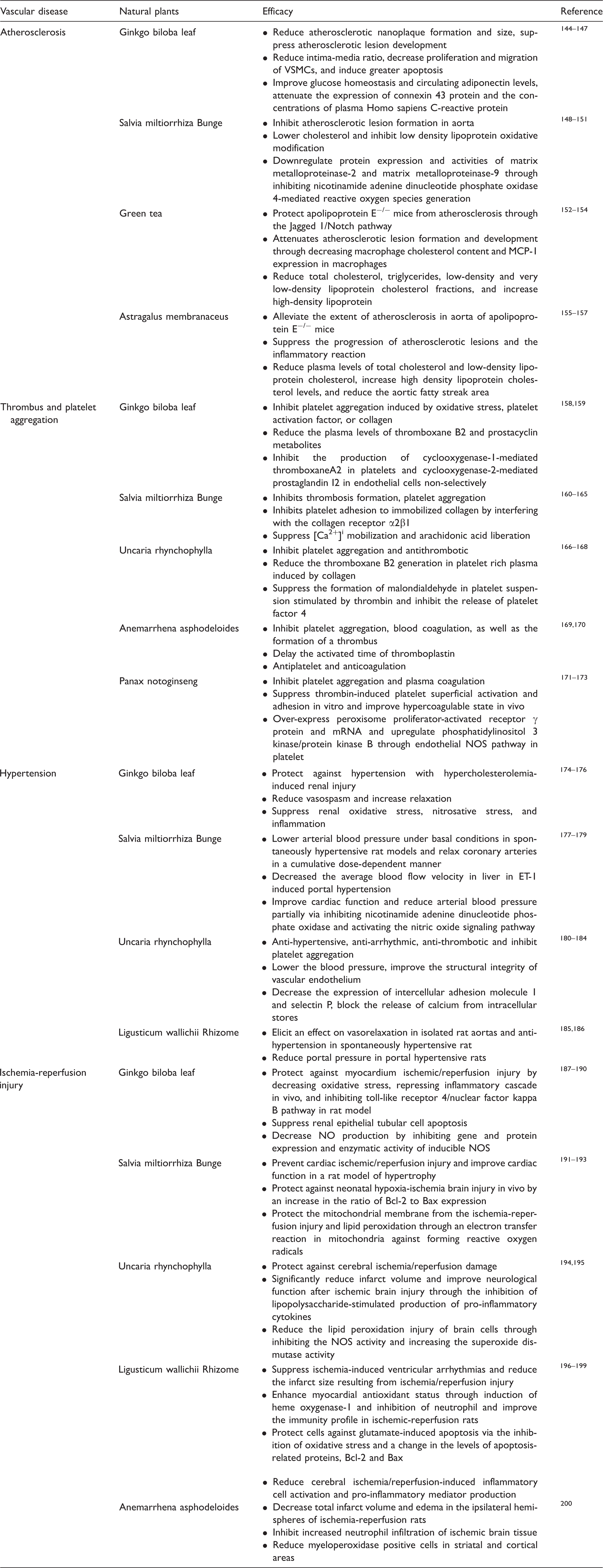
Bcl-2, B cell leukemia/lymphoma 2; Bax, Bcl-2-associated protein x; ET-1, endothelin-1; NO, nitric oxide; NOS, nitric oxide synthase.
Natural plant products for possible PAH treatment.
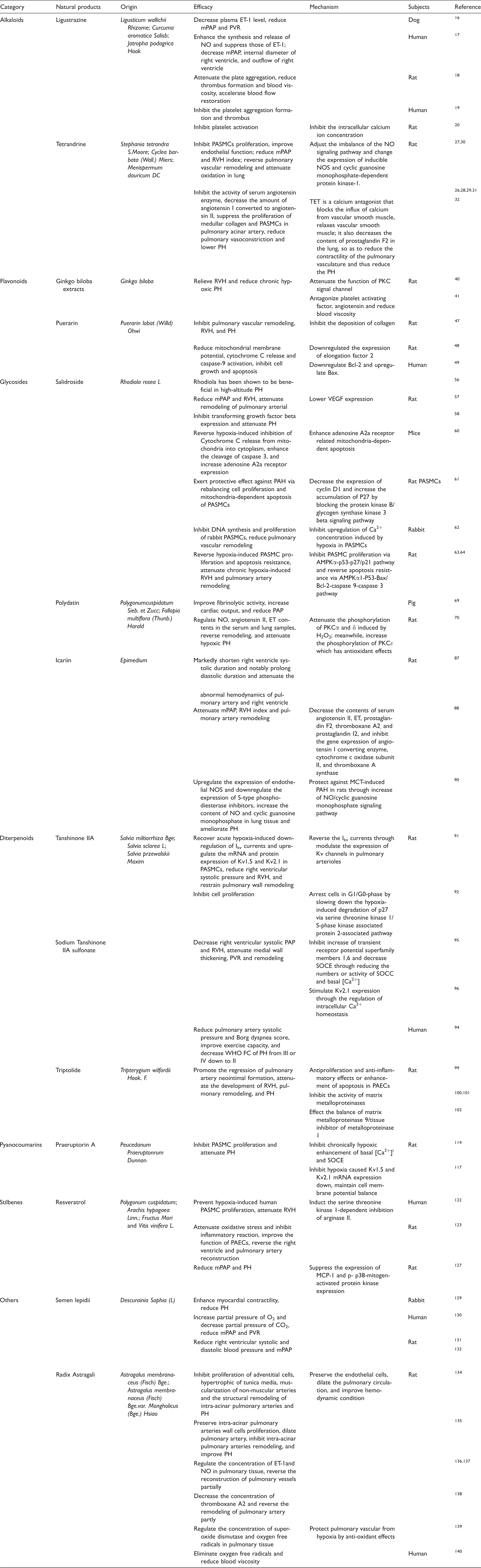
AMPK, adenosine monophosphate-activated protein kinase; Bcl-2, B cell leukemia/lymphoma 2; Bax, Bcl-2-associated protein x; ET-1, endothelin-1; FC, functional class; Kv, voltage-gated K+; MCT, monocrotaline; mPAP, mean pulmonary arterial pressure; NO, nitric oxide; PAEC, pulmonary arterial endothelial cell; PAH, pulmonary arterial hypertension; PH, pulmonary hypertension; PASMC, pulmonary artery smooth muscle cell; PKC, protein kinase C; PVR, pulmonary vascular resistance; RVH, right ventricular hypertrophy; SOCC, store-operated calcium channel; SOCE, SOCC-mediated store-operated Ca2+ entry; TET, Tetrandrine; WHO, World Health Organization.
Alkaloids
Alkaloids are a group of alkaline nitrogenous natural products, which are widely distributed in plants and usually exhibit a broad range of pharmacological activities including anti-tumor, anti-inflammatory, anti-viral, and analgesic.13–15 Many of them have been used in traditional and modern drug development.
Ligustrazine
Ligustrazine, also known as tetramethylpyazine, is an effective constituent of Scechwan Lovage Rhizome. It also exists in the rhizome of Curcuma aromatica Salisb and Jatropha podagrica Hook. Studies have shown that ligustrazine can significantly reduce mean pulmonary arterial pressure (mPAP), PVR, and the plasma endothelin-1 (ET-1) levels in acute hypoxia-induced pulmonary hypertension (PH) dogs; 16 and meanwhile upregulate NO levels in patients with PAH, through alleviating the damage of pulmonary arterial endothelial cells (PAECs) and restoring the balance between vasoactive factors. 17
There are several possible contributions to the function of ligustrazine. It is revealed that ligustrazine can inhibit platelet aggregation and prevent thrombosis effectively.18,19 It has also been discovered that ligustrazine can block the release of reactive oxygen species from lung tissue 20 and moderate the upregulation of hypoxia-inducible factor 1 and vascular endothelial growth factor (VEGF) expression, which consequently reduces hypoxia-induced lung injury. 21 Also, ligustrazine is a Ca2+channel antagonist which can dilate the blood vessels during hypoxia by blocking Ca2+ influx.22,23 This may be one of the principal mechanisms responsible for the protective effect of ligustrazine in patients with PAH.
Tetrandrine
Tetrandrine (TET) is a bisbenzylisoquinoline alkaloid extracted from the root of Stephania tetrandra S. Moore. It also existed in the stem of Menispermum dauricum DC, the root of Stephania cepharantha Hayata, and Cyclea barbata (Wall.) Miers. Xie et al. and Wei et al. found that TET produces multiple pharmacological effects, for instance, protecting myocardial, cerebral, and renal ischemia.24,25 Remarkably, it also helps to prevent hypoxic PH.
In 2010, Feng et al. reported that TET selectively ameliorated monocrotaline (MCT)-induced PAH in rats by reducing PVR and right ventricular hypertrophy (RVH) without affecting the systemic pressure, thus significantly reversing the damage of pulmonary vascular and lung tissue, 26 which merits TET as a candidate for PAH treatment. Furthermore, in 2014, Feng et al. demonstrated that TET could reverse the elevation of mPAP and the remodeling of small pulmonary arteries, induced by MCT. 27
TET acts as an antagonist of some vasoconstriction factors such as platelet-activating factor, angiotensin II, and prostaglandin F, which play a significant role in the occurrence and development of PAH. Studies have demonstrated that TET could directly downregulate the expression of platelet-derived growth factor and basic fibroblast growth factor in rats with PAH, thus inhibiting vascular smooth muscle cell (VSMC) proliferation, relieving pulmonary vascular remodeling, and consequently attenuating the development of PAH.28,29 Furthermore, TET improves the function of PAECs and remits mPAP by attenuating the expression of inducible nitric oxide synthase (NOS) and upregulating the expression of protein kinase 1 in the lung tissue of PAH rats. TET also increases the activity of superoxide dismutase in lung tissue, accelerates the scavenging of oxygen free radicals, and prevents the impairing of lung function cells. 30 It is generally accepted that hypoxic vasoconstriction can be inhibited by Ca2+ channel blockers via blood vessels dilatation. TET is thought to be a weaker calcium channel antagonists and studies have suggested that TET can turn down Ca2+ influx by blocking Ca2+ channels, which partly contributes to the protective effect of TET in PAH.31,32
Flavonoids
Flavonoids are widely distributed in plants and berries, such as Ginkgo biloba Linn, puerarin lobata, Crataegus pinnatifida, and Vitis vinifera. Modern pharmacological studies have revealed that these compounds possess obvious pharmacological effects in the cardiovascular and endocrine system.33–35 Many preparations have been utilized as medicines, such as puerarin-based Yufeng Ningxin tablets and ginkgo preparations of Tianbao Ning. 36
Ginkgo biloba extracts
Nowadays, Ginkgo biloba extracts (GBEs) are widely used in treating cardiovascular diseases for their outstanding pharmacological effects. The main active components of GBEs are flavonoids and diterpenoids. Ginkgo biloba flavonoids have strong anti-oxidation and free-radical scavenging effects. Diterpenoids, such as Ginkgolide B, can also reduce the generation of free radicals. 37
Also, GBEs exert promising effects on improving acute lung injury (ALI) via downregulating the c-Jun N-terminal kinase and protein kinase B-dependent nuclear factor κB activation pathway. 38 Moreover, they inhibit platelet activation and aggregation induced by platelet factors and therefore have the potential to improve blood circulation. 39
Studies have shown that Ginkgo biloba can reduce chronic hypoxic PH and relieve RVH, which is partly related to the attenuation of the function of the protein kinase C (PKC) signal channel. 40 It is also reported that Ginkgo Plus significantly reduces the hypoxia-induced increase of mPAP and PVR as well as the ratio of right ventricular weight vs. left ventricular plus septal weights. 41 GBEs alleviate the apoptosis of endothelial cells (ECs) caused by hydrogen peroxide. 42 In addition, they stabilize inflammatory cells and show anti-inflammatory effect by decreasing the release of inflammatory mediators. 43 Furthermore, GBEs may decrease the concentration of NO and increase superoxide dismutase activity in plasma accompanied by the downregulation of inducible NOS expression. 44 Consequently, GBEs indirectly decrease the injury of pulmonary vascular ECs and improve PAH.
Puerarin
Puerarin is isolated from the dried roots of puerarin lobata (Willd.) Ohwi. It dilates blood vessels, decreases myocardial oxygen consumption, and improves myocardial ischemia.45,46 Recently, Li et al. observed that puerarin could improve pulmonary vascular remodeling in rats with PH by inhibiting the deposition of collagen. 47 A study also showed that puerarin exerted protective effects in MCT-induced PAH rats. 48 Furthermore, puerarin can induce the release of cytochrome C, activate caspase-9, downregulate B cell leukemia/lymphoma 2 (Bcl-2), and upregulate Bcl-2-associated protein x (Bax) expression. It can scavenge oxygen free radicals and inhibit the proliferation of smooth muscle cells (SMCs). Studies have also confirmed that puerarin induces human pulmonary artery smooth muscle cells (PASMCs) apoptosis via a mitochondria-dependent pathway. 49
Glycosides
Many Chinese herbal medicines contain glycosides such as ginseng, liquorice, Rhodiola, Polygonum cuspidatum, etc., which are effective ingredients with powerful activities.
Salidroside
Medicinal plant Rhodiola rosea L is a kind of perennial herb; it contains salidroside, tyrosol, flavonoid compounds, amino acids, trace elements, and other ingredients. Rhodiola mainly possesses effects of anti-aging, anti-anoxia, anti-fatigue, anti-depressants, and anti-radiation.50–53 It can also enhance immunity, regulate the nervous system, and protect the cardiovascular system.54,55 Above all, Rhodiola has great therapeutic potential.
Rhodiola can significantly inhibit VSMC proliferation and contraction, and reduce the concentration of plasma ET-1 in rats with PH. It is also suggested that Rhodiola inhibits ET-1 expression and promotes the synthesis and the release of NO by affecting pulmonary vasculature selectively. Furthermore, Rhodiola can alleviate the imbalance of systolic and diastolic pulmonary arterial pressure. It also lowers mPAP, alleviates RVH, and improves PH which may be associated with the declined expression of VEGF in the pulmonary arteriolar wall.56,57 In addition, Rhodila has a notable effect on high-altitude environment-induced PH rats, and inhibition of transforming growth factor beta-1 expression is one of the possible mechanisms. 58
Adenosine A2a receptor, which is one of the G protein coupled receptors, shows the effects of anti-inflammation after being activated by adenosine and analogues under physiological and pathological conditions. 59 Moreover, studies have shown that the Salidroside, as a main pharmacological ingredient of Rhodiola, can increase the expression of Adenosine A2a receptor in PASMCs, reversing the downregulated ratio of Bax and Bcl-2 induced by hypoxia. Furthermore, it also promotes the release of mitochondrial cytochrome C into the cytoplasm, accelerates the elimination of caspase 9 via mitochondrial pathway, and thus enhances apoptosis. In addition, Salidroside can reverse the remodeling of pulmonary arterial pressure induced by chronic hypoxia and therefore alleviate the mPAP. 60
Also, Salidroside inhibits platelet-derived growth factor-BB-induced proliferation and DNA synthesis of PASMCs by blocking the process of G0/G1 to S phase. This may be related to decreasing the expression of cyclin D1 and increasing the accumulation of p27 by blocking the protein kinase B/glycogen synthase kinase-3β signaling pathway. 61 In recent years, the relationship between adenosine monophosphate-activated protein kinase (AMPK) and lung disease has increasingly caught the attention of researchers. The current studies suggest that AMPK also plays a vital role in treating lung cancer, bronchial asthma, PAH, and other pulmonary diseases. Besides, Salidroside inhibits the increase of G2/M phase cells induced by hypoxia via AMPKα1-P53-P27/P21 pathway. Accordingly, the proliferation and DNA synthesis of PASMCs are inhibited. 62 In addition, Salidroside lowers the levels of P21 and P27, upregulates P53, and mediates apoptosis by regulating the expression of Bax and Bcl-2 via AMPKα1-P53-Bax/Bcl-2-caspase 9-caspase 3 pathway. Consequently, the imbalance of PASMCs proliferation and apoptosis are restored, the pulmonary arterial remodeling is inhibited and the chronic hypoxia-induced PH63 is relieved via AMPKα1-P53 pathway. 64
Polydatin
Polygonum cuspidatum Sieb. et Zucc is a TCM which is mainly used for treating chronic bronchitis, traumatic injury, and damp-heat jaundice clinically.65,66 Polydatin (PD) is the main active ingredient extracted from Polygonum cuspidatum Sieb. et Zucc and Fallopia multiflora (Thunb.) Harald with the pharmacological effects of suppressing myocardial cell contraction and platelet aggregation, anti-oxidation, and anti-shock.67,68 It is reported that PD significantly reduces PAP in hypoxic animals and it can increase cardiac output and improve fibrinolytic activity. 69 Moreover, Miao et al. observed that PD can alleviate hypoxic PH and reverse remodeling, which attributes to a protective role in treating oxidative stress injury via PKC signaling pathway. 70 On the one hand, PD attenuates the phosphorylation of PKCα and δ induced by H2O2; meanwhile, it increases the phosphorylation of PKCε which has antioxidant effects. 71 On the other hand, PD alleviates lung injury 72 through inducing apoptosis and inhibiting proliferation by depressing the cell cycle, upregulating Bax, and downregulating Bcl-2. 73 However, the exact mechanism of PD reducing the mPAP needs to be further researched and confirmed.
Icariin
Icariin (ICA), a typical flavonol glycoside isolated from the Chinese medical herb Epimedium and has been reported to have abundant pharmacological effects, including anti-depressant,74–76 anti-inflammation,77,78 anti-oxidative stress,79–81 heart failure inhibition, 82 cardiovascular protection, 83 and sexual and immune function enhancement.84–86
In 2016, Li et al. confirmed that ICA could alleviate the abnormal hemodynamics of the pulmonary artery and right ventricle in PAH model rats induced by MCT, with systolic PAP, diastolic PAP, mPAP, right ventricular systolic pressure, right ventricular diastolic pressure, mean right ventricular pressure reduced, right ventricular preload decreased, compensatory enhancement of right ventricular systolic and diastolic function eased, and right ventricular maximum dP/dt and right ventricular minimum dP/dt absolute value dropped. Furthermore, ICA can slow down the heart rate and prolong the cardiac cycle of PAH model rats. Also, the length of the diastolic period in the cardiac cycle increases gradually following the increase in ICA administration dosage; therefore, it is conducive to improve cardiac function. 87 In addition, ICA treatment is reported to significantly attenuate mPAP, RVH index, and pulmonary artery remodeling, and to decrease the contents of serum angiotensin II, ET, prostaglandine F2α, thromboxane A2, and prostacyclin, and to inhibit the gene expression of angiotensin converting enzyme, cyclooxygenase-2 and thromboxane A2 synthetase. 88 Moreover, Li et al. found that ICA administration could increase the contents of NO and cyclic guanosine monophosphate by improving expression of endothelial NOS 89 and inhibition of 5-type phosphodiesterase in lung tissue of the MCT-injected rats. That is to say, ICA may be effective in protecting against MCT-induced PAH in rats through the increase of NO/cyclic guanosine monophosphate signaling pathway. 100
Diterpenoids
Diterpenoid compounds mostly exist in the form of resins, lactones, or glycosides in nature. Tanshinone compounds and triptolide are the main tricyclic diterpenes that affect PAH.
Tanshinone IIA
Tanshinone IIA is a main constitute of Salvia miltiorrhiza Bge, Salvia sclarea L, and Salvia przewalskii Maxim. Luo et al. reported that Tanshinone IIA could inhibit cell proliferation and pulmonary vasoconstriction. Furthermore, it can alleviate the downregulation of voltage-gated K+(Kv)1.5 and Kv2.1 in messenger RNA (mRNA) and protein levels induced by chronic hypoxia and upregulate the level of Kv-mediated currents in PASMCs, which leads to reduced mPAP. 101 There were also reports that Tanshinone IIA inhibited hypoxia-induced PASMC proliferation through arresting the cells in the G1/G0-phase by slowing down the degradation of p27 via protein kinase B/S-phase kinase associated protein 2-associated pathway. 102 Meanwhile, Tanshinone IIA inhibits the binding of non-canonical nuclear factor-κB and activator protein-1 to DNA, thus suppressing tumor necrosis factor (TNF)-α-mediated migration of SMCs. 103
Sodium Tanshinone IIA Sulfonate is a water-soluble derivative of Tanshinone IIA. Wang et al. have identified that Sodium Tanshinone IIA Sulfonate exerts promising effects on treating PH, 104 including lowering mean right ventricular systolic pressure, and relieving RVH and pulmonary arterial wall thickness. 105 In addition, it is well-known that intracellular Ca2+ plays a crucial role in the complex mechanisms of VSMC contraction and proliferation. Store-operated calcium channel (SOCC) is mainly composed of canonical transient receptor potential superfamily members and the expression of transient receptor potential superfamily member 1,6 are upregulated selectively by chronic hypoxia. Recently, studies indicated that the upregulation of SOCC induced by hypoxia is the main reason for the imbalance of calcium ions in SMCs. Consequently, the results indicate that Sodium Tanshinone IIA Sulfonate reduces SOCC-mediated store-operated Ca2+ entry (SOCE) by inhibiting the chronic hypoxia-induced expression upregulation of transient receptor potential superfamily member 1,6 in remote PASMCs of rat. 105 Thus, it lowers the concentration of intracellular calcium, dilates pulmonary vasculature, and decreases mPAP. 106
Triptolide
Triptolide is the active component of TCM Tripterygium wilfordii Hook. F., which exhibits a variety of pharmacological effects, such as anti-inflammatory and immune suppression.107,108 Research shows that Triptolide can alleviate the development of PH and RVH, and promote regression of pulmonary arterial neointimal formation, possibly through the inhibition of matrix metalloproteinases activity.109–111 Moreover, it attenuates the development of PH and RVH in rats receiving MCT injection. Effects on the expressions of matrix metalloproteinases-9 and tissue inhibitor of metallopmteinase-1 may play an important role in facilitating the regression of vascular remodeling. 112 Furthermore, it also can improve the early inflammatory infiltration of PAH and reduce inflammation reaction. In addition, Triptolide may improve the MCT-induced PAH by inhibiting cell proliferation and inducing apoptosis. 113
Pyranocoumarins
Pyranocoumarin compounds are widely found in the plant kingdom, especially in angiosperms such as Umbelliferae, Rutaceae, Leguminosae, etc., with biological activities of anti-acquired immunodeficiency syndrome, anti-tumor, and cardiovascular disease treatment.104,105
Praeruptorin A
Peucedanum Praeruptonrum Dunnon, a well-known TCM, is mainly used for the treatment of respiratory diseases in people. In the 1980s and 1990s, Wang et al. found that Peucedanum Praeruptonrum Dunnon and its extracts had therapeutic effects on PAH animals. Not only can they reduce mPAP and ameliorate pulmonary circulation of a PAH animal model, but they can also suppress pulmonary inflammation.106,107 The following studies demonstrated that Peucedanum Praeruptonrum Dunnon can reduce mPAP without influencing the systemic artery pressure and can decrease the right heart index and thickness of small pulmonary artery media significantly. It was also reported that the composition of tenascin-C decreased significantly in pulmonary vasculature of rats upon treatment with Peucedanum Praeruptonrum Dunnon. 108 Several angular-type pyranocoumarins, such as Praeruptorin A, B, C, D, and E, have been identified as the main components of Peucedanum Praeruptonrum Dunnon. 109 Among them, Praerutorin A is considered to be the bioactive component, which showed relaxant effect on ex vivo pulmonary arteries. 110
It is well accepted that chronic hypoxia increases the basic calcium concentration of PASMCs in both hypoxia PH rats and cell models. SOCC-induced SOCE enhancement is the main reason for the imbalance of intracellular Ca2+ concentration.111–113 Previous studies reported that Praerutorin A could significantly decrease the enhancement of basal Ca2+ and SOCE in distal PASMCs of rat, which might suppress cell proliferation and improve PAH. 114
Also, the expression and function reduction of the potassium channel, especially the voltage-dependent K+ channel causes a series of pulmonary vascular pathological changes in the pathogenesis of PAH. Particularly, abnormal expression and function of Kv 1.5 and Kv 2.1 channel are key factors for PASMC proliferation and apoptosis, which ultimately lead to pulmonary vascular remodeling.115,116 Furthermore, it was confirmed that Praerutorin A obviously suppressed the downregulation of Kv 1.5 and Kv 2.1 mRNA expression caused by hypoxia in rats PASMCs, which may maintain the balance of cell membrane potential, consequently inhibiting cell proliferation and ameliorating PAH. 117
Stilbenes
The stilbene compound is a general term for a class of substances which have a polystyrene nucleus or a polymer thereof. Stilbene compounds have a variety of biological activities. In addition to the already known antibacterial effects, in recent years it has been found that some stilbene compounds possess lipid-lowering, expansion of coronary blood vessels and inhibition of platelet aggregation, and anti-hypertensive and anti-tumor effects. 118
Resveratrol
Resveratrol (RES) is a kind of polyphenol mainly derived from polygonum cuspidatum, Arachis hypogaea Linn, Fructus Mori, and Vitis vinifera L. It exists free-form or as a corresponding glycoside in two geometric isomers: cis- (Z) and trans– (E), both of which have anti-oxidative activity. 119 RES is a new type of compound which can protect ECs and show antioxidant and anti-inflammatory effects on systemic circulatory system. 120 Furthermore, it can be used for the prevention and treatment of a variety of cardiovascular diseases, including PH. 121
Recently, Chen et al. confirmed that RES, the deglycosylation form of polydatin, could prevent hypoxia-induced human PASMC proliferation and attenuate RVH through the phosphoinositide 3 kinase -protein kinase B signaling pathway. 122 It was also suggested that resveratrol could improve endothelial function, attenuate oxidative stress, and inhibit inflammatory reaction, while suppressing vascular reconstruction in MCT-induced PAH rats. RES also alleviates mPAP by controlling the proliferation of SMCs and the vascular remodeling. 123 Accordingly, RES achieves the purpose of prevention and treatment of PAH by playing a vasodilation role.
Moreover, anti-inflammatory effects of RES may be associated with lower expression of inflammatory factors such as interleukins and TNF-α. 124 Studies have shown that monocyte chemoattractant protein-1 (MCP-1) recruits huge amounts of inflammatory cells for the injured part after ALI to form positive feedback. 125 At the same time, a series of inflammation-related mediators are generated to cause pulmonary vascular EC damage and mPAP increase. 126 RES significantly decreases the mRNA and protein levels of MCP-1. It suggests that RES can reduce the recruitment of monocytes and alleviate the injury of PAECs caused by inflammatory cells and inflammatory mediators. Previous studies have demonstrated that p38-mitogen-activated protein kinases is the key upstream molecule to generate MCP-1. Experimental results have also revealed that RES suppresses the expression of MCP-1 mainly by limiting the activation of p-p38-mitogen-activated protein kinases. Hence, those effects of RES mitigate PAH eventually. 127
Other natural products
Semen lepidii
Semen lepidii, the seeds of Descurainia Sophia (L), have been used in TCM to relieve cough, prevent asthma, reduce edema, and promote urination. 128 Studies have shown that the compound capsule of Semen lepidii evidently decreases rabbit PH induced by 5-hydroxytryptamine in vivo and increases the contraction amplitude of myocardial, that is, enhances myocardial contractility. 129 So it seems that Semen lepidii have effects of improving cardiac output and lowering mPAP and PVR. 130 Furthermore, it is observed that Semen lepidii can improve arterial blood gas in PAH rats. 131
Mustard glucoside and G-sitosterol, the active ingredients of Semen lepidii, can relieve cough, relax bronchial smooth muscle, and remit bronchial spasm. Moreover, research has found that the Hlvetivoside of Semen lepidii distinctly decreases MCT-induced right ventricular systolic and diastolic blood pressure, as well as mPAP. 132
Radix Astragali
Radix Astragali, the traditional Chinese herb, is the root of Astragalusmembranaceus (Fisch) Bge. or Astragalusmembranaceus (Fisch) Bge.var.Mongholicus (Bge.) Hsiao, which has been used as folk herbal medicine in China for many years. Several experimental and clinical studies have provided evidence of its extensive pharmacological effects, including regulating blood pressure and treating nervous, respiratory, and endocrine diseases. 133
Although accumulative data have shown that Radix Astragal was beneficial for the treatment of PAH, 134 its mechanisms were multifaceted, and mainly included the following: (1) inhibition of the remodeling of intra-acinar pulmonary arteries and the hyperplasia of collagen; 135 (2) decrease in the content of ET-1 and increase in the content of NO, improving the expression level of NOS, maintaining the balance of NO/ET-1; 136 (3) intervening with mRNA expression of collagen in right ventricle; 137 (4) lowering the concentration of thromboxane A2 in pulmonary tissue and reversing the reconstruction of pulmonary vessels; 138 (5) regulating the concentration of superoxide dismutase and oxygen free radical in pulmonary tissue, preserving pulmonary vasculature from hypoxia stimulation by the action of antioxidant; 139 and (6) exerting impact on the other of vasoactive substances. 140
Perspectives
With the clinical efficacy of natural plant products being fully confirmed from years of practice, they have received more recognition and attention from the international pharmaceutical industry. Proved by numerous studies, natural plant products such as TET have great potential in the treatment of PAH. There are numerous advantages of natural plant products. They are green and with lower economic costs compared with chemical drugs. Natural product treatment is a multi-target and multi-link system with a unique advantage in the therapy of complex diseases, while chemical drugs are primarily for a single target. Meanwhile, some natural plant products exhibit selective functions on pulmonary circulation with no significant effect on system circulation. Hence, there is a good prospect and potential development value for natural plant products in PAH therapy.
From the literature reported so far, we summarize the achievements of this field in PAH. (1) Pre-clinical studies and traditional clinical practices have revealed that a number of natural plant products, such as tetrandrine, ligustrazine, salidroside, etc., harbor potential in PAH therapy. (2) Some natural plant products, such as ligustrazine, Qingning oral solution, Astragalus, etc., show selective effects in pulmonary circulation and cardiac function. (3) Multiple mechanisms have been involved in the treatment of PAH by natural plant products. For example, Rhodiola inhibits the secretion of ET-1 and promotes the synthesis and release of NO from PAECs, while ligustrazine has an antagonistic effect of Ca2+.
However, these studies are preliminary and have limitations. (1) Some natural products can reduce systemic blood pressure and even cause hypotensive reactions. (2) Generally, the effects of nature plant products are weaker than chemical medicines in PAH treatment; they are reasonably compatible and doses should be considered seriously. (3) Experimental and clinical studies with large numbers of subjects are still insufficient to form treatment standards in the utilization of nature plant products. (4) Some plants are reported as showing toxicity in system and pulmonary vasculature, such as MCT, Ergotamine, 141 and pyrrolizidine alkaloids 142 contained in the Senecio and Crotalaria plants. 143 The multifunction of natural plant products should be considered carefully.
In summary, natural products have great potential in the treatment of PAH, but the specific mechanisms need further study. We are looking forward to the next efficient medicine for PAH treatment. We also believe that natural products have broad prospects and great value in the future.
Footnotes
Conflict of interest
The authors declare that there is no conflict of interest.
Funding
This work was supported by National Natural Science Foundation of China (grant no. 81503071 to Y Li, grant no. 81773734 to XH Li) and the 2016 Annual Postgraduate Innovation Program of Central South University (grant no. 2016zzts497 to LL Xiang).