Abstract

In their paper on combined pre- and post-capillary pulmonary hypertension, Assad et al. say that “the resistance-compliance (RC) time has emerged as a measure of pulmonary vascular physiology that integrates the mean and pulsatile afterload of the right ventricle.” 1 They discuss reports in the literature of changes in RC time in a variety of conditions. The findings in their study show that “the RC times in combined post-capillary and pre-capillary pulmonary hypertension and in pulmonary arterial hypertension were nearly the same, and both were almost twice as high as that in isolated post-capillary pulmonary hypertension.” 1 However, the nearly 2000 patients without pulmonary hypertension demonstrated that a “normal” RC time lies somewhere in-between.
We consider that this shows that the RC time does not integrate the mean and pulsatile afterloads of the right ventricle. Indeed, as pulmonary hypertension worsens, the components of RC time go in opposite directions: pulmonary vascular resistance (PVR) increases, while pulmonary vascular compliance (PVC) decreases. Consequently, one offsets the other in the term, RC time. For the clinician trying to describe the severity of the afterload to right ventricular ejection, would it not make more sense to calculate the PVR times the reciprocal of the compliance (1/PVC). This (resistance over compliance; ROC) would increase steadily as the pulmonary hypertension worsens and would be more intuitive.
To illustrate this, we calculated the RC time and ROC for the four groups of patients described by Assad et al.: controls, isolated post-capillary pulmonary hypertension, combined post-capillary and pre-capillary pulmonary hypertension, and pulmonary arterial hypertension.
1
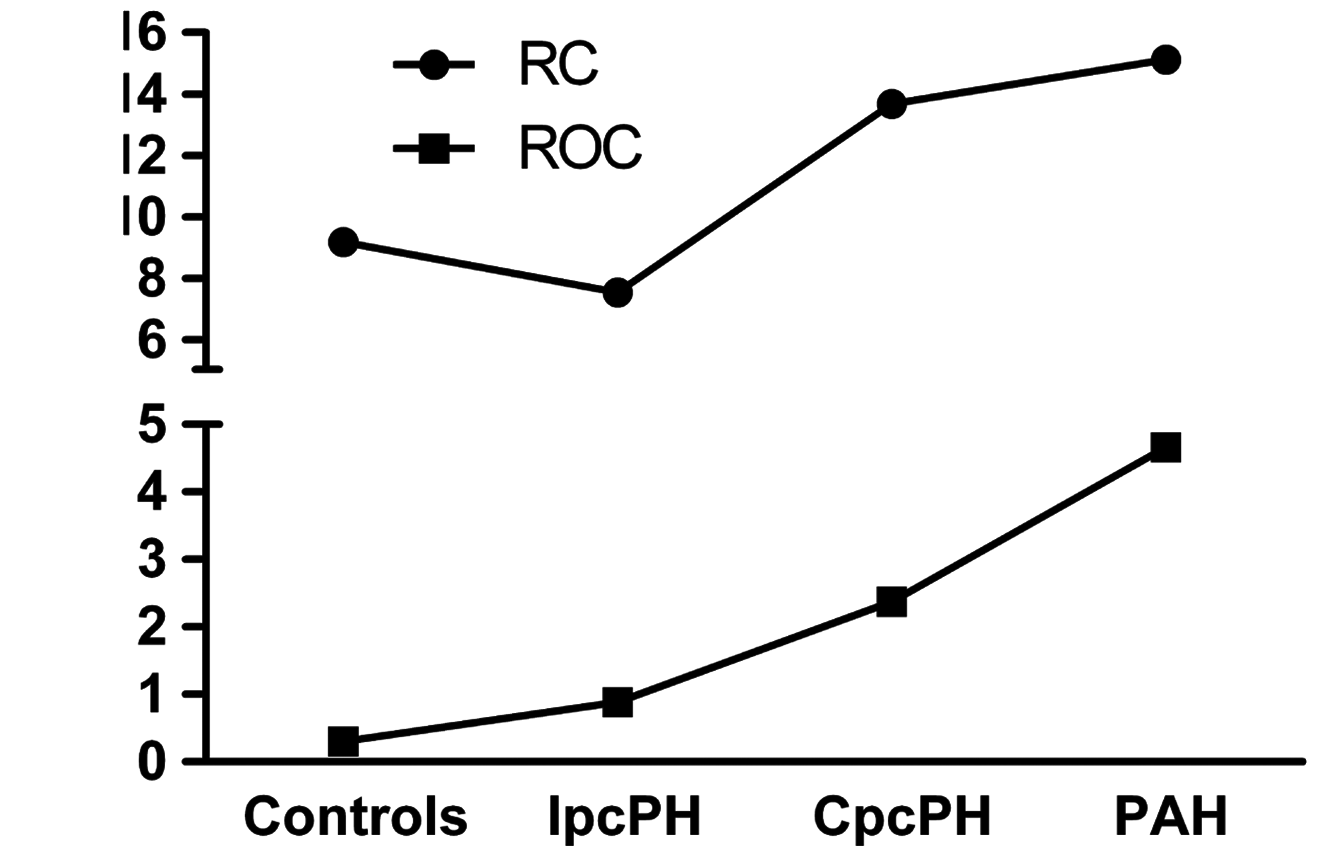
We used the mean PVR and PVC of the groups to compute the RC time and ROC as we did not have the individual patient level data. The ROC increased linearly as the severity of pulmonary hypertension increased from the control group to patients with isolated post-capillary pulmonary hypertension, combined post-capillary and pre-capillary pulmonary hypertension, and pulmonary arterial hypertension (Fig. 1).
Comparison of RC vs. ROC in different forms and severities of pulmonary hypertension. These are patients who underwent right heart catheterization from 1998 to 2014 at Vanderbilt University and were in Vanderbilt’s Synthetic Derivative database.
1
Controls are patients with no pulmonary hypertension. CpcPH, combined post-capillary and pre-capillary pulmonary hypertension; IpcPH, isolated post-capillary pulmonary hypertension; PAH, pulmonary arterial hypertension; RC, resistance-compliance time; ROC, resistance over compliance.