




Abstract
Background:
Antipsychotics are the treatment of choice in the therapy of schizophrenia. These drugs can be associated with changes in heart rate, but this question has never been examined systematically.
Objective:
We aimed to analyse changes in heart rate during treatment with antipsychotics using the frequency of tachycardia and bradycardia events.
Design:
For this systematic review and meta-analysis, we included all randomized controlled trials for the acute treatment of schizophrenia comparing antipsychotics head-to-head or with placebo.
Data Sources and Methods:
We searched Embase, MEDLINE, PsycINFO, PubMed, BIOSIS, Cochrane Central Register of Controlled Trials (CENTRAL), WHO International Clinical Trials Registry Platform and ClinicalTrials.gov (last search June 2021). Two authors independently selected studies and extracted data. We conducted pairwise meta-analyses using a random-effects model. Outcomes were tachycardia and bradycardia events.
Results:
We found 469 trials meeting the inclusion criteria. Seventy-seven studies with 16,907 participants provided data on tachycardia or bradycardia events. We found no significant differences between antipsychotics and placebo or between antipsychotics for bradycardia events based on sparse data. Antipsychotics had a higher risk for tachycardia events compared with placebo [N = 37, n = 7827, risk ratio (RR) = 1.83, 95% confidence interval (CI) = 1.40–2.41], with large differences between the individual substances (iloperidone RR = 14.05, chlorpromazine RR = 4.84, loxapine RR = 4.52, risperidone RR = 3.38, quetiapine RR = 2.64, paliperidone RR = 1.65). Some head-to-head comparisons were also significantly different: olanzapine versus haloperidol RR = 2.87, chlorpromazine versus thiothixene RR = 2.92, quetiapine versus lurasidone RR = 3.22, risperidone versus aripiprazole RR = 4.37, iloperidone versus ziprasidone RR = 4.65).
Conclusion:
Many studies do not report data for cardiac outcomes, but the available evidence indicates that treatment with antipsychotics raises the risk for tachycardia. Therefore, especially patients with cardiac risk factors should be monitored closely during antipsychotic treatment.
Registration:
PROSPERO: CRD42014014919
Introduction
Schizophrenia is a debilitating disease with a huge burden for patients and their relatives. 1 Antipsychotics are the treatment of choice, but can cause severe side effects. 2 Some antipsychotics (e.g. clozapine and olanzapine) are associated with higher cardiometabolic risks compared with other (e.g. aripiprazole). 3 There is evidence that people with schizophrenia have a higher risk of cardiovascular disease–related deaths compared with the general population, which maybe increased by the use of antipsychotics. 4 Furthermore, patients with schizophrenia often have many risk factors for cardiovascular events such as tobacco addiction or metabolic syndrome. 5 Often, they do not seek medical treatment at all 6 and there is evidence that they obtain fewer cardiac interventions than the general population. 7 A large cohort study found that second-generation antipsychotic agents raise the risk of sudden cardiac death. 8 These drugs influence repolarisation and heart rate, which can result in fatal arrhythmias. 9 In general, higher heart rates are associated with a higher mortality due to cardiovascular diseases even in the general population. 10 In the past, several retrospective trials have examined the risk for cardiac events during antipsychotic treatment and the prolongation of the QTc interval. But the evidence of randomized clinical trials in terms of heart rate has never been summarized systematically. We therefore aim to systematically summarize the available evidence of this cardiac side effect in randomized controlled trials of acute treatment of schizophrenia.
Methods
This analysis follows the PRISMA-Guideline 11 and is part of a larger already published project 2 (PRISMA checklist Supplemental Appendix 1). The according protocol was registered a priori at PROSPERO under the registration number: CRD42014014919 (Supplemental Appendix 2).
Participants and interventions
We included randomized controlled trials (RCTs) in adults with acute symptoms of schizophrenia or related disorders (such as schizophreniform or schizoaffective disorders). We excluded studies in patients with treatment resistance, first episode, predominant negative or depressive symptoms, concomitant medical illnesses and relapse-prevention studies. We included trials with a minimum duration of 3 weeks. Interventions were all second-generation antipsychotics approved in Europe or the United States and placebo. Based on a survey among 50 international schizophrenia experts, 12 we also included the following older antipsychotics: benperidol, chlorpromazine, clopenthixol, flupenthixol, fluphenazine, haloperidol, levomepromazine, loxapine, molindone, penfluridol, perazine, perphenazine, pimozide, sulpiride, thioridazine, thiothixene, trifluoperazine and zuclopenthixol. Intramuscular formulations were excluded as they are mainly used for relapse prevention (long-acting) or in emergency situations (short-term). We included target to maximum doses according to the ‘International Consensus Study of Antipsychotics’ for flexible dose studies. 13 We included all flexible dose studies because investigators can titrate the dose for the individual patient. As the examined outcomes are based on the objective measurement of heart rates, we included double-blind, single-blind and open studies, but excluded open studies in a sensitivity analysis. Studies from mainland China were excluded due to quality concerns. 14 We excluded studies with high risk of bias for randomization and allocation.
Search
We searched the following databases without language restrictions: Medline, Cochrane Central register of Controlled Trials (CENTRAL), Embase, Biosis, PsycINFO, Pubmed, Clinicaltrials.gov and WHO International Trial Registry. The references of included studies were screened for additional studies. The search strategy was based on the update of a previously conducted analysis and the full search strategy is presented in the supplement (last search June 2021, Supplemental Appendix 3).
Outcomes
We extracted bradycardias and tachycardias reported as adverse events as stated by the original authors, but also reported with the adverse event terms ‘low heart frequency’ and ‘low pulse’ or ‘high heart frequency’ and ‘high pulse rate’.
Data extraction and analysis
At least two reviewers (MH, TA, JST, Natalie Peters, Lio Baeckers, Angelika Kapfhammer, Dongfang Wang and Shimeng Dong) screened the search results independently, retrieved full-text articles, and checked inclusion criteria. In case of doubt, a third reviewer (SL) was involved. Two reviewers independently extracted data and entered them in electronic forms in Microsoft Access 2010 (MH, TA, JST, Natalie Peters and Lio Baeckers). An algorithm checked for conflicting data entries.
We calculated pairwise random-effects meta-analyses combining the event rates in intervention and control groups. 15 Effect sizes were risk ratios and number-needed-to-harm (NNTH). All effect sizes were presented along with their 95% confidence intervals (CIs). We assessed between study heterogeneity with the I2-statistic and the chi-square test for homogeneity, with I2 > 50% and chi-square p < 0.05 indicating significant heterogeneity. 16 We used contour-enhanced funnel plots 17 and the trim and fill method 18 to explore small trial bias, if at least 10 studies were available. All statistical analysis were conducted with the statistical programme R version 3.6.1 19 using the package meta. 20 The p values lower than 0.05 were considered statistically significant.
Sensitivity analysis
We excluded open and single-blind studies in a sensitivity analysis. We also applied a fixed-effects model and checked for probable changes when a random-effects model was applied. We decided post hoc to exclude long-term studies (duration >13 weeks) in a sensitivity analysis to check for higher event rates in short-term studies.
Risk of bias
Risk of bias was assessed independently by two reviewers (Maximilian Huhn, Thomas Arndt, Natalie Peter, Lio Baeckers and Johannes Schneider) using the criteria stated by the Cochrane Collaboration 21 (Supplemental Appendix 6).
Results
Descriptives of the sample
The searches resulted in 55,097 hits. After elimination of duplications, titles and abstracts were screened for matching the inclusion criteria and 3283 full texts retrieved. After full-text screening, 77 studies with 16,907 participants provided data on bradycardia or tachycardia events. The detailed PRISMA flowchart can be found in Figure 1. A detailed list of the included studies can be found in Supplemental Appendix 4. The studies were published between 1968 and 2019. Seventy-three studies were double-blind, two single-blind and two open. Mean trial duration was 8 (SD = 5.94) weeks. Thirty-nine studies were placebo controlled. The sample had the following characteristics: 10,372 participants were male and 6535 female. Mean age was 37.34 (SD = 4.12) years and the duration of illness in years was 12.80 (SD = 5.94).

PRISMA flow diagram.
Bradycardia
Seventeen studies with 6866 participants reported data for bradycardia events. Bradycardias were overall quite rare and reported for 0.4% of patients. Eight studies with 2363 participants reported bradycardia events for the comparison of antipsychotics with placebo. The overall risk ratio of antipsychotics compared with placebo was not significant [N = 8, n = 2363, risk ratio (RR) = 1.83, 95% confidence interval (CI) = 0.56–5.96, p = 0.32] [Figure 2(a)]. There was no significant difference between haloperidol and placebo (N = 3, n = 429, RR = 3.57, 95% CI = 0.75–16.99, p = 0.11) and lurasidone and placebo (N = 3, n = 1220, RR = 1.81, 95% CI = 0.30–11.0, p = 0.52) [Figure 2(b)]. The comparisons of loxapine, olanzapine, quetiapine, risperidone and ziprasidone could not be calculated because there were no events in both arms.

(a) Antipsychotic drugs versus placebo (overall) – bradycardia events. (b) Antipsychotic drugs versus placebo (individual antipsychotics) – bradycardia events. (c) Antipsychotic drugs head-to-head comparison – bradycardia events.
The comparison of haloperidol with amisulpride/olanzapine/ziprasidone showed no significant difference for the pooled comparison (N = 8, n = 3983, RR = 2.03, 95% CI = 0.66–6.27, p = 0.22) nor for the comparison with olanzapine (N = 2, n = 2198, RR = 5.92, 95% CI = 0.62–56.56, p = 0.12) or ziprasidone (N = 5, n = 1586, RR = 1.62, 95% CI = 0.37–7.11, p = 0.52) or amisulpride (N = 1, n = 199, RR = 0.90, 95% CI = 0.06–14.11, p = 0.94) alone [Figure 2(c)]. We found also no significant differences for lurasidone, perphenazine, quetiapine and risperidone compared with other drugs.
Tachycardia
Seventy-three studies with 15,732 participants reported data for tachycardia events. Tachycardias were reported for 4.8% of patients. Treatment with antipsychotics had a significant higher risk for tachycardias than placebo (N = 37, n = 7827, RR = 1.83, 95% CI = 1.40–2.41, p < 0.001, NNTH = 43) [Figure 3(a)], but there were large differences between the individual substances. The following drugs had a higher relative risk for tachycardia compared with placebo. The ranking is from highest to lowest risk RR: iloperidone 14.05 (95% CI = 1.93–102.26, p < 0.01), chlorpromazine 4.84 (95% CI = 1.82–18.29, p = 0.02), loxapine 4.52 (95% CI = 1.06–19.28, p = 0.04), risperidone 3.27 (95% CI = 1.11–10.32, p = 0.03), quetiapine 2.64 (95% CI = 1.13–6.16, p = 0.02), paliperidone 1.65 (95% CI = 1.08–2.51, p = 0.02) [Figure 3(b)]. We found no significant differences for the following antipsychotics: aripiprazole, fluphenazine, haloperidol, loxapine, lurasidone, olanzapine, perphenazine, thioridazine, trifluoperazine, ziprasidone and zotepine [Figure 3(b)]. The following antipsychotics differed significantly from each other: aripiprazole was better than risperidone: RR 0.23 (95% CI = 0.1–0.541, p < 0.01), haloperidol better than olanzapine: RR 0.35 (95% CI = 0.13–0.95, p = 0.04), lurasidone better than quetiapine: RR 0.31 (95% CI = 0.12–0.78, p = 0.01), thiothixene better than chlorpromazine: RR 0.34 (95% CI = 0.14–0.85, p = 0.02) and ziprasidone better than iloperidone: RR 0.21 (95% CI = 0.07–0.7, p = 0.01) [Figure 3(c)].
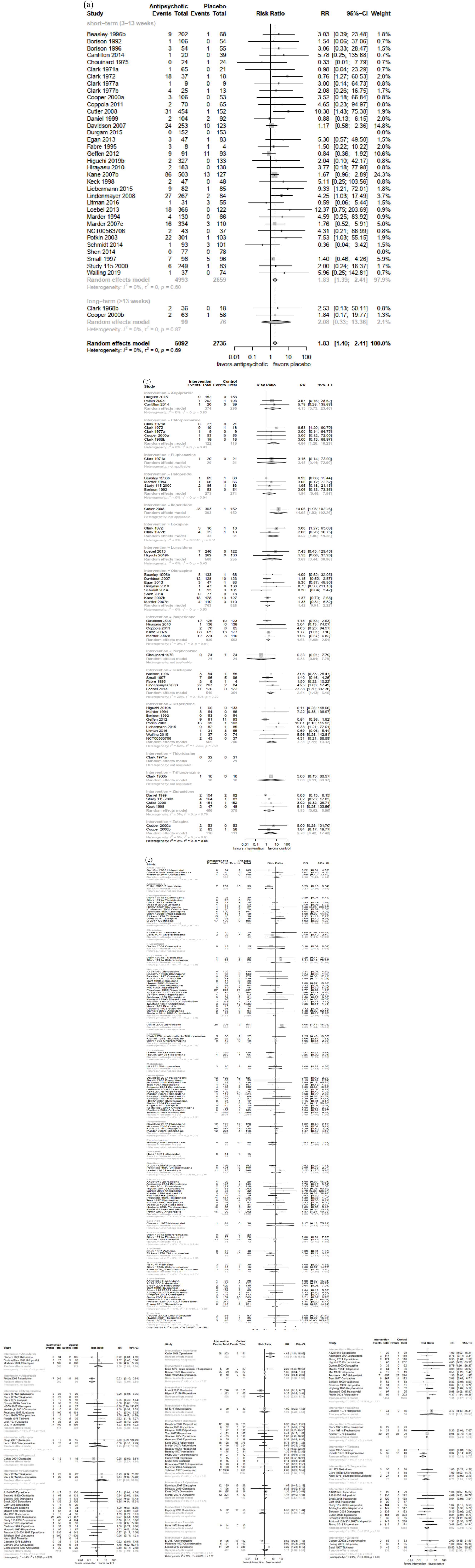
(a) Antipsychotic drugs versus placebo (overall) – tachycardia events. Results are presented separately for short- and long-term studies. (b) Antipsychotic drugs versus placebo (individual antipsychotics)– tachycardia events. (c) Antipsychotic drugs head-to-head comparison – tachycardia events.
Risk of bias
The percentage of studies with low/unclear/high risk of bias for the individual items was randomization (57.1%, 42.9%, 0%), allocation (42.93%, 57.1%, 0%), blinding of patients and personnel (57.1%, 36.4%, 6.5%), rater blinding (59.7%, 32.54%, 7.8%), missing outcomes (67.5%, 20.8%, 11.7%), selective reporting (72.7%, 10.4%, 16.9%) and other bias (89.6%,5.2%, 5.2%), whereas selective reporting was based on overall symptom scales like positive and negative syndrome scale (Supplemental Appendix 5).
Assessment of heterogeneity
We found no significant heterogeneity for any comparison concerning the outcome bradycardia. Concerning tachycardia, only the comparison of risperidone with placebo (τ2 = 1.2088, p = 0.04; I2 = 52%) and quetiapine with other antipsychotics (τ2 = 0.7570, p = 0.01; I2 = 77%) revealed significant heterogeneity. Many comparisons consisted only of one study, so heterogeneity assessment was not applicable.
Sensitivity analysis
Using a fixed-effects model instead of a random-effects model in a sensitivity analysis changed the results only in case of tachycardia. Chlorpromazine compared with any antipsychotic using a fixed-effects model was statistically significant and RR raised from 1.36 (95% CI = 0.96–1.94, p = 0.025) to 1.46 (95% CI = 1.03–2.08, p = 0.003). Results for all other comparisons did not change materially. We did not conduct the a priori planned sensitivity analysis exclusion of open studies as there were only two open studies in the complete data set. Exclusion of long-term studies (duration > 13 weeks) did not change the results for bradycardia or tachycardia (Supplemental Appendix 7).
Publication bias
We did not assess small study bias for bradycardia events as no comparison had 10 or more studies. We did a contour-enhanced funnel plots for tachycardia events, which revealed a possibility that small trials with a lower relative risk for tachycardia events in the antipsychotic group could be missing (Figure 4).

Contour-enhanced funnel plot for all antipsychotics compared with placebo.
Discussion
The analysis presents bradycardia and tachycardia events from 77 studies with 16,907 participants using antipsychotics for the treatment of acute schizophrenia. Based on few data, we found significant differences in bradycardia events neither between antipsychotics and placebo nor between individual antipsychotics. Overall bradycardia is primarily dangerous for people at risk, for example, after a myocardial infarction or with already existing arrhythmia (e.g. branch blocks). 22 In contrast, bradycardia can be even physiological in young or exercised people. 23 Nevertheless, bradycardias can cause dizziness and are responsible for 3–10% of syncopes. 24
The risk for tachycardia events was 1.81 times higher for antipsychotics compared with placebo with a number needed to harm of 43. There are some substances that have a significantly higher risk for tachycardia than placebo. Some of the reported tachycardias may be reflex tachycardias caused by an adequate autonomic reflex to orthostatic hypotension. Undermining this hypothesis is the fact that antipsychotics with a higher risk for orthostatic hypotension like iloperidone and chlorpromazine have a higher risk for tachycardias. 25
The antipsychotic substance most often associated with tachycardia is clozapine. 26 This may be related to the vagolytic effects of clozapine. Unfortunately, we did not find an RCT that compared clozapine with placebo, only one comparison with olanzapine 27 and one with chlorpromazine. 28 Neither found significant differences in tachycardia risks. Haloperidol that can be associated with prolongation of the QTC interval, especially when given intravenously, 29 had a significantly lower risk of tachycardia compared with olanzapine based on three studies with 2454 participants (RR = 0.35, p = 0.04).
We conducted the analysis using state-of-the-art methods and following the PRISMA guidelines. Nevertheless, there are some limitations. The primary outcome of most included studies was efficacy of antipsychotics. So bradycardia and tachycardia events were only reported as adverse events. It is unclear whether changes in heart rate did not occur in most of the studies or whether the studies did not report these events. No study presented a bradycardia or tachycardia definition in beats per minute, so we had to rely on the original author’s definition of these events. Of the 469 studies examining acute treatment with antipsychotics, only 77 studies with 15,732 participants reported data for tachycardia events and even less for bradycardia events (17 studies with 6866 participants). Bradycardias and tachycardias could be missed as the heart rate of patients is not monitored 24 h. This could lead to an underestimation of the ‘real’ event rate. We did not analyse mean heart rate, which would be interesting and allow to test for factors that could mitigate changes in heart rate like weight gain. Unfortunately, authors often did not state whether they counted all bradycardias and tachycardias irrespectively if the underlying rhythm was sinus rhythm or not. So tachycardia in the presence of atrial fibrillation could be counted even it is most likely not caused by the intake of antipsychotic drugs. We also did not analyse other arrhythmias, except QTc prolongation which is published elsewhere, 2 because they are even rarer than bradycardias. To pool the results, we needed a homogeneous sample. Therefore, we had to exclude studies focused on elderly patients, although bradycardias and tachycardias are more dangerous for this population, 30 but only few studies were excluded on this basis. 31 So the generalizability of our results is limited, especially as patients with concomitant somatic medial illness are typically excluded from randomized controlled trials of antipsychotics in schizophrenia. The risk-of-bias assessment was focused on overall efficacy measures, but only the risk-of-bias items ‘missing outcomes’ and ‘selective reporting’ are not outcome-specific.
Conclusion
There is evidence that treatment with antipsychotics increases the risk for tachycardia. Therefore, especially patients with risk factors should undergo electrocardiography and be monitored closely during antipsychotic treatment. 32 In case of pre-existing cardiovascular disease, an antipsychotic agent with low risk profile should be used.
Supplemental Material
sj-docx-1-tpp-10.1177_20451253221097261 – Supplemental material for Effects of antipsychotics on heart rate in treatment of schizophrenia: a systematic review and meta-analysis
Supplemental material, sj-docx-1-tpp-10.1177_20451253221097261 for Effects of antipsychotics on heart rate in treatment of schizophrenia: a systematic review and meta-analysis by Maximilian Huhn, Thomas Arndt, Johannes Schneider-Thoma and Stefan Leucht in Therapeutic Advances in Psychopharmacology
Footnotes
Acknowledgements
We thank Natalie Peter, Lio Baeckers, Angelika Kapfhammer, Dongfang Wang and Shimeng Dong for their help with data extraction. This analysis was part of the doctoral thesis of Thomas Arndt.
Ethics approval and consent to participate
Not applicable.
Consent for publication
Not applicable.
Author contribution(s)

Funding
The authors disclosed receipt of the following financial support for the research, authorship and/or publication of this article: This study was funded by the German Ministry of Education and Research (grant number FKZ01KG1406).
Conflict of interest statement
The authors declared the following potential conflicts of interest with respect to the research, authorship and/or publication of this article: MH has received honoraria as a consultant for Recordati. In the past 3 years, SL has received honoraria as a consultant/advisor and/or for lectures from Angelini, Boehringer Ingelheim, Gedeon Richter, Janssen, Johnson & Johnson, Lundbeck, LTS Lohmann, MSD, Otsuka, Recordati, SanofiAventis, Sandoz, Sunovion, TEVA, Eisai, Rovi, Medichem and Mitsubishi. All other authors declare no competing interests.
Availability of data and materials
Not applicable.
Supplemental material
Supplemental material for this article is available online.
References
Supplementary Material
Please find the following supplemental material available below.
For Open Access articles published under a Creative Commons License, all supplemental material carries the same license as the article it is associated with.
For non-Open Access articles published, all supplemental material carries a non-exclusive license, and permission requests for re-use of supplemental material or any part of supplemental material shall be sent directly to the copyright owner as specified in the copyright notice associated with the article.
