



Abstract
This teaching case illustrates how Adapt Ideations, a leading technology company in Australia, develops IoT-enabled solutions for real-time, temperature-controlled asset tracking and sustainable supply chain monitoring. The case explores how Adapt’s devices designed for both cold storage facilities and moving assets collect temperature, location, and environmental data, supporting compliance, visibility, and operational efficiency. The company’s cloud-based platform integrates data from multiple devices into client systems, addressing interoperability, security, and procedural challenges. Insights from company’s growth show how strategic capabilities, certifications, and partnerships support competitive differentiation and operational resilience in a complex industry. The teaching case demonstrates (i) the role of IoT technology in enabling digital transformation across supply chains, (ii) the application of reusable, sustainable devices to reduce e-waste, and support ESG goals, (iii) challenges in technology adoption, integration, and connectivity across diverse geographies, and (iv) the impact of real-time monitoring on risk management and operational decision-making. The case is suitable for courses in business, operations, supply chain, and information systems, facilitating discussions on digital transformation, sustainability, and supply chain innovation, with insights on strategic directions, effective decision-making, and managing technology development. Accompanied by teaching notes organized into seven modules, the case provides educators with structured guidance to engage students with the challenges and opportunities presented connecting practical insights to relevant academic literature, strategic implications, and theoretical frameworks.
Keywords
Teaching objectives
1. To introduce students to IoT-driven traceability and sustainability in supply chains. 2. To assess how digital platforms can enhance ESG compliance while leveraging unique firm capabilities and informing strategic decision-making. 3. To explore the opportunities and risks of scaling IoT solutions globally under industry pressure. 4. To analyze the implementation challenges of IoT technologies in multi-stakeholder ecosystems and explore managerial strategies to overcome these challenges.
Suggested teaching approach/plan
The teaching case illustrates how Adapt Ideations addresses traceability and sustainability challenges in global supply chains. It highlights both operational hurdles and opportunities for leveraging IoT and digital platforms to enhance compliance, visibility, and ESG performance. The teaching notes, structured into seven modules, guide educators through discussions, linking practical observations to strategic implications and theoretical insights. Designed for undergraduate and postgraduate students in business, information systems, supply chain, and operations management, the case can be taught in a 90–120 minute session with module-based discussions providing focused exploration of the key themes.
Modules and guiding questions
Module 1: Understanding digital traceability
Global supply chains face risks such as recalls, counterfeiting, and regulatory non-compliance, requiring resilience, agility, and visibility. Christopher (2016) highlights the principles of responsiveness, reliability, resilience, and relationships, which digital technologies now enable through real-time data.
Digital traceability systems provide accuracy, security, efficiency, real-time control, and lower labor costs, with applications in logistics, production, and supply chain management (Lim et al., 2013; Ustundag and Cevikcan, 2018). IoT extends these capabilities by offering visibility and adaptability through data from smart objects (Ellis et al., 2015). When analyzed effectively, such data enables early detection of disruptions and faster responses.
The key challenge has been processing big data quickly enough for decision-making (Ben-Daya et al., 2019). IoT addresses this by reducing the lag between data capture and action, enabling real-time responsiveness, remote management, improved collaboration, and more informed decisions (Ellis et al., 2015).
Use the following questions to assess your understanding of digital traceability in supply chains: Why is real-time asset monitoring critical for modern supply chains? How does IoT enhance transparency? How should managers prioritize technology investments for digital traceability to maximize both operational efficiency and strategic advantage?
Module 2: IoT and platformization
Traditional tracking methods, such as barcode scanning and checkpoints, provide only fragmented data and are inadequate for managing modern supply chains. By contrast, IoT platforms enable scalability, predictive analytics, and cost savings by minimizing human error and delays (Greengard, 2021). IoT can be defined as a digitally connected network of physical objects that sense, monitor, and interact across supply chains, enhancing agility, visibility, traceability, and information sharing to improve planning, coordination, and control (Ben-Daya et al., 2019).
IoT has found broad applications, including in healthcare, where it supports the integration of resources and delivery of reliable, data-driven services for chronic disease management. However, its implementation raises critical issues related to connectivity (e.g., latency, device efficiency, and battery life), platform interoperability, standards, security, data analytics, monetization, and service innovation (Lindqvist and Neumann, 2017; Shim et al., 2017). Challenges such as cybersecurity, privacy, and regulatory compliance must also be addressed, while opportunities emerge from IoT–Blockchain convergence and sensor-based service models. A holistic view of these benefits and challenges is essential to fully realize the transformative potential of IoT in supply chain management (Shim et al., 2017).
Drawing insights from the teaching case, discuss the concepts of IoT and platformization in supply chain management. What are the advantages of IoT-driven platforms compared to traditional manual monitoring? What challenges exist in ensuring interoperability? What strategic decisions are needed to ensure successful platform adoption and integration across diverse client systems?
Module 3: Sustainability and ESG alignment
In 2015, the United Nations introduced the Sustainable Development Goals as a global framework to achieve sustainability by 2030 (United Nations Department of Economic and Social Affairs, 2025), reinforcing the importance of corporate accountability in sustainable practices (Arvidsson & Dumay, 2022). Within this context, Environmental, Social, and Governance indicators have become a central benchmark for evaluating organizational sustainability, supported by the expansion of corporate reporting regulations (Friede et al., 2015). However, ESG evaluation continues to face significant challenges, including inconsistencies across environmental, social, and governance dimensions, reliance on subjective expert assessments, and variations in industry contexts and national regulatory systems (Bhandari et al., 2022; Folqué et al., 2021). Establishing a standardized ESG framework is therefore essential to enable robust and comparable assessments of corporate sustainable development (Mansouri and Momtaz, 2022; Singhania and Saini, 2023).
Emerging digital technologies provide promising solutions to address these limitations. Recent studies highlight the role of digital twins, the Internet of Things, and blockchain in strengthening ESG evaluation and monitoring (Qian et al., 2023; Zhang et al., 2023). Industrial IoT enables continuous monitoring of energy consumption, emissions, and resource use, while blockchain provides immutable records that enhance transparency, trust, and accountability across supply chains (Qian et al., 2023). The integration of these technologies supports circular economy principles by minimizing resource use, promoting recycling and reuse, and reducing waste (Qian et al., 2023). Furthermore, when combined with artificial intelligence and big data analytics, these technologies can enhance governance by providing real-time visibility into supply chain and logistics operations, and ensuring compliance with ESG standards (Wang, 2023).
Using the teaching case, the educator can use these questions to examine how real-time data supports sustainability and ESG initiatives. How do Adapt’s solutions support ESG reporting and sustainability mandates? What opportunities exist in carbon footprint tracking? In what ways can emerging technologies enhance stakeholder trust and accountability in corporate sustainability practices? How can firms align ESG initiatives with long-term strategic objectives using IoT and data analytics?
Module 4: Technology in practice
Real-time monitoring is critical for temperature-sensitive products, where deviations can compromise safety, efficacy, and quality. Cold chains play a central role in maintaining controlled conditions during storage and transport, particularly in the pharmaceutical industry, with temperature ranges including ambient (15–25°C), cold (8–15°C), refrigerated (2–8°C), and frozen (−25°C and below) (Turan and Yucel, 2022). Compliance with these standards reduces waste and ensures product integrity for end-users.
IoT technologies have modernized cold chain logistics by enabling continuous, real-time tracking of temperature, humidity, and other environmental parameters. RFID sensors, wireless sensor networks, and low-power communication protocols such as Narrowband IoT and Low Range support accurate remote monitoring, while cloud and edge computing allow rapid processing and timely decision-making (Huang, 2023). For instance, RFID-integrated sensors provide precise data and alert operators to deviations, preventing spoilage. Real-time tracking enhances transparency, improves client trust, minimizes waste, and optimizes operational efficiency. Successful implementations include Europe’s “Cool-Logistics” project, the US “FreightFriend” platform, and China’s JD Cold Chain Logistics initiative, demonstrating effective practical deployment of these technologies (Wang and Du, 2025).
Drawing insights from the teaching case, the educator can explore how supply chain technologies are implemented in practical settings. Drawing parallels to the Adapt’s case, how is technology applied to enable real-time monitoring in pharmaceutical cold chains? How could these technological approaches be adapted to other temperature-sensitive industries? What value does real-time tracking deliver to clients in temperature-sensitive supply chains? What operational decisions are influenced by real-time IoT monitoring, and how can managers leverage this data to optimize supply chain resilience?
Module 5: Challenges in scaling
IoT adoption is expanding across sectors, but scaling remains challenging due to technical, operational, and organizational barriers. Many scholars have examined these limitations, and Ahmad et al. (2024) identify 13 key challenges based on a review of existing literature. Security is particularly critical, as IoT devices often consume high energy, impose processing overheads, and remain vulnerable to tampering, hacking, and data theft (Krotov, 2017; Saleem et al., 2018). Effective deployment requires safeguarding data across perception, network, and application layers, while restricting access to authorized entities (Ahmad et al., 2024). Additionally, high costs for device manufacturing, deployment, training, and maintenance, especially for small-scale firms, further impede adoption, and limited early client uptake may generate resistance despite the operational benefits of IoT (Ahmad et al., 2024; Kumar et al., 2021).
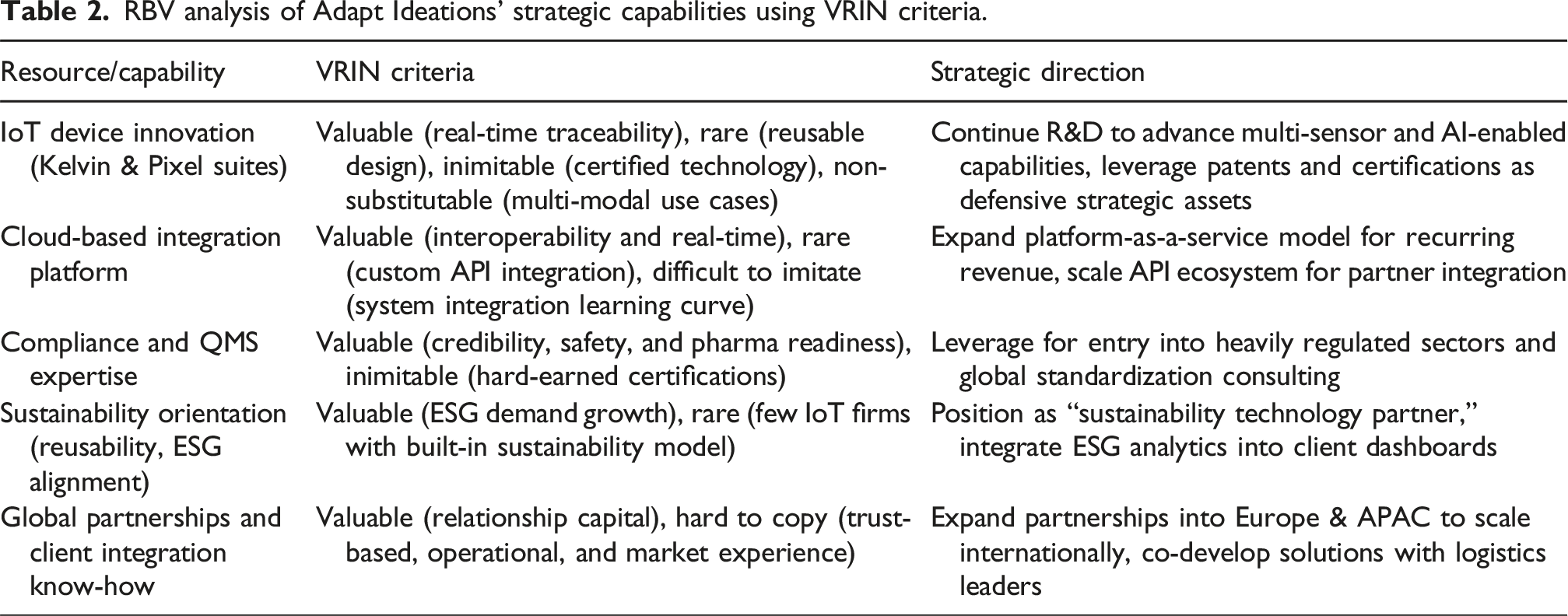
Beyond these challenges, successfully scaling IoT innovations requires complementary adjustments in human resources and organizational processes, reinforcing the firm’s strategic capabilities and sustainable performance in line with the Resource-Based View (RBV). Thus, technological resources alone are insufficient; firms must also develop and coordinate supporting capabilities to fully realize operational efficiency and long-term strategic advantage (Brofman Epelbaum and Garcia Martinez, 2014).
Using the teaching case, the educator can guide discussion on the obstacles and complexities involved in scaling supply chain technologies, What are the most significant barriers to scaling digital traceability solutions? How do organizational size and resource availability influence IoT adoption challenges in supply chains? How can companies like Adapt address client resistance and cost concerns? Which strategic approaches can organizations take to overcome adoption barriers and scale IoT solutions effectively?
Module 6: Blockchain, AI, and the future
The pharmaceutical supply chain is highly vulnerable to disruptions from cyberattacks and trade disputes due to its reliance on proprietary knowledge, global data flows, and moderate levels of digitization (Foster et al., 2021). Emerging technologies extend the value of IoT, and Blockchain mitigates these risks by recording IoT device activity in an immutable, decentralized ledger, ensuring transparency, security, and trust across all transactions.
AI enhances IoT by analyzing data and identifying patterns; however, integrating both at compatible capability levels is essential for success in IoT-driven ecosystems. AI also supports supply chain traceability by detecting defects, weaknesses, and adulteration to improve quality and safety (Amin et al., 2019; Zhu et al., 2022). A study carried out by McKinsey & Company highlights that 65% of drug shortages result from deviation management issues, with 15–20% recurring due to ineffective remediation. Generative AI can reduce these risks by identifying similar deviations, accelerating root cause analysis, recommending corrective and preventive actions (CAPAs), and automating documentation, enhancing resilience and compliance (Spencer et al., 2025).
Consider the following questions to reflect on the role of Blockchain, AI, and emerging technologies in shaping the future of supply chains: Could Adapt integrate blockchain for immutable traceability? How will AI strengthen predictive analytics and supply chain visibility? How should leaders evaluate emerging technologies to ensure alignment with strategic growth and risk mitigation objectives?
Module 7: Strategic growth pathways
As IoT and asset monitoring technologies mature, organizations are increasingly seeking ways to scale their solutions strategically. Growth is no longer just about expanding market share but also about creating sustainable and adaptable models that address long-term industry needs. One critical pathway lies in cross-industry partnerships, which enable expertise sharing, data pooling, and co-innovation (Dosumu et al., 2024; Henke et al., 2016; Onukwulu et al., 2021). These collaborations accelerate the development of predictive analytics, energy-efficient equipment, and other scalable tools that improve efficiency and competitiveness (Dosumu et al., 2024; Eyo-Udo et al., 2024). Emerging technologies such as blockchain and IoT further strengthen partnerships by enabling transparent, auditable, and trustless interactions, supporting both partnership efficiency and long-term growth (Christidis and Devetsikiotis, 2016; Kim and Shin, 2019).
Equally important is the integration of sustainability into growth strategies. Businesses are positioning themselves not only as technology providers but also as sustainability partners, embedding environmental considerations across all operations. Green IoT practices, such as reducing energy consumption in devices, improving recyclability, and enhancing e-waste management, reflect this shift (Memić et al., 2022). By aligning innovation with sustainability, companies can move beyond serving single industries to unlock opportunities across multiple sectors.
Educators can explore the following questions to discuss strategic growth opportunities: What are the advantages and risks of pursuing growth through partnerships compared to independent scaling? Which industries or sectors present the strongest opportunities for IoT-enabled asset monitoring solutions? Should Adapt in this space position themselves primarily as technology providers or as sustainability-oriented partners? How can managers balance growth, sustainability, and technological innovation when planning strategic pathways?
Strategic framework for classroom application
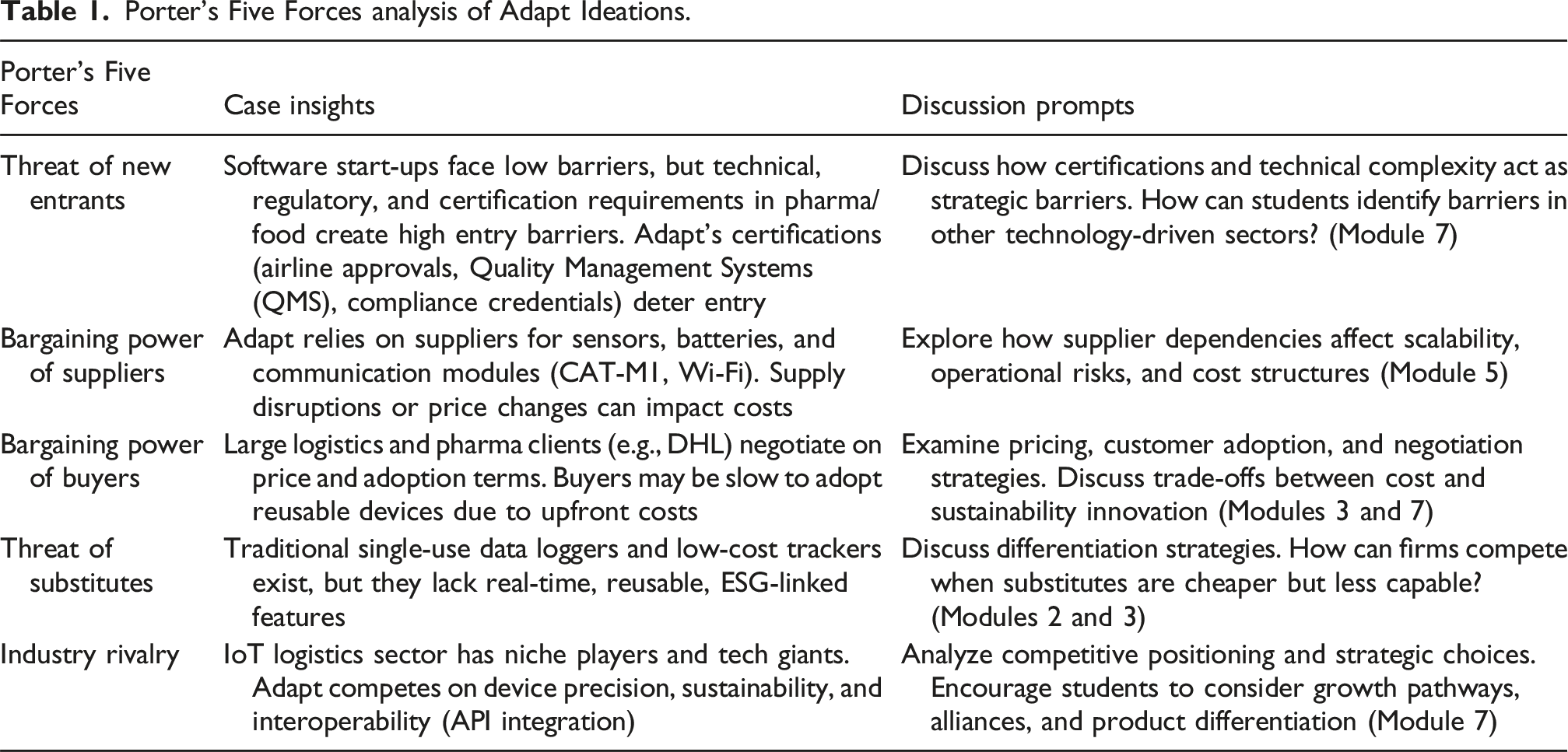
Porter’s Five Forces analysis of Adapt Ideations.
RBV analysis of Adapt Ideations’ strategic capabilities using VRIN criteria.
Footnotes

Funding
The authors received no financial support for the research, authorship, and/or publication of this article.
Declaration of conflicting interests
The authors declared no potential conflicts of interest with respect to the research, authorship, and/or publication of this article.