




Abstract
This case study explores the critical success factors (CSFs) that drive the effective utilisation of artificial intelligence at tiket.com, an established online travel agency in Indonesia. Through in-depth interviews with key employees, this case identifies and describes essential elements that contribute to the successful deployment of data science initiatives, which are essential for enhancing operational efficiency and competitive advantage in the digital travel industry. This study explores how tiket.com leverages a problem-driven approach, cost–benefit analysis, data understanding, top management support, collaboration, communication, essential knowledge and skills, and operational agility to address specific business challenges and foster continuous innovation and customer-centric strategies. By analysing real-world applications and employee insights, this case highlights how tailored artificial intelligence strategies can significantly impact business outcomes, providing valuable lessons for the broader travelling and entertainment sector.
Keywords
Introduction
The rapid advancement of information technology (IT) has revolutionised the travel industry, paving the way for the emergence and growth of Online Travel Agencies (OTAs). These digital platforms have transformed how travellers plan, book, and manage their journeys, creating unprecedented opportunities for consumers and businesses. Given intensifying competition and evolving customer expectations, OTAs’ successful operations hinge on efficient and seamless business processes.
Artificial intelligence (AI) initiatives have become crucial strategic pillars for OTAs to improve consumer experiences and streamline operations in the ever-changing digital age. OTAs such as tiket.com leverage data science to manage, analyse, and harness vast datasets, enhance their services, and maintain competitiveness. It is imperative to identify critical success factors (CSFs) in data science and AI projects in the unique context of OTAs to ensure successful implementation of insights and to drive business growth for OTAs. Tiket.com, a major player in the online travel industry in Indonesia, faces complex challenges in effectively utilising data science. This case describes the critical factors contributing to the success of data science and AI projects at tiket.com. By gaining a comprehensive understanding of these CSFs, the insights can guide the development of effective data science strategies and empower innovation in the OTAs sector.
This case specifically explores CSFs that play a decisive role in the success of data science and AI projects at tiket.com. Through interviews with five tiket.com’s employees, this case study aims to unravel the complexities of these success factors, offering valuable insights into how data science can be strategically leveraged within the unique context of OTAs. This case allows for a nuanced examination of real-world scenarios, shedding light on the practical implications and lessons learned that can inform industry practices and guide future endeavours in the ever-evolving landscape of data-driven decision-making.
Background
OTAs are crucial in today’s digital travel industry. To stay competitive, they utilise AI to enhance operations and customer experiences (Vinod, 2016). As OTAs evolve, they integrate features such as dynamic pricing and personalised recommendations, leveraging large volumes of data from user interactions and external sources to optimise services and customer satisfaction (Fararni et al., 2021). However, implementing AI has challenges, including algorithmic biases, privacy issues, and the need for multidisciplinary teamwork. Understanding the critical factors for the success of these initiatives is essential, together with specific challenges that are relevant to a particular setting or industry. Research across various industries has identified CSFs for data science and AI projects. Merhi (2023) outlined 19 factors critical to AI projects in healthcare, suggesting these may also apply to OTAs. In their Systematic Literature Review, Gökay et al. (2023) identified the success dimensions essential for OTAs, including data governance, precise business requirements, and organisational culture.
Further studies, such as that of Lutfi et al. (2022) on Jordanian SMEs, emphasise the influence of external support and organisational readiness on big data adoption. Al-Sai et al. (2020) offer an extensive list of success factors, while Martinez et al. (2022) stress the importance of stakeholder needs alignment and teamwork. Surbakti et al. (2020) identify and categorise success factors into themes such as data quality and governance, enhancing the understanding of the multifaceted nature of big data projects. Gao et al. (2015) highlight the importance of multidisciplinary teams and top management support. Brous et al. (2020) focused on strategic alignment and data governance. These studies collectively underline the complex and varied nature of the success factors for big data projects in different contexts.
Despite extensive research, each sector has unique factors; for example, ethics related issues in healthcare (Merhi, 2023) differs from those in OTA, due to the risk involved, the types of customer interaction, and the nature of the sectors. For example, healthcare ethics focused on patient well-being, life-and-death decisions, and strict confidentiality, requiring a high degree of responsibility and adherence to professional standards. In contrast, ethics in the OTA emphasise transparency, fairness, customer satisfaction, and data privacy, with the primary goal of providing reliable consumer services. This case study aims to deliver real-world insight into OTA-specific success factors that are crucial for leveraging AI to transform the travel industry and enhance online travel experience. Understanding these factors is crucial for fostering innovation, enhancing competitiveness, and delivering greater value to customers in the OTA sector.
Overview of the company: tiket.com
Tiket.com is an online travel agency established in Indonesia in the 2010s. Founded by a group of technopreneurs with a history of technology-driven projects, it quickly became a leader in the travel, events, and hospitality-booking sectors. The founders’ entrepreneurial spirit was evident from their early 2000s ventures in an online lifestyle directory, an idea that despite its initial promise, was ultimately abandoned due to limited growth potential. Launching tiket.com addressed a critical need in the Indonesian market for streamlined and accessible travel booking options. The platform began by focusing on airline ticket bookings, which initially constituted 40% of its business. This expanded over time to include train tickets, hotel bookings, and car rentals, although the latter faced tough competition from established brands. With savvy marketing strategies that utilise billboards, online advertising, and social media, it quickly established its presence in the market.
Tiket.com’s growth has been characterised by a steady trajectory, achieved through a user-friendly platform that allows customers to book multi-airline round-trip flights and hotel rooms in seamless transactions, thus minimising the need for multiple browser tabs. Despite starting with limited funding, they managed its resources wisely and adopted a conservative growth strategy that shunned high-risk investments in favour of stable and gradual development. This approach has paid off, with the platform processing thousands of transactions daily, primarily for domestic flights. In a competitive online travel market, voters distinguish themselves by focusing on service quality rather than engaging in aggressive price wars. Strategically targeted discounts ensure customer loyalty without undermining financial stability, helping build a robust brand reputation based on reliable services and strong customer relationships.
The company’s strategic partnerships have been pivotal, including collaborations with national railway and airline companies to enhance ticket sales and expand service offerings. The launch of mobile applications has marked the beginning of numerous technological innovations to improve user experience. Even after more than a decade, the core management team remains intact to preserve the company’s strategic direction and operational continuity. tiket.com aims to maintain market leadership by leveraging data science and technology to enhance its services and adapt to evolving customer needs. This focus on continuous innovation and customer-centric strategy positions to shape the future of Indonesia’s travel industry.
Critical success factor 1: Problem-driven approach
The problem-driven approach in data science and AI is a methodological shift that emphasises defining and understanding the business problem at the outset rather than allowing data availability to dictate the project’s direction (Staudt and Hoffmann, 2024). This approach ensures that each data science and AI initiative is strategically aligned with the organisation’s objectives, making every analysis and outcome directly relevant to the company’s needs (Günther et al., 2017). This approach requires a keen understanding of the business landscape, ensuring that data science and AI activities are technically sound and strategically focused (Grover et al., 2018). By addressing specific, well-defined problems, data science teams can apply their skills to areas where they can make the most significant impact. This approach helps avoid the common pitfall of pursuing interesting data explorations that, while intellectually stimulating, may have little relevance to the company’s immediate goals. For instance, a key player in the data science department at tiket.com explains the critical importance of this approach: “In a company that has a data science team, it's essential to have a significant business problem that requires a data science solution. Simply having a data science team, whether in the short, medium, or long term, isn't enough. Without clear objectives, interest in the team will diminish, and the team may not deliver any substantial outcomes. Therefore, the company should identify several pressing business issues that the data science team can effectively address.…(interviewee three)”
Selecting and defining the correct problems is a critical skill in problem-driven approaches. This involves thoroughly analysing the business’s operational, financial, and strategic priorities to identify areas where data science and AI can provide the most value. This precision in problem selection ensures that the projects undertaken are essential for the organisation’s success and sustainability. For example, a data science team at tiket.com provides the overarching support to optimise logistical operations, reduce costs, and improve delivery times to enhance the bottom line and customer satisfaction. They use machine learning for dynamic pricing and recommendations, integrated diverse data sources, using real-time processing, and leveraging advanced analytics, automation, and visualisation tools for operational insights.
This precise problem definition aids in crafting solutions that are measurable and impactful. This problem-driven approach fosters an environment of continuous engagement and iterative improvements. A data science team at tiket.com works closely with business units to refine their understanding of the problem and adjust their methods and models in response to new insights and feedback. This dynamic interaction ensures that the solutions developed are theoretically sound, practically viable, and continuously enhanced.
Critical success factor 2: Cost–benefit analysis
A cost–benefit analysis begins with a detailed assessment of the potential costs associated with data science and AI projects, including direct costs such as software, hardware, and personnel and indirect costs such as training and time diverted from other projects (Zolnowski et al., 2017). The anticipated benefits are weighed against the costs. These benefits may be tangible, such as increased revenue or cost savings, or intangible, such as improved customer satisfaction and enhanced decision-making capabilities. A senior analyst from the organisation elaborated on the process: “We first discussed the business impact and whether it was essential to address the issue. We considered if solving it was mandatory and examined aspects such as the business value that would create once the problem is resolved. Understanding this business value is a very important consideration … (interviewee four)”
Cost–benefit analysis enhances the precision of decision-making in data science and AI projects by providing a structured framework to evaluate the economic value of these initiatives. By quantifying the costs and benefits, decision-makers are better equipped to assess the feasibility of projects from a financial perspective. This methodical evaluation helps prioritise projects with the highest potential return on investment. Furthermore, cost–benefit analysis is critical in aligning data science and AI projects with broader strategic objectives. This ensures that projects are not merely technical exercises but integral to the company’s growth and development plans. This alignment is vital for securing the support of key stakeholders, including the top management and investors.
Cost–benefit analysis is, therefore, not a one-off activity at tiket.com but a continuous process that extends throughout the lifecycle of a data science and AI project. By regularly revisiting cost–benefit analysis, tiket.com can adapt to changes in the project scope, external market dynamics, or internal strategic shifts, maintaining the relevance and effectiveness of the project. Robust cost–benefit analysis is indispensable for successfully managing data science and AI projects at tiket.com. It ensures financial discipline and strategic alignment, enhances stakeholder confidence, and supports dynamic decision-making, thereby maximising the impact and effectiveness of data science initiatives within the organisation.
Critical success factor 3: Data understanding
Understanding the data at hand is fundamental to the success of any data science project (Dremel et al., 2017; Staudt and Hoffmann, 2024). This comprehension extends beyond mere data acquisition to include a thorough understanding of its context, origin, and limitations. Adopting a user-oriented approach during the metadata presentation phase of data collection can significantly enhance data comprehension and utility in subsequent analyses (Sejahtera et al., 2018). Data provenance, which involves understanding where data comes from and the processes through which it has been collected and transformed, is crucial. This knowledge helps to assess the reliability, quality, and appropriateness of the data for specific types of analysis (Dremel et al., 2017; Lee et al., 2014). Without this understanding, there is a risk of misinterpreting data, leading to flawed insights and decisions.
Awareness of the data origin and collection methods allows data scientists to make correct assumptions about the data. This accuracy is critical when modelling, as it affects the selection of appropriate tools and techniques for data analysis. Correct assumptions lead to more reliable models and predictions, enhancing the overall quality of insights derived from the data. Metadata plays a crucial role in data understanding. It provides information regarding data attributes essential for effective data handling and usage in complex projects. User-friendly metadata presentations help bridge the gap between data scientists and business users, enabling them to engage more effectively with the data. The importance of data understanding was highlighted by one interviewee
“So, you mentioned the challenges, right? The first challenge is understanding the business problem and translating it into a data science solution. This is the biggest challenge; if we don't get it right, nothing we do afterward will matter. The second challenge is collecting and analysing data, which will be used to implement the solution we have designed for the business problem. …(interviewee three)”
Understanding the data fully allows for aligning data science and AI projects at tiket.com with its business objectives. Furthermore, another interviewee added that “Well, there are many aspects involved that can present challenges to industry practitioners. One of these is understanding the data. We conduct Exploratory Data Analysis during this phase to better understand the data. However, before this, we need to curate the data …(interviewee five)”
This alignment ensures that the efforts of data scientists are not just technical exercises but also directly contribute to tiket.com’s strategic business goals. For instance, understanding seasonal variations, customer preferences, and purchasing power in dynamic pricing can significantly optimise pricing strategies for the customers, directly affecting tiket.com’s business bottom line.
Data understanding is more than an initial step in the data science process. This continuous requirement ensures the accuracy, reliability, and relevance of data analytics. By fostering a deep understanding of data, they can ensure that its data science initiatives are well-founded and aligned with its strategic objectives, thereby maximising the value derived from its data assets.
Critical success factor 4: Top management support
Top management support is a critical factor in the success of data science and AI projects, emphasising the role of senior executives in facilitating and championing these initiatives (Dremel et al., 2017; Staudt and Hoffmann, 2024). This support involves not only the provision of resources but also the empowerment and strategic guidance necessary to execute projects effectively. Executive backing is essential because it significantly influences a project’s direction, pace, and eventual success (Windt et al., 2019). The commitment of top management is crucial for integrating advanced technologies such as AI and machine learning into business processes (Tabesh et al., 2019). Senior executives play a pivotal role in setting the tone and priorities of these projects, ensuring that they align with broader organisational strategies. As indicated by one of the interviewees: “In terms of higher end, our Vice President has emphasised the need to implement AI in our products. Therefore, the push to start integrating data science and machine learning engineering projects is also coming from the top…(interviewee one)”
This support is not merely about funding but also about creating an environment where these projects can thrive. This involves ensuring teams have access to the right tools, sufficient data, and the freedom to experiment and innovate. In tiket.com, senior management actively promoted these initiatives. They strive to overcome resistance to change, fostering a culture of data-driven decision-making within the organisation. Essentially, top management’s endorsement and active participation in data science and AI projects underscores their importance to the organisation’s future. This leadership commitment is vital for leveraging the full potential of data science capabilities, driving the company’s strategic objectives, and maintaining a competitive edge in the market.
Critical success factor 5: Collaboration
The critical role of collaboration in the success of data science projects is clearly demonstrated by its ability to bridge technical expertise with strategic business insights (Lee et al., 2014). This ensures that the solutions developed are technically robust and closely aligned with business objectives. The case of tiket.com exemplifies effective collaboration, showing how teamwork between various departments can lead to substantial outcomes. In this environment, interactions between data science and product teams illustrate a growing mutual understanding and cooperation that enhances the effectiveness of their initiatives. One participant shared an insight into this evolving relationship “So, sometimes we approach the product team and suggest …. that we can help solve their issues. With increasing collaboration between our teams, they are now more aware of what we do, the impact of data science products, and, how we can assist them…(interviewee one)”
This narrative highlights the dynamic nature of collaboration as the relationship strengthens and communication flows more freely, the product team becomes more engaged and better informed about the capabilities and contributions of the data science team.
The benefits of such collaboration are evident at tiket.com in how multidisciplinary teams tackle complex problems more effectively than homogenous groups. These teams combine diverse skills to facilitate deeper understanding and integration of different perspectives, leading to more innovative and effective solutions. Moreover, effective collaboration among cross-functional teams: business professionals, data scientists, and IT professionals in the organisation is crucial for translating technical data insights into actionable business strategies. This cooperative environment accelerates problem-solving and fosters a culture of continuous learning and adaptation. Ongoing interactions help both teams better understand their roles in achieving the company’s data-driven goals, ensuring that projects remain relevant and aligned with business needs, thereby maximising the impact and value of these initiatives.
Critical Success Factor 6: Communication
Effective communication is a cornerstone for the success of data science projects, particularly in bridging the gap between technical teams and other stakeholders within an organisation (Staudt and Hoffmann, 2024; Tabesh et al., 2019). The complexity of data science can often lead to misunderstandings or misalignments regarding projects’ strategic objectives. Therefore, it is vital for organisations to clearly articulate the purpose, expectations, and potential impacts of these initiatives, ensuring that all stakeholders are on the same page regarding both the effort required and the expected benefits. One employee vividly describes the initial phases of project communication: “When we kick off the project, we often need to communicate extensively with the product team. This involves educating them about our role, how we can contribute, and what our outputs will be. Essentially, we need to clarify our contributions, the areas where we can help, and expected results of our work …(interviewee one)”.
This statement highlights the necessity of establishing a clear communication channel from the onset of a project, highlighting the importance of correctly setting expectations and educating all involved parties about the scope and goals of the project.
This type of communication conveys what the data science team is doing and ensures a mutual understanding of how these activities align with broader business objectives. Effective communication helps the data science team at tiket.com prevent scope creep and keeps the project aligned with the intended outcomes by continually engaging with stakeholders to clarify and adjust the project’s direction as needed. Moreover, regular updates and discussions about the project’s progress and challenges keep stakeholders informed and foster an environment of trust and collaboration. This ongoing dialogue enables quicker resolution of issues as they arise and helps maintain momentum throughout the project lifecycle.
In addition to regular updates, incorporating feedback mechanisms into the communication process is crucial in the organisation. This allows stakeholders to voice their concerns or suggest adjustments in real-time, which can be instrumental in steering the project more effectively towards its goals. By integrating these feedback loops, organisations can ensure that data science projects remain flexible and responsive to the business’ needs, enhancing the project’s overall effectiveness and efficiency. Effective communication in data science projects is about more than just exchanging information; it is about building a shared vision, aligning team efforts, and fostering an atmosphere in which collaborative problem-solving thrives. This approach enhances project outcomes at tiket.com and strengthens the relationships between the data science team and other parts of the organisation, ensuring that the projects deliver real value and drive meaningful business improvements.
Critical success factor 7: Knowledge and skills
Possessing the necessary technical competencies is crucial for data science and machine learning professionals. These competencies extend beyond traditional analytical skills, including a blend of scientific acumen, technological expertise, and a solid understanding of industry-specific challenges (Grublješič and Jaklič, 2015; Sivarajah et al., 2017). As the demand for these skills evolves, expectations placed on data scientists have expanded significantly. An interviewee keenly observed the changing landscape: “I mean, first the skill point of view. Currently, at least for the last 3-4 years, and it will be the same for next five years as well I believe, just being a data scientist is not good enough. You have to have some minimum basic engineering skill as well…(interviewee three)”.
This insight underscores the growing necessity for data scientists to possess a broader skill set that includes engineering capabilities, enabling them to tackle more complex problems and integrate seamlessly with other technical teams.
The comprehensive skill set required today encompasses technical abilities such as coding and algorithm development and a deep understanding of the ethical and legal implications of data use, governance structures, and privacy principles. These competencies are vital to ensure that data science practices comply with increasing regulatory standards and societal expectations regarding data privacy and security. Moreover, proficiency in decision science and sector-specific knowledge allows data scientists to make informed decisions and tailor their approaches to the unique challenges in their respective fields. Whether working in healthcare, finance, or retail, understanding the industry’s nuances can significantly enhance the relevance and impact of data-driven strategies.
The company recognised the importance of these comprehensive skills. They structured teams using specialised data units. These units focus on analysing large datasets and integrating this analysis with strategic business functions. Such integration is supported by advanced social content strategies that enable the company to leverage data for internal decision-making and enhance customer engagement and market positioning. Integrating diverse skill sets into the data science domain highlights the shift towards more interdisciplinary teams where data scientists work closely with engineers, business analysts, and compliance officers. This collaborative environment fosters innovation at tiket.com and ensures that the solutions developed are technologically advanced, strategically aligned with business goals, and compliant with regulatory demands.
Critical Success Factor 8: Operational Agility
Operational agility is a critical aspect of modern organisations that aims to harness the full potential of big data (Chan et al., 2019; Lahiri and Saltz, 2023). This concept encompasses the ability to rapidly adapt and refine operational processes in response to changing market conditions and external environmental factors. The agility to react to and implement changes swiftly sets apart dynamic enterprises in today’s fast-paced business environment. A participant shared a practical approach to achieving operational agility:
“We try to fit into the software development lifecycle in a semi-agile manner. It's a hybrid approach. It's not fully agile, but we do weekly check-ins for each project. These check-ins help us understand our current status and ensure we are on track with the tasks we planned at the beginning of the quarter. To handle more projects from different divisions and address various use cases, we need to improve our processes. There are still many projects and divisions we haven't interacted with much yet, and we can definitely expand our support and collaboration with them…(interviewee one)”
This narrative reflects a methodical yet flexible approach to project management in data science at tiket.com. Starting small allows for manageable iterations that can be adjusted or scaled based on initial outcomes and ongoing feedback. This approach enables the data science team to mitigate risks by not overcommitting resources and allowing for continuous learning and adaptation. The ability to iterate based on short-term feedback loops within each quarter exemplifies operational agility by allowing incremental improvements that can significantly enhance the outcome of projects.
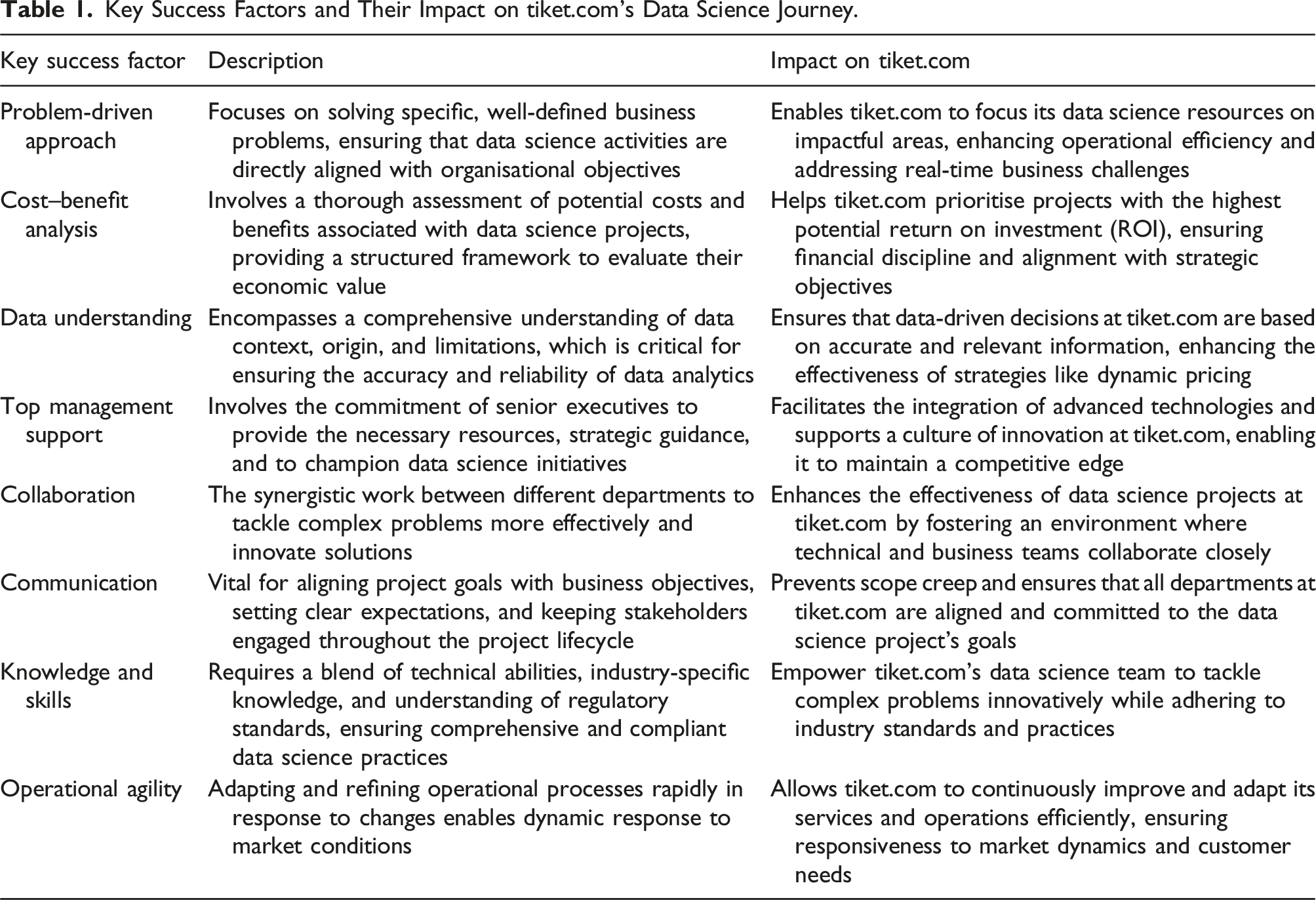
Key Success Factors and Their Impact on tiket.com’s Data Science Journey.
Concluding discussions: Challenges of data science journey in OTA
In theory, data science comprises the overarching principles to support and guide information and knowledge extraction from a given dataset (Provost and Fawcett, 2013). The trajectory of data science journey often leads to tackling the business needs that require end-to-end AI based solutions and automations to support decision-making with certain confidence levels. To the best of our knowledge and observations, there are several key challenges of navigating data science journey in OTA, which can be distinctively different from other industries. The first immediate challenge is related to the unique nature of data that is associated with dynamic seasonality and users’ travel needs with diverse preferences. Especially with the shifting behaviours of users due to the post-pandemic situation where people started to perform ‘revenge travel’ and being flexible to work from anywhere. Hence, special techniques are required to solve the data science problems within the travel industry. Although tourism has a larger percentage of publications than hospitality in terms of machine learning topics as previously explored by Rita et al. (2018), the problems covered within the current literature given the context of OTA and AI applications are still limited. Similar problem definitions and machine learning techniques applied to other domains may not be entirely suitable for OTA applications. One of next challenges to navigate a data science journey in OTA would be the intrinsic characteristic of problems that are often intertwined with customers’ purchase intention (based on several control variables of age, income, and gender) in OTA platforms that should impact the core customer value perceptions consisting of functional, social, and emotional values in a research model proposed by Shi et al. (2022). Hence, data science projects and their solutions constantly have to tailor the notion of purchase intention supported by ever-changing customer behaviours, which could result in misalignment for business expectation due to the prevalent concept drift and data drift.
Discussion Questions
(1) How does the problem-driven approach influence the strategic alignment of data science and AI projects in organisations such as tiket.com? (2) Discuss the role and importance of cost–benefit analysis in the planning and executing data science and AI projects. (3) Evaluate the impact of top management support on the success of data science and AI initiatives. (4) How does the company ensure effective collaboration and communication in data science and AI projects? What are the benefits of such practices? (5) Analyse the significance of data understanding in the company’s approach to data science.
Conclusion
The success of data science and AI projects within organisations hinges on a comprehensive understanding of multiple intersecting factors spanning technical, organisational, and business dimensions. Our case elaborated on these complex layers, centred on the strategic utilisation of data science in an OTA. We identified eight essential factors that were pivotal in successfully implementing data science initiatives. These factors range from the technical prowess of the team to the cultural and structural readiness of the organisation to integrate data-driven insights into their decision-making processes. Understanding these key factors provides actionable insights that can significantly enhance the effectiveness and impact of data science and AI projects in any organisational setting.
Footnotes
Declaration of conflicting interests
The author(s) declared no potential conflicts of interest with respect to the research, authorship, and/or publication of this article.
Funding
The author(s) disclosed receipt of the following financial support for the research, authorship, and/or publication of this article: This work was supported by the Unika Atma Jaya Catholic University of Indonesia Decentralised Research Grant, Award Number: 129.18/III/LPPM-PM.10.01/03/2024.
