



Abstract
In 2023, ByteDance, a prominent Chinese technology firm, rose to entrepreneurship prominence. It is the world's leading start-up, with a market capitalization of over $353 billion. This case study examines ByteDance’s remarkable journey from humble beginnings to rapid ascent to global fame. The case discusses the strategic importance of its flagship products, TikTok and Toutiao. Many innovative technologies and pivotal offerings have placed ByteDance alongside significant players such as Google and Facebook. The case navigates through the numerous obstacles encountered by ByteDance, encompassing the intense competition in the global technology industry and the imminent uncertainties posed by a constantly evolving future. Our case reflects the company's unwavering commitment, forward-thinking vision, and innovative technologies. The case also analyses how ByteDance has maintained its competitive advantage through cutting-edge technologies and visionary innovations. It illustrates the company's commitment to excellence and innovation as essential to its success. ByteDance's narrative is a remarkable depiction of success despite adversity, demonstrating the company’s exceptional achievements.
Introduction
The COVID-19 pandemic has significantly affected individuals' daily routines and the global tourism sector, resulting in a notable surge in digital activities, particularly within social media (Saud et al., 2020; Škare et al., 2021; Wong et al., 2021). The observed upswing can be attributed to the availability of more leisure time resulting from travel limitations, leading to a notable increase in the creation of content and the cultivation of a vibrant digital landscape. Social media has remarkable global and instantaneous information-sharing capabilities. Organizations have strategically adjusted their approaches by diverting from conventional media channels and adopting social media platforms, acknowledging their inherent potential (Shekhar et al., 2023; Suttikun et al., 2023). This shift has been augmented by the network effect, leading to increased reliance on these platforms.
The acknowledgment of social media’s revenue generation potential is growing as the physical and digital realms continue to converge, enabling enhanced connections and communication (Mason et al., 2021). The immense possibilities presented by social media’s extensive reach and influential power motivate businesses to harness this potential to expand their operations and enhance profitability (Mason et al., 2021; Saud et al., 2020). As a result, they are reevaluating their strategic approach and ushering in a new era of digital commerce.
Within the landscape of trailblazers in the current era of interconnectedness, ByteDance distinguishes itself through its distinctive AI-driven methodology (Brennan et al., 2020). The ascent of ByteDance is a testament to the unexplored possibilities and significant influence of social media on the trajectory of the upcoming times. Their digital interfaces, such as TikTok and Toutiao, provide customized user experiences that foster innovation and active involvement. Their forward-thinking approach showcases the disruptive capabilities of digital innovation, underscoring the viability of user-centric innovation that can effectively compete with established industry leaders in a rapidly changing digital industry.
This case study examines ByteDance’s rise to global prominence through innovative technology, and its unwavering determination. It emphasizes a company's commitment to constant innovation as a driving principle behind its achievements. Despite considerable challenges, ByteDance's progressive mindset and dedication to technology have allowed it to maintain a competitive edge amid digital changes. The ByteDance journey, marked by its excellence and groundbreaking advancements, showcases noteworthy achievements against significant odds.
Humble Beginnings
Established in 2012 under the leadership of software developer Zhang Yiming, ByteDance has rapidly emerged as a pioneering force in digital innovation (Feng and Cu, 2021). This is primarily attributed to Zhang's visionary perspective on the transformative role of smartphones, supplanting conventional newspapers as paramount sources of information. Consequently, Jinri Toutiao was developed to serve as ByteDance's prominent application (Kuai et al., 2022). This app is an AI-driven content recommendation platform that delivers customized content to users (Perez, 2020). Despite its innovative strategy, Toutiao encountered initial difficulties, such as establishing a unique market position with competitors, such as Tencent News and Baidu News, and devising a sustainable revenue model as users became more resistant to intrusive advertisements (N. Liu and Shepherd, 2019).
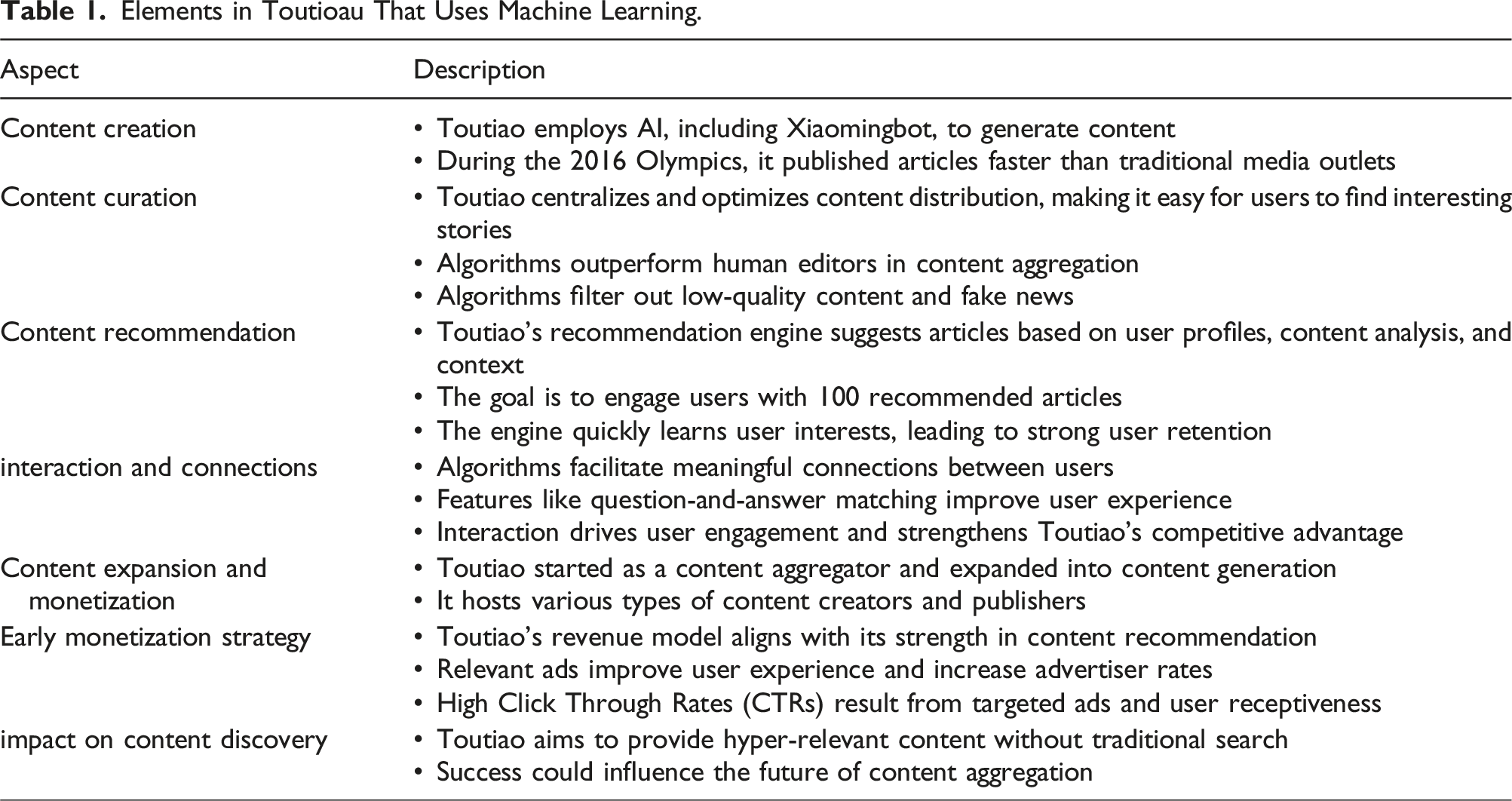
ByteDance's strategic approach was to tailor Toutiao's content distribution mechanism to enhance user engagement and optimize advertising precision (Kuai et al., 2022; Xu and Flew, 2022). The application employs advanced data analysis techniques to deliver personalized content-based on individual preferences, thereby augmenting user involvement. To enhance the efficiency of content distribution, Toutiao utilized AI technology to aggregate current news updates from a network of more than 4,000 affiliated websites (Kuai et al., 2022). The app initially experienced a constrained user base; however, through sophisticated deep learning algorithms, improvements were made to its content recommendation and filtering mechanisms, resulting in increased user influx. It employs a blended approach that merges content-based and collaborative filtering techniques, thereby delivering a tailored and holistic user experience.
ByteDance utilizes data-driven analysis to customize advertising targeting the Toutiao platform. Employing user data for personalized advertising improved user satisfaction and amplified ad click-through rates, resulting in revenue growth. ByteDance implemented strategies to enhance Toutiao’s financial viability by integrating an e-commerce platform and facilitating in-app transactions that resulted in heightened user interaction and amplified revenue generation. Zhang Yiming emphasized that Toutiao's recommendation system prioritizes user preferences and strives to maintain a harmonious blend of content consumption and contributions. This approach guarantees diverse and balanced content selection, consequently fostering the expansion of the user community.
The platform employs advanced algorithms to detect and eliminate subpar content, thereby augmenting the overall user experience. The recommendation system leverages the collected data, including user preferences and recent views, to curate tailored content feed. Customized news feed has received commendation for its convenience, effectively obviating users' need to manually search for a wide range of articles, and has played a vital role in driving Toutiao's noteworthy expansion. With the expansion of the user base, the advertising revenue potential of ByteDance has increased proportionally, positioning advertising as the predominant source of revenue for Toutiao.
ByteDance prioritized optimizing the user experience of Toutiao by implementing an intuitive interface, sophisticated search functionalities, and a wide array of content choices. As a result, Toutiao established itself as a prominent news aggregation platform in China, with a substantial user base of over 300 million active users daily, generating billions of dollars in annual revenue. ByteDance's adept utilization of data-driven insights in product development is evident in the notable achievements of Toutiao's successful transformation. While ByteDance has expanded into various verticals, it must be noted that Jinri Toutiao continues to serve as a fundamental pillar of its brand identity. The company has implemented its core principle of tailor-made content delivery utilizing AI technology on globally renowned platforms, such as TikTok (Jennings, 2019). Despite exponential growth, ByteDance remains committed to upholding its initial vision, demonstrating Zhang Yiming's foundational principles, and effectively adapting to the ever-changing digital realm.
Rise to prominence & copyright saga
Over time, Toutiao witnessed an unparalleled surge in popularity within China, rapidly emerging as a leading application in the Chinese App Store. As the influence of Toutiao grew, ByteDance began garnering significant attention and interest from investors. Enterprises worldwide have begun to acknowledge the inherent potential of Toutiao and its prospects for subsequent advancements (Chang et al., 2021; Hariharan, 2023). Toutiao achieved a remarkable milestone in 2016, attesting to its significant rise in popularity. The platform garnered an impressive daily active user base of 120 million users, which spent 74 minutes every day in 2023 (Hariharan, 2023).
Nevertheless, exponential expansion is accompanied by an inaugural obstacle for ByteDance. Owing to Toutiao's role as an intermediary, collating news articles from diverse sources on its platform, it inadvertently initiated a series of copyright infringement and plagiarism disputes (Wangshu, 2016). Primary news channels have encountered a substantial decline in audience engagement, resulting in widespread discontent. ByteDance implemented a strategic course of action to address these concerns and enhance its standing. It formed strategic alliances with thousands of media entities to leverage its news sources, effectively turning a potentially detrimental scenario into mutually beneficial collaboration. 1 This measure has been widely supported and viewed as a dependable and feasible solution, showcasing ByteDance's ability to swiftly adapt and strategically address challenges.
Xiaomingbot, the world’s first multilingual robot news reporter
In 2016, ByteDance, a prominent technology enterprise, delivered a pioneering exhibition exemplifying the effective utilization of AI within journalism. Within the Rio Olympics, ByteDance unveiled Xiaomingbot. This is an intelligent software robot with a wide range of abilities. It operates in multiple languages and uses various modes of communication. It excels in four essential functions: generating news content, translating news articles, reading news aloud, and creating animated avatars for news presentations (Xu et al., 2020). Robots can efficiently produce and disseminate a substantial number of articles. This groundbreaking implementation of AI provided a persuasive glimpse into the upcoming advancements in generating and distributing news, showcasing fascinating prospects in AI-powered journalism (Huang, 2016).
Amidst the intricacies of the news and journalism landscape, ByteDance identified a substantial hurdle: leverage exerted by news providers. These providers play a critical role in the content-creation process and have the capacity to impact ByteDance's standing in the industry. To proactively manage potential risks and enhance content supply, ByteDance initiated a formidable endeavor called Xiaomingbot (Xu et al., 2020). The main objective of this endeavor was to consistently produce proprietary news content, thereby decreasing the dependence on external sources. Xiaomingbot serves as a demonstration of the remarkable capabilities of state-of-the-art text generation algorithms. This AI system leverages a template-driven table-to-text model to autonomously generate news articles based on structured data. Furthermore, it utilizes Bidirectional Encoder Representations from Transformers (BERT-based) to generate abstracts or summaries of articles (Xu et al., 2020). These advanced algorithms enable Xiaomingbot to generate informative and succinct news content efficiently, positioning it as a reliable news source.
In contemporary international landscapes, the news must transcend linguistic barriers. Xiaomingbot has an exceptional proficiency in multiple languages. It leverages a state-of-the-art transformer-based machine translation model to facilitate efficient translation of international content into Mandarin. This new advancement amplifies Xiaomingbot’s international appeal by granting Mandarin-speaking users convenient access to foreign news. In addition to generating and translating news, Xiaomingbot is at the forefront of pioneering AI capabilities for news delivery. Utilizing a Text-to-Speech (TTS) model trained on a concise dataset of recorded voices, an AI system can effectively articulate news articles across multiple languages (Wang et al., 2022). Incorporating an advanced sequence-to-sequence (seq2seq) 2 model and supplementary algorithms such as normal mapping facilitates the generation of synchronized avatar animation that emulates the behavior of a news broadcaster (Feng et al., 2023). The integration of synchronized audio and visual animation enhances the immersive nature of news consumption.
Elements in Toutioau That Uses Machine Learning.
Fierce competition
The rise of ByteDance and the rapid expansion of its news aggregation app, Toutiao, have triggered competitive dynamics in the industry, leading competitors to compete for a portion of the growing market. Tencent Group established itself as a formidable competitor. Tencent, the owner of WeChat, is a widely used Chinese application with an extensive user base of over one billion and possesses a substantial strategic edge. The organization successfully created Tencent News, an innovative platform that enables seamless navigation by WeChat users to access news content by inputting pertinent search keywords. The seamless integration of WeChat and Tencent News users, considering WeChat’s exponential user base, offers Tencent News an exceptional platform for growth (Shen, 2020). This strategic merger has the potential to pose a challenge to ByteDance’s current market position (Liu and Liu, 2020).
Given this emerging competition, ByteDance was compelled to reassess its corporate strategy. Toutiao's personalized news feeds leveraged sophisticated AI algorithms to deliver distinctive value propositions. Nevertheless, because of its seamless integration with WeChat, ByteDance must demonstrate strategic adaptability in response to Tencent News’s competitive advantage. Simultaneously, ByteDance has extended its online presence by introducing TikTok and Douyin, its domestic equivalent platforms that have garnered global recognition because of their highly regarded condensed mobile video content. However, owing to the intense competition posed by Tencent's comprehensive news platform, ByteDance is compelled to explore alternative sources of revenue and potentially re-evaluate its approach to the market (Liu and Liu, 2020). The continuously evolving competitive dynamics observed between Tencent and ByteDance offers significant insights into strategic maneuvers within the rapidly evolving landscape of news and social media platforms.
Musical.ly and douyin
“The Social Media industry is very interesting as unlike traditional industry where it will be stable after a certain period of establishment, like Laoganma where you just don’t have to change the formula and production, you will survive in the industry for long, the nature of our industry is that we have to keep innovating for new ideas.” - Zhang at a Dialogue in CCTV.
3
In 2017, ByteDance executed a strategic acquisition of Musical.ly, a widely renowned platform for short-form music videos, in a transaction estimated at approximately US$ 1 billion. Since its inception in 2014, Musical.ly has experienced significant growth, achieving top rankings on the US App Store and accruing a user base of over 10 million daily active users by 2016. This success can be attributed to the effective targeting of younger audiences and their ability to deliver compelling and concise music content (Muliadi, 2020).
In 2016, ByteDance launched Douyin, a short-form video sharing platform in China, adopting an approach comparable to Musical.ly. Douyin experienced a significant surge in popularity within the Chinese online landscape, presenting a diverse range of captivating succinct videos, typically with a duration of 30 s. This format proved highly effective among audiences in an age characterized by short attention spans and wealth of digital information. Additionally, Douyin's utilization of exclusive deep learning algorithms and a robust recommendation system facilitated customized content distribution, resulting in heightened user interaction and the establishment of Douyin as a standout player in the short-form video content industry (Hao, 2021).
Dealing with cold start
The “Cold Start” phenomenon presents a considerable hurdle for ByteDance, primarily during the initial phases of introducing new applications (Du et al., 2020; Zhao et al., 2019). This challenge pertains to the ability of recommendation systems to provide precise suggestions to users with limited data. ByteDance needs to focus on resolving this issue because the company relies heavily on leveraging data-driven personalization to effectively engage its user base. The company adopted a diversified strategy to address this issue, encompassing the collection of initial user preferences, leveraging common user behavior patterns, and employing content-based filtering techniques. To address the Cold Start issue, ByteDance effectively applies the insights gained from its highly acclaimed product, Toutiao (Perez, 2020).
The procedure commences with a preliminary user survey aimed at unveiling distinct preferences, thereby facilitating the provision of personalized content from the outset. As users engage with the platform, ByteDance employs sophisticated deep learning algorithms and recommendation systems to track and analyze user engagement patterns encompassing factors such as viewing preferences, duration of content consumption, and genre inclinations. Rigorous examination of the data facilitates the development of a customized content feed, which is expertly curated to match the unique preferences of every user.
The algorithm developed by ByteDance possesses distinctive features that can mitigate bias, thereby establishing a beneficial ecosystem for exceptional content creators that operate beyond established norms. This particular strategy facilitates the ability of content creators to captivate audiences and garner the following objectives often met with increased difficulty on alternative platforms: By implementing this approach, ByteDance adeptly addressed the challenge of the Cold Start issue, thereby augmenting user satisfaction and cultivating a multifaceted and lively content ecosystem.
Taking on the global stage
“In this era, China itself has opportunities, but only by taking advantage of a global configuration can it achieve better results. The marginal cost of internet businesses drops rapidly. With the same investment, if the population of other markets is five times that of yours, you cannot sustain long-term competition.” Zhang during a Dialogue at Tsinghua University (Li and Bo, 2018)
As part of a strategic initiative to streamline its user base and enhance operational efficiency, ByteDance integrated Douyin and Musical.ly, resulting in the introduction of TikTok in the US and East Asian markets in 2017, while maintaining Douyin as an independent brand in China. The launch signified a momentous achievement for ByteDance, effectively facilitating the international expansion objectives set forth by its esteemed founder Zhang Yiming. Despite encountering regulatory challenges, such as a prohibition in India and potential comparable measures in the US, ByteDance demonstrated commendable user engagement and achieved a significant annual revenue of $35 billion by 2020 (Z. Huang, 2021).
This significant increase can primarily be attributed to the circumstances engendered by the COVID-19 pandemic. ByteDance leveraged the heightened availability of leisure time resulting from widespread lockdowns and remote work, culminating in a significant upswing in user engagement and subsequent expansion of online advertising. Amidst the ongoing global challenges, ByteDance skilfully leveraged these circumstances, effectively establishing itself as a prominent contender in the digital content realm.
Challenges faced
ByteDance has implemented a strategic shift in its advertising methodology as it has adopted a novel approach for TikTok. Rather than incorporating intrusive pop-up advertisements commonly encountered on platforms such as Toutiao and Douyin, ByteDance adopted a more inventive strategy. This alternative approach revolves around fostering business-to-business (B2B) alliances with the primary objective of enhancing user experience and fostering engagement rather than causing interruptions. Businesses actively participate in TikTok by creating sponsored and branded content, often leveraging popular hashtags to enhance their online presence (Sherman, 2020). They can also establish direct connections with their landing pages, thereby converting user engagement into a potential business prospect. This innovative framework offers enterprises a robust platform for accessing a vast audience and guarantees a seamless and delightful user experience.
In addition, ByteDance has implemented a digital currency system on the TikTok platform. Users are allowed to express their gratitude towards their preferred content creators by donating virtual gifts, which are conveniently available for purchase using this currency. This strategy enables users to provide direct support to the creators they admire and generates an additional source of revenue for TikTok by retaining the percentage of each transaction. However, the rapid expansion of ByteDance has resulted in several hurdles. The magnitude of its operations and swiftly evolving dynamics of the digital content industry have presented significant challenges to founder Zhang Yiming. Consequently, ByteDance is currently confronted with potential risks and challenges that have the potential to disrupt its established revenue streams and threaten its ongoing achievements. Confronting these challenges successfully, while upholding the company's culture of innovation and unwavering dedication to meeting user needs, will determine the path forward for its future.
Data privacy and security controversies
The utilization of ByteDance's advanced deep learning algorithms on platforms such as TikTok and Toutiao, which personalize user experiences, has engendered apprehension regarding data privacy and security. These concerns stem from the algorithms' heavy reliance on a broad range of personal data, including the GPS location, biometric information, and payment details. The inappropriate use of this sensitive information, particularly in international relations, has generated concerns. There are growing concerns, particularly within the United States, regarding the potential exploitation of TikTok's data by the Chinese government to engage in political espionage or leverage it to blackmail American leaders. The convergence of technology and politics has given rise to skepticism regarding the possible exploitation of user data (Musil, 2021). The credibility of TikTok's data security protocols is further questioned by recent findings from the cybersecurity company Check Point, which uncovered several vulnerabilities in the platform that could jeopardize user privacy. 4
ByteDance has experienced significant financial and legal consequences, owing to the aforementioned data privacy and security concerns (Hamilton, 2020). The organization was compelled to reach a settlement of $92 million due to legal action over privacy infringements affecting individuals within the United States (Shepardson and Wang, 2021). Additionally, ByteDance faces potential legal scrutiny from the European Union (EU) regarding allegations surrounding insufficient safeguards to protect children's data (Leskin, 2020). These legal matters emphasize the increasing need to address data privacy and security concerns in light of the proliferation of AI and deep learning algorithms.
Protecting TikTok users
The immense popularity of TikTok, coupled with its large number of underage users, presents distinctive obstacles for ByteDance in safeguarding its well-being. Trends such as the “Blackout Challenge,” which advocates self-asphyxiation, present significant safety hazards. An unfortunate occurrence in Italy, which resulted in the unfortunate demise of a participant who was just 10 years old, has sparked worldwide examinations and a demand for enhanced age verification procedures (France-Presse, 2021). ByteDance has faced significant scrutiny owing to concerns regarding its alleged inadequate monitoring of harmful trends that could potentially impact vulnerable users, along with the apparent ease with which minors can bypass age restrictions.
Additional safety considerations are raised because of the potential exploitation of the platform by unauthorized individuals. The “Silhouette Challenge,” originally intended as a body positivity movement, has raised concerns regarding privacy and security in light of reports suggesting that hackers can remove the red filter utilized in the challenge, thus exposing participants' identities (Wilkins, 2021). The existence of tutorial videos available on the Internet that provide instructions to circumvent this filtering mechanism has intensified concerns. Although it is difficult to ascertain the precise magnitude of these hacks, such speculations have the potential to undermine user confidence and tarnish TikTok's reputation. This could result in diminished user interaction and widespread concerns regarding the platform’s data protection measures and privacy practices.
Uncertainties and disputes
“We do not yet know the exact details of what our end solution will be. Candidly, it is unlikely that the level of interest and speculation around TikTok will cease in the short term, and I recognize that this can be very distracting.” Zhang explained the situation to the US authorities (Chen, 2020).
The operations of ByteDance have been significantly affected by geopolitical dynamics, especially between China and other nations. Notably, the ongoing border tensions between China and India have led to an indefinite TikTok ban in India, significantly hampering ByteDance's growth owing to the loss of its substantial Indian user base (Khan, 2020). Despite efforts to remain relevant in the Indian digital market through the 2018 launch of Helo, a social media platform tailored for Indian users, the broad prohibition of the Indian government also covered this platform. In the U.S., former President Trump's attempts to ban TikTok or force its divestiture due to concerns over user data access and misinformation have left the app's future uncertain under President Biden's administration (McMillan et al., 2020).
The Stage of bytedance’s Business Journey.

Looking into the future
Douyin, which serves as ByteDance's primary source of income, mirrors the functionalities of TikTok while capitalizing on China's thriving e-commerce landscape. This enables brands and retailers to engage in direct sales by leveraging the video content to convert viewers into customers. The active Douyin community employs a virtual currency framework that enables users to support preferred creators by utilizing purchases and donations facilitated by popular third-party payment platforms, such as Alipay and WeChat Pay. In 2021, ByteDance introduced Douyin Pay, an integrated payment solution within its application, thereby diminishing reliance on external third-party payment platforms. This strategic plan was implemented by acquiring Wuhan Hezhong Yibao Technology Co., a company with a third-party payment license (“China’s ByteDance Buys UIPay to Leverage e-Payment Capabilities at Home,” 2020). This license empowers ByteDance to operate its own payment system effectively.
The 2021 Spring Festival Gala served as a platform to significantly enhance the visibility of Douyin Pay, courtesy of a substantial $186 million sponsorship from ByteDance (Hao, 2021). Douyin implemented a strategic incentivization initiative during the event, which significantly enhanced the visibility and uptake of its services among its extensive global audience of 1.4 billion. Douyin Pay ’s introductionaligns with ByteDance's strategy of solidifying its presence in the Chinese mobile payment industry, thereby establishing versatile groundwork for future international growth through TikTok (“TikTok Owner ByteDance Launches Douyin Pay, Mobile Payment Service for China,” 2021).
In addition, ByteDance has entered the lucrative gaming sector, which is the largest industry globally, amassing commendable revenue of $40.85 billion in 2020 (Liao, 2021). By utilizing the industry intelligence gathered from rival companies, ByteDance successfully created a wide range of game titles, surpassing the previous trend of focusing solely on a specific gaming genre. ByteDance’s proficiency in developing interconnected gaming experiences enhances the unity and sense of community within the TikTok platform. By employing advanced AI technology, ByteDance successfully captures and analyzes user preferences, thereby enhancing the delivery of personalized game recommendations. This is achieved by utilizing powerful machine learning capabilities, contributing to their game portfolio design and continual enhancement.
The ongoing trade dispute between China and the United States poses notable obstacles for Chinese technology enterprises, particularly the restrictions imposed on Huawei. This significantly disrupts the ability of a company to procure critical semiconductor components. The significant disparity between China's $143 billion chip imports and its relatively smaller domestic production of $31 billion effectively highlights the impact of the imposed sanctions. In light of the situation, the Chinese government emphasizes the importance of tech companies achieving self-sufficiency in the semiconductor domain (Yang and Munroe, 2021). Consequently, influential entities such as ByteDance and Baidu are encouraged to produce their AI chips. ByteDance is currently engaged in the investigation and development of AI chips intended to enhance cloud computing capabilities with the objective of augmenting data processing efficiency and performance. By expanding its semiconductor portfolio, ByteDance mitigates reliance on external suppliers and strategically enters the burgeoning AI chip sector, which is forecasted to expand to $19.1 billion by 2024 (“TikTok Owner ByteDance Makes Foray into AI Chipset amid In-House R&D Wave,” 2021). The pursuit of AI and semiconductor self-sufficiency can potentially revolutionize the prospects of ByteDance in complex geopolitical circumstances.
Discussion questions
1. Explore the Six Thinking Hats technique to brainstorm several strategies which may be applied to effectively understand the ByteDance business model. How can you use the technique to experience critical thinking including problem-solving, argumentation, comprehensive planning, and a creative thought process to analyze the various stages ByteDance’s business lifecycle? 2. How has ByteDance navigated its business journey through different stages, and what strategic decisions, technological advancements, and responses to challenges have been key to its growth and resilience? 3. How does ByteDance navigate the Volatility, Uncertainty, Complexity, Ambiguity (VUCA) landscape in the tech industry, and what strategies do it employ to manage the challenges and uncertainties inherent in its business environment? 4. Based on the Strengths, Weaknesses, Opportunities and Threats (SWOT) analysis of ByteDance, how can a company leverage its strengths and opportunities while mitigating weaknesses and threats to maintain a competitive edge in the rapidly evolving tech industry? 5. Given the Political, Economic, Social, Technological, Environmental and Legal (PESTEL) analysis of ByteDance, how can a company strategically navigate political, economic, sociocultural, technological, environmental, and legal challenges to ensure sustained growth and success in the global tech industry? 6. In the context of ByteDance's strategic approach to managing the VUCA environment and considering its SWOT and PESTEL analyses, how can the company leverage its core competencies to ensure sustainable growth and success in potential future sectors? Moreover, what strategies should ByteDance employ to mitigate the challenges and maximize the opportunities presented by these new ventures in the increasingly volatile and uncertain global business landscape?
Conclusion
With the continuous growth of TikTok and Toutiao, ByteDance is expected to maintain a significant position as the world's most valuable start-up. The global community eagerly awaits the official announcement of ByteDance's forthcoming Initial Public Offering (IPO), an event destined to commemorate a noteworthy milestone in the company's trajectory. Taking a more expansive view, the forthcoming initial public offering compels us to deliberate on the future trajectory of this highly valued and innovative start-up. ByteDance firmly established itself as a prominent player in the technology sector, showcasing its remarkable expertise and leadership in the industry.
However, a crucial concern is whether ByteDance can maintain commitment to innovation and consistently foster new concepts to evade stagnation. A company's long-term success is contingent on its consistent capacity to innovate and remain proactive, thus preventing the onset of complacency in the market. The global community will closely observe whether ByteDance, leveraging its dedication to groundbreaking advancements and a meticulous strategic approach, can fully realize its potential as a formidable brand capable of disrupting the well-established Chinese Trinity of BAT (Baidu, Alibaba, TenCent). The fluid nature of the technology sector introduces inherent unpredictability when making projections. However, it is undeniable that ByteDance can significantly reshape this industry. Only the passage of time determines whether ByteDance can establish itself as a leader in the industry and redefine industry norms.
Footnotes
Declaration of conflicting interests
The author(s) declared no potential conflicts of interest with respect to the research, authorship, and/or publication of this article.
Funding
The author(s) received no financial support for the research, authorship, and/or publication of this article.
