




Abstract
This case study discusses the concept of big data analytics, which involves managing and analyzing large, complex data to discover patterns and insights. Implementing big data analytics has many benefits, such as improving decision-making processes, enhancing accounting processes and compliance, boosting marketing campaigns, and providing better credit risk assessment procedures. This case study aims for the student to understand the challenges of big data analytics implementation in a Malaysian commercial bank. Students take on the role of a Senior IT Manager who needs to consider solutions to the implementation problems. Although the team proposed using cloud-based services as a solution to these issues, the CEO expressed concerns about security risks and requested other alternative solutions. The team has also been requested to come up with solutions to the data quality issues experienced by the case study bank.
Keywords
Introduction
What is big data analytics?
Imagine you can retrieve internally from your database millions of records of transactions per day. In addition, you also have access to external data sources from which you can make your decisions. For example, a bank might use non-traditional external data sources, such as third-party credit ratings, utility bills, and rent payments, to determine the creditworthiness of a customer applying for a credit card.
The five characteristics of big data in the context of the banking system.
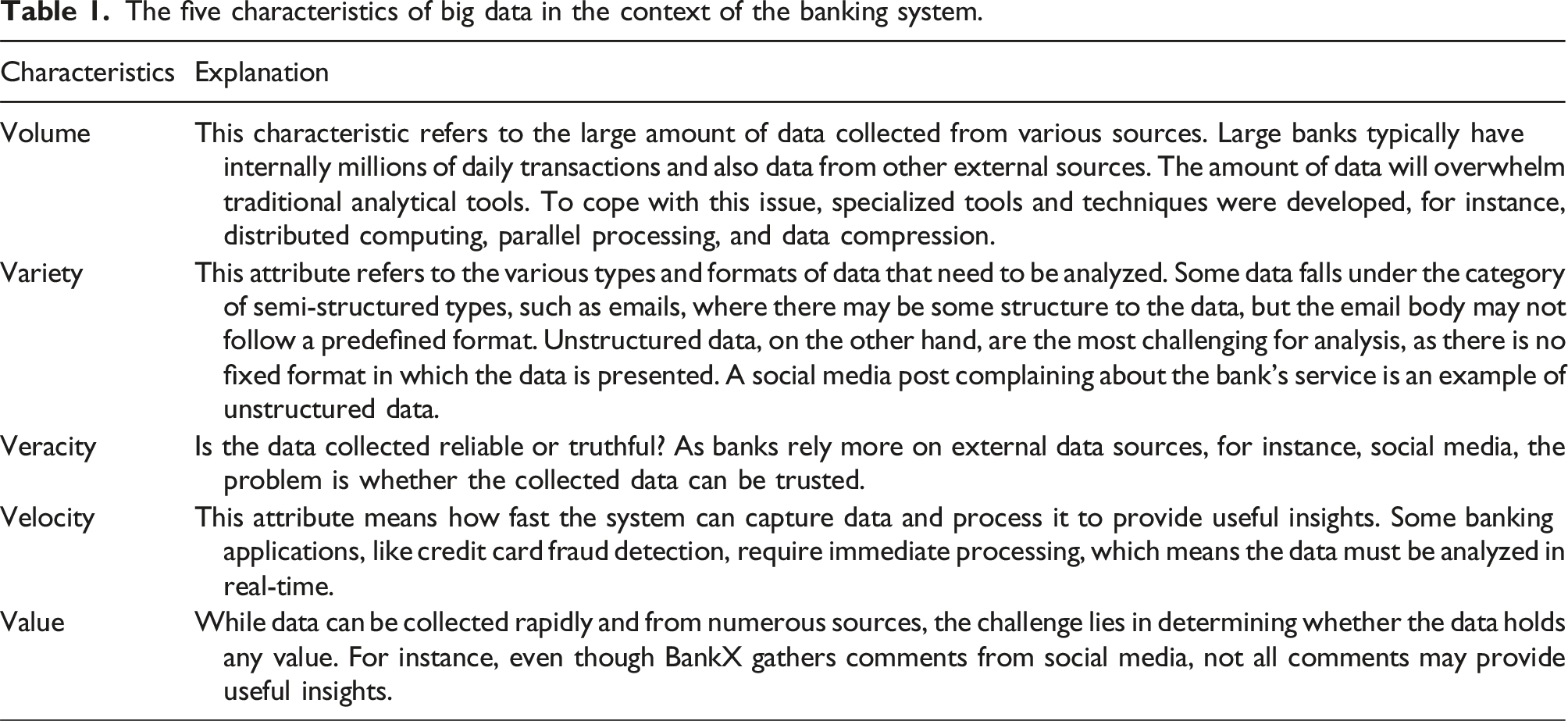
This case study aims to develop students’ critical thinking and problem-solving skills by presenting them with a real-world scenario that requires them to solve the problems of big data analytics implementation. The objectives of this case study are: 1. To examine the impact of big data analytics; 2. To understand some of the issues in implementing big data analytics; 3. To assess the benefits and risks of using cloud-based services to address those problems; and 4. To provide alternative solutions besides cloud-based services to overcome those issues. 5. To understand the importance of data quality and provide solutions to address the data quality issues of BankX.
It is essential for students to recognize the issues and risks of implementation to understand that the benefits derived from big data analytics (and most IT solutions) are not always straightforward and that there are challenges and risks involved.
Background of the case study
BankX is a Malaysian commercial bank that provides a wide range of banking and financial services. It has branches in all of the 10 ASEAN (Association of Southeast Asian Nations) countries: Malaysia, Singapore, Indonesia, Thailand, Vietnam, Thailand, Philippines, Laos, Brunei, and Cambodia. It is one of the ASEAN region’s largest banks and one of the biggest Islamic banks in the world. After expansion into the ASEAN region in 2018, BankX wants to continue its growth and protect its market position by adopting new innovative technologies.
However, despite BankX’s dominant position in the Malaysian and ASEAN region, it faces severe pressure from FinTech startups and other conventional banks as they adopt new technologies to chip away at BankX’s position. FinTech startups are typically small technology organizations that may not necessarily have the regulatory, legacy, and size burdens that conventional banks normally face in adopting innovations. FinTech startups are seen as competitors to traditional banks since they offer some financial services that banks typically provide, such as digital banking, lending, and investment.
Big data analytics has gained popularity recently because many companies recognize its benefits. BankX has also realized that big data analytics can improve its decision-making processes, streamline accounting processes and operations, and offer its customers more personalized financial services to stay ahead of its competitors.
As a service-oriented industry, BankX understands the importance of keeping up with the ever-changing needs and expectations of its customers. By automating the analysis of customer data, BankX can gain a better understanding of its customers and make more informed decisions. For example, if BankX identified customers that travel a lot, BankX could target those customers with its “Platinum Travel Card” and “Travel Plus” insurance offers.
Moreover, BankX can use customer data to enhance its marketing campaigns. By analyzing data such as age, employment, education, income level, savings, loans, and investments, BankX can tailor its investment products, like unit trusts, e-Gold investments, or fixed income investments, to the most relevant customers, instead of marketing to all customer segments haphazardly.
Another benefit that BankX could gain is the enhancement of its credit risk assessment procedures. By evaluating data such as credit scores, payment histories, education levels, employment information, and utility payment histories, BankX can more accurately determine the creditworthiness of new loan applicants or accounting for the credit risk of existing customers.
Given the above mentioned benefits, BankX actively implemented big data analytics through various planned activities. To begin with, implementing big data analytics was a strategic decision. It was incorporated as a 4-year plan in BankX starting in 2018. BankX also made several structural changes to increase data-driven transformation efforts by introducing new sections for Extract, Transform, Load activities that involve piping data to the analytical layer for analytics purposes. BankX introduced a new stream within its organization called the analytics stream that worked on web-analytic activities. It also introduced new roles, teams, and departments to mobilize big data analytics activities. Furthermore, it also started streamlining its activities with regard to data by various measures ranging from upskilling staff, integrating data in a central data warehouse, and starting the sandbox incubator program. BankX hopes that by making these significant changes to its operating environment and structure, it can realize the full potential of big data analytics.
In this case study, you take on the role of the Senior IT Manager of BankX. You are part of the steering committee that oversees the big data analytics implementation project.
The implementation issues
As your team started to implement big data, your team encountered various problems. The first issue is the number of legacy systems that BankX is using. “The span of this bank has been 40 years; that’s a lot of legacy systems” (Siti Aminah, Director of Analytics Service Provider). “BankX is also the outcome of multiple mergers for the years. So naturally, each bank had its own system and the works. When they merge, they absorb the various systems” (Hafiz, Senior Manager in the Data Governance Department).
“The problem with these various systems is that you can’t pipe data from one system into another directly because there might be data loss in the process” (Hafiz, Senior Manager in the Data Governance Department). This is because if data is transferred between legacy systems without proper conversion, it may not be recognized or interpreted correctly, resulting in data errors.
Your team also has issues integrating the different formats from the legacy systems to a standardized format used by the big data system. “Our core systems are old, but we keep them running. They are simple and fantastic because they do that one job well. They also contain the business [process] logic that we are so accustomed to. But if you try to combine data [from different systems], that becomes a problem” (Ismail, Managing Director). Besides, legacy systems often have issues with data quality which renders the big data analytics process an expensive and lengthy affair to clean and transform the data into usable form. “Data quality is a big problem around legacy systems. And these challenges are there because the data was never seen in the past as a very important part of doing business, and the systems that were built in banks were built to be like mono-line businesses” (Ismail, Managing Director).
Any system migration from the old system to integrating multiple systems takes time. It is usually done during an offline maintenance period when customers cannot use the bank’s online system. As system migration affects system uptime, transformation can take years. Your team struggles to make quick and significant progress in implementing BankX’s big data analytics plan. The various regulations and complexity of the banking work practice is a frustrating stumbling block. Ismail, the managing director of BankX, states, “It’s very tedious and very painful for a bank to put anything in production.” When data modelers build a model for any process optimization, the time taken for this model to be put into operation or production can take up to a year. Alan Tham, the senior manager of data strategy and modeling, mentioned, “So I think there’s a long story short is probably how do we move fast? From the experimentation stage to start going system live.”
The CEO Ahmad stated, “It’s just that you need to go through the bank process. It may take a few months.” The nature of the work process complexity with long governance and approval procedures in the banking industry makes it less agile compared to newer startups, and the time taken to market a product and implement a process is very long. Working with several divisions or departments, sitting in committees, and the lengthy process of getting approvals from the Malaysian Central Bank was among the reasons cited for delays.
The proposed solutions
The board members and your team discuss possible workable solutions to mitigate previously mentioned problems. One of the solutions mentioned is using cloud-based services.
Siti Aminah, the Director of Analytics Service Provider, “We should move to the cloud as it allows us to have a single data repository that we can synchronize data from our various legacy systems.”
You also mentioned that the cloud-based system allows BankX to synchronize and obtain data from various locations. You added that cloud-based services would allow BankX to integrate easily with big data analytics tools, such as fraud detection. The legacy systems were not easily modifiable, were incompatible with modern systems, and were not designed for more modern purposes, such as big data analytics.
Ahmad, the CEO, has some concerns about the proposed solutions, “Ok, you gave me the benefits of the cloud-based services. What about the risks associated with this solution? I heard that security could be a major issue. You people only provided one solution. What are the other alternatives?”
Suggested assignment questions
1. The case study highlighted the big data analytics’ benefits to the bank. What about the banking customers? How would they be positively and negatively affected by big data analytics? 2. The case study highlighted the problems associated with big data analytics implementation. Your team came up with a cloud-based service. Besides what was mentioned in the case study text, what are the other benefits of cloud-based services to big data analytics? 3. Do you agree with Ahmad, the CEO? What are the risks associated with the recommended cloud-based services? 4. Recommend at least an alternative besides the cloud-based service solution to address the challenges of implementing big data in BankX’s legacy systems and complex work environments. 5. Why is data quality important in big data analytics? Recommend how BankX could help solve its data quality issues.
Footnotes
Acknowledgements
This case study was part of a broader research project that was presented at the Australasian Conference on Information Systems (ACIS) in New Zealand in 2020. We would like to thank the comments and reviews given by reviewers and conference attendees.
Declaration of conflicting interests
The authors declared that there are no potential conflicts of interest with respect to the research, authorship, and/or publication of this article.
Funding
The authors received no financial support for the research, authorship, and/or publication of this article.
Ethics
This project (23314) was approved by the Monash Ethics Committee.
