




Abstract
This paper presents an exploratory case study of the Internet of things in telecommunications to analyze IoT technology in the telecom sector. It examines the IoT value in telecom and discusses the role of telecom operators across the value chain. It also presents a case analysis of IoT adoption in an emerging market of Pakistan to explore the IoT landscape in Pakistan and analyzes the IoT market positioning among telecom operators. It presents the business models and strategies which the telecom operators are following and analyzes the cost and benefits of IoT technology. It also discusses the IoT challenges faced by telecom operators during the adoption of IoT. In an emerging country like Pakistan, telecoms are adopting Internet of things technology, a novel, and real-time phenomenon. They are considering IoT technology as a new business opportunity in emerging markets, with the potential to be utilized as a new source of revenue. Telecoms are focusing on testing their roles in different areas of the IoT value chain. Their primary focus still remains basic connectivity which is evolved into smart connectivity. Telecoms are embracing their resources and capabilities across the IoT value chain, from connectivity to partnership, with innovative, value-added services. They are moving up to the IoT value chain by evolving further as an enabler for devices and enterprise-to-enterprise (E2E) solutions. They are developing partnerships with enterprises for providing various applications, service delivery, and system integration.
Introduction
The Internet of Things (IoT) is quickly evolving into the Internet of Everything. The IoT revolution is reshaping the way humans live and work, and penetrating all aspects of human life. The IoT is an emerging technology that integrates physical devices and systems and allows them to interconnect and communicate over the Internet (Botta et al., 2016; Wortmann and Flüchter, 2015). Machine-to-Machine (M2M) communication, in which devices communicate with one another via a network without the need for human intervention, has spawned the Internet of Things. The IoT takes M2M to the next level by connecting people, systems, and applications to gather, manage, and share data over a network of billions of intelligent devices. M2M enables IoT by providing connectivity. The IoT is a more advanced version of M2M, in which numerous sensors of devices are combined and communicated device data to a central platform, which analyzes the data and delivers valuable information which helps to drive more informed decisions and actions (Aulia & Gunawan, 2019).
The Internet of Things is evolving telecoms’ role in enabling connectivity between objects and people. The IoT’s deployment in telecommunications transforms the dynamics of human-computer interaction. (Jabeen and Ishaq, 2022). The Internet of things is enabling digitization, technological advancement, and innovation in the telecom business through its deployment (Aulia & Gunawan, 2019). The telecom industry is undergoing a digital transformation which is the key driver of new business models, prompting telecom companies to develop new strategies and plans (Mihailović, 2019; Shatila and Gunawan, 2019). With IoT technology, telecom companies are expanding their offerings with novel, innovative services, and solutions and thus gaining a competitive edge in the telecom industry (Shoukry, et al., 2021; Andersson and Mattsson, 2015). They are increasing their portfolio of products and services using IoT that bring value addition to their existing networks (Mashal et al., 2015).
Through digital transformation, the telecom industry improves, advances, and expands its infrastructure, operations, and services using IoT technologies (Yepez and Kim, 2018). The benefits of IoT adoption are being realized by telecoms in the form of improved operational efficiency, upgraded processes, increased revenues, and lower costs and risks (Borgia, 2014; Madakam et al., 2015; Russo et al., 2015; Zhou et al., 2015). However, telecoms also face several challenges in adopting the Internet of Things. Aside from the technical and digital issues that telecom businesses encounter while adopting IoT, other challenges emerge, such as policy, legal, social, and development challenges (Attia, 2019).
Telecom operators are playing an important part in the IoT value chain (Jabeen and Ishaq, 2022). They are playing their roles in different areas of the IoT value chain such as connectivity provider, network provider, platform provider, device provider, and service provider. Through the IoT value chain, telecom operators are providing value addition to their businesses. They are moving up to the IoT value chain by evolving further from basic connectivity to smart connectivity. Moreover, they are developing partnerships with enterprises for providing various services and solutions. Their share of the added value, generated by the IoT, depends on the role they play in the value chain.
Telecom operators in emerging countries are adopting IoT technology as an emerging technology. They are broadening their operations and services, from sim and data sales to innovative IoT-enabled products (Jabeen and Ishaq, 2022). The Internet of Things is considered a new economic opportunity for telecom operators in emerging economies. Telecom operators are integrating their key resources and capabilities with innovative, value-added products and services from telecommunications infrastructure and connectivity as connectivity providers. (Jabeen and Ishaq, 2022). They are building an ecosystem for providing IoT solutions and services under innovative business models in various use cases. Therefore, it is necessary to examine the role of telecom operators in the IoT value chain and in building the IoT ecosystem. Further, it is also important to examine the IoT landscape in emerging markets. It is needed to do cost benefits analysis to assess the current telecom operators’ status in emerging markets. For this, the paper presents an exploratory case study of IoT in telecommunications. It discusses the opportunities and value, the IoT brings to telecoms. It examines the role of telecoms in the IoT value chain and the distribution of value across the IoT value chain. It also presents a case analysis of IoT adoption in an emerging market of Pakistan to explore the IoT landscape in Pakistan and analyzes the IoT market positioning among telecom operators. It examines the business models with business strategies that the telecom operators are adopting across the IoT value chain. It also discusses the benefits realized and challenges faced by telecom operators in Pakistan.
The structure of the paper is followed as: Section 2 presents a case study on the Internet of things and telecommunications, Section 3 presents a case analysis of the Internet of things and telecoms in Pakistan, Section 4 presents a discussion and conclusion, and Section 5 presents implications and limitations.
A case study: Internet of Things and telecommunications
The IoT initiatives in the telecommunications industry bring technological advancement and innovation to the telecom business. IoT technology and its adoption help telecoms in opening new opportunities, generating value, and gaining benefits.
The opportunities IoT opens to telecoms
The world’s technology landscape has been quickly changing during the last decade. Owing to the fourth-generation industrial revolution, technology users can access the digital world. According to IoT analysts, “IoT data marketplaces will unlock $3.6 trillion of annual revenue by 2030 and IoT will be leading the future with more than 100 billion connected devices by 2030” (Attia, 2019). The telecom industry is one of the largest potential players in the IoT market. The telecom industry is one of the leading users of fast-evolving Internet of things (IoT) technologies. According to GSMA, IoT will generate an estimated US$1.8 trillion in revenue for mobile network operators by 2026 and 38.6 billion IoT devices connected to cellular networks globally by 2026, which highlights the massive growth opportunities for the telecom sector.
Telecoms are capitalizing on the growth in the number of IoT devices. Their greatest advantage is the existing infrastructure, which acts as a foundation for developing new 5G and IoT-based solutions and services. Particularly, they have a distinctive opportunity to capitalize on their access to vast volumes of data flowing through their networks. Owing to IoT capabilities, they can gain a competitive edge in the industry by expanding their offering with new, innovative solutions, services, and products to meet the requirements of customers from various vertical markets. Telecoms can take full advantage of the opportunities by developing massive ecosystems of interconnected devices and people, as well as providing seamless communication between them. They may expand a service portfolio with a variety of IoT-enabled services in sectors like smart cities, smart homes, smart manufacturing, smart retail, and others. With new IoT networks, telecoms can create large-scale IoT applications for several use cases, including city parking, city lighting, water and gas metering, safety monitoring, industrial asset tracking, smart grids, and vending machines. They can provide innovative low-cost solutions that use low data rates, have extended battery lives, and can be used in remote regions.
According to the research, the most potential revenue streams for IoT are consumer demand for smart homes (US$441 billion), smart electronics (US$376 billion), and smart car technologies (US$273 billion). 1 However, due to governments and consumers seeking smarter ways to manage utilities, other areas such as smart energy are expected to reach US$128 billion by 2026. By 2026, revenues from smart cities are expected to reach $78 billion.
The adoption of IoT by telecoms enhances their business procedures and increases their revenue generation opportunities. Therefore, they must develop innovative products and applications for monetizing IoT solutions to take advantage of new revenue opportunities and business prospects.
Telecoms are rethinking their strategy and integrating digital into their core business models, particularly in the B2B market, as new revenue-generating opportunities. Thus, they may use IoT efficiently by implementing novel business models such as SaaS, PaaS, and BaaS. They can use this approach to determine which applications will be advantageous to their operations.
IoT value for telecoms
The Internet of Things (IoT) is the most important enabler of the telecom sector’s growth and development, and expansion of its capabilities. IoT technology adds value to the telecom industry and provides businesses with more tangible benefits (Borgia, 2014; Madakam et al., 2015; Russo et al., 2015). The main benefits are data analytics, improved decision-making, data quality, operational planning and processes, and productivity, and better communication with clients, enhanced organization performance, reduced operating cost and risk. Some of the benefits are as follows: i. Higher Speed and Expanded Bandwidth: The integration of IoT technology with other network technologies and communications solutions can provide data transmission from thousands of devices to a large number of users while maintaining high communication speed and high bandwidth (Brous et al., 2020). ii. Low Latency: The IoT technology can enhance improvement in real-time operational processes and efficiency, reduce operational costs and risks as IoT minimizes downtime (Zhou et al., 2015 and Brous et al., 2020). iii. Low Power WAN and Increased Power Efficiency: By implementing IoT technologies, telecom companies can enable energy-efficient M2M communication. They can use and offer less power-consuming wide area networks (WAN) in IoT devices for various applications. Further, they can improve their energy efficiency and expand their capacity to handle millions of connected devices (Ingemarsdotter et al., 2020). iv. Data Analytics: The IoT technology increases the efficiency of the collection, processing, and analysis of Big Data in real time. Telecoms can obtain massive volumes of data by adopting IoT through the development of information pools that collect data from sensors in IoT devices. Further, they can utilize the information data to generate analytics which can assist them in gaining valuable business insights (Kamble et al., 2019). These analytics can also assist them in gaining a better understanding of patterns of client usage. Telecom businesses use predictive models by merging IoT data with big data analytics. This allows them to forecast future telecom trends. v. Increased Revenues: To generate new revenue streams, telecom companies may design IoT-based goods, services, and solutions and ensure additional income growth in the long run. vi. Equipment Monitoring: Telecoms can utilize IoT to provide real-time equipment monitoring. Auxiliary equipment like energy meters, UPS, generators, and other items, as well as major telecommunication devices, are placed in remote cell towers to ensure seamless telecom operations. To achieve 24-h uptime, such equipment necessitates a solid power backup. Additionally, telecom devices must be monitored regularly for maintenance purposes. For this, an IoT-powered Tower Operations Center collects and analyzes data from cell towers by integrating on-site IoT devices with cloud-based analytics. Telecoms can use this method to track key performance metrics of passive and active equipment in remote places. As a result, implementing IoT helps telecoms to cut operational and maintenance expenses while also improving power management (Kamble et al., 2019). vii. Physical Security: With the adoption of IoT, telecoms can ensure the execution of effective security protocols in remote locations where expensive equipment is deployed. They can set up smart cameras enabled by the IoT at their remote locations. These can identify tampering on-site and notify officials instantaneously (Kamble et al., 2019). They can also utilize beacons and RFID badges to secure the perimeter and restrict unauthorized personnel from entering. Telecom companies can also use this method to construct a geofence for their IoT devices. With the support of IoT devices, a geofence can be used to construct an interconnected barrier that only enables authorized users to access it. viii. Safety Hazards: By utilizing IoT, telecoms can more effectively monitor remote locations for safety hazards (Kamble et al., 2019). In case of any unfavorable event, IoT sensors can alert concerned authorities for taking necessary actions.
IoT challenges for telecoms
The Internet of Things brings substantial challenges for telecoms that include technical, social, legal, development, and policy for IoT adoption (Attia, 2019). These challenges include investment, performance, security and privacy, scalability, interoperability, availability, reliability, mobility, compatibility, precision, and Big IoT Data (Roman, et al., 2013; Mukhopadhyay and Suryadevara, 2014; Sood, et al., 2015; Müller et al., 2018; Badarudin et al., 2018; Ahmed, 2019; Balaji, et al., 2019). Several numerous (technical and social) challenges include power consumption, energy, availability of the Internet, IoT functionality, computational ability, diverse alternatives for connectivity, creating architecture, enabling a dynamic sensing environment, and acceptability among society (Mukhopadhyay & Suryadevara,2014; Whitmore et al., 2015).
Telecoms face challenges in different aspects of IoT adoption. The challenges for the adoption of IoT across components of IoT are interoperability, security, and power consumption of IoT sensors, and tremendous increase in connected devices, as well as network coverage availability. While challenges for the adoption of standards within the IoT are processing and organizing unstructured data, protection and privacy issues, and regulations. The challenges for the adoption of IoT analytics are handling and managing real-world data and unreliable analysis of data. The challenges for the adoption of intelligent IoT activities include interoperability of machines, protection and privacy of information, slower adoption of new technologies, and mean-reverting behavioral patterns of humans.
Technological challenges are connectivity, compliance, and durability, as well as security, standardization, and insightful analysis and actions. Business challenges are rival operators, telecom equipment and infrastructure, business model and strategy, value chain, and legal and regulatory scrutiny. Society challenges are to meet consumer privacy, requirements, demands, and confidence (Rehman et al., 2017; Luthra et al., 2018; Yadav et al., 2018). The IoT-specific adoption challenges are the inadequacy of an organized data management system, and problems of developing IoT-enabled products for upgradeability, adaptability, and interoperability. (Ingemarsdotter et al., 2020). The IoT development challenges include a lack of infrastructure and relevant resources (Attia, 2019).
IoT value chain
The IoT value chain consists of connectivity, device supplier, application, system integration, and service delivery. Telecom’s key roles are providing a network for the transmission of data, providing devices, terminals, and chipsets, providing the application that uses device data, integrating devices, connectivity with the application(s), and managing the distribution and service delivery. IoT through its value chain provides value addition to businesses. Their share of the added value, generated by the IoT, depends on the role they play in the value chain. The distribution of value across the IoT chain is shown in Figure 1 which shows the share value of each segment. The distribution of value across the IoT chain.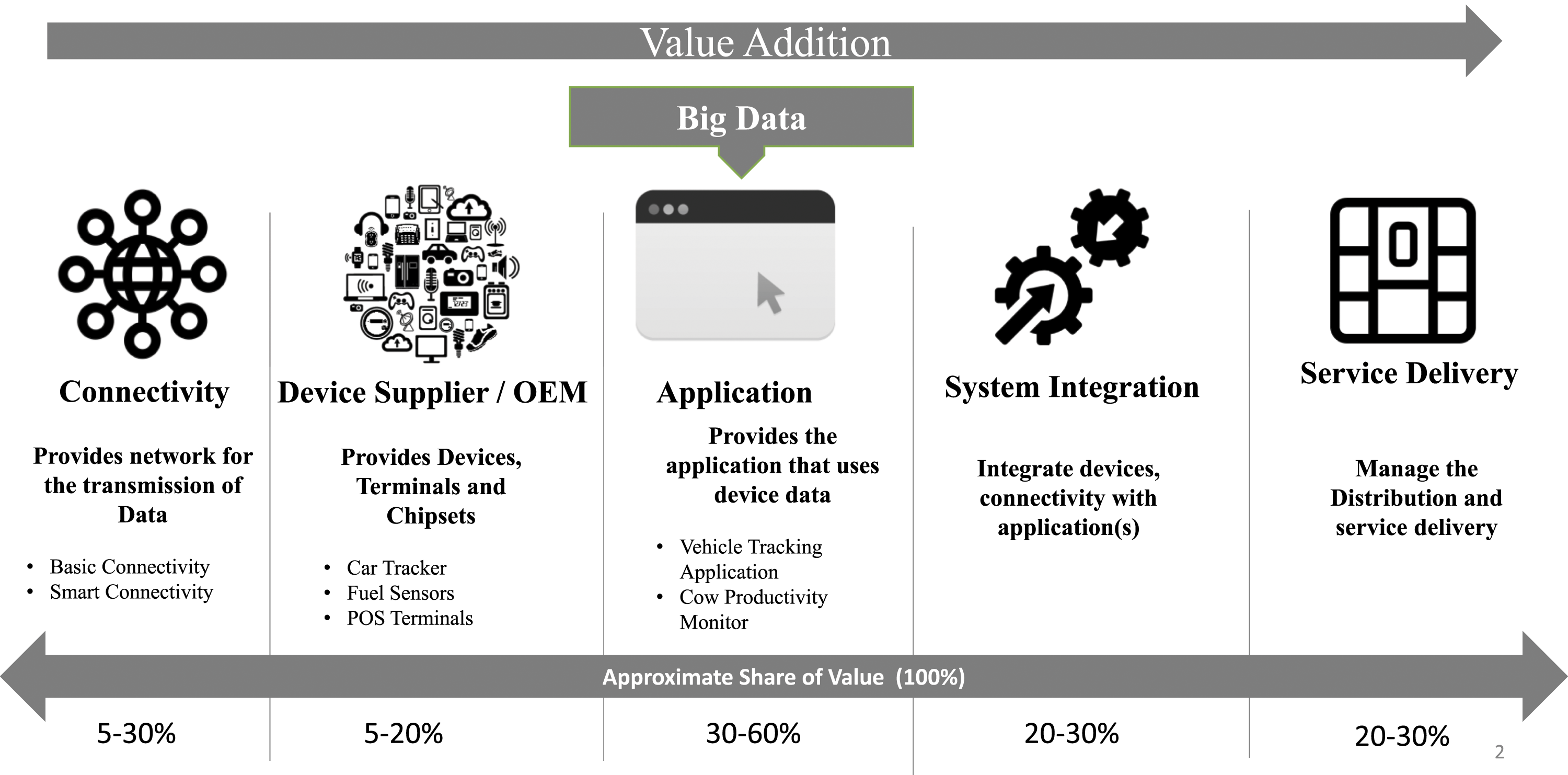
Telecoms are focusing on testing their roles in different areas of the IoT value chain. Their primary focus still remains basic connectivity which is evolved into smart connectivity. Telecoms are embracing their resources and capabilities across the IoT value chain, from connectivity to partnership, with innovative, value-added services. They are moving up to the IoT value chain by evolving further as an enabler for devices and enterprise-to-enterprise (E2E) solutions. They are developing partnerships with enterprises for providing various applications, service delivery, and system integration. Telecoms in the IoT value chain are shown in Figure 2 which shows the roles of telecoms in different areas of the IoT value chain. Role of telecoms in the IoT value chain.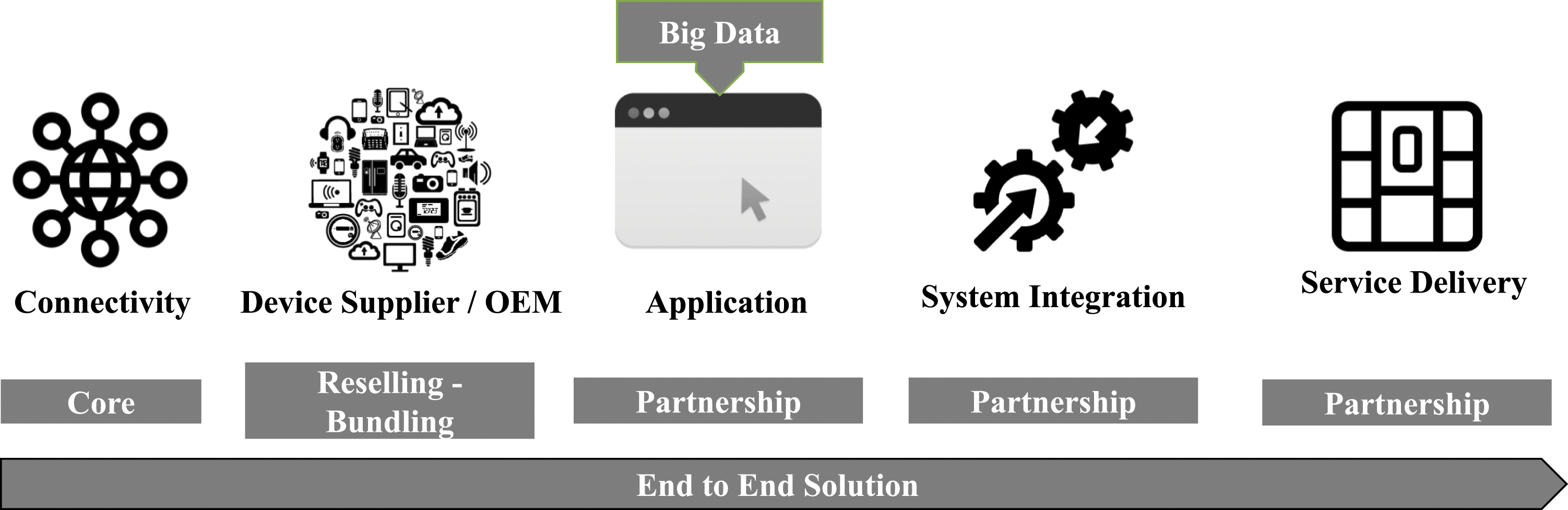
Telecoms are offering the network for the transmission of data from IoT services, offering end-user modules with an embedded M2M chipset, providing the actual application that manages the data collected by devices, managing the distribution, supply chain, service delivery and support, and providing system integration services. Telecoms are leveraging the IoT to offer products for value addition to their existing networks. They are exploring IoT use cases to develop a wider range of services and applications for big data analytics where their profit margin is high as compared to other segments in the IoT value chain. Telecoms in the IoT value chain are shown in Figure 3 which shows the description of offerings and services of telecoms across different segments of the IoT value chain. Telecoms in IoT value chain.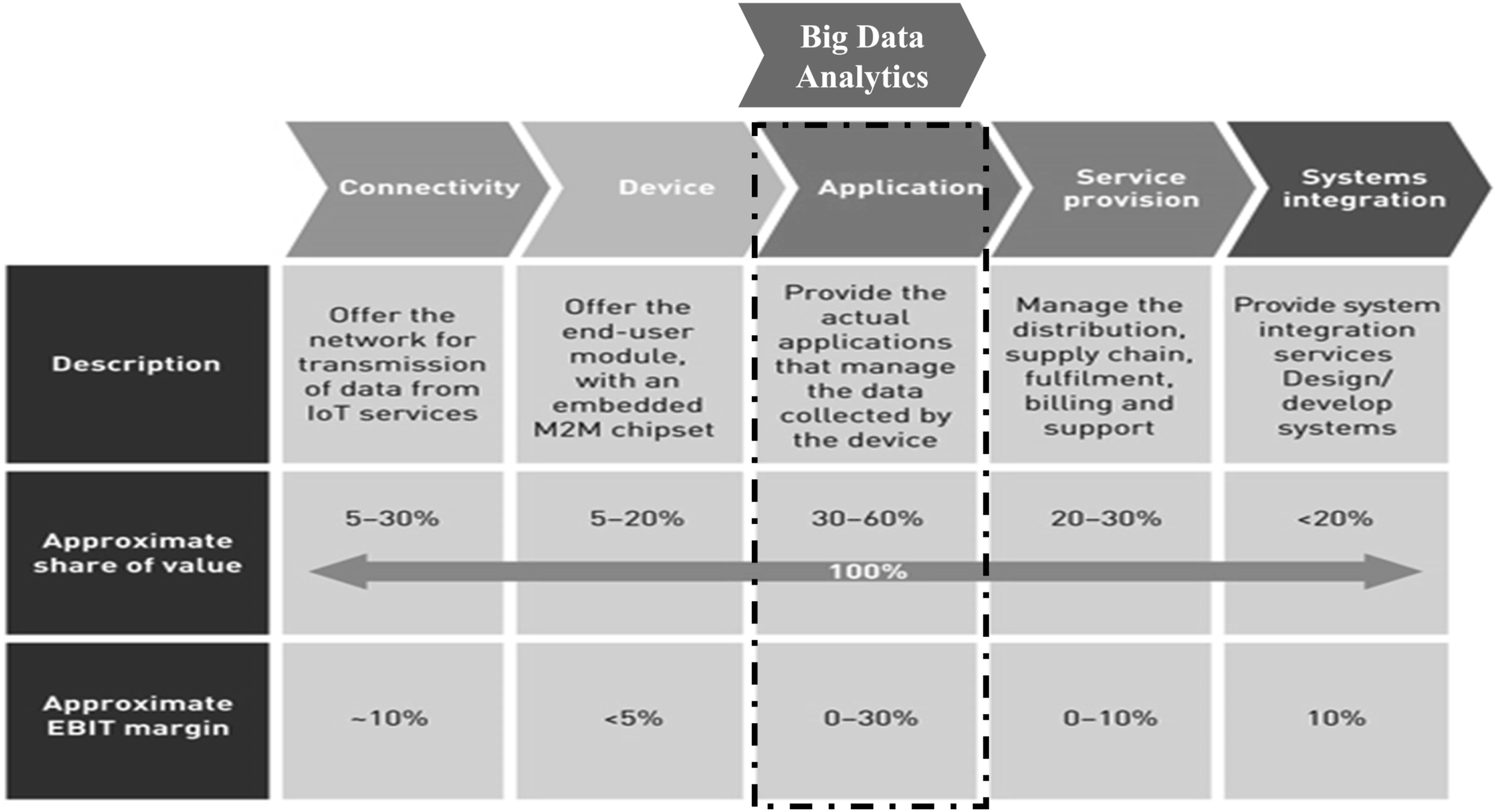
IoT applications
The Internet of things technology is leveraging businesses through IoT applications and solutions. Businesses are looking to expand their adoption of IoT to manage their resources and equipment effectively in real time. The advent of IoT is opening up a substantial opportunity for telecoms to strengthen and improve their business operations by developing broad-ranging new applications and solutions for their customers (Khan et al., 2012; Al-Fuqaha et al., 2015). Telecoms are improving the IoT industry value by focusing on key industry areas. These are smart buildings, health care, assets tracking, retail and financial, agriculture, security, utilities, and automotive and transport (Figure 4). IoT applications.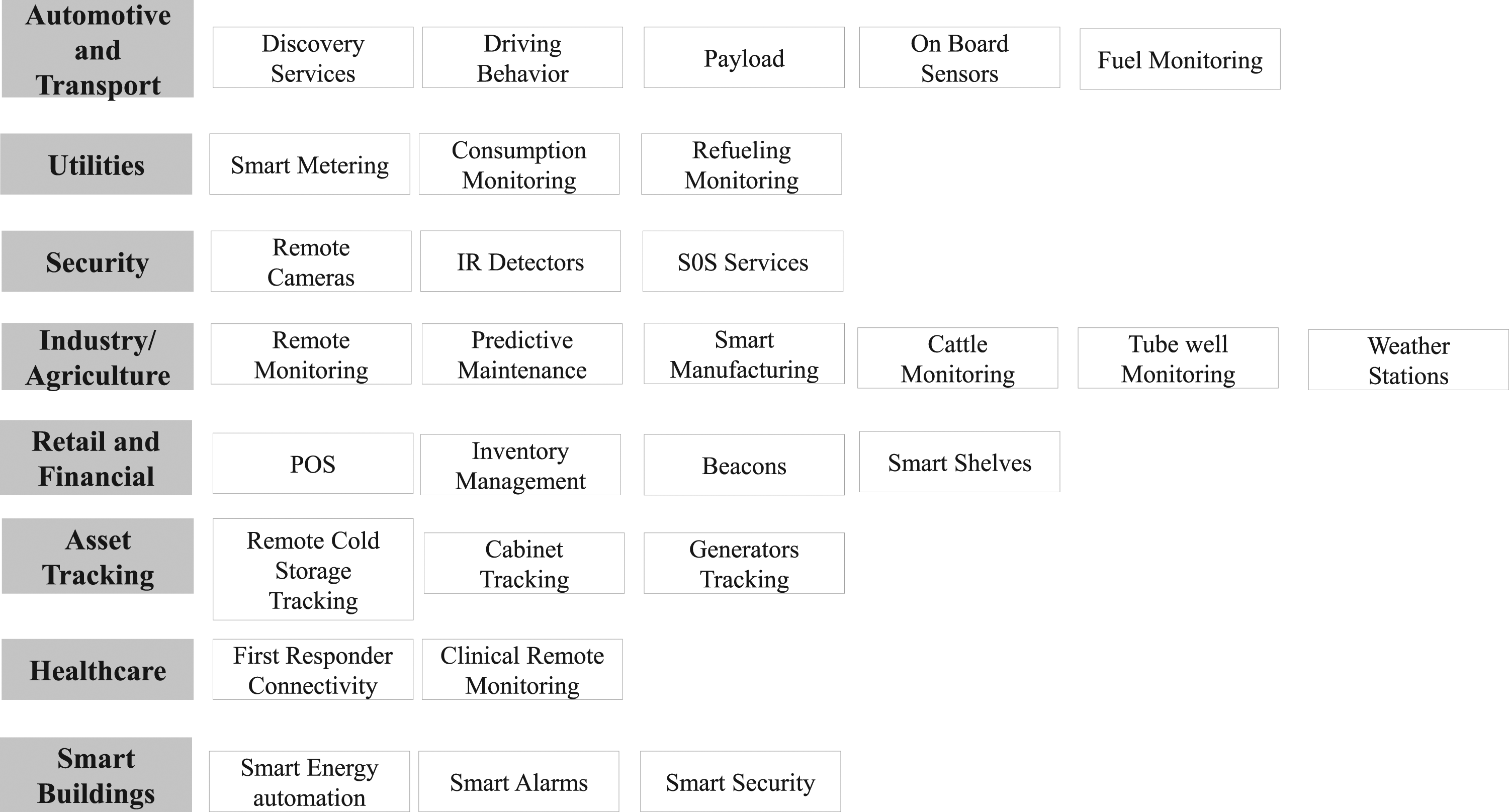
A case analysis: Internet of Things and telecoms in Pakistan
The telecom industry in Pakistan is undergoing a digital transformation. The emergence of this digital transformation is the key factor of changes in the business models of the telecom sector, affecting all areas of telecom businesses. Through digitalization, the telecom industry is improving, advancing, and expanding its operations, infrastructure, and services. This, in turn, leads to providing innovative, significant value-added products to the broader community.
In 2021, Pakistan’s telecom sector witnessed a growth of 189 million cellular subscribers, 108 million 3G/4G subscribers, and 110 million broadband subscribers. The data and telecommunications infrastructure in Pakistan is rapidly evolving to provide seamless connectivity and uninterrupted services to customers. For this, telecom operators are putting their efforts to revolutionize the connectivity infrastructures.
Pakistan’s telecom sector is playing an important role in economic growth and development. The telecom sector through digital transformation brings social and economic benefits to Pakistan. For development plans, the authorities use cellular platforms for improving education, health, gender equality, and reduce poverty. According to GSMA, the telecom sector contributes around $16.7 billion, accounting for 5.4% of the GDP of the economy in 2021. The cellular broadband network covers 80% of the population and mobile devices use 97% of Internet connections. The Telecom sector provides direct employment to around 320,000 people in Pakistan. According to GSMA Intelligence forecasts, Pakistan’s telecom sector would contribute $24 billion to the country’s economy, and 6.6% of GDP by 2023. This growth will result from enhanced productivity, efficiency, wider network coverage, and Internet connectivity.
Further, the telecom operators in Pakistan are adopting IoT technology. Through partnerships with IoT firms, they are providing IoT-enabled products, services, and solutions to strengthen domestic connectivity infrastructure in Pakistan.
They are offering a range of IoT solutions on their 4G network including fuel monitoring, genset monitoring (power generators), water management, energy management, smart fleet management, cold chain monitoring, etc.
Telecom operators are creating the basis for the Internet of Things. In Pakistan, Zong has deployed China Mobile’s IoT platform OneNet, while Telenor inaugurated the country’s first narrowband IoT (NB-IoT) network site in November 2019. According to GSMA Intelligence forecasts, “IoT will have a positive impact on the economy worth 0.34% of GDP in 2025. 2 Further, licensed cellular IoT connections in Pakistan will reach 3.8 million in 2025 which is currently 0.7 million.” 3
Telecoms’ Internet of Things landscape and positioning in Pakistan
Telecom operators such as Jazz, Zong, Telenor, and Ufone are offering connectivity, devices, system integration, and solutions. Over the period of time, they are expanding their role as connectivity providers, device providers, integrators, and solution providers across the IoT value chain. For that, they are developing partnerships with enterprises for providing various IoT devices and solutions. Telecoms role in value chain.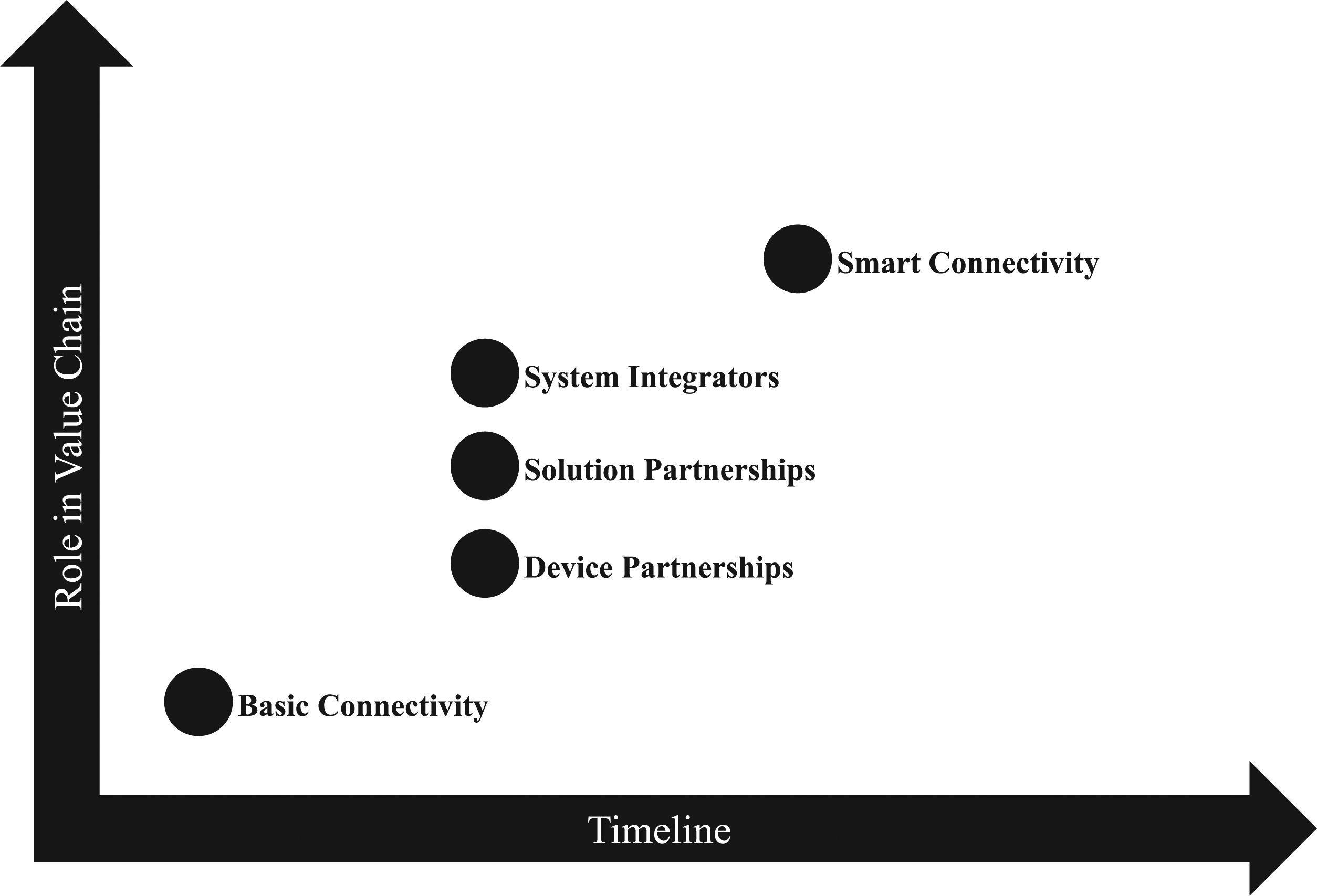
The telecom operators in Pakistan are moving up to the IoT value chain by evolving further from basic connectivity to enterprise (E2E) solutions. They are penetrating the market through vertical integration in the value chain through partnerships. They are providing end-to-end solutions that focus on market verticals through IoT services (Figure 5).
Among telecom operators in Pakistan, Jazz is the market leader in the IoT market in Pakistan. Jazz is providing enterprise-to-enterprise (E2E) solutions through IoT verticals. Jazz is exploring IoT verticals such as Automotive, Asset tracking, and other verticals. The other telecoms are mostly limited to basic connectivity and limited device portfolio (Figure 6). Vertical integration of telecoms in IoT value chain.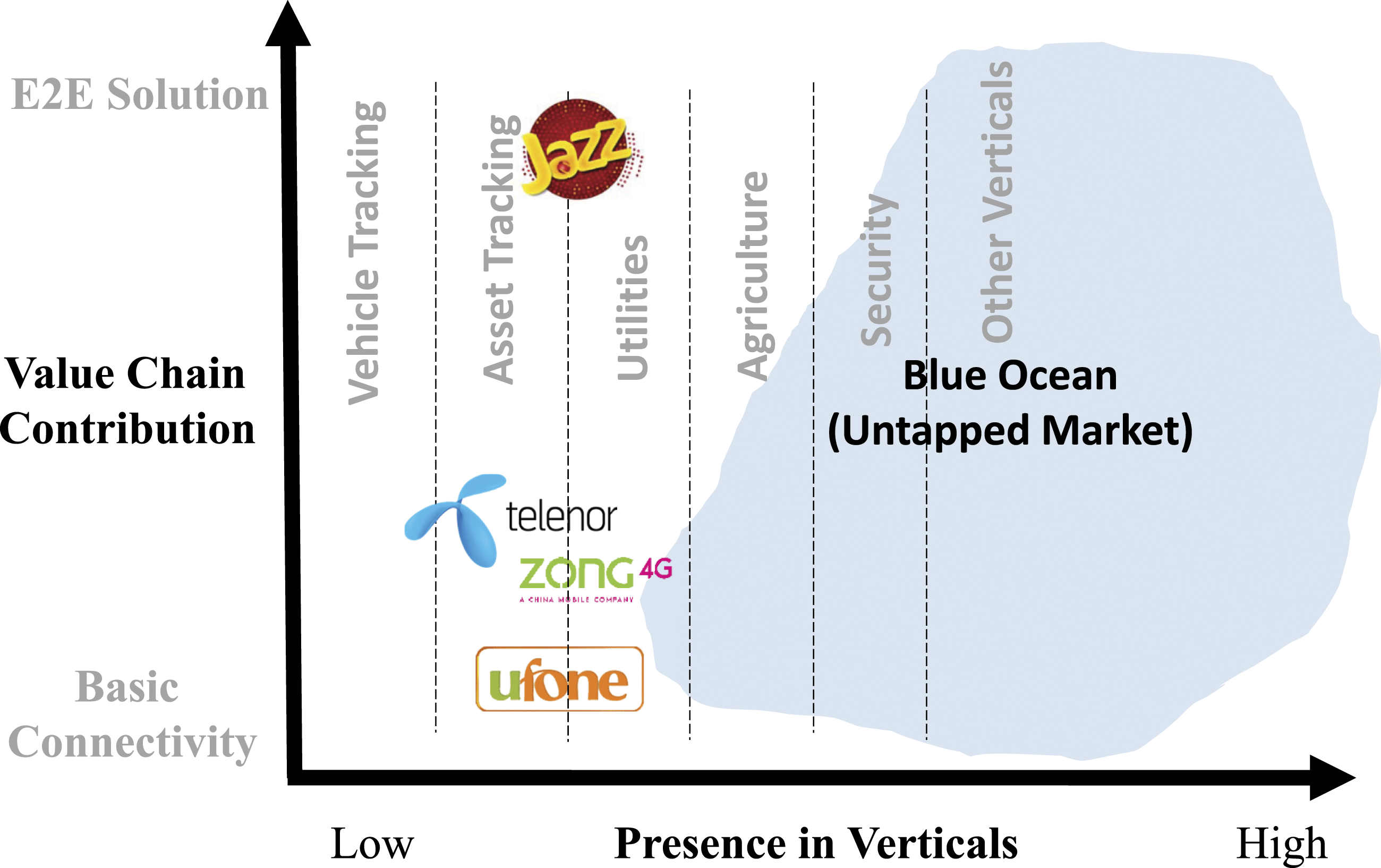
Moreover, telecom operators in Pakistan are working on exploring their roles in various aspects of the IoT value chain. Basic connectivity, which has evolved into smart connectivity, is still their core focus. Telecoms are utilizing their core competencies across the IoT value chain, from connectivity to partnerships for providing various devices, solutions, and system integration (Figure 7). Core competencies of telecoms across the IoT value chain.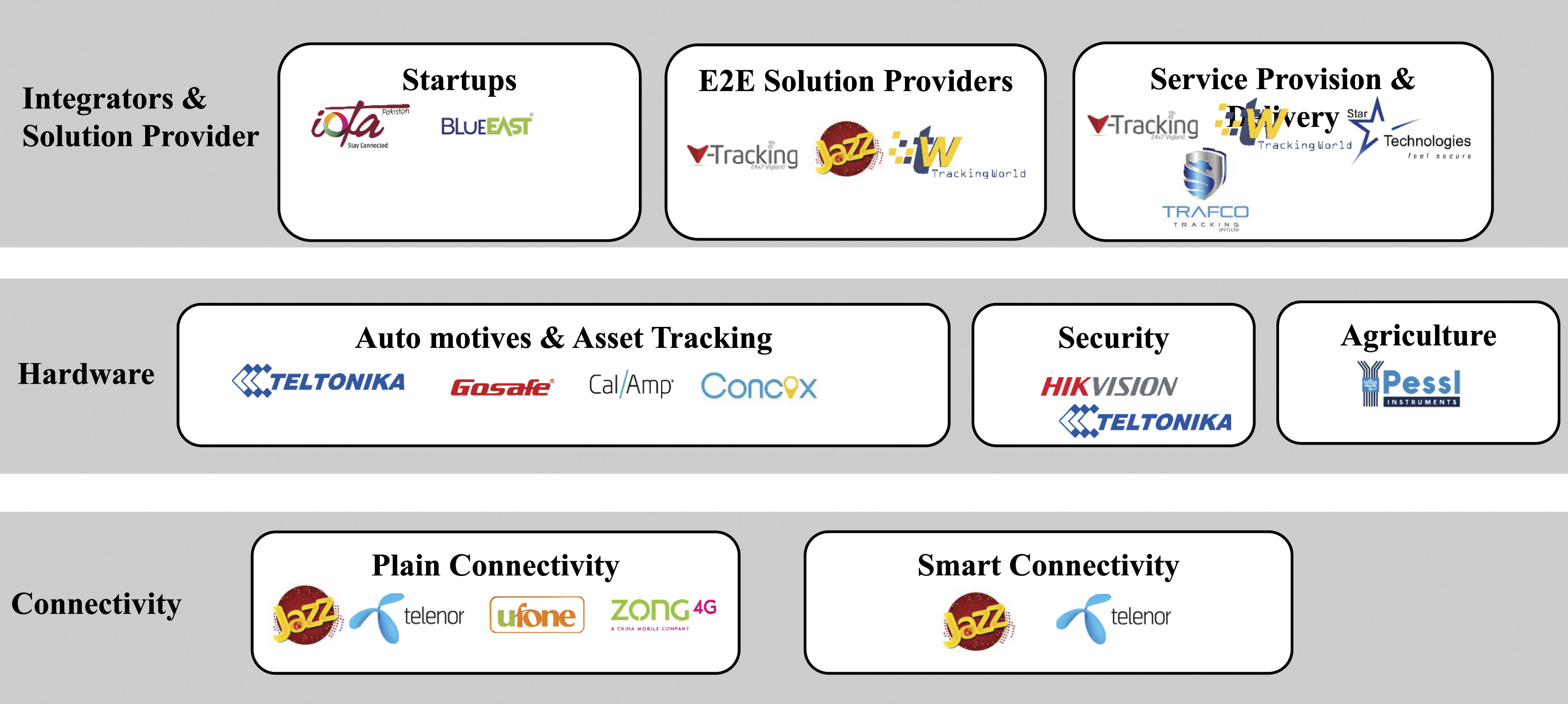
Telecoms’ Internet of Things and business models
While adopting IoT technology, telecom operators in Pakistan follow different business models across the IoT value chain. As network and service providers, they are adopting the following IoT deployment business models:
Connectivity provider
In this business model, the telecom operators are only providing connection and network. As network providers which is the core competency of telecom operators, they are ensuring affordable networks and providing good quality services to increase their customer base. With Infrastructure as a Service (IaaS) deployed through Machine-to-Machine (M2M), telecom operators are harnessing the power of their network and are focusing on revenue/connection growth, customer growth, and IoT connectivity provision.
Device provider
In this business model, the telecom operators are providing IoT devices, sensors, networks, network devices, and IoT connections. For this, they are working with IoT device providers in providing IoT devices and sensors with network connectivity.
Platform provider
In this business model, the telecom operators are providing IoT platforms that are used by the developers for creating and hosting IoT applications and solutions. With Platform-as-a-service (PaaS), telecom operators are providing hardware, software, infrastructure, and development tools for running, developing, and managing applications. IoT platform serves as a link between devices and applications. IoT platform-as-a-service allows a set of services in facilitating for developing, testing, and deploying applications. With a wide range of network environments, telecom operators are offering device access and management services. IoT platform offers a broad array of open APIs and data dissemination features for applications to meet industrial development needs such as device management, data aggregation, data processing, data analysis, and smart decision-making.
End-to-end solution provider
In this business model, the telecom operators are providing all end-to-end solution services to businesses according to the application for a specific area. The telecom operators are focusing on providing service integration—Software as a Service (SaaS) to integrate devices, and connectivity with the application(s). They are offering physical and virtual services, as well as networking and storage, over the Internet, at any time and from any location.
These business models are offering several benefits for telecom operators. As already mentioned, Telecom operators can now generate new revenue streams by delivering value-added services due to the Internet of Things. The above-mentioned IaaS, PaaS, and SaaS models make it easier to provide these offers and services, giving operators additional options to stand out in the market. Telecoms use IoT technology to give new and innovative service offers to their clients, as well as improve profitability and consumer satisfaction.
Telecoms’ Internet of Things and business strategies
The telecom operators in Pakistan are developing a strategy for leveraging the role of telecom as a digital facilitator in the IoT ecosystem. For this, they are employing two approaches in IoT businesses, namely, the vertical and horizontal approaches. They are adapting existing business models with a horizontal approach that focuses on basic IoT services. They are penetrating the market through vertical integration in the value chain through partnerships and offering end-to-end solutions focused on market verticals via IoT services.
Telecoms are focusing on market expansion and competitive positioning, as well as delivering the best operational solutions, demonstrating their business-centric approach. Furthermore, meeting the requirements and needs of the customers and delivering the best products, services, and solutions with technology shows the consumer-centric approach of telecoms. Moreover, leading the digital revolution in Pakistan shows a country-centric approach to telecoms.
Cost and benefit analysis of the Internet of Things for telecoms in Pakistan
Telecom companies in Pakistan are adopting IoT technology. The cost and benefits of adopting IoT technology are discussed below:
Costs
Telecom companies in Pakistan are doing heavy investments in building their own IoT platform or in having partnerships with platform providers. They are bearing hardware (sensors, devices) costs, operation and maintenance expenses, and connectivity costs. For the development of IoT-enabled applications and solutions for their customers, they are also incurring application development costs. To host these applications, telecoms are using cloud hosting services. Telecoms are investing in human resources capacity building for having IoT knowledge and experience. They are also hiring IoT experts. In addition, telecoms in Pakistan are paying heavy government taxes (Figure 8). IoT costs.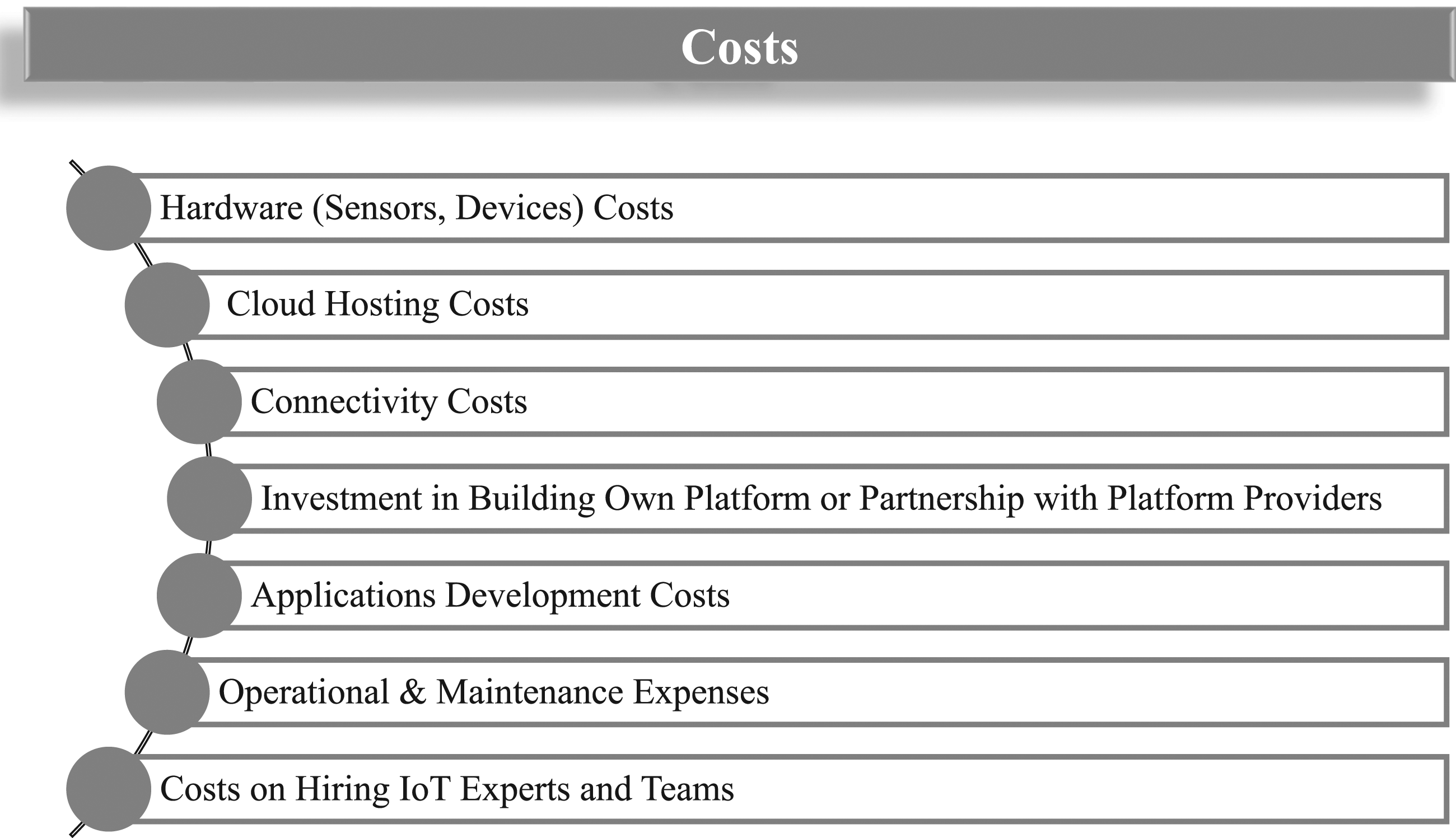
Benefits
Telecom operators in Pakistan are realizing benefits from IoT technology. They are diversifying their focus from selling SIM cards and data to developing new IoT-enabled services and solutions. They are realizing multiple benefits in terms of solutions and connectivity. With IoT technology, they are expanding their operations and infrastructures. They are offering services and solutions beyond network connectivity. They are harnessing their core competencies in telecommunications infrastructure, and connectivity with innovative, value-added products and services. They are improving customers’ experience by streamlining procedures, services, supply chains, and networks. They are monetizing data volume and network connectivity. Through IoT technology, telecom operators are enhancing their processes, performance, and productivity. They are creating significant additional value for customers by delivering quality products and services.
As a new source of revenue, they are utilizing IoT technology to expand their service portfolio with a variety of IoT-enabled services in different sectors. For this, they are making ventures into new business and they are integrating and adapting different business models to their core business model. They are playing their roles in different areas of the IoT such as connectivity provider, network provider, platform provider, device provider, and service provider. They are investing in building their own IoT platform or having partnerships with platform providers. They are building partnerships with IoT developers, integrators, and solution providers. They are building an ecosystem for providing IoT solutions and services under innovative business models in various use cases. They are also collaborating with other businesses in the IoT ecosystem to explore new opportunities and IoT use cases in telecom, allowing them to build a wider range of services.
With IoT technology, telecom operators can generate, process, and analyze big data in real-time. Data accuracy and precision make them do different data analytics which helps in making fact-based and real-time decisions (Figure 9). IoT benefits.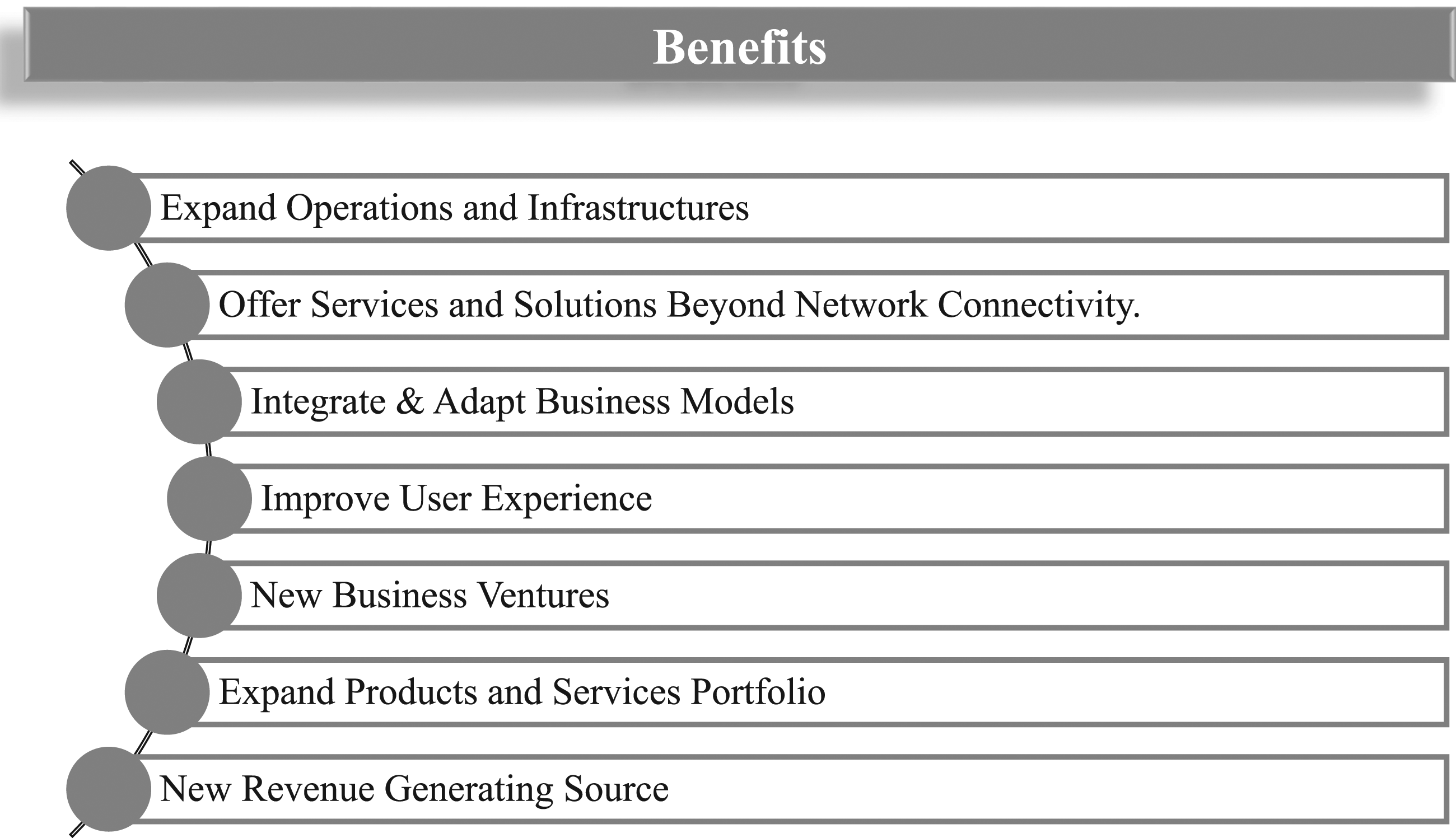
Internet of Things challenges for telecom in Pakistan
For the adoption of IoT technology, initially, telecom operators faced several challenges. These challenges are not just on commercial and technological fronts but also on the economic and social fronts. In Pakistan, IoT was a new technology, and telecom operators had no clear guidelines or paved path to adopt. The creation of an ecosystem for the adoption of IoT technology was challenging owing to the immature market and acceptability issues. Furthermore, in the market no qualified and competent developers or hardware and business partners are available. Also owing to insecurities, no one was interested in entering this field. Apart from immature market conditions, the majority of people had no idea what IoT technology was, and those who knew thought it was a luxury rather than a need. The majority of the target market was unwilling to embrace IoT in their everyday lives or routine activities as a result of this mindset.
The telecom operators also faced human resources-related challenges due to a scarcity of skilled personnel availability in the market. Telecom operators have faced a difficult time finding resources for IoT. There were technology integration-related challenges faced by telecom operators which were mainly hardware integrating protocol standardization. Redundancy of equipment, performance, availability, reliability, and scalability were some technical-related challenges faced by telecom operators while adopting IoT. The IoT development challenges which include infrastructure resources-related challenges were also faced by telecoms in Pakistan.
In addition, there were regulatory challenges faced by telecom operators in the beginning because the government did not have an IoT policy. As the government’s technology policies and regulations were not clear at the time when telecom operators in Pakistan were starting the adoption of IoT technology. After repeated discussions with regulatory authorities on respective technologies by telecom operators, a clear threat was noticed that the government may close and will not permit the adoption of this technology in Pakistan.
Discussion and conclusion
This paper examines the role of telecom operators in the IoT value chain and in building the IoT ecosystem. Through an exploratory case study, it analyses IoT technology for telecom in Pakistan as an emerging market for IoT. It analyzes the IoT market positioning among telecom operators in Pakistan. It examines the business models with business strategies that the telecom operators are adopting across the IoT value chain. Further, it analyzes the benefits realized and challenges faced by telecom operators in Pakistan from IoT technology.
The telecom industry in Pakistan is undergoing a digital transformation. The emergence of this digital transformation is the primary driver of changes in the business models of the telecom sector, affecting all areas of telecom businesses. Through digitalization, the telecom industry is improving, advancing, and expanding its operations, infrastructure, and services. This, in turn, leads to providing innovative, significant value-added products to the broader community.
The telecom operators in Pakistan are adopting IoT technology. Telecom operators such as Jazz, Zong, Telenor, and Ufone are offering connectivity, devices, system integration, and solutions. They are expanding their role as connectivity providers, device providers, integrators, and solution providers across the IoT value chain. For that, they are developing partnerships with enterprises for providing various IoT devices and solutions. They are offering a range of IoT solutions on their 4G network including fuel monitoring, genset monitoring (power generators), water management, energy management, smart fleet management, cold chain monitoring, etc.
While adopting IoT technology, telecom operators in Pakistan follow different business models across the IoT value chain such as connectivity providers, device providers, platform providers, and end-to-end solution providers. They are using a horizontal approach in their existing business models that focuses on basic IoT services. They are penetrating the market through vertical integration in the value chain through partnerships and offering end-to-end solutions focused on market verticals via IoT services. These business models are offering several benefits for telecom operators. Telecom operators can now create new revenue streams by adding value-added services due to the Internet of Things. The IaaS, PaaS, and SaaS models make it easier to provide these offers and services, giving operators additional options to stand out in the market. Telecoms use IoT technology to give new and innovative service offers to their clients, as well as improve profitability and consumer satisfaction.
During the adoption of IoT, telecom operators have identified several challenges, including the lack of government technology policies and regulations, a scarcity of high-quality resources, the creation of an IoT ecosystem, and others.
Implications and limitations
This paper is an attempt to analyze IoT technology in telecommunications from the perspective of the emerging market of IoT in Pakistan. It has presented a case study for IoT technology in an emerging market which highlighted different aspects of IoT technology such as IoT landscape, IoT market positioning among telecom operators, IoT business models and strategies adopted, challenges faced, and benefits realized by telecom operators in Pakistan. Therefore, several implications can be drawn from this case study research. This study helps the management of telecom operators and others in the IoT value chain such as device and hardware providers, equipment suppliers, solution providers, and local application developers in understanding the complexities of IoT technology for telecoms. It supports the management of telecom operators in others emerging markets of IoT by knowing the challenges while adopting IoT in their organizations. Further, it is beneficial for the local suppliers and application developers for undertaking investment in the IoT area so that they can smartly focus on only those devices and applications which are required in the local market. Also, it aids regulators and policymakers in taking support from government bodies and in designing frameworks and policies for IoT in telecommunications in emerging markets.
However, this case study is only confined to telecom operators who are providing LTE (4G) services. It covers an emerging market perspective for IoT by examining different aspects of IoT in the telecom sector only. Therefore, as a qualitative case study for telecom, its generalizability is limited.
Case questions
1. How do IoT technology and its adoption help telecoms in opening new opportunities, generating value, and gaining benefits? 2. What are the challenges faced by telecoms for IoT adoption? 3. What is the role of telecoms across the IoT value chain? 4. How are telecom operators in Pakistan expanding their role in the IoT value chain? 5. What are the business models followed by telecom operators in Pakistan for the adoption of IoT technology? 6. What are the business strategies taken by telecom operators in Pakistan for the adoption of IoT technology? 7. What are the benefits gained by telecom operators in Pakistan for the adoption of IoT technology? 8. What are the challenges telecom operators have faced during the adoption of IoT technology? 9. What are the remedial strategies that should be taken by telecom operators to address the challenges they have faced? 10. How telecom operators in Pakistan reap the benefits of IoT technology in the future? 11. What can telecom operators in other emerging and developed markets learn from Pakistan’s experience of the adoption of IoT technology? 12. How this case study helps the management of businesses in other emerging markets that want to adopt IoT technology?
Footnotes
Declaration of conflicting interests
The author(s) declared no potential conflicts of interest with respect to the research, authorship, and/or publication of this article.
Funding
The author(s) received no financial support for the research, authorship, and/or publication of this article.
