




Abstract
This case presents the background, operational modalities, and benefits of this first application (APP) based truck booking service, “Truck Lagbe.” This is an app that has digitally created a marketplace where truck owners or drivers and buyers or truck tenants rent trucks through price negotiations. This case has emphasized its uniqueness and the strategies they used to become successful. All information has been collected through secondary sources. It is a two-sided marketplace; truck owners/drivers and shippers. Fortunately, “Truck Lagbe” has made life much easier for truck drivers/owners or those who hire trucks, enabled coordination, reduced controversy in the whole process from truck hire to payment, and improved efficiency and flexible price through bidding. “Truck Lagbe” offers three categories of services: B2C, business solution, and enterprise solution. B2C or individual customers are those who may have rented a truck for once to shift their home or to carry small items or goods, usually for one time. The business solution category is where the pickup location will be the same, but the delivery location may be different, or the pickup location is the same, but delivery in different regions. Finally, an enterprise solution is a solution where a fixed account manager offers a variety of advice to the particular business owner, such as VAT, AIT and Tax, and a minimum of 10 business purpose truck rental agreements be fixed. In short, “Truck Lagbe” is a platform where “a single click will move anything.”
Introduction
The trucking industry has always been considered a labor-intensive, costly and highly competitive industry (Belzer, 2002). Entrepreneurs have always tried to look for new ways to gain competitive advantage. The arrival of data driven technology and app-based hiring system has completely changed the game by making the process more efficient and effective (Muaz et al., 2020).
The truck transport industry is a promising industry for any country, and Bangladesh is no exception. The biggest hurdle for consumers is to book a truck in times of emergency as no structured marketplace was available to locate and book trucks before the launching of an available digitalized transportation company, “Truck Lagbe” in Dhaka, Bangladesh. “Truck Lagbe” started its journey in October 2016 to modernize the transportation system of Bangladesh. From the very beginning, “Truck Lagbe” has been making the process of hiring trucks easier for various businesses and general people through app updates. Some of the significant changes that have taken place in the freight industry over the last 3 years with the “Truck Lagbe” app is as truck hiring facility in any part of the 64 districts in Bangladesh, confirming truck booking within the shortest time duration, instant pickup booking within Dhaka city, opportunity to hire trucks at the best rate in the market through a bidding process, and reduction of logistics costs up to 30%.
Besides, “Truck Lagbe” deals with two interdependent segments of stakeholders based on their needs and they are—(i) truck owners/drivers and (ii) consumers, shippers, and businesses. They have a wide range of customers. General people use “Truck Lagbe” for house shifting, businessmen use trucks for carrying out industrial goods, industries use this app for moving industrial heavy materials, and export–import businesses use heavy trucks like prime movers for business purpose.
“Truck Lagbe” acts as an electronic marketplace by establishing a direct connection between truck drivers and consumers. It mitigates the intermediaries, agents, and agencies, thus create transparency in the transaction process. It materially upgrades traditional truck owners’ business by getting rid of the multiple layers of mediators and ensuring they get their deserved price. “Truck Lagbe” also helps amateur truck business owners to get rides consistently. It resolved challenges for the consumers who earlier faced difficulties hiring transportations. Besides, “Truck Lagbe” succeeded because of its core value to its customers. Moreover, the official “Truck Lagbe” app is user-friendly so that customers from all walks of life can hire trucks without any hassle. The core perception that “Truck Lagbe” has positioned in the market is- “
Startup history
The thought came from an individual involvement where the founder and CEO, Anayet Rashid, had to bargain with truck transportation in one of his other businesses. The CEO used to discuss business ideas with Mir Hossain Ekram, who is the co-founder of “Truck Lagbe.” They had come up with tons of thoughts that they might attempt, and once they even thought of opening a primary need shop where individuals seem to arrange items over the phone. However, internet issue blocked their path. Besides, around 2005 when the internet was not a popular thing like today, they attempted to start car components and parts. However, after proceeding for a longer time, they had to forsake it at one point due to a few issues in that specific line of business. After that, they concentrated on their existing FMCG Company, which was a wholesale business. They needed to send heavy products from one place to another across the country. They noticed that within the same destination, there was a huge transportation cost difference in separate batches within a distance of a week. As there was a lack of management issue in the process, people had to pay very high for truck transportation. That incident helped Anayet Rashid for developing a new idea by using his vehicles. That was when he started “Truck Lagbe” for ensuring better coordination and better matching with the help of technology to solve a huge problem.
Business strategies of “Truck Lagbe”
Initially, “Truck Lagbe” struggled to reach both the supplier and the shipper market. Also, they faced difficulty to manage the initial capital for a longer period. However, they managed to overcome those using their business strategies. The app secured the first position in the “Startup Challenge 2017” organized by the Information and Communication Technology (ICT) division of the Bangladesh Government.
In this section, we discussed several business strategies used by the company to get ahead of their competitors.
Product description
Products of ‘Truck Lagbe’.
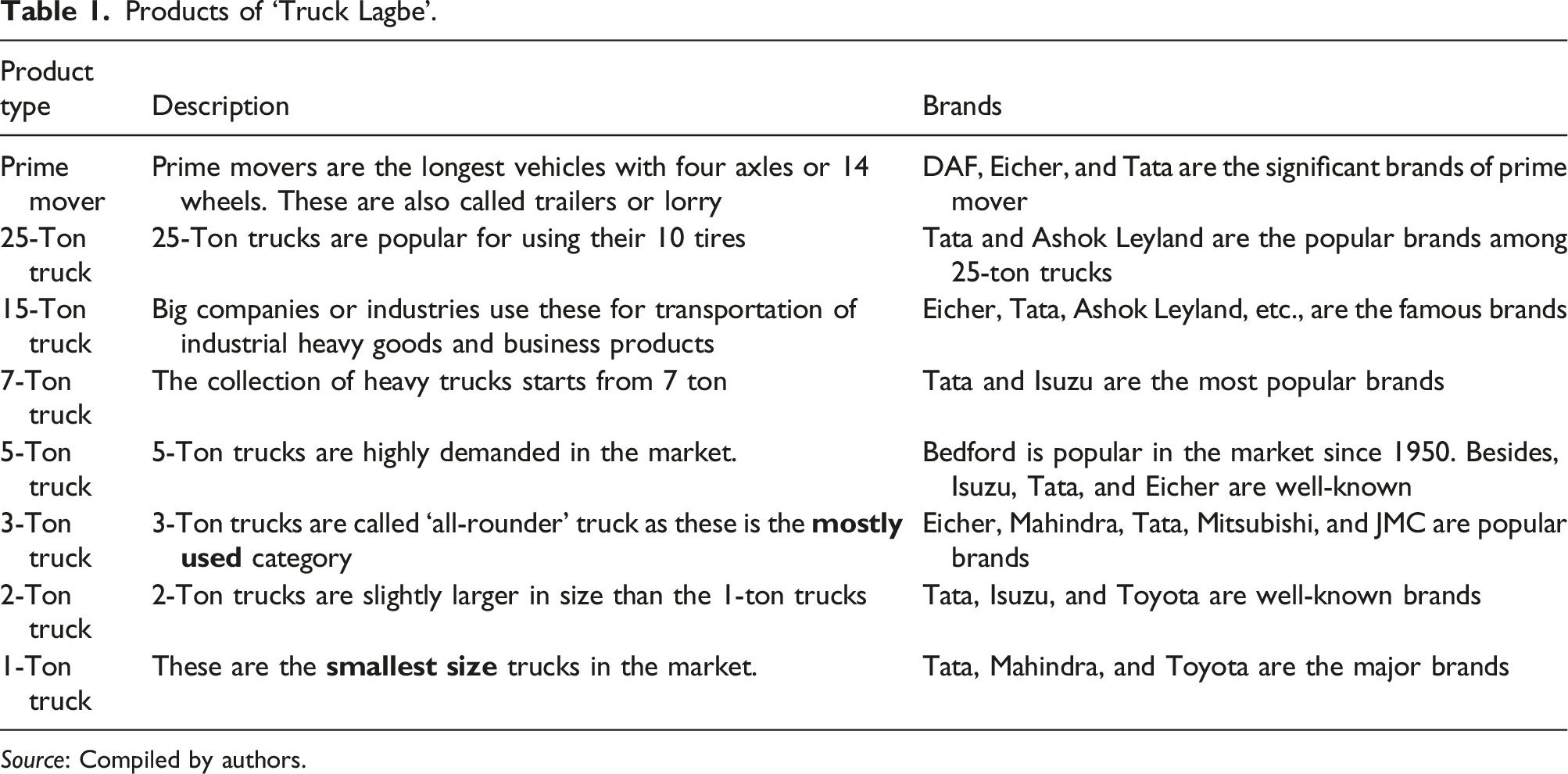
Source: Compiled by authors.
Pricing strategy
When we hire transportation, the first thing that comes to mind is the cost. However, “Truck Lagbe” helps to hire transportation at market rate and as a result, there is no chance of paying high even if you are a new comer.
Although the study of Krishnan et al. (1999) says that the pricing of new products should be based on its pattern of sales growth, this app has taken a different route as they want to be as fair as possible to their customers. Through the “Truck Lagbe” app, drivers can inform the fare to the user by bidding. The user then can know the market rate and choose the fare which is cheaper. “Truck Lagbe” team has fixed the rental rate only for 1 ton 7 feet pickup. Except this one, rental rates for other trucks are set through bidding. Though they fix the rate for 1 ton truck, they set it up by observing the market rate for 3 years and also by using state of the art technology with data driven algorithms. Therefore, there is no chance of being cheated.
Besides, they have some terms and conditions that are tempered in a way to benefit both the parties and make the business conflict-free. Some of the terms and conditions are minimum rate is charged within the same area, maximum rate is charged when the truck is hired for going to other areas in Dhaka city, if the truck shipment time takes more than 6 h, the rate increases by 500–1000 BDT for the heavy trucks and the rate increases by 300–500 BDT for medium sized truck, and finally, heavy trucks above 12 feet cannot travel during day time in the Dhaka city. Therefore, one can hire these after 10 p.m.
Rental rates outside the Dhaka city vary on several factors like type and size of trucks, type and number of shipments, and market demand of trucks on that time.
Application: “Truck Lagbe”
“Truck Lagbe” is the first online application in Bangladesh for hiring trucks and pickups with just a click. The app is swift, secured, affordable, easy to manage, and also very user-friendly. It has various options and gives customers the chance to request accordingly. There is also an option for later and instant booking. The customer selects the vehicle’s preferred size and shape and therefore, contact nearby truck drivers immediately for instant booking. For later options, the truck drivers will call and talk about their pricing, and the customer can choose their preferred one. It is the last-minute lifesaver for home shifting, office shifting, and also logistic facilities. They also have an extensive option for labor service with extra price. The app is only available to android users. Others can call their hotline directly and get the booking done (Figure 1). Design of ‘Truck Lagbe’ app.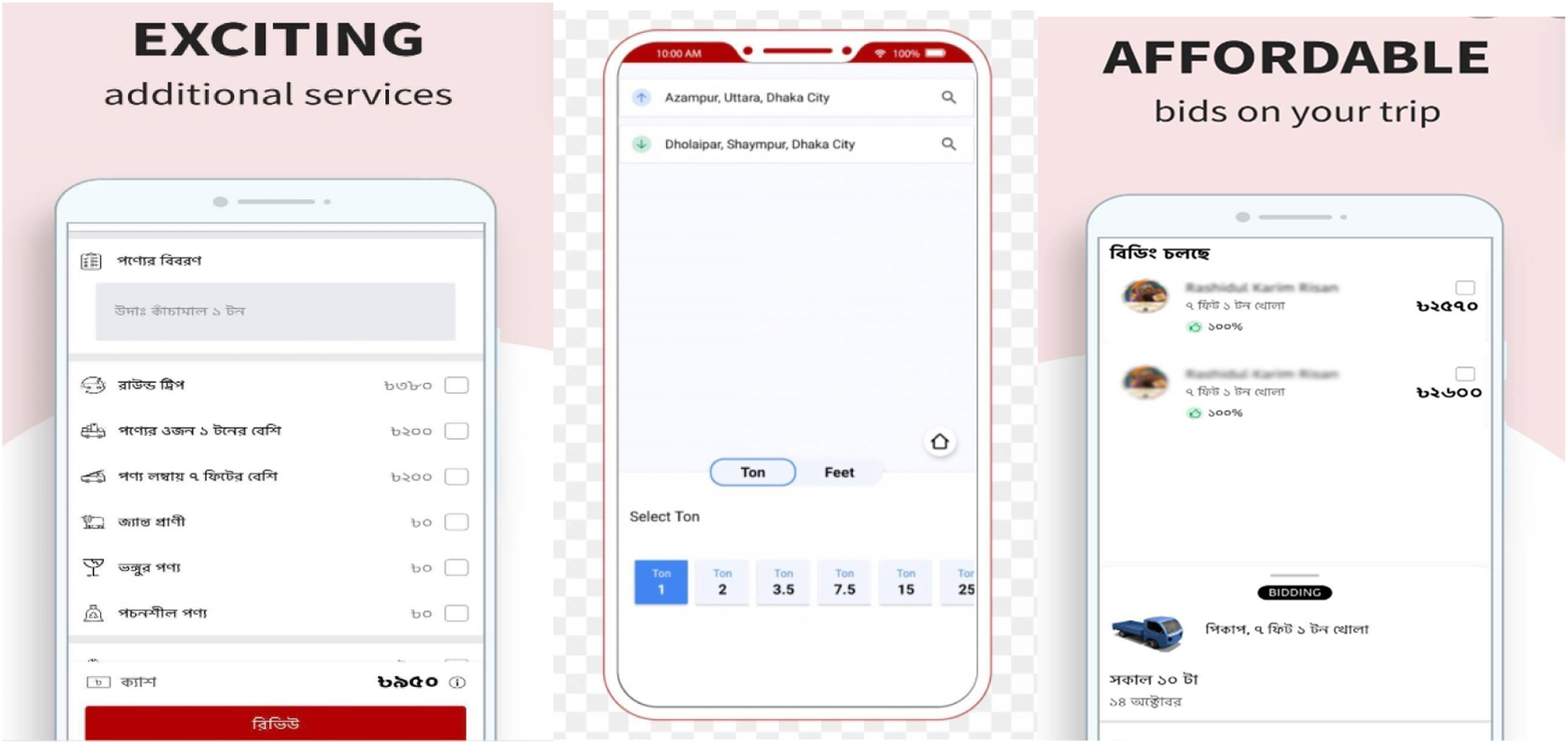
Facilities
“Truck Lagbe” is a solution to many problems for a vast customer base. Hiring a truck has never been this easy in Bangladesh since many drivers used to ask for more money even after fixing the payment. Also, the truck drivers used to create a syndicate among themselves, exploiting the customer.
One of the first benefits is that the app is
Competitor analysis
“Truck Lagbe” has its competitors in both the online and offline spheres. Some of these competitors are direct competitors who operate exactly like “Truck Lagbe” and offer the same kind of services, sometimes coupled with other services, whereas some can be considered indirect competitors.
Industry profile.
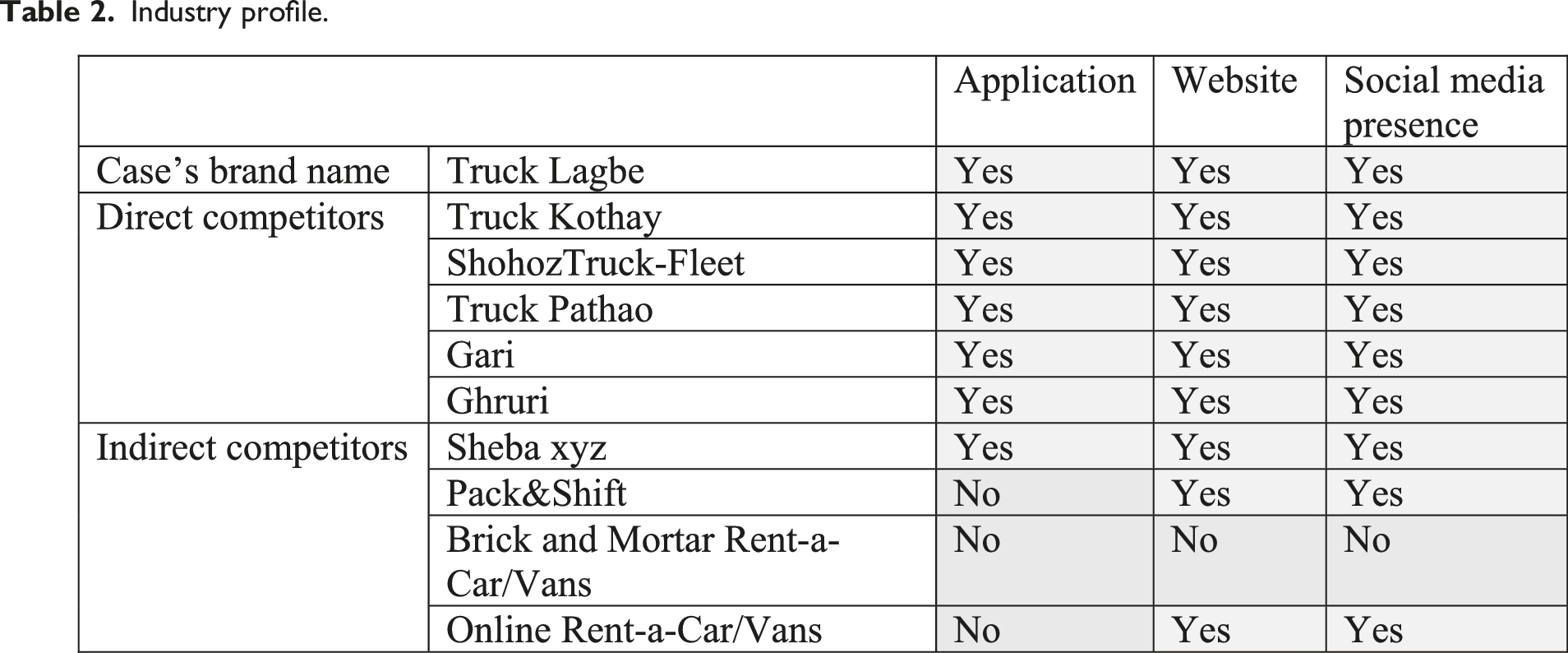
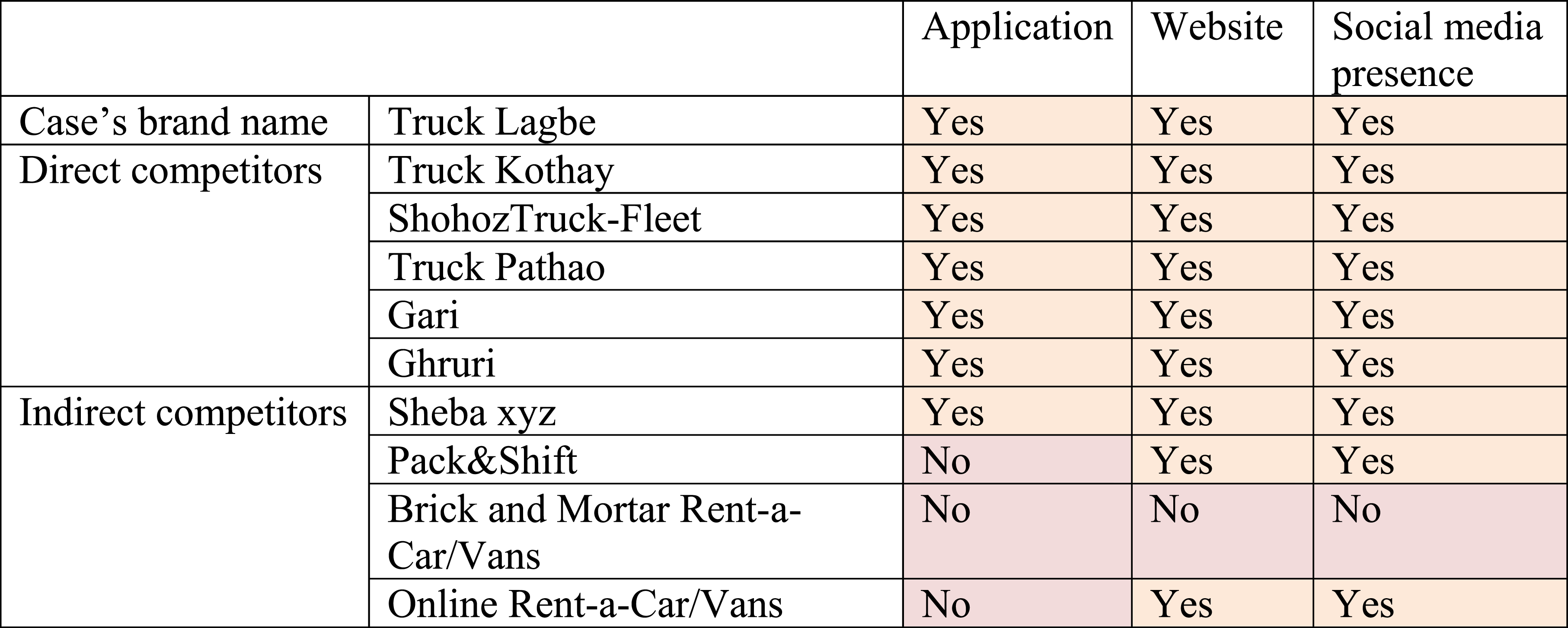
Truck Kothay, ShohozTruck-Fleet, Truck Pathao, Gari, and Ghuri are some of the top competitors of “Truck Lagbe.” Therefore, these organizations can be considered as direct competitors as they all provide the same service, in the same manner and has been keen to maintain the core value proposition along with targeting similar customer segment. Lastly, as it is evident, they also kept their presence in the digital ecosystem identical to “Truck Lagbe.”
Sheba xyz
Sheba xyz is one of the largest online service marketplaces in Bangladesh, and one of their services is providing moving services, including van/truck/pick-up services. However, not a direct competitor, yet “Truck Lagbe,” has to compete with Sheba xyz.
Pack & Shift
Pack&Shift is another service that provides trucks/vans/pick-ups only inside Dhaka. Therefore, another indirect competitor with a very niche target segment, yet core service matches in some forms.
Brick and Mortar Rent-a-Cars/Vans
In many places around the country, we find countless physical rental shops that let us directly hire trucks, vans, and cars. These fragmented service providers are one of the biggest competitors and challenges for “Truck Lagbe.”
Online Rent-a-Car/Vans
Some Brick and Mortar Rent-a-Car services have now put their feet into the digital world and have an outstanding presence in social media, some even operate through websites. The numbers of such services are on a growing scale and have been rising in the COVID period as paranoia reached its peak and people wanted to avoid going outside.
Challenges
One of the biggest challenges in this industry is the intermediary and syndicate, which barred the efficiency of this industry, but thanks to “Truck Lagbe” as we no longer have to deal with it. Nevertheless, Truck Lagbe’s initiative did solve our challenges, but they have some of their own challenges.
Internet availability
We are still in a developing stage as a country, and therefore the quality of internet services is not equal in all parts of the country. Rural areas lack good quality internet services, and as “Truck Lagbe” is an application-based service, the lack of good quality internet service remains a challenge for them.
People’s general education level
The educational level among people who are incorporated with work such as the truck drives is not that high in our country. As “Truck Lagbe” is a technology-based service, it is a challenge for the drives to get adapted to it swiftly, and therefore is also a challenge for “Truck Lagbe” to get them educated and adapted to the application. As drives are the front-line workers for “Truck Lagbe,” their performance judges Truck Lagbe’s service. Therefore, to educate them to give good service remains yet another challenge.
Understanding customer needs
Proper understanding of customer needs and providing them might be a massive challenge for “Truck Lagbe” as they operate in a vast geographical area and therefore, serve a very diverse and colossal customer segment, ranging from a home shifter to a large corporate.
Fragmented industry
Last but not least is to bring a structure in the industry. This industry is a fragmented one, and this remains a challenge. A fragmented industry refers to an industry with several competitors but no single or group of companies that stand out or dominate the industry (Dollinger, 1990). Though “Truck Lagbe’s” primary solution is to turn it into a structured industry, it is yet to be fully achieved.
Conclusions
The Truck Lagbe app was established in 2016 to remove the hassle in the truck industry. Everyday tons of heavy products are transferred through this app as it ensures safe delivery and the best rate. The initiative is a very unique one in the context of Bangladesh and the strategies they use deserve to be analyzed. The case has focused on the descriptions and business strategies used by “Truck Lagbe.” Their strategies show us that having a user-friendly app and strategic pricing can make the truck hiring process more convenient for both parties. This could encourage potential entrepreneurs to join this blooming industry and improve it.
Discussion questions
1. Give an example of what can “Truck Lagbe” do to expand their business in the future? 2. What are the necessary steps one should take before hiring a truck from “Truck Lagbe”? 3. Provide recommendations to be a successful entrepreneur in the truck hiring business.
Footnotes
Declaration of conflicting interests
The author(s) declared no potential conflicts of interest with respect to the research, authorship, and/or publication of this article.
Funding
The author(s) received no financial support for the research, authorship, and/or publication of this article.
