



Abstract
In the face of innovations triggered by advances in digital technology, biomedicine, and behavioural/neurological research, the analysis of power relations has moved into substantially new territory. Attempts to chart this new territory in terms of ‘surveillance capitalism’, ‘algorithmic governmentality’, ‘sensory power’, ‘post-liberal government’, or ‘neuroliberalism’ have emphasized different dimension of emerging systems of power. These power relations challenge many established understandings of ‘freedom’ as something distinct from ‘domination’, ‘determination’, or ‘necessity’. However, critical assessments have thus far proceeded on the basis of an assumed and idealized subjective ‘autonomy’, anti-subjectivist genealogies of ‘governmentality’, or technologically oriented theories of the posthuman. The ambition of this paper is to address freedom in relation to embodied and negotiated experience. Ricoeur's meticulous, anti-dualist phenomenology of freedom enables us to anchor our analysis in intelligible structures of lived experience located between subjective autonomy and dissolution and technological enhancement and subjugation. We explore these conceptual concerns through an empirical investigation of the negotiated forms of freedom that emerge in and around people's use of smart/intelligent technology. Reflecting on a SenseMaker® analysis, we consider emerging configurations of freedom and oppression (or in Ricoeurian terms, the voluntary and involuntary). We draw specific attention to how, in an age of smart/intelligent technology, practices of freedom are not experienced as forms of either digital liberation or oppression but as complex negotiations between the biological and digital involuntary and voluntary acts of negotiated consent.
Introduction
This paper develops what we consider to be novel conceptual and empirical reflections on the problem of freedom. The problem of freedom has a long and complex history (de Dijn, 2020). As Prozorov (2016: 64) observes, ‘freedom remains a philosophical problem that must prohibit its own resolution’. Following Prozorov, we eschew grand, emancipatory accounts of freedom. We also seek to avoid the temptation to uncover the conditions of existence for a ‘sovereign subject’ upon which freedom can be secured (Prozorov, 2016). Instead, we explore freedom as a heterogenous set of practices which serve to ‘enhance[s] our potentiality for being otherwise’ (Prozorov, 2016: 94). We argue that it is important not to interpret freedom in binary terms: whether that be free or unfree, positive or negative, voluntary or compelled, intentional or unconscious. Drawing on Paul Ricoeur's work on the philosophy of will, we propose a more equivocal way of interpreting freedom. Ricoeur's work draws attention to the constitutive ambivalence of the voluntary and involuntary within the human condition. In this context, we consider the potential to be otherwise to be the contingent, but ultimately necessary, outcome of the practical interplay between the chosen and the obligatory.
This paper is inspired by the surfacing of new empirical manifestations of the problem of freedom. Tensions over freedom can be discerned in a multitude of recent contexts. The distinction between legitimate protest and insurrection, the rise of authoritarian populism, deliberations over the relation between gender identity and biology, debates over the nature of free speech, and ongoing concerns about the long-term socio-economic consequences of neoliberal regimes of freedom (see Rose, 2017b). Our primary focus, however, is on the socio-economic and political developments associated with the rise of smart/intelligent technology (see Rose, 2017a; Sadowski, 2020; Whitehead and Collier, 2022; Yeung, 2016; Zuboff, 2019). According to Zuboff (2019), the emerging combination of the data and behavioural sciences offers unprecedent opportunities for the commercial and governmental comprehension of human nature and the shaping of human action. Others suggest that related smart-technology systems could liberate people from onerous physical labour and the cognitive burdens of ever more complex fields of decision-making (Risdon, 2017). Within this paper, we draw attention to the complex folding of the voluntary and involuntary within our interactions with digital technology. 1
Our analysis focuses on the everyday embodied experiences of using smart/intelligent technology. We focus on the socio-technological mundane because it tends to generate perspectives that are not easily reconciled with the idealized notions of autonomy, decision-making, and privacy typically associated with liberal notions of freedom or more critical posthumanist accounts of the decentring of human autonomy. It thus provides us with a practical context within which to explore anew the ambivalent complexities of the voluntary and involuntary within specific practices of freedom. In these contexts, we aim to foreground the implications of smart/intelligent technology for the human experience of freedom, without essentializing this experience as being determined only at the human level. Additionally, our focus on smart technology enables us to extend Ricoeur's concern with the biological and psychological components of the will into the realms of the digital and algorithmic. 2
In proposing this perspective, we must acknowledge Sharp et al.'s (2000) pioneering work on the entangled geographies of dominance and resistance. Like our Ricoeurian perspective, Sharp et al. assert a complex ontology of power within which domination and resistance are always already intertwined and can never be understood in simple zero-sum terms. Within their analysis, domination and resistance are broadly understood as operating in opposite directions: with domination forever constraining the liberties of the oppressed and resistance providing subversive frictions and opportunities for manoeuvre. Thus, within the metaphor of entanglement, domination and resistance are proximate but still functionally distinct. The Ricoeurian perspective we outline proposes the fundamental inescapability of the involuntary but also sees the involuntary as the very context within which freedom can be realized. 3 In this context, the voluntary and involuntary are not opposing forces, but emergent qualities of the everyday interplays between the already ambivalent movements of human will and the material/biological/technological worlds in which we live.
Critical theories of freedom in a smart-technology age
We understand smart technology to refer to any digital device or platform which can learn from a user's previous actions to guide future behaviours in more ‘optimal’ directions. Smart technology can most easily be understood in relation to individual interactions with specific digital technologies (perhaps a smart watch or car, a social media platform, or a search engine). However, the digital monitoring and analysis associated with smart technology operates at larger population scales, ranging from households, clusters, and clouds to smart precincts, neighbourhoods, cities, and nations (see Sadowski, 2020; Whitehead and Collier, 2022). The emergence of smart technology has been a focus for work within human geography (see Rose, 2017a; Sadowski, 2020; Whitehead and Collier, 2022; 2023). Related analyses have explored the spatial implications of smart technology with a particular focus on the foundational significance of space and context within digital learning (and increasingly artificial intelligence (A.I.)) (Janowicz et al., 2022) and how the promises of smart technology have facilitated new forms of corporate control over urban territories (Cugurullo et al., 2024; Sadowski, 2021; Whitehead and Collier, 2023). This work has been used to (1) develop a critical technopolitical account of the regimes that have given rise to the spread and adoption of smart technology (Sadowski, 2021) and (2) explore what related entanglements of people and digital technology means for how we understand what it is to be human (see Rose, 2017b). While our analysis draws on existing work within the critical geographical cannon on smart worlds, by focusing on the question of freedom, and related human experiences of smart technology, we aim to offer a novel addition to this increasingly significant field of inquiry.
Freedom, power, and digital technology
The emergence of digital, and more recently smart and intelligent, technologies has disrupted assumptions about the operation of power and the nature of human freedom. Following the rise of personal computing in the 1980s and the wider digitization of everyday life, thinkers such as Deleuze (1992) and Barbrook and Cameron (1996) were among the first to anticipate the implications of such developments. For Deleuze (1992: 4), digital technologies enabled the spread of the ‘ultrarapid forms of free-floating control’ described within the work of Paul Virilio. 4 Deleuze claimed that the continuous, flexible, and highly adaptive systems of power enabled by digital technologies reflect a new ‘system of domination’: what he termed societies of control. Unlike disciplinary societies, societies of control do not express power through acts of regulated enclosure. Societies of control are instead characterized by the ability to express power in the wilds of human life. According to Deleuze, such modalities of power enable novel realignments between power and freedom. Individuals appear to be ostensibly afforded greater freedom and flexibility within everyday life, but that freedom is circumscribed by forms of digital surveillance and regulation that are far more continuous (and intrusive) than those associated with older forms of disciplinary power.
Writing at a similar time to Deleuze (1992) argued that the emergence of digital societies has been undergirded by a pervasive, if rarely acknowledged, political logic, which they name the Californian ideology. This ideology supports seemingly contradictory accounts of human freedom. First, it suggests that digital technology will deliver unprecedented forms of human liberty (from both work and the State). Second, it promotes a form of technological determinism about the future within which human choice is severely curtailed (see Cheney-Lippold, 2024).
If the emergence of early digital technologies threatened human privacy and suggested new vectors of social control, smart/intelligent technologies disrupt systems of power and understandings of freedom in related but distinct ways. Smart technologies offer opportunities for machine learning, which have become synonymous with algorithmic systems of governmentality (Amoore and Piotukh, 2015; Cooper, 2020; Roberts, 2019). As was partially anticipated by Deleuze, algorithmic governmentality offers flexible and highly personalized systems of digital control which are based upon constant experimentations in the efficacy of acts of digital manipulation. But the evident impacts of smart technology in some respects exceed Deleuze's account of our digital future. In being able to construct digital depictions of individuals (our so-called data selves, Cheney-Lippold, 2017) and making increasingly accurate predictions of human needs and desires, smart technology poses novel threats to, as well as opportunities for, our decision-making autonomy. 5
Problematic disentanglements: Surveillance capitalism and the smart-technology world
Zuboff's (2019) more recent analysis of surveillance capitalism is arguably the most influential, and certainly comprehensive, account of the specific impacts of smart technology on modern life. Zuboff primarily addresses questions of freedom in the digital world from two perspectives. First, she describes the ways in which surveillance capitalism forms an historically unprecedented concentration of knowledge among the surveillance capitalist class (Zuboff, 2019: 498). According to Zuboff, the uneven division of learning within the smart-technology society simultaneously liberates surveillance capitalists (who are increasingly able to operate beyond the reaches of state regulation) while oppressing the users of surveillance capitalist technologies (who lose their privacy, autonomy, and even their awareness of the operation of surveillance capitalism, for nothing more than modest technological conveniences (see Sadowski, 2020: 3)). Second, Zuboff describes how surveillance capitalism utilizes its knowledge about us, in combination with its digital reach into our everyday lives, to instigate novel forms of behavioural manipulation. In this context, and drawing on Sartre, Zuboff constructs a vision of human subjectivity defined by ‘[P]ersonal boundaries that shelter inner life’ and the ultimate sanctuary that is ‘the inward freedom to create meaning’ (Zuboff, 2019: 290–291). In this context, Zuboff's account of the smart-technology world becomes one marked by the twin processes of trespass and sanctuary. For Zuboff, the practices of trespass denote the freedom of unregulated surveillance capitalists extracting our experiences for financial gain, while sanctuaries (whether it be homes, family, or the inner will) become our wellsprings of freedom which must be defended anew from digital threats.
We are sympathetic to Zuboff's arguments and find her overall description of surveillance capitalism compelling. However, we find that her account of freedom relies too heavily on the assumption that liberty and oppression can be disentangled. Within Zuboff's strategic analysis, less emphasis is given to the embedded negotiations which often characterize the lived experiences of freedom and oppression. In the forms of trespass and sanctuary, the involuntary and voluntary (and indeed the technological and the social) are set apart. Thus, while strategically valuable, Zuboff's analysis is less concerned with the complicated lived experiences of smart technology we wish to explore here. In the remainder of this paper, we develop an analytical perspective which, rather than seeking to disentangle freedom from oppression within digital systems, recognizes their inherent embeddedness. This requires us to think again about the relationship between the voluntary and the involuntary, biology and human will, trespass and sanctuary, and increasingly, atoms and bits.
Ricoeurian perspectives on the question of freedom
The scope of Paul Ricoeur's philosophical writings ‘encompasses a wide range of diverse spheres of discourse: theories of history, analytic philosophy of language, ethics, theories of action, structuralism, critical theory, theology, semiotics, psychology, biblical studies, literary theory, and phenomenology and hermeneutics’ (Ricoeur, 1986c: ix). As this imposing list of thematic areas itself already suggests, an underlying conviction of Ricoeur's work is that the ‘critical sciences’ focused upon social institutions, structures, and processes cannot be separated from the ‘hermeneutic sciences’ that deal with the constitution and negotiation of meaning in the midst of lived existence (Ricoeur, 1986c: xviii). Our deployment of Ricoeur's ideas here is very much in line with this conviction. 6
In the years following World War II, Paul Ricoeur embarked on a projected three-volume philosophy of the will (Ihde, 2007). The first volume, translated into English as Freedom and Nature: The Voluntary and the Involuntary (Ricoeur, 2007), presents a non-dualistic phenomenological description of freedom as a mutually constitutive intertwinement of the voluntary and the involuntary. 7 Ricoeur's phenomenology of the will can certainly be accused of the universalist-humanist perspective of classical phenomenology. It is culturally, historically, and geographically provincial in its assumption that the reduced, unspecific subject it constructs through eidetic and phenomenological bracketing is equally descriptive of features of basic human experience across all socially constructed differences and power relations. However, Ricoeur does acknowledge this limitation, and he avoids another one all too common in classical phenomenology, that is, the assumption of a disembodied, self-contained, sovereign, and essentially cognitive subjectivity. Like Merleau-Ponty, he conceives embodiment as central to human beings in the world. Moreso than Merleau-Ponty, he understands embodiment as a constitutive ambivalence involving the voluntary and the involuntary.
The classical phenomenological register affords a second advantage in retaining some coherent (though not sovereign or self-contained) notion of subjectivity. Without an appropriately chastened subjective anchor, it would be difficult either to comprehend what could be problematic about new technologies of digital power or to relate the issues we discuss to everyday embodied experience. We thus follow Kinkaid in believing that there are dangers lurking in the drive to decentre individual, embodied subjectivity from human geographic discourse under the sign of a posthuman post-phenomenology (Kinkaid, 2021). On the other hand, we shall suggest below that Ricoeur's own later writings on ideology provide resources with which to add critical qualifications to the notion that the ‘subjective anchor’ in his phenomenology of freedom could be extra-historical. Further, we argue that the ambivalence at the heart of his account of ‘free’ decision-making can be seen as a point of contact with recent work on the posthuman. In this context, our analysis does not reject a posthuman perspective per se. Rather, we claim that enthusiasm for the posthuman perspective should not become dogmatic and that useful dialogues can be established between posthumanism and phenomenological perspectives which remain cautious of essentialized accounts of subjectivity. In the context of our focus on digital technology, we are specifically interested in a perspective that is sensitized to expressions of agency beyond a narrow human focus but continues to recognize the enduring significance of varied human experiences of technologically mediated agency.
In Ricoeur's account, a description of freedom in its relation to its outsides or limiting conditions (‘nature’ in the broadest sense) can best be pursued by distinguishing three ‘moments’. These three moments are at work in all acts of willing but should not be understood as necessarily separated in time; they are three different forms of intentionality which are inherent in willing but which can all be realized simultaneously (Ricoeur, 2007: 38). The key to Ricoeur's entire argument is to discern ineliminable tensions and complementarities between the voluntary and the involuntary within all three moments. This is the crux of his anti-dualism and is also what suits his analysis particularly well for the diagnosis of new challenges to the dualism of freedom versus domination/determination.
The meat of Ricoeur's description consists in showing that core features of deliberate activity, typically understood as external limitations on freedom are, actually, constitutive of it in important ways. Thus, ‘motives’ do not impinge from without upon the moment of decision or detract from its deliberateness but animate it; ‘effort’, ‘emotion’, and ‘habit’ are likewise internal rather than exogenous to the voluntary movement realizing a decision. Finally, the ‘absolute involuntary’ (which Ricoeur exemplifies with the terms ‘character’, the ‘unconscious’ and ‘biological life’) does place limits on what is abstractly possible, but the will consents to this ‘absolute involuntary’ in deciding what to do. In the paragraphs to follow, no attempt is made to summarize Ricoeur's argument in an overall sense. Much is left out, not least the extensive debate he carries on with different strands of psychology. However, the key features of his notion of freedom will be sketched in sufficient detail to allow us to bring them into dialogue afterwards with our empirical analysis of smart technology.
Decision and motivation
Freedom, for Ricoeur (2007: 152), is ineluctably tied to temporality: ‘The noun willing designates the structure of the instantaneous act … The adjective free indicates the mode of its birth in time’. The temporality of a decision is tied to that of motivation, but not through a ‘before–after’ structure. ‘The history of a decision is also a history of a motivation running through sketches, temptations, rejections, leaps, crises and the decree’ (Ricoeur, 2007: 70). Motives are not, in this view, causes that can be separated from the concrete process of willing and then conceived as previously existing external impulses in a ‘mental physics’ (Ricoeur, 2007: 69). Speaking of physical motives, Ricoeur (Ricoeur: 71) writes that ‘it is the very thrust of the physical involuntary which moves our will, but by a sui generis motion which our free will appropriates in deciding’.
The language of ‘sketches, temptations, rejections, leaps …’ indicates that the motives emerging in concrete acts of willing are multiple and often incompatible but also confused, initially fuzzy, not fully formed. Thus, the choice of a course of action is ‘not created by the irruption of a projecting consciousness but by the simplification of a hesitating one’ (168). This simplification takes the form of attention settling upon one possibility. Hesitation and attention are thus central to Ricoeur's account of decisions. Taking attention in the broad sense of ‘turning towards or away from’ (156), he describes it as ‘the active mode of temporal form’, as ‘time in the first person’ (157; see also Hannah, 2019: 91).
Against Bergson's attempt to reject the notion of the coexistence of mutually exclusive possibilities, Ricoeur conceives of both hesitation among nascent possibilities and the resolution of this hesitation as two sides of the ‘temporal freedom of attention’ (Ricoeur, 2007: 167). This crucial role of attention is, however, masked in the very act of resolution, ‘as if swallowed up by the projecting of the project’ that has been resolved (Ricoeur, 2007). The ‘event of choice is precisely the practical reconciliation of the paradox […]’ of the voluntary and the involuntary ‘[…] in the moment which simultaneously brings the process to a resolution and bursts forth into novelty’ (168).
The larger context of this dynamic of hesitation and decision is described in one passage that will afford a point of connection to the issues raised by our analyses of smart technology: Because man [sic] finds himself in a corporeal, historical situation, because he stands neither at the beginning nor at the end but always in the middle, in media res, he must decide in the course of a brief life, on the basis of limited information and in urgent situations which will not wait. Choice surges forward in a context of radical hesitation which is a sign of finitude and infirmity, a sign of the constriction of human existence. I am not divine understanding: my understanding is limited and finite. (174–175)
Movement, the body, and effort
To decide, according to Ricoeur, always implicates a second moment, that is, a capability to realize the decision through bodily motion/action. The latter, like the more cognitive/internal moment of a decision, is intentional in structure and oriented towards a pragmatic goal. It is a ‘non-representative consciousness … which is an action, a consciousness which presents itself as matter, a change in the world through a change in my body’ (208–209). But movement in realizing a decision is inseparable from effort: ‘Effort is the moving itself, made more complex by an awareness of resistance’ (214). The intertwinement of the voluntary and the involuntary is at work here as well.
External resistance posed by physical objects and other circumstances is important here, but we only encounter it through the effort external resistance calls forth in our own embodied carrying out of decisions. The importance of effort first becomes intelligible in our internal relations to bodily capabilities. And the body is ambivalent: it offers resistance but is also the seat of ‘preformed skills’ that enable (232). These skills, such as the movement of prehension or grasping, are not involuntary reflexes, since they can be internally mobilized. However, they are involuntary in that ‘the internal coordination of the movement and its coordination with a system of regulative objects is prior to all willing’ (243).
Likewise, emotions such as wonder, joy, fear, or desire invest and inflect movements. Positive emotions such as desire carry the danger of a loss of freedom in enslavement to passions. In the normal course of daily life, however, the involuntary and the voluntary are inseparable: ‘I submit to the body which I guide’ (276). Habit, too, occupies an ambivalent place in willed action, both as learned capability – ‘the useful naturalization of consciousness’ (307) – and as potential descent into automaticity (280ff). Habit ‘affects my will as a kind of nature, a second nature’ that harmonizes with pre-formed skills and thus becomes a ‘unique form of the involuntary’, the product of a deliberate alienation that makes it available (282–283).
In all these bodily aspects, there is a ‘paradox of effort which brings together organic unity and the “polemical duality” of the voluntary and the involuntary … my body is available for voluntary motion’ but is also, whether through the passions or automatization of habit, always ‘on the verge of becoming dissociated from the voluntary realm. This is why my hold on my body is always in some way a recapture’ (311). Effort is thus often deployed against the resistances thrown up, by habit or emotion, to willed projects (312) (this is the ‘polemical duality’). Often, the disordering of projects through emotion is tamed through the effortful (re-)assertion of habit, the ‘building up’ of a ‘less affective form of consciousness’ (314), for example, in turning to routine tasks as a way of blunting the force of anger or sadness. Conversely, the excessive ordering of activity through habit that threatens to abandon the voluntary altogether is often overcome in an effort that lets desire, wonder, or other emotions steer what one does (315–316).
In Ricoeur's account, effort is not strictly limited to ‘movement’ but already resides in attention (a point confirmed in more recent psychological and philosophical studies of attention). Here, too, the voluntary is called to effort by involuntary resistance or passivity, and it is ‘the effort of attention which none can make in my place’ that ‘gives to knowledge the personal mark of the “I”’ (Ricoeur, 2007: 337). The fact that the movement of attention at the heart of decisions also involves effort will prove important in re-considering the meaning of ‘freedom’ below.
Necessity and consent
The third major moment in Ricoeur's phenomenology of the will is consent. While the involuntary is already at work in the themes discussed above, Ricoeur argues that we must take a deeper sense of necessity into account. This ‘absolute’ necessity appears in certain ineliminable and inconvenient ‘facts’: first, character, the irreducibly personal style and perspective of each person; second, the ‘unconscious’ as an ‘obscure, moving sea of unknown potentialities’, which is ‘not a motive, but a source of motives’, and in which decisions ‘are never more than an islet of clarity’; and finally, dependence upon biological life and its organismic limitations (341–342). Aspects of our socio-historical and geographical contexts also impinge upon us as necessities of this sort but are bracketed by Ricoeur as part of his eidetic analysis.
As in the cases of habit and emotion, there are dangers attached to conceptualizing necessity. There is the epistemological danger of misunderstanding necessity by way of the psychologistic tendency to conceive of character, the unconscious, and biological life as external and objective factors with respect to willing, rather than as factors that are ineluctably tied to a specific ‘I’. A considerable portion of Ricoeur's discussion of consent is thus taken up with a detailed critique of psychology as opposed to phenomenology.
‘Character’, as constructed by the mid-20th century ‘science of character’ and its catalogues of character traits, is thus ‘not an anthropomorphic chit which could circulate from hand to hand …; it is a concrete totality’; indeed, it is ‘only my freedom's mode of being’. ‘I have a way of choosing and of choosing myself which I do not choose’ (368). The ‘unconscious’ is likewise not an independently operating realm, a homunculus, or a second personality determining us, which we can make transparent. It is the unconscious ‘in the first person’, a ‘pre-intentional’ reservoir of ‘impressional matter’ that intentionality brings to life (387). It is ‘the indefinite matter which confers an impenetrable obscurity and a suspect spontaneity on all thoughts I form’ (448). Finally, biological life is not relevant to freedom as an ensemble of organic processes but as life in the first person, ‘being-alive-myself’. In living, ‘I take as the center of my perspective my existence as a task and as a project’, which I place in relation to the pure fact of living. Ricoeur thus observes: My life is ambiguous: it is at the same time a resolved problem … I have nothing to do with the beating of my heart, and everything with nourishing, caring for and guiding this body. Thus I constantly experience within myself the mixture of two involuntaries. (419)
The absolute necessities of character, the unconscious and biological life impose three ‘sorrows’ as responses to three ‘negativities’. The first ‘sorrow’, evoked by the concrete individuality of a character, is the ‘sorrow of finitude’: ‘how cruel it is to choose and exclude. That is how life moves: from amputation to amputation; and on the road from the possible to the actual lie only ruined hopes and atrophied powers. How much latent humanity I must reject in order to be someone!’ (447). The second ‘sorrow’ is the ‘sorrow of formlessness’ evoked by the negativity of the unconscious as an uncontrolled and opaque source of impulses, which ensures that ‘all self-possession is fringed with non-possession’ (449).
The third sorrow, the ‘sorrow of contingence’, is evoked by biological nature, and here, Ricoeur offers some tentative but intriguing meditations on spatiality and temporality. The negativity of biological existence is revealed most mundanely in physical suffering, to which the extended embodiment of the subject renders it vulnerable (450). Ricoeur contrasts the outward directedness of effort through a ‘docile volume’ with the inward focusing characteristic of pain. More generally, space constitutes my misfortune: it is the exteriority which threatens intimacy, exposing and prostituting the secrecy of consciousness, excluding the here from the elsewhere, intercepting the ‘winged word’, separating and dividing consciousness from itself and from other consciousnesses. (451)
Similarly, the temporality of life contributes crucial forms of negativity, though precisely not in the Heideggerian foregrounding of death. Death is, for Ricoeur, not an element of experience; it is something we know based upon external evidence (458), which subsequently becomes charged and confused with forms of temporal negativity we can experience. These include the awareness of ageing as a destructive process (from birth onward) and the irreversibility of lived time, which means that moments are both irretrievably lost and indestructible: ‘What I can no longer change is at the same time abolished and consecrated’ (452). We will argue below that the utilization of this last aspect of indestructibility is an important element in new power relations.
Finally, Ricoeur locates the most potent source of our existential anxiety in our having been born. The fundamentally disturbing things about having been born are, first, that the event of our birth is completed and inaccessible, a pure fact, and second, that ‘I do not posit myself in my existence’, that is, I have not been free to give myself whatever concrete, embodied forms of freedom I have (455). Together, these aspects of birth confront us with our fundamental contingency: ‘I am here, and that is not necessary’ (456).
What does it mean to consent to all this? At the level of the subjective experience of freedom, consent to necessity is not the first response of the will. Instead, freedom refuses its conditions. Ricoeur sees this fundamental refusal and the wishes it expresses as the ever-present wellspring of the idealist temptation. Against the specifics of character, we wish, in a Promethean manner, for human completeness or ‘totality’; against the unconscious, we wish for complete transparency; against the contingency of our dependent and non-necessary biological existence, our wish is for the absolute freedom of the self-positing being (463–464). 8
At the core of Ricoeur's thoughts on consent is the idea that character, the unconscious, and biological life are not simply there as a kind of mute and immutable frame for the activity of willing but must in some sense be taken on by it. Like decision, [consent to necessity] can be expressed by an imperative: let it be; a strange imperative, to be sure, since its terminus is the inevitable. At least in willing the pure fact, I change it for myself since I cannot change it in itself. In this respect consent is always more than a knowledge about necessity: I do not say, as from without: ‘It is necessary…,’ but passing in some sense over the necessity, I say, ‘yes, let it be.’ ‘Fiat.’ I will thus. (344) Yes to my character, whose constriction I can change into depth, consenting to compensate its invincible particularity by friendship. Yes to the unconscious, which remains the indefinite possibility of motivating my freedom. Yes to my life, which I have not chosen but which is the condition which makes all choice possible. (479)
In his 1975 Chicago lectures, Ricoeur takes the writings of Marx, Althusser, Mannheim, Weber, and Geertz as the basis for developing a view of ideology that identifies deeper roles for ideology than merely distortion. Ideology can indeed involve distortion, but in Ricoeur's view, it is an inescapable part of life, because social processes and human action have an indelibly symbolic structure. Ideology thus works at other levels to legitimate the social order and to support subjective identities, functions which need not be harmful in themselves. Ideology and utopia share ‘distance from reality’, but this distance is intrinsic to human life: ‘most of our life in fact is ideological … – we could say Utopian too – because this element of deviance, of taking distance from reality, is fundamental’ (Ricoeur, 1986a: 310). Indeed, the ‘polarity between ideology and Utopia may exemplify the two sides of imagination’, one tending to preserve and the other tending to challenge what appears as reality (Ricoeur, 1986b: 310–311).
Returning to the involuntary and consent, this pairing of ideology and utopian impulses suggests important qualifications. The three circumstances to which Ricoeur says we must consent in order to act freely – character, the unconscious, and biological life – have all been revealed as historical and political in a range of ways. Certainly, ‘character’ (or, as it now might be termed, ‘identity’), though it must always be understood as ‘mine in particular’, is always built out of the symbolic and practical raw materials available in specific historical contexts (Jaeggi, 2014). Likewise, our embodiment and psychological lives have been shown to be much more historically specific and shot through with power relations than previously assumed (see, e.g., Ahmed, 2007; Butler, 2006; Foucault, 2009). Thus, what exactly is involuntary both within and outside our bodies, and what we consent to, is more contingent than in Ricoeur's original formulation.
This contingency applies as well to the more specific issue of human freedom in digital contexts. Perhaps the closest existing geographical analysis of human freedom/agency in the digital world to Ricoeur's is that developed by Rose (2017a). Drawing on the work of Bernard Stiegler, Rose outlines a framework for rethinking human agency in digitally mediated systems (particularly smart cities). Rose's work aligns most closely with what we propose here when she challenges the tendency within the social sciences to make space for the agency of technology by under-theorizing human agency/freedom. Rose's posthuman perspective thus uses Stiegler's ideas of individuation and differentiation inter alia to offer a new grammar through which to interpret human responses to digital technology. The analysis we propose here supports Rose (and Stiegler's) assertion of the always already technological nature of the human condition. But, through Ricoeur, we propose an analytical perspective which remains grounded in human experience while still complexifying and differentiating the nature of related technological experiences. We thus seek to hold on to more than just a ‘dash of humanism’ as we problematize the nature of freedom within digital life.
Through Ricoeur's analytics, we thus hope to avoid merely adding an account of human freedom onto a posthumanist perspective. In a sense, Ricoeur's integration of the involuntary into the interior of processes of free decision can be seen as itself pointing towards posthumanism. Discussions of posthumanism have often tended to thematize the ‘outward’ extensions and articulations of the traditionally human with tools, prostheses, and technologies or, alternatively, the presence in non-humans (animals, natural processes, or technologies) of qualities (agency, etc.) previously assumed to be restricted to humans (e.g., Ash and Simpson, 2016; Castree and Nash, 2006). A third kind of posthumanism, though, focuses upon the recognition that the interdigitation goes inward as well as outward, that our faculties and capabilities themselves, our internal workings, are not ‘simply’ human. With Simonsen (2013), we would hesitate to call this insight post-phenomenological, as it emerges from major strands of ‘classic’ phenomenology and thus still centres reportable ‘human’ experiences.
With this in mind, we seek to use the experience of digital technology as a context in and through which to develop a more thoroughly worked-through understanding of freedom as a non-essentialist category of human experience.
Methodology
The empirical data this paper draws upon are derived from a SenseMaker® survey of 100 smart-technology users. Before exploring the sampling and interpretative methods associated with the research, it is important to outline the operating principles of this SenseMaker® survey and its connections with the non-binary understandings of freedom we advocate in this paper. The SenseMaker® method we deploy was developed by David Snowden (2002) as an approach to studying complex and emergent systems and has been used by the United Nations, the Defense Advanced Research Projects Agency (DARPA, US), a range of national governments and non-governmental organizations (NGOs), and academics. 9 SenseMaker® was developed to study complex and chaotic action spaces which are defined by high levels of social uncertainty and adaptive change. Sensemaking thus seeks to shift attention from rational/planned reflections on hypothetical issues to studying the meaning that individuals give to specific events as they emerge (Weick et al., 2005). In contemplating how people make sense of, and give meaning to, particular occurrences, SenseMaker® is specifically interested in the narrative form. Narratives are emphasized within sensemaking not because they are a royal road to the truth of social events, but because they are commonly used by people to give meaning to complex social circumstances and their responses to related situations.
To ensure that our SenseMaker® survey was grounded in a particular (memorable) event, it commenced with the following elicitation statement: It is claimed that advances in smart tech mean that the social media platforms you use will know you better than you know yourself. Reflecting on a social media platform that you use on a regular basis, give an example of when it anticipated your needs in an unexpected way. (SenseMaker® survey prompt)
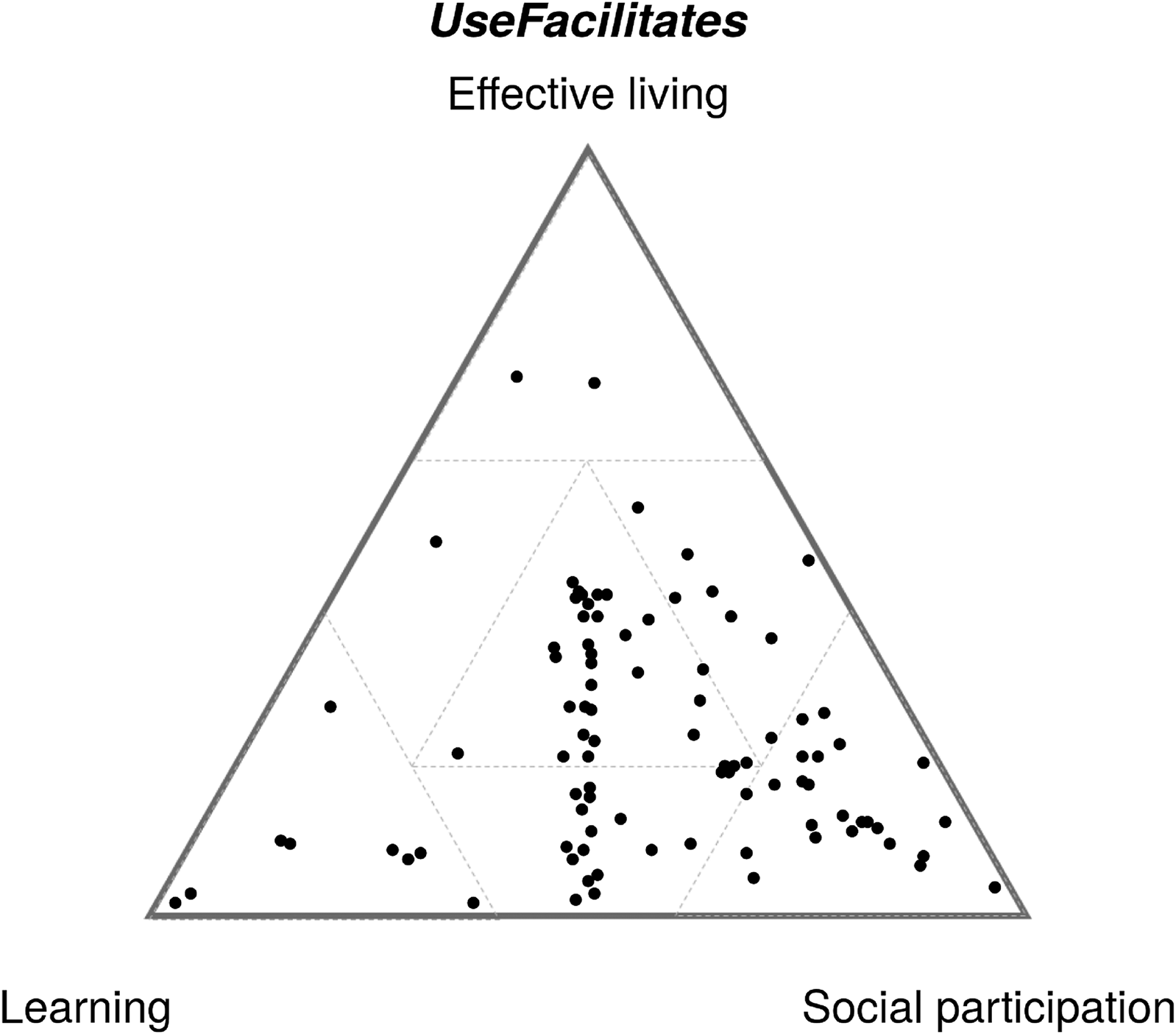
Reasons for using social media platform (SenseMaker® survey).
SenseMaker® is designed to be exploratory in its orientation and is non-parametric in its assumptions about the distribution of a survey population. We did not seek to gather a representative sample of respondents from a specific population, but rather to reveal different forms of meaningful responses to the predictive power of smart technologies. The survey was thus designed to reveal specific personal responses (and related clusters of responses) and not to report on likely population trends (see Bryman, 2016). In this context, and given that the main assumption about the survey space was that it was complex and dynamic, analysis was interested in outliers (as well as clusters) as potential weak signals of emerging trends. The survey sought to elicit responses that could stimulate theoretical speculation on emerging forms of smart technology and offer insights into specific (individual or small cluster) negotiations with digital tech. The SenseMaker® recruitment involved only purposive sampling to the extent that it sought to survey those that engage regularly with smart technology. Because the survey was relatively time-consuming for participants (taking approximately 15–20 min. to complete), it was necessary to rely on a convenience/volunteer sampling approach to ensure that a range of different perspectives were included (see Bernard, 2000; Sapsford, 2005). The survey was thus shared on Facebook/Meta and Twitter platforms to ensure that it was reaching relevant user groups. 11 It was also distributed on a number of higher education mailing lists. Finally, the survey was shared by our research partner Cognitive Edge and our funder the Independent Social Research Foundation among their user groups. No particular groups were targeted for inclusion in the survey, although efforts were made to ensure that a range of different age groups were included as it seemed likely that relations with smart technology were likely to be different among digital natives and non-natives. The sample was determined by those who were willing to complete it and were reachable by the networks outlined above.
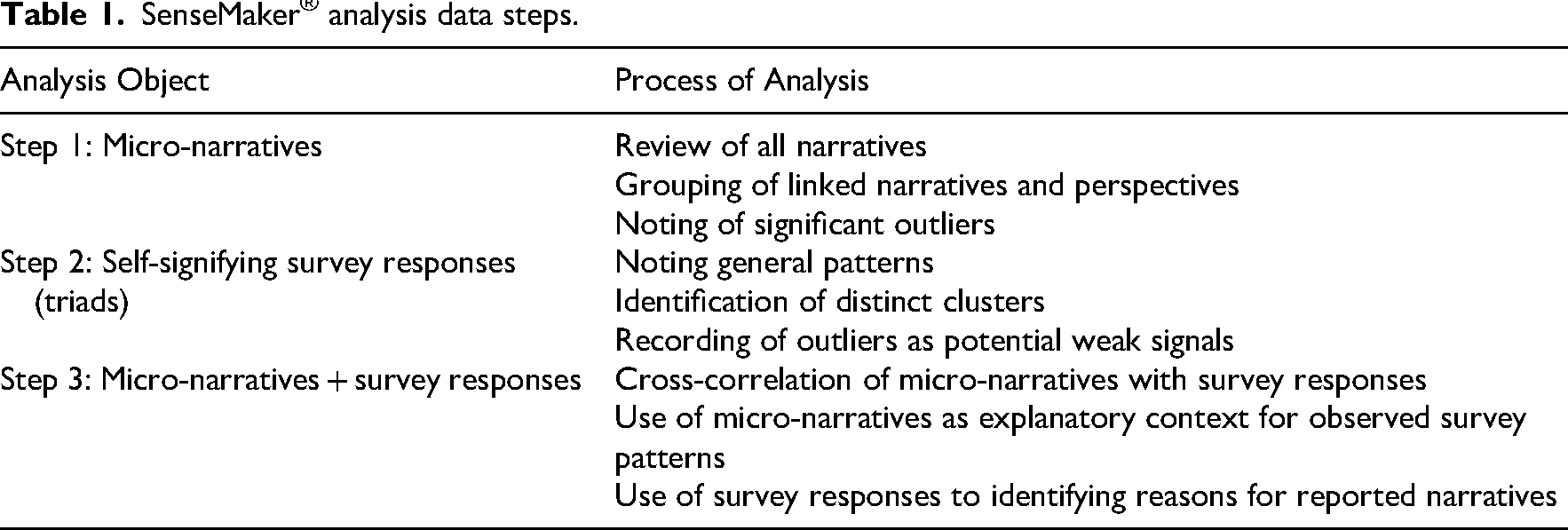
Of those who took the survey, 75% were under 45 years of age (with 39% being under 25). Of those surveyed, 68% had a bachelor's degree or higher (with 25% having a doctorate). On these terms, the results should be interpreted, predominantly, as the types of experiences of, and responses to, smart technology from relatively young and educated segments of the population. We also note that 45% of survey responses were negative/very negative in tone compared to 13% that are positive/very positive. However, 42% were designated as neutral, which suggests that the survey was able to capture a range of different types of responses to smart-technology predictions. The data analysis steps are outlined in Table 1. The questions that were asked in the survey can be viewed here: https://docs.google.com/document/d/19dTZ1N338kHQ8mTVglwF3K2IUEIwYV11Gams-NFhgpk/edit?tab = t.0.
SenseMaker® analysis data steps.
The negotiated spaces of smart-technology use
We were initially interested in the reasons that participants were engaging with smart technologies (and in this instance, more specifically, social media platforms). Figure 1 above indicates a clear cluster of responses around social participation, with learning being also a consideration for many. Although smart technology is often associated with the liberatory potential of convenience (see Whitehead and Collier, 2022), our results indicate that, at least in the context of social media platforms, smart technology's empowering properties are also associated with the insights it provides into the social dynamics of ever more complicated and distantiated lives. In this context, engaging with smart technology appears to be important due to both the tacit and more explicit insights it provides into the complexities of social life.
A prominent cluster of participants indicated that the benefits of using social media primarily relate to its ability to offer high levels of personalization (presumably in the forms of recommendations and notifications that were pertinent to organizing various aspects of their lives) (see Figure 2). The processes associated with smart-technology personalization speak directly to our concern with the relationship between the voluntary and the involuntary. For personalization to be optimized, it is necessary for users to share information with the smart technologies they use so that the underlying algorithms can be optimized. Significantly, the processes of sharing reflect a voluntary act which simultaneously entails involuntary consequences. These involuntary consequences include the construction of digital selves (see Cheney-Lippold, 2017), which are used for processes of personalization and yet we do not see or control. Sharing also relates to the addictive demands for our attention, which are built into related digital technologies.
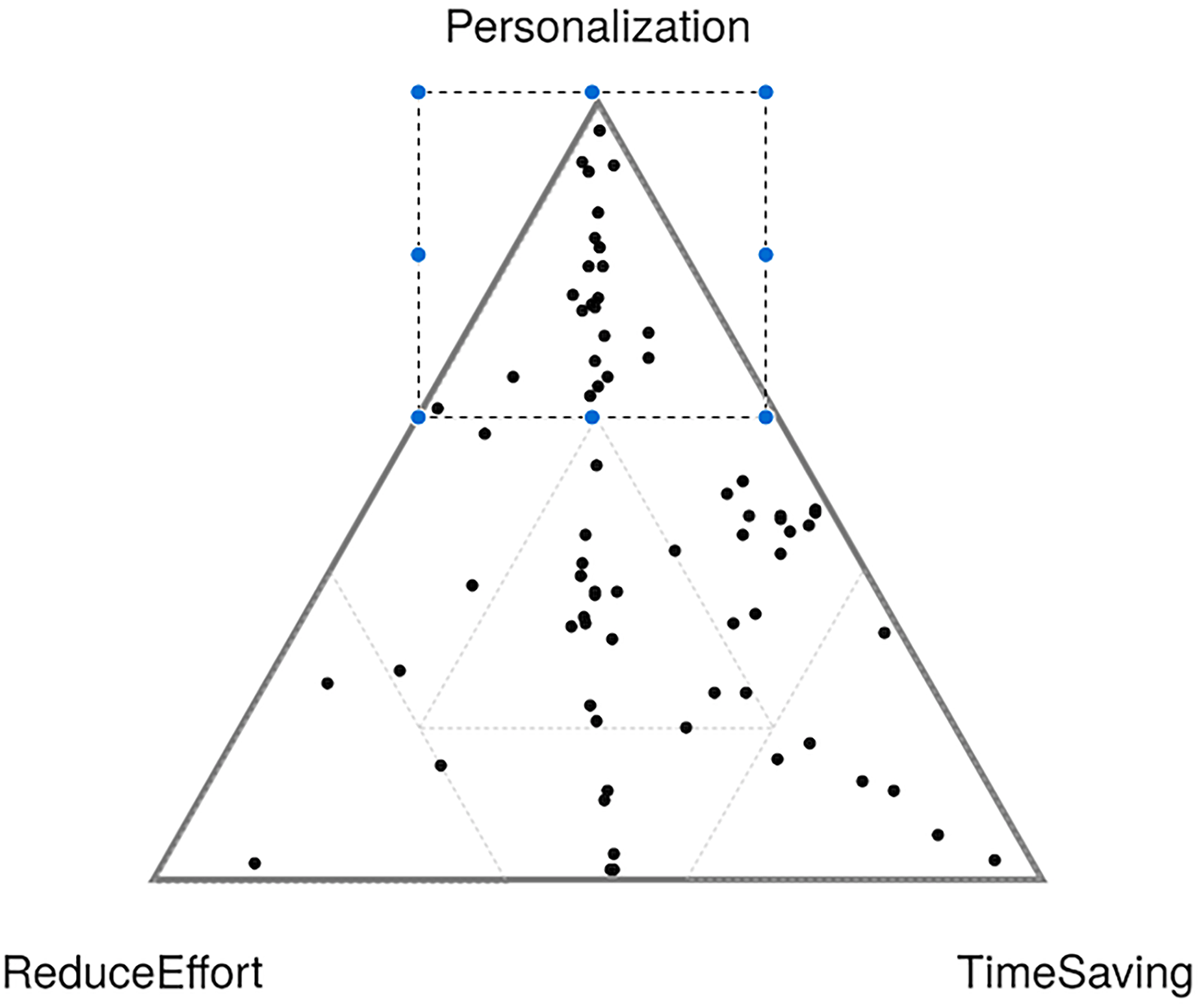
Benefits of using social media platform (SenseMaker® survey).
In the context of the purported threats to freedom that engaging with social media involves, it is interesting to note the ways in which study participants assessed the relative importance of their technological concerns. Figure 3 demonstrates a strong multivariate apprehension over the loss of privacy, a loss of control over personal data, and the potential behavioural manipulation that people associate with smart technology. Despite this broad spectrum of concern, Figure 4 demonstrates that the primary loss that participants associate with using social media platforms is not a freedom to act or decide, but where to direct attention. 12 The ability of smart technology to draw attention to what is most relevant/desired (personalization) operates in contradistinction to its deliberate attempt to distract us from other activities. The capacity of social media to distract us from off-platform activities, only to then hold our attention, embodies a complex interplay between the voluntary and the involuntary at the cognitive level.
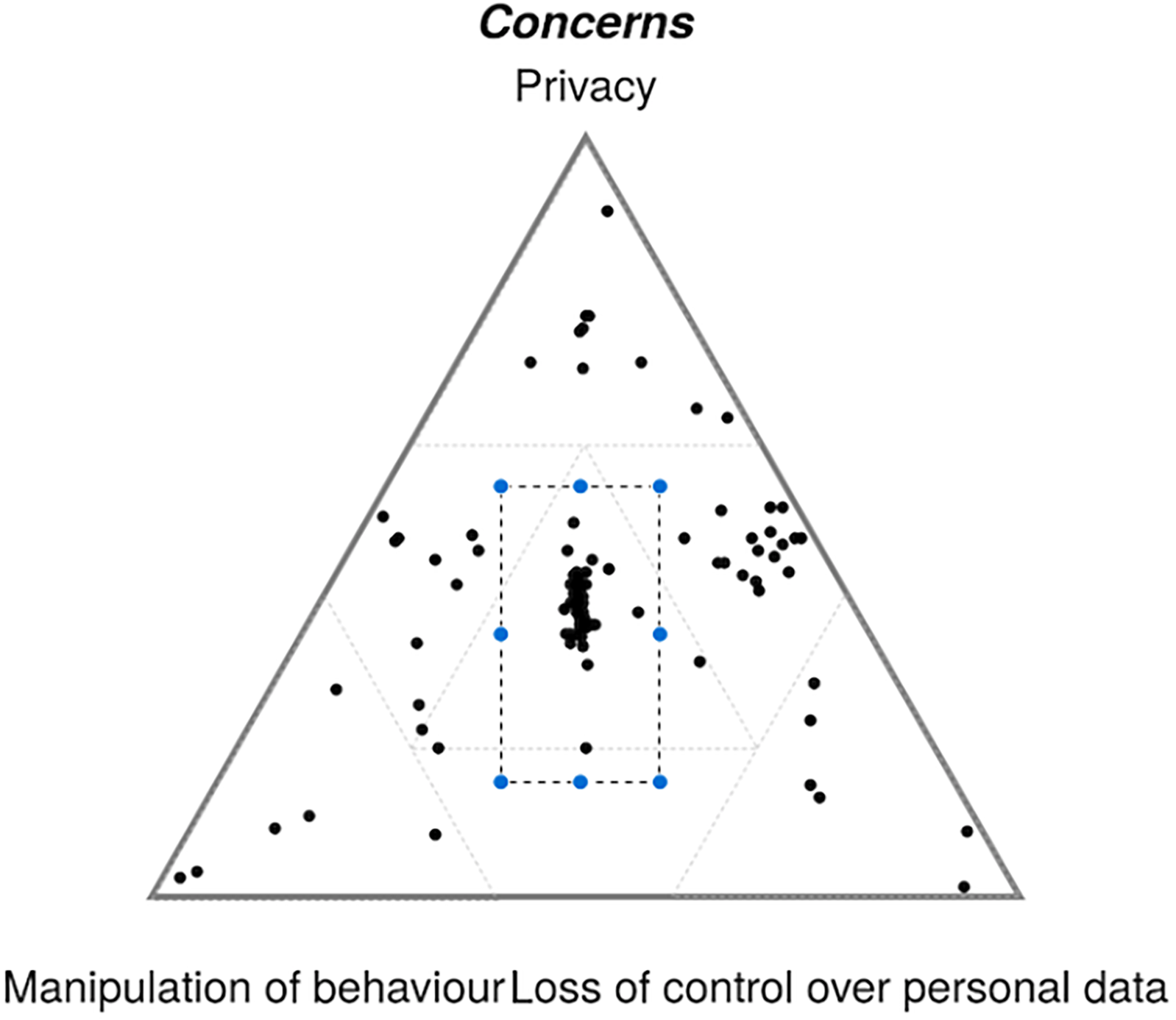
Concerns related to use of social media platform (SenseMaker® survey).
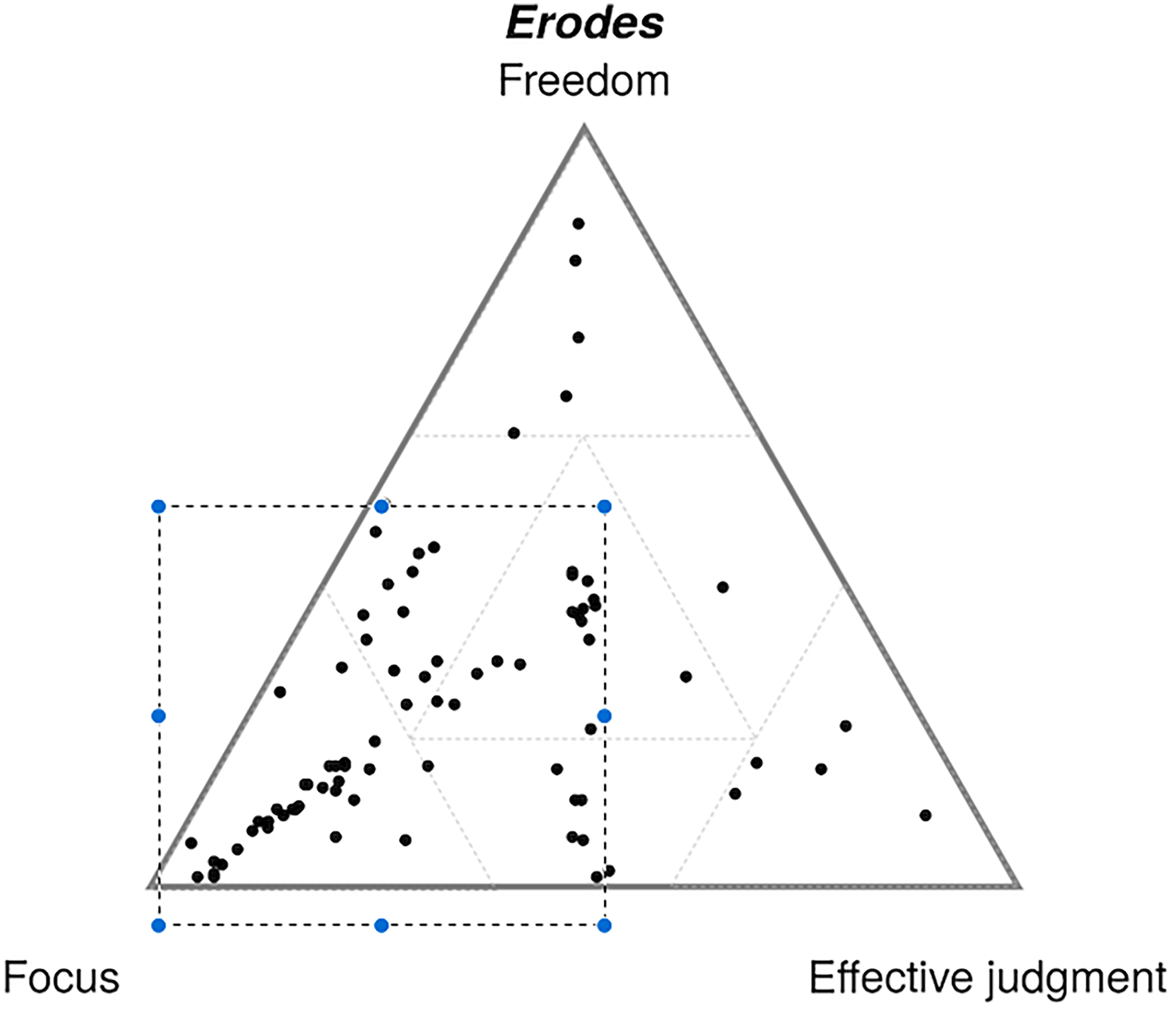
What social media platform use erodes (SenseMaker® survey).
The evident tension that exists between digital sharing, personalization, and attention is brought into sharper focus when we asked SenseMaker® participants to reflect upon their reactions to the predictions that smart technologies make about their needs. While some participants did reflect on surprisingly inaccurate predictions of their needs, the majority of respondents recounted memorable times when social media platforms had made unexpectedly prescient forecasts. For example, one narrative observes: […] we have a Siri unit in our kitchen. One day I was talking to my brother about looking at new knives and new saucepans [….] I would like to say it was a coincidence but on my Facebook page I started to receive promotional adverts on both items […] even with the right colours […]. (SenseMaker® survey narrative response)
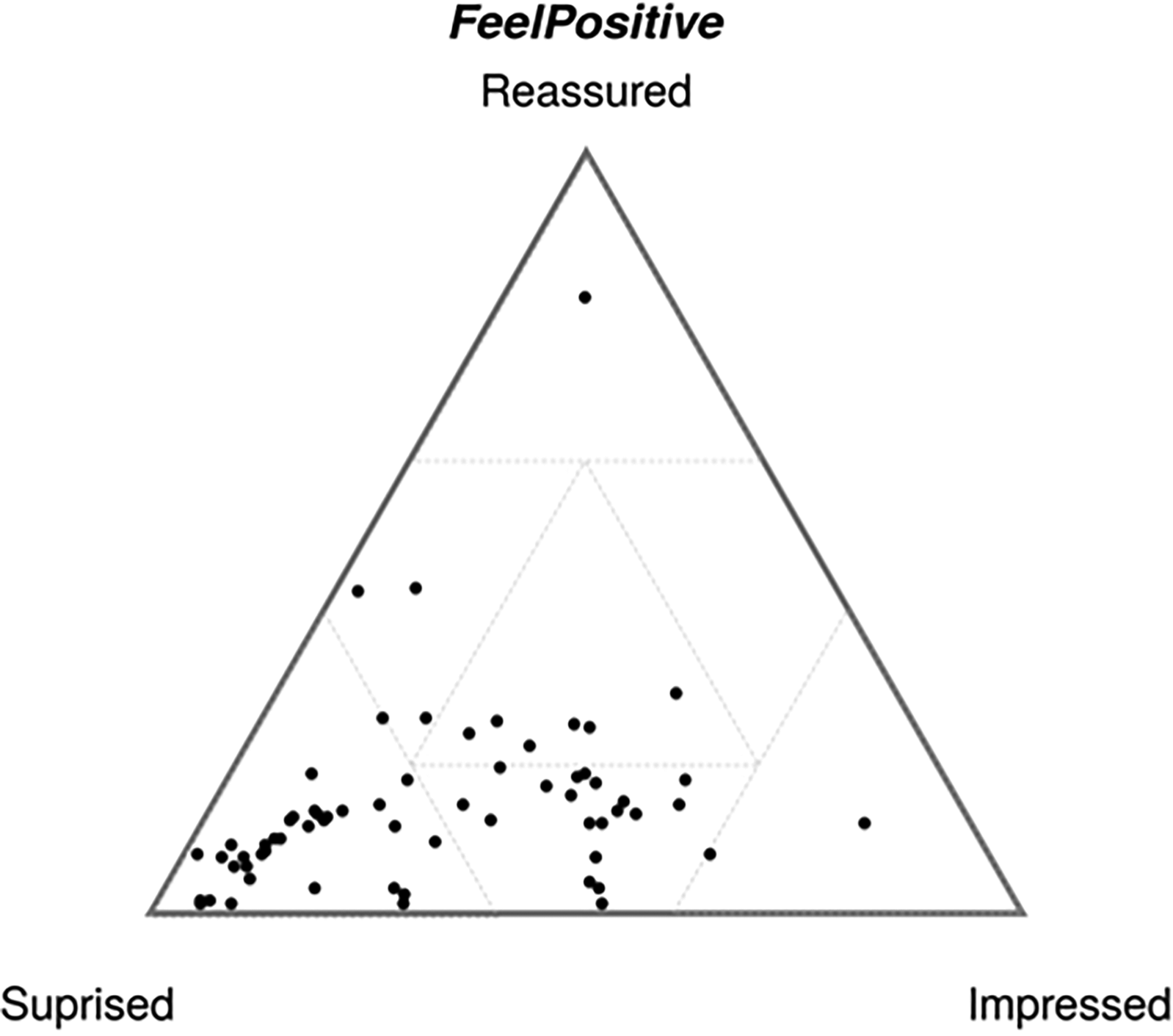
Feelings about social media platform's prediction (SenseMaker® survey).
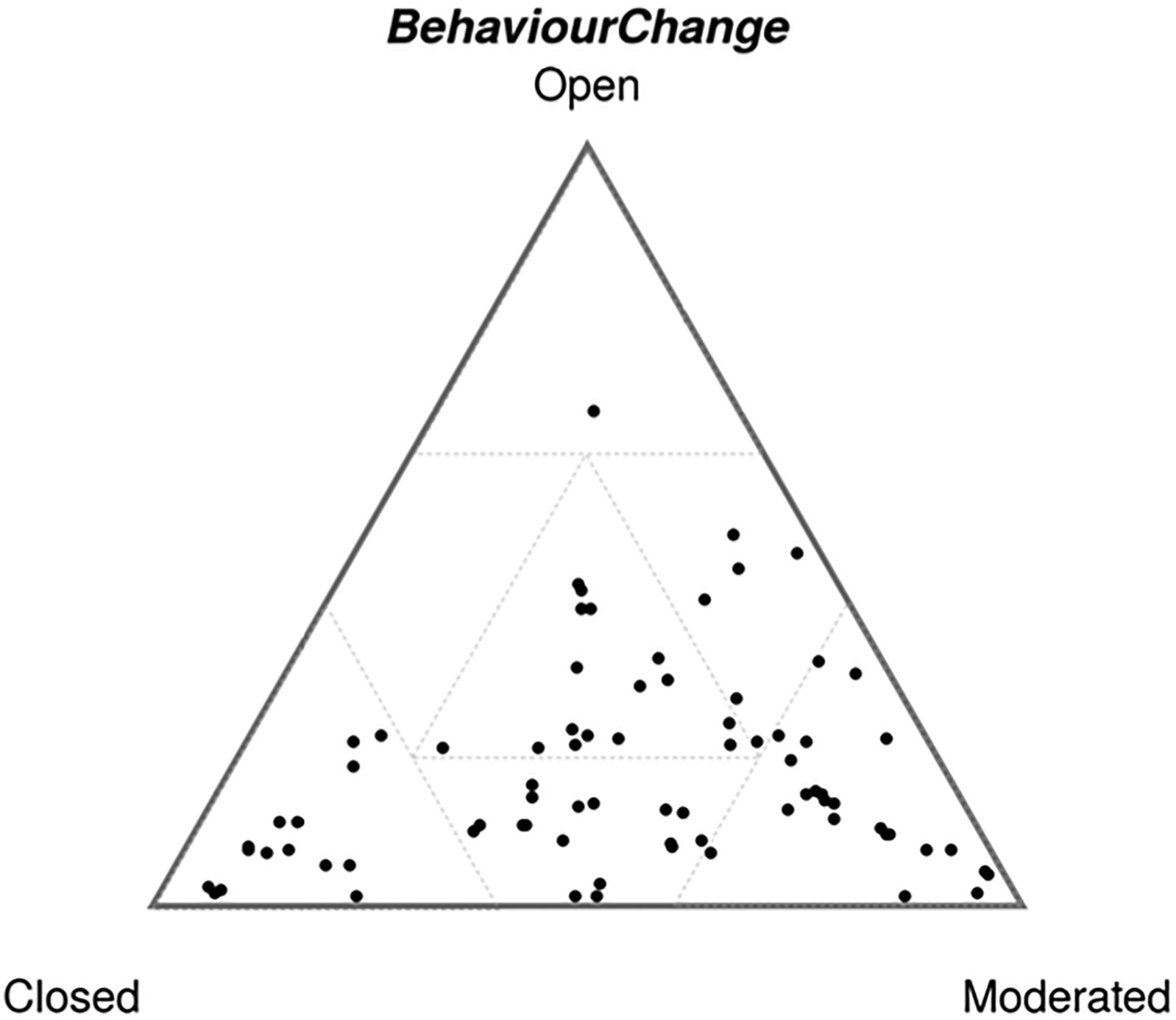
Behaviour change when using social media platform following prediction event (SenseMaker® survey).
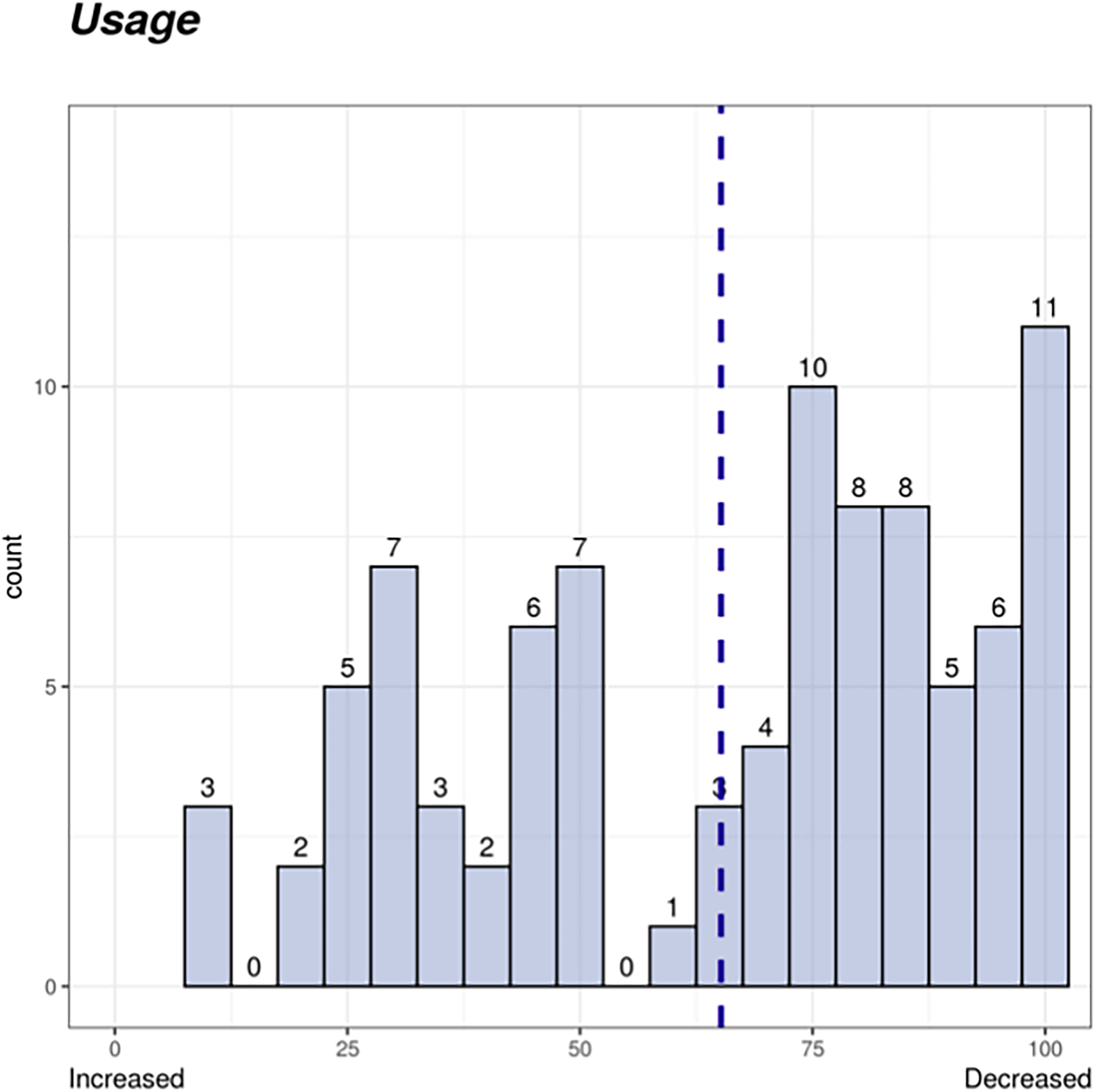
Changing patterns of participant usage of platform following prediction (SenseMaker® survey).
Taken together, these insights present a complex picture of user engagement and disengagement with smart technology. The more accurate the recommendations smart technology generates, the more inclined users become to shield themselves from it. This appeared to be particularly evident when participants had not consciously left clues to their needs. This is, perhaps, best described as a kind of prediction paradox: whereby the more precise the prediction is, the less likely the subject is to share information which is needed to provide accurate predictions. Here, effective personalization and the freedoms it may afford are drawn into conflict with the more oppressive processes that are associated with digital surveillance. This tension does not appear to lead to a simple resolution with participants either submitting to surveillance capitalism to maximize convenience or abandoning smart technology in the pursuit of enhanced privacy. What emerged instead is a form of tactical realignment between people and smart technology, which involved a mix of more moderated sharing and reduced use. In this context, it is interesting that relatively few participants described their use of smart technology as either a complete luxury or necessity (see Figure 8). As a kind of ‘useful necessity’, smart technology appears to have insinuated itself sufficiently into people's lives to mean that abandoning it is not an easily taken option. In the final section of this paper, we return to the work of Ricoeur and consider what the complex interactions that are evident between users and smart-technology platforms reveals about the emerging configurations of freedom in the silicon age.
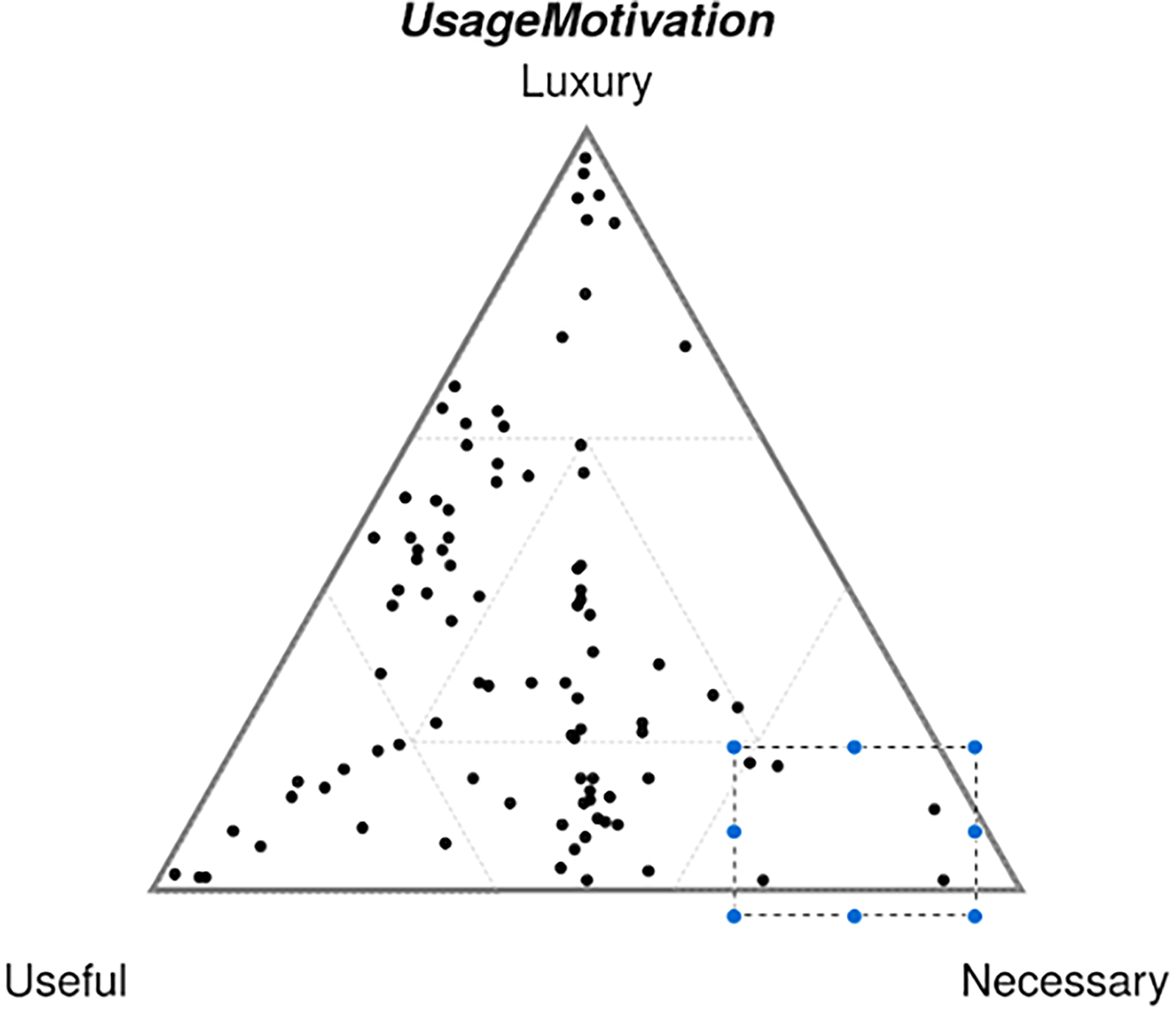
Perception of use of platform (SenseMaker® survey).
Useful necessities, sharing, attention, and the digital self
We do not have scope here for a systematic application of Ricoeur's theories of the will and freedom to emerging engagements with smart technology. What we offer instead are a series of specific analytical expositions.
Histories of digital decisions
The moment of deciding to act is a central focus of Ricoeur's analysis of freedom. But a Ricoeurian perspective emphasizes the importance of not understanding a decision as an isolated moment (an eruption of the will as it were), but rather as part of a much longer temporal chain of voluntary and involuntary acts. In this context, we are particularly drawn to Ricoeur's invocation to consider the ‘history of a decision’. There are many decisions that surround and inform human relations with smart technology. However, our SenseMaker® analysis primarily considered people's motivation to use social media platforms and their subsequent decisions regarding ongoing engagement with the platforms.
The history of the decision to use social media platforms (and then use them again and/or use them differently) is clearly one that must recognize an uneven historiography of motivations. In this context, Ricoeur's analytical approach exposes the limitations of our own research methodology. While social media may be tied to effective forms of social participation in the present (see Figure 1), the initial decision to engage is likely to have been informed by a mix of intrigue, technological novelty, peer pressure, and a fear of missing out. The initial temptation to use social media is likely a product of an involuntary fixing of attention on the technology; a subsequent assertion of agency in the form of hesitancy over whether to use it or not; and ultimately, a practical resolution of the Ricoeurian paradox of freedom in the decision to engage with the platform. The initial decision to use smart technology does, of course, set in motion a series of subsequent decisions about how much we use the technology, what we use it for, and how much we share with it. Ricoeur's reflections on the physical involuntary is particularly salient in this context. While smart technology has the potential to partially liberate us from certain physical/psychological limits within our decision-making, it generates a new involuntary realm: what we term the digital involuntary. The digital involuntary in part operates at a biological (and psychological) level, as the addictive features of social media platforms mix dopamine hits with infinite scroll technology to produce seemingly endless loops of habitual engagement. But the digital involuntary also works at a social level. As digital platforms facilitate extended social networks, they generate so-called network effects in and through which engagement is locked in by a collective inability to independently choose to connect through other, under-populated, digital mediums (see Whitehead and Collier, 2022). Figures 3 and 4 specially reveal the presence of the digital involuntary in the loss of focus/attention and privacy/behavioural determination associated with the use of smart technology.
From a Ricoeurian perspective, the digital involuntary should not be interpreted simply as a form of cybernetic repression. As with the physical involuntary, the digital involuntary can be a key context within which expressions of freedom emerge as we engage in wilful decision-making in conditions only very loosely (and distantly) of our choosing. Recognizing the digital involuntary does, however, have implications for Ricoeur's account of the voluntary/involuntary. For Ricoeur, the biological is predominantly the realm of the involuntary – the arena of our baseline physical needs. Yet, in the age of smart technology, the biological realm of human life increasingly becomes a sanctuary from the demands of the digital involuntary. According to Crary (2014), within the market imperatives of digital engagement, the realms of the physical involuntary, whether it be sleep (at the biological level) or day and night and seasons (at the planetary level), become obstacles to economic accumulation. According to Crary (2014: 9), the 24/7 demands of digital technology ‘[…] disavow its relation to the rhythmic and periodic textures of human life’. To some extent, the emergence of all technology has challenged the circadian rhythms of human biology. But in the digital age, there appears to be a deepening of this process. It is our contention that with the emergence of smart technology, there is a re-inscription of the biological involuntary as a realm of respite from digital surveillance and predictions. This represents a Ricoeurian moment which Ricoeur could never have realistically anticipated.
Movement and the data self
In a time of smart technology, Ricoeur's evocation of the history of a decision takes on a novel dimension. In its predictions of our needs, smart technology is constantly representing the history of our previous decisions back to us in anticipation of likely future desires. Our SenseMaker® analysis considered people's responses to the digital rendering of our histories of decision-making. In this section, we consider what Ricoeur's reflections on movement, as a key expression of the will, can offer to our analysis of the impacts of digital projections of behaviour. For Ricoeur, movement embodies a distinct moment within the practices of freedom. If a decision is seen as the cognitive/internal moment of determination, then movement reflects the projection of that internal determination into the external realms of the body and world. In the context of our SenseMaker® survey, our primary interest in movement relates to the predictive paradox. On these terms, we are interested in the practices of the moderated use of, and protection against, the social media platforms that people engage with. Our concern is thus with the consequences of movement towards and away from smart technology.
The role of movement within the negotiation of the voluntary and involuntary has specific qualities in the digital realm. Ricoeur's own discussion of movement, in terms of embodied effort and physical resistance, is certainly less relevant in these digital contexts. In terms of driving engagement with it, smart technology is primarily designed to reduce embodied human effort, 13 although its demands on human attention could be interpreted as a form of cognitive exertion. We nonetheless assert that Ricoeur's account of the body as a site of movement could be usefully extended to the data self. Ricoeur notes how ‘I submit to the body which I guide’. He thus positions the body as an always already-present meeting point of the voluntary and involuntary. It is our contention that engagement with smart technology brings us into the presence of our data selves (at least in refracted form). Our SenseMaker® narratives are dominated by accounts of people engaging with scarily accurate, and comically inaccurate, digital projections of themselves. As with our physical bodies, our data selves are at one and the same time expressions of our acts of sharing and engagement, but not things that we can ultimately control. While we coproduce our data selves, we do not control them. As with Ricoeur's body, the data self could be considered ambivalent in relation to questions of human freedom: it facilitates new capacities for human action/skills while at one and the same time defying our control and facilitating new vectors of potential behavioural manipulation.
Our survey revealed obvious concerns with the smart-technology production of data selves related to questions of privacy, behavioural manipulation, and a loss of focus (see Figure 4). These concerns were linked to attempted moves away (perhaps best expressed as realignments) from social media platforms, in the form of more closed or moderated data sharing and lower levels of engagement (Figure 6). Attempts to control the effects of our data selves through acts of disengagement clearly limit the ability of related technologies to provide effective personalization and social participation. In this context, a complete disassociation from social media platforms (as perhaps the ultimate expression of the voluntaristic assertion of the will) appeared to be difficult and rare. Ultimately, the ambivalence of the data self to questions of human freedom is, perhaps, expressed most clearly in the observation that the movements towards and away from smart technology both simultaneously empower and disempower users.
Despite the helpful parallels, there are important distinctions to be made between the data self and the body. Unlike the body, our digital self is still functionally separate from our biological body: we can literally and metaphorically live without it. However, while our data selves are not sine qua non to our very existence, they are far more difficult for us to consciously control. While our bodies offer perpetual forms of resistance to our will, through habit and conscious effort, they are subject to intermittent control. The functional segregation of our data selves from ourselves means that while they can affect our lives, we cannot control them simply through a projection of personal will. The nature of automation enabled by our data selves is thus distinct from that produced within embodied practice. The forms of automatic action we learn at an embodied level (e.g., how to tie shoelaces) are something we may do unthinkingly but which we can teach others. Unlike the automations that belong to us, the digital automations enabled by our digital selves do not belong to us in the same way. These are systems of automation that we cannot share but instead circulate in support of the commercial projects of others. Our data selves are also not subject to the same form of biological frailties as our bodies: they do not forget, for example. On these terms, the digital involuntary is both more and less resistant to our voluntary projects than the physical involuntary. Our data selves facilitate movement towards certain needs, but not towards itself.
Consent, refusal in digital life
As outlined above, for Ricoeur, moments of consent are the imperfect resolutions of voluntaristic desire with involuntary necessity. In his discussion of consent to necessity, Ricoeur introduces a concept which is indirectly related to the notion of the data self, namely, character. For Ricoeur, character is a trope of personality which we forge during our lives, guides our sense of self and related behaviours, but which we do not control. As a marker for our sense of self, character can be a key source of voluntaristic expression in the world. However, as a dimension of personality which cannot be easily changed, it is also marked by involuntary forms that are associated with habit and the unconscious. Crucially, Ricoeur depicts character in terms of ‘[…] a way of choosing and of choosing myself which I do not choose’ (368). This is where the notion of consent becomes prominent in Ricoeur's analysis. Not only do we not get to choose our character, but for it to be useful to us, we must, to some extent, consent to its power over us.
For us, the question of character and consent are fruitful terrains upon which to interpret emerging relations with our data selves/digital character and smart technology. As with character, our data selves are partly forged by us, but we do not control them. Unlike, our character, our data selves are partially programmed to support the commercial needs of the smart-technology corporations who created them (Cheney-Lippold, 2017). Our SenseMaker® analysis reveals the operation of forms of uneasy consent in our relations with our data selves. Our research reveals a move away from social media platforms on the basis of the digital images they reflect back to us. But in keeping with Ricoeurian thinking, the abandonment of digital technology is uncommon. For Ricoeur, refusal is an expression of an idealist temptation based upon a belief in a voluntaristic escape from the necessary. While our engagement with smart technology may be a useful necessity, it ultimately reflects a history of decisions and movements that cannot be simply dismissed.
Our analysis indicates a complex negotiation of engagement and protective disengagement with social media as both a necessary luxury for some and a useful necessity for others. We argue that understanding the reduced and moderated use of social media platforms as a form of consent rather than refusal offers insightful perspectives on emerging amalgams of social and digital technology. There is much work on the blocking, refusal, and denial of digital technology (see Kitchin and Fraser, 2020; Whitehead and Collier, 2022). Our own research would suggest that such practices, while voluntaristic and politically provocative, are relatively rare (and perhaps a luxury available to only a few). While disengagement with smart technology is conceptually arresting, we claim that it is our continued (moderated) engagement with, and consent to, digital technology that is most significant. Consent, in this context, is not interpreted as purely a submission to the digital involuntary: consent for Ricoeur is always more than a mere acceptance of necessity. Consent to smart technology reflects a mix of voluntaristic endeavour (the less use and insulation from our data selves indicated in our SenseMaker® analysis) and moderated sharing (weakening the predictive power of smart technology) and a submission to the digital involuntary. As Ricoeur observed, ‘I change it for myself since I cannot change it in itself’ (344). It is particularly interesting in this context that our negotiated consent to smart technology is not just an interplay between the voluntary and involuntary, but a movement between the biological and digital involuntary. Unlike character, our data selves have a degree of functional separation from our biological being. It is thus easier to imagine a negotiated separation from digital prediction and manipulation than an escape from our character. But this retreat to the biological entails a choice to be subjugated to the very biological involuntary which our digital selves promise to liberate us from. To paraphrase Ricoeur, in a time of smart technology, I change my relationship to my data self for myself since I cannot change it in itself. The predictive paradox is a Ricoeurian problematic.
A final subtlety is worth mentioning in this regard. The discomfort that leads to the predictive paradox may have more than one source. It may have to do with realizing that digital technologies have managed to predict decisions or preferences we ourselves would prefer to think of as autonomous. It may also have to do with the external source – the fundamental heteronomy – of such predictions. To the extent that the latter is the case, it is worth keeping in mind that the external origins of some claims on our attention or incentives for our activities do not in itself necessarily detract from our (always impure) autonomy. On the one hand, as noted above, the complex moments of a ‘free’ decision are already shot through with the involuntary. On the other hand, the voluntary side of our consciousness and activity would have no meaning in the complete absence of the unexpected arrival of external appeals and events to which to respond (Hannah, 2019: 168–170).
In this sense as well, a life worth living is not (and cannot be) a life of ‘pure’ freedom. The problem is not so much the externality of our digital selves per se as it is the relation between this form of externality and those other forms that provoke the kinds of hesitation, movement, and consent to necessity that we want and need in our lives. The problem is how to balance the limitation of manipulative efforts with a continuing openness to positive signals emanating from elsewhere.
Conclusion
In this paper, we have sought to problematize inherited notions of ‘freedom’ by bringing recent research on how people make sense of novel experiences with digital technologies into dialogue with Ricoeur's non-dualistic phenomenology of freedom as a complex and inextricable weave of the voluntary and the involuntary. The encounter not only helps us to contextualize the impacts of new technologies within more fundamental dimensions of human being-in-the-world; it also throws Ricoeur's ideas into a new light and suggests some ways in which they can be updated. Reflecting on our SenseMaker® analysis, this paper has taken up Ricoeur's invitation to explore the history of the decisions we make in the context of the strictures of the biological involuntary. We argue that in the era of the algorithm, the involuntary should be understood not only in bio-psychological terms but also in its digital forms. Additionally, our analysis suggests that, in keeping with Ricoeur's insistence on the complex intertwining of the voluntary and the involuntary, in the context of smart technology, the biological needs of our bodies can be a liberating constraint against the attentive demands of the digital realm.
Our analysis also considered the parallels between Ricoeur's account of the body and movement and the idea of our digital self. For Ricoeur, our bodies are the biological sites through which our cognitive resolutions/decision move out into the world. Our digital selves, on the other hand, reflect back to us the collective history of our previous decisions as anticipations of our future needs. What connects Ricoeur's account of the body and the digital self is their complex relations with the voluntary and the involuntary. Although the body imposes biological limits of our volition, it also enables the movement of our will into the world. In contrast, we can live without our digital selves but have, perhaps, less control over its form than our actual bodies. Critically then, while our relations to smart/intelligent technology appear to be characterized by similar Ricoeurian interplays of the voluntary and involuntary, the nature of these interplays is functionally distinct and generates genuinely novel phenomenologies of freedom.
A central insight of our empirical analysis was the idea of the predictive paradox. The predictive paradox refers to the fact that as digital technology is able to more accurately predict and anticipate our needs, we are less likely to trust, and reveal our preferences, to it. Combining our SenseMaker® analysis with a Ricoeurian sensibility to freedom suggests that a focus on consent (as opposed to refusal) is, perhaps, the most analytically productive perspective from which to interpret emerging human relations with technology. Our SenseMaker® analysis reveals a tendency towards negotiated consent to digital platforms as opposed to refusal and deletion. This consent to smart technology reflects a mix of voluntaristic endeavour (less use) and moderated sharing. To these ends, emerging relations with our digital self reflect Ricoeur's interpretation of our relationship to the involuntary power of our character: ‘I change it for myself since I cannot change it in itself’ (344). We argue that a consent-orientated interpretation of human experiences of freedom could offer a felicitous framework for emerging studies of power and autonomy within digital life and beyond.
Footnotes

Funding
The authors disclosed receipt of the following financial support for the research, authorship, and/or publication of this article: This work was supported by the Independent Social Research Foundation (Grant Number Re-Thinking Freedom in a Neuroliberal Age).
Declaration of conflicting interests
The authors declared no potential conflicts of interest with respect to the research, authorship, and/or publication of this article.